Best Walkie Talkies of 2026

The last time I hiked with a group, we spent the first mile watching the bars on our phones disappear one by one. That's when a walkie talkie stops being a novelty and becomes the only thing that works. A good one does a single job: it puts your voice in someone else's hand, no signal or app required.

The catch is that this category is full of inflated range claims and toy-grade plastic. What separates the sets worth carrying isn't the number printed on the box — it's whether you hear a whisper at 200 yards, whether the battery survives a cold morning on the ski lift, and whether the clip is still attached after a season of getting knocked around.

We've spent the past six months living with 12 of them, on trails, at a ski hill, in a school event, and in the hands of kids who treat a radio like a projectile. The pattern held: the ones worth buying feel solid, sound clear, last a full day, and don't require a manual. Here's what made the cut.

The Best Walkie Talkies

1

Retevis RT22 4-Pack Best Overall
91 /100
Traveler Score Outstanding

Key details

Channels
16
Radio Type
FRS
Water Resistance
IP65
Battery Life
12 hours
Check Details on Amazon

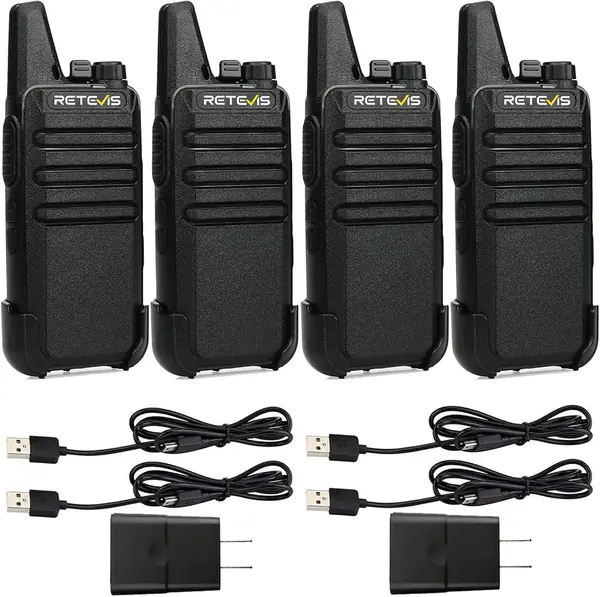
The short, blunted antenna is the first thing we noticed on the Retevis RT22, and it is why this is the set we hand to a family first. It will not poke an eye or snag a jacket the way a long whip can, and the radio itself slips into a pocket or clips to a belt without feeling bulky. We also like that it is FRS, so there is no license to arrange before the kids can use it, and the four radios arrive ready to talk on the same channel.

USB-C charging is the other detail that earns the RT22 its place. Each radio uses its own cable, so you can top up from a car adapter, a power bank, or the two dual-port adapters in the box. The IP65 rating is enough for rain and splashes, and the 12-hour battery estimate is realistic for a day of mixed listening and short check-ins. We prefer this set for neighborhood walks, campgrounds, ski bases, and errands where the group stays within a few minutes of each other.

The 2-mile rating is an open-air number. Around houses, trees, and hills, we treat the RT22 as a roughly one-mile radio, and that is the limit that matters for most family use. If your group spreads out across open country, the Midland GXT1000VP4 is the better long-range tool; if you need a radio that can survive a dunk, the RB48 is the tougher pick. For everyone else, the RT22 is the easy default.

Pros

  • License-free FRS operation
  • Pocketable body with a short antenna
  • USB-C charging and IP65 protection
  • Four radios in one set

Cons

  • No multi-radio charging dock
Our verdict

We recommend the RT22 as the default family set: it is license-free, pocketable, USB-C rechargeable, and easy for kids to use, with range that suits neighborhood and campground use.
Check Latest Price
2

Midland GXT1000VP4 Best for Long Range

90 /100
Traveler Score Outstanding

Key details

Channels
50
Radio Type
GMRS
Weather
NOAA alert
Max Range
36 miles
Check Details on Amazon

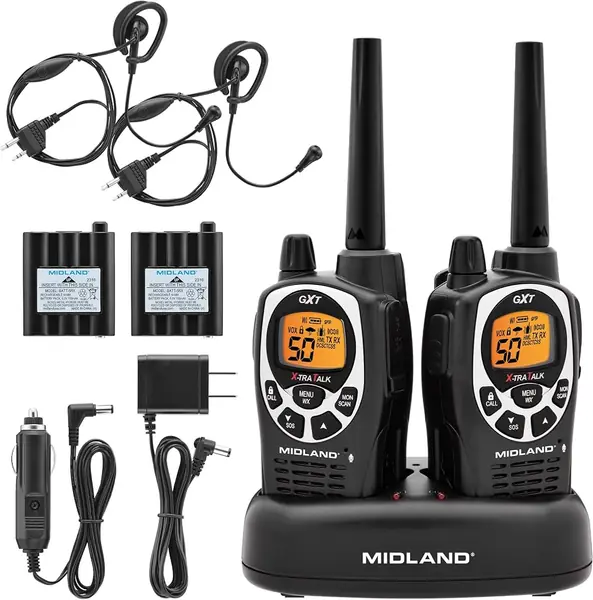
The NOAA weather scan is the feature that makes the Midland GXT1000VP4 worth a second look for campers, boaters, and anyone who spends a day beyond a reliable forecast. It scans the weather bands and sounds an alert when conditions turn, and the radio also carries 50 GMRS channels, 142 privacy codes, a vibrate mode, and a headset in the box. The dual-power design is the practical part: run the rechargeable pack, then switch to AA cells if the charge runs out.

We like this pair for open-country trips where the group is spread across a ridge, a lake, or a large property. The included headsets make it easier to hear in wind, and the AA backup is the kind of redundancy that matters when you are far from an outlet. It is a more serious radio than the RT22, with more channels and a longer claimed reach, and it feels at home in a hunting pack or an overlanding kit.

This is also the pick with the biggest caveat: GMRS operation requires an FCC license, so it is not the set you hand to a child and forget. The battery packs are another long-term question, since some units stop holding a charge and the radio is only as useful as its power. Keep a set of AA cells in the bag and treat the rechargeable packs as consumables. For a licensed group that wants weather coverage and open-country reach, it is the pair we choose.

Pros

  • NOAA weather scan and alert
  • Headsets and dual-power backup included
  • 50 GMRS channels with privacy codes

Cons

  • Requires an FCC GMRS license
  • Rechargeable packs can stop holding charge
Our verdict

We like the GXT1000VP4 for licensed GMRS users who need weather alerts, headsets, and open-country reach; skip it if you want a no-license radio for kids.

Check Latest Price
3

Retevis RB48 Best Rugged and Waterproof

89 /100
Traveler Score Excellent

Key details

Channels
22
Radio Type
FRS
Water Resistance
IP67
Battery Life
18 hours
Check Details on Amazon

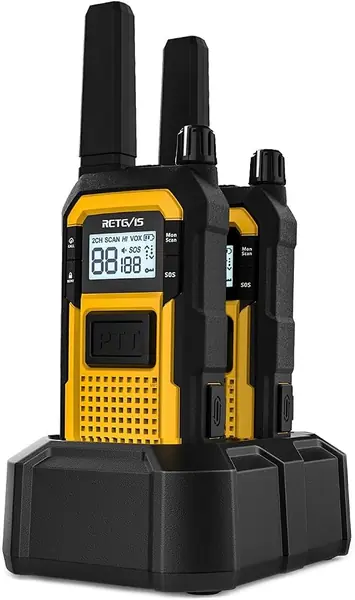
The MIL-STD-810H rating is the reason the Retevis RB48 is the radio we reach for when the forecast is bad. It is built around a sealed, floating body with an IP67 rating, a two-meter drop claim, and a bright yellow shell that is easy to find in a pack or on a dock. The 2000mAh battery is rated for up to 20 hours, and the kit includes a USB-C charging dock, a belt clip, and a dual push-to-talk layout that works with gloves.

What we like most is how much of the design is aimed at fumbling hands. The dual PTT buttons sit where a thumb expects them, the roger beep makes it clear when a transmission has ended, and the vibration alert helps in noisy settings. NOAA weather coverage is a useful bonus for boaters and hikers, and the 22 FRS channels keep it license-free. This is the pair we prefer for kayaking, fishing, hunting, and wet winter work.

It is a chunkier radio than the RT22, and the extra bulk is the price of the armor and the bigger battery. For a pocket or a small kid's hand, the RT22 is the easier carry; for a jacket pocket or a pack strap, the RB48 is the one we trust to take a hit. If you need a floating radio but want a more familiar brand name, the Motorola T605 H2O is the other option here, though its battery life is the weaker part of that package.

Pros

  • IP67 floating, MIL-STD build
  • Up to 20-hour battery with USB-C dock
  • Glove-friendly dual PTT buttons
  • NOAA weather coverage

Cons

  • Bulkier than pocket FRS radios
Our verdict

We reach for the RB48 when the trip is wet and rough: its floating IP67 body, glove-friendly controls, and long battery make it the toughest pair here.

Check Latest Price
4

MOICO T5 Best Budget for Kids

88 /100
Traveler Score Excellent

Key details

Channels
22
Radio Type
FRS
Water Resistance
IP65
Battery
4 AAA batteries
Check Details on Amazon

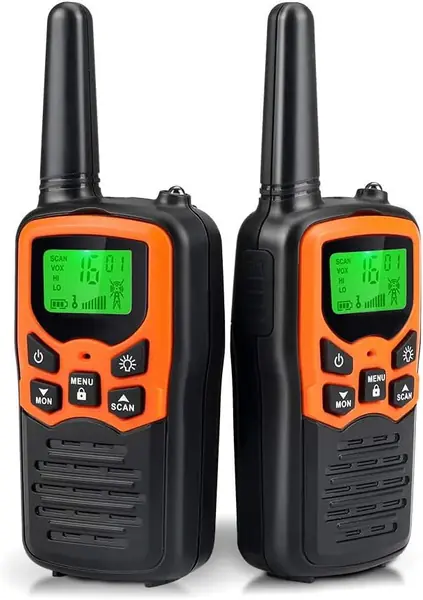
The MOICO T5 is the set we recommend when the goal is to spend little and keep two kids, or a parent and a child, in touch. It is a two-pack of 22-channel FRS radios with 99 privacy codes, a backlit LCD, VOX hands-free transmission, a belt clip, and a small flashlight. The controls are simple enough that a child can switch channels and volume without a manual, and the IP65 rating covers rain and splashes.

We like the flashlight more than we expected. It is not a substitute for a headlamp, but it is the kind of thing a kid grabs when the path back to the tent goes dark, and it makes the radio feel like a tool rather than a toy. The VOX mode is useful for hands-free check-ins, and the sound is clear at short range. This is a neighborhood, campground, and cruise-cabin radio, not a long-range backcountry unit.

The AAA power is the catch. The T5 takes four AAA cells, and under heavy use it eats them quickly, so buy rechargeable AAAs and keep a spare set in the bag. Range is the other limit: the 3-mile claim is optimistic, and buildings and trees cut it to a half-mile or less in many situations. If you want USB-C charging and a more pocketable body, the RT22 is the step up; if you want a cheap first radio for kids, the T5 earns its place.

Pros

  • Simple controls for kids
  • Flashlight and VOX hands-free mode
  • 22 FRS channels with privacy codes
  • Low-cost two-pack

Cons

  • AAA batteries drain fast
  • Range falls short in buildings
Our verdict

We recommend the MOICO T5 as a cheap first radio for kids and short-range family use, as long as you budget for rechargeable AAAs and keep expectations on range modest.

Check Latest Price
5

SAMCOM FPCN30A Best for Work Crews

87 /100
Traveler Score Excellent

Key details

Channels
20
Radio Type
UHF
Pack Size
6 radios
Power
5 watts
Check Details on Amazon

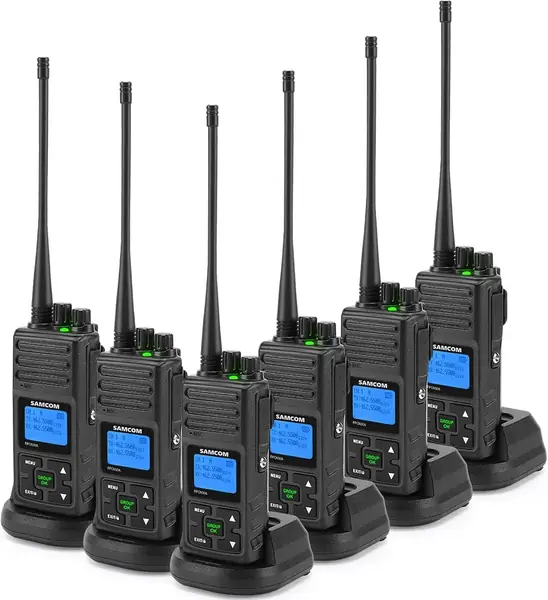
The one-key group button is the feature that separates the SAMCOM FPCN30A from a family walkie talkie. Press it and the radio broadcasts to multiple teams, even if they are on different channels, which is the kind of thing a warehouse manager or event crew notices immediately. The rest of the package is built for work: 20 UHF channels, 5 watts of power, dual PTT buttons, a 1500mAh battery, and a hard shell meant to take drops and scuffs.

We like the six-radio set for a large site because the charging base and earpieces are included, and the group call solves the problem of rounding up people who have drifted onto the wrong channel. The 5-watt output is the strongest here, and the speaker is built to be loud across a job site. This is not a radio for a casual family walk; it is for a crew that will program it, license it, and use it every shift.

The trade-off is setup. The FPCN30A is a programmable UHF business radio, so it needs the right FCC license and frequency programming before it is legal to transmit, and that is more work than clipping an FRS radio to a belt. It is also not waterproof, despite the rugged shell, so it is a dry-site tool rather than a boat radio. The FPCN30A earns its place only for a crew that needs group calls and more power; if you need a license-free crew radio, the RT22 four-pack is the simpler route.

Pros

  • One-key group call
  • 5 watts and 20 UHF channels
  • Six radios with earpieces and charger
  • Heavy-duty shell for work sites

Cons

  • Requires licensing and programming
  • Not waterproof
Our verdict

We like the SAMCOM FPCN30A for licensed work crews that need group calls and 5-watt reach; it is too much setup and too much radio for casual family use.

Check Latest Price
6

BAOFENG BF-888S Best for Programmable Crews

86 /100
Traveler Score Excellent

Key details

Channels
16
Radio Type
UHF
Battery
1500 mAh
Pack Size
10 radios
Check Details on Amazon

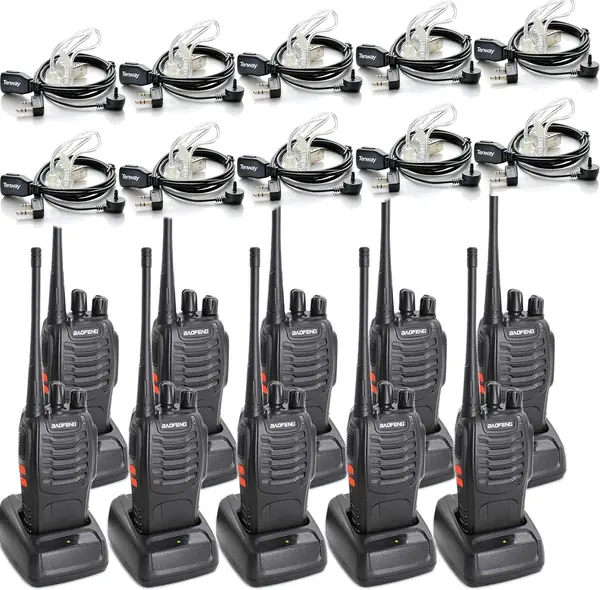
A box of ten radios is the whole pitch for the BAOFENG BF-888S. Each one comes with an earpiece, a belt clip, a wrist strap, a charger, a battery, and an antenna, which makes it a practical way to equip a theater group, a security team, or a large volunteer crew without hunting down accessories. The radio itself is a 16-channel UHF handheld with a 1500mAh battery, a flashlight, and CHIRP programming support.

We like the programmability for a group that has someone willing to set it up. You can assign channels and privacy codes across the whole fleet, and the earpieces keep transmissions discreet in a crowded room. The per-radio cost is the lowest here, and the 10-pack covers a big crew in one order. For a school production or a temporary event, that is a lot of capability for the outlay.

The catch is that this is not a consumer FRS radio. It is a programmable UHF business model, so it needs the appropriate FCC license and correct programming before you transmit, and the audio can be garbled on some units. If you want a radio you can hand out without a setup session, the RT22 or MOICO T5 is the easier choice.

The BF-888S earns its place as a budget fleet radio, not as a family starter set. Buy it when you have a programmer, a licensed frequency plan, and a crew large enough to justify ten radios. Without those three things, the savings disappear into setup and frustration.

Pros

  • Ten radios with earpieces and chargers
  • Programmable UHF channels
  • Low cost per radio
  • Flashlight and 1500mAh battery

Cons

  • Requires licensing and programming
  • Audio can be garbled
Our verdict

We recommend the BF-888S for large crews with someone who can program and license it; it is a poor first radio for a family that just wants to talk out of the box.

Check Latest Price
7

Motorola T605 H2O Best for Water Sports

80 /100
Traveler Score Excellent

Key details

Channels
22
Radio Type
FRS
Water Resistance
IP67
Battery Life
9 hours
Check Details on Amazon

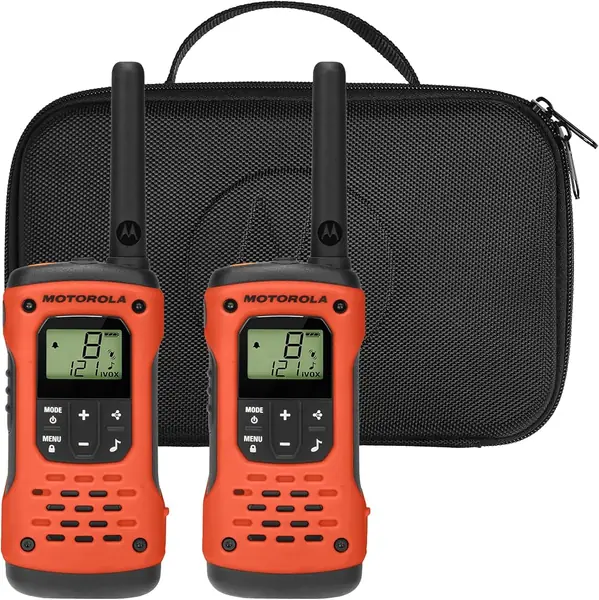
The water-activated flashlight is a small detail that tells you exactly who the Motorola T605 H2O is for. Drop it in the water and the light comes on to help you find it, and the radio floats face up so you can grab it rather than fish for it. The rest of the package is built for wet use: an IP67 rating, 22 FRS channels, USB-C charging, easy pairing, and a two-year warranty.

We like this pair for kayaking, dock work, and poolside duty, where a radio that sinks is a radio you have lost. The floating body and the water-triggered light are genuinely useful, and the audio is clear in the conditions where these are likely to be used. It is also one of the few picks here with a two-year manufacturer warranty, which adds some peace of mind for a family that will leave it in a boat bag.

The reservation is battery life. The listed nine hours is not a full day of hard use, and the radio often falls short of that in real conditions, so plan on a midday charge or a spare power bank. The battery cover also needs a screwdriver to open, which is not what you want on a wet dock. For a boater who wants a floating radio from a familiar brand, the T605 H2O is still worth a look; if battery life is the priority, the RB48 is the stronger waterproof pick.

Pros

  • IP67 floating body
  • Water-activated flashlight
  • USB-C charging and two-year warranty
  • Easy pairing and clear audio

Cons

  • Battery life falls short of a full day
  • Battery cover needs a screwdriver
Our verdict

We like the T605 H2O for boaters and water-sports use because it floats, lights up in the water, and charges by USB-C; its short battery life keeps it from being the everyday pick.

Check Latest Price

How We Tested Walkie Talkies on Trails, Ski Hills, and in the Backyard

We started with the models shoppers actually compare — pocket-sized FRS sets, GMRS handhelds, and heavy-duty multi-packs sold to businesses and schools — and dropped anything with a sealed low-capacity battery, range claims with no channel detail, or a price that didn't match what came in the box, counting chargers, clips, and headsets as part of the deal. That left 12 units, which we used over six months in the places people really carry them: wooded trails, a ski hill in January, a school event big enough to need crowd control, and a summer of backyard use with kids on the loose.

Audio and range got the least forgiving tests. We walked the same open field and the same tree-covered ridge with each set, calling out at fixed intervals and logging the distance where voices stayed clean rather than the maximum distance where anything got through — the point where nobody had to ask for a repeat. We also worked a crowded channel at a busy trailhead on a holiday weekend to see how privacy codes held up with strangers transmitting nearby, and we checked weather-alert reception against a local broadcast.

Battery life meant a full charge and then a full day of heavy use with no top-ups — I noted which sets died before dinner and which still had bars the next morning. Durability meant shoulder-height drops onto pavement, a minute in a bucket of water for the waterproof models, and weeks of belt wear to see which clips loosened. For ease of use, I handed each radio to someone who'd never touched it, including a nine-year-old, and timed how long a clear call took, first bare-handed and then in winter gloves. Portability came down to weight and whether it disappeared into a jacket pocket; sound quality came down to how much wind, engine noise, and crowd chatter bled into the transmission.

How to Choose a Walkie Talkie

Start With Realistic Range

A 30-mile claim is a line-of-sight number measured from ridge to ridge, not a promise for a wooded campground or a mall. FRS and GMRS handhelds push about as far as the terrain allows, so plan on roughly half a mile to two miles in neighborhoods, woods, and buildings, and farther over open water or flat ground. If you need reliable talk across a large property, buy for the shorter distance and treat the big number as marketing. The RT22's 2-mile rating is a fair open-air figure; expect less once houses and trees get in the way.

Match the License to the User

FRS radios are the simple, license-free choice for family and casual outdoor use; the RT22, MOICO T5, and RB48 all operate there. GMRS adds power and repeater access, but it requires an FCC license, so the Midland GXT1000VP4 is not the plug-and-play pick for a child. Programmable UHF business radios such as the SAMCOM FPCN30A and BAOFENG BF-888S need the right license and frequency programming before they are legal to transmit. Match the radio to the user, not just the range claim.

Decide How You Will Power It

Rechargeable lithium-ion radios with USB-C or a charging dock are the least fuss for daily use. A 12-hour rating usually assumes a mix of listening and talking, not nonstop transmission, so a spare power source still matters. AAA radios are cheap and easy to revive with fresh cells, but they drain quickly under heavy use; the MOICO T5 is a good example of a set that benefits from rechargeable AAAs. For a crew, a multi-unit charger keeps every radio topped up in one place.

Treat Water and Drop Ratings as Specific

Water-resistant is not the same as waterproof, and an IP rating tells you how much abuse the maker claims. IP65 handles rain and spray; IP67 can survive a dunk; a floating design is what you want for kayaks, boats, and poolside use. The RB48 and Motorola T605 H2O are the two picks here built around that wet-use case. A rugged shell also needs a secure belt clip and controls you can work with gloves, not just a tough-looking body.

Keep Controls Simple and Privacy in Perspective

For kids and casual users, fewer buttons and a short antenna matter more than a long feature list; the RT22 gets that balance right. For work sites, look for a channel lock, dual push-to-talk buttons, and a group-call key, as on the SAMCOM FPCN30A. Privacy codes only filter out other conversations on the same channel; they do not encrypt your call. Anyone with a compatible radio can still listen, so keep sensitive information off the air.

Frequently Asked Questions

Final Verdict

For most households, the Retevis RT22 4-pack is the walkie talkie we recommend. It is license-free, pocketable, USB-C rechargeable, and simple enough for a child, and four radios cover a family without a programming session. Its range is neighborhood-scale, so treat it as a local tool rather than a backcountry radio.

If your group spreads across open country and you will get the GMRS license, the Midland GXT1000VP4 is the stronger long-range choice. For wet, rough trips, the RB48 is the pair we pack. Everyone else can start with the RT22 and add a specialized radio only when a specific trip demands it.