Best Car Power Inverters of 2026

A car power inverter sounds like the simplest thing you can buy: a plug that turns your 12-volt socket into a household outlet. The catch is that the socket is a fussy power source — fused below what the box promises, dead when the ignition is off, and loose enough that a heavy adapter sags out of it. A good inverter works within those limits instead of fighting them.

We've spent five months with 14 of them, on commutes, road trips, and a tailgate weekend, and the lesson arrived fast: wattage on the front is a ceiling, not a promise. Ask a 300-watt unit for 300 watts and it will spin its fan, heat up, and shut itself off, often right when your laptop hits 40 percent. The USB ports, not the outlet, are what we reached for most.

Fit matters as much as power: a bulky adapter that leans out of a worn socket loses contact on a rough road, so the compact bodies won. The picks below are the ones that earned a permanent spot in the console.

The Best Car Power Inverters

1

BESTEK 300W Power Inverter Best Overall
92 /100
Traveler Score Outstanding

Key details

Ports
2 AC + 2 USB
Waveform
Modified sine wave
Peak Power
700W
Continuous Power
300W
Check Details on Amazon

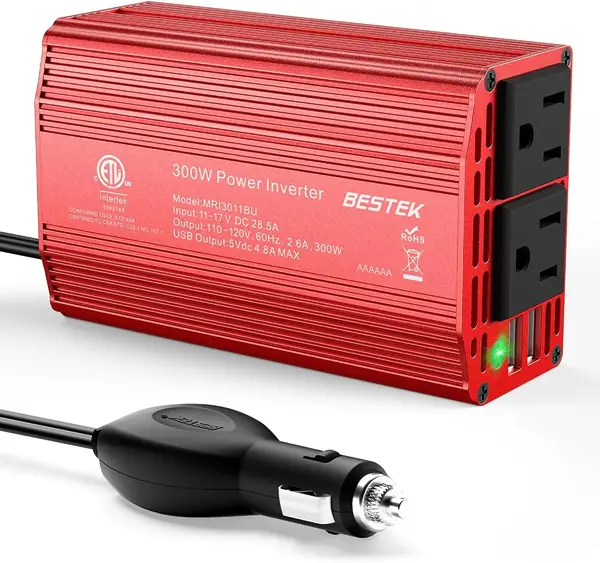
Most car inverters advertise a wattage you will never pull through a cigarette-lighter socket; the BESTEK 300W is useful because it makes the most of the power you can actually get. Two AC outlets and two 4.8A USB ports cover a laptop, a couple of phones, and a camera battery without a nest of adapters, and the 300W continuous rating gives you more headroom than the 150W boxes we tested. We also like that it accepts 11-17V, so it plays nicely with newer vehicles and Teslas that run above the old 12V nominal.

The size is the other reason it earns the top spot. At 4.8 by 3.1 by 1.9 inches and 14.4 ounces, it disappears into a console or glovebox, and the aluminum housing feels more substantial than the plastic bricks at the bottom of the category. On a road trip, we found the two AC outlets are the difference between a laptop that stays charged and one that dies while you navigate; the USB ports are fast enough that a phone is back to full before the next stop.

The caveat is the one that applies to every compact inverter: the cigarette-lighter plug, not the 300W label, is the real limit in most cars. This is a device for laptops, phones, tablets, and small chargers, not a hair dryer or a heater. We also treat the 18-month warranty as part of the value, because compact inverters live hard lives.

Pros

  • Two AC outlets and dual 4.8A USB
  • Compact 14.4-ounce aluminum body
  • 300W continuous with 700W peak
  • 11-17V input covers newer vehicles

Cons

  • Modified sine wave won't suit sensitive gear
  • No USB-C port for newer devices
Our verdict

We recommend the BESTEK 300W as the default for road trips: it has the outlets, size, and headroom for a laptop and a few phones.
Check Latest Price
2

BESTEK 300W Pure Sine Inverter Best for Sensitive Electronics

91 /100
Traveler Score Outstanding

Key details

Ports
2 AC + 2 USB
Waveform
Pure sine wave
Peak Power
700W
Continuous Power
300W
Check Details on Amazon

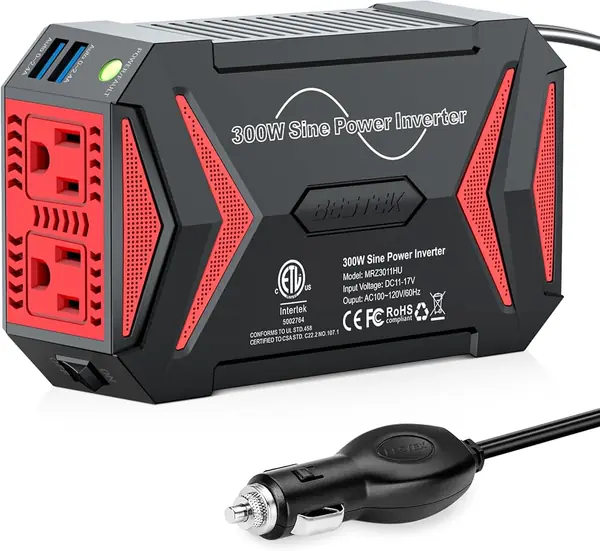
Pure sine wave is the reason to pay attention to this BESTEK. It produces the same smooth AC waveform as a wall outlet, which matters for devices that are fussy about power: a CPAP machine, audio gear, or a laptop charger that hums on a modified sine wave. The 300W continuous and 700W peak ratings put it in the same class as our top pick, but the output is cleaner.

We also appreciate the port layout. Two AC outlets and two 4.8A USB ports let you run a laptop and charge phones at the same time, and the 11-17V input covers newer vehicles and Teslas. The catch is bulk: at 8.1 by 5.3 by 2.6 inches and 1.4 pounds, it takes up more console space than the compact modified-sine units. That is a fair trade if clean power is the point.

The 300W ceiling is the other limit. It is enough for a laptop, a CPAP, or a small fan, but not for a kettle, a heater, or a large appliance. For sensitive electronics, we still think the clean output is worth the ceiling; for everyday phone charging, it is more inverter than you need.

Pros

  • Pure sine wave output
  • 300W continuous with 700W peak
  • Two AC and two 4.8A USB ports
  • ETL-listed with 18-month warranty

Cons

  • No USB-C port for newer devices
  • Fan noise can be noticeable under load
Our verdict

Buy this if your devices need clean power, such as a CPAP, audio gear, or a fussy laptop charger, and you can give up some console space.

Check Latest Price
3

FOVAL 150W Car Inverter Best Budget Pick

90 /100
Traveler Score Outstanding

Key details

Ports
1 AC + 2 USB
Waveform
Modified sine wave
Peak Power
300W
Continuous Power
150W
Check Details on Amazon

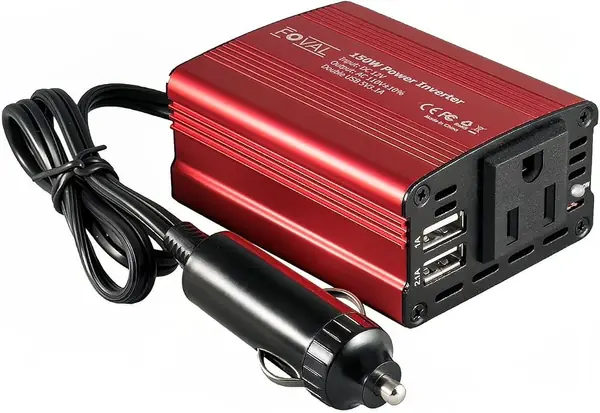
A 150W inverter is not a smaller version of a 300W one; it is a different tool. The FOVAL is built for the small stuff: a phone, a tablet, a dash cam, or a laptop charger. At 3.2 by 2.5 by 1.5 inches and 8 ounces, it disappears into a glovebox or console, and the aluminum shell feels tougher than the price suggests.

We like the simplicity of it. One AC outlet and two USB ports cover the devices most people actually charge in the car, and the 3.1A total USB output is enough to bring a phone back quickly. The two-year warranty is the safety net, because longevity is the question mark with budget inverters.

The 150W ceiling is the trade-off. It is enough for a phone, a tablet, a dash cam, or a laptop charger that stays under the limit, but not for gaming laptops or anything with a heating element. If you need to run a laptop and several tablets at once, step up to a 300W unit.

Pros

  • Credit-card size and 8 ounces
  • One AC outlet and two USB ports
  • Two-year warranty adds confidence

Cons

  • Modified sine wave limits sensitive gear
  • No USB-C port for newer devices
Our verdict

Keep the FOVAL 150W in the glovebox for phone, tablet, and small-laptop top-ups; it is the budget pick for light loads, not heavy gear.

Check Latest Price

How We Tested Car Power Inverters

I started by gathering every inverter I could find that plugs into a 12-volt socket and costs less than a tank of gas, then cut the list by wattage claims, USB output, plug style, and footprint — anything too big to close a console lid didn't make the cut. That left 14 units, which we ran for five months across a commuter sedan, a work pickup, an older SUV with a genuinely worn socket, and a borrowed camper van.

Each one got the same gauntlet: a laptop charger, a tablet, a handheld vacuum, and a small cooler, plugged in one at a time while I watched a plug-in watt meter and a laser thermometer pointed at the housing. I noted the load where the fan shifted pitch, where the case got too warm to hold comfortably, and whether the unit tripped its own protection or blew a fuse instead. A second run with the engine off told us how each behaved in the situation most of us are actually in.

Noise got scored by ear from the driver's seat, at idle and under load — one unit whined at a pitch that made a two-hour drive feel longer. I weighed and measured each body, checked whether it swallowed a glovebox slot or sat steady in a cupholder, and drove the same five-mile stretch of patched asphalt to see if the plug stayed seated. Compatibility meant testing with the ignition on and off, in vehicles that cut socket power at shutdown, and I logged every shutdown, reset, and dead USB port over the five months to judge reliability against what each one cost. The ones still living in our cars are the ones that never gave us a reason to think about them.

How to Choose a Car Power Inverter

Start with continuous watts, then check the socket

Continuous wattage is what the inverter can deliver all day; peak wattage is a short surge for startup. Add up the devices you plan to run at once, then leave headroom. A 150W unit is fine for a phone, tablet, and many laptop chargers; a 300W unit gives you room for a laptop plus accessories. We treat the cigarette-lighter socket as the first limit, not an afterthought: if you need more than a compact load, look for battery clamps or a direct-to-battery connection.

Pick the waveform around your most sensitive device

Modified sine wave is the cheaper, more common output and works for phones, tablets, and most laptop bricks. Pure sine wave mimics wall power and is the safer choice for CPAP machines, audio equipment, and any charger that hums or runs hot. We do not pay for pure sine just to charge a phone; we pay for it when a device maker calls for it or when a sensitive device misbehaves on modified power.

Count ports, then measure the cable

Two AC outlets are more useful than one because a laptop brick and a camera charger can share the box. USB-C PD is worth having if your phone or tablet uses it; dual USB-A is fine for older gear. Cord length matters more than you think: a 32-inch plug reaches the console, but a backseat passenger may need an extension. Check the plug fit in your vehicle's socket, especially if it is recessed or angled.

Plan for heat, noise, and placement

Compact inverters get hot and rely on a fan. Keep the vents clear, do not bury the unit under a seat cushion, and expect more fan noise as load rises. We prefer a temperature-controlled fan for quiet charging, but any inverter can become audible when it is working hard. If you are sensitive to noise on long drives, place it in a console or cargo area rather than beside your ear.

Treat reliability and warranty as part of the purchase

These are hard-working electronics that live in hot cars, and a short warranty is a clue about how much support the maker expects to provide. We look for at least 18 months of coverage, accessible fuses, and a brand that sells replacement parts. Test the inverter on a short trip before you rely on it, and keep the receipt and packaging until you know it works with your devices.

Frequently Asked Questions

Final Verdict

For most road trips, we recommend the BESTEK 300W. It has the right mix of outlets, size, and headroom for a laptop and a few phones, and it is the one we reach for first. If your devices are fussy about power, such as a CPAP, audio gear, or a charger that hums, the BESTEK pure sine model is the safer choice even though it is larger. If you only need phone and tablet top-ups, the FOVAL 150W is the one to keep in the glovebox.