Best Portable Power Stations of 2026

The first time I genuinely needed a power station, I didn't own one. A nor'easter took out my block for three days, and I spent them watching the freezer thaw and nursing a dying phone. A good unit keeps the fridge, the router, and a laptop alive without gas, fumes, or a pull cord — quiet electricity anywhere there's no outlet.

Over the past eight months, my team and I have lived with eight of them, from palm-sized packs that top up a phone twice to a home-backup unit that can carry a fridge for days. They came camping in the rain, through a real blackout, and on a long road trip.

The number that should decide your purchase isn't capacity — it's running wattage, plus headroom for the surge a fridge compressor or space heater pulls when it kicks on. Most of the disappointment I hear about comes from buying too little power, not too much. The picks below earn their price on honest capacity, fast recharge, and build quality that survives being hauled around.

The Best Portable Power Stations

1

Jackery Explorer 1000 v2 Best Overall
94 /100
Traveler Score Outstanding

Key details

Capacity
1,024Wh
AC Output
1,500W (3,000W surge)
Weight
23.4 lb
Recharge Time
50 min in app mode; 4 hr standard
Check Details on Amazon

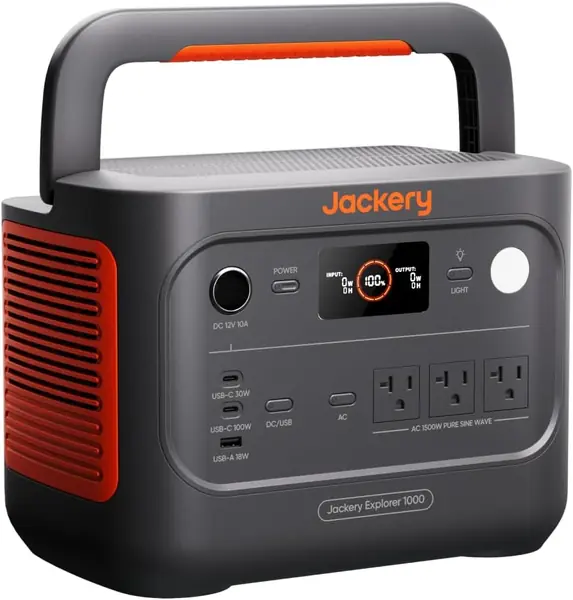
Three figures define a station in this class: 1,024 watt-hours of capacity, 1,500 watts of AC output and 23.4 pounds of carry weight. The Explorer 1000 v2 hits all three, and of the three 1,024Wh units on this list it's the lightest — which matters more than it sounds when the walk from the car to the tent is the third trip of the day.

That balance is why it's the one we recommend first. The 1,500-watt inverter covers the ordinary camping and outage load — a 12-volt cooler, a laptop, phones, a fan, a CPAP — and the 3,000-watt surge is enough to start a fridge compressor. It has also been the unit we hand to someone who has never used a power station, because there's one button, a screen with a percentage on it, and nothing to configure. The 10-millisecond transfer switch means you can leave a router or a desktop plugged in and let the battery take over when the grid drops.

Charging is where the spec sheet needs translating. The headline 50-minute recharge only happens with emergency charging switched on inside the Jackery app; leave that off and you're closer to four hours. We used the fast mode the morning before a trip and the slow one overnight, and both have their place, but don't expect the 50 minutes to be the default behavior out of the box.

The other number to hold against your own list is the AC ceiling. A coffee maker, a microwave or a space heater is fine; a well pump or a big induction motor is not. What we appreciated most in practice was the overnight mode that drops the charging fan to a whisper, because a station charging in a tent is otherwise the loudest thing in it.

Pros

  • Lightest 1,024Wh unit here at 23.4 pounds
  • 50-minute recharge with emergency charging enabled
  • 10ms transfer keeps a router or desktop alive
  • LiFePO4 rated to 4,000 cycles

Cons

  • Costs more than the EcoFlow while outputting 1,500W
Our verdict

We recommend it as the default: the lightest 1,024Wh station here, with a sub-hour recharge and a battery rated to outlast a decade of use.
Check Latest Price
2

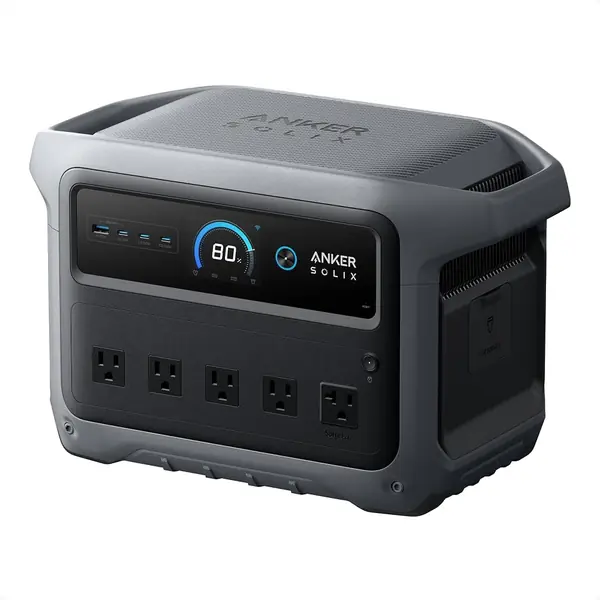
Anker SOLIX C1000 Gen 2 Best for High-Power Appliances

92 /100
Traveler Score Outstanding

Key details

Capacity
1,024Wh
AC Output
2,000W (3,000W peak)
Weight
11.3 kg (24.9 lb)
Recharge Time
49 minutes
Check Details on Amazon

A microwave is the appliance that sorts this category, and at 2,000 watts of continuous output the SOLIX C1000 Gen 2 is the only 1,024Wh unit here that runs one without a second thought. A coffee maker, a space heater or a hair dryer are all fair game too, which is more than the other two stations in this class will carry.

The rest of the package backs that up. A 1,600-watt wall charge takes it from empty to full in about 49 minutes, 600 watts of solar does the same in under two hours, and the LiFePO4 cells are rated to hold 80 percent of their capacity after 4,000 cycles. Anker's five-year warranty is the longest coverage on any pick here, and that counts for something on a battery that will sit plugged in for years.

Where it earns its spot is the overlap of power and patience: it runs the appliances that turn an outage from a crisis into an inconvenience, and it refills fast enough that a lunch stop on a road trip is a full charge. In the hand it feels like a small toolbox — a molded top handle, a metal-and-plastic shell, roughly 25 pounds — and it has gone in and out of a hatchback without complaint.

The one thing to plan around is the wall draw. A 1,600-watt charge is most of a 15-amp circuit, so it wants an outlet of its own rather than a strip shared with a kettle. If your garage has only the one circuit, the slower-charging Jackery is the more forgiving arrangement.

Pros

  • 2,000W continuous, the highest at this capacity
  • Full recharge in about 49 minutes
  • Five-year warranty, the longest here
  • Holds 80% capacity after 4,000 cycles

Cons

  • Heavier than the Jackery at roughly 25 pounds
Our verdict

If a microwave, a coffee maker or a space heater is on your list, this is the one to buy: 2,000 watts of continuous output at 1,024 watt-hours.

Check Latest Price
3

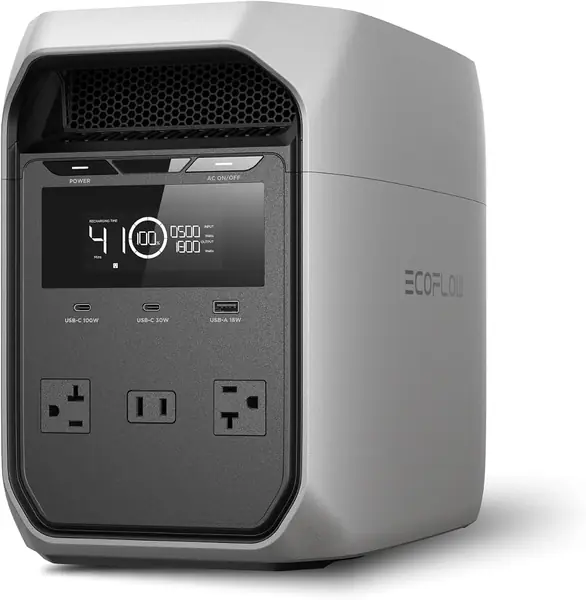
EcoFlow Delta 3 Classic Best Value

91 /100
Traveler Score Outstanding

Key details

Capacity
1,024Wh
AC Output
1,800W (3,600W surge)
Weight
26.7 lb
Recharge Time
45 minutes to 80%
Check Details on Amazon

This is the value play in the 1,024 watt-hour class, and it isn't a stripped-down one. The Delta 3 Classic costs less than the Jackery or the Anker while matching them on capacity and beating the Jackery on output — which makes it the pick when the budget is the first thing on the page.

The inverter is rated at 1,800 watts continuous and 3,600 watts of surge, the highest surge figure in this group. That headroom is what lets a fridge compressor or a small air conditioner start without the unit shutting down, and X-Boost stretches it further for resistive loads. Charging runs from empty to 80 percent in about 45 minutes on AC, and there's a 100-watt USB-C port for a laptop that never needs the inverter at all.

Home backup is the other reason to pick it. Transfer time is under 10 milliseconds, so a desktop, a router or a CPAP keeps running through a flicker and through a longer outage, and the LiFePO4 pack is rated for a decade of daily use. We've kept this one plugged in as a UPS between trips, which is the least glamorous job in this guide and the one that has quietly earned its keep.

Pros

  • Cheapest of the three 1,024Wh units
  • Highest surge here at 3,600W
  • 10ms switchover for desktop and router backup
  • 100W USB-C output for laptops

Cons

  • Heaviest of the 1kWh picks at 26.7 pounds
Our verdict

The best watts per dollar here: 1,024 watt-hours and an 1,800-watt inverter for less than either of its closest rivals.

Check Latest Price
4

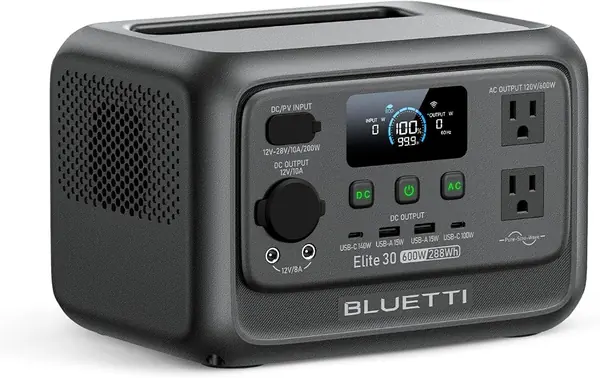
BLUETTI Elite 30 V2 Best Lightweight

89 /100
Traveler Score Excellent

Key details

Capacity
288Wh
AC Output
600W (1,500W lifting mode)
Weight
9.5 lb
Warranty
60 months
Check Details on Amazon

Two numbers on the Elite 30 V2 look like a mismatch: a 288 watt-hour battery and a 600-watt inverter. One is the smallest capacity here outside the pocket units; the other is twice the output of the 300-watt stations selling for the same money.

The pairing is deliberate rather than accidental. Six hundred watts continuous, or 1,500 watts in the lifting mode, runs a small space heater, a blender, a projector and speakers, or a work light — none of which a 300-watt box will touch. That's the argument for it: a station small enough to carry in one hand that still starts the appliance you actually brought.

Filling it back up is quick for the size. A 380-watt wall charge reaches 80 percent in about 45 minutes, and the 10-millisecond transfer switch keeps a router or a CPAP alive if the power drops mid-evening. At 9.5 pounds with a top handle it goes into a tote with the rest of the camp kitchen, and the five-year warranty is the longest coverage at this capacity.

Where we place it is the second station in a kit rather than the only battery in the house — the one you grab for a tailgate, a job site, or a cabin night with a fan and a light. If the plan is keeping a fridge cold for two days, no 288 watt-hour unit will do it, and this one doesn't pretend otherwise.

Pros

  • 600W continuous in a 9.5-pound body
  • 45 minutes to 80% on a 380W wall charge
  • 10ms transfer for router or CPAP backup
  • Five-year warranty

Cons

  • Runtime at 600 watts is measured in minutes
Our verdict

For day trips and tailgates, this is the most appliance-capable station you can carry in one hand at under ten pounds.

Check Latest Price
5

Dyness 300W Power Station Best Budget

87 /100
Traveler Score Excellent

Key details

Capacity
256Wh
AC Output
300W (600W surge)
Dimensions
9.3 x 5 x 6.8 inches
Output Ports
6
Check Details on Amazon

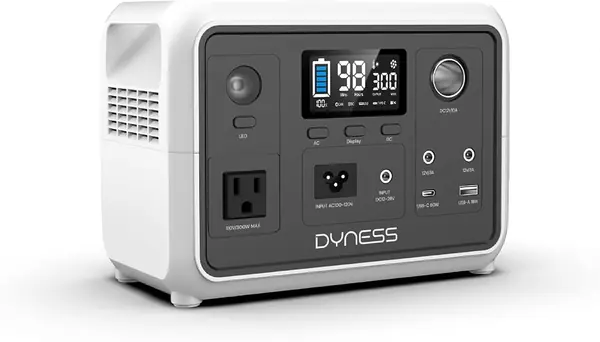
Dyness isn't a name most American shoppers recognize, and that's the honest reason to look twice here. What the 300W model offers is a genuine inverter and lithium iron phosphate cells for barely more than the pocket-size power banks in this guide, from a manufacturer standing behind it with a two-year warranty.

The hardware is straightforward. A 256 watt-hour LiFePO4 pack feeds a 300-watt inverter with a 600-watt surge, which is enough to start a small fan motor or a mini fridge compressor and then run it. Six outputs cover USB-C, USB-A, two DC ports, a car socket and the AC side, and the body measures 9.3 by 5 by 6.8 inches, so it shelves next to the fuse box without complaining. It recharges from a wall outlet, a car or a solar panel.

For a first power station, a cabin drawer or a car emergency kit, this is the least money you can spend here and still get a real sine wave inverter rather than a phone bank with an adapter. We treat it as the starter unit: phones, a router, a fan and a laptop, all fine. What we can't tell you yet is how it ages, because there simply isn't much track record behind the model, and for a battery that's the number that matters most. The two-year warranty is the backstop, and it's shorter than the five years Anker and BLUETTI give you.

Pros

  • LiFePO4 cells near the bottom of the price range
  • 600W surge starts small motors
  • Six outputs including USB-C and a car socket
  • Compact 9.3 by 5 by 6.8 inch body

Cons

  • Only one AC outlet
Our verdict

The budget pick we're comfortable recommending: real LiFePO4 cells and a 600-watt surge for barely more than the pocket-size units.

Check Latest Price
6

Jackery HomePower 3600 Plus Best for Whole-Home Backup

86 /100
Traveler Score Excellent

Key details

Capacity
3,584Wh (expandable to 21kWh)
AC Output
3,600W (7,200W in parallel)
Weight
77.2 lb
Recharge Time
2 hours on AC plus DC
Check Details on Amazon

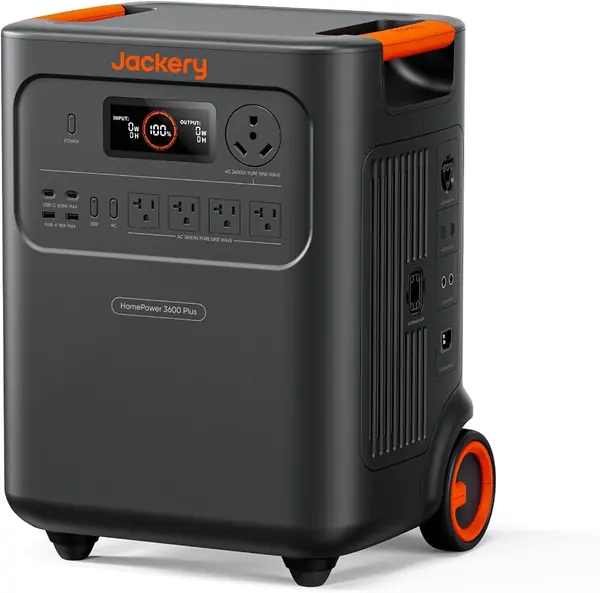
The HomePower 3600 Plus rolls. Built-in wheels and a pull handle move its 77.2 pounds from the garage to the living room without a second person, and that single design choice is what turns a 3.6 kilowatt-hour battery into a household appliance instead of a permanent installation. It's also the only unit here that can carry a house through a multi-day outage rather than an evening.

The numbers behind that claim: 3,584 watt-hours of LFP capacity, 3,600 watts of output, and expansion to 21 kilowatt-hours if you add batteries later. Run two in parallel and you get 7,200 watts and 240 volts, which is the configuration that runs a dryer, a well pump or a big electric heater — the loads that normally force people to buy a fuel generator.

Recharging is 0 to 100 percent in about two hours on AC and DC together, which is the difference between a battery you plan your day around and one you don't. The cells are built to resist thermal runaway, and the five-year warranty matches the longest coverage in this guide.

What it isn't is a camping battery. In a tent the capacity and the wheels are just ballast, and you'd be hauling a nightstand to run a fan. This one earns its place if outages in your area are a recurring problem rather than a hypothetical, and if there's a spot to park it near the panel.

Pros

  • 3,584Wh, expandable to 21kWh
  • 3,600W with 240V and 7,200W in parallel
  • Two-hour recharge on AC plus DC
  • Built-in wheels and pull handle

Cons

  • Panel hookup needs a transfer switch
Our verdict

The only station here built to carry a house through a multi-day outage, and the wheels are what make 3.6 kilowatt-hours genuinely movable.

Check Latest Price
7

Daran YOUYO R100 Best for Phones and Laptops

85 /100
Traveler Score Excellent

Key details

Capacity
89.6Wh
AC Output
100W
Weight
2.54 lb
Recharge Time
1.5 hours to 80%
Check Details on Amazon

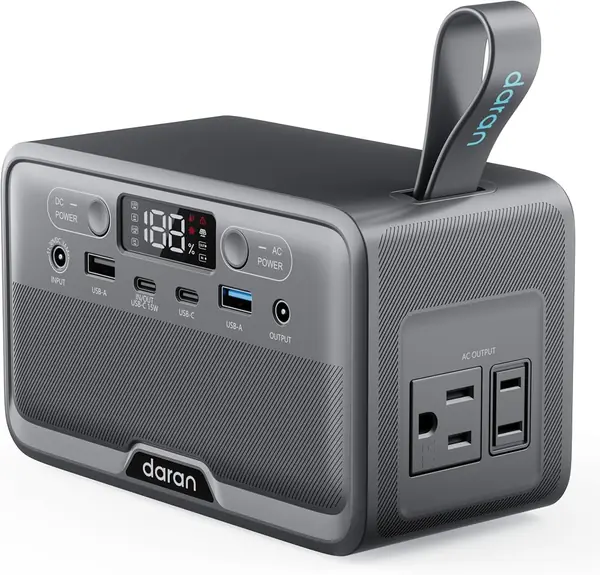
Set the YOUYO R100 beside a smartphone and the difference is a couple of inches. At 2.54 pounds and roughly 6.5 by 3.3 by 4 inches it drops into a jacket pocket or a small camera bag, with a soft handle sewn across the top.

We treat it as a power bank that happens to have an AC socket, and judged that way it's a good one. There's 89.6 watt-hours of LiFePO4 behind a 100-watt AC outlet, plus USB-C PD, USB-A ports and a four-level flashlight, all of it fanless and silent — which counts for more than it sounds like in a hostel dorm or a tent. It handles a laptop, a camera battery and two phones across a travel day, and a 0-to-80 percent charge takes about an hour and a half.

One quirk to know before you rely on it: the unit has to be switched on and set to AC or DC output before it will pass power at all. That's the kind of thing you discover while holding a dead phone in an airport, so turn it on and test the outlet before you leave.

The other caveat is runtime. This is a small battery asked to do a lot, and a phone and a watch over a long weekend is realistic where a laptop all afternoon is not. The one-year warranty is the shortest in this guide, so keep the receipt.

Pros

  • Fits in a jacket pocket at 2.54 pounds
  • Fanless, silent operation
  • LiFePO4 rated to 3,500 cycles
  • Doubles as a four-level flashlight

Cons

  • 100W AC outlet won't run heating appliances
Our verdict

A power bank that happens to have an AC socket, and a good one for phones, laptops and camera batteries on a travel day.

Check Latest Price

How We Tested Portable Power Stations

We started with spec sheets for more than 40 models and cut anything that couldn't run a fridge for a few hours, shipped without a pure sine wave inverter, or had no fast-charge input. That left eight units, bought at retail rather than accepted as loaners, and we've lived with them for eight months.

Capacity claims got checked, not trusted: each unit ran a 500-watt work light until the inverter cut out, and we compared the minutes we got to the watt-hours printed on the box. During a two-day blackout at my house, we cycled the fridge, the router, and a laptop through them one at a time and wrote down how fast the percentage fell. We also cold-started a fridge compressor and a circular saw on each to see which ones tripped on the surge and which rode it out.

Charging speed was a stopwatch job — dead to full on a wall outlet, then again off a solar panel on a cloudy afternoon, with notes on fan noise and whether the unit slowed itself down as it heated up. For the models claiming a UPS mode, we pulled the plug on a running desktop and watched whether it stayed up without rebooting. Battery compatibility meant trying an older solar panel and, where one exists, an expansion battery; a few refused the input voltage entirely.

Durability and value came last. Each unit spent a week in a hot garage, came along on a rainy camping weekend, and rode in a truck bed, then got carried up and down stairs by its handle so we could judge weight and grip honestly. We did the math on cost per usable watt-hour, and reliability showed up on its own over the months — a fan that developed a rattle, a screen that stopped reporting runtime, a battery that held its charge less well by month six.

How to Choose a Portable Power Station

Watt-Hours Decide How Long, Watts Decide What

Capacity is the size of the tank and output is the width of the tap. A 300 watt-hour station keeps a fan, a router and a couple of phones alive overnight; a 1,024 watt-hour station does the same for a fridge or a CPAP and still has charge in the morning. Read the pair together, because capacity without output is a big battery that refuses to boil a kettle, and output without capacity is a kettle that boils for six minutes.

List the three things you genuinely need to run, note the wattage on each label, and buy for the largest one. Most of our picks cluster around 256 to 300 watt-hours for light duty and 1,024 for the middle, and that middle is where most households land.

Find the Heating and Motor Divide

Anything that heats up or spins is the line between a small station and a serious one. Lights, phones, laptops, fans and most medical devices sit comfortably under 300 watts; a coffee maker, a microwave or a space heater wants 1,000 to 1,500. Motors need a surge rating two or three times their running wattage to start, which is why the 1,500-watt models here advertise 3,000 and 3,600 watts of surge.

If nothing on your list heats or spins, buy small and save the weight. If anything does, start at 1,500 watts of continuous output and check the surge figure before you commit.

Recharge Time Is the Spec People Forget

The fast units here refill in under an hour and the budget ones take an afternoon, and that difference decides whether a station is a tool or a chore. It's worth knowing that a station you can top up over lunch gets used, while one that needs a full afternoon tends to stay in the closet.

Speed has a cost at the outlet. A 1,600-watt charge is most of a 15-amp circuit, so plan a dedicated socket rather than a power strip shared with a kettle. Solar recharge is slower and less predictable than the panel's rating suggests, so treat it as a top-up rather than a plan.

Lithium Iron Phosphate Is the Chemistry to Look For

Almost every pick here uses lithium iron phosphate, sold as LiFePO4 or LFP, and that's the upgrade worth paying for. The chemistry is rated for thousands of charge cycles before capacity drops meaningfully — both Anker and Jackery publish 4,000 — against a few hundred for the older lithium-ion packs that still turn up in cheap units.

In practice it's the difference between a battery that's still useful when the warranty runs out and one that isn't. If a listing never names the chemistry, assume it's the older kind and price accordingly.

Weigh It Before You Fall for the Word Portable

Portable covers everything from a ten-pound box with a handle to a 77-pound unit on wheels, and the gap only shows on the third trip from the car. Under ten pounds goes in a tote bag; 23 to 27 pounds is a one-handed lift for most adults but not a long walk; past 50 pounds you want wheels and a reason for the capacity.

Check weight before capacity. A bigger battery you leave in the trunk is a smaller battery than the one you actually carry to the campsite.

Frequently Asked Questions

Final Verdict

For most people the Jackery Explorer 1000 v2 is the one to buy: 1,024 watt-hours and a 1,500-watt inverter in a 23.4-pound body, with a recharge short enough to fit into a lunch stop and a battery rated to outlast a decade of use. In a category full of near-misses, it is the safest default.
Two situations change that. If a microwave, a space heater or a coffee maker is on your list, the Anker SOLIX C1000 Gen 2's 2,000 watts is the reason to pick it instead. And if the goal is keeping a house running rather than a campsite, the HomePower 3600 Plus is the only station here built for the job.