The Best Portable Chargers for Travel

A portable charger should be the least interesting thing in your bag — until your phone hits 1% while you're running for a train in a city you don't know. Then it's the most important thing you packed. The right one tops up your phone fast enough to matter, slips into a jacket pocket without dragging it down, and has a cable you won't leave in a hotel room. The wrong one is a paperweight with a charging port.

The pattern is clear after eight months with 12 travel chargers: the best aren't always the ones with the biggest battery number on the box. Built-in cables save you from digging through your bag, but they have to survive being wrapped around a charger in a carry-on. Compact size and weight matter more than capacity once you're walking a mile to your gate, and value comes down to whether it holds a charge trip after trip. After timing charging speeds, running each battery down repeatedly, and dropping a few on purpose, these are the ones I'd pack.

1

Best Overall

Anker Zolo 10,000mAh 30W

91 /100
Traveler Score Outstanding

Key details

Weight
7.87 oz
Dimensions
4.32 × 2.58 × 0.98 in
Output Power
30W
Battery Capacity
10,000mAh
Check Details on Amazon

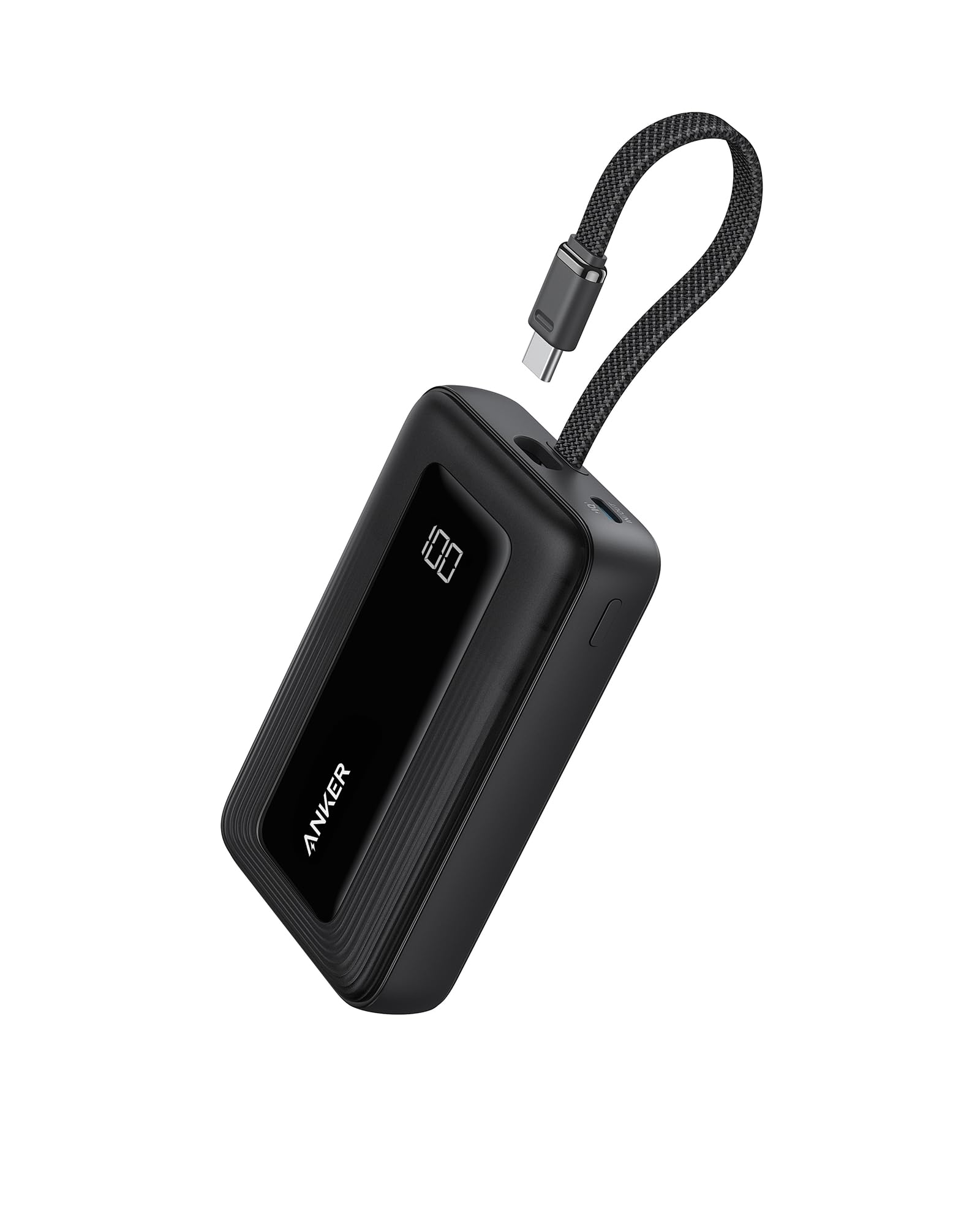
Anker builds the USB-C cable into this bank and shapes the housing so the cable, unplugged, forms a loop you can hook over a finger or a backpack strap. We've come to care about that more than any line on a spec sheet: at a busy station, the difference between a bank you use and a bank you swear at is whether the cable is attached to it. The body measures 4.32 by 2.58 by 0.98 inches and weighs 223 grams, closer to a deck of cards than to a phone, so it drops into a jacket pocket and disappears.

It takes the top spot on the two things travelers argue about, speed and size. The 30W output is the highest of the pocket-size banks in this group, Anker's figure is 50% on an iPhone 16 Pro Max in 27 minutes, and the 10,000mAh cell is rated at two full charges for an iPhone 15. Just as important, the same port accepts 20W in, which is the difference between a bank that's ready for day two and one that isn't.

Two limits are worth knowing before you order. The built-in cable is USB-C, so a Lightning phone still needs its own cord, and because the built-in counts as one output you're charging two devices at a time rather than a family's worth. Anker rates the built-in cable at 10,000 bends and covers the bank for 18 months, which is the sort of claim we like to see attached to the part that usually fails first.

Pros

  • 30W output, quickest of the pocket-size banks here
  • Built-in USB-C cable doubles as a carry loop
  • Takes 20W in, so the bank refills fast
  • Pocketable at 223 g and under an inch thick

Cons

  • Built-in cable is USB-C only
  • Charges two devices at once, no more
Our verdict

Our default pick for a phone-first trip: 30W charging, a built-in USB-C cable that loops over a finger, and a body small enough to forget. Choose it unless you're carrying a laptop or charging three people.

Check Latest Price
2

Best for Laptops

Anker Power Bank 20,000mAh 87W

91 /100
Traveler Score Outstanding

Key details

Weight
15.2 oz
Output Power
87W
Recharge Time
1.5 hours
Battery Capacity
20,000mAh
Check Details on Amazon

At 15.2 ounces and an inch thick, this is the heaviest thing in our travel kit when it comes along, and the only bank here that earns the weight. Eighty-seven watts split across three devices, with up to 65W going to one, is enough to run a phone, a tablet and a camera battery together, and Anker rates the built-in cable at 52% on a MacBook Air in half an hour. We carry it on working trips and leave it home on weekends, which is exactly the test it should pass.

The rest of the design serves the same job. The integrated USB-C cable is rated to 10,000 bends, Anker quotes a full recharge in about an hour and a half, and at 20,000mAh it still sits inside the carry-on limit most airlines apply. An 18-month warranty covers it.

Against our top pick, the difference is simple arithmetic. The Zolo does the phone-and-earbuds job at less than half the weight and a fraction of the bulk, so this one has to change what you can actually do: charge a laptop through a layover, keep a camera alive for a week, run two tablets on a long flight. If it doesn't, you're carrying 15 ounces to do a job a lighter bank handles.

Pros

  • 87W shared output charges a laptop
  • Built-in USB-C cable rated to 10,000 bends
  • Full recharge in about 1.5 hours
  • 20,000mAh still inside carry-on limits

Cons

  • Premium price against the rest of this set
Our verdict

If a laptop or a camera comes with you, this is the bank to carry: 87W and 20,000mAh in a body that's heavy because it has to be.

Check Latest Price
3

Best Capacity Without the Bulk

HELLEE 15,000mAh Power Bank

89 /100
Traveler Score Excellent

Key details

Weight
8.82 oz
Output Power
22.5W
Built-in Cables
4
Battery Capacity
15,000mAh
Check Details on Amazon

Fifteen thousand milliamp-hours is the size almost nobody shops for and a lot of people should. It's half again the capacity of the 10,000mAh banks that fill this list, HELLEE rates it at up to 3.5 charges for an iPhone 17, and it stops well short of the near-pound bricks at 20,000mAh.

The bank carries four built-in cables and six outputs in total, including a bi-directional USB-C port, so a mixed household can charge an iPhone, a USB-C Android and a pair of micro-USB gadgets without anyone hunting for a dongle. A small display shows the remaining percentage, which beats guessing from four dots. It recharges in about three hours, and the body measures 6 by 3.2 by 1.1 inches at 250 grams.

What convinced us is the arithmetic: this is the capacity that covers a long day out with two people sharing, and it does it without the 20,000mAh heft. The trade is bulk rather than money. At 250 grams it's a bag bank, not a pocket one, and the 1.1-inch thickness makes that plain the first time you try to sit down with it in your jeans.

Pros

  • 15,000mAh without 20,000mAh bulk
  • Four built-in cables cover mixed device families
  • Percentage display instead of four dots
  • Six outputs for sharing

Cons

  • 22.5W ceiling trails the 30W top pick
Our verdict

The sensible middle: 15,000mAh, four built-in cables and a display, for travelers who run out of juice on day two but don't want a brick in their bag.

Check Latest Price
4

Best All-In-One

AIFENG CP2 10,000mAh

91 /100
Traveler Score Outstanding

Key details

Output Power
22.5W
Built-in Plug
Foldable AC
Recharge Time
4 hours
Battery Capacity
10,000mAh
Check Details on Amazon

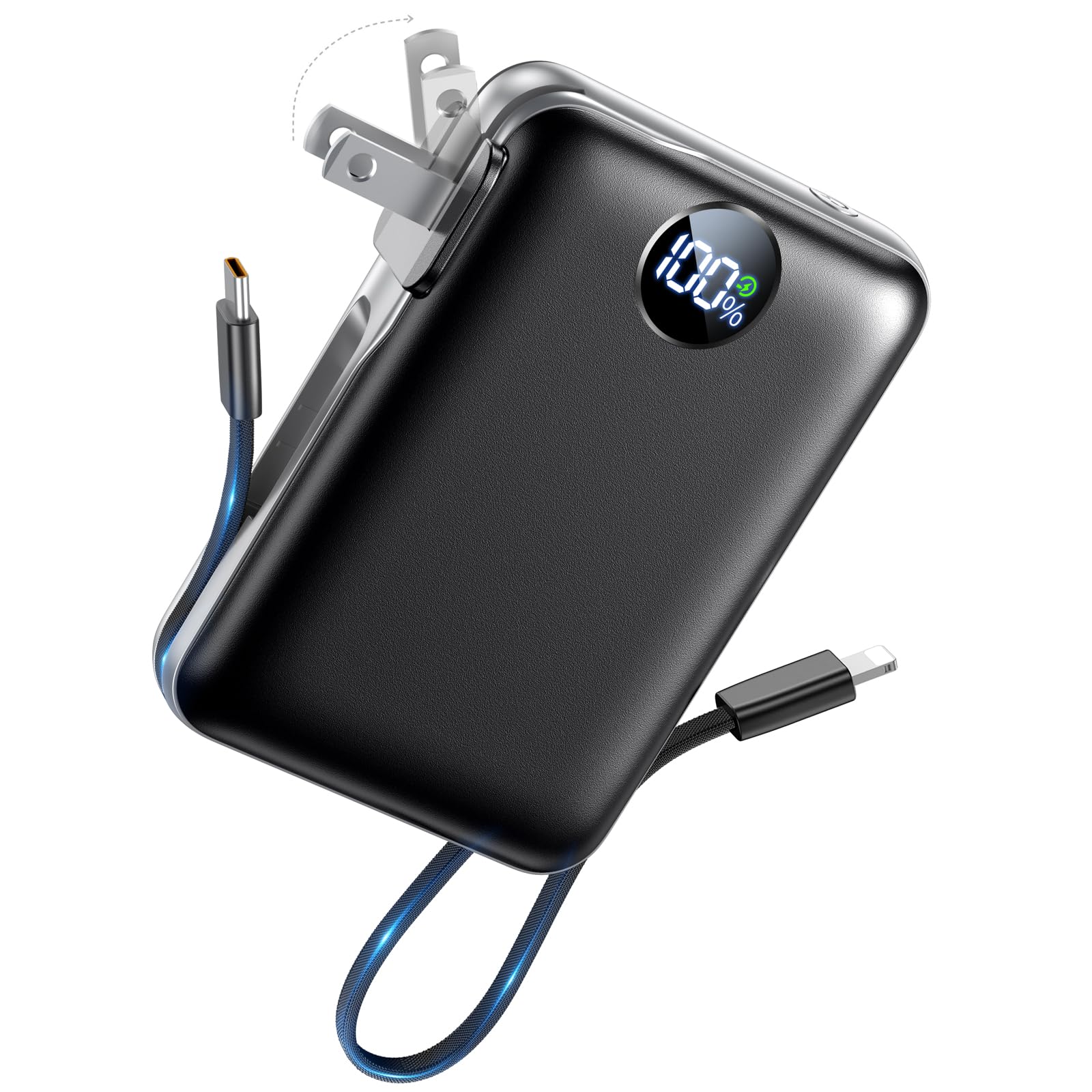
A foldable plug on the end of the bank reorganizes a packing cube. Push it into any outlet and the bank recharges itself in about four hours, so the wall adapter you'd normally bring for your phone can stay home, and the built-in USB-C and Lightning cables cover the phones without anything else coming along.

That's why it's our pick for carry-on-only travel, where every adapter you cut is space in the bag. The rest of the package is competent rather than thrilling: 10,000mAh, 22.5W, four devices at once, 200 grams, and just under two charges for a current iPhone by AIFENG's numbers. We're comfortable with the modest wattage because the plug is what buys you the space.

Two things to keep straight. The plug only helps where there's an outlet, so on a long day out it's dead weight and the real charging happens back in the room. And at 1.26 inches thick it's the chunkiest of the small banks here, a jacket-or-tote carry rather than something you forget in a jeans pocket.

Pros

  • Foldable AC plug recharges it with no charger
  • Built-in USB-C and Lightning cables
  • Light at 200 g for an all-in-one
  • Charges four devices at once

Cons

  • Chunky 1.26-inch body for a pocket
Our verdict

The one to pack when you're traveling carry-on only: a foldable wall plug and built-in cables mean the bank is your charger, your cables and your battery.

Check Latest Price
5

Best for Sharing

Charmast 10,000mAh Power Bank

89 /100
Traveler Score Excellent

Key details

Weight
9.2 oz
Built-in Cables
4
Devices At Once
6
Battery Capacity
10,000mAh
Check Details on Amazon

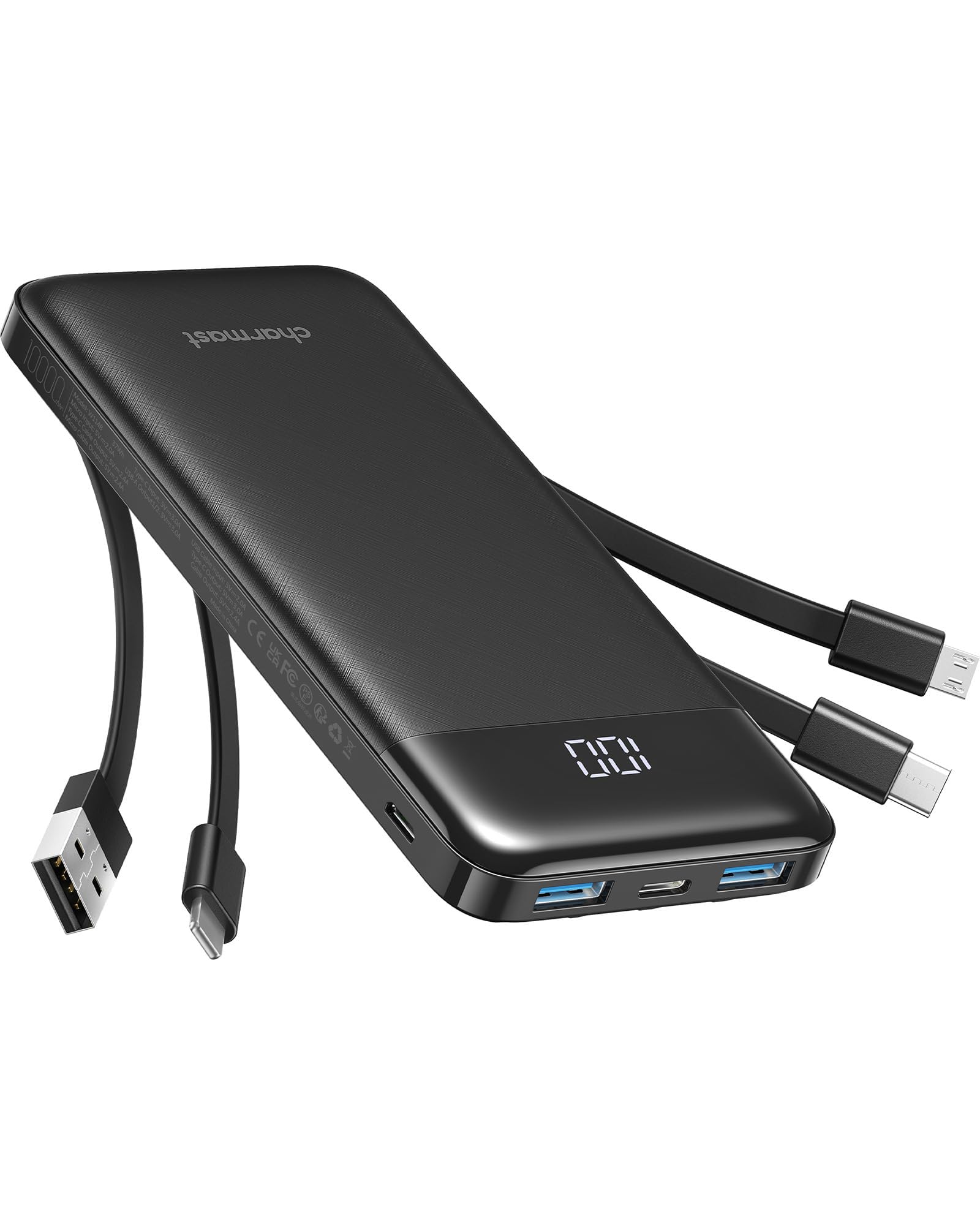
Three dead phones, one hotel outlet, and a rental car with a single USB port: that's the trip this bank is designed around. Built-in cables plus three extra ports let it charge up to six devices at once, which makes it the one we drop in the middle of the table and let everyone plug into. It's the bank we share rather than the one we carry for ourselves.

Recharging is unusually flexible, too. The bank tops itself up through its own built-in USB-C cable, its built-in USB-A cable or a micro-USB input, so whichever adapter is nearest wins and you never need a dedicated cable. The built-in cords are short, which keeps them from tangling and dangling, though you won't be using a phone at arm's length while it charges. It measures 5.67 by 2.64 by 0.71 inches, weighs 9.2 ounces, and comes with a storage bag and a three-year warranty.

The honest caveat is arithmetic. Ten thousand milliamp-hours split six ways is a round of top-ups rather than a full charge for everybody, and the bank itself will want topping up overnight. As a shared resource it's the most useful thing here; as a personal bank it's more plugs than one phone needs.

Pros

  • Built-in cables plus three extra ports
  • Charges up to six devices at once
  • Recharges three different ways
  • Three-year warranty and a storage bag

Cons

  • Long, narrow body takes a whole pocket
Our verdict

Built for a group: four built-in cables, six outputs and three ways to recharge itself, so one bank keeps everyone's phone alive on a shared trip.

Check Latest Price
6

Spare Bag

Zmmyuluo 10,000mAh Power Bank

87 /100
Traveler Score Excellent

Key details

Weight
6.63 oz
Recharge Time
4 hours
Built-in Cables
4
Battery Capacity
10,000mAh
Check Details on Amazon

Four built-in cables for the least money in this group is the pitch, and we think the cables are the right thing to spend on: iOS, USB-C, micro-USB and a USB-A cord all fold out of the body, so a bag full of mismatched devices never needs a separate cable.

The rest is sensible. A digital display reads from 0 to 100 rather than showing a row of dots, the bank runs up to five devices at once, it weighs 188 grams and measures 4.17 by 2.8 by 0.71 inches, and the manufacturer covers it for a year. The display is the part we use most: a percentage is far more useful than four dots when you're deciding whether to plug in before a long transfer.

Where it gives ground is output. The 3A rating puts it behind the faster banks here, and it isn't the one to grab when you need 30 minutes of charge before boarding. As a spare that lives in a backpack, a glovebox or a kid's bag, so that one bank is always full while the other travels, it's hard to argue with.

Pros

  • Four built-in cables including micro-USB
  • Percentage display rather than indicator dots
  • Light at 188 g
  • Lowest-priced bank in this guide

Cons

  • Recharge takes about four hours from empty
Our verdict

The best value here for built-in cables: four of them, a percentage display and a light 188-gram body, with speed as the trade.

Check Latest Price
7

Two Travelers

FancyBean 2-Pack 10,000mAh

86 /100
Traveler Score Excellent

Key details

Dimensions
5.83 × 2.68 × 0.63 in
Banks Included
2
Built-in Cables
2
Battery Capacity
10,000mAh each
Check Details on Amazon

Two people traveling together have a problem one power bank can't solve: the moment you split up, the bank is in the wrong bag. This pack answers it with two complete 10,000mAh banks, each with a built-in Lightning cable, a built-in USB-C cable and two USB-A ports.

Each bank runs up to four devices, measures 5.83 by 2.68 by 0.63 inches, and is slim enough to live in a jacket pocket. Both carry a three-year warranty.

What you don't get is speed. No wattage figure is published for these, and the built-in cables stop at Lightning and USB-C, so a micro-USB gadget or an older camera still needs its own cord. The pair is also plainer than the Anker picks, with none of the battery readout hardware you get up the list.

We like it for the arithmetic of traveling as a pair: each of you gets a self-contained kit, neither has to ask for the bank back, and if one fails the other keeps going. Alone, one better bank is the smarter purchase.

Pros

  • Two complete banks in one purchase
  • Built-in Lightning and USB-C cables
  • Slim 0.63-inch body
  • Three-year warranty on both

Cons

  • Built-in cables stop at Lightning and USB-C
  • No published output wattage
Our verdict

Two complete 10,000mAh banks in one purchase, the sensible buy for a couple or a family that splits up during the day.

Check Latest Price
8

Backpack Carry

VRURC T1116 10,000mAh

89 /100
Traveler Score Excellent

Key details

Weight
9.17 oz
Airline Rating
37Wh
Built-in Cables
4
Battery Capacity
10,000mAh
Check Details on Amazon

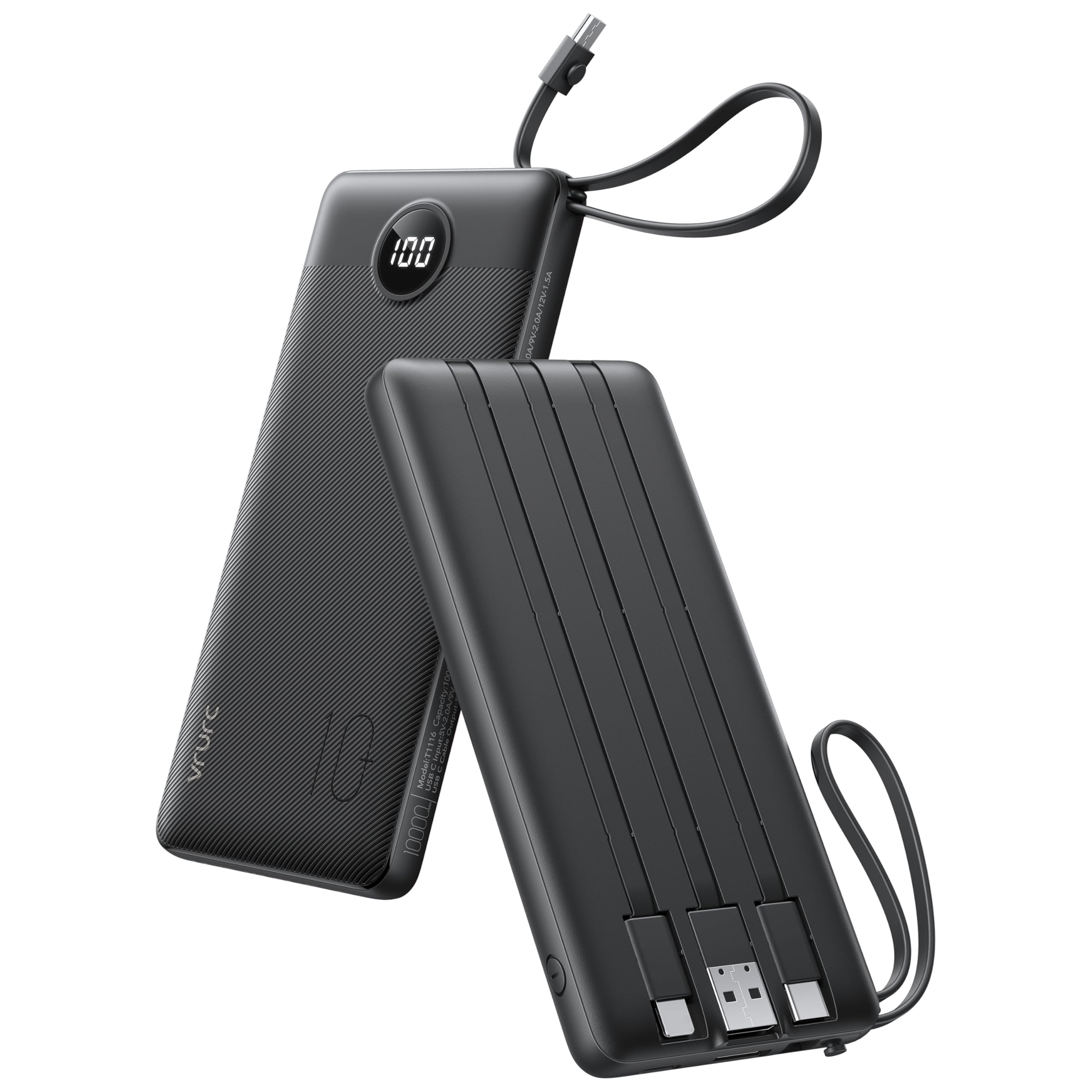
The lanyard and the little travel pouch are what separate this bank from a stack of look-alike four-cable models. Hang it off a daypack's strap and it rides outside the bag, which means you actually use it on a walking day instead of remembering it at the hotel.

The 37 watt-hour figure is the clearest airline statement in this group: it's the number security staff look for, and it sits comfortably under the 100Wh ceiling most carriers apply. Four built-in cables, covering USB-C, Lightning, micro-USB and USB-A, feed up to five devices, a display shows what's left, and a full recharge of the bank takes about six hours.

The cable set earns its place on the awkward devices: micro-USB for an old e-reader or a camera, USB-A for the friend who forgot theirs. Six hours to refill is the other thing to plan around, so plug it in when you get back to the room rather than when you leave in the morning.

Our view is that the pouch and the lanyard earn it a spot for walking days and festival weekends, where you want power on the outside of the bag and 20 minutes of charging at a time is the whole ask. For anything longer, the 12W ceiling makes it the wrong tool and the faster banks here are worth the extra ounces.

Pros

  • Printed 37Wh rating, clearly under carrier limits
  • Four built-in cords plus a charge display
  • Lanyard and travel pouch included
  • Up to five devices at once

Cons

  • 12W output limits it to slow top-ups
Our verdict

A backpack-friendly bank with a printed 37Wh rating and four built-in cords, best as a top-up charger rather than a fast one.

Check Latest Price

How We Tested the Best Travel Chargers

We started by pulling together the travel chargers that show up most often in traveler forums and retail best-seller lists, then narrowed the field by capacity, weight, price, and whether the built-in cable was actually integrated rather than a loose dongle. We eliminated models with proprietary cables, vague capacity claims, or a history of reliability complaints. That left 12 chargers, which we tested over eight months.

Each charger went on real trips: airport layovers, train commutes, weekend hikes, and hotel rooms with exactly one free outlet. We carried them in jacket pockets, tote bags, and carry-ons, and we noted whether the size felt pocketable or just packable. We weighed every model on a kitchen scale and compared that number with the capacity it promised.

For performance, we drained two phones to zero, plugged in, and timed how long each charger took to reach 50% and 100%. We also counted how many full phone charges each battery delivered before dying, and whether it held that charge between trips. To check reliability, we left each one in a hot car for an afternoon and ran it through at least ten charge cycles.

For durability, we dropped them from waist height onto concrete, stuffed the built-in cables back into their slots, and looked for fraying or loose connections. We compared price against capacity and real-world charge count to judge value, and we paid attention to whether a charger got too warm to hold while the phone was still charging. The ones that rose to the top stayed fast after repeated use, slipped into a pocket without a fight, and didn't make us hunt for a cable.

How to Choose Portable Chargers for Travel

Start With Charges, Not Milliamp-Hours

Every 10,000mAh bank here is quoted at roughly two phone charges, and in practice you'll see less. Converting the cell's 3.7 volts to the 5 volts a phone wants loses energy along the way, and a phone working hard on a cold platform or a hot beach charges more slowly again. Treat the quoted figure as a ceiling rather than a promise.

For a weekend or a day bag, 10,000mAh is the right size. For a week with a tablet in the mix, the 15,000mAh HELLEE is the step up that doesn't become a brick; 20,000mAh belongs to laptops and long-haul itineraries.

The 100Wh Line Decides What Flies

Power banks go in the cabin, never in checked luggage, and most airlines draw the line at 100 watt-hours, which is roughly 27,000mAh. Anything from 100 to 160Wh needs carrier approval; above that, it doesn't fly.

The trap is the phrase airline approved on a listing, which means nothing at security, where staff look for the Wh figure printed on the case. Check that number before you pack. Everything here sits comfortably under the ceiling, and the VRURC states its 37Wh outright, so there's no arithmetic to do at the gate.

Watts Are What Fast Actually Means

A bank can only charge as quickly as its output ceiling allows, and the gap across this group is wide: 12W at one end, 87W at the other. Match the bank to the device you're actually carrying. A phone that accepts 25W fast charging is wasted on a 12W bank, a tablet wants 30W or more, and a laptop only really works with the 65W the Anker 20,000mAh can send down a single port.

If a listing says fast charging with no wattage attached, assume the lower number.

Count the Cables You Actually Need

Built-in cables are the most useful travel feature in this category: nothing to forget, nothing to untangle, nothing lost under a seat. The right number depends on your party. One phone and a pair of earbuds are covered by a single built-in USB-C cable, as on the Anker Zolo. Two people with different phones, or a camera and an e-reader along for the ride, justify four cables, which is why the Charmast and the HELLEE suit families.

The trade is that a built-in cable which fails takes the whole bank with it, so weigh the warranty alongside the connector count.

Recharge Speed Is the Spec Nobody Checks

How fast a bank refills decides whether it's ready for day two, and it's the number shoppers skip. A 20W input on a 10,000mAh bank means an evening top-up covers you; a six-hour trickle means plugging in the moment you get back to the room.

If you change hotels nightly, weigh the input side as heavily as the output. If you stay put for a week, a foldable AC plug like the AIFENG's takes the wall charger out of your bag altogether.

Frequently Asked Questions

Final Verdict

The Anker Zolo is the bank we recommend to most travelers. Thirty watts, a built-in USB-C cable and a body that slips into a jacket pocket cover a phone-first trip better than anything else we tested, and the input speed means it's ready again the next morning.

Two requirements change the answer. If a laptop comes along, the 87W Anker carries that load and nothing else here does. If you're flying carry-on only and counting every adapter, the AIFENG's foldable plug earns its thicker body.