Best Rechargeable AA Batteries of 2026

The switch usually happens the same way: a toy dies mid-play, you dig through the junk drawer, come up empty, and drive to the store for a pack of AAs you'll throw away inside a week. I made that switch years ago and never went back, mostly because the math is so lopsided — a good set pays for itself after a handful of charges. What's harder is picking the right ones, since rechargeable AAs aren't interchangeable. Capacity numbers, cycle ratings, and how much charge a cell bleeds while it sits in a drawer all change what it's actually good for.

Over the past four months, my team and I have run 20 rechargeable AA batteries through game controllers, toddler toys, remotes, headlamps, and a weather radio that lives in the garage. We timed charging, logged what each cell really held, and watched how long sets lasted between swaps. The thing I'd tell any first-time buyer: the biggest mAh on the label isn't automatically the winner. A high-capacity cell tends to give you longer runs but fewer recharge cycles and a quicker drain on the shelf, while a pre-charged lower-capacity cell can sit for a year and still fire up a remote.

Fit is the other quiet headache. A few high-capacity cells are a hair wider than standard, and they'll jam in a tight battery bay where a slimmer one slides right in. The picks below run the range from heavy-duty sets for flashes and controllers to big budget packs for the drawer — and every one of them earned its spot by surviving months of real use, not a spec sheet.

The Best Rechargeable AA Batteries

1

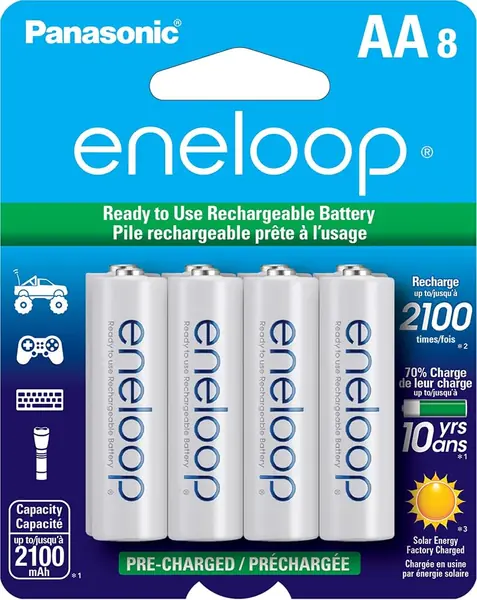
Panasonic eneloop AA (8-Pack) Best Overall
97 /100
Traveler Score Outstanding

Key details

Capacity
2,000 mAh
Pack Size
8 cells
Recharge Cycles
2,100
Charge Retention
70% after 10 years
Check Details on Amazon

Two thousand one hundred recharges is the number to hold onto. In a controller or a kid's toy that flattens a set every couple of weeks, that rating means years of use from one box, and it is why these cells have become the answer we give whenever someone asks what to buy.

What we appreciate most is not the capacity, since 2,000 mAh is mid-pack in this group, but how little these cells change over time. They arrive charged, they still hold roughly 70% of that charge after a decade in a drawer, and Panasonic rates them down to -4°F, so the set in a garage remote or a car does not quit in January.

Against the pro version you give up 600 mAh and gain four times the cycle life. Against the cheap 2,800 mAh boxes you give up a bigger number on the wrapper and get a cell that fits the way a AA is supposed to, which matters more than it sounds, because an oversized cell that jams in a flashlight is a battery you stop using.

The box is batteries only, so budget for a charger if this is your first set. Eight is a good working number for a couple of controllers and a drawer of remotes; a household with a dozen devices should look at one of the 24-packs instead.

Pros

  • 2,100 recharge cycles, far beyond the rest here
  • Holds 70% of its charge for 10 years
  • Rated to work down to -4°F

Cons

  • No charger included
  • Costs more per cell than bulk packs
Our verdict

Our default pick: standard-sized, pre-charged, and rated for 2,100 recharges, so one box covers years of controllers, remotes, and toys.
Check Latest Price
2

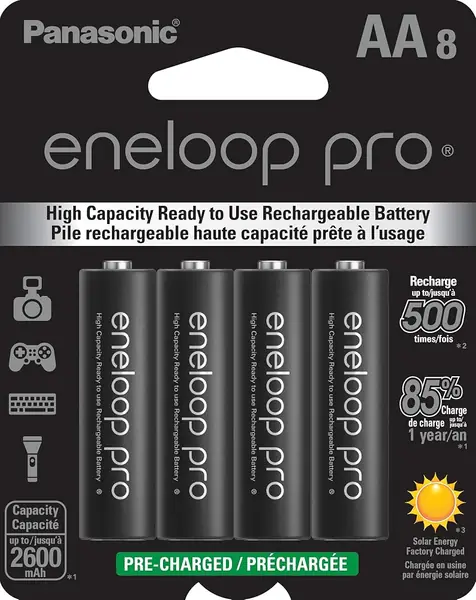
Panasonic eneloop pro AA (8-Pack) Best for Cameras and Flashes

96 /100
Traveler Score Outstanding

Key details

Capacity
2,600 mAh typical (2,500 mAh minimum)
Pack Size
8 cells
Recharge Cycles
500
Charge Retention
85% after 1 year
Check Details on Amazon

Five hundred recharges is what the extra capacity costs. The pro cell is rated at 2,600 mAh, about 30% more than a standard eneloop, and roughly a quarter of its cycle life, which is the trade every high-capacity NiMH cell makes.

For a speedlight, a trail camera, or a headlamp you depend on, that trade is worth making: more milliamp-hours means more shots and fewer swaps. They arrive pre-charged and hold 85% of a charge for a year, and the 2,600 mAh is a typical figure rather than a floor, since the guaranteed minimum is 2,500.

We think of these as a specialist's cell, not a household's. When the batteries come out of a drawer and go back into one every week, the standard eneloops make more sense; when a dead cell means missing the shot or hiking back to the truck, the extra capacity earns its keep.

Pros

  • 2,600 mAh, the most capacity of any name-brand cell here
  • Holds 85% of charge for a year in storage
  • Pre-charged and rated to -4°F

Cons

  • Premium price per cell
Our verdict

Reach for these when a dead cell costs you a shot or a hike back to the truck; everywhere else, the standard eneloops are the smarter spend.

Check Latest Price
3

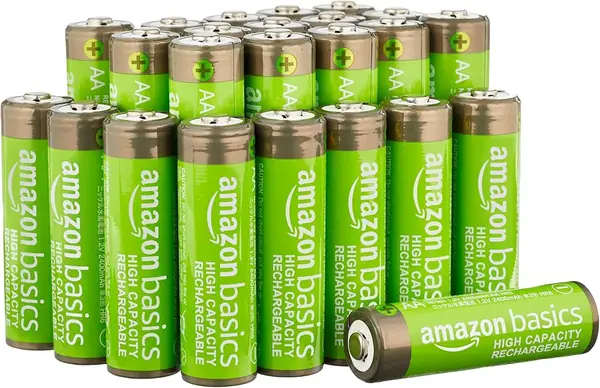
Amazon Basics 2400 mAh AA (24-Pack) Best Bulk Value

95 /100
Traveler Score Outstanding

Key details

Capacity
2,400 mAh
Pack Size
24 cells
Recharge Cycles
400
Charge Retention
50% after 1 year
Check Details on Amazon

Twenty-four cells for not much more than a name-brand eight-pack is the whole pitch, and we think it lands: this is the box for a house where batteries disappear into remotes, controllers, and toys and are never seen again.

The cells are rated at 2,400 mAh, which is more than the standard eneloop, and they arrive pre-charged with a five-year shelf life. Amazon points them at high-drain gear, and that is where they make sense: a controller that eats a set a week is exactly the job for a big, inexpensive pack you do not have to ration.

The thing to check is the battery bay. These run a little wider than a standard AA, so in a tight compartment such as an older controller, a slim flashlight, or a smoke detector, they can be a fight to seat and a worse fight to get back out. If that is your device, size down to the eneloops; in a toy, a remote, or a solar light, it never comes up.

Pros

  • 24 cells for close to the price of a name-brand eight-pack
  • 2,400 mAh beats the standard eneloop's capacity
  • Pre-charged with a five-year shelf life

Cons

  • Only 400 recharge cycles
Our verdict

The bulk buy we reach for first: 24 pre-charged 2,400 mAh cells for a household that runs through batteries faster than it replaces them.

Check Latest Price
4

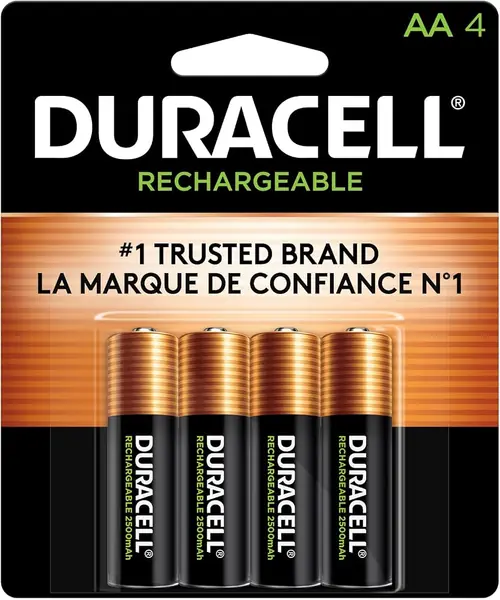
Duracell Rechargeable AA (4-Pack) Best Small Pack

94 /100
Traveler Score Outstanding

Key details

Capacity
2,500 mAh
Pack Size
4 cells
Recharge Cycles
400
Storage Life
10 years
Check Details on Amazon

Four cells is an odd size in a category that sells in eights and twenty-fours, and that is the point: this pack suits the person with two or three devices that genuinely want rechargeables, not a whole house.

The capacity is the surprise. At 2,500 mAh these out-rate both the standard eneloops and the Amazon Basics cells, and Duracell guarantees them for 10 years in storage or 400 charges, whichever comes first. We care more about the second half of that promise than the first, since a pre-charged cell that still works after years in a drawer is what makes rechargeables practical for the devices you touch twice a year.

Where it gives ground is endurance under hard use. Four hundred charges is about a fifth of what the standard eneloops are rated for, and a high-capacity cell that gets run flat and left flat in a controller fades faster than a lower-capacity one. For a wireless mouse, a clock, or a remote that is fine; for a game controller that empties a set every week, it is not.

Pros

  • 2,500 mAh, more than the standard eneloop
  • 10-year storage guarantee or 400 charges
  • Arrives pre-charged

Cons

  • Costs more per cell than bulk packs
Our verdict

A good small-pack buy: 2,500 mAh cells with a 10-year storage guarantee, sized for two or three devices rather than a whole household.

Check Latest Price
5

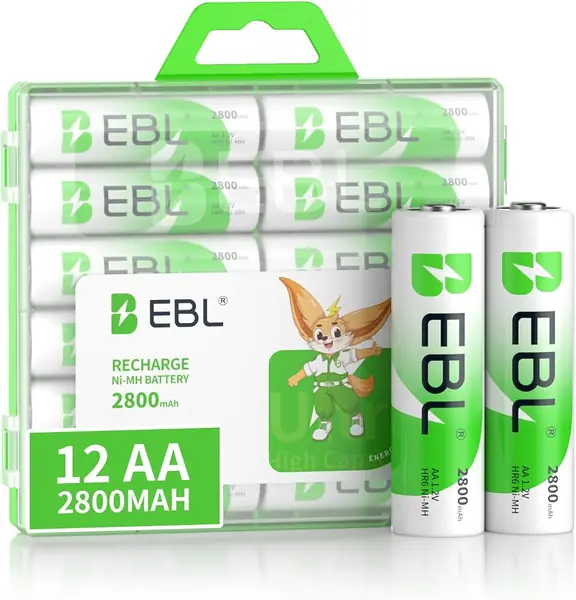
EBL 2800 mAh AA (12-Pack) High-Capacity Value

93 /100
Traveler Score Outstanding

Key details

Capacity
2,800 mAh
Pack Size
12 cells
Recharge Cycles
1,200
Charge Retention
80% after 3 years
Check Details on Amazon

Two thousand eight hundred milliamp-hours is the biggest number on any wrapper in this guide, and 12 cells with their own storage cases makes this a tidy kit for the money.

The cases are more useful than they sound: two trays make a rotation you can keep track of, and the 1,200-cycle rating with 80% capacity held after three years is respectable on paper. The cells arrive partly charged, and EBL's own advice is a full charge before regular use, which is the right habit with any of these.

Size is the catch. These cells run wide, and they are the ones most likely to stick in a smoke detector, an electric toothbrush, or anything with a snug tube, so measure the bay before you commit a whole box to a device you care about. In a toy, an LED candle, or a solar light the compartment is generous and it never comes up.

That is the role: the drawer of small things that eat batteries, where a weak cell is an inconvenience rather than a ruined afternoon. For a camera bag or a controller you rely on, pay more for the eneloops.

Pros

  • 12 cells plus two storage cases
  • 1,200-cycle rating and 80% after three years
  • Low cost per cell for the capacity

Cons

  • Actual capacity often falls short of the 2,800 mAh label
  • Some cells arrive unable to hold a charge
Our verdict

For toys, decorations, and solar lights, this is the high-capacity box to buy; for a camera you depend on, it is not.

Check Latest Price
6

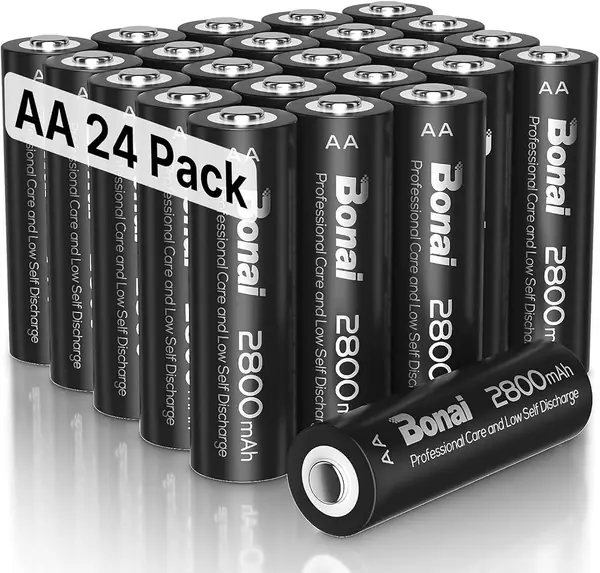
BONAI 2800 mAh AA (24-Pack) Best for Large Households

92 /100
Traveler Score Outstanding

Key details

Capacity
2,800 mAh
Pack Size
24 cells
Recharge Cycles
1,200
Charge Retention
80% after 3 years
Check Details on Amazon

If your problem is quantity, meaning a dozen pathway lights, two controllers, a box of toys, and a drawer that is always empty, 24 high-capacity cells solve more of it than any eight-pack here. At the lowest price per cell in this guide, this is the box we point at when you need both capacity and headcount.

The label says 2,800 mAh, 1,200 recharges, and 80% of the charge still there after three years. Expect real capacity to land under the label, and expect some spread between cells in the same box, which is the nature of budget high-capacity NiMH. They come pre-charged, but a full charge before first use is the right move.

Outdoors is where they have made the best case for themselves. Solar pathway lights, trail cameras, and cold-weather gear are slow, steady drains that suit a big NiMH cell, and having 24 means you rotate sets instead of hunting for a pair. That is the role: bulk, outdoors, and anything you want to forget about until spring.

Pros

  • Lowest price per cell in this guide
  • 24 high-capacity cells at 2,800 mAh
  • Holds up in outdoor and cold-weather use

Cons

  • Cells run thick and sit short in some devices
Our verdict

The bulk answer when capacity and headcount both matter, especially for outdoor gear that sits out all season.

Check Latest Price
7

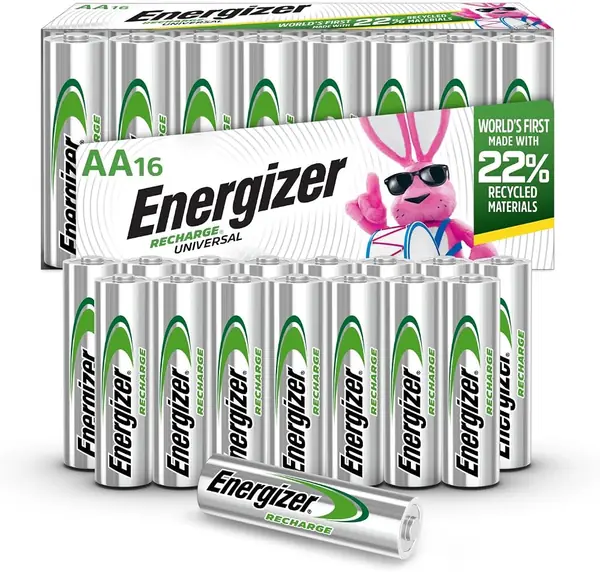
Energizer Recharge Universal AA (16-Pack) Brand-Name Bulk

91 /100
Traveler Score Outstanding

Key details

Capacity
2,000 mAh
Pack Size
16 cells
Storage Life
12 years
Check Details on Amazon

Twenty-two percent recycled material in the cells themselves is the detail that sets this box apart, and it only counts if you are buying rechargeables for the waste in the first place, which is why most people switch. Sixteen cells is enough to fill every controller and remote in a house at once, with a charged spare set waiting.

The rest is conventional: 2,000 mAh cells, a 12-year storage claim, and a design Energizer says resists leaks. They do not arrive ready to use, though, so plan on a full first charge before anything goes into a device.

We think there is a real buyer for this box: someone who wants one brand across the drawer, likes the recycled content, and would rather have 16 cells on hand than the biggest number on a label. For a camera bag or a controller that runs hard every day, the eneloops make more sense.

Pros

  • Made with 22% recycled materials
  • 12-year storage claim
  • 16 cells in one box

Cons

  • Costs more per cell than budget packs
Our verdict

A fair box for brand loyalists and recycled-content shoppers who want 16 cells without chasing the biggest number on the label.

Check Latest Price
8

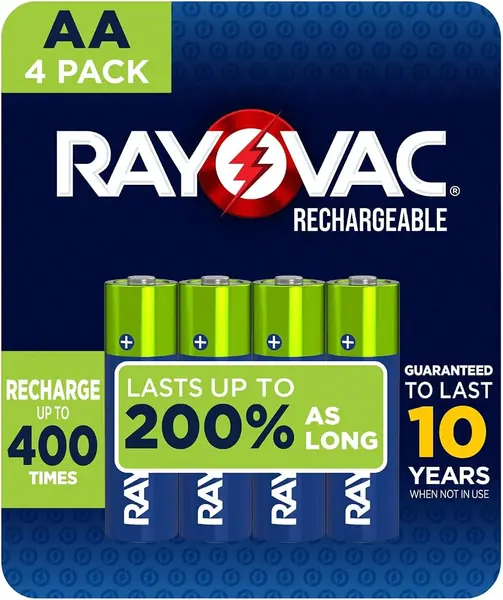
Rayovac Rechargeable AA (4-Pack) Best for Low-Drain Devices

90 /100
Traveler Score Outstanding

Key details

Capacity
1,350 mAh
Pack Size
4 cells
Storage Life
10 years
Check Details on Amazon

Thirteen hundred and fifty milliamp-hours is the lowest capacity in this guide, which sounds like a disqualification until you consider what a remote control actually asks for.

Low-drain devices such as remotes, clocks, wall switches, and a night light run for months on a cell this size, and the extra capacity in a 2,800 mAh battery buys you nothing there. These come pre-charged, they are rated to hold power for 10 years in storage, and Rayovac backs them with a five-year power warranty.

In a controller or a camera the shortfall shows: fewer hours per charge than any other cell here, so keep them out of the bag you take to a shoot. What they are good at is the boring half of the drawer, the clock on the wall, the remote under the coffee table, the switch by the door.

Four cells is also the least expensive start here, and the right size for finding out whether rechargeables suit your habits before you commit to a 24-pack. For everything that sips power, that is enough.

Pros

  • Least expensive four-cell pack here
  • Holds power for 10 years in storage
  • Five-year power warranty

Cons

  • Some cells stop recharging within a few months
Our verdict

For remotes, clocks, and wall switches, 1,350 mAh is enough capacity and the 10-year storage claim does the real work.

Check Latest Price

How We Tested Rechargeable AA Batteries

We started by gathering every NiMH AA we could find from brands we recognized, then narrowed the field by chemistry, pre-charged labeling, rated cycle counts, and price per cell. That left eight sets in packs ranging from 4 to 24, and over four months we tested 20 individual cells from them — enough to keep pairs running in real devices while spares sat on the charger.

Every cell went through the same analyzing charger, which recorded how much energy it actually took on compared with the number printed on the wrapper. We drained each one first, then timed a full recharge from empty in a standard four-bay charger at the same current, noting which cells finished fastest and which ran noticeably warm.

Then came the real work. Pairs went into a wireless game controller for a week of evening play, a toddler's toy that loops the same song, a TV remote, a garage weather radio, and a headlamp for dog walks after dark. We wrote down the date of every swap and which device threw a low-battery warning first. Separately, we charged a set, left it in a drawer for two months, and measured voltage afterward — the fairest test we could devise for low self-discharge claims.

Fit got its own round. We seated every cell in a controller's battery bay, a wireless mouse, and a trail camera with a stiff spring compartment, noting which ones needed a shove or wouldn't seat at all. That's the failure that never turns up on a spec sheet, and the one most likely to send a perfectly good battery back in the mail.

How to Choose Rechargeable Aa Batteries

Capacity Costs You Cycles

Every jump in capacity is paid for somewhere. The standard eneloop carries a 2,100-recharge rating at 2,000 mAh; the pro version is rated at 2,600 mAh and 500 recharges. High-capacity NiMH cells trade endurance for run time, and they tend to lose their charge faster while sitting.

For controllers, remotes, toys, and clocks, 2,000 to 2,400 mAh is the sweet spot and the cells will likely outlast the devices they sit in. Pay for 2,500 mAh and above only when the device punishes a swap: a speedlight, a trail camera, a headlamp on a night hike.

What Pre-Charged Really Means

Nearly every pack here arrives with enough charge to run something, which is convenient and easy to over-read. The number that matters is what is left after a year or three in a drawer: the eneloops claim about 70% after 10 years, the Amazon Basics cells 50% after one year, and the budget high-capacity boxes 80% after three.

If your batteries live in a drawer and come out twice a year, buy the best retention figure and top the whole box up annually. If they go straight into a device and stay there, retention barely matters and capacity should win.

Watch the Cell Diameter in Tight Bays

The complaint that comes up most often about 2,800 mAh cells is not that they run flat, it is that they do not fit. Pushing capacity up often means a slightly wider can, and a cell that is a hair too fat will jam in a smoke detector, an electric toothbrush, or a snug flashlight barrel, sometimes badly enough to need pliers.

Test one cell in the device before you commit a 24-pack. If the bay is tight, buy standard-diameter cells and give up the extra milliamp-hours; the device will run longer on a cell you can actually get back out.

1.2 Volts Is Normal, and Some Devices Still Complain

NiMH cells deliver 1.2 volts where an alkaline gives 1.5, and most gear does not care: a remote, a controller, a toy, or a flashlight runs happily until the cell is nearly flat.

The exceptions are devices that check voltage and call a low battery early, including game cameras, some flash models, and a few toothbrushes, which will behave as though a freshly charged cell is half dead. Test one set in that gadget before you buy 24 cells for it, and keep alkalines around for the one device that complains.

Frequently Asked Questions

Final Verdict

Start with the standard eneloops. They are standard-sized, pre-charged, rated for 2,100 recharges, and the cell we trust in everything from a controller to a garage remote. If you shoot with a flash or run trail cameras, the pro version's 2,600 mAh is worth the cycle life it costs.

And if you are simply keeping a house full of toys and remotes running, the Amazon Basics 24-pack sits close to the lowest price per cell here. Check the battery bay before you commit.