Best Monoculars of 2026

Every monocular box leads with a big number, and that number is the least useful thing on it. A 16x stamp means nothing if the glass behind it turns a warbler at forty feet into gray soup, and the higher the magnification climbs, the harder it is to hold steady. What you actually want is a bright, sharp image you can raise with one hand and hold for the ten seconds before the bird moves.

I've been carrying twelve of them for nine months — on dawn bird walks, on weekend hikes, and on a whale-watching boat where the deck pitched under me the whole time. What separated the keepers from the ones I quietly left at home wasn't magnification at all. It was focus.

A smooth, fingertip-light focus wheel that settles quickly beats a stiff one every time, and an eyecup that twists up for bare eyes and down for glasses decides whether you'll actually use the thing. The picks below are the ones that earned a permanent spot in a jacket pocket rather than a gear drawer.

The Best Monoculars

1

Vortex Solo 10x25 Best Overall
91 /100
Traveler Score Outstanding

Key details

Magnification
10x
Objective Lens
25 mm
Weight
5.6 oz
Field Of View
107.14 feet
Check Details on Amazon

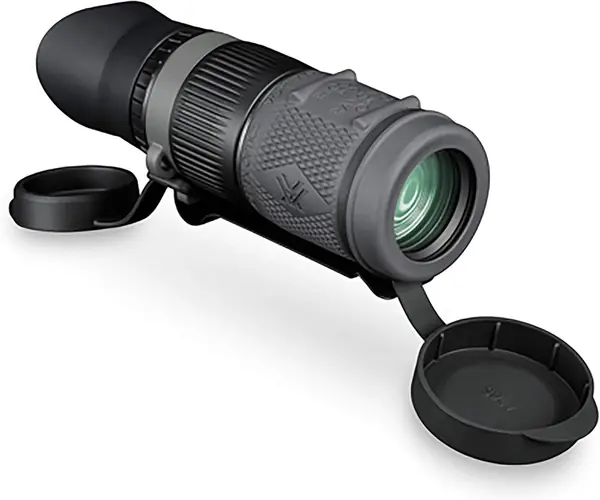
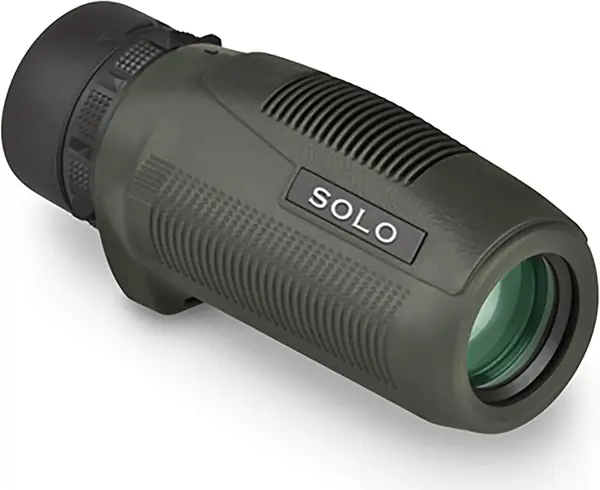
At 5.6 ounces and 4.4 inches long, the Solo is the monocular that actually leaves the house. It slides into a jacket pocket or the lid of a daypack and stays out of the way until something moves in the hedge, which is the whole reason to carry one barrel instead of two. That portability is why it's our top pick: nothing else here pairs this little weight with a view this usable.

The specification is modest and honest — 10x magnification, a 25 mm objective, a listed 107-foot field of view — with fully multi-coated lenses, rubber armor, and nitrogen purging with O-ring seals for waterproof, fogproof performance. We value sealing on a scope this small more than we value another fraction of magnification, because it means rain, spray and a dusty pack don't end the walk. A lanyard and a soft case come in the box.

Focus is the one part that asks for patience. The ring is firm, so you brace the barrel with one hand and turn with the other rather than trying to do both in the same grip. Once it's set for your eye, most of a stroll stays sharp, and the adjustable eyecup works with or without glasses.

Where the Solo gives ground is light. A 25 mm objective and a 2.5 mm exit pupil are daylight tools, and the image flattens in the last twenty minutes before dark. If that's when you glass, the 42 mm Bushnell below is the better instrument. For everything else, this is the one that's always in the pocket.

Pros

  • 5.6 ounces and genuinely pocketable
  • Waterproof, fogproof and rubber armored
  • Unlimited, transferable lifetime warranty

Cons

  • 25 mm objective fades in low light
Our verdict

Our default pick: light enough to forget in a pocket, sharp enough for birds at the feeder, and backed by a warranty that covers damage, not just defects.
Check Latest Price
2

Bushnell Legend 10x42 Ultra HD Best for Low Light

90 /100
Traveler Score Outstanding

Key details

Magnification
10x
Objective Lens
42 mm
Weight
13.2 oz
Glass
ED Prime with ultra wide band coating
Check Details on Amazon

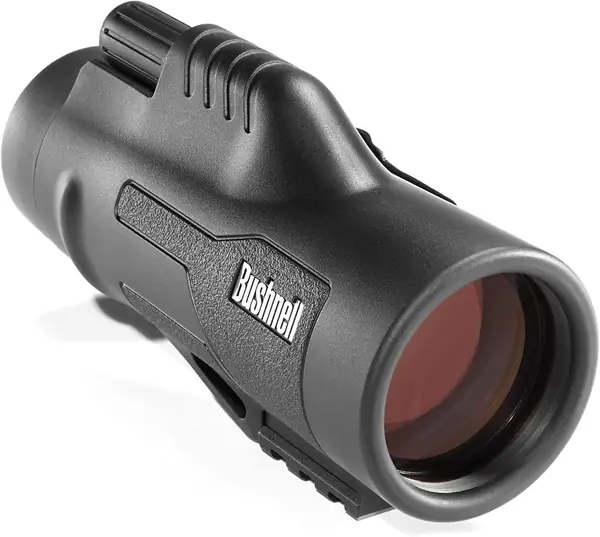
A 42 mm objective behind a 10x eyepiece works out to a 4.2 mm exit pupil, and that figure is why the Legend is the one we hand people who glass at dawn. With ED Prime glass and Bushnell's ultra wide band coating, it produces the sharpest, most color-true image in this set — edges stay clean, and a dark feather stays dark brown instead of turning to mud.

The rest of the package is built for the field. A fast focus knob you can work with one hand, a twist-up eyecup, a tripod mount for steady work, and an O-ring-sealed, rubber-armored housing rated waterproof and fogproof. The 340-foot field of view is generous for a 10x, which matters when a bird flushes and you have to find it again. We think the optics justify the price for anyone who takes glassing seriously.

What you pay is weight. At 374 grams it's a jacket-pocket optic, not a shirt-pocket one, and it swings on a lanyard in a way the 5.6-ounce Vortex doesn't. The jump in brightness and resolution over a 25 mm scope is obvious the moment you look through both, so the trade is easy to make if your outings run into dusk or across open country.

Pros

  • ED Prime glass gives the best low-light image here
  • Fast focus knob and tripod mount
  • Sealed against rain and fog

Cons

  • 374 grams swings heavily on a lanyard
Our verdict

The best view in this group, especially at dusk: 42 mm of ED Prime glass makes the Legend worth its weight for anyone who glasses in low light.

Check Latest Price
3

Nocs Provisions Zoom Tube 8x32 Best for Travel

89 /100
Traveler Score Excellent

Key details

Magnification
8x
Objective Lens
32 mm
Weight
8 oz
Water Resistance
IPX4
Check Details on Amazon

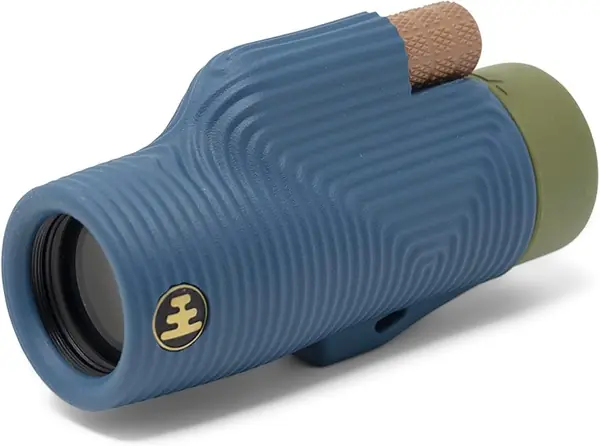
The Zoom Tube looks like something you'd clip to a backpack rather than lock in a case — rubberized, brightly colored, sealed to IPX4 for drizzle, spray and a wet hand-off. That finish isn't decoration. A monocular you aren't afraid to use is a monocular you actually use, and this one has spent more time hanging off a shoulder strap than any other scope here.

Inside is an 8x32 configuration with BaK-4 prisms, fully multi-coated lenses, a 384-foot field of view, and a three-position twist-up eyecup that suits glasses as well as bare eyes. It weighs 8 ounces, focuses with a center wheel, and has a tripod mount underneath. The No-Matter-What lifetime warranty is the kind of promise that makes sense on gear aimed at hikers.

We noticed the wide view most when following a bird through branches: at 8x there's simply more to see around the target, and the image sits steadier in the hand than any 10x here. That's the trade — less reach across a lake or a canyon, more comfort in the woods. For a trip that's mostly walking, this is the scope that comes along.

Pros

  • Wide 384-foot field of view at 8x
  • Sealed, rubberized body that travels easily
  • Smooth center focus and lifetime warranty

Cons

  • 8x gives up reach at long distance
  • IPX4 is splash resistance, not submersible
Our verdict

Pack this one for a hiking trip: sealed, wide, easy to focus one-handed, and bright enough that 8x never feels like a compromise.

Check Latest Price
4

Vortex Recce Pro HD 8x32 Best for Hunters and Shooters

88 /100
Traveler Score Excellent

Key details

Magnification
8x
Objective Lens
32 mm
Length
6.18 inches
Reticle
MRAD with ranging silhouettes
Check Details on Amazon

The reticle is the reason this scope exists. A mil-based grid with quick-ranging silhouettes lets you estimate distance and hold for it without digging out a rangefinder, and a separate reticle focus keeps the markings crisp while the image stays sharp. Nothing else on this page does that, and it's what separates a hunting tool from a viewer.

The glass isn't an afterthought: high-density extra-low dispersion elements with XR anti-reflective coatings, a flared eyecup that blocks side light, and Armortek coatings that resist scratches, oil and fingerprints. For a 32 mm objective with a 4 mm exit pupil it's bright and clean, and we found the edges far better controlled than the cheaper scopes here.

Carry is sorted too — a utility clip that grabs pack webbing or a pocket edge, a MOLLE/PALS-compatible pouch, textured rubber armor, and full waterproof, fogproof sealing. The large focus wheel is easy to find with gloves on. It's a specialist's optic, and it's priced like one, but nothing about the build feels like a compromise.

Pros

  • MRAD reticle with quick-ranging silhouettes
  • HD ED glass with XR and Armortek coatings
  • Utility clip and MOLLE pouch for carry

Cons

  • Focus wheel is stiff when new
  • Reticle is clutter if you only want a clean view
Our verdict

If you range targets, the Recce Pro earns its price: an MRAD reticle, HD glass and a utility clip that keeps it on your chest rig, all under a lifetime warranty.

Check Latest Price
5

Pankoo 16x52 Monocular Best Budget

87 /100
Traveler Score Excellent

Key details

Magnification
16x
Objective Lens
52 mm
Field Of View
5.8 degrees
Exit Pupil
3.25 mm
Check Details on Amazon

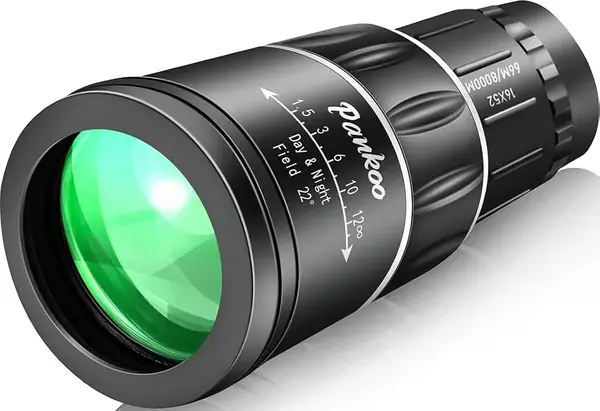
Sixteen power for a fraction of what the brand-name scopes cost is the pitch, and the Pankoo mostly delivers. The 16x52 view is bright and punchy in daylight, with enough reach to pick a sparrow out of a hedge at the far end of a field. It's the least expensive scope we're comfortable recommending to someone who isn't yet sure how often they'll use one.

For the money the build is generous: a BaK-4 prism, multi-coated lenses, a nitrogen-filled body rated waterproof, fogproof and shockproof, a 5.8-degree field of view and a 3.25 mm exit pupil. You also get a hand strap, a velvet bag, a cleaning cloth and a gift box. That's more packaging than optics, but the scope itself feels solid in the hand rather than hollow.

Two things to know going in. At 16x, small hand movements turn into big jumps in the image, so plan to brace on a railing, a tree or a knee. And the 6.7-inch barrel is a pack item, not a pocket one. Neither bothers us at this price — this is the scope we pass to a kid or a new birder and don't worry about.

Pros

  • Bright 52 mm objective for the money
  • Waterproof, fogproof and shockproof body
  • Complete kit with strap, bag and cloth

Cons

  • 16x needs a rest to stay steady
  • 6.7-inch barrel is too long for a pocket
Our verdict

We point first-time buyers here: bright, well-sealed 16x glass at the lowest price in this roundup, and the right place to start if you're unsure.

Check Latest Price
6

Celestron Nature 10x25 Budget Name Brand

86 /100
Traveler Score Excellent

Key details

Magnification
10x
Objective Lens
25 mm
Weight
6 oz
Field Of View
5.8 degrees
Check Details on Amazon

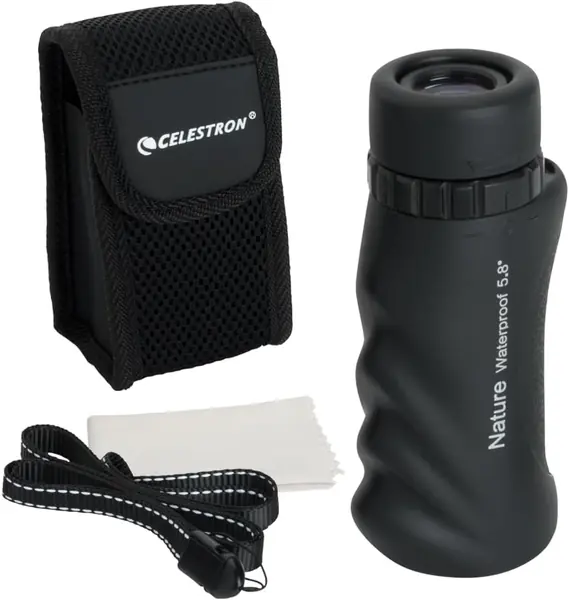
Celestron backs the Nature with a limited lifetime warranty, and on a small scope that gets knocked around in a glove box, that promise is worth more than a marginal gain in glass. At 170 grams with a 10x25 configuration and BaK-4 prisms, it does the basic job: a compact viewer for the backyard feeder, the ballgame or the far side of a field.

The body is rubber-armored polycarbonate, waterproof and nitrogen-purged against internal fogging, with a twist-up eyecup that works for glasses and a 5.8-degree field of view. Multi-coated optics put it a step behind the fully multi-coated Vortex on contrast, though in good light the gap is smaller than the price difference suggests.

Where it stumbles is the focus ring, tight enough that fine adjustment takes a deliberate two-finger turn, and the 2.5 mm exit pupil makes eye placement fussy if you wear glasses and leave the eyecup up. Line your eye up properly and the view is clean and sharp for a 25 mm lens — we just found ourselves adjusting more often than with the Solo.

We see the Nature as a sensible second choice rather than a first one. It's a known name with real sealing and a real warranty, and it will serve a casual user for years. But the Vortex Solo is lighter, better coated and covered by a stronger promise for not much more, which is why it sits below the top tier here.

Pros

  • Limited lifetime warranty
  • Waterproof, nitrogen-purged and rubber armored
  • Glasses-friendly twist-up eyecup

Cons

  • Multi-coated rather than fully multi-coated
Our verdict

A dependable 10x25 with a limited lifetime warranty and honest sealing that suits a glasses wearer who wants a known brand without paying much.

Check Latest Price
7

PhysioPhyx 80x100 Monocular Best for Phone Digiscoping

85 /100
Traveler Score Excellent

Key details

Magnification
80x
Objective Lens
8 cm
Included
Tripod and smartphone adapter
Body Size
6.65 x 2.99 x 3.99 inches
Check Details on Amazon

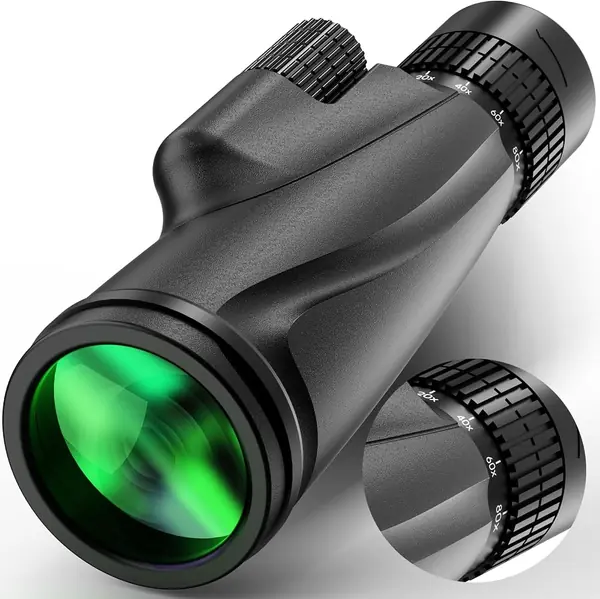
You're buying a kit here: a monocular, a retractable tripod, a smartphone adapter, a hand strap, lens covers, a storage bag and a manual. The phone holder is the interesting part — clamp a phone to the eyepiece and the scope becomes a long lens for stills and video, with the tripod keeping the frame steady enough to be worth watching.

The body runs about 6.65 inches, with an 8 cm objective and the company's BaK-4 prism and multi-layer coating claims. It's light enough to carry in a pack, and it arrives with everything needed to set up on a deck rail or a windowsill, which is realistically where a scope this size gets used.

The 80x100 figure on the box is where we get cautious. A body this size pushed to 80x produces a dim, jittery image, and the tripod stops being an accessory and becomes the way the scope works. Planted on a fixed view with a phone attached, it's a lot of entertainment for the money. Hand-held at high zoom, it isn't.

So we recommend it for one specific job: watching a nest, a feeder or a hillside from a single spot while grabbing photos. For a scope that goes in a pocket and comes out mid-walk, put the same money into a 10x with better glass — the difference shows up the first time you try to follow a moving bird.

Pros

  • Tripod and smartphone adapter included
  • Compact body for a large-objective scope
  • Simple phone setup for photos and video

Cons

  • Labeled 80x is optimistic at this size
  • Awkward to hand-hold at high zoom
Our verdict

Buy it as a phone-scoping kit for a fixed viewpoint, not as the pocket monocular its size suggests; the bundle is the appeal, not the 80x label.

Check Latest Price
8

Barska Lucid View 10x25 Glove Box Spare

76 /100
Traveler Score Very Good

Key details

Magnification
10x
Objective Lens
21 mm
Weight
3.88 oz
Coatings
Fully coated
Check Details on Amazon

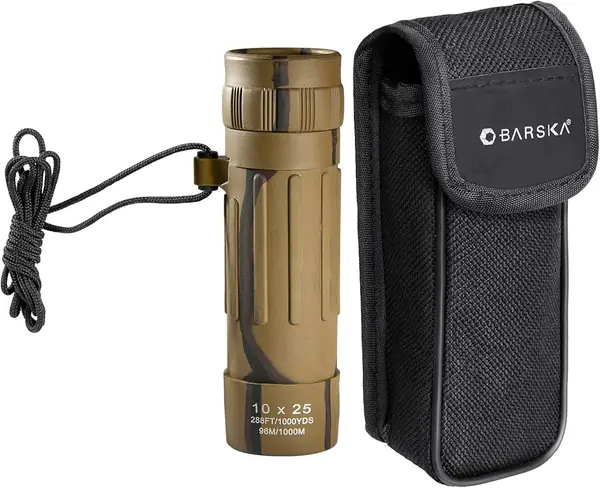
The name says 10x25, but the specification lists a 21 mm objective, which tells you how much this one trades away to hit its price. The optics are fully coated rather than fully multi-coated and the roof prism is BK7 rather than BaK-4, so contrast and edge sharpness sit a step below everything else on this page. That's the whole story of the Lucid View in one line.

What you still get is a working 10x monocular: rubber armor, a 5.5-degree field of view, a 2.5 mm exit pupil, a neck strap, a carry case and a lens cloth, plus a camo finish. At a listed 0.11 kg it's among the lightest scopes here, and it focuses with a simple knob that's easy to find by feel.

We treat it as a glove-box scope, a spare for the car, or a first optic for a kid who is rough on things. In good light it does the basic job, and the one-year warranty tells you what the maker expects. Use it more than a few times a season and the extra money for the Vortex buys noticeably better glass plus coverage that doesn't expire.

Pros

  • Least expensive working 10x here
  • Light, armored and pocketable
  • Case, strap and cloth included

Cons

  • Fully coated BK7 optics are basic
  • One-year warranty only
Our verdict

An honest, cheap 10x25 for a glove box or a kid's first optic, as long as you accept basic coatings and a small objective.

Check Latest Price

How We Chose and Tested These Monoculars

We started by pulling every monocular with a real following — birder forums, hunting and wildlife-observation reviews, spec sheets — then cut anything whose headline magnification looked like a marketing decision rather than an optical one. That left 12 models, from pocket-sized 8x and 10x glass up to full-size objective lenses, all bought at retail so nobody was testing a hand-picked sample.

Testing ran nine months, from a cold-weather start through a hot, humid summer. Most of the work happened where monoculars live: dawn at a local wetland preserve, the backyard feeder while the coffee went cold, a few day hikes, and one long afternoon on a whale-watching boat. We also kept one in a jacket pocket for a week at a time and clipped others to a daypack strap to see which came out easily and which stayed buried.

Focus got the closest look, since it's the part you touch most. We turned each wheel one-handed from close focus to far and noted whether it moved smoothly or in stiff little jumps, whether it overshot the sharp point, and whether we could refind a moving bird without lowering the glass. Anything claiming a zoom got checked at both ends of its range, since a zoomed-in image that goes dim is no use at dusk. Every eyecup went up and down and got used with and without glasses, watching for blackout at the edges. For clarity, we read small print on a far sign at noon and again at last light, and checked for color fringing where dark branches crossed a bright sky. Each one rode a neck strap for a full walk, got weighed in a jacket pocket, and sat on a cool porch after a warm car ride to see if anything fogged.

How to Choose a Monocular

Magnification, Objective Size and Exit Pupil

The first number is magnification, the second is the objective lens diameter in millimeters. Divide the second by the first and you get the exit pupil, the width of the light column reaching your eye: 10x25 works out to 2.5 mm, 8x32 to 4 mm, 10x42 to 4.2 mm. A wider exit pupil is brighter at dusk and far more forgiving about where you place your eye, which is exactly why the 42 mm Bushnell Legend outruns the pocket scopes once the light drops.

Magnification is never free. Each step up narrows the field of view and enlarges hand shake. For a scope that rides in a pocket and comes out on daylight walks, 8x to 10x is the sweet spot. Treat 16x and above as something you brace against a railing, a tree or a tripod.

Focus, Eyecups and Wearing Glasses

Focus rings on compact scopes are often firm when new, and a firm ring is a two-handed job until it wears in. That isn't a defect, but it does mean a scope you plan to run one-handed while walking deserves a try before a trip. The other fit question is the eyecup: a twist-up or multi-position eyecup sets the distance from your eye to the lens, and eyeglass wearers want it turned all the way down.

Spend ten minutes with a new monocular before you pack it. Set the eyecup, focus on a sign down the street, then practice finding the same object twice in a row. People who end up disappointed by a monocular are usually the ones who never did that.

Sealing, Weight and How It Rides

Waterproof and fogproof matter more on one barrel than on two, because there's no spare. Nitrogen purging with O-ring seals is the usual recipe, and an IPX4 rating covers rain and spray rather than a dunk in a lake. Then decide how it travels: a lanyard for a scope you use constantly, a clip or pouch for one that lives on a pack, a case for one that rides in luggage.

Weight decides whether it comes along at all. Under about 8 ounces it vanishes into a jacket pocket; 12 or 13 ounces becomes a lanyard scope that swings as you walk. Neither is wrong, as long as you match it to how you'll carry it.

The Big Numbers on Budget Scopes

Labels like 80x100 and 16x52 sell monocular telescopes, and magnification is the figure most often overstated. A genuinely huge objective is not pocketable, and a compact body claiming 80x delivers something far less, in a dim and jittery image. The tripods and phone adapters bundled with these scopes are genuinely useful for digiscoping from one spot; they don't improve the glass.

Our rule is to buy for the job. A 10x32 or 10x42 covers birding, hunting and travel; a high-magnification scope on a tripod is for watching one hillside or one nest. If you want both, that's two purchases, and the modest 10x is the better half to own first.

What the Warranty Is Worth

Coverage ranges from a single year to unlimited and unconditional, and the difference matters on gear that rides in a pack and gets set down on rocks. Vortex's is the strongest here — fully transferable and covering damage rather than just defects — with Nocs Provisions and Celestron behind it. If you'll use a monocular hard, that protection is a feature worth paying for, not fine print.

Frequently Asked Questions

Final Verdict

For most people the answer is the Vortex Solo 10x25. At 5.6 ounces it goes everywhere, the view is sharp for a lens that size, and an unlimited lifetime warranty covers the damage that actually happens outdoors. That's the monocular we tell friends to buy first.

Change the requirement and the pick changes. If your best sightings happen early or late, the 42 mm Bushnell Legend is worth the extra weight and money. If you hike in drizzle and want a wide, steady view, take the Nocs Zoom Tube. If you're outfitting a kid or a glove box, the Pankoo 16x52 does the job for less than anything else here.