Best Spotting Scopes of 2026

Magnification is the number most shoppers fixate on, and it's the one that matters least past about 40x. What actually decides whether you can pick a warbler out of a thicket — or call a shot at 200 yards — is the glass, the focus mechanism, and whether the tripod stops trembling. A spotting scope solves what binoculars can't: sustained high-power viewing of something far away without your arms giving out.

I've carried a scope up more ridgelines than I care to count, and the gap between a good one and a frustrating one shows up within minutes. Over the past eight months my team and I have set up 12 spotting scopes at backyard feeders, on the range, and along a windy coastal bluff. Maxing out the zoom is almost never the answer: the image softens, the field of view narrows to a straw, and you spend more time hunting than watching.

What separated the picks below came down to glass and focus feel, the two things no spec sheet tells you. Scroll on for the ones we kept reaching for.

The Best Spotting Scopes

1

Gosky Flagship 20-60x80 Best Overall
92 /100
Traveler Score Outstanding

Key details

Objective Lens
80mm
Weight
2.4 lb
Magnification
20-60x
Prism And Coatings
BAK4, fully multi-coated
Check Details on Amazon

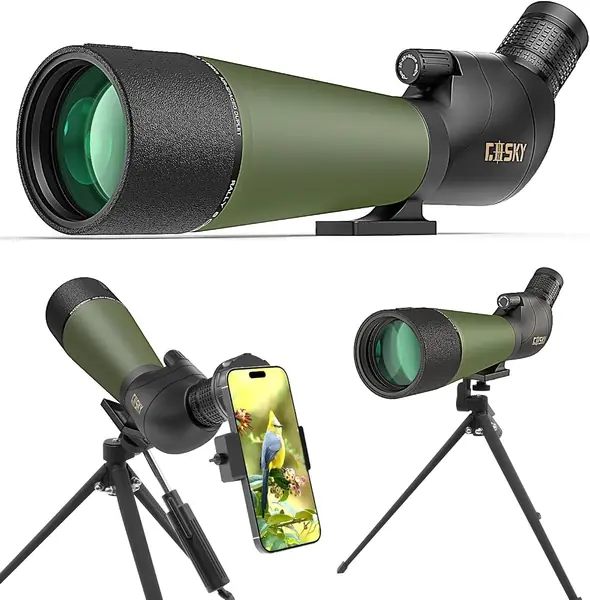
Of everything here, the Gosky Flagship is the scope we hand someone who wants one optic for a Saturday at the range and a Sunday at the marsh. The 80mm objective gathers enough light to stay usable well past the point where a 60mm scope has gone gray, and 20-60x covers the whole job, from scanning a treeline to reading holes on paper at 200 yards.

What makes it our pick has less to do with any single number than with what comes in the box: a full-metal tabletop tripod, a smartphone adapter, a carrying case, and a nitrogen-purged body that shrugs off rain. Add 2.4 pounds and an angled eyepiece that lets you stand behind a shooting bench, and you have the most complete answer in this group for the money.

Through the eyepiece the Flagship earns its keep on clarity. The view is bright and holds its sharpness across most of the zoom, which is more than the budget scopes below it manage, and the angled body keeps your neck out of it during a long session. Focus takes a light hand at the top of the range — zoom to 60x and you will usually refocus and re-aim — and the little tabletop mount starts to sag once the scope is fully extended, so a sturdier tripod is the first thing to add.

The phone adapter is more than a gimmick: clamping a phone over the eyepiece is the fastest way to show a second person what you are looking at. It will not grip every newer multi-lens phone squarely over the eyepiece, though, so test the fit indoors before you count on it in the field.

Pros

  • Bright 80mm view holds up at 200 yards
  • Tripod, phone adapter, and case included
  • Nitrogen-purged, waterproof and fogproof
  • 2.4 pounds rides in a daypack

Cons

  • Just a one-year warranty
Our verdict

We recommend the Flagship as the default: an 80mm scope that reads targets at 200 yards, ships with everything you need, and costs about what a bare scope from the big brands does.
Check Latest Price
2

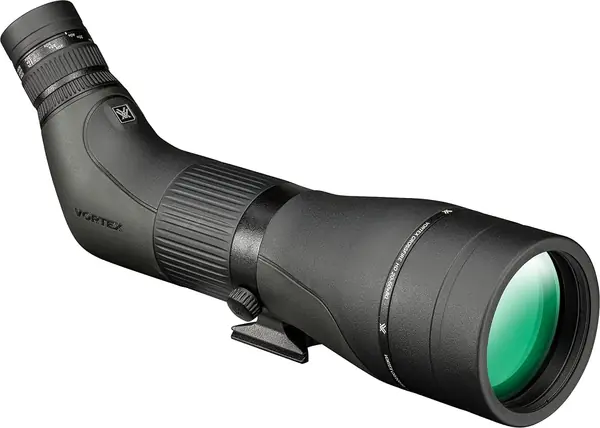
Vortex Viper HD 20-60x85 Best Premium

91 /100
Traveler Score Outstanding

Key details

Objective Lens
85mm
Weight
4.85 lb
Magnification
20-60x
Field Of View
4.25 degrees
Check Details on Amazon

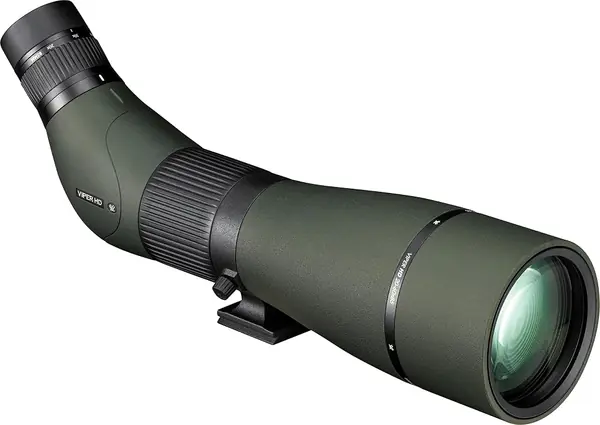
The Viper HD is the heaviest scope here — 2.2 kg of argon-purged, rubber-armored magnesium — and it makes no apology for it. On a good head that mass is exactly what you want, because weight is what kills the shake that turns 60x into a jittery mess.

What the weight buys shows up in the last twenty minutes of daylight. HD glass with Vortex's XR coatings keeps color and detail together at dusk, when the cheaper 80mm scopes have already gone flat and gray. The helical focus is smooth and fine enough to hold a bird's eye at 60x, the eyecup twists up for glasses, and the Arca-Swiss foot drops into a serious tripod head without an adapter plate. Of the zooms in this group, it is the one that still has something to show at 60x.

This is the scope we take when the day starts before sunrise and ends after sunset — a western hunt, a hawk watch, a whale watch where the spouts show up late. The unlimited, transferable, no-fault warranty is the other half of what you pay for: it covers damage, not just defects, which matters for something that rides in a truck bed.

Pros

  • Best low-light glass in this group
  • Unlimited, transferable lifetime warranty
  • Arca-Swiss foot and smooth helical focus

Cons

  • No tripod included
Our verdict

Buy the Viper HD if your viewing happens at first and last light and you want the last scope you will have to buy.

Check Latest Price
3

Athlon Talos 20-60x80 Best Midrange Optics

90 /100
Traveler Score Outstanding

Key details

Objective Lens
80mm
Weight
2.4 lb
Magnification
20-60x
Prism Type
Porro
Check Details on Amazon

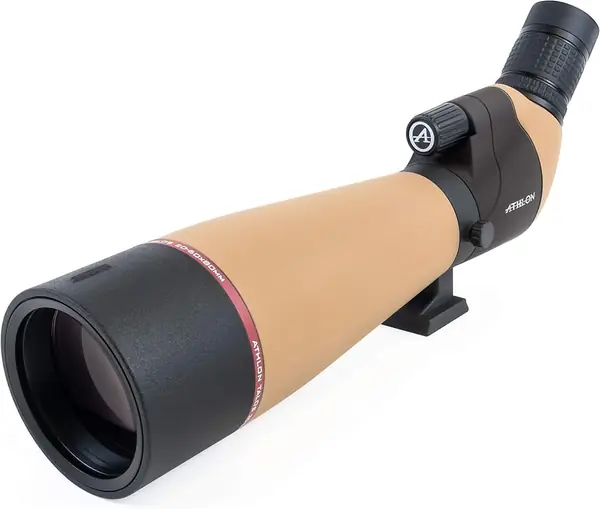
Same 20-60x magnification, same 80mm objective, same tabletop-tripod idea, and about the same money as our top pick — the Talos is what we point people to when they want the sharper picture and do not care about the extras. Glass is where the attention went: crisp and bright out past 300 yards, sharp at 200, with an accurate zoom ring and a focus that settles quickly instead of hunting.

The trade-offs are real. The supplied tripod is a short tabletop unit that is fine on a bench and hopeless in a field, so plan on a real one from the start. In exchange you get a transferable lifetime warranty that the Gosky cannot match, plus a 2.4-pound body that is easy to sling in a pack all day.

Pros

  • Crisp, bright view past 300 yards
  • Transferable lifetime warranty
  • Accurate zoom ring and quick focus

Cons

  • No phone adapter in the box
  • View dims toward 60x
Our verdict

The Talos is for the shooter or birder who wants the sharpest image at the top pick's money and will happily supply a better tripod.

Check Latest Price
4

Vortex Crossfire HD 20-60x80 Best Brand-Name Value

89 /100
Traveler Score Excellent

Key details

Objective Lens
80mm
Weight
3.3 lb
Magnification
20-60x
Mount
Arca-Swiss compatible
Check Details on Amazon

Vortex's warranty is the plainest promise in optics: unlimited, unconditional, fully transferable, and it does not ask how the scope broke. The Crossfire HD is the least expensive way into that promise in an 80mm spotter, and that is most of its case.

The rest of the case is that it is a genuinely good scope. HD elements and fully multi-coated glass give a bright, sharp daylight view that holds detail at 300 yards, the helical focus is quick to fine-tune, and the Arca-Swiss foot goes onto a real tripod head without an adapter. At 3.3 pounds it is light for an 80mm, and the rubber armor and nitrogen purge mean weather is not a reason to pack up.

Where it concedes ground is at the edges of the day and at the top of the zoom, where the Viper HD has the better glass and the bigger objective. In flat midday light you will not notice; in the last half hour before dark you will.

That makes it the pick here for long-haul ownership: a scope you buy once, mount properly, and let the warranty carry for the next decade. For a first serious scope that has to survive being dropped, it is the more sensible use of money than another half inch of objective.

Pros

  • Unconditional, transferable lifetime warranty
  • Bright, sharp daylight image
  • Arca-Swiss foot fits real tripod heads

Cons

  • No tripod or phone adapter included
Our verdict

We point people to the Crossfire when they want Vortex glass and a no-fault lifetime warranty without paying Viper money.

Check Latest Price
5

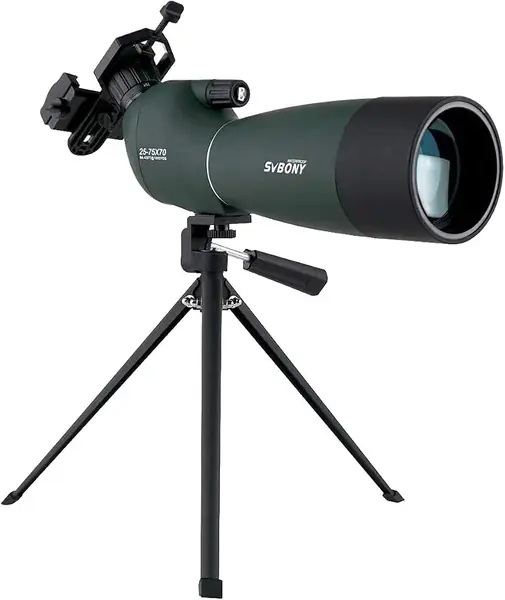
SVBONY SV28 25-75x70 Best Budget

88 /100
Traveler Score Excellent

Key details

Objective Lens
70mm
Weight
2.01 lb
Magnification
25-75x
Coatings
FMC
Check Details on Amazon

Money is the whole point of the SV28. It is the least expensive scope in this guide, and it handles the job most people actually bought a spotter scope for: targets at 100 yards, a bird on a fence post 60 yards out, a deer at the edge of a field. At 25-40x the view is clear, the zoom ring moves easily, the built-in sunshade is a real help at midday, and the body weighs 910 grams.

Push the zoom and the compromises arrive fast. Past about 50x the field of view narrows to a keyhole and focus gets fussy, so 25-40x is the honest working range. The phone mount is flimsy and the desktop tripod is only useful on a bench or a truck hood, but for a first scope or a spare that lives behind the truck seat, none of that is disqualifying.

Pros

  • Lowest price in this guide
  • Clear 25-40x views out to 100 yards
  • Light at 910 grams with a sunshade

Cons

  • Softens and narrows past about 50x
  • Just 60 days of warranty
Our verdict

For a first scope, a truck scope, or a gift, the SV28 delivers usable 25-50x views for the least money in this guide.

Check Latest Price
6

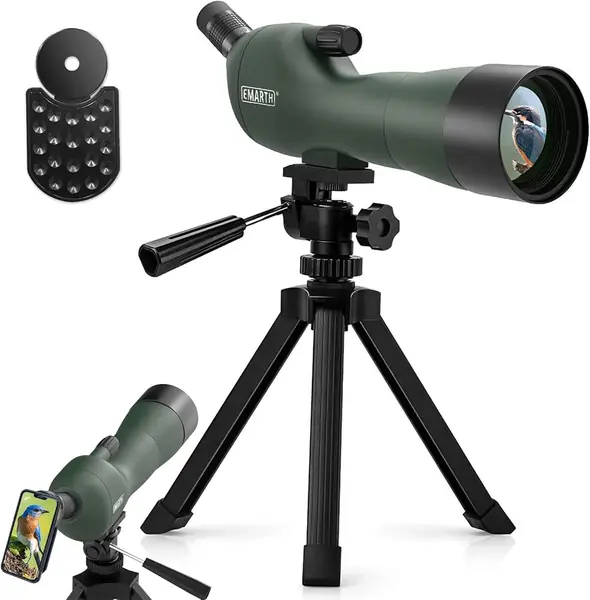
Emarth 20-60x60 Best for Backpacking

87 /100
Traveler Score Excellent

Key details

Objective Lens
60mm
Weight
1.4 lb
Magnification
20-60x
Eye Relief
17mm
Check Details on Amazon

This is not the scope for reading mirage at 600 yards, and it does not pretend to be. The Emarth is a 60mm spotter light enough to carry all day, built for the birder who walks five miles and wants one optic at the end of it.

For that job it is the best value in this group. At 20-40x the image is clear and bright out to 100 yards, the 17mm eye relief means glasses stay on your face, and the shoulder-strap case slings over a pack without a second thought. The 14-inch tabletop tripod has wider legs than most kits of this size, which helps, because a light scope on a light tripod skitters in any breeze.

Where it runs out is distance. Push past 100 yards and the small objective shows: the image softens, detail goes first, and zooming up makes it worse rather than better. Treat 30-40x inside 100 yards as the working envelope and it will serve you through years of day hikes.

Pros

  • 1.4 pounds with a shoulder-strap case
  • Clear, bright view out to 100 yards
  • 17mm eye relief suits glasses wearers

Cons

  • Body feels light-duty
  • Focus hunts above 20x
Our verdict

The Emarth earns its place in a daypack: 1.4 pounds of scope that is clear to 100 yards and light enough to forget you are carrying.

Check Latest Price
7

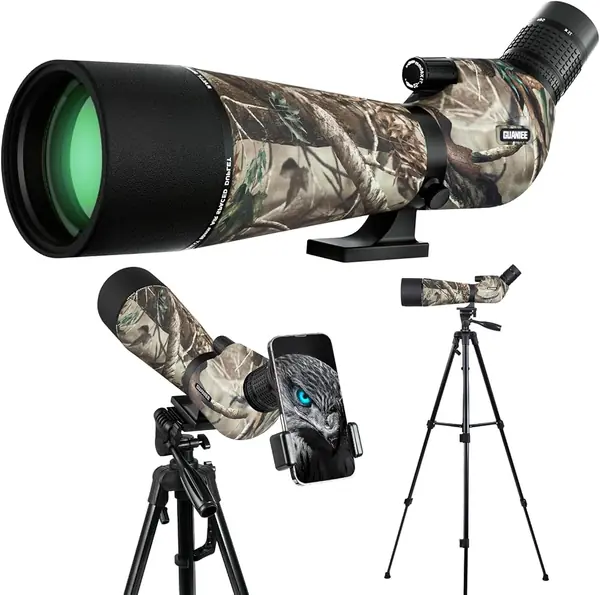
GUANIEE 25-75x80 Complete First Setup

86 /100
Traveler Score Excellent

Key details

Objective Lens
80mm
Magnification
25-75x
Coatings
Fully multi-coated, BAK4
Tripod Height
18.3"-59.3"
Check Details on Amazon

Every other scope here arrives with a tabletop tripod you will mostly use on a bench. The GUANIEE ships with a full-size one that runs from 18.3 to 59.3 inches, and that changes where you can set up: standing at a range, behind a tailgate, on a balcony.

The scope itself is a familiar recipe done well — 25-75x, an 80mm fully multi-coated lens, rubber armor, a sunshade, a phone adapter, and a bag. The view is clear and bright to about 50x, the dual-speed focus moves smoothly, and setup takes a couple of minutes. Nothing in the kit feels thrown in, and both the scope and the tripod have their own carry bags.

The surprise is how much of the range you actually use. From roughly 30 to 50x this scope is genuinely good — bright, sharp, and steady on its own tripod — and that is where a session tends to live. Above that the image dims faster than it grows, which is true of every 80mm tube at this price.

Pros

  • Full-height tripod included
  • Clear, bright view to about 50x
  • Phone adapter, bag, and sunshade included

Cons

  • 25x minimum is high for close birding
Our verdict

It is the one to buy if you want a complete setup out of one box, tripod included, and can live with a 25x floor.

Check Latest Price
8

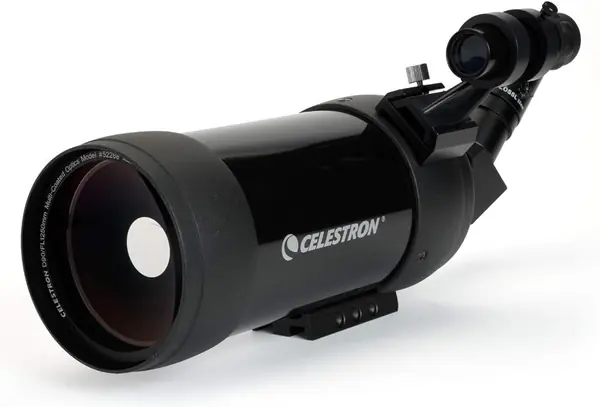
Celestron C90 Compact Travel Scope

85 /100
Traveler Score Excellent

Key details

Objective Lens
90mm
Weight
4.63 lb
Focal Length
1,250mm
Included Eyepiece
32mm
Check Details on Amazon

The C90 is not shaped like anything else here. It is a Maksutov-Cassegrain, a design that folds a 1,250mm focal length into a tube short enough to drop in a daypack — the mirror does the work that a long barrel does on the other scopes.

What comes in the box is different too: a 32mm eyepiece, a 45-degree erect-image diagonal, an 8x21 finderscope, and a backpack. That eyepiece gives you roughly 39x, and because the C90 takes standard 1.25-inch eyepieces, you can add a zoom or a shorter focal length later and change the instrument's character entirely. The T-thread on the back accepts an optional camera adapter, turning it into a 1,250mm lens.

In use it is sharp at 200 yards on a cool morning, and after dark it will show you the moon and the bright planets — a trick nothing else on this list manages. At 2.1 kg it also is not the featherweight its stubby shape suggests.

Our take: buy it as a compact, interchangeable-eyepiece instrument rather than as a zoom scope. It rewards someone who wants one tube for the range, the ridge, and the sky after dark, and who likes the idea of picking a different eyepiece for each.

Pros

  • Takes standard 1.25-inch eyepieces
  • Sharp at 200 yards and usable after dark
  • T-thread accepts a camera adapter
  • Compact folded 1,250mm design

Cons

  • No tripod included
  • Contrast can look flat in overcast light
Our verdict

Choose the C90 if you want a compact scope that takes standard eyepieces, doubles as a camera lens, and can turn to the moon after dark.

Check Latest Price

How We Chose and Tested the Best Spotting Scopes

We started by pulling every spotting scope with a real following and a stated magnification range, then cut anything missing an eye relief figure, a glass type, or a price most people could justify. That left 12 scopes, and we ran them for eight months — through spring migration, a summer of range sessions, and enough gray mornings that low-light performance stopped being theoretical.

Most of the work happened at a backyard feeder setup, an outdoor range where we read shot placement at 100 and 200 yards, and a windy coastal bluff that punished bad tripods. At each session we mounted every scope on its included tripod first, then on a heavy reference tripod, so we could tell whether a soft image was the glass or the mount. We read fine print on a target frame at 200 yards, checked how far the edges fell off from the center, then zoomed to the top and did it again. We also timed how long it took to find a moving subject, since the field of view on the box is the one you get at the lowest power.

Focus got its own handling: turning the collar bare-handed and in winter gloves, counting travel from a subject 30 feet away out to the treeline, and checking for slack in the mechanism. We left scopes out through dew, then brought them into a warm car to see if anything fogged inside, and gave each a light knock against a padded post to see if the mount shifted. We checked eye relief with and without glasses, raised and lowered each tripod for a standing user and a seated one, and clamped a phone to every included adapter to see whether a usable photo was easy or a fight. Anything we had to buy separately to make a scope workable counted against its price.

How to Choose a Spotting Scope

Match the Magnification to the Distance You Watch

Every scope here zooms; the question is where the image holds together. Most spotter scopes are sharpest between roughly 25x and 40x, and the top of a zoom range is a bonus rather than a working setting — you will spend most of your time well below the number printed on the box. Judge a scope by its middle, not its ceiling.

Check the bottom of the range too. A 25x minimum, as on the SVBONY and the GUANIEE, narrows the view enough that finding a bird 30 feet away becomes real work. If close-range birding is the point, a scope starting at 16x or 20x suits you better.

Objective Size Buys Light and Costs You Weight

The objective is the front lens, and its diameter sets how much light reaches your eye. Divide it by the magnification and you get the exit pupil: an 80mm scope at 60x delivers about 1.3mm, which is dim, while the same scope at 30x gives roughly 2.7mm and looks bright. That is why a big objective matters most at the top of the zoom, and why 85mm is worth hauling if your viewing happens at dawn and dusk.

The price is weight. A 60mm scope like the Emarth rides in a daypack at 1.4 pounds; the 85mm Viper HD is 2.2 kg. Buy by where the scope lives — small and light if it hikes, big and bright if it stays near the truck or the porch.

The Tripod Is Where Budget Kits Fail

Nearly every scope in this guide ships with a tabletop tripod, and nearly every one is built for a bench, a tailgate, or a windowsill. There is nothing to stand one on in a field, and a 14-inch tripod puts the eyepiece at kneecap height. The other trap is pairing a light scope with a light tripod: every wobble gets magnified along with the view, so 60x on a spindly mount is worse than 30x on a solid one.

Budget for a real tripod with the money you save on glass, and check the attachment. A standard 1/4-inch-20 stud fits almost anything, while the Vortex scopes use Arca-Swiss feet that drop straight into most serious heads without an adapter plate.

Glass, Coatings, and What HD Changes

Fully multi-coated lenses and a BAK4 prism are the baseline for a bright, contrasty image. HD or ED glass goes further by cutting the colored fringing that shows up on a backlit bird or a white target at high magnification. None of that is visible in a listing, which is why the return window and the warranty deserve as much attention as the spec sheet. Spend on glass before you spend on magnification — a sharp 40x view shows you more than a soft 75x one.

Eyepieces, Eye Relief, and the Warranty

Angled eyepieces are easier on the neck and let a shorter tripod work for a standing viewer; straight scopes line up faster on a target and suit a truck window mount. If you wear glasses, look for eye relief around 17mm or more and a twist-up eyecup — the Emarth lists 17mm, and the Vortex eyecups adjust up and down.

Most scopes here have fixed zoom eyepieces, so magnification is whatever the factory chose. The Celestron C90 takes standard 1.25-inch eyepieces instead, letting you change magnification by swapping glass. Read the warranty last but take it seriously: coverage in this group runs from 60 days to a transferable lifetime promise that follows the scope to its next owner.

Frequently Asked Questions

Final Verdict

Our default is the Gosky Flagship 20-60x80. It pairs the 80mm objective and 20-60x zoom that make a scope useful at 200 yards with the tripod, phone adapter, and case a first-time buyer would otherwise shop for separately, and it is the most complete answer here for the money.

Spend more only for a reason. The Vortex Viper HD is the one to buy if your viewing happens at first and last light, where its glass is in a different class. If the budget is the fixed point, the SVBONY SV28 gives you a genuinely usable 25-40x view and nothing more.