Best Binocular Straps of 2026

Somewhere around the second hour of a bird walk, a neck strap stops being an accessory and becomes the thing you're thinking about. I've done that shuffle — binoculars swinging into my chest, one hand hooked under the strap to ease the pull on my neck — and it's a lousy way to spend a morning outside. A good strap should be nearly invisible: weight across the shoulders instead of the neck, optics held steady, nothing to fiddle with.

Over four months, my team and I carried 14 of these through wetland bird walks, cold mornings in a deer stand, and one very windy boat ride — from neoprene neck straps to X-shaped chest harnesses. A harness quiets the swing but adds a step when you lift the binoculars; a padded neck strap is faster but punishes you on a long hike. Hardware is where these straps live or die, too: the connectors take the load every time you raise the optics. The picks below are the ones I kept reaching for, sorted by how you'll actually carry your glass.

The Best Binocular Straps

1

Vortex Binocular Harness Strap Best Overall
94 /100
Traveler Score Outstanding

Key details

Carry Style
Chest harness
Weight
3.17 oz
Warranty
Unlimited, unconditional
Adjustment
One size fits most
Check Details on Amazon

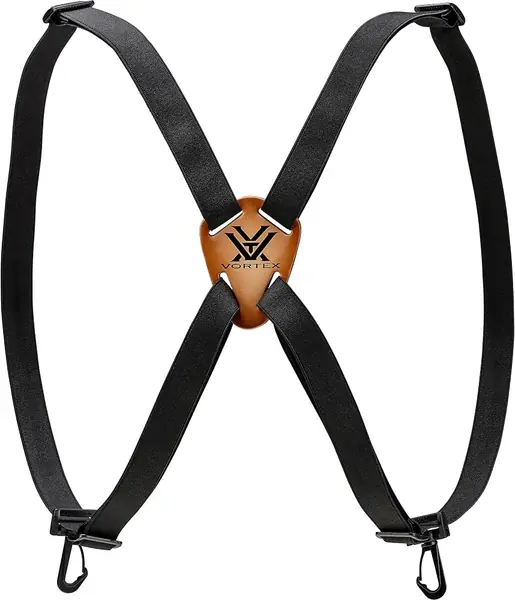
A pound and a half of glass on a half-inch strap stops being charming about ninety minutes into a walk. The Vortex harness is the fix we reach for first: two elastic straps over the shoulders, a crosspiece at the back, and the binoculars pulled flat against your sternum instead of swinging from your throat. We noticed the difference inside the first mile — the glass stops moving when you do, and it comes up to your eyes without a fight because the bungee has already taken up the slack.

The adjusters are what sold us. One size fits most usually means one size fits nobody, but there is enough range here to set it over a T-shirt in September and over a rain shell in December without starting from scratch, and the straps sit close enough on a slender frame that the pads do not stand off the shoulders. Because the harness goes on over your head fully assembled, you can leave the straps threaded on the binoculars between trips.

What you give up is the simplicity of one strap. There is more webbing on your torso, it covers the spot where a backpack's sternum strap wants to sit, and getting out of it takes two hands instead of one. Archers should skip it entirely: chest carry is exactly where a bowstring needs to travel, which is why Vortex sells a separate long strap for that job below.

For birders, hikers, and anyone out for hours with full-size glass, this is the harness we hand people first. It is also the only pick here with an unlimited, unconditional warranty behind the hardware, which matters when the thing holding your binoculars is a plastic buckle.

Pros

  • Takes the weight off your neck entirely
  • Holds binoculars tight with no swinging
  • Adjusts over light layers or a winter jacket
  • Unlimited, unconditional warranty on the hardware

Cons

  • Chest carry sits in a bowstring's path
Our verdict

We recommend it as the default for anyone who carries binoculars for hours: the elastic harness takes the weight off your neck and holds the glass still against your chest.
Check Latest Price
2

OP/TECH USA E-Z Comfort Strap Best Neck Strap

91 /100
Traveler Score Outstanding

Key details

Carry Style
Neck or cross-shoulder
Warranty
Lifetime against defects
Hardware
Quick-release disconnects
Pad Material
Neoprene
Check Details on Amazon

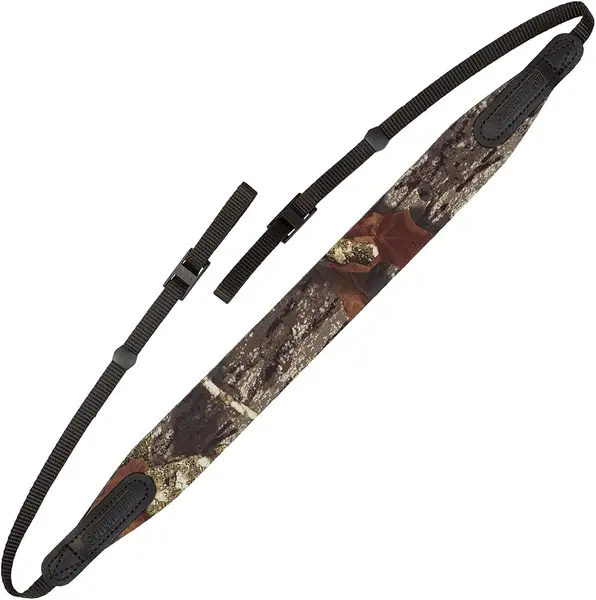
No harness, no shock cord, no learning curve: the E-Z Comfort is a neoprene pad, a length of 3/8-inch nylon webbing, and leather tabs with quick disconnects at each end. It is the strap we keep in a daypack because it folds into a fist and moves between a compact camera and a pair of binoculars in about as long as it takes to unclip one and clip the other.

The camo section is the pad, and it is softer than the firm neoprene on cheaper straps — closer to memory foam, with enough give that a 10x50 sits on the back of your neck instead of into it. We also like that the length runs far enough for cross-shoulder carry, so the binoculars can hang at your hip on a long walk and come up across your chest when something moves. For the money, this is the neck strap we point people to.

It is made in the USA and covered by a lifetime warranty against defects in materials and workmanship, which is more backup than most straps at this end of the range offer. The disconnects are the quiet advantage: leave a set of clips on each pair of binoculars and the strap moves between them without threading anything.

Pros

  • Soft neoprene pad eases neck pressure
  • Quick disconnects swap between optics
  • Long enough for cross-shoulder carry
  • Made in the USA with a lifetime warranty

Cons

  • Wide tabs need split rings on compact binoculars
Our verdict

Buy this if you want one soft, plain neck strap that swaps between a camera and binoculars; it is the simplest cure for a sore neck here.

Check Latest Price
3

Rick Young Outdoors Binocular Harness Best Ultralight Harness

90 /100
Traveler Score Outstanding

Key details

Carry Style
Shock-cord chest harness
Weight
2.24 oz
Storage
Wraps around binoculars
Wearing Positions
Five
Check Details on Amazon

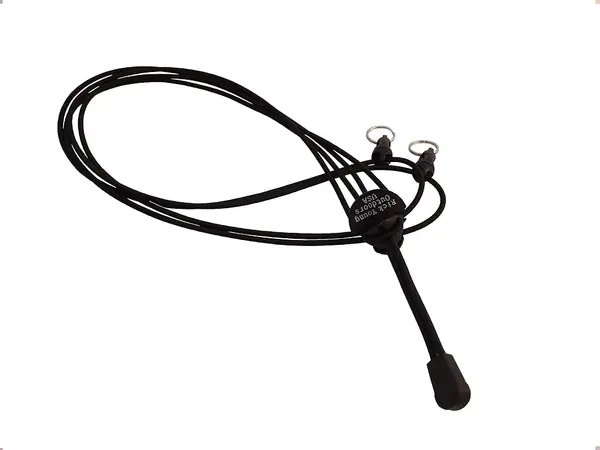
Out of the package, the Rick Young harness looks like a length of bungee cord and a handful of plastic hooks — not much of a harness. That is the point. It weighs 2.24 ounces, it goes over your shoulders in one motion, and when you are finished it wraps around the binoculars themselves, so it lives in a jacket pocket instead of tangling at the bottom of a pack.

The cord runs across your back and over both shoulders, and tension rather than foam is what holds the glass against your chest. Because it is cord, it re-rigs into five different carry positions: both shoulders, bandolier across one, tightened down for a climb. On a hunt or a hike where you add and shed layers all morning, that is the difference between a harness you keep wearing and one you take off.

Two costs come with the minimalism. The rear adjuster is a plastic toggle and a knot of cord, and you feel it against your spine when you lean back into a tree or a pack frame. And with no padding, a big 10x50 hangs off elastic tension alone — fine for an hour, noticeable by four. We treat it as the ounce-counting harness: for a full day with 8x42s and a light pack, nothing here disappears as completely.

Pros

  • Lightest harness in this group at 2.24 ounces
  • Re-rigs into five carrying positions
  • Stores wrapped around the binoculars
  • Elastic tension keeps glass from swinging

Cons

  • Rear adjuster presses into your back when leaning
Our verdict

Our pick for trips where every ounce counts: the lightest harness here, and the one that packs down around the binoculars themselves.

Check Latest Price
4

OUFABE X-Shaped Binocular Harness Best Value Chest Harness

89 /100
Traveler Score Excellent

Key details

Carry Style
X chest harness
Weight
4.66 oz
Adjustment
Adjustable
Attachment
Rubber connector straps
Check Details on Amazon

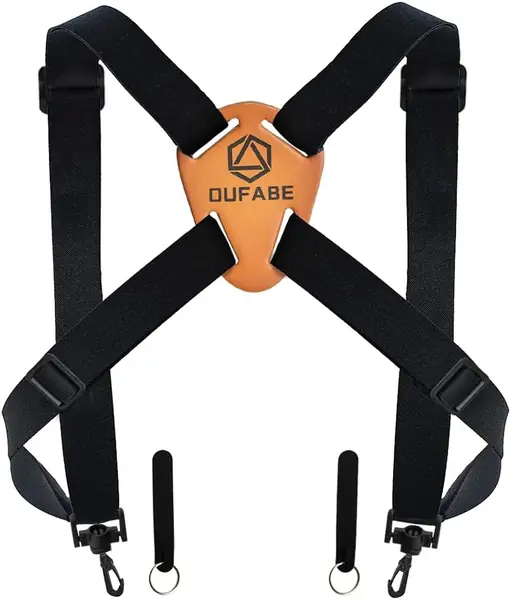
The same chest-carry idea as our top pick for less money: the OUFABE is an X of padded straps across the back with shoulder adjusters and a leather patch where they cross. We found it does the main job — the glass comes off your neck entirely, sits flat against your sternum, and does not bounce when you walk.

Padding is where the two harnesses part company. This one is softer and wider across the shoulders, which is welcome under a pack, but it is also 4.66 ounces against the Vortex's 3.17, and you feel that in a stuff sack. The first setup takes a few minutes of balancing the adjusters, and after that it goes on over a jacket in one motion like any other harness.

The connectors are the weak link. The rubber straps that thread your binocular lugs are wide, and on compact glass they simply will not pass; the clips are big enough that some binoculars need the supplied attachment straps instead. Watch the plastic hardware too — some of these run for years, and a broken attachment clip puts your binoculars on the ground, so it is worth a tug on the buckles before each season.

Pros

  • Moves the load off your neck and onto your shoulders
  • Softer, wider shoulder padding than the top pick
  • Holds binoculars flat and still when walking

Cons

  • Wide rubber connectors will not pass small lugs
  • Plastic attachment clips can fail
Our verdict

We recommend it as the value version of a chest harness: the same weight off your neck as the top pick, with connectors you need to check against your binoculars.

Check Latest Price
5

Vortex Archer's Binocular Strap Best for Side Carry

88 /100
Traveler Score Excellent

Key details

Carry Style
Extended side sling
Weight
2.4 oz
Warranty
Unlimited, unconditional
Material
Neoprene
Check Details on Amazon

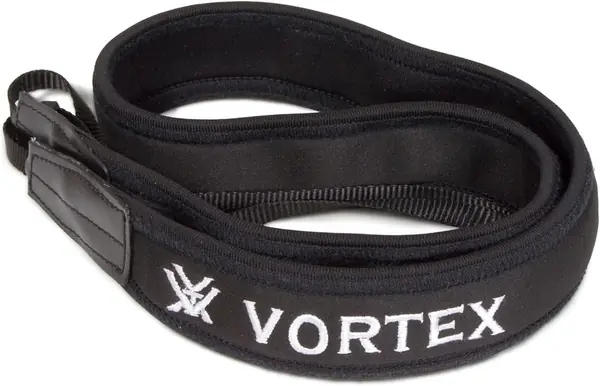
If you draw a bow, a chest harness is the wrong answer: it parks your binoculars exactly where the string needs to travel. The Archer's strap solves that by skipping the chest entirely — it is a long neoprene neck strap, long enough to sling the binoculars under one arm at hip level, where nothing catches and nothing swings.

It earns a place outside the archery blind too. Over a pack with a hipbelt, this is the strap we use when we do not want another band of webbing across the chest: the binoculars ride at the side and come up across the body when you need them. The neoprene is soft, and it adjusts long enough for cross-body carry over a winter jacket.

The friction slider is the weak point — walk with any bounce in your step and the length creeps, so you will be hauling the strap back up a few times a day. Vortex's own harness is the set-and-forget alternative. But nothing else here gets your binoculars clear of a hipbelt and a bowstring at the same time.

Pros

  • Extended length keeps binoculars at hip level
  • Clear of a bowstring at full draw
  • Works cross-body over a pack
  • Unlimited, unconditional warranty

Cons

  • Slider creeps, so length needs re-tightening
Our verdict

For bowhunters and anyone who wants the glass at their hip instead of their chest, this long neoprene strap does exactly that job.

Check Latest Price
6

Nocs Provisions NocLoc Tapestry Strap Best-Looking Strap

87 /100
Traveler Score Excellent

Key details

Carry Style
Neck or over-the-shoulder
Weight
4.8 oz
Connector
NocLoc quick connect
Load Rating
50 lb static
Check Details on Amazon

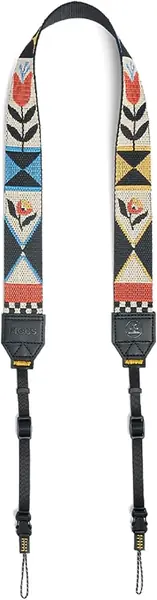
Every other strap here is black webbing. The Nocs is a woven tapestry — a cotton face over a polyester base, in a floral pattern the maker calls Flora — and it is the only one in this group that looks like something you picked on purpose. On binoculars that come out at a market, a boat, or a safari lodge rather than on a ridge, that is not a frivolous thing to pay for.

It is not only decorative. The stitching is multi-layer, the internal structure is rated to a 50-pound static load, and the G-clip adjusters set length for neck or over-the-shoulder carry. The NocLoc quick connect is the part that earns its keep on a trip: pop the strap off one optic and onto another with one hand, which is what you want when you are switching between binoculars and a camera on a game drive.

Two trade-offs come with the fabric. At 4.8 ounces it is the heaviest strap here, and you feel that in a pocket before you feel it on your neck. It is also priced with the premium harnesses in this group, and the money goes to the look rather than to extra function. What surprised us is how much the pad does: the cotton face stays soft against bare skin in heat, which is the payoff for the extra ounces.

The quick connect is Nocs' own system, so confirm it will thread your binoculars' lugs before you order. Otherwise, if your binoculars live in a tote bag and come out at brunch, this is the strap; if they live on a harness in the backcountry, save the money.

Pros

  • Woven tapestry face looks nothing like black webbing
  • NocLoc quick connect swaps optics one-handed
  • Rated to a 50-pound static load
  • Soft cotton face against bare skin

Cons

  • Heaviest strap here at 4.8 ounces
  • Priciest neck strap in this group
Our verdict

If you want a strap that looks like something, this is the one: a woven tapestry strap with one-hand quick connects and a 50-pound load rating.

Check Latest Price
7

TROSCAS Super Comfort Neoprene Strap Padded Budget

86 /100
Traveler Score Excellent

Key details

Carry Style
Neck strap
Weight
2.26 oz
Hardware
Field repair buckle
Attachment
Loop connectors
Check Details on Amazon

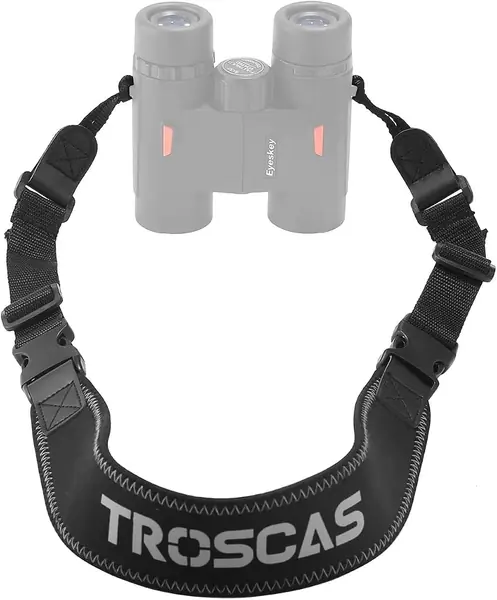
The detail worth knowing about the TROSCAS is the buckle: it is a field-repair design, so if a connector lets go at the wrong moment you can rethread it and keep the strap working instead of carrying your binoculars by the hinge for the rest of the walk. Add the quick-release clips at the ends — the kind you pop off without unthreading anything — and a wide neoprene pad, and there is a lot of neck strap here for the money.

Width is what makes it work with heavier glass. This is the widest pad of the neck straps in this group, and on a full-size 8x42 we barely noticed it; the load spreads across the back of your neck instead of cutting a line into it. That, plus the clips, makes it the one we hand someone who wants to swap a single strap between two pairs of binoculars and not think about it again.

Two things to check. The length tops out sooner than some wearers need, so if you are tall, compare the range against a strap you already own. And the neoprene is smooth enough that slung over one shoulder it will slide, which is worth knowing if you carry cross-body rather than around the neck. Around your neck, with both clips loaded, it stays where you put it.

Pros

  • Widest neck pad in this group
  • Quick-release clips swap between binoculars
  • Field repair buckle keeps it usable
  • Low price for the padding you get

Cons

  • Length tops out for tall wearers
  • Smooth padding slides off a shoulder
Our verdict

A wide, comfortable neck strap with quick releases and a repair buckle for very little money; just check the length if you are tall.

Check Latest Price

How We Tested Binocular Straps

We started by gathering every strap that kept coming up in birding club threads, hunting-gear write-ups, and forum posts from people who walk miles with heavy glass, then sorted them into the three formats shoppers actually choose between: padded neck straps, elastic shock-cord harnesses, and full X-shaped chest rigs. We dropped anything with a fixed length, a single connector style, or hardware that looked like it would crack in the cold. That left 14 straps, each used for four months.

Every strap carried real optics: an 8x42 and a 10x42 binocular, plus a rangefinder and a compact mirrorless camera wherever the connectors allowed it. We wore them at dawn on wetland bird walks, through a week of cold-weather deer hunting with a parka over several layers, on day hikes, and on a blustery boat trip. Before each outing we ran the strap to both ends of its adjustment range and noted whether it sat correctly over a T-shirt and over a heavy jacket without the binoculars riding up under the chin.

The long stretches were the real test. We wore each strap for at least three hours at a time and wrote down where the pressure landed — back of the neck, across the shoulders, under the arms — and whether we were still aware of it by hour three. We jogged a short stretch and climbed in and out of a truck to see how much the binoculars swung, and we watched whether the elastic in the harnesses started to sag once the heavier 10x42 was hanging from it.

Secure fit got checked every time we put one on: we pulled down on the optics to see if the connectors held, examined the stitching around the loops, and looked at buckles for cracking or stretching after each trip. We adjusted length one-handed with gloves on and counted how many tries it took. At the end, we set what each strap cost against how it felt at hour three — an inexpensive strap you stop noticing is a better value than one you keep fiddling with.

How to Choose a Binocular Strap

Neck strap or chest harness?

The honest question is not which design is better but how long you carry. For a market, a ballfield, or an hour in the woods, a neck strap is simpler: one strap, one motion, nothing across your back. Past that, full-size binoculars with a strap are easily a pound and a half, and it all lands on the same two inches of neck. A harness — sometimes sold as a bino harness — moves that load onto your shoulders and stops the glass swinging when you walk.

The cost of a harness is hardware on your torso: more webbing to put on, something else competing with a pack's sternum strap, and a slower exit. If you carry for hours, we prioritize the harness every time. If you carry for twenty minutes, we reach for the neck strap.

Adjust it over the layers you actually wear

A strap that sits right over a T-shirt is short over a parka, and that is the most common fit failure in both styles. Set the length with your bulkiest jacket on, then raise the binoculars and check that the eyepieces meet your face rather than your chin. Harnesses need enough slack in the shoulders to rotate the glass up one-handed; if you have to duck your head to meet the binoculars, the back is too tight.

The attachment end is where straps fail

Lug slots are narrower than almost anyone expects, and a wide tab or a thick rubber connector simply will not pass through a compact binocular's hinge. Measure the slot on your binoculars before ordering and compare it with the connector: most standard lugs take 3/8- to 1/2-inch webbing, while small roof-prism models often need split rings. Quick-release swivels earn their keep even with one pair of binoculars, because they let you move a strap between optics without rethreading anything.

Weigh ounces against what you carry

Strap weight matters less on your neck than in your pack. A 2.2-ounce cord harness disappears into a pocket and suits a trip where everything gets counted; a 4.8-ounce tapestry strap is a pleasure to wear and a lump to stow. Padding is the other half of that trade. The widest pad in this group sits on a budget neck strap, and it does more for heavy binoculars than another inch of adjustment ever will.

Hardware, care, and the end of a strap's life

Plastic clips and friction sliders wear out long before the webbing does. Give the connectors a firm tug before each season, treat a cracked clip as a failed part rather than something to nurse along, and read the warranty before you need it — the two Vortex picks here carry an unlimited, unconditional one. Neoprene and foam pads last longer if you rinse the sweat out and air dry them, which is also the fastest way to stop a strap smelling like a gym bag.

Frequently Asked Questions

Final Verdict

The Vortex Binocular Harness Strap is the one we hand to most people. It takes the whole load off your neck, keeps the glass still while you walk, and adjusts over everything from a T-shirt to a storm shell, with an unconditional warranty standing behind the hardware.

If a harness is more rig than you want, the OP/TECH E-Z Comfort is the neck strap to keep in a daypack: soft, light, and easy to move between optics. Archers and anyone pushing through brush should take the long Vortex sling instead — it is the only design here that keeps binoculars out of a bowstring's path.