Best Camera Straps of 2026

Every camera I've bought came with a strap in the box, and every one ended up in a drawer within a week. That freebie is the cheapest thing in the bag and the only thing between the camera and a concrete floor. Over the past six months, my team and I have carried 12 straps on the same two bodies, and the difference is clear by the second mile.

Comfort is where most fail. A strap that runs an inch short turns a crossbody carry into a slow choke by the third hour, and padding that feels plush in a shop goes clammy by afternoon — overdo it and the strap won't roll into a bag pocket. Adjustability matters too: tight while you walk, loose when you stop to shoot.

One thing worth understanding before you buy: the quick-release connector, which lets you clip the strap off for a tripod or gimbal in one motion. Alone it's a convenience; with a backup tether or second anchor, it's insurance. Every strap below earned a permanent spot on our cameras.

The Best Camera Straps

1

Peak Design Slide Lite Best Overall
97 /100
Traveler Score Outstanding

Key details

Attachment
Quick-release anchors
Carry Styles
Neck, shoulder, sling
Length Adjustment
Tool-free, one-handed
Check Details on Amazon

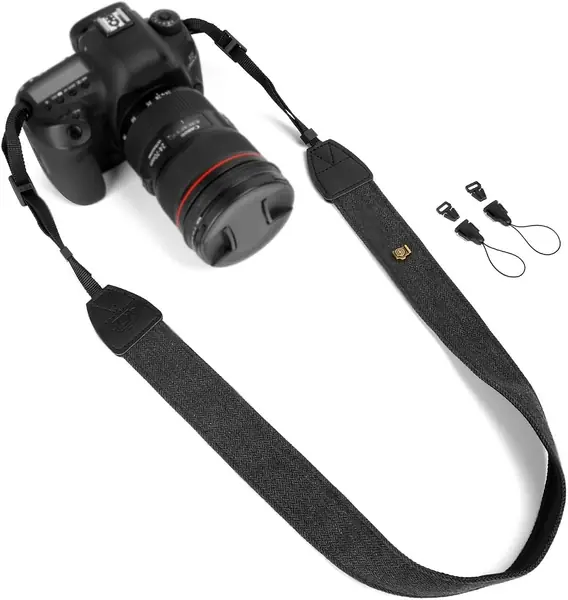
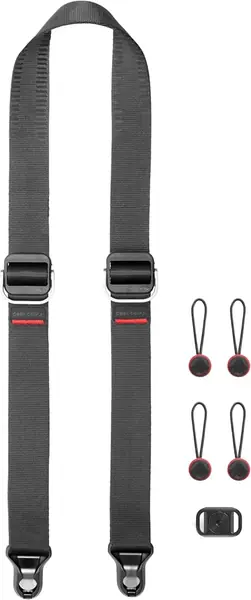
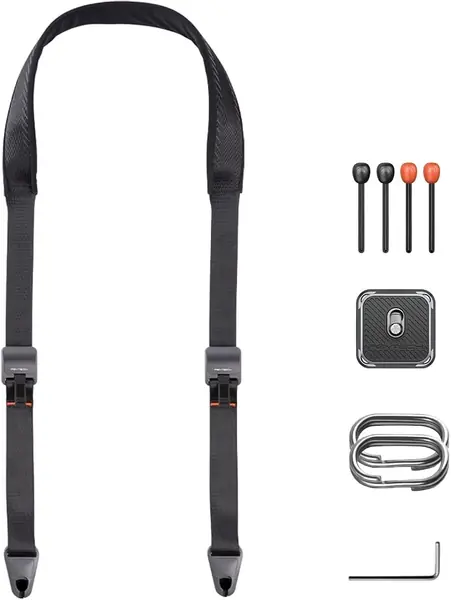
The anchors are the whole idea, and they are why this is the strap we hand to anyone who carries a camera for more than an hour at a time. Two short cord loops stay threaded on the camera's lugs, and the strap's clips snap onto them, so the whole thing comes off in a second — onto a tripod, into a bag, or swapped for a wrist strap — without rethreading webbing through a lug in the cold.

Because it is built to come on and off, it is also built to be adjusted constantly. The length runs through cam-style adjusters that sit where your hand falls, and we shortened it one-handed with the camera hanging while working into a crowd. Worn across the chest it behaves like a sling; worn on one shoulder it stayed put on a jacket that was not slick. Under a full-frame body and a zoom it spread the weight better than its width suggests.

The case against it is simple: it is the most expensive strap in this guide, and the gap between it and the Art Tribute is wider than the difference in comfort. If your camera is a small mirrorless body you carry for an hour, the cotton strap below does the job for a fraction of the money. If you move between hand, neck, and tripod in one afternoon, the anchors earn it back in saved fuss. They also mean the Cuff clips onto the same loops, so adding a wrist strap costs nothing in extra hardware.

Pros

  • Anchors swap neck, sling, and tripod in seconds
  • Length adjusts one-handed while worn
  • Comfortable under a full-size body and zoom
  • Understated black that does not shout

Cons

  • The priciest strap in this guide
Our verdict

We recommend it to anyone who carries a camera for hours and changes how they carry it — the anchors make neck, sling, and tripod swapping the work of a second.
Check Latest Price
2

Art Tribute Camera Strap Best All-Day Comfort

96 /100
Traveler Score Outstanding

Key details

Pad
Wide padded cotton
Carry Styles
Neck, shoulder, crossbody
Ends
Reinforced leather
Pattern
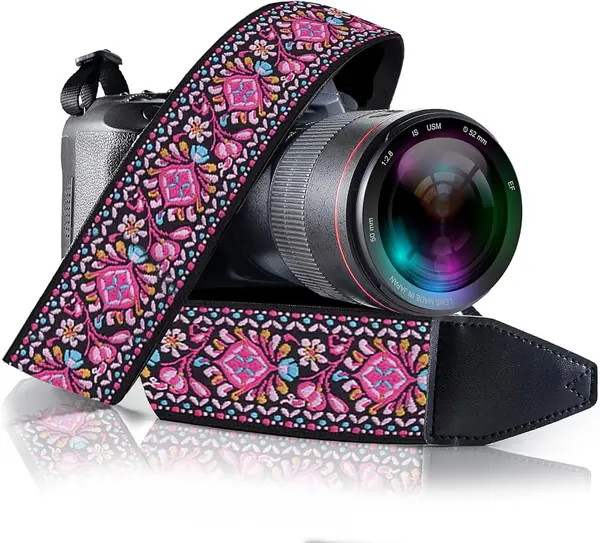
Floral pink woven
Check Details on Amazon

The pad is wide, the cotton is soft, and the back has a brushed, almost velvety finish that does not grab at your neck the way the rubberized pad on a kit strap does. On a hot afternoon that difference is the whole purchase.

What we appreciate most is how ordinary the good parts are: leather ends with dense stitching, a length that runs from a snug chest carry out to a relaxed crossbody, and quick-release clips that take the strap off without unthreading anything. Nothing about it feels like a costume accessory that happens to hold a camera, which is not something we can say about every patterned strap. It also comes in a long list of designs, which is either the reason you are buying it or the reason you are not.

The pink woven floral we priced is a lot of pattern, and the strap is unapologetic about it; if you want your camera to read as gear rather than as an accessory, the Slide Lite is the quieter choice. The padded body also takes more room in a small bag than a rope strap does. Neither is a dealbreaker at this end of the market, and both are the price of the comfort above.

Pros

  • Wide cotton pad spreads weight all day
  • Soft backing resists chafing
  • Reinforced leather ends and dense stitching
  • Dozens of patterns to choose from

Cons

  • Prints are a strong personal statement
  • Padded body takes up bag room
Our verdict

For long days on your feet, this is the strap we point most people to: a wide cotton pad that spreads a camera's weight, at a price that makes it an easy yes.

Check Latest Price
3

PGYTECH Padded Camera Strap Best for Heavy Gear

95 /100
Traveler Score Outstanding

Key details

Weight
4.9 oz
Length Range
43.3–59.8 in
Pad Width
1.8 in
Load Rating
198.4 lb
Check Details on Amazon

Ninety kilograms is an absurd number for a camera strap until you remember what people hang off one: a full-frame body, a 70-200, a flash, and a bracket. The webbing is rated far past anything you will attach, and unlike most straps here it says so on the label. That is why it is the one we recommend for heavy rigs.

The parts that matter day to day are the adjusters at both ends, so you can cinch the pad where you want it without walking the buckle around your body, and the round connector at the camera end. It swivels, so the strap lies flat instead of twisting into a stiff loop that swings into your face when you raise the camera. The pad is lined with a grippy material, and on a jacket shoulder it stayed where we put it.

The short end of the range is still long. On a smaller frame the pad hangs around the waist even cinched up, and the extra webbing flops when you are not wearing it across the body. If you are tall, or you like a hip-length carry, that is a feature. If you are short and want the camera high on the chest, the Slide Lite adjusts to a tighter carry.

Pros

  • Rated to 90 kg, far past any rig
  • Quick adjusters at both ends
  • Swiveling connector resists twisting
  • Grippy pad stays on the shoulder

Cons

  • Hangs low at its shortest on smaller frames
Our verdict

If your rig is a full-frame body with a long lens, this is the one we trust — rated far beyond what you will hang on it, with adjusters at both ends.

Check Latest Price
4

Peak Design Cuff Best Wrist Strap

94 /100
Traveler Score Outstanding

Key details

Attachment
Quick-release anchors
Type
Wrist strap
Wrist Fit
Cinching, adjustable
Check Details on Amazon

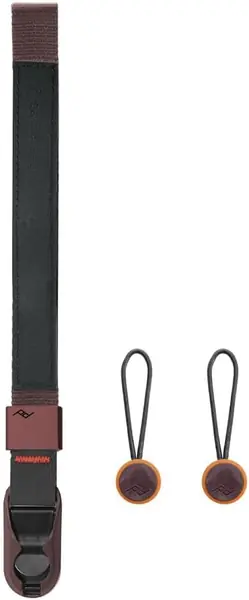
A wrist strap is for a particular kind of shooting: camera in hand, ready, working a market or a street for an hour with no bag open. The Cuff is a better version of that idea than the thin loop that comes in the box, a wide band that cinches down on your wrist so the camera cannot slide out of your hand if you open your fingers.

The anchor system is what makes it worth owning rather than merely fine. The same cord loops hold the Slide Lite, so one camera can wear a neck strap for the walk and a wrist strap for the crowded stretch without touching a lug. It is small enough to leave clipped to the camera permanently, and the cinch works one-handed, which is the entire point of wearing one.

The opening runs small. If you have big hands or a thick wrist, the cuff is a fight to get on, and it tightens rather than sits loose, which is a real limitation and not a matter of taste. It is also a lot of money for a strip of webbing. Buy it as the second half of a system rather than as your only strap, and it earns its place.

Pros

  • Shares anchors with our top pick
  • Cinches so the camera cannot slip
  • Small enough to leave on the camera
  • Clips on and off in a second

Cons

  • Tight opening on larger hands
  • Expensive for a wrist strap
Our verdict

Our pick for handheld shooting: it cinches to your wrist and shares anchors with our top pick, though the opening runs small.

Check Latest Price
5

JJC Neoprene Neck Strap Best Budget Padded Strap

92 /100
Traveler Score Outstanding

Key details

Weight
3.53 oz
Material
Neoprene
Pad Width
2.36 in
Second Use
Hand strap
Check Details on Amazon

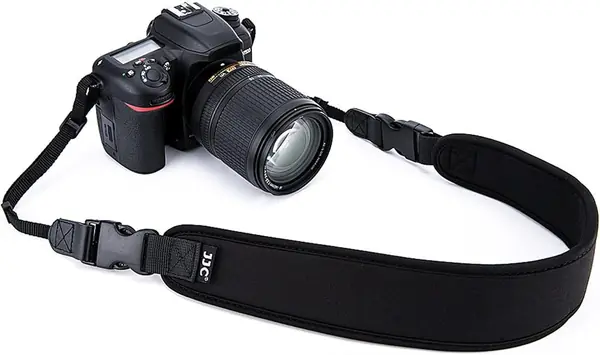
Neoprene is the reason to look at this one. The pad is 2.36 inches wide and soft enough that a crop-sensor DSLR with a kit zoom stops feeling like a brick on your collarbone after the first hour. For the money, the comfort is the whole story.

The feature we ended up using most is not the pad, though. The quick-release clips let you unclip the neck section and join the two ends into a short hand strap, which is a genuinely useful second strap for the price of one. The underside has a light anti-slip finish, so it does not skate off a smooth jacket the way bare webbing does, and the wide part sits flat instead of curling at the edges.

Two things to know. It is short — fine around the neck, not enough to wear crossbody on a tall frame, and the two buckles do not buy much extra reach. And the small hooks that attach to the lugs take patience the first time; thread them once and leave them there. On a light body it is the best comfort for the money here; on a full-frame with a long lens, step up to the PGYTECH.

Pros

  • Wide 2.36-inch neoprene pad
  • Anti-slip backing holds the shoulder
  • Clips convert it into a hand strap
  • Comfortable for the money

Cons

  • Too short for crossbody carry
  • Lug hooks take patience to thread
Our verdict

We think it is the easiest upgrade from a kit strap: a wide, soft neoprene pad for your neck that unclips into a hand strap, for very little money.

Check Latest Price
6

K&F Concept Rope Strap Best for Small Cameras

91 /100
Traveler Score Outstanding

Key details

Weight
2.12 oz
Material
Nylon rope, O-rings
Length
100 cm
Adjustment
Fixed length
Check Details on Amazon

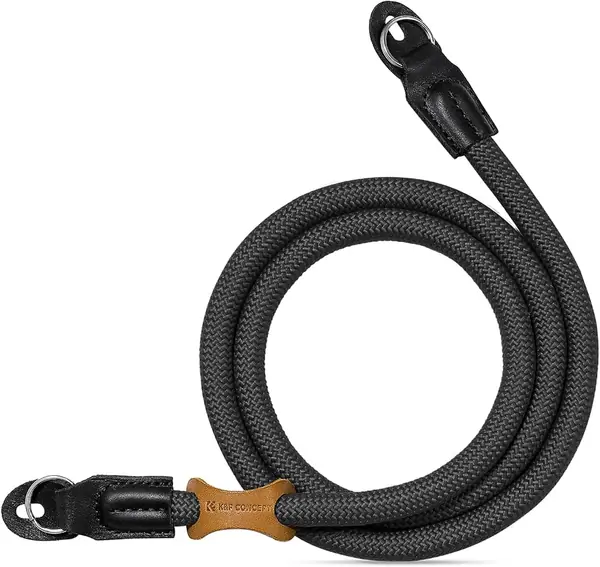
Sixty grams of nylon rope does not sound like much of a strap until you have carried a camera all day with something that does not press on your neck at all. It rolls into a pocket, takes less room than a spare battery, and it is why this is the strap we pack when the camera is a compact body and the bag is already full.

The quality is the surprise at this price. The nylon is tightly braided, the leather tabs at the ends are tidy, and the double-ended O-rings drop through standard strap lugs and sit there without rattling. Those O-rings also mean you can move the strap between two bodies in about a minute, which is more than most straps at this end of the market manage.

The catch is that the length is fixed at 100 cm. There is no adjuster, so on a tall wearer the camera rides near the belt and on a short one it sits high, and there is nothing to do about it afterward. It also carries like a rope, a thin line across the neck rather than a pad, so a heavy body will find the edge of it by the end of the day. Buy it for a light camera and a small bag; that is the whole brief.

Pros

  • 60 g and rolls into a pocket
  • O-rings fit standard strap lugs
  • Clean look on a small body

Cons

  • Fixed 100 cm length with no adjuster
Our verdict

The one we take when the camera is small and the bag is full — 60 grams of rope that rolls into a pocket and looks good doing it.

Check Latest Price
7

WANBY Canvas Camera Strap Best for Tight Budgets

90 /100
Traveler Score Outstanding

Key details

Weight
1.41 oz
Attachment
Plastic quick-release buckles
Material
Cotton canvas, PU leather
Width
1.5 in
Check Details on Amazon

This is the least expensive strap in the guide, and it does not look it: cotton canvas webbing, PU leather ends, and a plain black finish that reads like the strap that came with the camera rather than a cheap add-on. The 1.5-inch width is the part that matters, narrow enough for a small body and wide enough to take the edge off a zoom.

There is very little fuss here. The quick-release buckles let you take the strap off without unthreading anything, an elastic section near the neck gives a little when the camera bounces, and a light anti-slip layer on the inside keeps it from creeping around your shoulder. At 40 grams you forget it is in the bag when the camera is not.

The honest caveat is the hardware. The clips are plastic, and they are the part that gives way first when a strap is asked to carry more than it should. Keep this one on a light mirrorless body or a film camera, give the clips a look before a trip, and it is the best value here; hang a full-frame body and a 70-200 on it and you are asking the wrong strap to do the job.

Pros

  • Canvas and leather look for very little
  • 1.5-inch pad with an elastic neck section
  • Quick-release plastic buckles
  • Light at 40 grams

Cons

  • Plastic clips are the weak point
  • Not for a heavy body and zoom
Our verdict

The least expensive strap here is one we are happy to recommend for a light camera: canvas, leather ends, quick-release buckles, and plastic clips worth watching.

Check Latest Price
8

waka Rapid Camera Strap Hip Carry

89 /100
Traveler Score Excellent

Key details

Weight
9.92 oz
Attachment
1/4-inch tripod stud
Length Range
20.8–31.5 in
Pad
Neoprene
Check Details on Amazon

This one hangs the camera at your hip instead of on your chest. The plate screws into the tripod socket, the strap clips to it, and the camera rides from a wide neoprene pad with the weight on your shoulder rather than your neck, which is a much better arrangement for a body with a long lens bolted to the front.

We understand the appeal for anyone shooting with a 150-600. The load moves off the neck entirely, the strap stays out of the way when you raise the camera, and the safety tether gives you a second line of defense if the socket screw works loose. On a long lens it does a job none of the other straps here can do.

The adjustment range is the problem. At 20.8 to 31.5 inches it is a neck strap, and one cut for a large frame; on a smaller wearer the camera rides high and the pad lands across the shoulder blade instead of the shoulder. It also slides off a smooth jacket, and it occupies the tripod socket, so you unscrew the whole assembly every time the camera goes on a plate. Check the tether before a trip, since it is the part that takes the shock if the screw backs out.

Pros

  • Hangs a heavy lens at the hip, off the neck
  • Safety tether backs up the socket screw
  • Wide neoprene shoulder pad

Cons

  • Short 20.8–31.5 inch adjustment range
  • Occupies the tripod socket
Our verdict

For a heavy lens on a big frame, this is the sling we reach for: it takes the weight off your neck, as long as you do not need the tripod socket.

Check Latest Price
9

TARION Magislide Best for One-Handed Work

88 /100
Traveler Score Excellent

Key details

Weight
4.16 oz
Attachment
Magnetic quick release
Length Range
33–56 in
Load Capacity
110 lb
Check Details on Amazon

The magnetic connector is the hook. Two halves snap together and pull apart one-handed, which is the difference between getting the camera up and fumbling with a buckle when something happens in front of you. It is rated to 110 lb and backed by four Dyneema cord anchors, so the magnet is never the only thing holding your camera, and that redundancy is why we are comfortable recommending it.

The rest is competent rather than clever. The 33-to-56-inch range covers neck and crossbody on most frames, the whole thing weighs 4.16 ounces, and the pad is thin enough to fold into a bag pocket. The load travels down the cord anchors rather than through the magnet, which is the right way to build a quick release.

Check one thing before you commit. The magnets sit close to the camera body, and a magnet in that position can interfere with a rear screen or an internal compass on some bodies, so test it at home before you trust it on a trip. If your camera has no magnetic-sensitive mode, it is the fastest-handling strap in this guide.

Pros

  • Magnetic release works one-handed
  • Four cord anchors back up the magnet
  • 110 lb rated capacity
  • 33–56 inch adjustment range

Cons

  • Magnet can interfere with camera electronics
Our verdict

The quickest strap here to get a camera up and away: a magnetic release we could work one-handed, backed by four cord anchors.

Check Latest Price

How We Tested 12 Camera Straps Over Six Months

We started by collecting every strap we could find that fits a DSLR or mirrorless body — padded neck straps, sling-style crossbodies, rope straps, and a wrist strap or two — and cut anything with a fixed length or no backup anchor point. That left 12, and we carried them for six months.

Each one went through the same routine: a daily walk across town with a mirrorless body and a mid-range zoom, an all-day event shoot where the camera never left my shoulder, two day hikes, and a week of travel where the whole kit had to pack into a carry-on. We rotated straps across the same two bodies so the weight never changed from one test to the next.

Adjustability got timed with a stopwatch — could we change the length one-handed, mid-stride, with the camera already hanging? Comfort we judged at hour four, once the pad had absorbed some sweat, and we noted whether a strap would coil into a jacket pocket or demand its own slot in the bag. For security, we hung a body with a 70–200mm lens from each strap for an hour and watched for stretch at the pad and the attachment points, then pulled each connector sideways under load to see how easily it could pop. Durability meant a few hundred clip-and-release cycles and a week of being stuffed in with the rest of the gear. Design counted for something, too: a strap you don't mind being seen with is a strap that actually gets used. Value, in the end, came down to what a strap did rather than what it cost.

How to Choose a Camera Strap

Start With How You Carry, Not With the Strap

Before you look at webbing or stitching, decide where the camera sits. A neck carry puts the load at the base of your neck and is the least comfortable over a long day; a shoulder carry spreads it over a wider surface but slides off smooth fabric; a crossbody or sling carry puts the camera at your hip and out of the way; a wrist strap is for a camera that stays in your hand. Think about what you actually wear when you shoot, because a pad that grips a wool coat can skate off a rain shell in a block.

Attachment: Lugs, Anchors, or the Tripod Socket

Most straps here connect to the camera's two strap lugs, either by threading webbing through or by clipping on a small hook, and that is the arrangement to prefer: it leaves the tripod socket free and spreads the load across the body. Quick-release anchors, the kind the Peak Design straps use, add a clip between strap and lug so the strap comes off without rethreading anything.

Sling straps take the opposite approach. The waka screws into the tripod socket and hangs the camera from one point, which is stronger for a heavy lens and worse for everything else: the strap comes off before the camera goes on a tripod or a plate.

Length Is the Spec That Decides Crossbody

Published lengths are hard to compare because some brands quote the strap and some quote the pad, so look at the top of the range. On an average adult, a crossbody carry wants roughly 55 inches of strap end to end. A strap that tops out near 31 inches, like the waka, is a neck strap and nothing more; the PGYTECH runs to almost 60 inches, which is why it works over a winter jacket.

Fixed-length straps are their own category. The K&F rope strap is 100 cm and stays there, which is right on a small body and wrong on a tall one, and no adjuster will fix that later.

Match the Padding to the Weight You Carry

A wide pad is a lever: the wider it is, the less pressure lands on any one spot, which is why the Art Tribute's cotton pad and the JJC's neoprene pad make a heavy camera bearable on a long walk. The trade-off is bulk. A padded strap takes bag room that a rope strap does not, and on a small mirrorless body a wide pad mostly gets in the way of your hands.

Match the strap to the rig: rope or thin webbing for a compact body, a pad in the 1.5-to-2-inch range for a DSLR, and something with a load rating and an anti-slip backing when a long lens is on the front.

Hardware Is Where Straps Fail

The webbing almost never breaks; the clip, the anchor, or the adjuster does. Metal clips and stitched anchors are the durable choice, and plastic quick-release buckles are fine on a light body and a poor match for a full-frame zoom. Give the whole load path a look before a trip, from lug to clip to stitching to adjuster, and retire anything that is worn or frayed.

If you move between hand, neck, and tripod often, a quick-release system is worth paying for: every connection you do not have to rethread is one you cannot get wrong in the cold.

Frequently Asked Questions

Final Verdict

The one strap we recommend for most people is the Peak Design Slide Lite. The anchors are the difference: the strap comes off when the camera goes on a tripod, moves from neck to sling without a fight, and adjusts one-handed while you walk. It is the priciest strap here, and that is the only real argument against it.

If that is more than you want to spend on webbing, the Art Tribute is the honest second answer, a wide cotton pad that makes a long day comfortable in a pattern you will either love or want to hide. And if the camera lives in your hand rather than on your shoulder, put the Cuff on the same anchors and skip both.