Best Camera Monopods of 2026

A monopod is a compromise you make on purpose: you trade hands-free stability for something you'll actually carry and set up in three seconds. In a dim gym or on a trail where every ounce counts, that's a good trade. It takes the weight of a long lens off your arms and gives back a couple of stops of steadiness.

I've hauled these up hills and into high school gymnasiums, and the gap between good and cheap shows up in seconds: some shiver under a 70-200mm the moment you breathe on them, others feel like fence posts and still pack down shorter than a water bottle. We spent six months testing 12 monopods, and the keepers share honest load ratings, locks that don't slip, and a base you can remove.

The spec people underrate is the feet: several now ship with a folding tripod base that unscrews, turning one stick into a monopod, a low tripod, and a rough video stabilizer — provided the joint is tight. A wobbly base is worse than none, which is why it became one of our first checks.

The Best Camera Monopods

1

IFOOTAGE Cobra 3 C180F-P Best Overall
92 /100
Traveler Score Outstanding

Key details

Maximum Load
17.6 lb
Folded Length
27 in (68.6 cm)
Maximum Height
71 in (180 cm)
Weight
2.8 lb (1.27 kg)
Check Details on Amazon

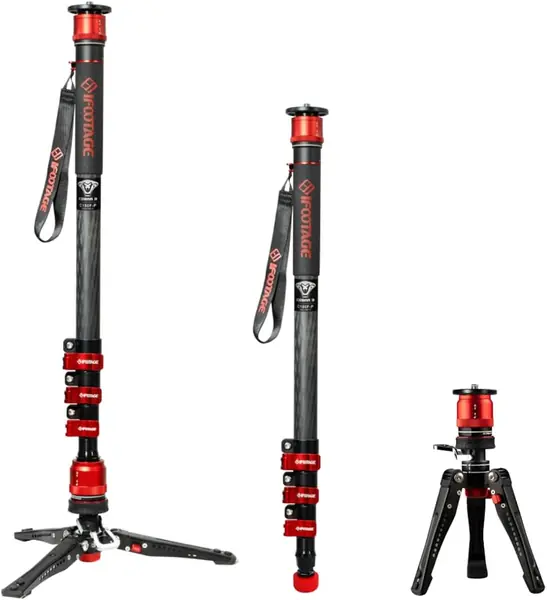
A foot pedal at the base is what sets the Cobra 3 apart: press it and the column swivels freely, step off and it locks where you left it, all without taking a hand off the camera or an eye off the finder. We paid close attention to that joint because it is where most monopods get fiddly, and moving it underfoot changes how quickly you can follow something that will not hold still. That pedal is the main reason this is our top pick.

The rest of the package backs it up. Carbon-fiber sections reach 71 inches, the rated payload is 17.6 pounds, and the pole itself weighs about 2.8 pounds. In practice that payload covers a full-frame body with a 70-200 f/2.8 mounted and leaves room to spare. The mounting screws convert between 1/4 and 3/8 inch, so a camera, a gimbal, or a mic bar all thread straight on, and pressing the sleeve at the top ejects the plate for a fast body swap.

The base detaches, which matters more than it sounds: pull it off and you have a plain pole to brace against a railing or pack alongside a tripod; leave it on and the three short legs hold the pole upright between frames. One thing to work before you trust it: cycle the pedal a few times and make sure it snaps back cleanly, because a pedal that stays down leaves the column loose and takes the stability with it.

Pros

  • Foot pedal frees and locks the base hands-free
  • 17.6-pound payload covers a body and fast zoom
  • Quick-release plate ejects on a sleeve press
  • Folding base detaches for a plain pole

Cons

  • 27-inch folded length is long for a daypack
Our verdict

We recommend the Cobra 3 to anyone who shoots both stills and video, because the foot pedal and 17.6-pound payload cover a full-frame rig without asking for a second tool.
Check Latest Price
2

Amazon Basics 67-Inch Monopod Best Budget

91 /100
Traveler Score Outstanding

Key details

Maximum Load
6.6 lb
Folded Length
21.4 in
Maximum Height
67 in (170 cm)
Weight
12.8 oz
Check Details on Amazon

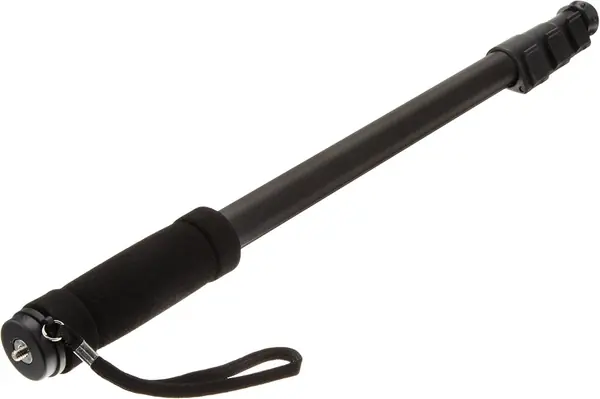
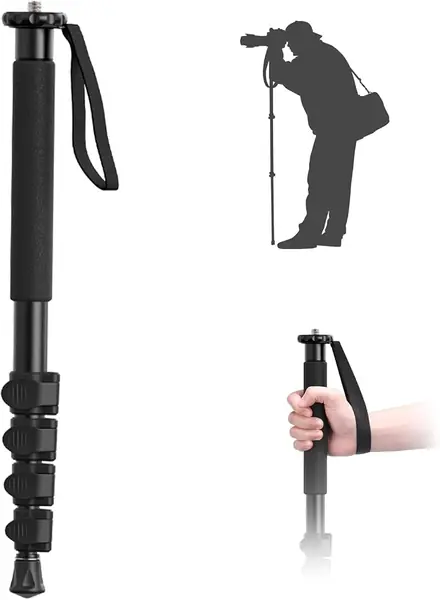
If you have never owned a monopod, this is the one to find out with. The Amazon Basics pole runs to 67 inches on four sections, collapses to 21.4, and weighs 12.8 ounces, and it is the cheapest pick in this guide.

What surprised us is how little it gives up at that price. The foam grip is comfortable through a long afternoon, the wrist strap sits where your hand actually goes, and the rubber foot hides a retractable spike for grass and gravel. It is happiest with a mirrorless body and a kit lens or a consumer zoom, where it is steady and unremarkable in the best way.

One thing to know before you order: this is a single-foot design rather than a folding base, so it leans on you instead of standing on its own, and that is exactly why it packs so small. Buy it as a pole for bracing and carrying, and it will do everything you ask of it.

Pros

  • Cheapest pick here, so trying one costs little
  • 12.8 ounces and 21.4 inches collapsed
  • Foam grip with an attached wrist strap
  • Rubber foot with a retractable spike

Cons

  • 6.6-pound limit caps you at lighter glass
  • Collars and screw-in foot wear under heavy use
Our verdict

This is the pole we hand to anyone buying a first monopod, as long as their camera and lens stay comfortably below its 6.6-pound ceiling.

Check Latest Price
3

ULANZI TB12 Best for Hiking

89 /100
Traveler Score Excellent

Key details

Maximum Load
11 lb (5 kg)
Folded Length
16.9 in (43 cm)
Maximum Height
61 in (155 cm)
Weight
0.83 lb (378 g)
Check Details on Amazon

A monopod that doubles as a trekking pole sounds like a gimmick until you are three miles up a trail with a camera on your back. The TB12 is 0.83 pounds and folds to 16.9 inches, so it rides inside a daypack or straps to the outside, and it opens to 61 inches across five sections. On the climb it takes weight off your knees; at the top it takes weight off your arms.

We expected the walking-stick modes to be the weak part and they turned out to be the useful one: the pole is rated for 11 pounds, which covers a DSLR with a 300mm zoom, and the clamps stayed tight at full extension. It is one of the few picks here that earns its place in a pack you carry all day rather than a bag you set down at a location.

The quirk is the ground tip, which threads off easily and will not announce itself until it is somewhere on the trail behind you. A dab of thread-locking compound on the threads settles it for good, and after that it is a pole you forget about until you need it.

Pros

  • 0.83 pounds and 16.9 inches folded
  • Works as a trekking pole on the approach
  • 11-pound rating covers a DSLR and a 300mm

Cons

  • Shortest of our picks at 61 inches
Our verdict

Buy the TB12 if your camera goes where your feet go, because it earns its weight as a trekking pole before it ever holds a camera.

Check Latest Price
4

COMAN KX3232Q6 Best for Video

88 /100
Traveler Score Excellent

Key details

Maximum Load
22 lb
Folded Length
26 in (64 cm)
Maximum Height
73.2 in (186 cm)
Head
Q6 fluid head
Check Details on Amazon

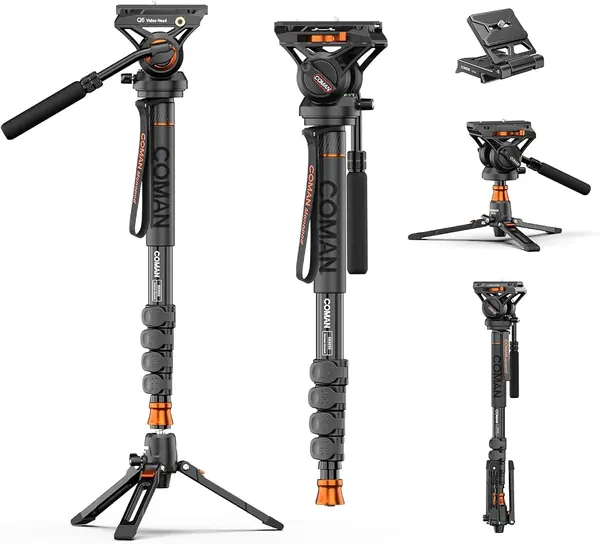
The Q6 head is the reason to buy this one. It is a proper fluid head with a Manfrotto-style plate that drops in from the top and locks almost instantly, which is what you want when you are moving between a gimbal, a tripod, and the pole in the middle of a shoot. Add 73.2 inches of reach, a 22-pound payload, and a folding base, and this is the video pick of the group.

It also stands up by itself with the tripod base attached, which none of the bare poles here can do, and 22 pounds is enough for a rig with a monitor and a matte box. The base unscrews so the pole can be used on its own, which is the difference between packing it for a shoot and leaving it behind.

The weight is the honest trade-off. At 4.6 pounds, before you add a camera and a rig, it is a pole you set down between setups rather than carry up a hill, and the folding base is what makes setting it down useful. For a hike-in landscape shoot the carbon IFOOTAGE is the better companion; for a gym, a conference, or a wedding, this one is built for exactly the work.

Pros

  • Top-loading fluid head locks in about a second
  • 22-pound payload handles a full video rig
  • Stands on its own with the folding base
  • Detachable base converts it to a plain pole

Cons

  • Foot base collar works loose under load
  • Fluid head drag stays stiff at its lightest
Our verdict

The KX3232Q6 is our video pick for anyone who pans and tilts on location, since the fluid head and folding base do work a bare pole cannot.

Check Latest Price
5

SIRUI AM-404FL Best for Long Lenses

87 /100
Traveler Score Excellent

Key details

Maximum Load
26.4 lb
Folded Length
22.8 in (580 mm)
Maximum Height
75.8 in
Weight
4.6 lb (2.1 kg)
Check Details on Amazon

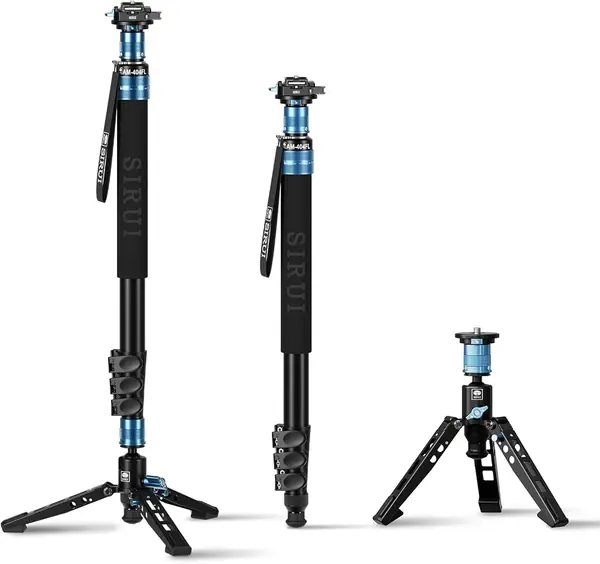
Nothing else in this group is rated to carry as much: 26.4 pounds, on a pole that opens to 75.8 inches. If a 100-400 or a 200-600 lives on your camera, that margin is the entire point, because a support that is merely adequate becomes a different object when you are holding a long lens steady for two hours.

The details are aimed at the same shooter. SIRUI fits a quick-release plate to the base as well as the top, so the mini tripod comes off in one press when you want a plain pole, and the mounting stud flips between 1/4 and 3/8 threads with a button press and a turn. Our favorite touch is the textured collar under the top plate: unlock it and the whole rig pans 360 degrees without any head at all, which is the move you need for something that will not hold still.

What that capability costs is 4.6 pounds and a folded length around 23 inches, which puts it in a pack rather than a pocket. It is the pick for a photographer who works from one position with big glass, not for anyone who wants a pole in a day bag.

Pros

  • 26.4-pound rating is the highest here
  • 360-degree panning collar works without a head
  • Quick-release plate at the top and the base
  • Reaches 75.8 inches, the tallest here

Cons

  • 4.6 pounds is a lot to carry all day
Our verdict

Buy the AM-404FL if you shoot long glass from a fixed spot, where its 26.4-pound rating and panning collar beat anything lighter here.

Check Latest Price
6

SmallRig Carbon Fiber Monopod Best Ball Head

86 /100
Traveler Score Excellent

Key details

Maximum Load
11 lb (5 kg)
Folded Length
26.8 in (68 cm)
Maximum Height
65.6 in (166.5 cm)
Head
Ball head, Arca plate
Check Details on Amazon

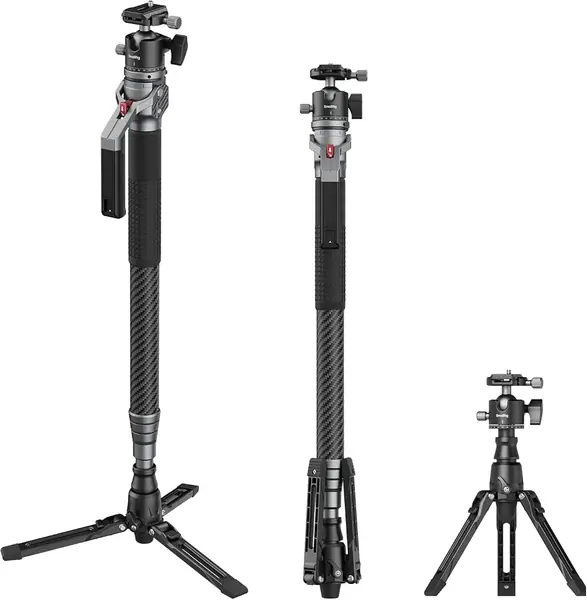
Press a button, slide the column, release. That is the whole height adjustment, one hand, no sequence of clamps to undo, and it is the feature that makes this SmallRig the pick for stills shooters working in tight quarters: a press box, a hallway, the front row of a ceremony where you cannot step back to raise a pole.

Under the head is a four-section carbon pole rated for 11 pounds, opening to 65.6 inches and folding to 26.8. The ball head takes an Arca-style plate, so the camera comes off in one motion, and the threaded hole on the side of the body takes a magic arm for a monitor or a microphone.

Where it belongs is a bag that travels by car, the kind that goes to weddings, conferences, and school gyms, where saving a minute on every height change matters more than a few ounces. Shoot video and the fluid-head picks are the better tools; this one is for framing a still, not for following motion.

Pros

  • One-button height change works with one hand
  • Ball head and Arca-style plate for fast framing
  • Carbon pole rated for 11 pounds
  • Accessory thread for a monitor arm

Cons

  • Arca-style clamp can lose its grip on the plate
  • Heavy at 3.8 pounds for carbon fiber
Our verdict

This SmallRig is the one for stills shooters in tight spaces, where one-button height changes are worth more than a lighter pole.

Check Latest Price
7

K&F CONCEPT MS16 Best for Second Pole for the Car

85 /100
Traveler Score Excellent

Key details

Maximum Load
22 lb
Folded Length
17 in (43 cm)
Maximum Height
63 in (160 cm)
Foot
Rubber and metal spike
Check Details on Amazon

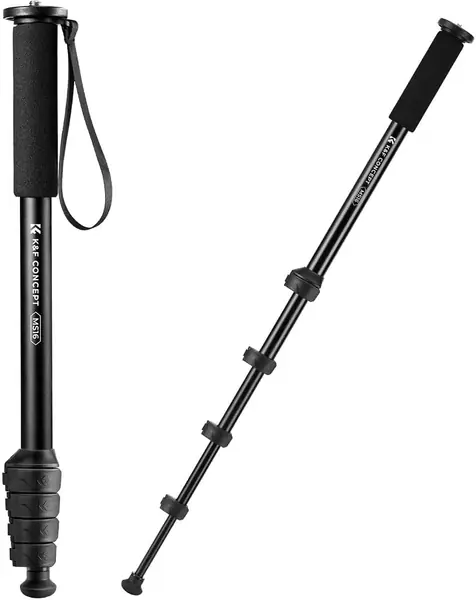
Seventeen inches folded, 63 inches open, and rated for 22 pounds: the MS16 pairs a budget price with a payload figure that beats most of the mid-priced poles here. Five sections get you the height, and the plate-style locks set quickly with two hands.

It is the pick for a second monopod, the one that lives in the car or the bottom of a camera bag and comes out for school plays, youth soccer, and the occasional hike. The 1/4 and 3/8 interfaces take a camera directly or a head you already own, and the foot switches between rubber and a metal spike depending on whether you are on a gym floor or a hillside.

What you give up is the last bit of refinement. It is aluminum and feels it, and that is most of the difference between this and the mid-priced poles. For a pole that sits in the trunk until game day, that difference never shows up in the photos.

Pros

  • 22-pound payload at a budget price
  • Folds to 17 inches
  • Rubber or metal spike on the same foot
  • 1/4 and 3/8 mounts out of the box

Cons

  • No folding base, so it will not stand alone
Our verdict

Buy the MS16 as a second pole that lives in the car, since it folds to 17 inches and carries more weight than its price suggests.

Check Latest Price
8

Altura Photo 62-Inch Monopod Ultralight Day Kit

84 /100
Traveler Score Excellent

Key details

Maximum Load
5 lb
Folded Length
16.75 in
Maximum Height
62 in
Weight
9.44 oz
Check Details on Amazon

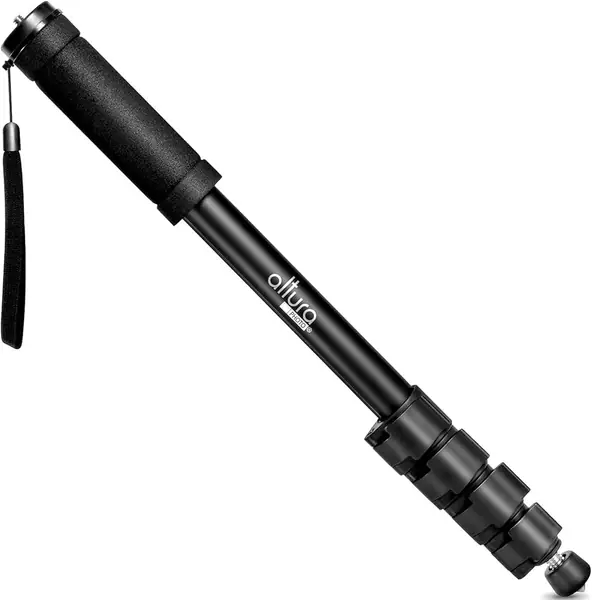
Nine and a half ounces and 16.75 inches folded, the Altura is the one that disappears. It fits across the bottom of a daypack or into a side pocket, which is the difference between a support you bring and one you leave in the car.

On a light kit it is genuinely useful. A mirrorless body with a small prime steadies up nicely, the foam grip keeps your hand from cramping, and the retractable spike gives you something to plant on a trail. Think of it as insurance for the shot that otherwise gets missed rather than the pole you build a shoot around.

Where it earns its place is travel: a phone clamp or a small body, a wrist strap, and a pole that weighs less than a water bottle. If your camera is heavier than that, one of the taller and sturdier picks is the better buy.

Pros

  • 9.44 ounces and 16.75 inches folded
  • Foam grip and wrist strap for handheld work
  • Rubber foot with a retractable spike

Cons

  • 5-pound limit is the lowest here
  • Top section flexes with heavier bodies
Our verdict

The Altura is right for a phone or a small mirrorless body, because it weighs under ten ounces and fits where other poles will not.

Check Latest Price
9

NEEWER T222 Best for Brief Hands-Free Setups

83 /100
Traveler Score Excellent

Key details

Maximum Load
11 lb (5 kg)
Folded Length
20.5 in (52 cm)
Maximum Height
66 in (168 cm)
Base
Folding three-leg base
Check Details on Amazon

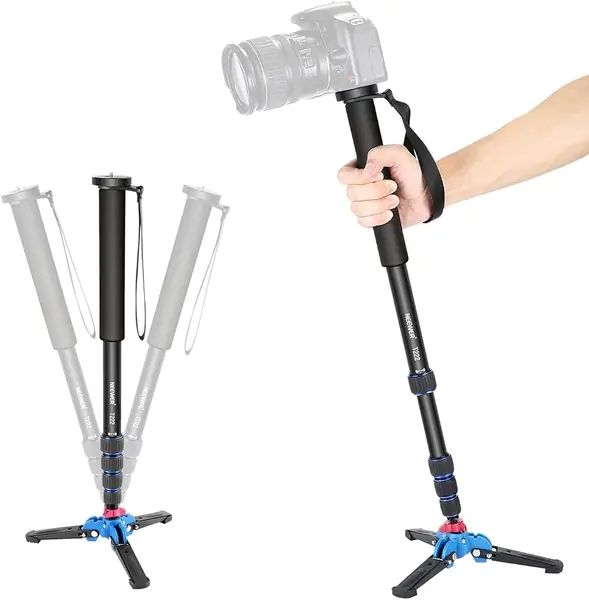
The folding three-leg base is what you are buying here: clip it on and the pole stands by itself, with 15 degrees of tilt and 360 degrees of rotation at the bottom for panning between shots. At 20.5 inches folded and 66 inches open, it is the least expensive way in this group to get a self-supporting monopod.

It is a reasonable compromise for a school gym or a conference floor, where you want the camera at eye level for an hour without carrying a tripod. The foam handle is comfortable and the whole thing weighs under two pounds, so it goes into a camera bag without an argument.

The base legs are short enough that a gust or a nudge will tip it, so treat it as a monopod that can briefly stand rather than a tripod, and never walk away with a camera mounted. That is a fair trade for a pole this light and this inexpensive.

Pros

  • Folding base lets it stand between shots
  • Under two pounds and 20.5 inches folded
  • 15-degree tilt and 360-degree rotation at the base

Cons

  • Feet and joint screws work loose over time
Our verdict

The T222 makes sense if you want a pole that stands up between shots without paying premium money for one.

Check Latest Price

How We Chose and Tested the Best Camera Monopods

To build the shortlist, I started with specs rather than star ratings: collapsed length, maximum height, weight, rated payload, section count, lock style, and whether the monopod came with a head or just a plate. Anything that couldn't plausibly hold a full-frame body with a 70-200mm f/2.8, or that wouldn't drop into a daypack's side pocket, came off the list. That left 12 monopods, which we lived with for six months.

Most of the testing happened where monopods actually get used. I shot dim high school basketball from the baseline, spent two golden hours on a windy overlook, worked a wedding reception where a tripod would have been in everyone's way, and carried each one collapsed on a shoulder strap during two-mile trail walks. At home, I timed setup and takedown solo with a stopwatch and extended each to full height in a dark room to see how the locks felt by touch.

Then we pushed harder. We pressed down on the top plate at full extension and watched how much the last section bowed, and hung a weight bag from the plate to see whether the stated payload was honest. We detached and refastened every folding base after each session to check the threads and whether the monopod still stood level, and dragged a couple through sand to see if grit fouled the locks. Portability got measured rather than guessed: collapsed length against a daypack, weight in hand, and whether anything rattled on a strap.

By the end, the pattern was clear. The cheapest model and one of the priciest both had sloppy locks, and a big payload number meant nothing without a stiff top section.

How to Choose a Camera Monopod

Match the Payload Rating to Your Rig, Not the Spec Sheet

The number that matters is body plus lens plus head, not the pole alone. A mirrorless body with a kit zoom runs around two pounds; a full-frame body with a 70-200 f/2.8 is closer to five or six, and a monopod carries that weight on its narrowest section with the most leverage. We want a rating with real headroom above the rig, which is why the 17-, 22-, and 26-pound picks here are the ones we trust with fast glass.

Long lenses add a second requirement: mount the camera by the lens collar's tripod foot rather than the body, so the weight sits over the pole instead of hanging off the front of it.

Feet Are for Standing, Not for Leaving

A monopod with a folding tripod base will stand on its own, briefly. The base exists so you can let go, check a screen, or hand off a lens, and so the pole can pan without you carrying its weight the whole time. It is not a tripod: the legs are short, the footprint is small, and a gust or a bump takes it down.

Buy the base if you shoot events or video and want the camera set down between takes. Skip it if you walk all day, because the base adds packed length and a couple of things to tighten.

Judge Height at the Camera, Not at the Top of the Pole

Maximum height is measured with every section extended, and those last inches are the least stable ones. What you want is a pole that puts the camera near eye level with a section still collapsed. A 61-inch pole packs small but sits low if you are tall or shooting over a crowd; the 71- to 76-inch picks cost more packed length and buy you a working stance.

Pick the Head Around What You Shoot

Stills shooters want a ball head: one knob, quick framing, and a flip to portrait when the shot turns vertical. Video wants a fluid head with a panning arm, which is what makes a slow pan look deliberate instead of jerky. A bare 1/4-inch screw is the lightest and stiffest arrangement, and it makes sense if you already own a head you like.

Check the plate standard before ordering. An Arca-style plate and a Manfrotto plate are not interchangeable, and a mismatched plate is the reason a new head sits in a drawer instead of on your camera.

Packed Length and Weight Decide Whether It Travels

Seventeen inches folded goes inside a daypack; 27 inches usually rides strapped to the outside or in checked luggage. That single difference decides which pole you actually take on a trip. Aluminum reaches the same height for less money and weighs more; carbon saves a few ounces and damps vibration.

Neither material matters if the pole stays in the hotel room. An aluminum pole that fits in the bag you already carry beats a carbon one you leave behind.

Frequently Asked Questions

Final Verdict

Most people should buy the IFOOTAGE Cobra 3 C180F-P. The pedal at the base turns a pole into a tool you can operate one-handed, the 17.6-pound rating carries a full-frame body with a fast zoom, and 71 inches gets the camera to eye level without extending every section. You pay for that in packed length, and it is worth it if the pole travels in a car or a checked bag.

If you want to spend as little as possible, start with the Amazon Basics 67-inch and stay well inside its 6.6-pound limit. If a 200-600 lives on your camera, the SIRUI AM-404FL and its 26.4-pound ceiling are the reason to pay more.