9 Best Travel Camera Tripod of 2026: Stable Without the Bulk

Which travel camera tripod stays steady at full extension without adding bulk to your carry-on.

Most lightweight tripods look good on paper: a 2-pound body, a folded length that fits in a daypack, and a load rating that claims to hold a full-frame camera. In practice, the real test is how the leg locks and ball head behave after a few hikes. A rating printed on a spec sheet means little if the head sags or the twist locks slip when you need a sharp long exposure.

The trade-off that matters is portability versus real-world stability. A lighter tripod is easier to carry but leaves less mass to resist wind and vibration; a taller, heavier one gives you more confidence but takes up room and weight in your bag. The right choice depends on your camera kit and how you travel.

This guide focuses on models that balance those trade-offs for actual travel use: compact enough for carry-on, stable enough for a mirrorless or DSLR kit, and priced in line with what they deliver.

1

Best Overall Travel Tripod

K&F Concept 64in Tripod

94 /100
Traveler Score Outstanding

Key details

Weight
2.53 lb
Max Height
64.1 in
Folded Length
15.5 in
Load Capacity
17.6lb vertical
Check Details on Amazon

The K&F Concept 64-inch weighs 2.53 pounds and folds to 15.5 inches, which makes it one of the easier travel tripods to justify carrying. Extended, it reaches 64 inches and carries up to 17.6 pounds, so a typical DSLR or mirrorless kit has room to spare. The aluminum build and 360° ball head feel more solid than the budget price suggests, and the 4-section legs keep weight down without the cost jump to carbon. For a first tripod, that combination removes the temptation to outgrow it quickly.

Flip locks open and close in one motion, so setup is a matter of releasing the four leg sections, setting the stance, and tightening the head. That speed is noticeable when a composition appears and disappears quickly. The ball head holds typical camera bodies without droop, and the spread-leg stance keeps a 70-200mm lens planted on pavement or packed dirt. The included carry bag fits the folded tripod and adds no clutter to a carry-on.

The 64-inch model does not chase the taller K&F sibling's remote and monopod features. That version adds height and flexibility, but it is also heavier; this one stays light enough to slide into a daypack rather than earning its own case. The 64-inch working height also puts the camera near face level for group shots, so framing does not require crouching or carrying a step stool. The mix of those numbers is what sets it apart from ultralight models that top out shorter and heavier-duty models that fold longer.

This tripod fits the traveler who carries one camera body, a normal zoom, and maybe a prime, and who wants quick setup without a second bag. First-time buyers get a capable baseline without paying premium prices. Leg-lock consistency varies between units; check locks before trusting full extension.

Value is the final argument. At a budget price, this tripod delivers the folded size, working height, and load capacity that travelers expect from costlier aluminum or carbon models. It keeps the experience simple, which is exactly what a travel tripod should do once the camera bag is packed. It can serve as a backup or loaner later, but it handles the travel years first.

Pros

  • Build quality exceeds the price without adding bulk.
  • Holds typical DSLR and mirrorless bodies firmly through a normal shoot.
  • Folded size and 2.53 lb weight tuck into a daypack for travel.
  • Flip locks get the tripod stable and ready in seconds.
  • Included carry bag simplifies airport and trail moves.

Cons

  • Ball head is stills-oriented; smooth video pans need a fluid head.
  • Near the 17.6 lb rating, large telephoto setups feel less planted when the legs are stretched.
Our verdict

For a travel stills kit, this is the tripod that gets packed. Leave the taller K&F at home unless you actually need its remote and monopod modes.

Check Latest Price
2

Best Budget Travel All-Rounder

XXZU 75in Tripod + Remote

95 /100
Traveler Score Outstanding

Key details

Weight
2.18 lb
Max Height
75 in
Folded Length
14.2 in
Load Capacity
17.6lb vertical, 6.6lb tilt
Check Details on Amazon

The XXZU stands out in the budget tier by pairing a 75-inch max height with a 2.18-pound frame. It converts into a monopod and includes a Bluetooth remote, so hybrid shooters get a single travel tripod for a mirrorless camera and a phone. Three-section legs open quickly, and the ball head offers a broad range of framing angles.

The 75-inch reach covers eye-level landscape and group shots without extra setup, and monopod mode keeps it useful on trails where a full tripod is overkill. The ball head holds typical mirrorless and compact kits at a variety of angles, and the quick leg action makes stop-and-shoot moments easier. Folded length is 14.2 inches, so it slips into a carry-on or daypack with room to spare.

This is for the budget traveler who wants one compact tripod for a mirrorless or compact camera plus a phone, with a remote for solo shots. The top pick offers stronger camera-specific stability; the XXZU counters with more height, monopod flexibility, and a friendlier price. Smooth-pan video and heavy telephoto work belong to a different class of tripod, but hybrid stills shooting on the move is exactly where it fits.

💡 On gusty days, lower the leg spread and avoid full extension to keep the frame steady.

Pros

  • Fast setup: three-section legs open quickly for a stop-and-shoot travel pace.
  • At 2.18 pounds it won't drag down a daypack, and it folds to 14.2 inches.
  • The ball head stays put with typical mirrorless kits and gives plenty of framing angles.
  • Bluetooth remote handles solo shots without reaching for the shutter.

Cons

  • Rotating for a pan can catch rather than glide, so smooth video work needs a fluid head.
  • The light legs can feel less planted on windy overlooks, especially at full height.
Our verdict

The XXZU is the right call for hybrid phone-and-camera travelers who want height, remote, and monopod flexibility without a heavy price.

Check Latest Price
3

Best Tall Travel Tripod with Remote & Monopod

K&F Concept 72in Tripod/Mono

93 /100
Traveler Score Outstanding

Key details

Weight
3.5 lb
Max Height
72.4 in
Folded Length
16.9 in
Load Capacity
22lb
Check Details on Amazon

With a 72.4-inch max height, 22-pound load rating, Bluetooth remote, and detachable monopod in a 3.5-pound aluminum body, this K&F Concept model brings full-size tripod features into a travel-sized package. It is one of the tallest options in this group, and the remote makes solo phone shooting as practical as camera work.

Heavier than the top pick, and leg-lock tightness can vary after extended use, so this K&F is best for travelers who want eye-level height and remote shooting without carrying a full-size tripod. The height-to-carrying-effort balance still leans reasonable for a camera-support tripod.

The detachable monopod extends the usefulness beyond a fixed tripod: convert it for walking shots, event coverage, or use the included extra QR plate to switch between phone and camera quickly.

Pros

  • 72.4-inch max height frames shots at eye level for tall photographers.
  • Well-built aluminum construction holds typical DSLR and mirrorless kits with confidence.
  • Detachable monopod and Bluetooth remote add flexibility for solo shooting and quick conversions.
  • Adjustable leg angles and height make leveling on stairs or uneven ground easier.

Cons

  • Folded at 16.9 inches, it is not the most packable option in this travel group.
  • In very strong wind, the tall five-section stance can feel less settled than a shorter tripod.
Our verdict

Choose the 72-inch K&F when eye-level framing, remote control, and monopod flexibility matter more than the lightest possible carry.

Check Latest Price
4

Best for Heavy Camera Rigs

SmallRig 71in Tripod/Monopod

88 /100
Traveler Score Excellent

Key details

Weight
3.4 lb
Max Height
71 in
Folded Length
16.9 in
Load Capacity
33lb vertical, 11lb tilt
Check Details on Amazon

The SmallRig 71-inch holds a 33-pound vertical load and reaches 71 inches in a 3.4-pound frame, giving full-frame DSLR bodies and telephoto lenses headroom that compact travel pods rarely offer. The detachable center column turns into a monopod, so event and walking shoots don't require a second support. Pair that with a 360-degree ball head, and the kit covers both tripod and monopod duties from one bag.

The 36mm ball head carries an 11-pound tilt limit, and the twist locks adjust with minimal fuss. For travel kit like a 24-70mm or 70-200mm, setup is quick, and the monopod conversion is handy when you need to move between positions without collapsing the legs. The 71-inch max height also brings a full-frame viewfinder close to eye level for average-height photographers.

This is for photographers traveling with larger camera kits who want one support that works as both a tripod and a monopod. Durability can vary by unit, so checking your specific example is part of owning this one.

The monopod is genuinely useful for hiking or event work, and the price undercuts typical carbon-fiber alternatives while keeping a 71-inch working height. For a single travel support, the combination of high payload and detachable monopod is hard to match at this price.

Pros

  • At 3.4 pounds, it stays portable for a tripod rated to support 33 pounds vertically.
  • Detachable monopod converts quickly, covering event and walking shots without a second support.
  • Build quality feels solid for the price, with a finish that avoids the cheap plastic look.

Cons

  • At 3.4 pounds and 16.9 inches folded, it won't disappear into a minimalist travel pack.
  • Leg-lock tension can degrade over time, allowing wobble under heavy telephoto loads.
  • Some units may develop loose legs after a few uses.
Our verdict

For shooters with full-frame bodies and long glass, this is the high-payload travel option that also converts to a monopod.

Check Latest Price
5

Most Compact Premium Design

Peak Design Travel Tripod

89 /100
Traveler Score Excellent

Key details

Weight
Max Height
60 in
Folded Length
15.4 in
Load Capacity
20lb
Check Details on Amazon

Five-section legs fold to 15.4 inches and the tool-free head moves from bag to shooting in seconds, giving the Peak Design a water-bottle footprint that stands apart from bulkier travel tripods. The built-in phone mount adds a second use when the camera stays packed, and the aluminum body keeps the package simple.

Polished aluminum construction gives it a premium feel in hand, and the omnidirectional ball head pairs naturally with mirrorless and compact kits. For that weight class, setup is fast and the leg locks hold position without fuss. The small folded size also makes it a practical everyday carry, not just a travel-day accessory.

The intended buyer is a frequent traveler who values compactness and quick deployment, likely already in the Peak Design ecosystem, with mirrorless, compact, or smaller DSLR kits as the primary load. Photographers who regularly mount a full-frame body with a heavy telephoto lens should look at a higher-payload stand instead; this Peak Design prioritizes packed size over raw capacity.

There is a clear difference between a load spec and a carry philosophy; this is a design-led travel tool rather than a budget workhorse. Those who already use Peak Design bags and prioritize one tripod that disappears in a bag will get the most value from it.

Pros

  • Folded length of 15.4 inches gives it a water-bottle footprint that packs easily.
  • Polished aluminum build feels premium and handles regular travel wear.
  • Tool-free head and built-in phone mount speed up everyday setup.
  • Travel-friendly weight and folded size suit backpacking and carry-on trips.

Cons

  • Premium price sits at the luxury end of travel tripods, so budget-focused travelers get more capacity for less money elsewhere.
  • Heavier full-frame rigs can push the ball head and leg locks past their comfort zone, with possible leg slide under load.
Our verdict

For travelers who shoot mirrorless, compact, or smaller DSLR kits and prioritize packability and fast setup, this design-forward tripod makes a strong travel companion.

Check Latest Price
6

Compact Camera Backups

Amazon Basics 50in Tripod

91 /100
Traveler Score Outstanding

Key details

Weight
1.23-1.4 lb
Max Height
50 in
Folded Length
16.9 in
Load Capacity
4.4lb
Check Details on Amazon

This is a genuinely lightweight backup stand for phones and compact cameras, priced low enough to toss in a bag without a second thought. The 50-inch height covers typical travel framing, and the included bag makes it easy to carry. The 4.4-pound load ceiling and plastic fittings keep it out of main camera-tripod recommendations: a DSLR with a heavy lens can exceed the stand's margin, and wind gusts can overcome the light legs. For smartphone or compact-camera duty, those limits rarely matter, but they are the reason to treat this as a backup rather than a primary travel tripod.

Pros

  • Quality is higher than the price suggests for an entry-level stand.
  • Light enough for a backpack strap and folds to a short bundle.
  • Setup takes seconds with simple leg locks and a 3-way head.

Cons

  • Plastic fittings and feet can be damaged by over-tightening or rough handling.
  • In wind or with a top-heavy camera, the light frame can wobble or tip.
Our verdict

For a phone, action cam, or compact camera owner who wants an ultralight spare stand for calm-weather travel, this budget tripod fits. Leave it at home when the main kit is a heavy DSLR or mirrorless setup.

Check Latest Price
7

Mirrorless/compact Travelers

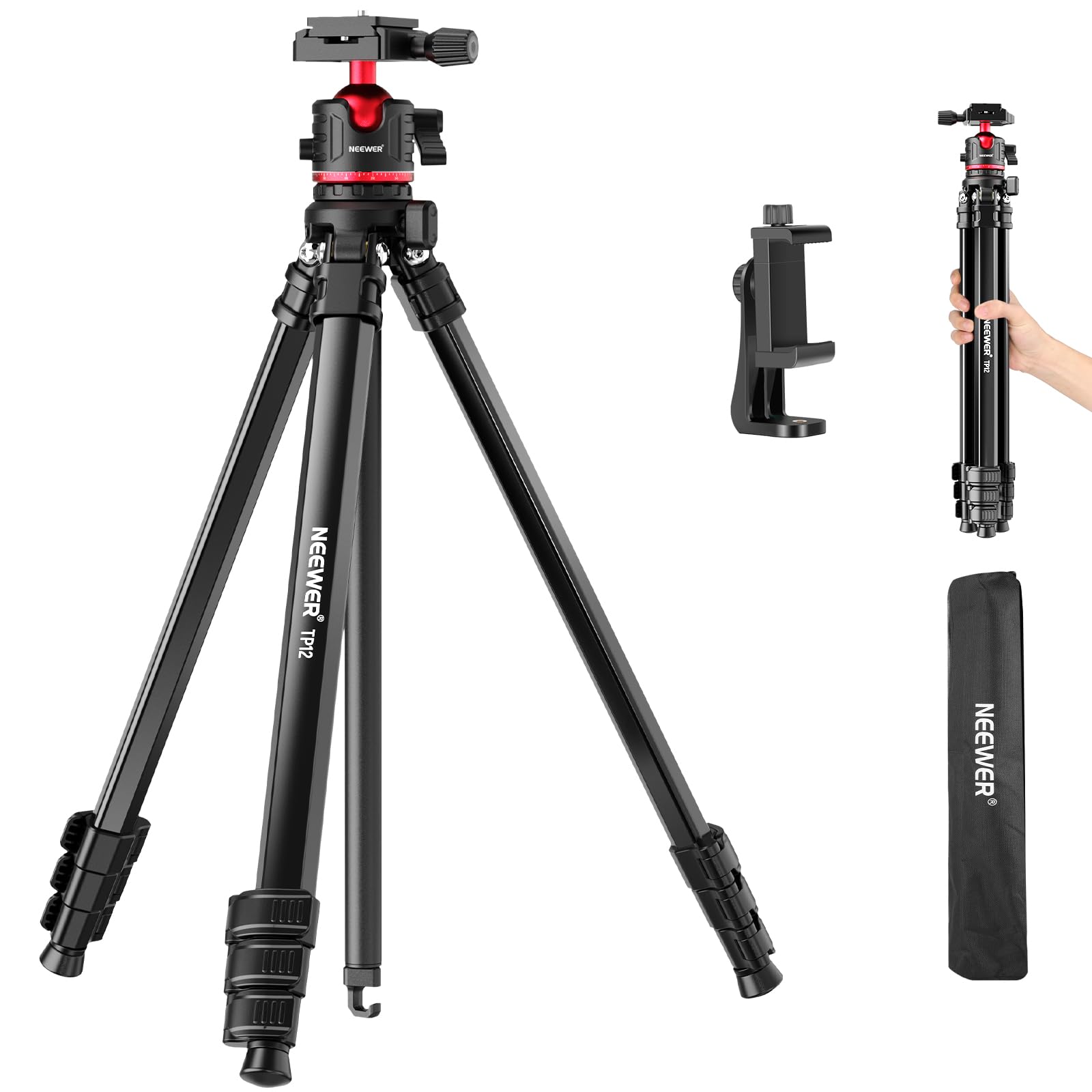
NEEWER Basics 66in Tripod

88 /100
Traveler Score Excellent

Key details

Weight
2.9 lb
Max Height
66.5 in
Folded Length
Load Capacity
11lb
Check Details on Amazon

The entry NEEWER targets mirrorless and compact camera travelers: the 2.9-pound aluminum frame reaches 66.5 inches, includes a phone holder, and supports up to 11 pounds. Set-up is tool-free, and the low-profile ball head holds a typical mirrorless body with kit zoom without complaint. The tradeoff appears with heavier gear: the ball head can sag after tightening with a heavier DSLR setup, and the included carry bag is light-duty enough to tear under stress. Those limits, more than build quality, are why it sits below the top-tier all-around pick.

Pros

  • Solid 2.9-pound aluminum build with a 66.5-inch working height.
  • Tool-free set-up gets the tripod ready quickly at your destination.
  • Included phone holder adds a second use beyond camera support.

Cons

  • Carrying bag can tear at stress points when overloaded.
  • Ball head may sag after tightening with heavier DSLR setups.
Our verdict

For mirrorless or compact camera travel where a phone holder and quick setup matter, this entry NEEWER is a budget-friendly fit. Keep heavy full-frame DSLR rigs on the top-tier all-around pick.

Check Latest Price
8

Carbon-Fiber Value Seekers

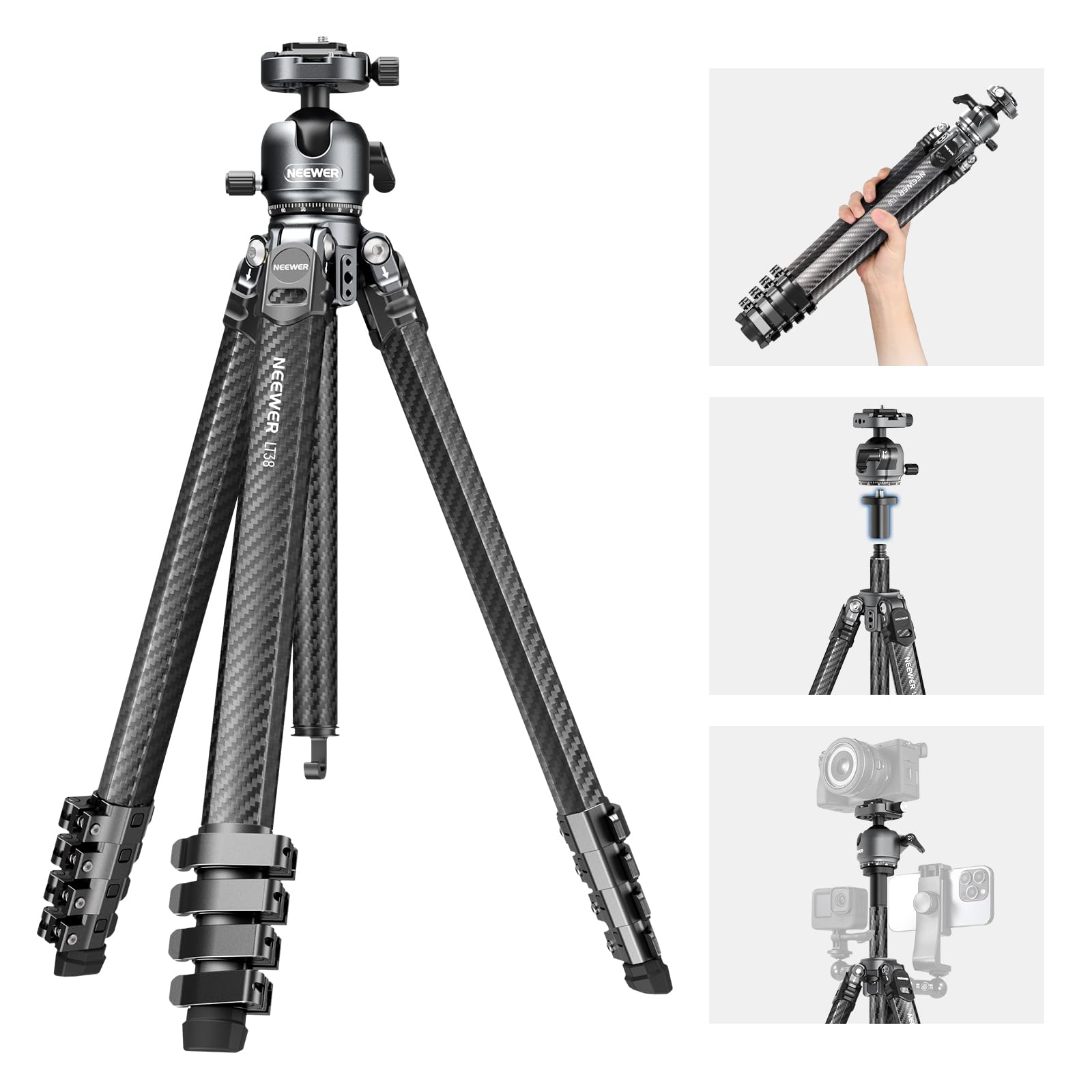
NEEWER LT38 Carbon Tripod

85 /100
Traveler Score Excellent

Key details

Weight
3.15 lb advertised
Max Height
61 in
Folded Length
19.7 in
Load Capacity
22lb
Check Details on Amazon

The LT38 takes the carbon-fiber travel formula toward heavier camera kits: a 22-pound load rating and 40mm low-profile ball head give full-frame mirrorless and DSLR bodies a stable platform, while the five-section legs collapse for travel. The build feels solid through the leg locks and head. One spec issue stands out: the advertised 3.15 lb weight and the 4.1 lb listed in product details disagree, so the true packed weight may be closer to the higher number. That still counts as light for a 22-pound-capacity tripod, but anyone expecting a sub-3-pound carbon tripod should plan around the listed figure. That weight discrepancy is why the LT38 stays in the also-consider column rather than the main pick.

Pros

  • Carbon-fiber build keeps a 22-pound-capacity tripod light enough for carry-on travel.
  • Sturdy enough for standard DSLR and mirrorless kits without noticeable flex at full height.
  • Build quality holds up across leg locks and head adjustments during regular travel use.

Cons

  • Travelers who set up repeatedly will find one more twist lock per leg to check with five-section legs.
  • Travelers who pack to the limit will find the folded length longer than the slimmest tripods in this set.
Our verdict

If your travel kit is a full-frame mirrorless body with a mid-size zoom, the LT38 has the capacity and build to replace a heavier tripod without adding bulk to your carry-on.

Check Latest Price
9

Travel Filmmakers

Manfrotto Befree 3-Way

83 /100
Traveler Score Excellent

Key details

Weight
Max Height
59.1 in
Folded Length
15.8 in
Load Capacity
13.2lb
Check Details on Amazon

The Befree 3-Way Live is a compact travel tripod with a genuine fluid head, so video pan and tilt moves stay smooth without the bulk of a full-size video stick. Folded length is 15.8 inches and the 6 kg load rating covers typical mirrorless and DSLR kits. That makes it a reasonable hybrid companion next to the all-around top pick.

The tradeoff is in the controls and build. Long levers and hard-to-reach knobs can slow quick framing changes, and build and stability can vary between units, leaving some less planted at full extension than the premium price suggests. Careful setup and deliberate moves get around both, and for video-first travel shooting the fluid head carries the value — yet this remains a specialist pick rather than the all-around travel tripod top pick.

Pros

  • Slips into a carry-on while holding a typical mirrorless or DSLR kit.
  • Fluid head delivers smooth pan and tilt for video work.

Cons

  • Long levers and hard-to-reach knobs can slow quick framing changes in the field.
  • Build and stability can vary between units, leaving some less planted at full extension with heavier DSLR kits.
Our verdict

For hybrid travel shooters who want smooth video movement in a compact kit, the Befree 3-Way Live fits; still-photography-first travelers should choose the all-around top pick.

Check Latest Price

How to Choose

Folded Length

Folded length decides whether a tripod rides in a carry-on, a daypack, or a checked bag. Five-section legs shorten the package but add more joints that can loosen, and each extra joint is another potential point of wear. A 15-inch folded length fits most carry-on bags; anything past 19 inches becomes a different packing problem.

Weight

Weight is a trade-off between what you carry and what the camera feels. A 2-pound tripod disappears in a backpack, but its lower mass makes it more vulnerable to vibration from wind and shutter slap. A 3.5-pound tripod is noticeably more solid but adds the weight of a water bottle to your kit.

Max Height

Max height affects how often you bend over and how stable the tripod is at full extension. Center columns are the catch: they add height, but raising them lifts a tall lever, so a camera shake that is a minor blur at chest height can become soft at full extension. Match the height to your eye level and avoid relying on the center column in wind.

Load Capacity

Load ratings are usually measured vertically, straight down, and a ball head locked at a 45-degree tilt handles far less. A 17.6-pound vertical rating can be marginal for a 4-pound DSLR with a 2-pound telephoto lens pointed upward. Look for the tilt rating when the data exists, and treat the vertical number as a ceiling, not a target.

Leg Locks and Setup

Flip locks are faster to deploy, but twist locks distribute clamping force more consistently around each leg segment. Lightweight aluminum and carbon legs rely on the lock mechanism to hold position, and a lock that slips is the most common problem point on travel tripods. Test each lock before you trust it with a long exposure.

Frequently Asked Questions