Best Travel Camera Bags of 2026

The moment I trust a camera bag least is the one where I'm standing in the rain with a lens in one hand and a zipper that won't close. A good travel bag earns its keep long before that — it decides whether your gear arrives organized or in a jumble, whether a full day of carrying ends in sore shoulders, and whether your kit clears airport security without a second look. I've learned to judge one by the boring parts: the stitching, the hardware, and how the closure behaves when you're in a hurry.

Over the past eight months, my team and I loaded, slung, and carried 12 travel camera bags through airports, overhead bins, day hikes, and long afternoons in the city. What separated the keepers wasn't a spec sheet — it was whether a bag still felt right at hour six, whether everything I packed actually fit the way the marketing claimed, and whether the price matched the hardware in my hands. The picks below are the ones I'd carry again.

1

Best Overall

CADeN D6 Camera Backpack

95 /100
Traveler Score Outstanding

Key details

Weight
1.74 lb (0.79 kg)
Capacity
17 liters
Dimensions
11 x 5.9 x 15 in
Water Resistance
Waterproof
Check Details on Amazon

Empty, the CADeN D6 weighs 1.74 pounds, and it still takes a camera body with four lenses, a flash, a tablet and a tripod. Put that beside the two biggest bags here, the MOSISO and the RAINSMORE, which weigh roughly twice as much before anything goes in, and the trade becomes obvious: capacity without the carry.

Eleven by 5.9 by 15 inches is small enough to ride under a seat on most flights and big enough that we stopped rationing lenses. It's the bag we recommend first for a boring reason — you stop noticing it. The whole front opens flat, so you see every divider at once instead of digging, and the deep side pockets take a water bottle or a folded travel tripod without stealing interior space. The fabric is a waterproof nylon, the zips are alloy, and the front pocket hides a passport and a phone behind a zip that doesn't announce itself.

Two things to know before you pack it. The tripod straps want a compact travel tripod; a full-size set of legs hangs awkwardly. And the tablet slot inside is a slot with a retaining strap rather than a padded, suspended laptop sleeve, so a 13-inch laptop goes in snug and unprotected at the base. Neither has cost us a shot. The durability is the one thing we're watching: fabric and stitching are where a bag at this price ages, and that's the dimension where this one sits lower in this set.

The change worth making is a couple of extra padded pouches. Four lenses fit, but not in four separate compartments, and loose glass sharing a divider is how a good trip ends early.

Pros

  • Carries a body, four lenses, a flash and a tripod
  • 1.74 pounds empty
  • Waterproof fabric with alloy zips
  • Hidden front pocket for passport and phone

Cons

  • Tripod straps only suit a compact tripod
  • Tablet slot is unpadded, not a laptop sleeve
Our verdict

The best travel camera bag here for most people: a full kit at under two pounds, waterproof fabric, and a shape that doesn't advertise what's inside.

Check Latest Price
2

Best Sling

K&F Concept Camera Sling

92 /100
Traveler Score Outstanding

Key details

Weight
1.32 lb
Capacity
10 liters
Tripod Straps
Up to 2.99 in diameter
External Dimensions
13 x 8.6 x 5.9 in
Check Details on Amazon

The argument for a sling is a crowd. The bag swings around to your chest without leaving your shoulder, and the camera is in your hands while everyone else is still unshouldering a backpack. The K&F does that at 600 grams, and after a day of it we think that's the entire reason to own one of these instead of a pack.

Ten liters is the honest figure, with an interior of 10.6 by 6.7 by 4.1 inches. Our load was a mirrorless body with a lens mounted, two small primes, spare batteries and cards, and it closed without a fight. The shell is a double-PU-coated recycled nylon that beads water, and the strap runs from 34 to 55 inches, so it goes over a winter jacket rather than bunching under one. Underneath, two straps take a compact tripod of up to about three inches in diameter.

One flexfold divider is the limitation. The backpacks here give you four or five and let you rebuild the interior around a different kit; this one asks you to commit to a layout. The external 13 by 8.6 by 5.9 inches is also smaller in person than the photos suggest, and a gripped body or a 70-200 will fill it alone. That's the bargain a sling makes: you give up the rebuildable interior and get a bag that stays close to your body and never swings wide on a crowded platform.

The part we didn't expect to value: it doesn't look like camera luggage. No logo across the front, a soft boxy shape, and front and back zips that lie flat against the body. On a trip where you'd rather not advertise what you're carrying, that's worth as much as the access.

Pros

  • Swings to the front for one-handed access
  • Weatherproof double-PU-coated nylon
  • 600 grams empty
  • Bottom straps take a tripod up to 2.99 inches

Cons

  • One divider limits how the interior is laid out
  • Tight for a gripped body or a long zoom
Our verdict

For city days when the camera needs to be out in seconds, this sling is the pick — light, weatherproof, and small enough to keep in front of you.

Check Latest Price
3

Best Protection

K&F Concept Hard-Shell Backpack

93 /100
Traveler Score Outstanding

Key details

Shell
One-piece EVA hard front
Weight
2.8 lb
Capacity
22 liters
Laptop Fit
Up to 15.6 in
Check Details on Amazon

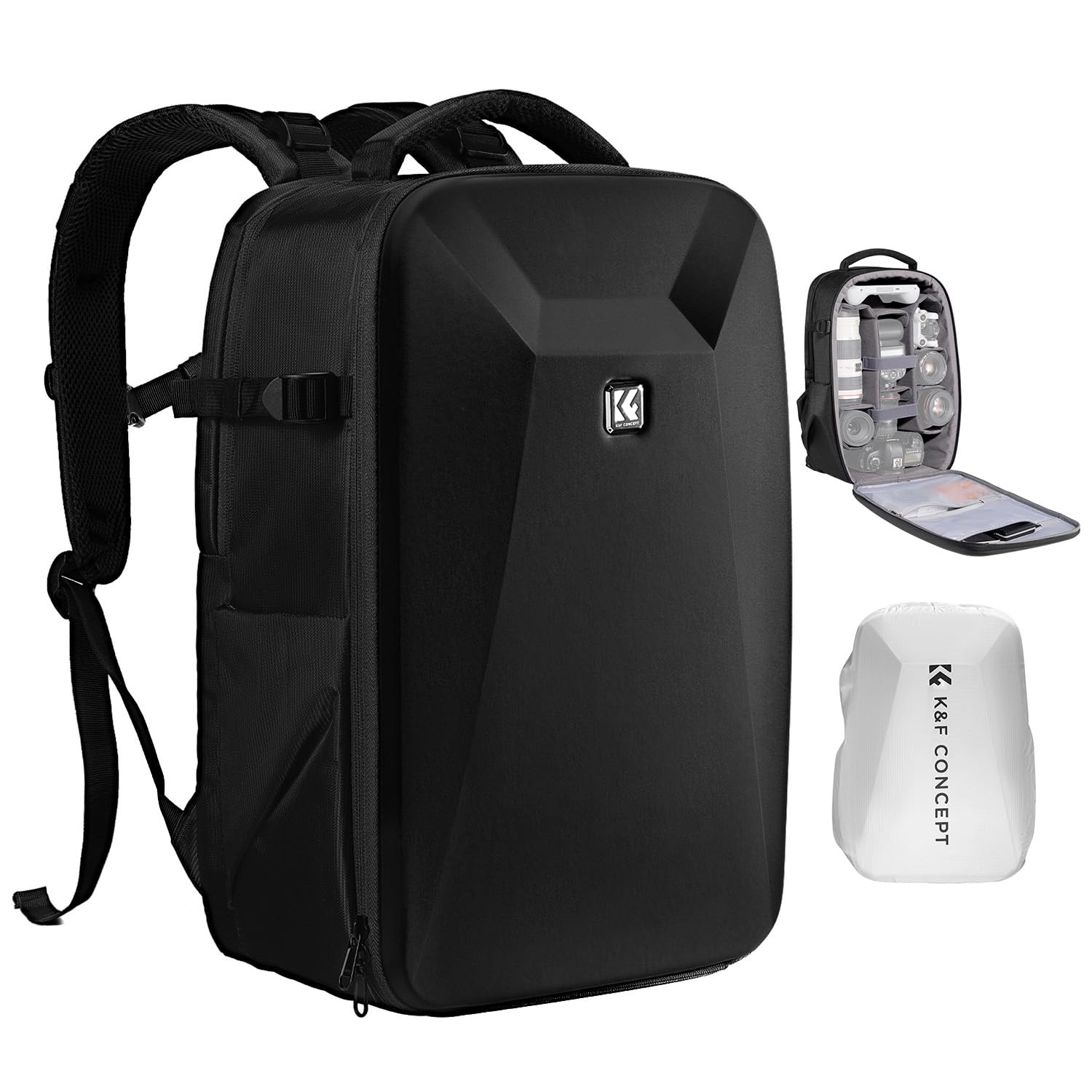
The front of this pack is one molded EVA panel, and that single decision changes how you treat it. You can put it in an overhead bin, under a bus seat or on a luggage rack without working out what's pressing into the camera, and it stands up on its own when you set it down.

Behind the shell sits a foam layer and five compartments inside 22 liters, plus a laptop sleeve that takes up to a 15.6-inch machine and a trolley belt across the back that slides over a rolling case handle. The shoulder straps adjust from 20 to 38.9 inches and the back panel is mesh over padding, so the load is spread rather than hanging off the base of your neck.

We think the hard front earns its 1270 grams on any trip where the bag leaves your back — flights, transfers, crowded trains. Where it costs you is packing: the shell doesn't give, so you fill it or you don't, and 22 liters of rigid bag takes a full kit and a laptop but not a week of clothes on top of that.

Pair it with a rolling case instead of a duffel and the weight stops mattering. The trolley belt and the stiff back make the two behave like one piece of luggage, which is clearly the setup this bag was designed around.

Pros

  • One-piece hard front protects the camera
  • Slides over a rolling suitcase handle
  • Laptop compartment up to 15.6 inches
  • 22 liters with five compartments

Cons

  • 1270 grams before you pack anything
  • Rigid front leaves no give when full
Our verdict

The one to take if your gear rides in overhead bins and on luggage racks: a hard front, a real laptop pocket, and a belt for a rolling case.

Check Latest Price
4

Best for One-Bag Travel

MOSISO Camera Backpack

95 /100
Traveler Score Outstanding

Key details

Weight
3.2 lb
Capacity
35 liters
Laptop Fit
Up to 15.6 in
Camera Insert
Removable padded insert
Check Details on Amazon

Thirty-five liters is the number that turns a camera bag into a carry-on. The MOSISO takes a full kit in the padded insert in the upper compartment, a 15.6-inch laptop in the sleeve against the back, and still has room elsewhere for a jacket, a change of clothes and a pair of shoes for a two- or three-day trip.

What we like most isn't the volume, it's that the insert lifts out. Take it out and the bag becomes an ordinary 35-liter backpack for the days the camera stays at the hotel; put it back and the dividers hold a body and three or four lenses. On a two-week trip that flexibility is worth more than any single feature on any bag here.

Durability is the weakest dimension of this one against the rest of the set. The shoulder strap and the main zip are the parts that go first, and a 35-liter bag invites you to load it to the top. Lift it by the top handle when it's full and don't swing it up by one strap, and you ask less of the seam carrying all that weight.

The rest of the layout is generous: nine pockets, two accessory pockets on the back panel, a tripod or monopod strap on one side, and a clip on the shoulder strap for sunglasses. It is 3.2 pounds empty and 7.5 inches deep, though, so it's the bag that takes up the most room in a crowded car.

Pros

  • 35 liters takes a full kit plus clothes
  • Padded camera insert lifts out
  • Waterproof front panel
  • 15.6-inch laptop sleeve

Cons

  • 3.2 pounds empty
  • 7.5 inches deep, so it sits far off your back
Our verdict

The roomiest bag here: 35 liters, a 15.6-inch laptop sleeve, and a camera insert that lifts out when you want an ordinary backpack.

Check Latest Price
5

Best Discreet Shoulder Bag

BAGSMART Canvas Crossbody

92 /100
Traveler Score Outstanding

Key details

Weight
1.28 lb
Padding
10 mm
Capacity
11 liters
Dimensions
11 x 5 x 7.9 in
Check Details on Amazon

This is the one that doesn't look like a camera bag. The canvas, the buckle and the proportions read as a shoulder purse, and all the padding is hidden inside where nobody sees it — which is the point when you're walking through a city with a camera worth more than your flight.

Eleven liters is more than the size suggests: a DSLR with a lens mounted and one or two spare lenses behind two detachable dividers, with 10 mm of padding wrapping the main compartment. The front and back pockets take a phone, a passport and cards, the shoulder strap detaches and is padded, and a rain cover stows inside for the days the water-resistant canvas isn't enough.

The closure is the thing to work out before a trip. It's a flap over a magnetic clasp, and the clasp needs a firm, deliberate snap to seat — close it in a hurry and you'll be checking it for the next hour. Pack it so the flap sits flat rather than bulging and it behaves, and the flat profile is what keeps the bag slim under your arm.

Where it earns its place is the day when the camera is one of the things you're carrying rather than the only thing: lunch, a museum, a market, no second bag. It's the pick for a trip where you'd rather blend in than look equipped.

Pros

  • Reads as a purse, not camera gear
  • 10 mm padding and two movable dividers
  • Rain cover stows inside
  • Front and back pockets for phone and passport

Cons

  • Holds a body and two lenses at most
Our verdict

The best-looking bag here for a city trip: a DSLR and two lenses in something that passes as a handbag, with a rain cover stowed inside.

Check Latest Price
6

Wet-Weather Hiking

RAINSMORE Camera Backpack

90 /100
Traveler Score Outstanding

Key details

Weight
3.64 lb
Capacity
28 liters
Laptop Fit
Up to 15.6 in
Rain Cover
Included
Check Details on Amazon

The RAINSMORE arrives with the things you'd otherwise buy separately: a full-coverage rain cover, a side zip that opens straight onto the camera compartment, and MOLLE webbing across the front for a jacket or a bottle. For the money, it's the best-equipped bag in this set.

Twenty-eight liters takes a body, three or four lenses, a flash and a 15.6-inch laptop, and the top pocket swallows a sweatshirt or a light layer — enough that you can leave the second bag at home on a short trip. The dividers are thick and padded, and the side entry means you can pull the camera out without laying the pack down on wet ground.

Two numbers to check before you commit. At 1.65 kilograms it's the heaviest soft bag here, and that's before a kit goes in. And 17.7 inches tall is close enough to carry-on limits that it's worth measuring against your airline's sizer, because a full pack bulges where an empty one doesn't. Neither matters much if the bag lives on your back rather than your shoulder.

The rain cover stows at the base and takes seconds to fit, which on a wet ridge is worth more than any of the organization. That's the honest case for this one: buy it for the weather, and accept the weight as part of the deal.

Pros

  • Full-coverage rain cover included
  • Side opening reaches the camera without unpacking
  • MOLLE webbing for extra gear
  • 15.6-inch laptop sleeve

Cons

  • 1.65 kilograms before you pack
  • 17.7 inches tall
Our verdict

For wet-weather trips with a camera plus a jacket, this is the best-equipped pack here, provided the 3.6 pounds is a weight you're happy to carry.

Check Latest Price
7

Minimal Kits

Besnfoto Canvas Shoulder Bag

94 /100
Traveler Score Outstanding

Key details

Strap
Detachable, adjustable
Weight
14.1 oz
Capacity
3.5 liters
Dimensions
8.27 x 4.72 x 6.7 in
Check Details on Amazon

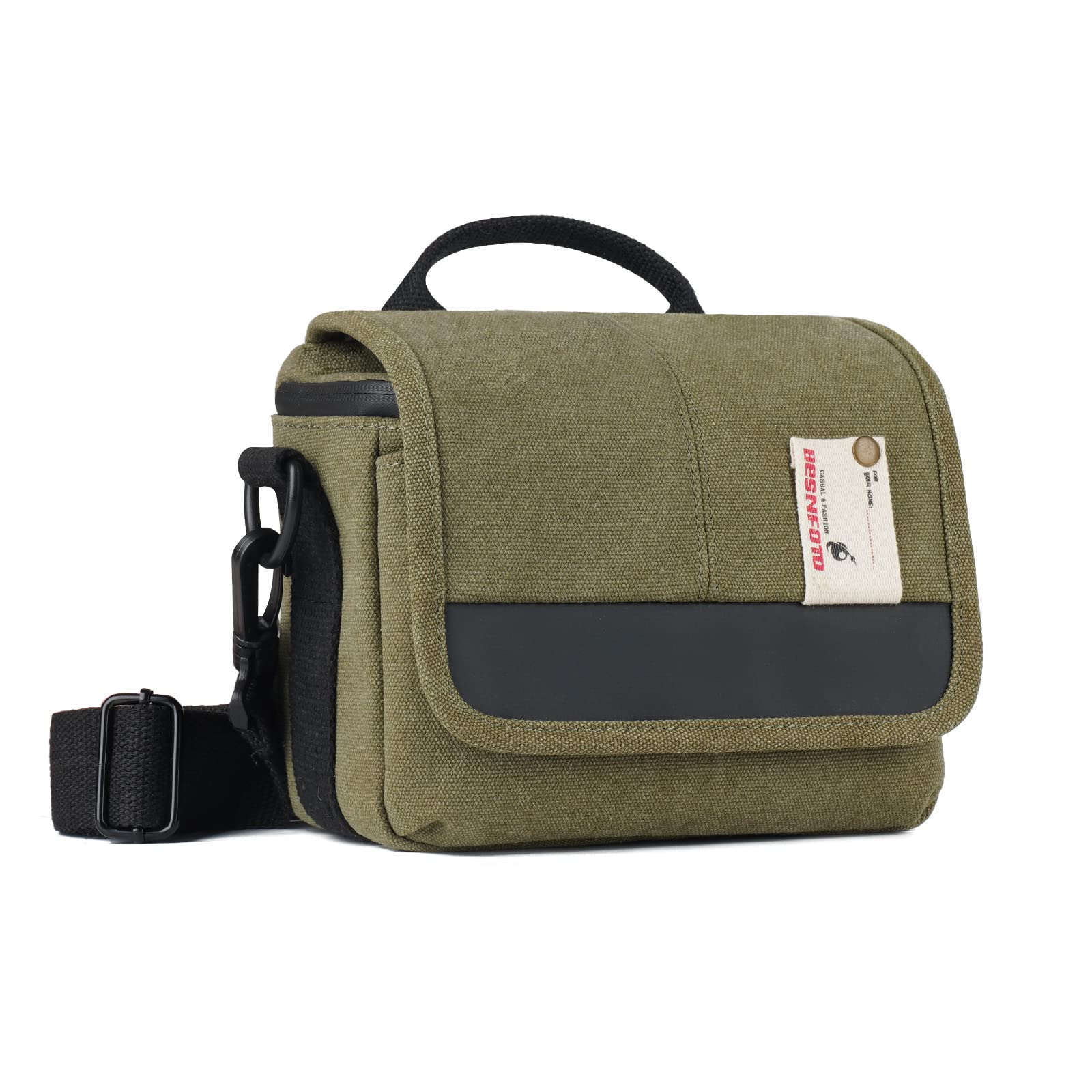
8.27 by 4.72 by 6.7 inches, and 400 grams. The Besnfoto holds one camera with a lens mounted and one spare lens, and that isn't a compromise, it's the specification — this is a bag for a compact or a small mirrorless and nothing beyond it.

What it does with that space is tidy. The 16A canvas is water-resistant, the main compartment is wrapped in shock-absorbing PE foam, and the flip cover opens away from your body so the camera comes out in one motion. The strap detaches at both ends on swivel hooks, so the bag works as a crossbody, a waist pouch, or — strap off — a padded insert dropped into a bigger travel pack.

On a trip where the camera is a compact or a small mirrorless with a prime, this is the least fuss of anything here: it sits flat against your side and disappears under a jacket, and you forget you're wearing it. It won't grow, though — a 70-200 or a second body means a different bag. What it gives up in capacity it makes up for in the fact that you'll actually bring it.

Pros

  • 400 grams and pocket-sized
  • Doubles as a padded insert
  • Water-resistant 16A canvas
  • Detachable strap with swivel hooks

Cons

  • One body and one spare lens, no more
Our verdict

For a compact or a small mirrorless and one spare lens, this little canvas bag is the lightest way to travel with a camera, and it doubles as an insert.

Check Latest Price

How We Tested the Best Travel Camera Bags

We started with a shortlist of about 40 bags and cut it down by reading specs closely: interior dimensions, exterior size against standard carry-on limits, empty weight, and harness design. Anything that couldn't swallow a full-frame body with a grip, two or three lenses, a laptop, and a tripod without inventing storage that wasn't there got eliminated early. That left 12 bags, from simple nylon shoulder models to structured rollers, and each one went into rotation for at least three weeks across eight months of real travel.

Every bag got the same loadout — a body, a 24–70mm, a 70–200mm, a 13-inch laptop, batteries, cards, and a travel tripod. I packed it cold each time and noted what had to be left behind, whether the dividers could be rearranged without tearing the whole interior apart, and whether a long lens mounted on a body would actually sit the way the product photos suggested. Each bag was then measured against a carry-on sizer and slid under an airplane seat to see how it behaved in the real world of a middle seat.

Carrying is where the field narrowed. I wore each bag through terminals, up subway stairs, and on six-hour walking days, paying attention to where the strap dug in, whether the harness adjusted short enough for a smaller frame, and whether the bag swung out when I turned quickly. Closure got its own pass: I opened each one one-handed while walking, checked whether the main zipper could be locked, and set bags down on wet ground to see if anything seeped through. Back home, I cycled every zipper and buckle repeatedly, hung each bag from a single strap with weight inside, and dragged the base across concrete. Value came last — whether the hardware and stitching in my hands justified the price against the rest of the field.

How to Choose Travel Camera Bags

Carry style comes before capacity

A backpack is the only shape that carries a full kit for a whole day, because the load sits across two shoulders and a padded back panel rather than one strap. A sling is faster and better in a crowd, and it's fine for two or three hours; wear one for ten miles and you'll feel the asymmetry by dinner. A shoulder bag is for evenings and short walks.

Pick the shape for your longest day of the trip, not your average one. Once that's settled, the capacity question gets much easier, because you're only comparing bags that carry the way you actually will.

Measure it against your airline, not the word compact

"Compact" in a product listing means it fits a car trunk. What matters is whether the bag passes a sizer: personal-item limits cluster around 18 by 14 by 8 inches, and anything much over 17 inches tall generally has to go in the overhead bin.

The CADeN at 11 by 5.9 by 15 inches fits either; the RAINSMORE at 17.7 inches tall is worth checking against your carrier before you book. Measure it packed, too — a full bag bulges where an empty one doesn't.

Do the kit maths before you shop liters

Liters only compare within a similar design. A camera with a lens mounted eats more room than the lens alone, and a padded divider set costs another inch or two of interior. Roughly: 3.5 liters is a compact and a prime, 10 liters is a body plus two or three small lenses, 17 to 22 liters is a full kit with a flash and a tablet, and 28 to 35 liters is a kit plus clothes.

Count the dividers as carefully as the liters. The backpacks here let you rebuild the interior around a different kit; the sling gives you one divider and expects you to live with the layout you chose.

Protection: padding, hard shells, and rain covers

Foam dividers stop gear knocking against gear; a hard shell stops the world knocking against your gear. If your bag spends time in overhead bins, under seats or on luggage racks, the molded front on the K&F hard-shell is worth its extra weight.

Weather is a separate question. Water-resistant fabric handles a shower, waterproof fabric and coated zips handle a wet afternoon, and a rain cover handles a downpour. Two bags here include one, and it remains the cheapest insurance in the category.

Access and discretion

A full-front-opening bag lets you see the whole kit at once, which is what you want when you're repacking on a hotel bed. A side or sling opening gives you one thing fast, which is what you want on a street. The trade-off is exposure: a bag that opens wide in public shows everything you own.

Look for something that doesn't read as camera gear — the BAGSMART canvas and the K&F sling both pass — and keep the camera behind a zip rather than under a flap you've left loose.

Frequently Asked Questions

Final Verdict

Carry all seven and the CADeN D6 is the one we hand most travelers: 17 liters, 1.74 pounds empty, waterproof fabric, and room for a body, four lenses, a flash and a tripod, for the least money here. It is the least fussy way to travel with a real kit.

Choose the K&F hard-shell if your gear rides in overhead bins, or the MOSISO if the camera bag is also your only carry-on. The case for going smaller is a compact kit and a long walking day — that's the K&F sling.