Best Travel Tripods for Camera and Phone of 2026

Every tripod small enough to travel with asks the same bet of you: you fold it down, trust it with a camera worth more than your plane ticket, and hope it stays put when the light finally turns. That bet is really one tradeoff — how little weight you're willing to carry versus how much steadiness you need when the wind picks up at a viewpoint. Get it right and you get sharp low-light shots, clean long exposures, steady video, and photos that actually include you.

Here's what first-time buyers miss: an advertised height usually assumes the center column is fully raised, which is the wobbliest position a tripod has. I care far more about eye level with the column down. We spent seven months shooting with 13 tripods — at trailheads, on hotel balconies, in a few stiff breezes — and the keepers earned it at the leg locks and in the phone clamp. The shortlist below is where that landed.

1

Best Overall

K&F Concept 64-Inch Travel Tripod

93 /100
Traveler Score Outstanding

Key details

Weight
2.54 lb
Folded Length
15.5 in
Load Capacity
17.6 lb
Maximum Height
64.1 in
Check Details on Amazon

It isn't the tallest tripod here and it isn't the cheapest. What the K&F Concept has that the tall budget picks don't is camera hardware: a 36 mm ball head, an Arca-Swiss compatible plate, and an 8 kg (17.6 lb) load rating, on legs that fold to 15.5 inches.

That folded length is the number we care about for travel. Fifteen and a half inches drops into a daypack or the bottom of a carry-on, and 1.15 kg doesn't announce itself on a long walk. The four leg sections use flip locks you can pop with one hand, the center column inverts with a short column for ground-level work, and a phone holder comes in the bag to sit on the same head.

Where it asks for care is up high. At full extension with a heavier camera aboard, the top of the mast has some give, and the flip locks want a firm hand rather than a shove while they are still new. Drop the column an inch or two and spread the legs a stage wider, and it settles into something you trust with a real lens.

What tipped it for us is how little you think about switching devices. One head, one plate, a clamp for the phone when the light goes flat, and nothing extra to lose in a hotel room. For a trip that mixes landscapes, a little video, and a group shot at dinner, this is the one that comes out of the bag first.

Pros

  • Folds to 15.5 inches for a carry-on
  • 36 mm ball head rated to 17.6 lb
  • Arca-compatible plate and phone holder included
  • Flip locks open one-handed

Cons

  • Tops out at 64 inches, below the tall picks here
Our verdict

Our default pick for travelers who pack a camera first: a 36 mm ball head, Arca plate, and 17.6 lb rating in a tripod that folds to 15.5 inches and still takes a phone.

Check Latest Price
2

Best Budget

XXZU 75-Inch Camera Tripod

93 /100
Traveler Score Outstanding

Key details

Weight
2.18 lb
Folded Length
14.37 in
Load Capacity
17.6 lb
Maximum Height
75 in
Check Details on Amazon

The center column unscrews and becomes a 43.9-inch monopod, and that is the trick that kept this one in our hands: you can leave the legs at the hotel and carry the stick to a viewpoint. It is also the tallest tripod here at 75 inches, and it still folds to 14.37 inches at 991 g.

The rest of the package is generous for the money. A 360-degree ball head, three leg angles that let the legs sit almost flat on uneven ground, a 17.64 lb rating, and a Bluetooth remote in the box. The phone clamp grips a bare handset firmly; a thick case or a very large phone is where it gets fussy, so try yours on it before you trust it at the top of the mast.

With a camera aboard, treat 75 inches as a phone height. The mast is thin and the whole tripod weighs under a kilo, so what makes it easy to carry is exactly what lets it move up there. Keep a camera on the lower sections and the frames come out clean; raise it all the way for a phone, a time-lapse, or a wide shot where a little sway never shows.

Pros

  • Detachable column becomes a 43.9-inch monopod
  • Tallest mast here at 75 inches
  • Remote and 360-degree ball head included
  • 17.64 lb rating at 991 g

Cons

  • Bluetooth remote does not pair with every phone
Our verdict

We recommend it when the phone does most of the shooting: 75 inches of height, a monopod column, and a remote, for less than the camera-first picks.

Check Latest Price
3

Best Ultralight

Ulanzi MT-78 Extendable Tripod

90 /100
Traveler Score Outstanding

Key details

Weight
1.54 lb
Head Type
Ball head
Leg Sections
7
Maximum Height
72.83 in
Check Details on Amazon

Seven hundred grams is the whole thing, head included, and it is the lightest tripod here that still gives you a ball head — the one we reach for when the rest of the bag is already full. It reaches 72.83 inches on a seven-section mast, more sections than anything else in this guide, which is how it packs down small.

The details are unusually thoughtful for something this size. Two cold shoe mounts sit on the head for a light or a microphone, the ball head turns a full 360 degrees with 180 degrees of pitch for overhead and portrait shots, and the phone clip and 1/4-inch screw both mount without tools. The remote detaches, so it works as a shutter in your hand as well as a clip on the frame.

The limits show up with a camera on top. Seven thin sections are built to collapse into a suitcase, not to resist a zoom lens, so a phone or a compact mirrorless is the right load; anything heavier and you will see the mast move when you touch the shutter.

Pros

  • 700 g including the ball head
  • Two cold shoe mounts for a light or mic
  • 72.83 inches from a seven-section mast
  • Detachable remote works off the frame

Cons

  • Leg arms can break away from the center hub
Our verdict

The one to take when every ounce counts: a ball head, dual cold shoes, and 72.8 inches of reach at 700 grams.

Check Latest Price
4

Best for Heavy Camera Rigs

SmallRig CT-10 Tripod and Monopod

88 /100
Traveler Score Excellent

Key details

Weight
3.4 lb
Folded Length
16.9 in
Load Capacity
33 lb
Maximum Height
71 in
Check Details on Amazon

Thirty-three pounds is a rating you expect from a studio stand, not from something that folds to 16.9 inches. The CT-10 pairs it with a 36 mm ball head, four-section legs that run from 16 to 71 inches, and a leg that unscrews into a monopod.

That payload is the point. A long telephoto, a gimbal, or a camera with a cage and a monitor goes on and stays where you put it, and the magnesium aluminum alloy feels like the rating is honest rather than optimistic. The price is weight: 3.4 lb is more than twice the ultralight picks here, which matters on a hike and stops mattering entirely if the tripod rides in a car or a studio bag.

The monopod mode is what makes it a travel tripod instead of a studio one. Unscrew a leg, thread the head onto it, and you have a stick that steadies a long lens at a wildlife stop without setting up three legs in the open. We keep this one for trips where the camera is the reason for going and the walking is short.

Pros

  • 33 lb rating holds a long lens
  • Converts to a monopod for hiking
  • 36 mm ball head on magnesium aluminum legs
  • Folds to 16.9 inches despite the payload

Cons

  • Legs and ball head work loose with use
Our verdict

Our pick when a long lens comes along: 33 pounds of rated capacity and a monopod mode in a tripod that still folds to 16.9 inches.

Check Latest Price
5

Mirrorless Travel Kits

NEEWER Basics TP14B

89 /100
Traveler Score Excellent

Key details

Folded Length
17 in
Load Capacity
13 lb
Quick Release
Arca type
Maximum Height
72 in
Check Details on Amazon

Seventeen inches folded, with legs that reverse over the head, and a two-stage center column that carries the working height from 22.8 inches up to 72. The idea is short legs plus a long column — the classic travel compromise, and one this tripod makes neatly.

We like where the money went. An Arca-type quick-release plate, a 360-degree ball head with a panning scale and a 90-degree notch for verticals, a phone holder in the box, and a 13 lb rating, for a little less than our top pick. Nothing about the head or the plate feels like a corner was cut to hit the price.

The thing to understand before you buy is how it gets tall. Because the legs are short, most of that 72 inches comes from the column, and a raised column over a compact base is a tall lever. On level ground with a mirrorless body it is fine; on a slope, drop the column and use the leg angles instead.

Pros

  • Arca-type plate and 360-degree ball head
  • Folds to 17 inches with reverse-folding legs
  • 13 lb rating and a phone holder included

Cons

  • Plastic leg-lock tabs are the wear point
Our verdict

For a mirrorless kit and a tight budget, this is the ball-head travel tripod we point to: Arca plate, phone holder, 13-pound rating, 17 inches folded.

Check Latest Price
6

Panning Video

Victiv 74-Inch Camera Tripod

93 /100
Traveler Score Outstanding

Key details

Weight
3 lb
Folded Length
20 in
Maximum Height
74 in
Minimum Height
19.5 in
Check Details on Amazon

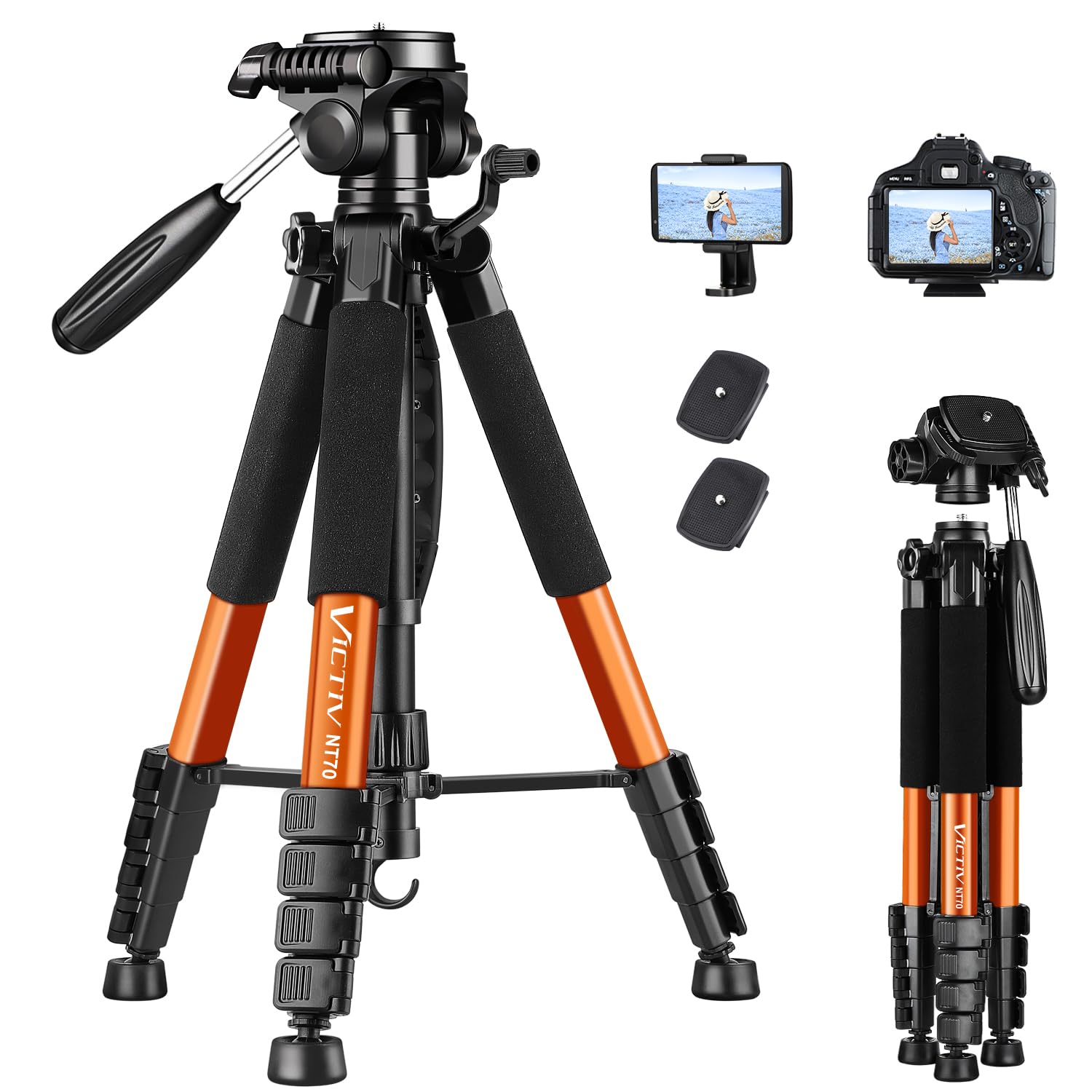
Every other tripod in this guide uses a ball head. The Victiv uses a three-way pan head with a handle, which pans and tilts on separate locks — the arrangement video shooters used long before ball heads took over travel kits.

There is a lot in the box for the money: an extra quick-release plate, a phone holder, both 1/4-inch and 3/8-inch threads, and three non-slip pads. Height runs from 19.5 to 74 inches, which is tall enough to shoot over a crowd, though it folds to 20 inches, the longest here, so it travels in the trunk rather than the daypack.

For filming a school concert or a game from the stands, we think the handle is worth more than any specification. You can follow the action smoothly instead of fighting a joint that wants to flop, and the pan stays level while you do it. It is the tripod that lives in the car and comes out four times a year, which is the life it suits.

Pros

  • Pan handle for smooth pans and tilts
  • Both 1/4-inch and 3/8-inch threads
  • Extra quick-release plate included
  • 74 inches tall for shooting over a crowd

Cons

  • Head works loose and the neck wobbles
  • Leg locks can fail early
Our verdict

The pan-handle pick: choose it if you film events from a fixed spot and want smooth pans without a ball joint fighting you.

Check Latest Price
7

Backpacking

ANXRE NT79 Phone Tripod

89 /100
Traveler Score Excellent

Key details

Weight
12 oz
Top Mount
1/4 in screw
Folded Length
13.58 in
Maximum Height
71 in
Check Details on Amazon

Three hundred and forty grams, folded to 13.58 inches, and it still stands 71 inches tall. Nothing about it looks delicate, but nothing is overbuilt either: aluminum legs in a telescoping mast, a bare 1/4-inch screw on top, and a phone clamp and remote in the box.

For a phone, that trade works. This is the tripod we tuck into a daypack on a hike: at that weight you forget it is there, and a handset at 71 inches in calm air is steady enough for video, a time-lapse, or a family shot where everyone is actually in the frame. The clamp holds a bare phone securely, and the remote saves the sprint back into shot.

Where it earns its keep is the bag. Folded to 13.58 inches it slides in beside a water bottle, and the whole thing is light enough to carry up a hill for the chance of a shot you would otherwise skip. That is a different job from holding a camera steady, and it does the first one better than anything else here.

Pros

  • 340 g and 13.58 inches folded
  • Stands 71 inches tall
  • Phone clamp and wireless remote included

Cons

  • No ball head, so angle comes from the legs
  • Remote pairs with some phones, not others
Our verdict

For hikers who mostly shoot on a phone, this is the one: 340 grams, 13.6 inches folded, and 71 inches of standing height.

Check Latest Price

How We Tested the Best Travel Tripods

We started by gathering every travel tripod we could find that folded small enough to disappear into a daypack and still listed a load capacity comfortably above the weight of a mirrorless body with a zoom attached, then cross-checked against what owners report in reviews: leg locks that creep, plates that won't stay tight, phone clamps that let a handset rotate. From that pool we bought 13 tripods, aluminum and carbon fiber, across a wide spread of prices, and used them for seven months.

Each one went to a trailhead, a hotel balcony, and at least one city sidewalk, and got set up in whatever breeze happened to be blowing. We timed the run from bag to first frame and noted where the fumbling happened — almost always the leg locks. With a camera mounted at eye level and the column down, we tapped a leg and watched the viewfinder, then shot 30-second exposures and checked for smear. After a beach day we tracked grit in the locks, checked how the rubber feet held on rock, and noted whether anything loosened after a week of daily folding.

Phone safety got its own round of abuse: we clamped a phone, tilted the head to portrait, gave the rig a shake, and watched for slip at the clamp and rotation at the plate. We swapped the quick-release plate between camera and phone mount mid-shoot to see how much of a production it was, and counted the adjustments each ball head and lock needed with cold hands. Finally, we weighed what each step up in price bought — some mid-priced models felt indistinguishable from budget ones, and a couple of cheap tripods held steadier than expected.

How to Choose Travel Tripods for Camera and Phone

Start with the camera, then add the phone

Almost anything with legs will hold a phone; the camera is what separates these tripods. Add up your body and the heaviest lens you travel with, then compare that total with the stated load rating. If a listing gives no rating at all, treat it as a phone tripod and nothing more.

A ball head with a 1/4-inch stud plus a clip-on phone holder covers both devices without swapping anything. A bare screw mount will take a phone clamp, but you end up setting the camera's angle with the legs, which is slow and imprecise for anything but a fixed shot.

Packed length is the number that decides

A tripod left in the hotel room is worse than a smaller one you actually carry. Compare folded length with the bag you really take: the packable picks here run from 13.6 to 17 inches, and the 20-inch model is the one that ends up strapped to the outside.

Watch the wording, too. Compact in a listing often describes a tripod that still measures 20 inches closed. Weight follows the same logic: under about a kilo you stop noticing it in a daypack, and above three pounds it becomes a decision you make each morning.

Height, stability, and what the column does

Height is cheap to add and expensive to keep steady. Tall travel tripods get their reach from a slim center column, and every inch of raised column is a lever that moves in a breeze. Pick the maximum height for the shot you actually take — 70 inches or more for standing video, considerably less for landscapes shot at chest height.

Then plan around it. Use a tall tripod with the column partway down when there is any wind, spread the legs a stage wider than looks necessary, and hang a bag low on the column for ballast. A steadier 60 inches beats a shaky 75 every time.

Heads, plates, and the parts that wear

A ball head sets any angle in one movement and is what most travelers want. A three-way pan head with a handle pans smoothly under load and is worth the bulk only if you film events from a fixed spot. Look for a quick-release plate — Arca-Swiss type if you already own brackets — so you can move between camera and phone without re-screwing anything.

The wear items are the leg locks and the phone clamp. Give both a firm workout in the first week, while returning is still easy, and check that the remote pairs with your own phone rather than assuming it will.

Frequently Asked Questions

Final Verdict

The K&F Concept is the tripod we point to first, because it balances the two things this search asks for better than anything else here: real camera support — a 36 mm ball head, an Arca-compatible plate, a 17.6 lb rating — in a package that folds to 15.5 inches and takes a phone without extra hardware.

Take the XXZU instead if your phone does nearly all the shooting and you want the extra height and the monopod column. Take the SmallRig if a long lens is coming along. Everyone else lands on the K&F.