Best Binocular Cases of 2026

The worst sound in birding isn't a missed call — it's your binoculars hitting a rock and the hollow clack that follows. A case is the least expensive part of the kit and the one that decides whether the glass comes home aligned, yet it's usually the last thing anyone shops for. What a good one fixes: grit in the eyecups, a neck strap tangled around the hinge, and the wet-trail moment when there's nowhere safe to set your binoculars down.

We've spent four months with 14 cases, and the differences show up fast. Hard shell versus soft matters less than the interior: a stiff shell with a loose cavity lets binoculars rattle, while a plainer case with foam cut close to the barrel holds them still. Zippers, handles, and straps are where inexpensive cases quietly fail, and they matter more than color.

Fit is also the spec listings describe least honestly; a snug case presses on the eyecups every time you close it. The picks below span compact to full-size glass, and each earned its place.

The Best Binocular Cases

1

LTGEM Hard Case Best Overall
92 /100
Traveler Score Outstanding

Key details

Shell
Hard EVA
Carry
Detachable shoulder strap
Closure
Zipper
Outer Dimensions
8.5 x 8.3 x 2.9 inches
Check Details on Amazon

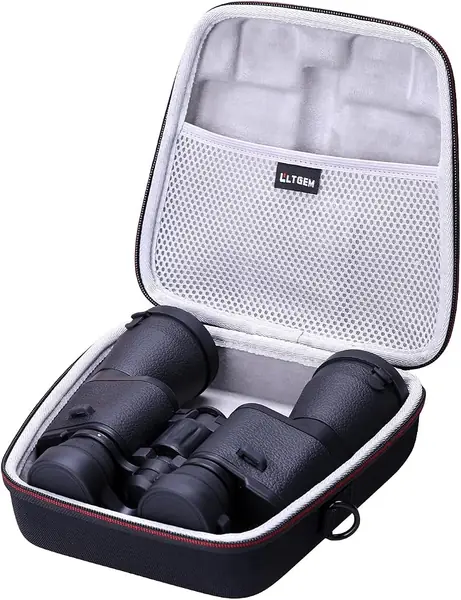
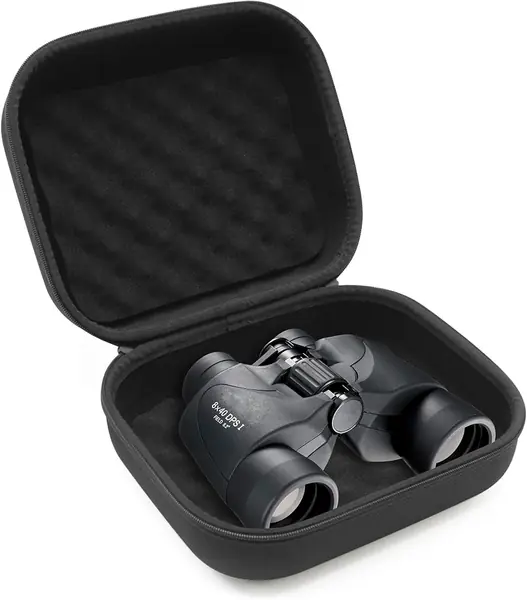
The LTGEM is the hard case we recommend first because it gets the basic travel job right: a rigid EVA shell, a smooth zipper, and a cut that suits full-size 50mm roof-prism binoculars. The stated outer dimensions are 8.5 by 8.3 by 2.9 inches, and the case is built around 20x50 models; it also has enough room for 12x50 and Nikon Aculon A211 pairs with the strap attached. We like that the detachable shoulder strap and mesh pocket make it feel like a travel case rather than a box.

Protection is the reason to choose it over a soft pouch. The hard shell stands off the optics, the zipper closes around the edge, and the semi-waterproof exterior handles splashes and damp grass without asking you to baby it. At 0.3 kg it is light enough to carry on a day hike, and the footprint slides into a backpack or carry-on without much fuss.

Where it earns its keep is the balance of protection and portability. The shoulder strap lets you carry it cross-body when your backpack is full, and the interior mesh pocket keeps a lens cloth and caps from scratching the lenses. It is not a substitute for a padded insert if you plan to check it in luggage, but for carry-on and daypack travel, it is the most sensible default in this group.

Pros

  • Hard EVA shell resists knocks and splashes
  • Included shoulder strap and mesh pocket
  • Light enough for daypack travel

Cons

  • Sized for 50mm bodies, loose on compacts
Our verdict

We recommend the LTGEM first for full-size 50mm binoculars: it pairs a rigid EVA shell and included shoulder strap with a light, packable shape.
Check Latest Price
2

CASEMATIX Binocular Case Best for Maximum Protection

91 /100
Traveler Score Outstanding

Key details

Shell
Hard shell with foam
Carry
Rubber handle
Interior Dimensions
9 x 8 x 4 inches
Exterior Dimensions
9.5 x 8 x 4.5 inches
Check Details on Amazon

The CASEMATIX is the case to choose when protection matters more than a trim silhouette. Its main compartment measures 9 by 8 by 4 inches, and the top and bottom are lined with convoluted foam that cradles the binoculars instead of letting them slide. The exterior is 9.5 by 8 by 4.5 inches, so it is the roomiest hard case in this group and the one that leaves the most room for a strap, lens caps, and a small accessory bag.

We like that the foam does two jobs: it cushions the optics and takes up slack around differently shaped barrels. The reinforced zippers and rubber travel handle make it feel like a case you can grab with one hand and load into the car, and the included netted pouch keeps a cleaning cloth and caps from rolling loose. For a full-size 50mm pair that lives in a vehicle or gets stacked in a duffel, that extra bulk buys real peace of mind.

The size is the catch. At 4.5 inches deep and nearly 10 inches long, it takes up more room than a soft case and can crowd a small daypack. If you are hiking with a 42mm pair and want the lightest possible shell, the LTGEM is the easier carry; if you want foam and space, this is the one. We also appreciate that the case is sold with an accessory bag rather than asking you to find one.

Pros

  • Foam-lined interior cushions full-size optics
  • Roomiest main compartment in this set
  • Accessory bag keeps small items together

Cons

  • Bulky 4.5-inch-deep shell for small packs
Our verdict

Choose the CASEMATIX when protection and accessory room matter more than bulk; its foam-lined interior is the most forgiving space here for full-size optics.

Check Latest Price
3

Xenage Hard Case Best for Compact and Mid-Size

90 /100
Traveler Score Outstanding

Key details

Shell
Hard EVA
Fits
9x35, 8x42, 7x35
Carry
Handle and shoulder strap
Interior Dimensions
7 x 7 x 2.5 inches
Check Details on Amazon

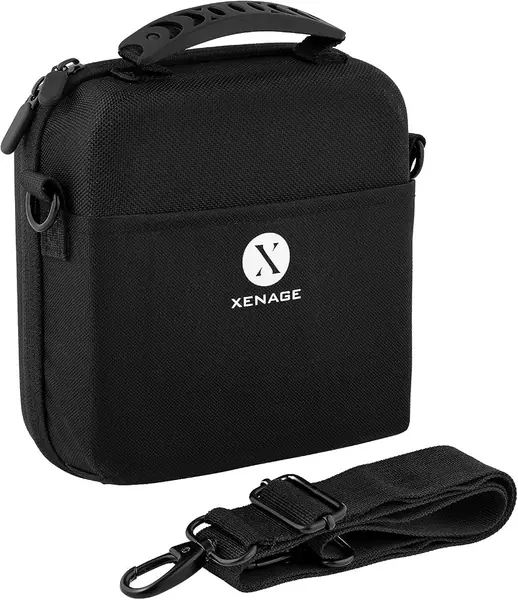
The Xenage is the case we point to for 42mm roof prisms that need to travel with a strap attached. The interior measures 7 by 7 by 2.5 inches and is intended for 9x35, 8x42, and 7x35 models, which is the sweet spot for most birding and hiking binoculars. A textured handle and D-rings give you two carry options, and the included shoulder strap makes it easy to sling over a shoulder when your hands are full.

What sold us is the interior hook-and-loop strap. It holds the binoculars in place so they do not slide into the lens covers or the case wall, and the mesh pocket gives a lens cloth somewhere to live. The hard EVA shell is water-resistant and rigid enough to take a knock in a backpack. It is a tidier, more compact case than the CASEMATIX, and for a 42mm pair it is the one we prefer to pack.

The fit is snug, which is good until you add accessories. If you leave bulky objective covers on or use a very thick padded strap, the lid can feel tight; the case works best with the strap arranged carefully or removed. That is the boundary: it is a compact-case solution, not a case for a 50mm optic. For the right 42mm binoculars, though, the size is the point.

Pros

  • Fits 42mm roof prisms with a strap
  • Interior hold-down strap keeps optics steady
  • Handle, D-rings, and shoulder strap included

Cons

  • Snug with bulky caps or padded straps
Our verdict

The Xenage is our pick for 42mm roof prisms that travel with a strap attached, thanks to its snug hard shell, interior hold-down strap, and included shoulder strap.

Check Latest Price
4

Maven Binocular Case Best Premium Soft Case

89 /100
Traveler Score Excellent

Key details

Shell
Molded foam, ballistic nylon
Fits
38-44 mm mid-size
Interior Dimensions
7 x 6 x 2.5 inches
Strap
Not included
Check Details on Amazon

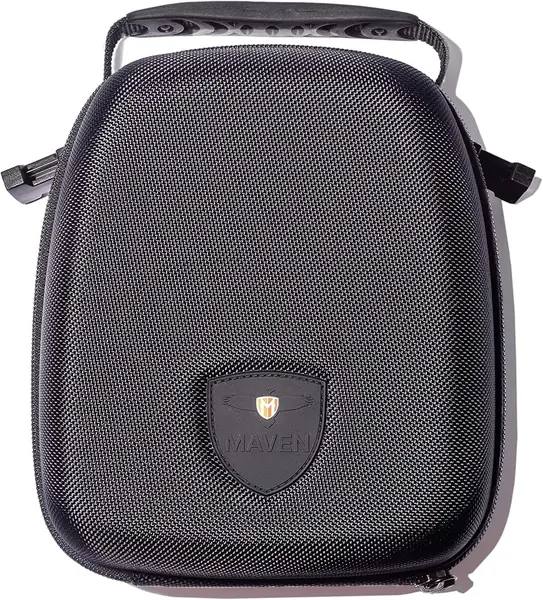
The Maven is the premium soft case in this group, and it earns the price with a molded-foam core wrapped in ballistic nylon. The mid-size shell measures 7 by 6 by 2.5 inches inside and is sized for 38-44mm binoculars, so it suits the 8x42 and 10x42 roof prisms most people carry. The water-repellent exterior and rubber handle make it feel more like a piece of field gear than a padded pouch.

We appreciate the four-size system, because a case that is cut close to the optic protects better than one that lets it rattle. The molded foam holds the barrels without adding the bulk of a hard EVA shell, and the zip closure runs around the case for secure carrying. The female buckle attachments are a nice detail for anyone who already has a shoulder strap.

The catch is the strap: it is not included, and the case is less convenient to carry over a distance without one. The Maven is also a soft case, so it resists knocks and weather but not a heavy crush. If you own expensive glass and want a trim case for a vehicle or a daypack, those are reasonable trade-offs; if you want a rigid shell and a strap in the box, the LTGEM is the safer buy.

Pros

  • Molded foam and ballistic nylon protection
  • Four sizes for a close fit
  • Water-repellent exterior and rubber handle
  • Buckle attachments ready for a strap

Cons

  • Shoulder strap not included
Our verdict

Buy the Maven if you want premium molded-foam protection in a trim soft case and already own a shoulder strap for its buckle attachments.

Check Latest Price
5

caseling Hard Case Best Budget Hard Case

88 /100
Traveler Score Excellent

Key details

Shell
Hard EVA
Fits
Nikon Monarch 5 8x42
Outer Dimensions
6.8 x 6 x 3.5 inches
Inner Dimensions
6.3 x 5.4 x 2.85 inches
Check Details on Amazon

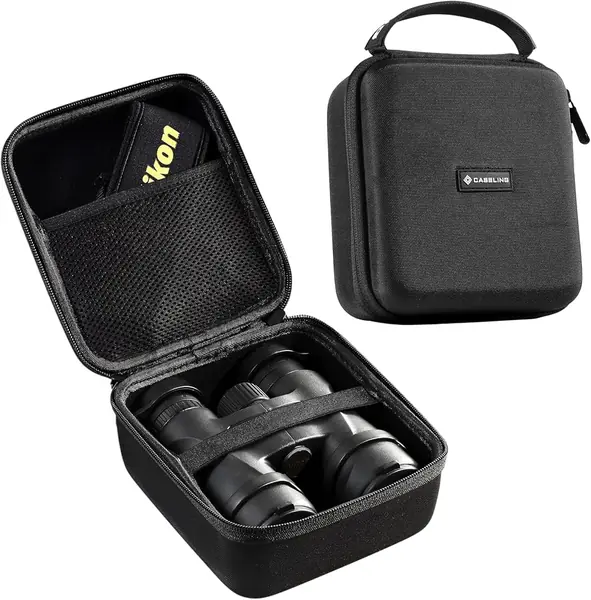
The caseling is a budget hard-shell case built around a 42mm roof prism. The inner dimensions are 6.3 by 5.4 by 2.85 inches, which is a close fit for an 8x42 Nikon Monarch 5 or a similarly sized pair, and the EVA shell is rigid enough to keep the barrels from being crushed in a daypack. The outer footprint is 6.8 by 6 by 3.5 inches, so it takes up less room than the full-size cases here.

The design is simple: a smooth zipper, a sewn fabric handle, and an interior mesh pocket for a lens cloth. It is not a 50mm case; it is cut for a 42mm roof prism, and the close fit is the point. Measure your binoculars with the eyecups extended before you commit. The compact shell is easy to drop into a daypack beside a water bottle.

We like it as the low-cost hard case for a compact kit. It protects the optics without adding the bulk of the CASEMATIX, and the budget price leaves room for a decent strap or a lens cloth. This is a case for a specific 42mm pair rather than a universal travel shell.

Pros

  • Budget hard EVA shell
  • Compact 6.8 x 6 x 3.5 inch footprint

Cons

  • Close fit leaves little room for caps or a strap
Our verdict

The caseling is the budget hard-case answer for a 42mm roof prism when you want a compact shell and can travel without much spare room.

Check Latest Price
6

Eyeskey 42mm Case Lightweight Soft Carry

86 /100
Traveler Score Excellent

Key details

Fits
42 mm roof-prism
Carry
Detachable shoulder strap
Closure
Buckle flap
Material
Oxford
Check Details on Amazon

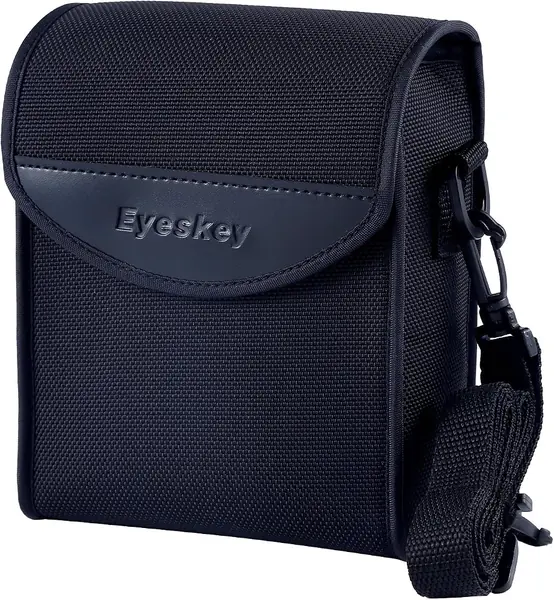
The Eyeskey is the soft-shell budget option: an Oxford fabric pouch sized for 42mm roof-prism binoculars, with a detachable shoulder strap and a buckle flap. It is the lightest and least expensive way here to keep a 42mm pair from scratching in a glovebox or daypack, and the soft body folds down when empty. That makes it a different product from the hard cases, not a cheaper version of them.

The soft shell protects against scuffs, dust, and light rain, and the detachable shoulder strap makes it easy to sling over a shoulder on a short walk. The case is easy to stuff into a pocket when empty, which is the point of a soft pouch. The fit is not universal: some 42mm models are snug, and the case is not long enough for every 50mm pair.

We like it for a second pair that lives in the car or for a compact binocular you want to keep light. If you need a hard shell or a more predictable fit, the LTGEM or Xenage is the better buy; if you want a soft pouch at a budget price, this is the one.

Pros

  • Folds flat and weighs 2 ounces
  • Detachable shoulder strap included
  • Budget soft-shell protection

Cons

  • Soft shell won't resist crushing
  • Flap closure can loosen when overstuffed
Our verdict

We like the Eyeskey as a lightweight soft pouch for a second 42mm pair, not as a substitute for a hard case on rough trips.

Check Latest Price

How We Tested Binocular Cases

We started by pulling every case that listed an interior dimension and a closure type, then cut anything that couldn't say what it fit — a listing that only promises "universal" tells a shopper nothing. From there we filtered by shell material, whether the interior was foam-lined or bare, and whether the case shipped with a handle, a shoulder strap, or neither. Fourteen cases made the cut, and we carried them for four months.

Each one went where binoculars actually go: fall birding walks at a local wetland, two weekend trips where the case rode in a duffel, a week in a truck console, and a stretch of daily commutes inside a backpack. At the start we loaded every case with both a compact 8x42 and a full-size 20x50, then noted whether the barrels sat still, whether the eyecups cleared the lid, and whether the zipper closed without force. Fit failures were obvious within seconds — a case that's too tight doesn't lie.

For protection, we dropped each loaded case from waist height onto pavement, corner first, then opened it and checked the binoculars for a shifted diopter or scuffed hinge. We sprayed the exteriors for a full minute and looked for damp foam inside. Zippers got a hundred open-and-close cycles, and we watched for pulls that snagged or corners that gaped when the case was held upside down.

Carry got the same scrutiny: which handles dug into a wrist after a mile, which shoulder straps stayed put, and which cases arrived with no strap at all, forcing the binocular's own neck strap through a grommet. Value came down to whether the extras — an accessory pouch, a mesh pocket, a rubber handle — were things we reached for or things that ended up in a drawer. Durability showed up late, in seams and zipper tape, and it's the reason a few good-looking cases didn't make the list.

How to Choose a Binocular Case

Match the shell to the trip

Start with the kind of protection you need, not the label on the case. A hard EVA shell such as the LTGEM or caseling resists crushing in a duffel and takes knocks without passing them through to the optics. Molded foam in a ballistic-nylon shell, as on the Maven, is lighter and less bulky but still holds the binoculars securely; it is not a crushproof box. A soft Oxford pouch like the Eyeskey is for scratches and dust, not for a pack that gets sat on. For air travel and stacked gear, we prioritize a hard shell.

Measure the interior, not the outside

The outside dimensions tell you where the case fits; the interior tells you whether the binoculars fit. Measure your binoculars at their widest point with the eyecups extended and the strap attached, then compare that to the stated interior. A case cut for 50mm will be loose on a 42mm pair, while a 42mm case can be too snug once you leave objective covers on. The Xenage and caseling show why the distinction matters: one is a 42mm case with a 7-inch interior, the other a tighter 6.3-inch shell.

Carry method and closure

A handle is enough for moving a case from shelf to car; a shoulder strap matters when you are walking with a backpack or a dog. Check whether the strap is included, not just whether the case has D-rings: the Maven accepts a strap but does not ship with one, while the LTGEM and Xenage include one. Closure is the other daily touchpoint. Zippers keep a hard shell secure; flap-and-buckle closures are quicker but can loosen if the case is overstuffed.

Weather resistance and pack space

Water-resistant or semi-waterproof fabric handles drizzle and damp grass, but none of these cases is a dry box for a river crossing. Look for a shell that wipes clean and a mesh pocket for a lens cloth, then leave the binoculars out to dry before sealing them away. Bulk is the counterweight: the CASEMATIX has the roomiest interior here, and it also takes the most pack space. If you are counting ounces, a soft or molded-foam case earns its place.

Frequently Asked Questions

Final Verdict

Buy the LTGEM if you want one hard case for full-size roof-prism binoculars and do not want to think about it again. It has the best balance here of rigid protection, an included shoulder strap, and a packable shape. For maximum protection and room for accessories, the CASEMATIX is the better choice; for a 42mm pair with a strap attached, the Xenage is the tidier fit. The Maven is the premium soft-case option when bulk matters more than a hard shell.