Best Smartphone Gimbals of 2026

The footage always looks better in your head. You follow your kid across the field, pan to the candles on the cake, then play it back and get a jittery mess no editing can rescue. That's the problem a gimbal fixes, and the main reason to own one. We've spent eight months shooting with nine of them.

Here's what nobody tells a first-time buyer: the stabilization is basically solved — almost any three-axis gimbal smooths out a walk. What separates them is everything around the motor: does tracking hold a face when you hand the phone to a stranger, does the app stay connected past minute four, does it unfold before the moment ends? And something you resent carrying is something you stop using.

We compared footage full-size on a laptop, ran batteries flat, and noticed the unglamorous parts — a clamp that fights a phone case, a mushy joystick, an app that forgets your settings. Value counted as much as specs. The picks below are the ones we kept reaching for.

The Best Smartphone Gimbals

1

DJI Osmo Mobile 7P Best Overall
93 /100
Traveler Score Outstanding

Key details

Weight
13 oz
Folded Size
190 x 95 x 46 mm
Extension Rod
Built-in with tripod
Tracking
Built-in module
Check Details on Amazon

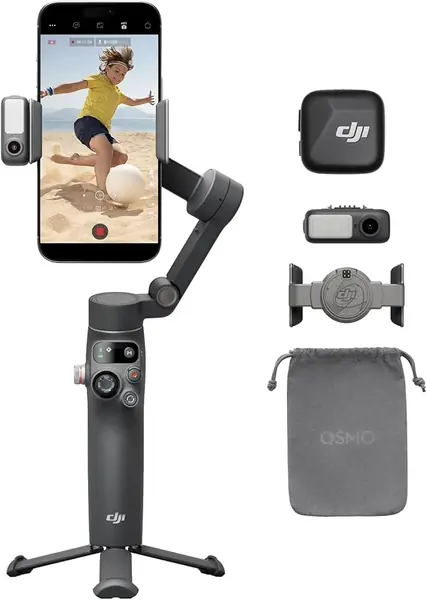
Three accessories usually travel with a phone gimbal: something that tracks you, something that lights you, and something that records your voice. The Osmo Mobile 7P folds all three into one clip-on module. It tracks the subject, it receives a DJI Mic Mini transmitter, and it adds a fill light. That module is why we made it the top pick rather than the lighter, cheaper Osmo Mobile 7, and it is why a solo shoot stops feeling like a juggling act.

The rest of the hardware backs it up. The magnetic clamp snaps a phone into place and the Mimo app opens on its own, the built-in extension rod and the tripod legs turn the handle into a stand for group shots or a high angle over a crowd, and the whole thing folds to about 190 x 95 x 46 mm at 368 g. That is daypack territory rather than camera-bag territory. Of the gimbals here with a rod, this is the one we reach for when there is no second person to hold the camera.

The software is the part to go in with your eyes open. Mimo is required for tracking, for ShotGuides, and for One-Tap Edit, and the app is also what drains the phone fastest on a long day. Buy from a seller with a straightforward return window and shoot a walking test in the first week, because the failure to watch for is a unit that powers on and then does nothing at all.

The quiet win is audio. Clip a Mic Mini on whoever is talking and the module receives it, so the sound stays as steady as the picture, with no separate receiver in a pocket and no second battery to think about. That is the part we did not expect to lean on as hard as the stabilization.

Pros

  • Tracking, light, and mic reception in one module
  • Built-in extension rod and tripod legs
  • Folds to 190 x 95 x 46 mm at 368 g
  • Magnetic clamp mounts in seconds

Cons

  • Requires the Mimo app for tracking and editing
  • Some units stop working within the first month
Our verdict

If you shoot alone, this is the one we recommend: tracking, a fill light, and mic reception in one module, plus the rod and tripod.
Check Latest Price
2

DJI Osmo Mobile 7 Best Lightweight

89 /100
Traveler Score Excellent

Key details

Weight
10.6 oz
Battery
10 hrs
Folded Size
179 x 95 x 39 mm
Max Phone Weight
10.6 oz
Check Details on Amazon

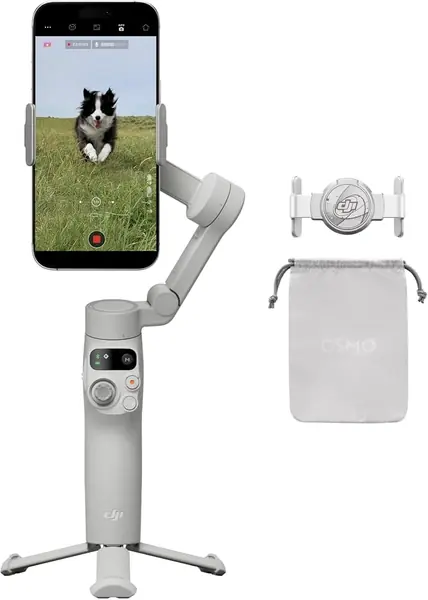
At 300 g the Osmo Mobile 7 is the one that ends up in a jacket pocket. It folds to 179 x 95 x 39 mm, a touch smaller than the 7P in every direction, and the tripod legs fold out of the handle, so a wall ledge or a cafe table becomes a stand without extra parts.

What it leaves out is the 7P's extension rod and its multifunctional module, and we think that is the right trade for a certain kind of trip. If you film yourself at arm's length and mostly want the phone to stop shivering, the 7 does that for less money and less weight in the bag. If you want a group shot with everyone actually in it, you will miss the rod on the first evening.

ActiveTrack 7.0 runs through DJI Mimo, and ShotGuides walks you through shot types if you are new to video. Tracking living inside the app is the compromise: the phone shoots through Mimo, and Mimo is also what flattens the phone battery. On the motors, the thing to check for early is a horizon that flops instead of locking, so film a slow walking shot in the first week while a return is still easy.

The listed 300 g phone limit matches the gimbal's own weight, which covers a large phone in a slim case but not a serious cage or a clip-on lens. For a kit that has to vanish into a small bag, that is the whole point.

Pros

  • 300 g and pocket-sized when folded
  • Tripod legs built into the handle
  • ActiveTrack 7.0 with ShotGuides in Mimo
  • 10 hours of listed runtime

Cons

  • No extension rod or tracking module
  • Tracking only works inside the Mimo app
Our verdict

We reach for this one when the bag is small: 300 g, tripod legs built in, and tracking that works, if you can live without an extension rod.

Check Latest Price
3

Hohem iSteady V3 Ultra Best for Solo Shooting

85 /100
Traveler Score Excellent

Key details

Weight
15.1 oz
Battery
9 hrs
Max Phone Weight
14.1 oz
Remote
1.22-inch touchscreen, 33 ft
Check Details on Amazon

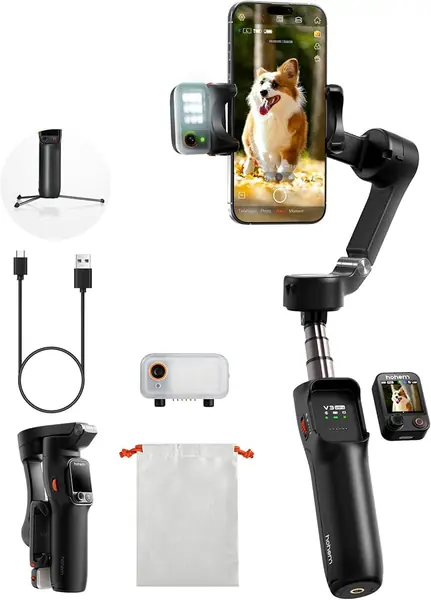
Picture the shot: you set the phone on a tripod across the room, walk into frame, and want the camera to follow you without a second person holding it. That is what the iSteady V3 Ultra is built for, and it is why we rank it above gimbals with smoother-looking stabilization claims. The detachable 1.22-inch touchscreen remote runs the phone from up to 33 feet, and the magnetic AI tracker handles the following.

The pieces add up to a one-person crew. The tracker carries its own fill light, so faces do not go flat indoors, and an 8-inch rod lifts the phone above a crowd. The tripod folds out of the handle. At 15.1 oz and folded to 3.9 x 1.7 x 6.3 in it is small enough for a jacket, though with a remote and a tracker along for the ride, the pouch earns its place in the bag.

In use, the touchscreen remote is the part we appreciate most. A screen on the remote means you can frame the shot, confirm the tracker has found you, and start recording without walking back to the phone, and solo shooting stops being a series of sprints.

Nine hours of listed runtime and a fill light whose brightness and color temperature you can change from the remote cover most indoor work. It costs more than the Osmo Mobile 7P, and what the extra money buys is the freedom to leave the phone exactly where you put it.

Pros

  • Detachable 1.22-inch touchscreen remote, 33 ft range
  • AI tracker with its own fill light
  • 8-inch rod, tripod, and 9-hour battery
  • Folds to 3.9 x 1.7 x 6.3 in at 15.1 oz

Cons

  • 400 g phone limit rules out the heaviest phones
  • Hohem Joy app has fewer editing tools than DJI Mimo
Our verdict

Our pick for filming yourself from across the room: the detachable touchscreen remote and AI tracker make solo shooting a one-person job.

Check Latest Price
4

FeiyuTech SCORP Mini 3 Best for Big Phones

84 /100
Traveler Score Excellent

Key details

Weight
2.07 lb
Battery
Up to 14 hrs
Max Payload
4.41 lb
Screen
1.3-inch touchscreen
Check Details on Amazon

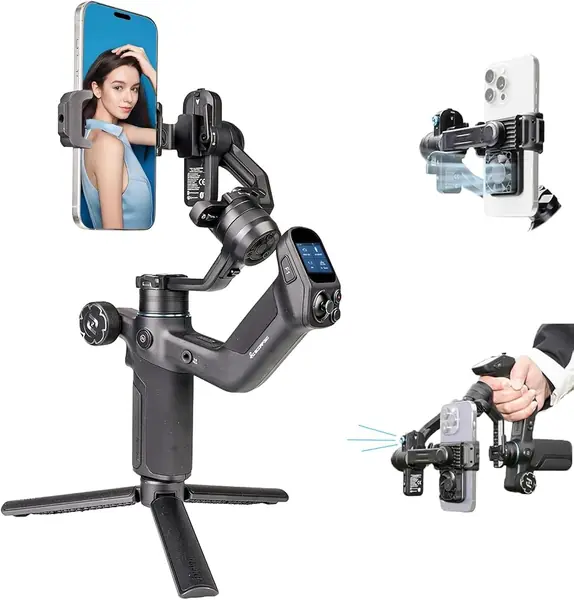
There is a cooling fan inside this gimbal, moving air across the back of the phone. That single detail explains the SCORP Mini 3: it is built for long takes with a phone that would otherwise overheat, not for slipping into a pocket.

The payload is the headline. The listing rates it to 2000 g, which no phone comes close to, and the point of that headroom is everything you add around the phone: a cage, filters, a receiver, a battery pack. It is the only gimbal here that will still balance once the kit grows past the phone itself, and the 1.3-inch touchscreen with locking axis buckles supports that read.

Weight is the price of that headroom. At 940 g it is roughly twice the DJI picks before a phone goes on, so it is a two-hand tool, and there is no remote in the box, which means solo work is set-and-walk-back. We think that trade is worth it only if the phone has already grown into a rig.

Fourteen hours of listed runtime, a 90-degree vertical switch, and a multifunction wheel for axis control round it out. For a phone you have built into a rig, or for shoots that run past an hour, this is the one. For a bare phone on a hike, it is more gimbal than you want to carry.

Pros

  • 2000 g payload handles a phone plus a cage
  • Built-in fan keeps the phone cool on long takes
  • Up to 14 hours of listed runtime
  • 1.3-inch touchscreen and locking axis buckles

Cons

  • 940 g is the heaviest gimbal here
  • No remote in the box for solo shooting
Our verdict

For a phone built into a rig, this is the only one we cover that is rated to carry it, and the cooling fan suits long takes.

Check Latest Price
5

COMITOK L7C Pro Best Budget

83 /100
Traveler Score Excellent

Key details

Weight
12.8 oz
Battery
2600 mAh
Folded Size
6 x 4.3 x 1.8 in
Max Phone Weight
9.92 oz
Check Details on Amazon

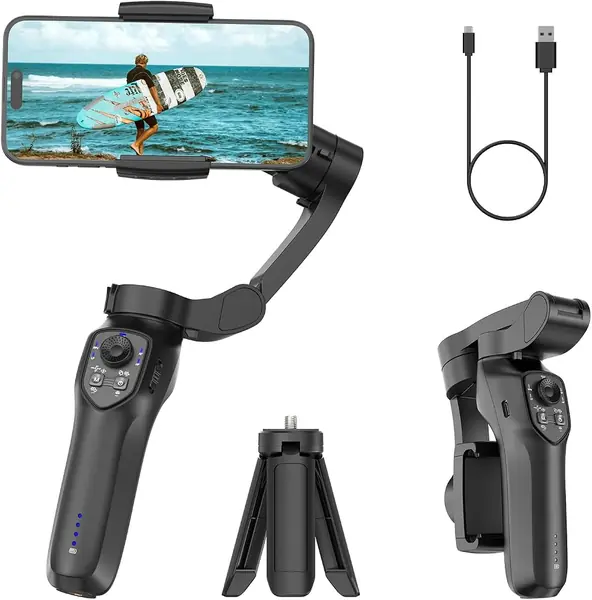
The L7C Pro is the least expensive true 3-axis gimbal here, and for a first gimbal it covers more than the price suggests: no leveling before a shot, a 2600 mAh battery, and app tracking that locks onto a face.

Setup is the part we appreciated. The mount clamps the phone and the motors take over without a counterweight or a balance dial, which is the difference between grabbing it on the way out the door and leaving it on a shelf. Folded it is 6 x 4.3 x 1.8 inches, and 12.8 oz in the hand is light enough for a long walk.

The app is where the money shows. Face tracking and the shooting modes work, but the feature set is at its fullest on iPhone; on Android expect less than the listing describes, so test the modes you actually want before the return window closes. Landscape framing can also flip the phone on its own mid-recording, which is the sort of thing you notice once and then work around.

Inception, dolly zoom, slow motion, time-lapse, and panorama are all there for the people who want them. The shot that earns this gimbal its place is the plain one: walking, panning, and keeping the horizon where you left it.

Pros

  • Real 3-axis stabilization at the lowest price here
  • No leveling needed before a shot
  • Folds to 6 x 4.3 x 1.8 inches
  • 2600 mAh battery

Cons

  • App features fall short on Android
  • Can flip the phone in landscape mode
Our verdict

We think it is the best first gimbal here: the least expensive true 3-axis option, with tracking that works on iPhone.

Check Latest Price
6

Hohem iSteady M7 Best for Large Phones

82 /100
Traveler Score Excellent

Key details

Weight
1.4 lb
Remote
1.4-inch touchscreen
Max Payload
1.1 lb
Extension Rod
193 mm
Check Details on Amazon

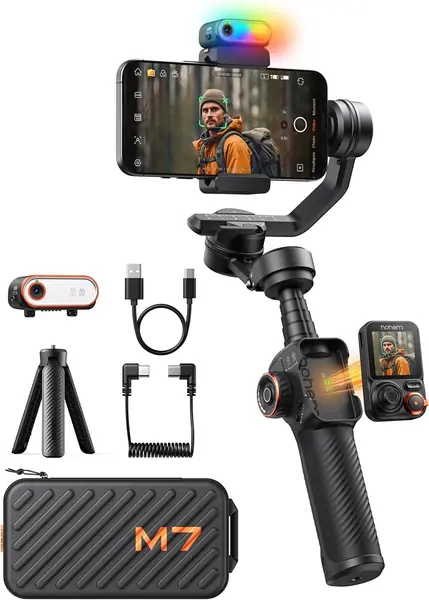
Think of the iSteady M7 as the V3 Ultra's bigger sibling: the same detachable touchscreen idea, a larger 1.4-inch screen, and a payload rating of 500 g instead of 400 g.

The extra capacity is the reason it exists. A large phone in a thick case, or a phone with a clip-on lens and a receiver riding along, sits inside the rating instead of at the edge of it. The 2-megapixel AI tracker works without opening the Hohem app and without the system restrictions that trip up app-based tracking, which is the difference between a device that follows you and one that asks to be paired again.

We think it is a tool for someone who already knows the gimbal will come out every week. At 1.4 lb it is a two-hand device, the 193 mm rod makes it longer than most of the others in a bag, and the price sits at the top of this group. What you get for that is the biggest phone support here short of the FeiyuTech, an RGB fill light adjustable from 2700K to 6500K, and a remote screen big enough to frame from.

It ships with a carry case, which is the honest admission that this one lives in a bag rather than a pocket. For vertical social work shot at arm's length and controlled from a distance, the remote and the fill light do more for the footage than another stabilization mode would.

Pros

  • 500 g payload fits any phone plus a case
  • AI tracker works without the app
  • 1.4-inch detachable touchscreen remote
  • RGB fill light from 2700K to 6500K

Cons

  • 1.4 lb makes long one-handed takes tiring
Our verdict

We point big-phone shooters here: 500 g of payload, a 1.4-inch remote screen, and tracking that skips the app.

Check Latest Price
7

AOCHUAN Smart XE Best for Compact Phones

81 /100
Traveler Score Excellent

Key details

Weight
0.77 lb
Battery
10+ hrs
Folded Size
6.4 x 4.3 x 2.1 in
Max Phone Weight
0.62 lb
Check Details on Amazon

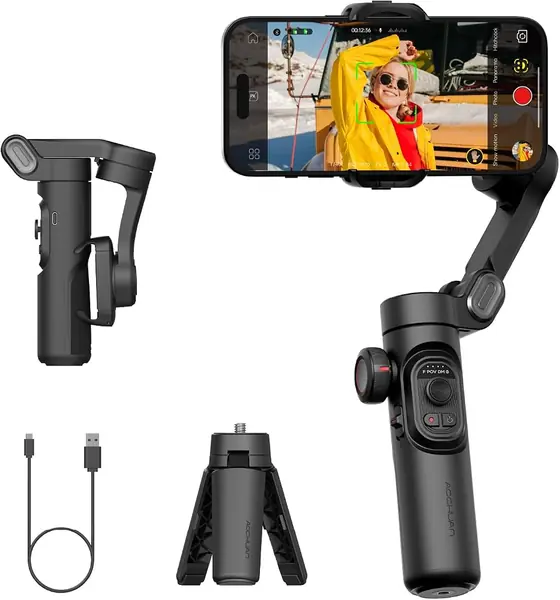
More than ten hours of shooting from a 3.5-hour charge is the number that makes the Smart XE a travel gimbal rather than a desk toy. It weighs 0.77 lb and folds to 6.4 x 4.3 x 2.1 inches, which is the size of a paperback in a daypack.

Within its limits it is a tidy piece of kit. Smart 8.0 stabilization does the routine work: a walk, a pan, a slow push in. The balance between weight, folded size, and runtime is the part that decides whether a stabilizer travels or stays in a drawer, and this one gets that balance right.

Tracking is Smart Tracking 6.0 inside the AOCHUAN app, with face, body, and object following plus third-party live tracking for streaming. Outside the app the stabilization still works, but nothing follows you, so plan to shoot through AOCHUAN's camera when being followed is the point of the shot.

Compatibility is broad on paper, from iPhone 18 down to 11 Pro Max, Galaxy S27 down to S21 Ultra, and Pixel 11 to 5, and the price is at the low end of this group. We think it is the easiest of these to keep in a bag and forget about until the moment you need it.

Pros

  • 0.77 lb and folds to 6.4 x 4.3 x 2.1 in
  • 10+ hours shooting on a 3.5-hour charge
  • In-app face and object tracking
  • Wide iPhone and Android compatibility list

Cons

  • 0.62 lb phone limit excludes large phones in cases
Our verdict

We like it for a standard-size phone: light, long-running, and the cheapest route here to real 3-axis stabilization.

Check Latest Price

How We Tested Smartphone Gimbals

We started with a shortlist of roughly two dozen gimbals, filtered by price, phone compatibility, and whether the clamp could hold a large phone in a case, then brought in nine to use ourselves. Research only tells you so much; the rest has to be shot. Testing ran eight months, long enough for a motor to develop a rattle and for an app update to break the tracking it shipped with.

These lived in our bags. We filmed a kid's soccer game from the sideline, walked busy farmers market aisles, shot a recipe at the kitchen counter, and recorded at dusk and inside a dim restaurant. Each gimbal was balanced with the same phone, and we timed how long it took to go from bag to shooting with one hand — noting when a clamp needed a second try or an arm pinched. We judged stability by reviewing slow pans and walk-and-talks at full size on a laptop, watching for the micro-jitter a phone screen hides.

Tracking got the hard test: our subject walked behind a parked car and back into frame to see whether the gimbal picked them up again or lost them for good. We stepped 30 feet away and around a wall to check whether Bluetooth held and the joystick still responded, then ran each battery from full until the phone dropped off, recording continuously, noting how much charge passed through to the phone. Durability was a week in a tote with a water bottle and a laptop, followed by a check for play in the joints. Every gimbal paired with both an iPhone and an Android, since app compatibility is where these quietly fail. And after each session, the same question: what does this one do that a cheaper one doesn't?

How to Choose a Smartphone Gimbal

Start With Your Phone's Weight

Every gimbal here carries a maximum phone weight, and the ratings run from 0.62 lb up to 2 kg. A current large phone sits near the bottom of that range, and a grip, a clip-on lens, or a magnetic wallet pushes it higher quickly. Overload the motors and nothing dramatic happens: the horizon sags, the arm buzzes, or the motors cut out halfway through a take.

Treat the payload rating as a ceiling to stay under rather than a target to hit, and buy some headroom. One number in a listing is the gimbal's own weight and the other is the phone limit, and they are not interchangeable.

Decide Who Does the Tracking

Two systems do the same job differently. App-based tracking follows a face or an object, and bundles templates, tutorials, and editing on top of it. A built-in module does the following on its own connection, which matters if you would rather record in the camera app you already know and trust.

App tracking is the cheaper and more common route, and it is also where the friction lives: the app is the battery drain, and it is the part that behaves differently from phone to phone. If following a moving subject is the whole reason you are buying, pay for the module.

Match the Fold to How You Carry It

Folded sizes land in two groups. Around three-quarters of a pound and six inches folded, a phone stabilizer disappears into a daypack or a jacket pocket. Around two pounds, it becomes something you plan a bag around. Neither is wrong; they belong to different trips.

Read the working length as well as the folded one. Compact in a listing usually describes the folded case, and with the rod out most of these run closer to a foot in the hand, which is fine on a street and awkward in a crowd.

Work Out Whether You Need a Rod, a Tripod, or a Remote

These three add-ons decide how much of a shoot you can finish alone. Tripod legs in the handle let you set the phone down and step into frame. An extension rod buys group shots and high angles over a crowd. A detachable remote lets you run the shot from across the room.

Our read: if you film other people more than yourself, the rod earns its place first. If you film yourself, the remote changes the day more than an extra stabilization mode does.

Plan on Charging Every Night

Listed runtimes run from 9 to 14 hours, and those numbers assume a light phone and light tracking. Add a large phone in a case with tracking running the whole time and the real figure drops well below the box; a cold morning drops it further.

For a trip, charge the gimbal and the phone together every night off one USB-C cable, and treat the listed runtime as a best case rather than a guarantee. A gimbal that dies at hour four is worse than one that folds slightly larger.

Frequently Asked Questions

Final Verdict

Buy the DJI Osmo Mobile 7P. It is the most complete solo-shooting kit here: native tracking, a fill light, and mic reception in one module, with the rod and tripod that let you film without a second person. Nothing else in this group puts all of that in one bag.

If the module is more than you need, the Osmo Mobile 7 does the same stabilizing work at 300 g for less money. And if your phone lives inside a cage or a rig, go to the FeiyuTech SCORP Mini 3: 2 kg of payload is the reason it exists.