Best Camera Rain Covers of 2026

A rainy forecast used to end the conversation for my camera bag. Now I toss a rain cover in next to the spare battery and shoot straight through the drizzle. It's one of the few photography accessories where the cheap version genuinely works — the catch is that fit, not price, decides whether you'll actually use it: too snug won't stretch over a long lens, and too baggy flaps into the frame the second the wind picks up.

We spent four months putting 12 covers on real cameras in real weather — sideline drizzle at a soccer game, a misty waterfall trail, a soggy morning shooting surfers. What separated them was whether water crept in at the seams, how fast you could find the shutter and read the rear screen with wet hands, and whether the thing survived being wadded into a backpack afterward.

One thing worth knowing before you buy: clear sleeves and fabric covers solve different problems. Clear plastic folds down to the size of a granola bar but clouds and stiffens with use; a fabric cover with hand sleeves keeps your fingers working through a long, cold session. The picks below are the ones that earned a permanent spot in my bag.

The Best Camera Rain Covers

1

Altura Photo Camera Rain Cover Best Overall
90 /100
Traveler Score Outstanding

Key details

Lens Fit
Up to 8 inches
Weight
6.4 oz
Material
Waterproof nylon
Access
Two hand sleeves and double zipper
Check Details on Amazon

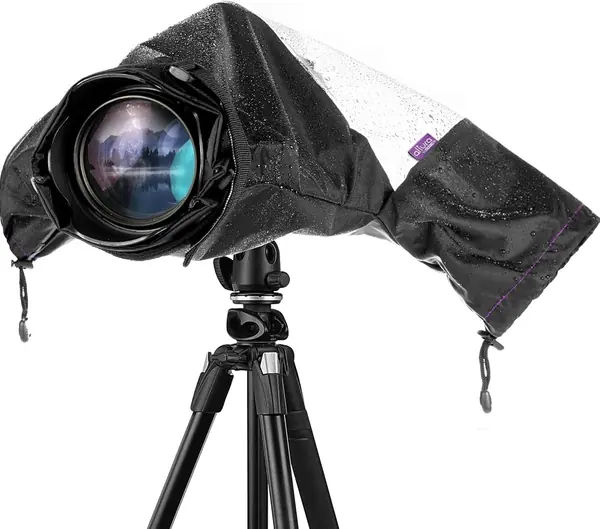
A rain cover is only useful if you can still work the camera. The Altura Photo has two hand sleeves and a full-length double zipper, so we could reach the zoom ring and shutter without pulling the cover off. That access is why it is our top pick for general DSLR and mirrorless use: it protects the gear without turning it into a lump under a bag.

The shell is waterproof nylon with an exterior hook-and-loop strap and interior anti-slip rubber, and it grips the lens instead of sliding around. It folds flat and weighs 6.4 ounces, so it lives in a camera bag without much penalty. The listed lens limit is 8 inches, which covers a typical 70-200mm but not a big super-telephoto. Working a zoom through the sleeves takes a little practice, especially with a thick lens.

For rainy walks, sports, and travel with a standard zoom, this is the balanced choice. It costs more than the disposable sleeves here, but you get a cover that stays put and lets you keep both hands on the camera. If your lens runs past 8 inches, go to the NEEWER PB004 or one of the 18-inch sleeves instead.

Pros

  • Hand sleeves and full double zipper
  • Anti-slip grip keeps the cover in place
  • Folds flat for bag storage

Cons

  • 8-inch lens limit
  • Clear rear window can cloud over time
Our verdict

We recommend the Altura Photo as the default rain cover for most DSLR and mirrorless kits, because its hand sleeves and double zipper let you keep shooting in the rain.
Check Latest Price
2

K&F Concept BR01 Rain Cover Best Anti-Fog Window

89 /100
Traveler Score Excellent

Key details

Weight
9.17 oz
Closure
Waterproof zipper
Carry
Integrated carry loop
Window
TPU anti-fog
Check Details on Amazon

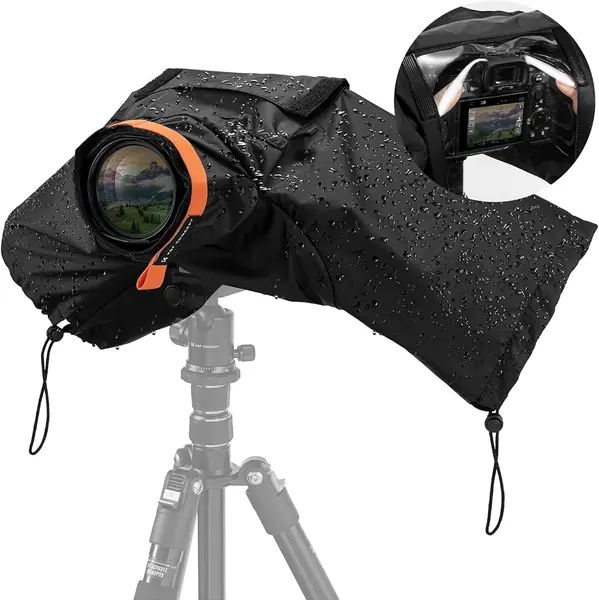
The feature that sets the K&F Concept BR01 apart is the window. It uses a TPU panel with a dual-layer anti-fog barrier, and that matters when you are trying to read the top LCD or check a histogram in wet weather. The rest of the cover is built around that idea: a waterproof zipper, adjustable hook-and-loop straps, elastic bands, and a textured grip patch to hold the lens.

We like the carry loop more than we expected; it lets you sling the covered camera over a shoulder when the rain pauses. The fit is roomy, which is good for a long zoom and less good on a small body, where the extra fabric can bunch. We treat the anti-fog window as a useful advantage, not a guarantee, especially in humid, changing conditions.

If your priority is seeing the camera's controls and screen while rain runs off the cover, this is the one we point to. It costs about the same as the Altura Photo but has a different strength: the window and the roomier cut. For a compact body, check the fit; for a larger zoom rig, the room is an advantage.

Pros

  • Anti-fog TPU viewing window
  • Waterproof zipper and adjustable straps
  • Integrated carry loop

Cons

  • Roomy cut can bunch on small bodies
Our verdict

We pick the K&F Concept BR01 when a clear view of the screen matters most, and its anti-fog window and waterproof zipper suit wet-weather shooters with room to spare.

Check Latest Price
3

Peak Design Shell Best for Hiking

88 /100
Traveler Score Excellent

Key details

Sizes
Small, medium, large
Fabric
4-way stretch waterproof membrane
Mounting
Capture clip and straps
Dimensions
10 x 7 x 2.7 inches
Check Details on Amazon

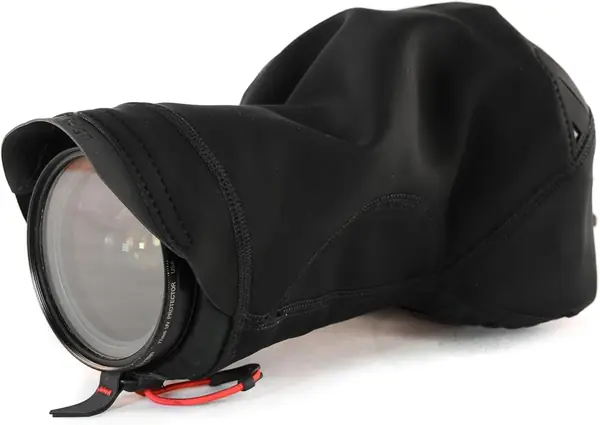
If you carry a camera on a backpack strap with a Capture clip, you already know the failure mode of a loose rain cover: it flaps, snags, and turns into a sail. The Peak Design Shell is the one here that fits like a wetsuit, using four-way stretch fabric and a waterproof membrane to stay close to the body and lens. It is the cover we reach for on a hike rather than a photo shoot where we plan to stand still.

The Shell is cinchable for hand carrying, tripod use, or stowing in a pack, and it works with Peak Design straps and Capture clips. That integration is the real luxury: the cover becomes part of the carrying system instead of another thing to manage. Its job is protection between shots, not the two-hand access of a sleeve-style cover, so it suits movement more than constant manual adjustment in a downpour.

Sizing needs attention. The Large is genuinely large, and a smaller body can swim in it; the three-size range helps, but you need to match it to your body-and-lens combo. At the premium end of this set, it earns the money for hikers, climbers, and street shooters who want a low-profile cover that stays put.

Pros

  • Close-fitting stretch shell
  • Works with Capture clips and straps
  • Cinchable for hand, tripod, or pack carry

Cons

  • Sizing is critical for a close fit
  • Premium price for a hiking-focused cover
Our verdict

We recommend the Peak Design Shell for active shooters who want a close-fitting, low-flap cover that works with a Capture clip, not for photographers who need constant hand access.

Check Latest Price
4

NEEWER PB004 Rain Cover Best for Super-Telephoto Lenses

87 /100
Traveler Score Excellent

Key details

Lens Fit
300–800mm primes
Weight
7.4 oz
Access
Dual hand sleeves
Coverage
35.4 x 21.7 inches
Check Details on Amazon

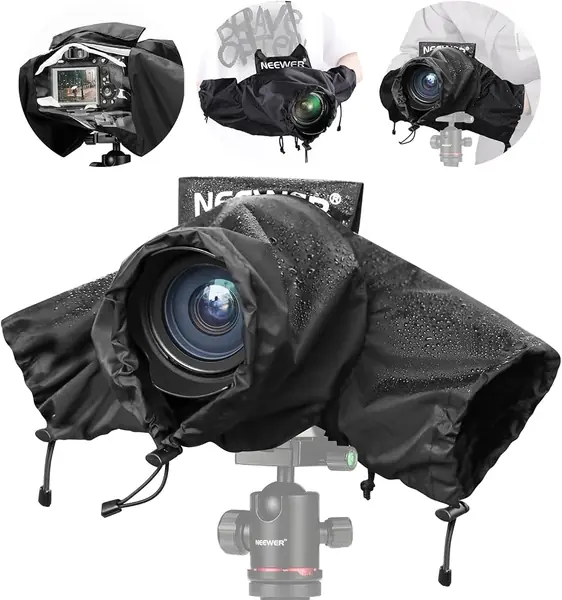
A 600mm lens is where most rain covers stop being useful. The NEEWER PB004 is built for that end of the bag: 35.4 by 21.7 inches, with two hand sleeves, drawstrings, and an oversized clear window. The size is the point. It gives a big prime room to breathe and still leaves your hands inside the cover.

The nylon shell is waterproof and weighs 7.4 ounces, and it rolls into its included bag, so it packs smaller than its footprint suggests. We like the oversized window for checking settings without lifting the cover, and the hand sleeves are positioned for both sides of the lens. On a compact body, though, this is a lot of fabric; it is not the cover to buy for a small mirrorless and a 24-70.

For wildlife and sports shooters with 300mm to 800mm glass, the PB004 solves a problem the cheaper sleeves do not: coverage without a tight, dragging fit. It costs more than the budget covers here, and it takes a minute to settle around a big lens. That is a fair trade if your longest lens is the reason you are shopping.

Pros

  • Fits 300–800mm primes
  • Two hand sleeves for lens control
  • Oversized clear viewing window
  • Packs to 7.4 ounces

Cons

  • Overkill for compact kits
  • Costs more than budget sleeves
Our verdict

The NEEWER PB004 is the right cover for 300mm to 800mm telephoto setups, with the size and hand access that smaller sleeves here cannot match.

Check Latest Price
5

JJC 18-Inch Rain Cover 2-Pack Best Long-Lens Value

86 /100
Traveler Score Excellent

Key details

Lens Fit
Up to 18 inches
Material
Clear PE
Pack Count
2 covers
Tripod Use
Yes, with lens hood
Check Details on Amazon

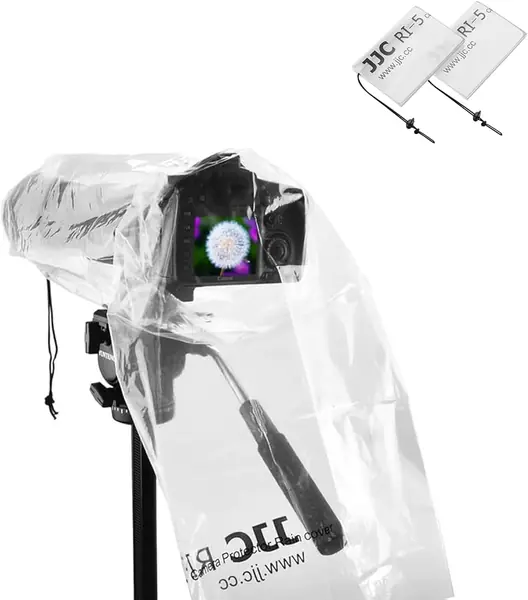
The JJC two-pack is the budget answer for a long lens. Each sleeve fits a camera and lens up to 18 inches long and 7 inches wide, which is enough for a 70-200mm or a 150-600mm, and the clear polyethylene lets you see the controls without a window cutout. Two covers mean you can keep one in the bag and one in the car.

It is not a structured cover. The drawstring closes around the lens, and the material can feel loose until you snug it down; in wind, that loose fit is the weak point. The plastic also will not last like nylon, so treat this as a reusable-for-a-while cover rather than a lifetime purchase. The flip side is packability and price: it folds flat, weighs almost nothing, and costs a fraction of the structured covers here.

We reach for this when the forecast is uncertain and we do not want to carry a bulky cover. It is also the easiest way to protect a long lens on a tripod, since the sleeve drapes over the camera and lens without blocking the mount. If you shoot in rain often, step up to the Altura Photo or NEEWER PB004; if you need backup protection, this is the value play.

Pros

  • Fits lenses up to 18 inches
  • Two clear covers per pack
  • Works with a tripod and lens hood

Cons

  • Thin polyethylene can tear
  • Loose fit can flap in wind
Our verdict

We recommend the JJC two-pack for long lenses on a budget, as long as you accept a thin, loose-fitting sleeve that is better for occasional rain than daily abuse.

Check Latest Price
6

OP/TECH Rainsleeve Best Packable Emergency Cover

85 /100
Traveler Score Excellent

Key details

Lens Fit
Up to 18 inches
Weight
1.76 oz
Closure
Drawstring
Viewing
Eyepiece opening
Check Details on Amazon

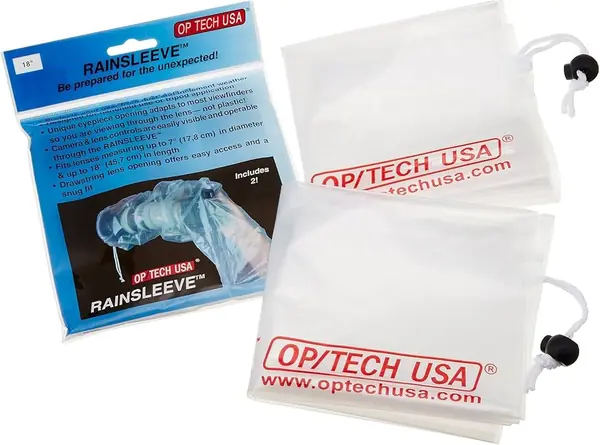
The eyepiece opening is what keeps the OP/TECH Rainsleeve in our bag. Instead of a plastic sheet between your eye and the viewfinder, the opening lets you press your eye to the camera and shoot normally. That sounds small until you have spent a rainy afternoon wiping a fogged window instead of framing.

The rest is deliberately simple: an 18-inch sleeve, a drawstring around the lens, and a clear body that lets you see the controls. It weighs 1.76 ounces and folds into a pocket, so it is the cover we stash for a forecast that might turn. The fit is not precise; it can be baggy on a small body, and the thin plastic will not survive snags like nylon. For light rain and travel, that is a reasonable trade.

This is the one to buy if you want protection you will actually carry every day. It is not the cover for a 600mm lens in a gale, and it is not as easy to work with as a hand-sleeve design. But for a compact kit and a sudden shower, the eyepiece opening and the packed size make it more useful than its simple construction suggests.

Pros

  • Eyepiece opening for viewfinder use
  • Packs into a pocket
  • Fits lenses up to 18 inches

Cons

  • Thin plastic can snag
  • Fit can be baggy on small bodies
Our verdict

The OP/TECH Rainsleeve is our pick for a packable emergency cover, especially if you want to keep your eye on the viewfinder instead of a plastic window.

Check Latest Price
7

Movo RC1 5-Pack Best Bulk Pack

84 /100
Traveler Score Excellent

Key details

Lens Fit
Up to 18 inches
Closure
Drawstring
Material
Clear polyethylene
Pack Count
5 covers
Check Details on Amazon

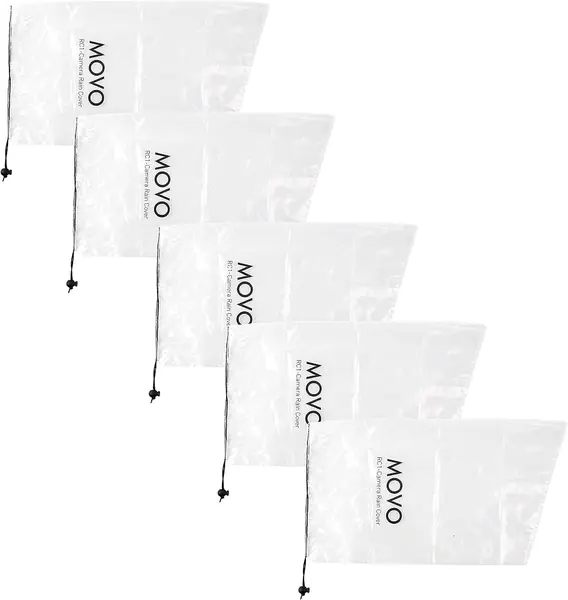
Five covers is the whole idea here. The Movo RC1 pack gives you five clear polyethylene sleeves, each sized for a camera and lens up to 18 inches long and 7 inches wide. We keep one in the camera bag, one in the car, and one in a jacket pocket; the point is never being caught without one.

Each sleeve has a drawstring closure, and the clear material lets you see the controls and viewfinder. The fit is roomy enough for a long lens and a tripod, and the covers fold small enough to disappear into a bag. They are not structured covers, so the material can feel loose until you cinch it, and the seams are the first place to watch after repeated use.

For a solo shooter, the JJC two-pack does the same job with less commitment. The Movo pack makes more sense for a small team, a rental kit, or anyone who wants a cover in every vehicle and bag. It is also the easiest way to hand a cover to a second shooter without giving up your own.

We like the Movo for that kind of insurance: inexpensive enough to treat as semi-disposable, light enough to forget, and big enough for most long lenses. Just do not expect it to feel like a nylon cover. If you need one cover that lasts for seasons, the Altura Photo is the better buy; if you need five covers for the what-if bag, this is the pack.

Pros

  • Five covers in one pack
  • Fits lenses up to 18 inches
  • Drawstring closure and clear body

Cons

  • Thin polyethylene can tear
  • Seams can separate with reuse
Our verdict

We recommend the Movo five-pack for teams and anyone who wants a rain cover stashed in every bag, with the understanding that these are light-duty sleeves.

Check Latest Price
8

NEEWER PB021 Camo Cover Best for Wildlife Shooting

83 /100
Traveler Score Excellent

Key details

Lens Fit
Up to 200mm
Weight
4.6 oz
Size
23.6 x 23.6 inches
Pattern
Reversible camouflage
Check Details on Amazon

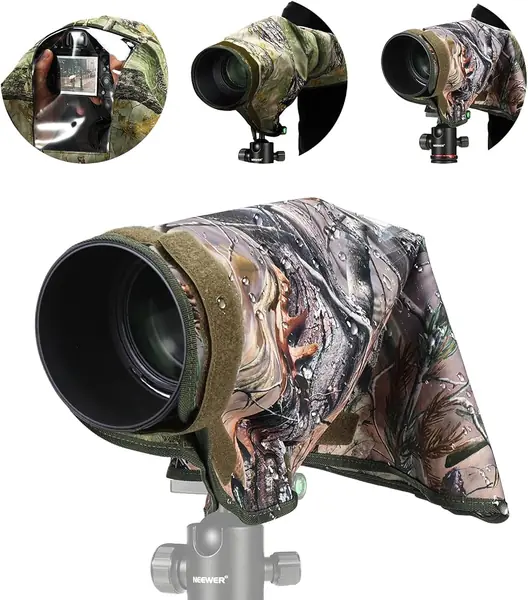
Wildlife photographers do not need a rain cover that looks like a black trash bag in the undergrowth. The NEEWER PB021 is a reversible camouflage nylon cover, with a 23.6-inch square that drapes over a camera and lens up to 200mm. The camo is the reason to look at this one; the rest is a simple, lightweight drape.

It uses touch fasteners and an enlarged opening to get the cover on and your hands to the camera, and it weighs 4.6 ounces. The square shape gives you more coverage than a tight sleeve, which helps when you are tucked into a blind or waiting for a subject to move. It is not a hand-sleeve cover, so fine control of the lens takes more care in a downpour.

The medium size is best for a standard DSLR or mirrorless body with a 200mm lens; it is not the cover for a 600mm prime. The camouflage pattern is reversible, which is a nice detail if you move between green and brown cover. We also appreciate that it is light enough to leave in the pack on trips where rain is only a maybe.

This is a specialist pick, not the default. If you shoot wildlife and want your cover to disappear into the scene, the camo earns its place. If you want maximum hand access or the longest lens coverage, the NEEWER PB004 or Altura Photo is the more practical choice.

Pros

  • Reversible camouflage pattern
  • 23.6-inch square coverage
  • Lightweight at 4.6 ounces

Cons

  • Less hand access than sleeve covers
  • 200mm lens limit
Our verdict

The NEEWER PB021 is our pick for wildlife shooters who want a reversible camo cover that packs light, provided a 200mm lens is as long as you go.

Check Latest Price

How We Tested Camera Rain Covers in the Field

We started by pulling every cover sold by established camera-accessory makers and filtering on what the listings actually promised: maximum lens length, whether the body fit with a battery grip attached, whether there was a hand sleeve or a viewing window, and whether it came as a single or a multi-pack. Anything that only swallowed a kit lens got ruled out, since most people reaching for a rain cover are out with something longer. That left 12 covers, which we used over four months.

I fitted each one over the same two setups — a mirrorless body with a 70-200mm and a DSLR with a 24-70mm — and noted where the material bunched, whether the drawstring cinched past the lens hood, and whether the sleeve openings landed where my hands actually wanted to be. Then I stood in the backyard and hosed each cover down for two minutes, working the zoom ring and pressing buttons the whole time. Afterward I ran a dry paper towel around the lens mount and along the seams to see what got through.

The rest came from using them for real: on the sideline of a rainy soccer game, on a misty waterfall trail, on a windy morning photographing surfers. I timed how long each took to get on one-handed with cold fingers, checked whether I could read the rear screen and change settings through plastic or a window, and noted which ones fogged over. After every session I shook them out, hung them to dry, and stuffed them back in a bag — across four months that showed which clear sleeves cracked along the folds and which fabric covers started weeping at the seams. Price only entered the conversation at the end, weighed against how many seasons we thought each one had left in it.

How to Choose a Camera Rain Cover

Start With Lens and Body Fit

Fit is the first thing to get right. A cover rated for an 8-inch lens handles a typical 70-200mm, but a 600mm prime needs a much larger shell with room for the hood; the NEEWER PB004 is built for that end of the bag. Battery grips and wide lenses add bulk, and a one-size cover that swallows a compact body can bunch around the controls. Measure your longest camera-and-lens combination before you choose, and treat the cover's stated limit as a ceiling, not a target.

Decide How Much Access You Need

Think about what you do in the rain. If you adjust zoom, focus, and shutter constantly, two hand sleeves and a full-length zipper are worth the extra bulk; the Altura Photo is the clearest example here. If you mainly walk, stop, and take a quick shot, a close-fitting shell or a simple rain sleeve with a drawstring is less fuss. An eyepiece opening, like the one on the OP/TECH, lets you shoot through the viewfinder without a plastic layer between you and the scene.

Reusable or Disposable?

Nylon and laminated covers cost more, but they resist snags and stay put in wind. Polyethylene sleeves are the backup plan: cheap enough to stash in every bag, light enough to forget, and easy to replace when they tear. If rain is a regular part of your work, buy the reusable cover first. If you shoot outdoors occasionally, a two- or five-pack of clear sleeves covers the what-if case without much money or space.

Check Stability, Tripods, and Packed Size

A cover that flaps or slides off the lens is worse than no cover because you stop trusting it. Look for a drawstring, elastic cuff, or exterior strap that grips the lens, especially if you shoot handheld in wind. If you use a tripod, check that the cover drapes around the mount without blocking the plate; the JJC and Movo sleeves are designed for that. Packed size matters too: a cover that lives in your bag is the one that saves the shoot.

Match the Cover to How You Carry

A camera on a backpack strap or Capture clip needs a close-fitting cover that will not sail in the wind; that is where the Peak Design Shell earns its premium. A wildlife shooter may care more about a camouflage drape that disappears into the background, which is the NEEWER PB021's reason to exist. Neither is the default for a standard zoom kit. Buy for the conditions you actually shoot in, not the worst storm you can imagine.

Frequently Asked Questions

Final Verdict

For most photographers, the Altura Photo is the one to buy: hand sleeves, a double zipper, and a grip that keeps the cover in place, for about the same money as the simpler nylon covers. If your lens runs past 8 inches, choose the JJC two-pack for budget coverage or the NEEWER PB004 for a big prime. Hikers should pay for the Peak Design Shell; its close fit is the difference between a cover you carry and one you leave behind.