Best Snowshoes of 2026

The first time I broke trail without snowshoes, I sank to my thighs every third step. Snowshoes solve that: a wider deck spreads your weight, and steel teeth grab on the climbs and the descents. What shoppers underestimate is how much the rest of the package decides the day — deck length, binding style, and whether there's a heel lift for long uphill grinds. A long shoe that floats in powder is a trip hazard on packed singletrack.

Our team spent a full winter in 14 pairs, from all-in kits to backcountry models with aggressive traction, and the gaps show up in details you notice an hour into a climb: whether you can strap in over a bulky boot in gloves, whether the bindings creep, and whether the frame stays stiff once the snow sets up crusty.

Weight and value count too — a pound on each foot adds up over three hours, and some kits throw in poles and a bag for less than a bare frame. The picks below cover everything from a flat rail-trail stroll to a steep, icy climb.

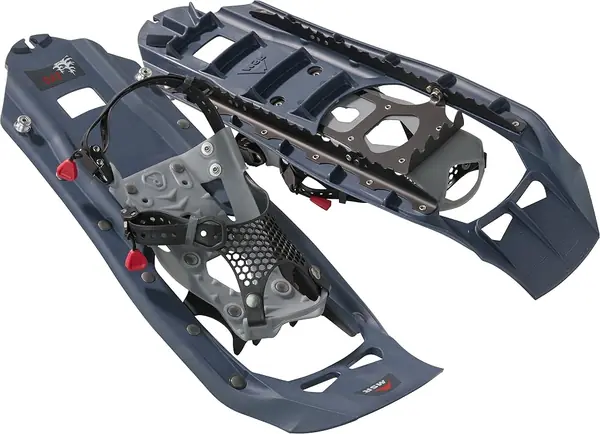
The Best Snowshoes

1

MSR Lightning Ascent Best Overall
92 /100
Traveler Score Outstanding

Key details

Deck Size
8 x 25 inches
Load Rating
220 lb
Pair Weight
4.33 lb
Crampons
Steel DTX, full-perimeter rails
Check Details on Amazon

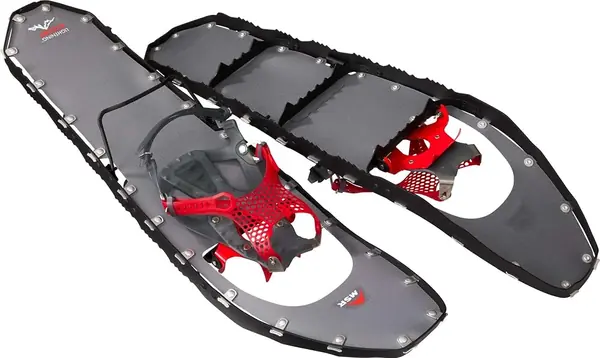
Traction is the whole argument for the Lightning Ascent. Instead of a few rows of teeth under the ball of your foot, the deck is edged on both sides with a toothed steel rail, so the shoe bites along its entire perimeter. On a sidehill traverse of refrozen spring snow, that's the difference between walking across the slope and sliding down it.

The Paragon binding is the other half of it. A single contoured strap wraps the whole boot rather than three buckles competing for space, so nothing hard presses on your instep, and the stated fit runs from men's 4.5 to 15, wide enough that one pair can be shared around a household. We switched between a low hiking boot and a bulky pac boot during testing, and both cinched down without a fight.

At 4.33 pounds for the pair on an 8-by-25-inch deck, it swings easily on packed trail, and the Ergo Televator heel lift flips up with a pole grip when the grade steepens. The 220-pound load rating covers most adults at this length, and the three-year warranty is the longest coverage in this group.

What we won't pretend is that everyone needs it. On flat rail-trail the crampons never get to work, and a good recreational pair does the same job for a fraction of the money. Point this one at ice, exposed traverses, and a loaded pack, and it earns the spend.

Pros

  • Full-perimeter steel rails grip sidehills and ice
  • One-strap binding fits men's 4.5 to 15
  • Light pair with a flip-up heel lift
  • Three-year warranty, the longest here

Cons

  • 25-inch deck limits flotation near its 220-pound rating
Our verdict

If your winter hiking includes ice, sidehills, or a loaded pack, this is the pair we hand you: perimeter rails grip where others skate, and the binding cinches over any boot.
Check Latest Price
2

Tubbs Mountaineer Best for Steep Climbs

91 /100
Traveler Score Outstanding

Key details

Deck Size
25 inch
Load Rating
200.6 lb
Binding
ActiveFit 2.0
Heel Lift
ActiveLift, 19 degrees
Check Details on Amazon

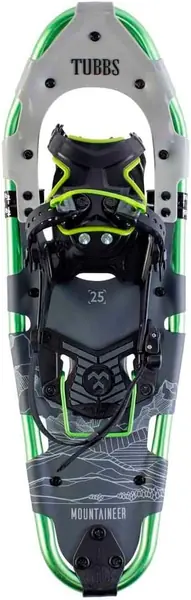
The heel lift is what you notice first on a sustained climb. ActiveLift raises a 19-degree platform under your heel so your foot stays level on a grade that would otherwise put you on your toes with your calves burning, and it flips back down with a pole tip for the descent. Underneath, the Anaconda toe crampon and Python heel crampon do the braking.

Tubbs' real advantage is fit and finish. The R2 articulation lets the tail trail behind your stride instead of slapping flat, and the ActiveFit 2.0 binding locks the toe box rigidly while the heel strap ratchets down separately, so the shoe pivots under your foot rather than rotating around it. We finished a long day with nothing to re-tighten and no hotspots, which is more than the ratchets on the cheaper shoes managed.

The limits are worth knowing. The 25-inch deck is rated to 91 kg, so a 220-pound hiker with a pack is asking it for more float than it has, and the one-year warranty is ordinary. For a 150-to-190-pound hiker on mountain trails it's close to ideal, and a tote bag comes in the box along with the EZ heel buckle that makes the exit quick.

Pros

  • Heel lift turns steep grades into stairs
  • Toe and heel crampons bite on refrozen crust
  • Binding locks the toe while the heel ratchets
  • Articulated tail follows your stride

Cons

  • Load rating stops at 91 kg on this deck
Our verdict

For long climbs and mixed mountain terrain, this is our pick: the 19-degree heel lift saves your calves and the binding holds a boot like a ski.

Check Latest Price
3

Tubbs Wayfinder Best for Quick on and off

90 /100
Traveler Score Outstanding

Key details

Deck Size
30 inch
Binding
CustomWrap 2.0 with BOA
Crampons
Recreational toe and heel
Articulation
Rotating toe cord
Check Details on Amazon

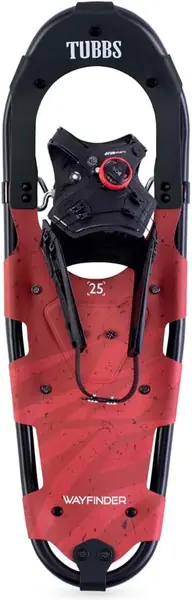
Turn the dial and the whole binding closes at once; lift it and the shoe releases. If you've ever wrestled a frozen ratchet strap in mittens, the appeal of the CustomWrap 2.0 system needs no explanation. It's the fastest pair to get in and out of here, and it's why this is the shoe we hand to someone who snowshoes a few weekends a season.

The rest is well-mannered recreation. The Fit-Step 2.0 frame has a rounded, raised tail, and the rotating toe cord lets the back of the shoe drop away as your heel lifts, so a 30-inch deck doesn't drag behind you. Soft-Tec decking keeps the ride quiet on hardpack, and since it works with most winter boots, you don't have to buy activity-specific footwear to use it.

Thirty inches is a lot of shoe. It floats well, but on tight, winding singletrack you'll feel the length every time the trail switchbacks. And if you wear an especially bulky pac boot, check that the rear strap has length to spare before you commit, because it ships set long and there isn't much margin left.

Pros

  • BOA dial closes the whole wrap in one turn
  • Releases instantly, even with gloves on
  • Rotating toe cord keeps the tail from dragging
  • Fits most winter boots without extra gear

Cons

  • Recreational crampons give up grip on icy steeps
Our verdict

The binding is the reason to buy it: one BOA dial closes the whole wrap and pops free, so gloved hands are in and out in seconds.

Check Latest Price
4

MSR Evo Trail 22 Best for Tight Trails

89 /100
Traveler Score Excellent

Key details

Deck Size
8 x 22 inches
Load Rating
180 lb
Binding
Paraglide stretch mesh
Flotation Tails
Optional 6-inch tails
Check Details on Amazon

Twenty-two inches is short for a snowshoe, and that's the design brief. In dense woods and on twisty trail the Evo Trail turns almost like a boot, and the injection-molded UniBody deck has no riveted seams to work loose, the kind of construction that shrugs off being kicked into roots all winter.

The Paraglide binding is a stretch mesh that hugs whatever you're wearing, and MSR lists it as compatible with everything from light hikers to snowboard boots. That's unusual, and it's the detail we didn't expect to care about as much as we did, since so many people snowshoe in whatever boot happens to be warm and dry. Glove-friendly straps and buckle tabs make for a quick exit.

Where it stops is flotation. Eight by 22 inches rated to 180 pounds is a packed-trail tool, and in unconsolidated powder a heavier rider will posthole. The fix is built in: the attachment points take MSR's 6-inch modular tails, sold separately, and with those on it becomes the most flexible shoe in this group, short for the trees and long for the meadow.

Pros

  • Unibody deck has no riveted seams
  • Mesh binding fits light hikers to snowboard boots
  • Add-on tails extend it to deep snow
  • Short deck turns fast in trees

Cons

No notable drawbacks to flag.

Our verdict

We pack this one for tight woods and packed trail: a short, tough, unibody deck that turns instantly, with optional tails for deep days.

Check Latest Price
5

Yukon Charlie's Sherpa Best for Heavy Hikers

88 /100
Traveler Score Excellent

Key details

Deck Size
10 x 36 inches
Load Rating
300 lb
Binding
Quick Click II ratchet
Pair Weight
5 lb
Check Details on Amazon

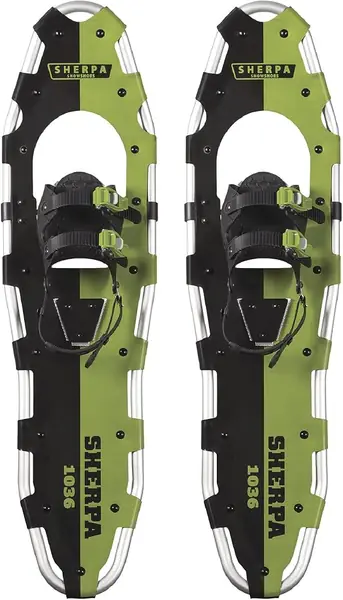
Most of the field here tops out between 200 and 250 pounds, and a heavy hiker on an undersized deck spends the day postholing. The Sherpa's 10-by-36-inch deck is rated from 251 to 300 pounds, the highest capacity in this group, and the HDPE deck is deliberately stiff so it bridges loose snow instead of folding into it.

We also like what that size does for boots. The toe and forefoot area of the binding is roomy enough for a pac boot, which matters, because the hiker who needs a 36-inch deck is usually the one in the biggest boots. Quick Click II ratcheting bindings and the Rapid-Lite Flex heel strap get you in and out fast.

Two things to plan around. The buckle pin on the heel strap is stiff to thread through the holes, especially with cold hands, and it's the part we fumble with most. And a deck this long swings wide through switchbacks and tight trees, so treat it as a flotation tool first and a nimble trail shoe second.

Pros

  • 300-pound rating, the highest in this set
  • Stiff 36-inch deck bridges loose snow
  • Roomy toe box takes a pac boot
  • Quick Click II binding is fast on and off

Cons

  • Heel strap buckle is stiff to thread in the cold
Our verdict

Over 250 pounds, this is the pair we point you to: a 36-inch deck and a 300-pound rating the rest of the field doesn't approach.

Check Latest Price
6

Wildhorn Sawtooth Best Budget

87 /100
Traveler Score Excellent

Key details

Deck Size
27 inch
Pair Weight
5 lb
Crampons
Two sets per shoe
Heel Lift
Steep-incline riser
Check Details on Amazon

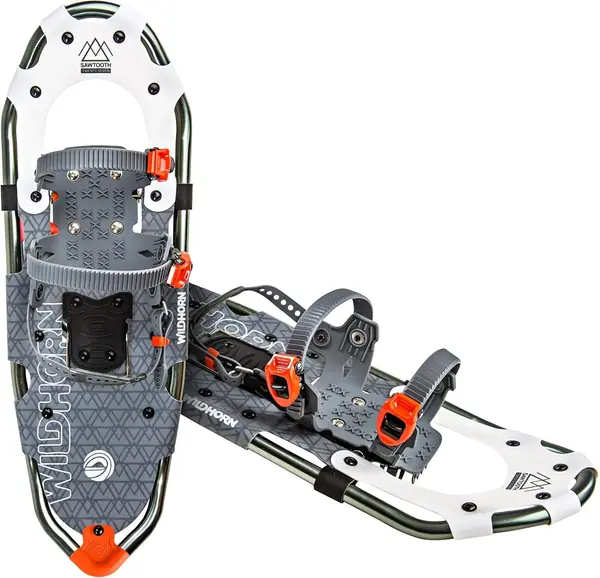
Cheap snowshoes usually look cheap. The Sawtooth doesn't: an aluminum frame, two sets of crampons under each boot, a steep-incline heel riser, and ratchet straps over the toes and instep that pull down hard.

Two details we appreciated. The no-slip textured pads under the boot keep your sole where you put it, and the excess heel-strap clip holds the loose tail of the strap so it isn't whipping your ankle all day. At 27 inches the deck suits an average adult, and the pair weighs around five pounds.

Where it gives ground is durability. The rear crampon rivets and the ratchet straps are the parts that fail first, which is another way of saying this is a packed-trail and easy-terrain shoe rather than a bushwhacking one. Keep it to the use it was built for and it's a lot of snowshoe for the money.

Pros

  • Aluminum frame with two crampon sets
  • Heel riser and no-slip boot pads
  • Excess strap clip keeps the tail tidy

Cons

  • Rear crampon rivets and straps are the wear points
Our verdict

The cheapest pair here that still has real crampons, a heel lift, and a proper binding, and the right first buy for packed trails.

Check Latest Price
7

G2 Snowshoes All-In-One Kit

86 /100
Traveler Score Excellent

Key details

Deck Size
21 inch
Load Rating
150 lb
Pair Weight
6 lb
Included
Trekking poles and tote bag
Check Details on Amazon

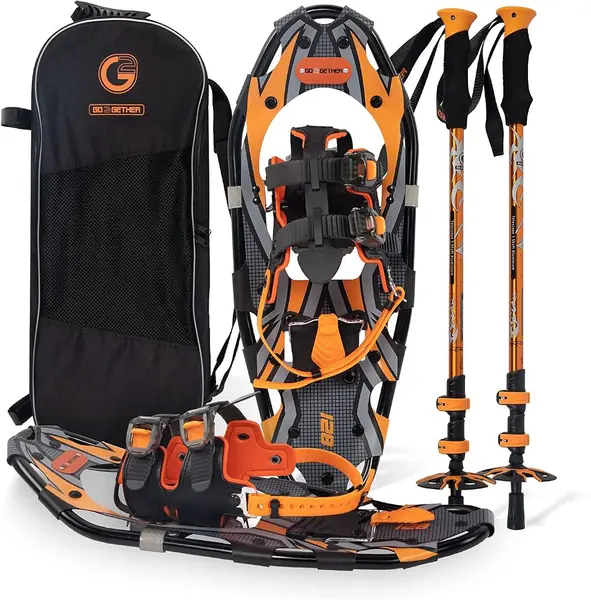
The box is the pitch: snowshoes, a pair of telescoping trekking poles, and a tote bag. For a family assembling a first set in December, that's one order instead of three, and the poles are the piece beginners always forget.

The hardware is more thoughtful than the price suggests. The ratchet binding is built for cold weather, a one-pull buckle designed to be worked with a single finger even in gloves, and it sits over EVA foam padding, a small thing we noticed on a long cold walk. There's a heel lift, a flex pivot bar, and aluminum crampons underneath.

The ceiling is size. This 21-inch deck is rated to 150 pounds, so it fits a smaller adult or a teenager and stops there; anyone heavier needs one of the longer decks in the same line. Beyond that, the kit is honest about what it is: a recreational shoe for packed trail and gentle woods rather than a mountain tool.

Bought for a teenager who might go out four times a winter, or kept as a guest pair in the garage, it's easy to like, and the bundled poles are the reason a first-timer stays upright on mile one.

Pros

  • Poles and tote bag included
  • One-finger ratchet built for cold weather
  • EVA padding under the binding

Cons

  • Plastic heel strap and ratchet are the wear points
Our verdict

A complete first set for a smaller adult or teenager: shoes, poles, and bag in one box, on a 21-inch deck capped at 150 pounds.

Check Latest Price
8

Odoland Snowshoes Powder Day Kit

85 /100
Traveler Score Excellent

Key details

Deck Size
30 inch
Load Rating
160 to 250 pounds
Pair Weight
7.61 lb
Included
Poles, gaiters, carry bag
Check Details on Amazon

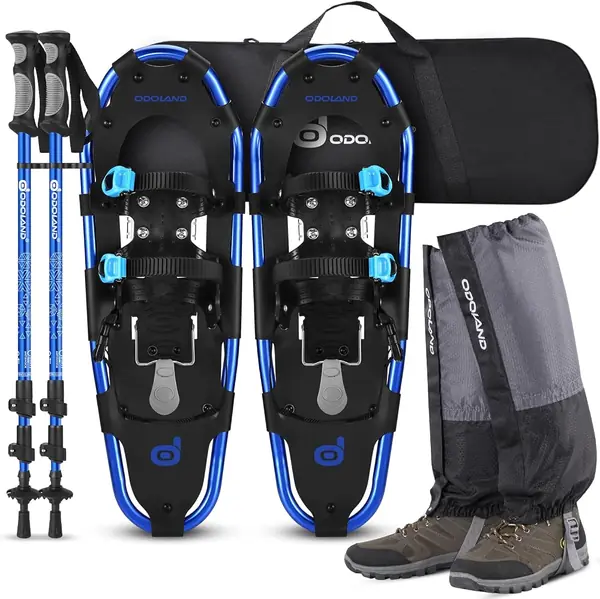
Compared with the G2 kit, the Odoland bundle covers a bigger body and a colder day. The deck runs 30 inches for 160 to 250 pounds, and there's a pair of waterproof gaiters alongside the poles and the carry bag.

Three adjustable straps, for toe, instep, and heel, let you tune the hold in stages instead of leaving everything to one ratchet, and there's a heel lift for climbing. The aluminum frame keeps the pair to a listed 3.45 kg, which is light for a deck this size.

The gaiters are the sleeper item. On a powder day they're what keeps snow from filling your boot tops, and they're the purchase most first-timers forget until the first wet sock.

What tempers our enthusiasm is the strap hardware. The straps stiffen in the cold and are fiddly to thread through the locking clips with gloves on, and they loosen over a long day, so plan a mid-hike tighten. For a heavier beginner who wants one order to cover everything, it still makes sense.

Pros

  • Poles, gaiters, and bag in one box
  • 30-inch deck rated 160 to 250 pounds
  • Three straps tune toe, instep, and heel
  • Light aluminum frame for its size

Cons

  • Straps stiffen in the cold and loosen on the trail
Our verdict

The most complete cold-weather kit here: a 30-inch deck for 160 to 250 pounds, with poles and gaiters in the same box.

Check Latest Price
9

TSL Symbioz Elite Quiet Trail Comfort

84 /100
Traveler Score Excellent

Key details

Deck Size
23.5 x 8 inches
Load Rating
264.6 lb
Binding
Memory-toe adjustment
Frame
HyperFlex composite
Check Details on Amazon

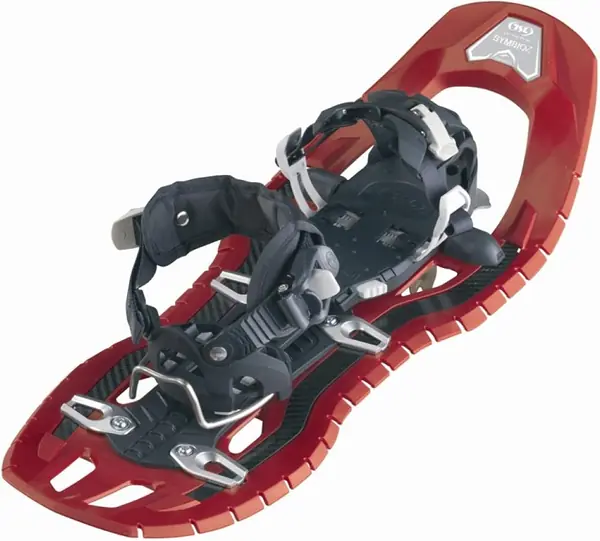
There's no aluminum frame here. The Symbioz Elite is a molded composite shoe built on TSL's HyperFlex concept, with deck and frame flexing with the ground underneath rather than staying a rigid plank.

What that buys is a ride. Over roots, buried rocks, and uneven crust the shoe conforms instead of bridging, and the flex is the reason it feels lighter than its listed 2 kg. It's also the boldest-looking pair in this group, since the red shell is the one you spot from the trailhead.

Setup works differently too. A memory-toe binding lets you set the length once for your boot and leave it, with a ratcheting instep strap doing the daily tightening, so after the first fitting there's less to fiddle with than on a three-strap binding.

The deck is 23.5 inches and rated to 120 kg, which makes this a mid-weight shoe. And the flex that feels so good on rolling ground doesn't bite like a steel perimeter rail on a hard icy traverse; on ice, we take the Lightning Ascent.

Which leaves a specific buyer: someone walking rolling forest trails in messy, varied snow who wants the day to feel easy rather than aggressive. If that's your winter, the smoothness is worth the premium.

Pros

  • Flexible composite frame conforms to rough ground
  • Memory-toe binding set once and left alone
  • Bold red finish unlike anything else here

Cons

  • Front-strap rivets can pull out
Our verdict

A different idea of a snowshoe: a flexible composite frame that rolls with the ground, for walkers who want a smooth ride over maximum bite.

Check Latest Price

How We Tested Snowshoes Through One Full Winter

We started by gathering every snowshoe we could find, from budget kits to backcountry models, sorting them by deck material, binding style, weight, and size range, and dropping anything with a pattern of complaints about cracked decks, slipping ratchets, or teeth that wore flat. That left 14 pairs, which we wore for a full winter — from the first storm in December through the rotten slush of late March.

Testing happened where snowshoes actually get used: a packed rail trail on weeknights, a steep wooded ravine with a hard crust on weekends, a golf course after a foot of fresh powder, and one long three-hour climb we repeated with every pair. I wore a bulky insulated boot for half the runs and a low hiking shoe for the rest, to see how each binding handled different fits.

At the trailhead we strapped in wearing thick gloves and timed it — the ones we liked were on in under a minute, and the ones we didn't needed bare hands. On the climb we tested heel lifts and noted which popped up and locked without looking down. On the way back we crossed an icy incline and a sidehill traverse to see whether the teeth bit or skidded.

Every pair got weighed on a kitchen scale and packed back into its carry bag. Durability was a season-long check: we re-inspected rivets, ratchet straps, and frame teeth after every few outings, and watched for decks that scuffed or delaminated. Adjustability came down to whether two testers in two boot sizes could swap the pair without tools, and we counted what came in the box against the price.

How to Choose Snowshoes

Size for your loaded weight, not the deck on the poster

Every maker publishes a weight chart, and every chart assumes packed snow. Weigh yourself with the boots and pack you'll really carry, find that number on the chart, then go up a size if you plan to break trail in light powder. Go the other way for groomed trails and tight woods, where a shorter deck turns faster and a wide one has you waddling.

The mistake we see most is a 150-pound hiker on a 30-inch deck. All that surface area is extra weight on every step, and the wider stance is what clips your opposite ankle.

Look at where the teeth sit, not how many there are

Two snowshoes can carry the same number of points and behave nothing alike. Crampons clustered under the ball of the foot give you bite going uphill. Rails that run the length of both edges give you bite on a sidehill traverse and on refrozen trail, which is where most winter falls happen.

Steel holds an edge longer than aluminum and costs you weight. If your hiking is hilly and often icy, this is the one place we spend extra rather than saving.

Bindings you can work with gloves on

Bindings fail in two directions: they don't hold, or you can't operate them with cold hands. Ratchets are positive and adjustable but can ice up. A BOA dial closes a full wrap with one turn and releases with a pull. A stretch-mesh binding swallows almost any boot but offers less fine-tuning.

The practical test is the one you can run in a shop: put the shoe on wearing the gloves you'll actually wear, do it up, and take it off. If that takes more than a few seconds or a bare hand, it will be worse at ten degrees.

Heel lifts and how the tail behaves

A heel lift is a bar that flips up under your heel so your foot stays level on a climb instead of you walking on your toes; 19 degrees is a common lift. Articulation matters just as much: a rotating toe cord or flex pivot lets the tail drop away as your heel rises, so the shoe swings along behind you instead of slapping flat.

Flat rail-trail walkers can skip both. Anyone who climbs will get more from a heel lift than from another inch of deck.

Frames, decks, and what wears out first

Aluminum frames with plastic decks are the norm and can usually be repaired. Molded unibody decks have fewer fasteners to lose but can't be fixed in the field. On inexpensive shoes, the rivets holding the crampons and the ratchet straps are the parts that go first, so look at how the crampons are attached before you look at the color.

Warranty coverage separates the tiers as much as the hardware does: most recreational pairs carry a year, while MSR's technical line runs to three.

Frequently Asked Questions

Final Verdict

The MSR Lightning Ascent is the pair we recommend first. It's the only snowshoe here with traction rails running the full perimeter of the deck, and that single design choice is what keeps you upright on the refrozen, sidehill, half-packed snow most winter hikes actually involve. It's also at the top of the price range, which is why it isn't the answer for everyone.

Walking packed trails a few weekends a season? The Tubbs Wayfinder's BOA binding is easier on cold hands, and the Tubbs Mountaineer is the better climber if your days involve real elevation. Over 250 pounds, start with the Yukon Charlie's Sherpa.