Best Snowboard Boots of 2026

Every snowboard boot is a compromise you feel by 2 p.m.: stiff enough to hold an edge on hardpack, soft enough that the walk from the car doesn't hurt, warm enough that the lift ride doesn't numb your toes. I've ridden pairs that managed two out of three. Over the past six months, we put 12 pairs through a full season, and the gap between them came down to fit and closure far more than anything printed on a spec sheet.

Here's what nobody tells a first-time buyer: boots don't really break in so much as they pack out, and a liner that feels snug in the shop can leave your heel swimming by February. Buy for the foot you have now, not the one you're hoping to grow into. Dial closures tighten with gloves on far more easily than laces, but no dial rescues a boot that's the wrong size.

Below are the pairs that felt right on day one and still felt right in April. None of them are the cheapest boots on the wall or the stiffest thing in the shop — they're simply the ones our testers kept reaching for, across a wide spread of feet and riding styles.

The Best Snowboard Boots

1

Burton Moto BOA Best Overall
89 /100
Traveler Score Excellent

Key details

Liner
Imprint 1+ heat-moldable
Closure
Single-zone BOA
Flex
1:1 soft flex
Outsole
DynoLITE
Check Details on Amazon

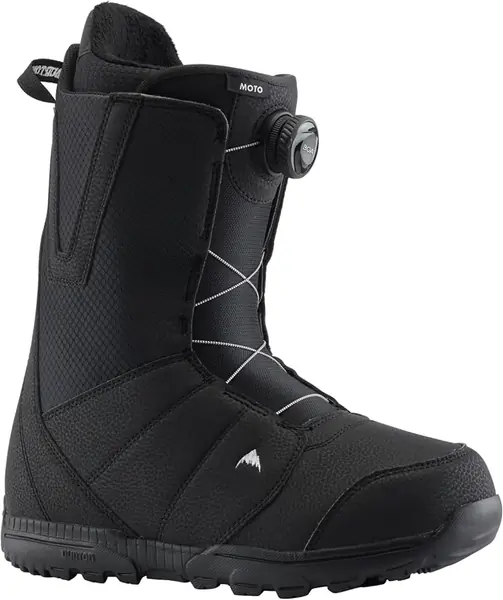
One dial, one gloved hand, and the Moto BOA is closed. That is the whole appeal of a single-zone BOA on a cold morning, and it is why this is the pair we recommend first to most riders. What we did not expect from Burton's entry-level boot is how little break-in it asks for: the Total Comfort construction and the Imprint 1+ heat-moldable liner feel ridden-in from the first lift ride, which is unusual among the boots here and the reason we keep coming back to it.

Comfort is where it separates from the rest of this set. The Moto is light on the foot on the walk from the car, the reflective foil under the footbed holds warmth on slow lifts, and the snow-proof internal gusset seals the lower boot so slush does not wick up the tongue. The liner wraps the instep and ankle without a pressure point, which is the part that most often goes wrong at this end of the market.

The single zone is the trade-off. You cannot lock the ankle and leave the shin looser, and the DC Phase BOA Pro's second dial does exactly that; the K2 Raider BOA gives you a firmer 5/10 flex for less money. Neither of those has the Moto's out-of-the-box ease, though, and for a rider who wants to strap in, ride all day, and not think about their feet again until the lift line, that is the better trade.

Pros

  • One dial tightens and releases fast
  • Heat-moldable liner feels broken in immediately
  • Light and warm without bulky socks
  • Internal gusset keeps slush out

Cons

  • Single zone tightens ankle and shin together
  • Sizing splits between true and a half size up
Our verdict

We recommend the Burton Moto BOA to most riders: one dial, a heat-moldable liner, and a level of comfort that needs no break-in.
Check Latest Price
2

K2 Raider BOA Best All-Mountain

88 /100
Traveler Score Excellent

Key details

Liner
Intuition Comfort Foam 3D
Closure
H4 Coiler BOA
Flex
5/10
Outsole
Rubber
Check Details on Amazon

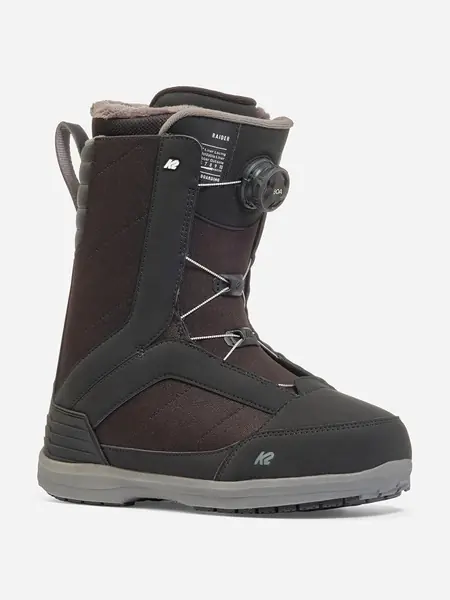
A 5/10 flex sits in the middle of this group, and that is the point of the K2 Raider BOA. It is firm enough to hold an edge when you are carrying speed across groomers and soft enough that you are not fighting it in the park. The Flex Zone upper cuff is what makes the middle ground work: the shell gives where your ankle needs to articulate and stays stiff where the boot has to transfer pressure to the board.

Where the Raider earns its place is heel hold. Internal J bars sit either side of the ankle and the liner lacing pulls the foot back into the heel pocket, so the boot stays put when you are up on your toes instead of lifting and dragging. We think this is the best all-mountain value in the set: the Intuition Comfort Foam 3D liner is heat-moldable, and the rubber outsole grips on a bootpack in a way the EVA soles here do not.

The trade-offs show up off the board. The firm midsole makes for a clunky walk across the parking lot and can feel tight under the arch for the first few runs, and the fit does not land the same way on every foot, so size against the maker's chart rather than your sneaker size. Against the Burton Moto BOA, this is the boot for hardpack and steeps; the Moto still wins on comfort straight out of the box.

Pros

  • 5/10 flex covers groomers and park
  • Internal J bars hold the heel down
  • Heat-moldable Intuition liner
  • Rubber outsole grips on bootpacks

Cons

  • Stiff midsole makes walking awkward
  • Fit varies enough to check sizing
Our verdict

The K2 Raider BOA is our all-mountain pick: a firm 5/10 flex, a moldable liner, and heel hold that keeps the boot locked down at speed.

Check Latest Price
3

DC Phase BOA Pro Best Dual-Zone BOA

87 /100
Traveler Score Excellent

Key details

Liner
Response Liner III, PrimaLoft
Closure
Dual-zone BOA, H4 Coiler
Flex
5/10
Outsole
Contact UniLite
Check Details on Amazon

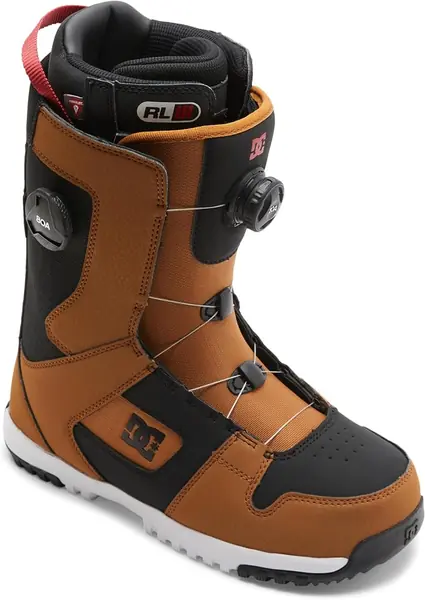
Two dials sound like a gimmick until you ride a boot that separates them. On the Phase BOA Pro, the upper zone locks the ankle and heel while the lower zone sets tension over the instep, so you can crank down the ankle without strangling the top of your foot. With a 5/10 flex and an internal ankle harness, that is the closest thing in this guide to a made-to-measure fit, and of everything here it is the boot we hand to a rider chasing precision.

The Response Liner III carries PrimaLoft insulation with Aerotech venting, a more serious warmth package than most of this set offers, and the molded Impact-ALG insole soaks up flat landings in a way a plain EVA footbed does not. The skate-inspired Contact UniLite outsole is the pleasant surprise: it keeps board feel sharp while still walking like a shoe on the way back to the lift.

The wheat-and-black finish is the detail we did not expect to like as much as we do, since it reads more street shoe than snow gear, which is a nice thing to be able to say about a boot in this range. What you are paying for is control and warmth, and neither the Moto nor the Raider matches it on those two counts.

Pros

  • Two BOA zones for ankle and instep separately
  • Heel harness keeps the foot locked back
  • PrimaLoft liner is warm and vents
  • Skate-style outsole preserves board feel

Cons

  • Snug, rigid shell that punishes wide feet
Our verdict

Choose the DC Phase BOA Pro if you want ankle and instep tension set separately; the dual-zone dial and heel harness deliver the most locked-in fit here.

Check Latest Price
4

K2 Market BOA Best Budget BOA

86 /100
Traveler Score Excellent

Key details

Liner
Comfort Foam EVA
Closure
H4 BOA Focus
Flex
2/10
Water Resistance
Water resistant
Check Details on Amazon

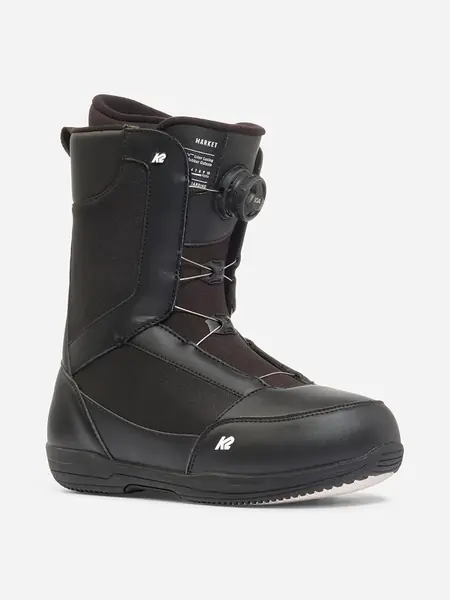
A 2/10 flex is the softest boot in this guide, and that is a feature rather than an apology. If you are learning, a boot that folds with you makes it easier to feel the board and get your shins forward over the tongue, instead of fighting a shell that wants to stay upright. The Market BOA is K2's entry model, and it is the one we point first-season riders toward when they want a dial instead of laces.

The comfort is tuning-free. The Comfort Foam EVA liner is plush from the first wear rather than heat-molded, the fast-in liner lacing snugs it up without a second set of hands, and the internal J bars do more heel-hold work than a boot at this end of the range has any right to. It also fits true to size more reliably than most pairs here, which is the single most useful thing a beginner boot can do for its owner.

Where the Market stops is where every soft boot stops: push it into steep, firm snow and you will feel the shell fold before the board runs out of grip, and the water-resistant upper is not the sealed waterproof build on the Moto or the DC boots. In a first or second season those limits rarely come up. A new rider gets more out of a boot they can actually flex than out of a stiff one they cannot.

Pros

  • Soft 2/10 flex forgives learner mistakes
  • True-to-size fit more reliably than most here
  • Plush liner needs no molding
  • BOA at the budget end of the set

Cons

  • Water-resistant upper, not waterproof
  • Shell folds under hard, aggressive riding
Our verdict

For a first or second season, we recommend the K2 Market BOA: a forgiving 2/10 flex, dependable sizing, and dial-in convenience without a flagship price.

Check Latest Price
5

Burton Women's Mint BOA Best for Women

85 /100
Traveler Score Excellent

Key details

Liner
Imprint 1+ heat-moldable
Closure
Single-zone BOA
Outsole
DynoLITE
Fit
Women's-specific True Fit
Check Details on Amazon

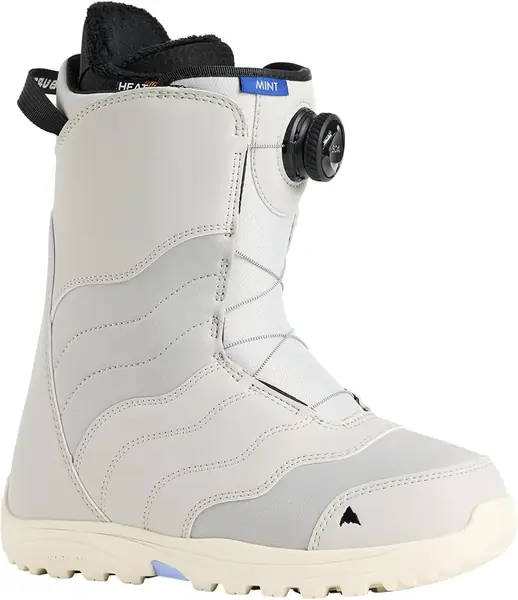
The Mint BOA shares its bones with the men's Moto: the same single-zone dial, the same Imprint 1+ heat-moldable liner, the same DynoLITE outsole. What changes is the last, which Burton builds specifically for a woman's foot, and that is the whole reason it is here instead of simply pointing women at the men's boot. The practical effect is a closer hold through the heel and calf, which is what stops a smaller foot sliding around inside a shell shaped for someone else.

Bought at your measured size, the fit hugs without pressure and the liner molds to your foot within a ride or two. Sized up, it goes wrong fast: the boot ends up roomy enough that you crank the dial to stop the heel lifting, and you pay for that in calf pressure by the end of the day. Buy the size your foot measures, not the size you wear in sneakers, and give the liner a chance to mold before you decide it is too snug.

The warmth package is the same as the Moto's: reflective foil under the footbed, a gusseted tongue, and a liner that shapes to your foot after a couple of days. There is a price argument in its favor as well, since the Mint sits well below the men's Moto, so you are getting the same closure and the same liner for less, in a shell built for a woman's foot.

Pros

  • Women's-specific last holds heel and calf
  • Heat-moldable liner molds within a ride or two
  • Warm without bulky socks
  • Costs less than the men's Moto

Cons

  • Soft flex gives out on firm, steep snow
Our verdict

We recommend the Mint BOA to women who want Burton's soft-flex comfort and a dial instead of laces, as long as they buy their measured size.

Check Latest Price
6

System APX Best Traditional Lacing

84 /100
Traveler Score Excellent

Key details

Liner
Thermofit heat-moldable
Closure
Traditional lace
Water Resistance
Water resistant
Warranty
3 year manufacturer
Check Details on Amazon

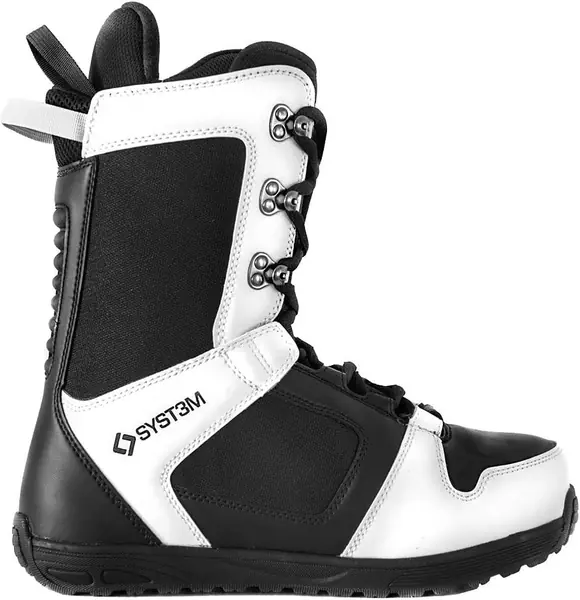
A three-year manufacturer warranty is the longest on this page by a wide margin, since Burton, K2 and DC all stop at one, and on a boot near the bottom of the price range it says something about how System expects the APX to hold together. The build backs it up: the PU shell, rubber sole and metal lace loops take scuffs without splitting, which is the usual failure point on a cheap boot.

Traditional laces are the reason to choose it over anything with a dial. You can crank the lower zone tight and leave the upper loose, which none of the single-zone BOA boots here can do, and if a lace snaps you replace it with a shoelace instead of ordering a part. The Thermofit liner molds with body heat, so a ride or two gets you a closer fit than the shell suggests, and the low-profile shape sits neatly in a binding without much bulk.

Stiffness is where the APX gives ground. It is a soft boot, and the ankle support thins out quickly on hardpack; the edge holds noticeably less decisively than it does in the K2 Raider BOA. Getting it on is a chore as well, with a tall, snug cuff and laces to work through. For a first pair, a spare pair, or a rider who wants to feel the board rather than the boot, we think it is the best value in the set.

Pros

  • Three-year warranty, longest in this group
  • Heat-moldable Thermofit liner
  • Laces tune ankle and shin separately
  • Metal loops and PU shell resist scuffs

Cons

  • Soft flex gives vague edge hold on hardpack
  • Tall cuff and laces make entry slow
Our verdict

The System APX is the value pick: a heat-moldable liner, a three-year warranty, and laces that let you tune the ankle and shin separately.

Check Latest Price
7

DC Phase BOA Best for Park Laps

80 /100
Traveler Score Excellent

Key details

Liner
Response Liner I
Closure
H4 Coiler BOA
Flex
4/10
Outsole
Foundation UniLite
Check Details on Amazon

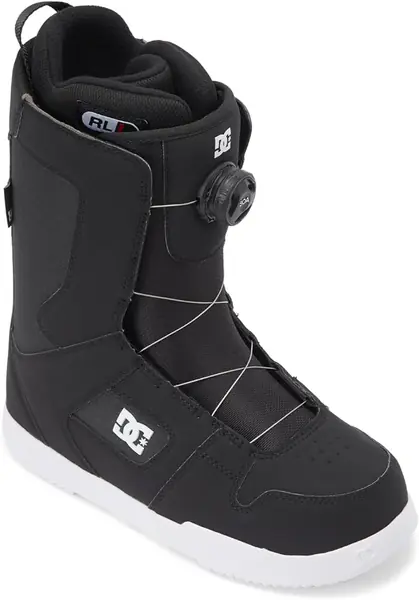
The Phase BOA is the Pro's plainer sibling, and the differences are the ones the price suggests: one dial instead of two, the Response Liner I instead of the PrimaLoft-lined Liner III, and a 4/10 flex instead of 5/10. What it keeps is the part that matters most. The H4 Coiler dial is current BOA hardware rather than a cheap imitation, and the upper is rated waterproof, just like the Pro's.

At 4/10 it lands between the K2 Market's soft 2/10 and the Raider's 5/10, which is a sensible place to be for park laps and lazy groomer days. The Impact-ALG insole and the Foundation UniLite outsole do the same jobs here as they do further up DC's line, cushioning underfoot with enough board feel that you can tell what your edges are doing. For a boot that sits lower in the range, nothing about the ride felt like a compromise.

Where it asks you to be honest with yourself is the liner. The Response Liner I is the plainest in this group, and it is the piece we want a full season on before calling it the equal of the Pro's. Buy from somewhere with a return window you can live in, and check the fit carefully in the first week rather than after the first trip.

What it comes down to is this: if you already know you like a softer flex and want a dial, the Phase BOA does that job for less than the Pro and without a second zone to think about. If you are the rider who fiddles with laces to get the ankle just so, put the difference toward the dual-zone boot instead.

Pros

  • Waterproof build for slush days
  • H4 Coiler dial is current BOA hardware
  • 4/10 flex splits soft and firm
  • Impact-ALG insole cushions landings

Cons

  • Single dial shares tension across the boot
Our verdict

We recommend the Phase BOA to riders who want a softer, waterproof dial boot for park and moderate groomers without paying for the Pro's second zone.

Check Latest Price

How We Tested a Season's Worth of Snowboard Boots

We started with several dozen models in the entry and mid-level range and cut the list down using spec sheets, published flex ratings, and size charts that actually cover wide forefeet and half sizes. Twelve pairs made the cut. Testing ran through one full season — about six months, from the first cold morning in the parking lot to wet spring slush — with each pair ridden at least 30 days by testers ranging from a never-ever to a weekend backcountry hiker.

Fit and sizing got the most attention, since they drive most of the returns in this category. Every tester measured their foot with a Brannock device at home and compared it to each maker's chart, then we heat-molded every liner that allowed it, following the manufacturer's directions in a home oven. On snow, we deliberately rode the toe edge and had testers report any heel lift, and we checked the toe box after a few runs for anyone with a wider forefoot.

For ease of use, we timed getting in and out of each boot in the parking lot at roughly 20 degrees, wearing gloves, one-handed. Stiffness we judged twice: flexing each boot cold out of the car and again after two hours of riding, then noting how much softer it felt by season's end. Support showed up on icy hardpack, where we paid attention to whether the boot folded under pressure or pushed back.

Warmth we tracked on the lift — toes or no toes by the top. Comfort we checked with a bare-foot blister inspection after day one and again after day ten. At the end of the season we looked at stitching, sole wear from all those parking lot walks, and whether the liners had packed out to the point of sloppiness. Appearance counted too: which pairs still looked sharp after 30 days and which came back scuffed and gray. Value was the last question, and the only one we asked from the receipt — what survived the season against what it cost.

How to Choose Snowboard Boots

Start With Flex, Not Features

Flex runs on a rough 1-to-10 scale, and it is the number that decides whether a boot suits you. Anything from about 2 to 4 folds easily, which is what a new rider wants: you can bend the boot to pressure an edge instead of fighting it. A 5 or 6 holds its shape under load and rewards a rider who is already comfortable at speed.

Our picks run from the K2 Market BOA at 2/10 up to the K2 Raider BOA and DC Phase BOA Pro at 5/10. Buy for the riding you do this season, not the rider you hope to be by March; a boot you cannot flex teaches bad habits faster than it builds good ones.

BOA, Laces, and How Many Dials

BOA closes a boot with a steel lace and a dial, and it is genuinely faster: one gloved hand, no wet laces, no re-tying at the top of the lift. The catch is zone count. A single dial tightens the whole boot at once, so you cannot lock your ankle without also clamping down over your shin.

Dual-zone systems, like the one on the DC Phase BOA Pro, split the boot in two. Traditional laces, as on the System APX, let you tune as many zones as you have hands for and cost nothing to repair. If you like a locked heel and a relaxed upper, that flexibility is worth more than the speed.

Sizing Is Where This Purchase Goes Wrong

Boots should be snug everywhere and painful nowhere. Your toes should just brush the front when you stand tall, and your heel should stay down when you rise onto your toes. Sizing misses are a last-shape problem rather than a quality one, which is why two boots in the same size can feel completely different.

Measure your foot in centimeters and use the maker's chart instead of your sneaker size. Buy somewhere with a return window you can live with, and mold the liner before you decide a snug boot is the wrong size.

Warmth, Waterproofing, and Dry Feet

Cold feet end a day faster than tired legs. A heat-moldable liner helps twice over: it fits closer, and a closer fit traps warmth. Check the water rating carefully, because the two terms are not interchangeable. The Burton Moto BOA and both DC boots are rated waterproof, while the K2 boots, the Burton Women's Mint and the System APX are rated water resistant.

An internal gusset matters as much as the fabric. It is the piece that seals the lower boot and stops slush wicking up the tongue, and it is the first thing to look for on a boot you plan to ride in wet, heavy snow.

Outsoles, Warranties, and the Long Run

Rubber outsoles grip better on rock and packed snow; EVA is lighter and passes more feel through to the board. If you hike, scramble, or ride somewhere with a long walk from the lot, weight grip more heavily than the spec sheet invites you to.

Warranty length is a fair proxy for how a maker feels about its own build. The System APX carries three years where Burton, K2 and DC all stop at one, and that is worth checking before you write any boot off as disposable.

Frequently Asked Questions

Final Verdict

The Burton Moto BOA is the boot we recommend to most people: one dial, a heat-moldable liner, and enough comfort that the first day feels like the tenth. Move to the K2 Raider BOA if you ride hardpack and want a firmer 5/10 flex with a rubber outsole, or to the DC Phase BOA Pro if separate ankle and instep tension is worth the extra hardware.

On a first-season budget, the K2 Market BOA is the pair we trust, and women should start with the Burton Women's Mint BOA rather than sizing down a men's shell. The System APX remains the pick if you want laces you can tune zone by zone and a warranty that outlasts the others.