Best Ice Cleats of 2026

Black ice doesn't announce itself. You find it halfway down the driveway with a bag of groceries in each hand, and the next thing you know you're flat on your back, wondering how the ground got so hard. Ice cleats are the fix: a stretchy harness of spikes you pull over the boots you already own, so your feet stay under you on packed snow, wet concrete, and that invisible glaze at the bottom of the steps.

I've worn them for years on late dog walks, and my team just spent a full winter with 14 pairs, from the first December ice storm through a slushy March thaw. What separates a good pair isn't the spike count printed on the box. It's whether the harness stays put when you pull it over a bulky boot, whether you can get them on with gloves already on, and whether the points actually bite when you shift your weight.

Fit and sizing trip up more buyers than anything else, and durability is where cheap pairs quietly fail, shedding points or going slack by February. The picks below run from a quick trip to the mailbox to a genuine winter trail.

The Best Ice Cleats

1

ICETRAX V3 Best Overall
95 /100
Traveler Score Outstanding

Key details

Traction Points
Tungsten
Footwear
Shoes and boots
Visibility
Reflective heel
Check Details on Amazon

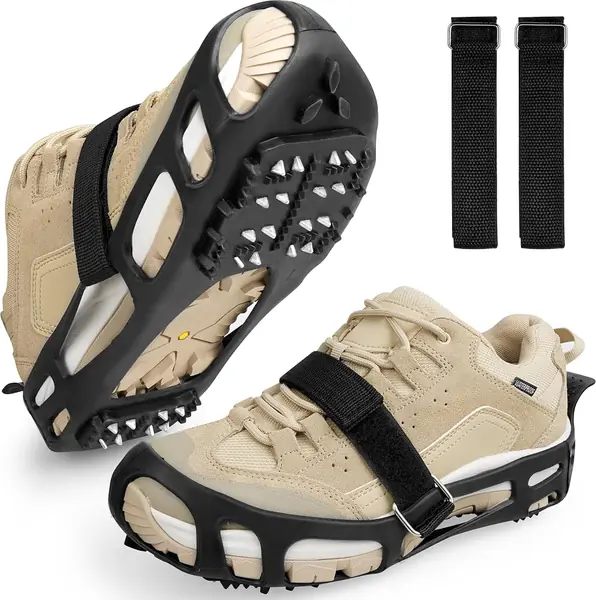
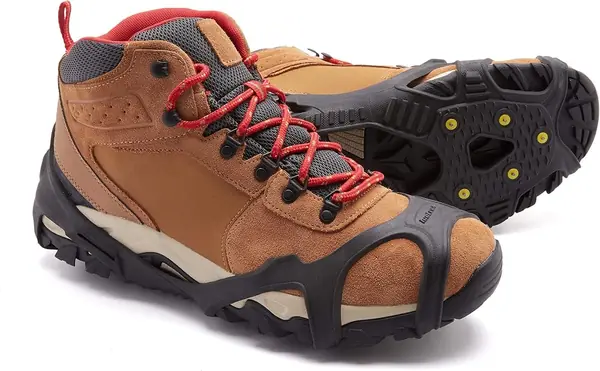
Tungsten traction points and a reflective heel are the two details that make the ICETRAX V3 the pair we reach for first for everyday winter walking. The tungsten tips bite into packed snow and glare ice without the jarring, full-crampon feel of a trail-specific cleat, and the reflective heel does real work on early dog walks and dark parking lots. We also like how little ceremony the harness requires: it stretches over shoes or boots, seats with a firm pull, and stays centered once it is on.

The design is simpler than the spike-heavy alternatives here, and that is the point. There is no extra instep strap to thread with gloves on, no chain system to untangle, and no stiff shell to wrestle over a bulky boot. The toe surround is the detail that keeps the fit honest: it wraps the front of the shoe, so the cleat does not migrate sideways when you turn on a snowy sidewalk. For errands, shoveling, and neighborhood walks, that easy-on, easy-off routine matters as much as the bite underfoot.

We keep the ICETRAX for packed snow, icy driveways, and paved paths, not for steep alpine ground. What stands out after living with them is the heel reflector: it catches a headlight before the rest of the cleat does, which is exactly the kind of small advantage that changes when you feel comfortable walking after dark.

Pros

  • Tungsten points bite into packed ice
  • Reflective heel adds low-light visibility
  • Stretches over shoes and winter boots

Cons

No notable drawbacks to flag.

Our verdict

We recommend the ICETRAX V3 as the default pair for errands, dog walks, and icy sidewalks, because the tungsten bite and reflective heel make winter walking feel less tentative.
Check Latest Price
2

Kahtoola MICROspikes Best for Icy Trails

94 /100
Traveler Score Outstanding

Key details

Harness
Elastomer with TPU eyelets
Spikes
12 per foot
Weight
16 oz
Pack Size
5 x 3 x 2 in
Check Details on Amazon

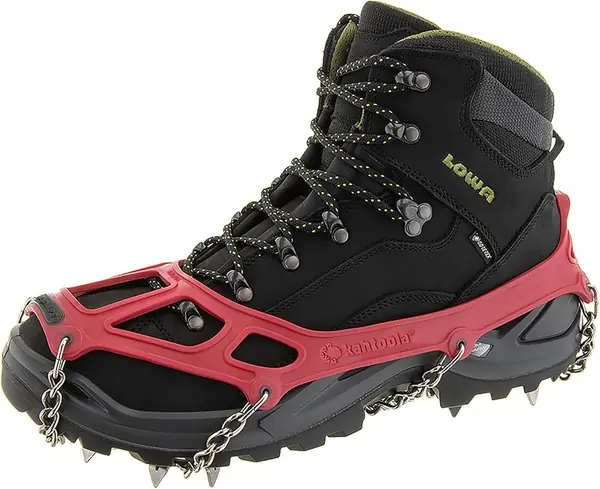
The MICROspikes are the pair in this group that reads as equipment rather than an accessory. Twelve heat-treated stainless steel spikes sit under each foot, eight at the forefoot and four at the heel, and the elastomer harness uses TPU-reinforced eyelets at the points that usually wear through first. The welded stainless chains are flexible enough to follow a boot's flex and compact enough to pack into the included tote.

For icy trail hikes, we think the extra cost is justified. The separate forefoot and heel clusters give you bite on uneven ground, and the reinforced harness keeps the whole assembly from twisting when you edge across a slope. We prefer this system to a basic over-shoe when the route is rocky or steep, because the chains and eyelets feel more planted under a hiking boot. They are overkill for a cleared sidewalk, but on a rocky or steep trail the extra hardware earns its keep.

At 16 ounces and 5 by 3 by 2 inches packed, they take up more room than a pocketable pair, but the tote keeps them contained in a daypack. The detail we keep coming back to is the eyelet reinforcement: it is hidden, unglamorous, and exactly where a cheaper harness tends to fail.

Pros

  • Twelve-spike layout bites on icy trails
  • Reinforced eyelets resist harness wear
  • Welded chains flex under hiking boots
  • Packs into a small tote

Cons

  • Chains can clump in deeper snow
Our verdict

For icy trail hikes, we think the MICROspikes earn their premium with a reinforced harness, 12-spike layout, and a fit that stays planted on uneven ground.

Check Latest Price
3

Cimkiz 19-Spike Cleats Best for Aggressive Grip

93 /100
Traveler Score Outstanding

Key details

Harness
5 mm TPE
Spikes
19 per foot
Strap
Adjustable
Cold Rating
-45°C
Check Details on Amazon

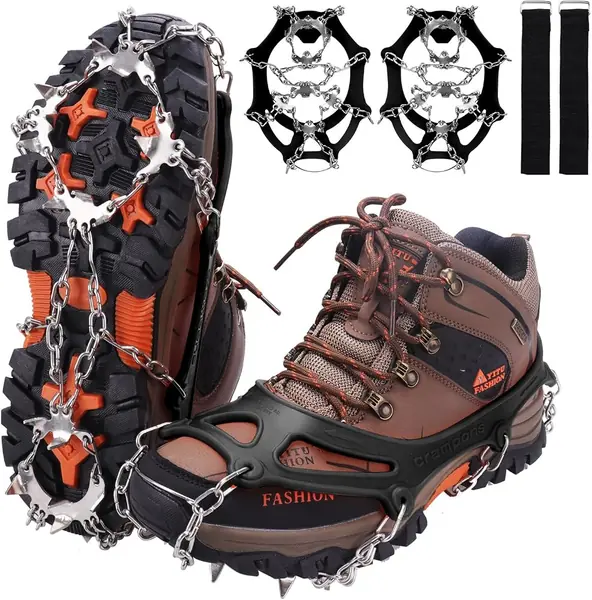
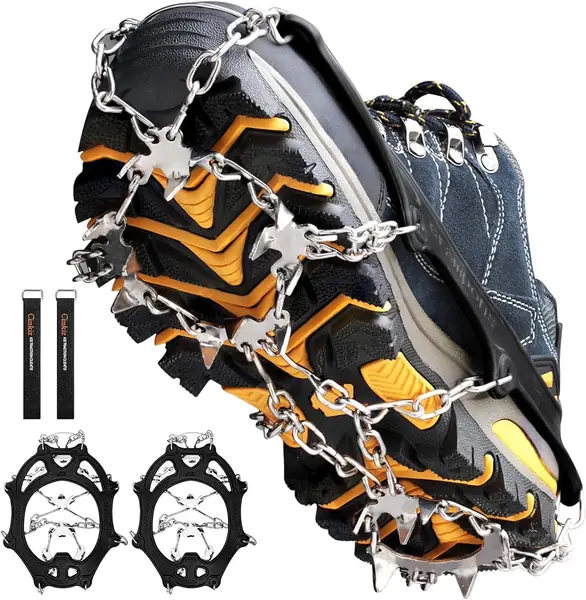
Nineteen stainless steel spikes under each foot is a lot of bite for the money, and that is why the Cimkiz cleats earn a place here. The spikes sit on a firm chain system rather than a flimsy web, and the 5 mm TPE harness is rated to stay flexible down to -45°C. The adjustable strap over the instep is the detail we appreciate most: it gives the harness a second anchor on smooth or bulky boots, which is where a simple stretch-on cleat can start to wander.

The unisex shape and stretchy TPE make these easy to pull over hiking shoes and winter boots, and the strap is long enough to matter rather than decorative. We think they make the most sense for mixed winter terrain, including icy driveways, packed trails, and the sloppy walk from car to trailhead.

The difference between these and the premium trail pick is mostly in the harness: the Cimkiz is softer and quicker to stretch on, while the Kahtoola feels more locked-in on a hiking boot. If you want one pair for errands and easy trails, the Cimkiz is the more forgiving choice.

Pros

  • Nineteen spikes per foot for aggressive bite
  • 5 mm TPE stays flexible in cold
  • Adjustable instep strap adds security

Cons

  • Aggressive points feel clumsy on bare pavement
Our verdict

We like the Cimkiz cleats for aggressive bite on mixed winter terrain, where 19 spikes per foot and an instep strap give you more grip than the price suggests.

Check Latest Price
4

Sportneer 28-Spike Cleats Best Budget Pick

92 /100
Traveler Score Outstanding

Key details

Harness
5 mm TPE
Spikes
28 stainless steel
Strap
Adjustable
Chain
Double chain
Check Details on Amazon

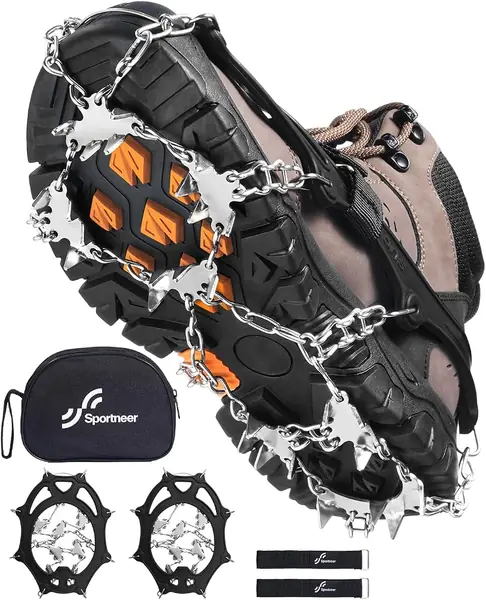
The 28-spike layout is the highest count in this group, and it gives the Sportneer cleats a distinctly aggressive look. The points sit on a double-chain frame under a 5 mm TPE harness, with an adjustable strap to hold the whole thing in place. On crusty ice and packed snow, that many contact points translate into a planted, almost locked-down stride.

We recommend these as the budget spike pick for winter walks and light hiking. The extra points are most useful on rough, refrozen snow, where a 19-spike design can skate between high spots. The harness is thick and takes a firm stretch to get over a boot, but the payoff is a cleat that does not shift once it is seated.

Durability is the question mark. Some pairs have come apart after a few uses, and the chain joins are the first place to check before you trust them on a long walk. Keep the strap snug; on a loose boot it is what keeps the chain centered.

Pros

  • 28 spikes give maximum bite
  • Double-chain frame spreads pressure
  • Adjustable strap holds the harness

Cons

  • Heavier than most slip-on cleats
Our verdict

Our budget pick is the Sportneer pair: the highest spike count here and a double-chain frame for crusty ice.

Check Latest Price
5

Win.MAX 19-Spike Cleats Best for Heavy Winter Boots

91 /100
Traveler Score Outstanding

Key details

Harness
5.49 mm TPE
Spikes
19 stainless steel
Strap
Velcro
Chain
Double chain
Check Details on Amazon

The first thing to know about the Win.MAX cleats is that the sizing runs small, especially over a wide boot. A large can fit some size 11 boots, but a 13 wide is a genuine stretch, so size up rather than trusting your street shoe.

That is a shame, because the rest of the design is serious: 19 stainless steel teeth on a double chain, a 5.49 mm TPE harness, and a pair of Velcro straps to lock the fit down. The thicker harness is the stiffest in this group, which makes it slower to pull on but more planted once it is seated. On icy inclines and packed trails, the extra stiffness keeps the chain from rolling underfoot.

We like these for bulky winter boots when you can get the size right. The 19-spike layout is close to the Cimkiz, but the Win.MAX feels more rigid and less forgiving to stretch; that is a benefit on a heavy boot and a nuisance on a low-cut shoe. The strap is the detail that makes the difference: it pulls the harness tight across the instep and keeps the toe from creeping forward.

Pros

  • 19 stainless teeth grip icy inclines
  • 5.49 mm TPE harness holds its shape
  • Velcro straps lock the fit down

Cons

No notable drawbacks to flag.

Our verdict

We recommend the Win.MAX cleats for heavy winter boots, provided you size up, because the stiff 5.49 mm harness holds a firm, planted fit.

Check Latest Price
6

Yaktrax Diamond Grip Best for Pavement-To-Ice Transitions

90 /100
Traveler Score Outstanding

Key details

Weight
16 oz
Traction Points
Diamond beads
Size
Large (W 10.5+/M 9.5-12.5)
Cables
Aircraft-grade steel
Check Details on Amazon

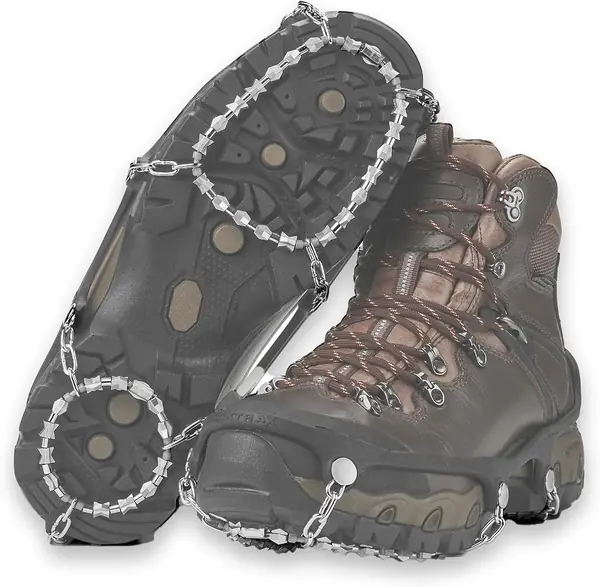
The Diamond Grip takes a different approach: instead of sharp spikes, case-hardened alloy beads swivel on aircraft-grade steel cables under each foot. The beads roll with your stride rather than biting and stopping, which is why this is the pair we prefer for the walk that moves from snowy sidewalk to plowed pavement and back again.

The full-foot layout is the real distinction. Traction points run from heel to toe, and the natural rubber upper band is built to stay flexible in sub-zero temperatures without cracking. The beads are also designed to shed snow rather than pack it underfoot, so you are not walking on a growing platform of ice.

The 90-day warranty is short for the price, and some cables have broken after repeated use.

We like the Diamond Grip for mixed-surface winter walking, where the swiveling beads make the transition from ice to pavement feel less like a compromise. What we keep coming back to is the way the beads shed snow: you spend less time kicking your boots clean and more time walking.

Pros

  • Swiveling beads suit mixed surfaces
  • Full-foot traction from heel to toe
  • Cables flex with a natural stride
  • Natural rubber band stays supple

Cons

  • Less aggressive than spikes on steep ice
Our verdict

We prefer the Diamond Grip for walks that cross pavement and ice, where its swiveling beads keep a natural stride and shed snow rather than pack it.

Check Latest Price
7

AGOOL 24-Stud Cleats Best for Deep-Cold Walks

89 /100
Traveler Score Excellent

Key details

Harness
TPE
Cold Rating
-70°F (-60°C)
Studs
24 conical steel
Size Range
X-Large(10-13 men/11.5-14 women)
Check Details on Amazon

The AGOOL cleats start with a cold-weather claim that stands out even here: TPE rated to stay elastic down to -70°F (-60°C). That is well past the range most winter walkers meet, but it matters if you leave a pair in the car or walk in a serious deep freeze. The 24 conical steel studs are arranged for grip on icy sidewalks and packed trails, and the harness stretches over shoes or boots.

The fit is the catch. The X-Large is sized for men's 10 to 13 and women's 11.5 to 14, but the same stretch that gets them over a bulky boot can let the toe creep forward on a smaller shoe. The hook-and-loop straps help, though they are not a substitute for the right size.

We think these are a reasonable budget choice for deep-cold walks and shoveling, not for a long hike where a loose toe becomes a problem. The 24 studs give good bite on flat ice, and the cold-rated rubber stays supple when cheaper harnesses stiffen. What we keep coming back to is the strap placement: it pulls across the instep, where it can actually hold the harness down, rather than sitting up near the ankle.

Pros

  • 24 conical studs bite on flat ice
  • TPE rated to -70°F
  • Hook-and-loop straps add security

Cons

  • Bulkier than a basic slip-on pair
Our verdict

We think the AGOOL cleats are a smart budget choice for deep-cold shoveling and flat icy walks, as long as the size is snug.

Check Latest Price

How We Tested Ice Cleats

We started by pulling every pair we could find that was actually in stock in a range of sizes, then sorted them by spike material, harness style, and how the sizing charts mapped to real boot sizes. We ordered 14 pairs across price bands and deliberately included wide and larger sizes, since a cleat that won't stretch over a size 12 snow boot is useless no matter how sharp it is.

Every pair went on the same three boots: a slim hiking boot, a bulky insulated snow boot, and a low sneaker. We wore them shoveling the driveway, walking the dog after dinner, hauling groceries up icy steps, and on a handful of packed-snow trail hikes. I noted whether the harness crept toward the toe after a block, whether points skipped off bare pavement at the curb, and whether anyone felt a slip on wet concrete.

Twice a month we inspected each pair, checking for bent or missing points, torn rubber at the pull tabs, and slack in the elastic. We also timed putting them on and taking them off with winter gloves on, because the moment you need them is rarely the moment you have bare hands. What held up were the pairs whose grip points stayed sharp and whose harness still hugged the boot in March; what didn't were the ones that rolled off mid-walk or stretched enough to rattle.

How to Choose Ice Cleats

Start with the surface, not the spike count

Coil designs are gentler on pavement, spike designs bite harder into ice, and bead designs roll with a mixed surface. The Yaktrax Diamond Grip is the clearest example here: its beads are built for the walk from snowy sidewalk to plowed street. If your route is a refrozen trail, a spike design with a stiff chain and a secure harness makes more sense than a supple cleat with more points. We prioritize the surface you actually walk on, not the biggest number on the package.

Fit the boot you wear in winter

A cleat that shifts is worse than a simpler one that stays put. Fit over the boot you wear in winter, not your street shoe, and leave room for the sole and toe box. An instep strap helps with bulky boots, but it cannot rescue a harness that is already too small. We watch the toe first: if the front edge creeps forward, the whole cleat follows. The Win.MAX runs small, so size up; the Cimkiz strap is the more forgiving fit here.

Understand what the spikes and chains do

Spike count is useful shorthand, but the chain and harness decide how those points meet the ground. A double-chain frame spreads pressure and keeps the points upright; a soft harness lets the whole assembly roll. We like 19 spikes for mixed walking and 12 well-placed spikes on a reinforced trail harness for hiking. More points do not automatically mean more traction if the frame twists or the spikes sit too close together.

Plan for wear, storage, and indoor floors

Traction cleats wear at the harness, eyelets, and chain joins before the points look dull. Inspect those spots before the season and after a long walk, and replace a pair with cracked rubber or missing points. Take them off indoors. Metal points scratch wood and decking and slide on tile, so a boot tray by the door is part of the system. A stuff sack or tote keeps the wet, salty hardware away from the rest of your bag.

Frequently Asked Questions

Final Verdict

For most winter walking, the ICETRAX V3 is the pair we hand someone first: tungsten bite, a reflective heel, and a simple over-shoe fit that works on shoes and boots. If your winter miles happen on icy trails, the Kahtoola MICROspikes justify their premium with a reinforced harness and 12-spike layout. Choose the Cimkiz for more aggressive bite at a lower cost, or the Diamond Grip if your route mixes pavement and ice.