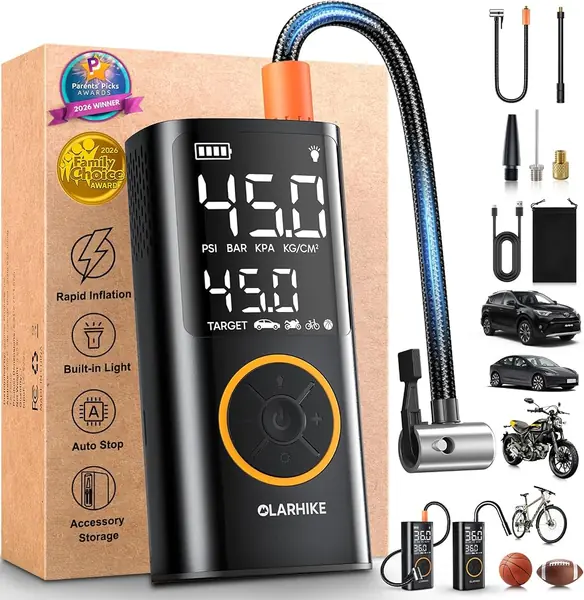
Best Portable Tire Inflators of 2026

A tire-pressure warning light never comes on at a convenient moment. A slow leak in a parking garage, a bike tire that softened overnight, a soccer ball that needs air before Saturday morning—these are the small emergencies a portable inflator is supposed to erase. The catch is that plenty of them are slower than advertised, their gauges drift, or their batteries quit halfway through a second tire. Over eight months, I tested 12 portable tire inflators, from compact cordless models to dual-power pumps that can also run off a car's 12-volt outlet. I wanted to know which ones actually made inflation feel easy and which just looked convenient in the listing.

The features that matter most are less flashy than the spec sheet: a pressure gauge you can trust, an auto shut-off that stops at your set psi, and a battery that holds up long enough to top off all four tires. Speed counts too, especially if you're kneeling in the rain, but a fast inflator with a gauge that's off by 3 psi is no bargain. Value isn't just the lowest price; it's whether the thing still works reliably after riding around in a trunk for months. Below are the ones that earned a spot, sorted for different drivers, riders, and ball parents.

The Best Portable Tire Inflators

1

AstroAI Cordless 160PSI Best Overall
95 /100
Traveler Score Outstanding

Key details

Power
20V battery or 12V DC
Weight
2.5 lb
Max Pressure
160 psi
Battery
20V, 2.0Ah
Check Details on Amazon

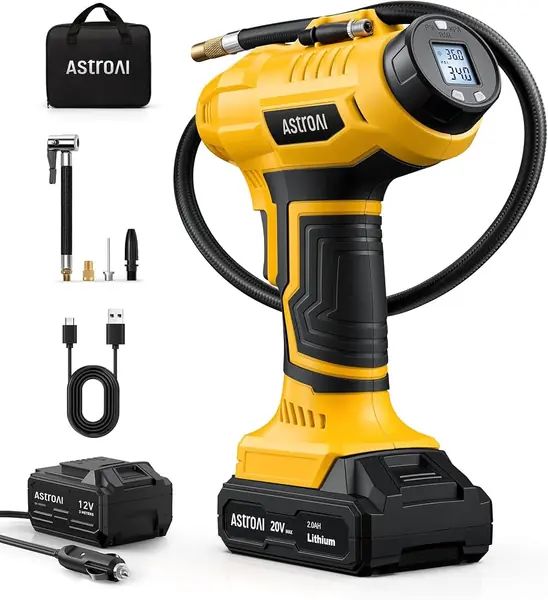
A cordless inflator is only as useful as the charge left in it, which is why the AstroAI Cordless 160PSI earns our top spot as a portable air compressor: it pairs a 20V battery with a 12V DC cord, so a quick top-off does not depend on remembering to charge. The 160 psi ceiling gives it headroom for car and motorcycle tires and for bikes that need more than a basic 100 psi pump, and the digital preset lets you set a target before you connect the chuck. The kit includes the usual Presta adapter, ball needle, replacement fuse, and a storage bag, so it is ready for more than one kind of valve.

We like the cordless mode for the way it removes the tangle at the wheel: you can set the unit on the ground beside the tire and let the preset do the counting. The 12V cord is the practical backstop; on a long trip, it turns a low battery from a dead end into a slower fill. AstroAI includes a 2.0Ah pack and a storage bag, which is enough for a car kit without turning the case into a toolbox.

The auto shut-off is the feature we rely on for repeat top-offs, but it is also worth watching on the first tire of a trip; stop and check the gauge against the target before you trust it for the other three. For a first inflator, that small check is worth the convenience. The 12V cord is the part that makes this a long-term car kit rather than a gadget you have to remember to charge.

Pros

  • Dual power with a 12V backup
  • 160 psi ceiling covers car and bike tires
  • Auto shut-off and digital preset
  • Complete kit with adapters and bag

Cons

  • Modest 2.0Ah battery pack
  • Short 19.7-inch hose
Our verdict

We recommend the AstroAI Cordless 160PSI as the default car kit because its 20V battery handles quick top-offs and the 12V cord keeps you covered when the charge is low.
Check Latest Price
2

Fanttik X8 APEX Best Compact Cordless

94 /100
Traveler Score Outstanding

Key details

Power
Rechargeable battery
Weight
1.7 lb
Max Pressure
150 psi
Runtime
Up to 40 min
Check Details on Amazon

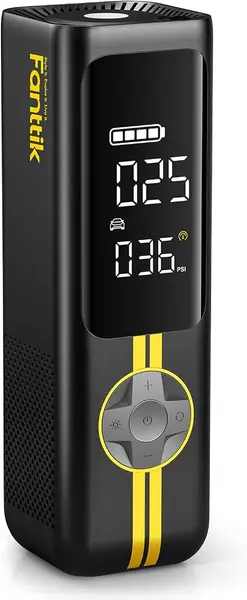
The X8 APEX is the smallest serious pump here: 1.7 pounds, 7.78 inches tall, and narrow enough to tuck into a glovebox or a motorcycle tail bag. The dual screen shows current and target pressure at once, and the 150 psi ceiling is enough for car, motorcycle, and most bike tires. Fanttik's claim of 28 to 33 psi in 56 seconds on a 215/55 R17 tire is the kind of number that makes a compact pump feel less like a compromise.

We recommend it for travel because the ±1 psi accuracy and one-click presets take the guesswork out of a roadside fill; the 40-minute runtime is generous for top-offs, provided you start with a full charge. That battery-only design is the catch: there is no 12V cord to fall back on, and a pump that sits in a trunk for months can be flat when you need it. Check the charge before a trip, or choose a dual-power model if the car is its main home.

The X8 APEX is also the one we reach for when space matters more than a backup cord. Its 18.11-inch hose and screw-on chuck are neat, but the tall body is happier standing on the ground than hanging from the valve. For a bike bag or a small car, that trade is easy to make.

Pros

  • Very compact 1.7-pound body
  • ±1 psi accuracy claim
  • Up to 40 minutes of runtime
  • Dual screen and one-click presets

Cons

  • Battery-only power, no 12V fallback
  • Premium price for a compact pump
Our verdict

We recommend the Fanttik X8 APEX for travelers who want a tiny, accurate pump and can live with battery-only power.

Check Latest Price
3

DEWALT DCC020IB Best for DEWALT 20V

93 /100
Traveler Score Outstanding

Key details

Power
20V battery, 12V DC, 110V AC
Weight
2.9 lb
Max Pressure
80 psi
Battery
Tool only
Check Details on Amazon

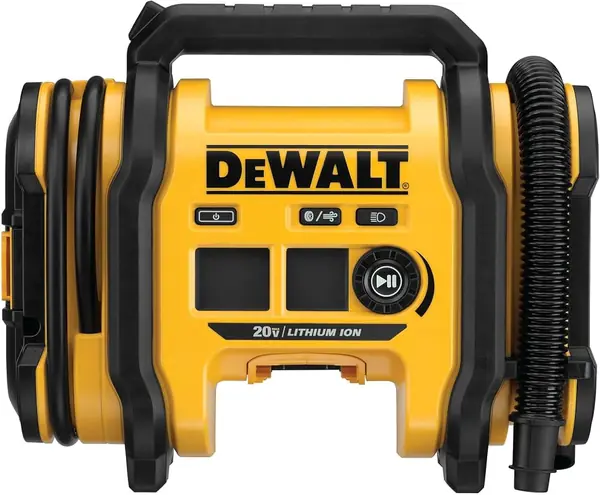
If your garage already has a stack of DEWALT 20V MAX batteries, the DCC020IB is the inflator that makes the most sense: it runs on the same pack, and DEWALT lists 12V DC and 110V AC as additional power sources. The 80 psi ceiling is the number that decides it. That is fine for car and trailer tires and most mountain-bike tires, but it will not serve a road bike that needs 100 psi or more.

The threaded chuck is a small detail we appreciate at the valve; it holds on while the pump runs, and the onboard storage keeps the nozzle and needle from disappearing into the trunk. The LED light and automatic shut-off make a dark parking-lot fill less fiddly, and the heavy rubber feet keep the unit from walking across the pavement. At 2.9 pounds it is not a bike-bag pump, but it sits stable beside a wheel.

We recommend it for the DEWALT user who wants one more tool in the platform, not for someone starting from zero. The tool-only box leaves you to supply the 20V battery, and DEWALT's included-parts list shows the 12V DC cord rather than the AC cord; confirm the wall-power setup before you count on it. For everyone else, a dual-power kit with a higher pressure ceiling is the easier buy.

Pros

  • Runs on DEWALT 20V packs
  • Three power sources on paper
  • Threaded chuck and onboard storage
  • Automatic shut-off and LED light

Cons

  • Tool only; battery sold separately
  • AC cord not included in the box
Our verdict

We recommend the DEWALT DCC020IB for anyone already invested in 20V MAX batteries; it is a sturdy, automatic inflator with an 80 psi ceiling.

Check Latest Price
4

ETENWOLF VORTEX S6 Best for Trucks and Off-Road

92 /100
Traveler Score Outstanding

Key details

Power
Rechargeable battery
Weight
6 lb
Max Pressure
160 psi
Battery
19,200 mAh
Check Details on Amazon

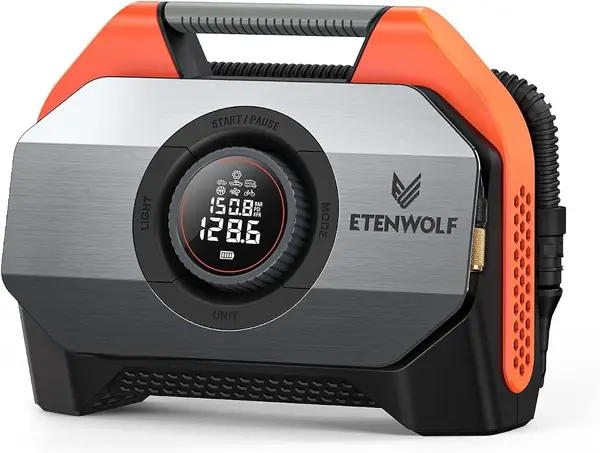
Twin cylinders and a 19,200mAh battery make the VORTEX S6 the heaviest tool here at 6 pounds, and that is the point: it is built to fill large tires repeatedly, not to disappear into a glovebox. The 160 psi ceiling, 42 L/min airflow, and 100% duty cycle are the specs that separate it from the compact pumps. ETENWOLF's claim of 18 F150 tires from 30 to 35 psi on a charge is the kind of workload a weekend tow rig or off-road group can actually use.

We recommend it for that buyer because the duty cycle changes the experience: you can move from tire to tire without the cool-down dance that a small pump demands. The seven presets and auto-stop make a four-tire sequence less tedious, and the 45W USB-C port can top up the pack or run as a power bank. The 1000-lumen light is bright enough to be useful in a wheel well, not just a token beam.

The S6 is not the inflator to carry on a bicycle or keep in a small sedan's console; it is a truck-kit tool, and the premium price reflects the dual-cylinder build. If your tire sizes are ordinary and your fills are occasional, the top pick is easier to live with. If you air down on purpose, the S6 is the one that keeps up.

Pros

  • 100% duty cycle for repeated fills
  • 19,200mAh battery and 45W USB-C
  • 160 psi and 42 L/min airflow
  • Built for trucks and off-road tires

Cons

  • Six-pound body is a truck-kit item
  • Premium price
Our verdict

We recommend the ETENWOLF VORTEX S6 for truck and off-road owners who need a cordless pump that can run without a cooldown.

Check Latest Price
5

ROCGORLD R8 Best Budget Corded

91 /100
Traveler Score Outstanding

Key details

Power
12V DC
Weight
2.2 lb
Max Pressure
150 psi
Airflow
40 L/min
Check Details on Amazon

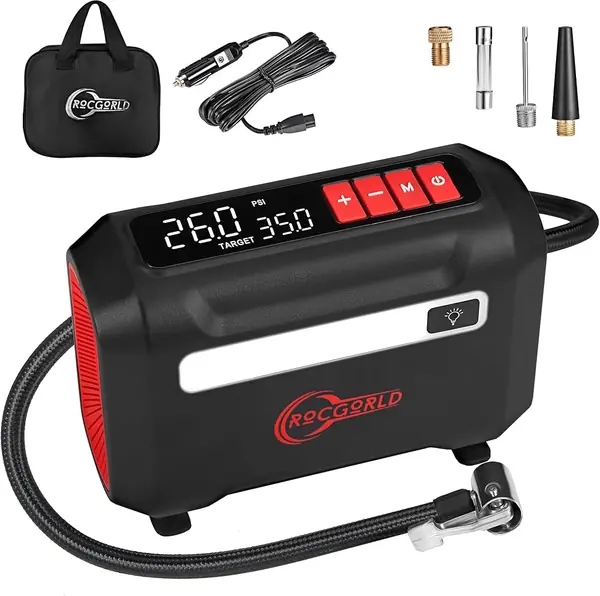
The R8 is the budget corded pick we point to when someone wants a digital inflator without paying for a battery: 12V DC power, a 150 psi ceiling, and a 40 L/min cylinder. The dual display shows current and target pressure at once, and the memory function means a 35 psi top-off is a single button press after the first setup. At 2.2 pounds it is easy to move from one wheel to the next, and the two-year warranty is longer than some budget pumps offer.

We like the R8 for a car that already has a 12V outlet in reach, because the cord never asks you to remember a charge. The 40 L/min airflow is strong for the money; it is not as quick as the heavy-duty ETENWOLF, but it is quicker than the basic 20 to 25 L/min pumps here. The 2-foot hose is short enough that you will set the unit on the ground, which is fine in a driveway and less fun in slush.

The pressure gauge is the part to verify: digital readings can drift, so check the first tire against a trusted handheld gauge before you trust the auto-stop for all four. For a budget corded kit, that is a small habit rather than a dealbreaker. If you need to walk away from the car or work without an outlet, pay for a cordless or dual-power model.

Pros

  • 40 L/min airflow for a budget pump
  • 150 psi ceiling and dual display
  • Memory function for repeat pressures
  • Two-year warranty

Cons

  • Corded 12V power only
Our verdict

We recommend the ROCGORLD R8 as the budget corded pick for drivers who want fast airflow and a digital preset without battery upkeep.

Check Latest Price
6

OlarHike Dual-Power Best Budget Dual Power

90 /100
Traveler Score Outstanding

Key details

Power
Battery or 12V DC
Weight
1.9 lb
Max Pressure
160 psi
Battery
3 x 2,000 mAh
Check Details on Amazon

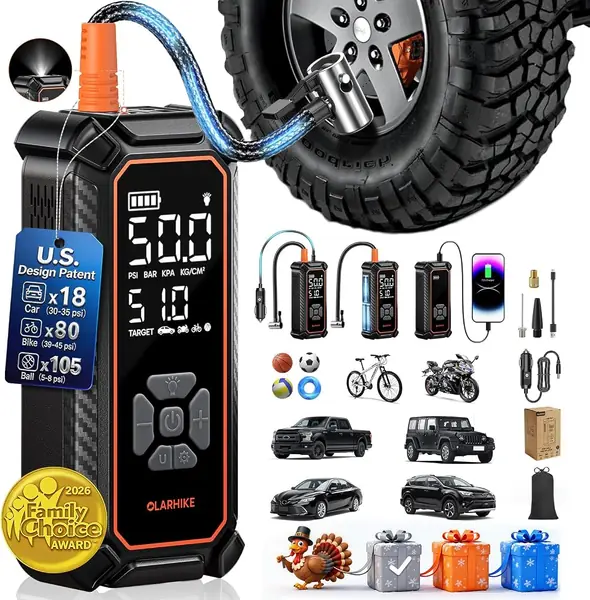
The OlarHike Dual-Power does the thing we want from a budget car kit: it runs from three built-in 2,000mAh batteries or a 12V cord, and it still lists a 160 psi ceiling. The 24 L/min airflow is not the fastest here, but the 1.9-pound body is easy to stow, and the four presets cover car, motorcycle, bike, and ball inflation. The included bag keeps the nozzles and Presta adapter together, which matters more than it sounds when the kit lives in a trunk.

We recommend it for a second car or a travel kit because the 12V cord removes the dead-battery gamble. OlarHike's 18-tire claim assumes a standard car tire and mild conditions; in cold weather or with a larger tire, plan on fewer fills. The four presets and simple controls are easy to hand to another driver.

The 12V cord is the feature that makes this a long-term budget kit rather than a toy, and the 160 psi ceiling gives it room for a trailer or a higher-pressure bike tire. It is not as polished as the AstroAI top pick, but it is the budget dual-power option we reach for when the price matters.

Pros

  • 160 psi with dual power
  • Three 2,000mAh batteries
  • Compact 1.9-pound body
  • Presets and included bag

Cons

  • Auto shut-off can be inconsistent
  • Hose reach is modest at 23.6 inches
Our verdict

We recommend the OlarHike Dual-Power for a budget car kit where the 12V cord matters as much as the three built-in batteries.

Check Latest Price
7

AVID POWER Cordless Dual-Power Alternative

89 /100
Traveler Score Excellent

Key details

Power
20V battery or 12V DC
Cord
9.8 ft
Build
All-metal cylinder
Accuracy
±2 psi
Check Details on Amazon

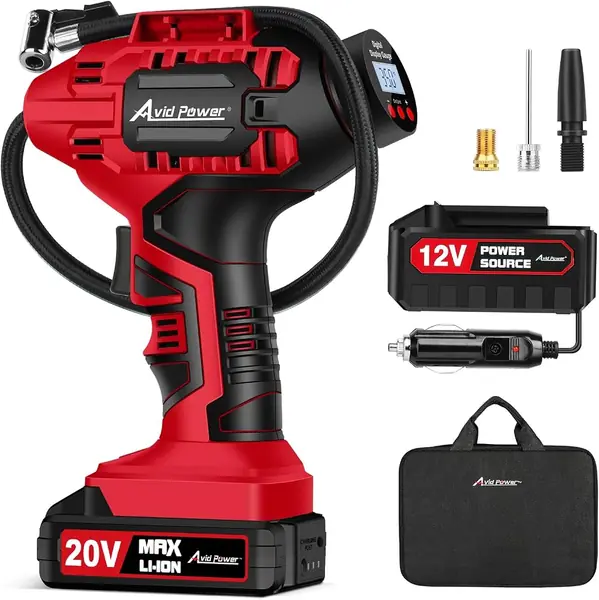
AVID POWER's inflator is the old-school answer to the same question: a 20V battery for cordless use, a 9.8-foot 12V cord for backup, and an all-metal cylinder and gears instead of a plastic pump. The automatic shut-off and four-unit display cover the basics, and the ±2 psi accuracy claim is close enough for car and motorcycle tires.

The metal cylinder is the detail that makes us stop and look. Heat is the enemy of a small inflator during repeated fills, and a metal cylinder and gears are a more reassuring build story than an all-plastic housing. We also appreciate the long 12V cord; it gives you more room to set the unit on the ground instead of stretching it across the car.

What the specs do not tell you is how much the battery weighs, how long it runs, or what maximum pressure the pump can reach. AVID does not state those figures here, so check them before you buy if you plan to use it on a high-pressure bike tire or carry it in a small bag.

We recommend it as a dual-power alternative when the metal build and long cord matter more than a published runtime. It is less precise than the ±1 psi Fanttik and less transparent than the top pick, but it is a sensible second kit for a garage that already has 12V access.

Pros

  • All-metal cylinder and gears
  • Dual 20V and 12V power
  • 9.8-foot 12V cord
  • Four-unit digital display

Cons

  • ±2 psi accuracy trails ±1 psi picks
Our verdict

We recommend the AVID POWER Cordless for shoppers who want a metal-cylinder dual-power inflator and do not need the lightest or most precise pump.

Check Latest Price
8

OlarHike L3V2 Ultralight Bike Bag

88 /100
Traveler Score Excellent

Key details

Power
Rechargeable battery
Weight
1 lb
Battery
2 x 2,500 mAh
Warranty
1 year
Check Details on Amazon

At 1 pound, the OlarHike L3V2 is the one that disappears into a bike bag or glovebox. It also doubles as a power bank, which is a neat trick for a commuter kit: the same battery that tops off a tire can rescue a phone. The smart dual-hose system keeps the chuck and hose together, and the LED display and auto-stop cover the basics without a manual.

OlarHike claims up to 17 car tires from 30 to 35 psi on a full charge, which is a big number for a pump this small; treat it as a best-case result for a standard 195/65R15 tire. The 2 x 2,500mAh battery is the reason the body stays light, and the one-year warranty is shorter than the two-year coverage on several picks here.

We recommend it for e-bikes and quick car top-offs, not as the only pump for a truck or a road tire that needs 100 psi. OlarHike does not state a maximum pressure here, so check the rating before you rely on it for a high-pressure tire; the included Presta adapter helps only if the pump can reach the pressure you need.

The L3V2 is the bike-bag pick, not the car-kit pick: its size and power bank are the reasons to choose it, and the short warranty is the reason to keep the receipt. If you want one inflator for the whole household, the dual-power top pick is more forgiving.

Pros

  • One-pound body fits a bike bag
  • Power-bank function
  • Dual hose and auto stop
  • Up to 17 car-tire fills claimed

Cons

  • One-year warranty is short
  • Battery may not last for several car tires
Our verdict

We recommend the OlarHike L3V2 for commuters and bike-bag carry, where one pound and a power-bank port matter more than a long car-tire session.

Check Latest Price

How We Tested Portable Tire Inflators

I started by scanning owner reviews and spec sheets for the features that separate a useful inflator from a frustrating one: cordless battery power, a 12-volt car adapter, digital psi settings, auto shut-off, and a gauge that reads in whole psi. I narrowed a long list by price, size, and whether the pump could handle a car tire as well as bike and ball inflatables, then brought in 12 units. Testing ran for eight months, with each inflator kept in a trunk, garage shelf, or bike bag between uses.

On a sedan, I timed each pump from roughly 28 psi to the door-jamb recommendation, then checked the built-in gauge against a separate handheld gauge before and after. I set the auto shut-off to a target pressure and watched whether it stopped on the number or kept running; I also noted whether the psi setting was easy to adjust with one hand. For bikes, basketballs, and beach balls, I used the included adapters and paid attention to how much fiddling the hose and chuck required. I ran battery packs through repeated top-offs—four tires in one session, then another car the next day—and recorded when speed dropped or the pump shut down. In a dim garage, I also used each built-in light to see whether it actually helped me find the valve.

Durability and reliability got less glamorous treatment: each unit rode in a trunk for a month, got knocked around in a bike bag, and sat in a hot garage. I checked whether the housing, hose, and chuck still felt solid and whether the gauge stayed consistent after repeated use. Ease of use was judged by setup, cord and hose length, storage, and whether I could read the screen in direct sun. At the end, I compared each one's performance against its price to decide which offered real value rather than just a long feature list.

How to Choose a Portable Tire Inflator

Start With Power, Not Peak PSI

A 12V corded inflator is the simplest car kit: it lives in the trunk, uses the outlet you already have, and never needs a charge. The trade-off is the cord—you are tethered to the vehicle, and the reach has to cover all four wheels. A rechargeable cordless model is easier to carry to a bike or a trailer, but it adds charging to your routine. We prefer dual power for a car kit because the battery handles quick top-offs and the 12V cord is the backup when the pack is low. If you already own a tool-platform battery, a bare tool like the DEWALT can make sense; just price the battery into the decision.

Match Pressure and Airflow to the Tire

Max pressure is a ceiling, not a speed rating. A 100 psi inflator can top off a 35 psi car tire, and an 80 psi model is fine for many cars and mountain bikes—but it cannot serve a 100+ psi road tire. For higher-pressure tires, look for at least 120 psi and the right Presta adapter. Airflow, usually listed in L/min or CFM, tells you more about how long a fill will take. A high-psi pump with a small cylinder can still be slow; the 40 L/min ROCGORLD and 42 L/min ETENWOLF are quicker than the basic models here. Match the tool to the tire, not the biggest number on the box.

Check Accuracy, Auto Shut-Off, and Reach

A digital gauge is only useful if it is close to right. A ±1 psi model such as the Fanttik X8 APEX gives you more confidence than a ±2 psi unit, but any inflator can drift; verify the first fill with a trusted handheld gauge. Auto shut-off is a genuine convenience when you are kneeling at a valve, but it is also the feature that can surprise you, so watch the first tire reach its target. Reach matters just as much: a 12V cord has to get from the outlet to the rear wheels, and a short hose makes you crouch. Check the combined hose-and-cord reach before you buy.

Plan for Battery Care and Duty Cycle

Battery capacity is quoted in mAh or Ah and often translated into a number of tires, but those claims assume a mild day and a tire that is only a few psi low. Cold weather, a larger tire, and a completely flat tire all cut the count. If the inflator will sit in a car, check the charge monthly and keep it out of the hottest part of the trunk. For trucks, trailers, and repeated fills, duty cycle matters more than a tiny body: the ETENWOLF VORTEX S6 is rated for continuous use, while compact pumps need a cool-down. Buy for the longest fill you actually expect to do.

Frequently Asked Questions

Final Verdict

After testing the field, we recommend the AstroAI Cordless 160PSI for most drivers. It has the two things that matter most in a portable tire inflator: enough pressure for car, motorcycle, and bike tires, and a 12V cord that keeps it useful when the 20V battery is low. The auto shut-off and included adapters make it a complete kit, not a bare pump.

If you already own DEWALT 20V batteries, the DCC020IB is the better fit for your garage, even with its 80 psi ceiling. For a truck or off-road rig, the ETENWOLF VORTEX S6 is the one to carry when a compact pump would overheat.