Best Kayak Roof Racks of 2026

Loading a kayak should take less time than the drive to the water. That’s the bar I set for every roof rack I try: can one person get a boat up, strapped down, and checked without balancing on a bumper or rereading the instructions? Over eight months, my team and I tested 12 kayak roof racks—J-bar cradles, folding stackers, and soft pad sets—on cars, SUVs, and trucks.

The first lesson for any new buyer is that the rack has to match your crossbars, not just your car. A J-bar is usually easier to load solo with one boat, a stacker makes more sense when you’re hauling several, and soft pads are best for occasional trips where you accept more strap fiddling. Value isn’t the lowest price, either—the racks that earned their keep loaded cleanly, stayed quiet, and still felt sturdy after wet, sandy launches.

Below are the picks that survived our loading and driving routine, sorted by paddler and vehicle. A solo day-trip rack is not the same as a family-hauling rack.

The Best Kayak Roof Racks

1

ARTIPOLY 4-in-1 Kayak Roof Rack Best Overall
88 /100
Traveler Score Excellent

Key details

Boat Capacity
2 kayaks
Load Capacity
165 lb
Crossbar Fit
Round, oval, square, flat
Folded Design
180-degree fold down
Check Details on Amazon

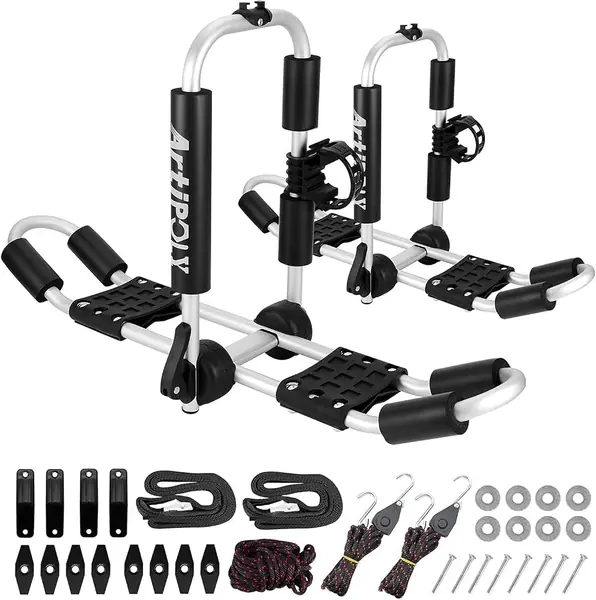
The first question we ask about any J-bar is whether it will clamp the crossbars already on the car. The ARTIPOLY is the one we recommend first because it handles round, oval, square, and flat bars, then folds down to 180 degrees when the boats come off. Its 165-pound rating covers two kayaks, and the aluminum frame weighs about 11 pounds, so one person can move it around without a wrestling match. That matters if you move the rack between cars or leave it on a daily driver.

Loading is where the wide-mouth J shape earns its keep: you can tilt a kayak into the cradle instead of lifting it over a tall upright. We also like the paddle holder, which keeps a paddle out of the cabin and off the kayak's deck. The rubber pedals and foam padding protect the hull at the contact points, and the folding mechanism leaves enough room for a garage or parking structure. The fold-down hardware also makes the rack less of a permanent roof ornament on the days you drive without a boat.

Two kayaks fit, but the rack still needs bow and stern lines for highway use; the J-cradles hold the hull, not the ends. The folding knobs are the one thing we check after the first highway run, because any folding rack can work loose as it settles. That check takes a minute and saves a loose upright later. For a car that switches between one boat and two, this is the easiest rack here to live with.

Pros

  • Fits round, oval, square and flat crossbars
  • 165-pound capacity for two kayaks
  • Folds to 180 degrees for storage
  • Includes a paddle holder

Cons

  • Included straps are basic
Our verdict

We recommend the ARTIPOLY first for its combination of two-kayak capacity, broad crossbar fit, and a folding frame that stays out of the way.
Check Latest Price
2

FORWODE Folding J-Bar Kayak Rack Best Heavy-Duty

87 /100
Traveler Score Excellent

Key details

Boat Capacity
2 kayaks
Load Capacity
150 lb
Folded Design
0 to 180 degrees
Frame
25 mm carbon steel
Check Details on Amazon

At about 28.5 pounds, the FORWODE is the rack you install once and leave on the roof. The frame is 25 mm carbon steel with a 1.2 mm wall, and the 150-pound rating covers two kayaks. That steel is the point: it feels more substantial than the aluminum J-bars here, and the 0-to-180-degree fold lets you drop the uprights when the car goes back in the garage.

We recommend it for the buyer who wants a heavy-duty two-kayak setup and does not plan to take the rack off between trips. The included kit is generous, with ratchet belts, S-hook pulley straps, and anchor straps, so you are not piecing together tie-downs on day one. The wide mouth is still easy to load, even with the extra steel. The trade-off is weight and bulk: installing it solo takes more care than the lighter ARTIPOLY, and the folding hardware adds a step at the launch.

The padding does its job on the hull, and the fold-down uprights keep the rack from turning into a permanent roof ornament. If your kayaks live on the roof all summer and you want steel rather than aluminum, this is the pick. The bolts stay accessible for a seasonal check, and the finish has held up to road grime in our use. Just plan for two people or a careful solo lift when the rack goes on.

Pros

  • 150-pound capacity for two kayaks
  • Thick 25 mm carbon-steel frame
  • Folds from 0 to 180 degrees
  • Full strap kit included

Cons

  • Included cinch straps wear quickly
Our verdict

We like the FORWODE for a steel-framed two-kayak setup that stays on the roof, as long as you can handle the extra weight at install.

Check Latest Price
3

GZDEMYYXGS Folding Kayak Roof Rack Best Folding for One Kayak

86 /100
Traveler Score Excellent

Key details

Boat Capacity
2 medium kayaks
Load Capacity
100 lb
Crossbar Fit
Most car, SUV, truck bars
Folded Design
Folds for storage
Check Details on Amazon

The folding feature is the reason to look at this one: the J-bars drop down when the kayak is off, so a low garage door or a tight parking space is less of a problem. The frame is alloy steel, the load rating is 100 pounds, and the rack is described as holding two medium kayaks when fully loaded. The uprights are padded on the load-bearing face, which matters when you slide a hull across them.

We treat it as a one-kayak rack for most people, because two touring boats plus gear will eat the margin fast. For a single recreational kayak, it is the budget folding pick here. The oversized knobs make angle changes easier than the small hardware on cheaper racks, and the rubber and foam contact points are kind to a hull. The J shape is narrow enough to leave room for a second rack if you later add another boat.

Once it is on the bars, the fold-down design is genuinely useful, and the rack stores flat enough to hang on a garage wall. The folded profile is low enough to leave the crossbars free for other gear. The folding knobs are large enough to turn with gloves on, which is a small thing that matters at a cold launch. Buy it for one boat and a car that needs its roof back.

Pros

  • Folds down for garage storage
  • Large knobs simplify angle changes
  • Rubber and foam padding protects hull

Cons

  • 100-pound limit rules out two heavy kayaks
  • Installation takes patience and extra hands
Our verdict

For one kayak and a garage that needs its height back, we think this folding rack is the budget pick to beat.

Check Latest Price
4

Abahub Soft Roof Rack Best for Cars Without Crossbars

85 /100
Traveler Score Excellent

Key details

Rack Weight
5 lb
Included Straps
2 cam-buckle, 2 tie-down, 2 loop
Mount Type
Soft roof straps
Pad Material
1680D fabric and EVA foam
Check Details on Amazon

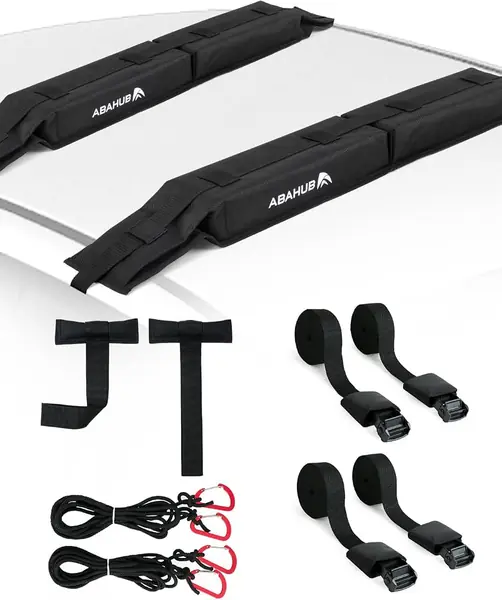
If your car has a bare roof, a hard J-bar has nothing to clamp to. The Abahub soft rack is the workaround: two foam-filled pads sit on the roof, and straps run through the cabin to hold them down. It weighs about five pounds and packs into a small bag, so it can live in the trunk and move between cars.

The kit is more complete than most soft racks, with cam-buckle straps, longer tie-downs, and hood loops for bow and stern lines. The cam buckles have neoprene sleeves to protect the paint. The pads are 1680D fabric with a PVC coating and EVA foam, which is the right combination for a roof that sees grit and rain. We like it for occasional kayak or paddleboard trips and for cars that do not have factory rails.

We recommend it as a temporary solution rather than a permanent roof rack. Keep the boat weight within your vehicle's roof limit, and use bow and stern lines every time. The straps can hum at highway speed; a half-twist in the loose tail quiets them. Store it dry, because a wet foam pad left against the roof is how marks start.

Pros

  • Works on cars without roof rails
  • Packs into a small storage bag
  • Complete tie-down kit included
  • EVA foam protects the roof

Cons

  • No published load rating
Our verdict

We recommend the Abahub when your car has no crossbars and you want a temporary soft rack that stores in the trunk.

Check Latest Price
5

Yakima BigStack Best for Multiple Kayaks

84 /100
Traveler Score Excellent

Key details

Boat Capacity
Up to 4 boats
Load Capacity
200 lb
Crossbar Fit
Round, square, factory, aero
Rack Weight
7.2 lb
Check Details on Amazon

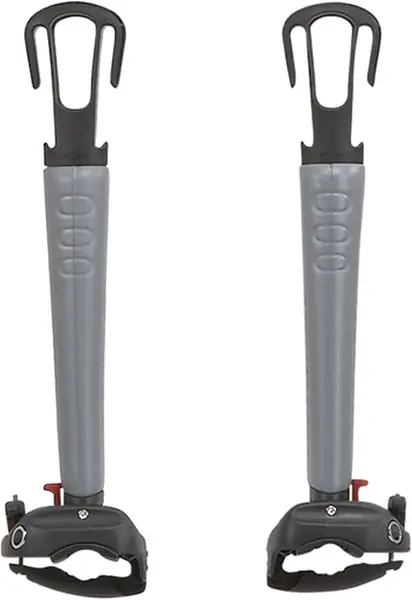
The BigStack is not a J-bar. It is an upright stacker that stands on the crossbars and lets you lean several boats against each other, with a 200-pound total rating and room for up to four. The frame folds down when the boats are off, and the universal mounts fit round, square, factory, and aero bars.

For a family or a club that regularly moves three or four kayaks, that capacity is the whole point. The HullGuard padding is generous at the contact points, and the upright gives you something solid to tie against. The frame feels solid once the mounts are tight, and the fold-down feature keeps the rack from whistling all week. It also leaves the roof free for a cargo box or bike tray when the boats stay home.

We recommend it for the group vehicle, not the solo paddler. A stacker always needs more attention to strap tension than a J-bar, but when the alternative is two cars, the BigStack earns its space. Check the fold-down clearance before you commit, especially in a low garage. The included hardware is straightforward, but give yourself a dry run in the driveway before the first launch.

Pros

  • Carries up to four boats
  • 200-pound load capacity for group trips
  • Fits round, square, factory and aero bars
  • Folds down when not in use

Cons

  • Needs extra straps for three or four boats
  • Does not fold flat on every roof
Our verdict

We recommend the BigStack for families and clubs that need to move three or four kayaks on one vehicle.

Check Latest Price
6

YUANSHI J-Bar Kayak Roof Rack Best Budget Two-Kayak Kit

83 /100
Traveler Score Excellent

Key details

Boat Capacity
2 kayaks
Load Capacity
150 lb
Crossbar Fit
Square, oval, flat
Frame
Carbon steel
Check Details on Amazon

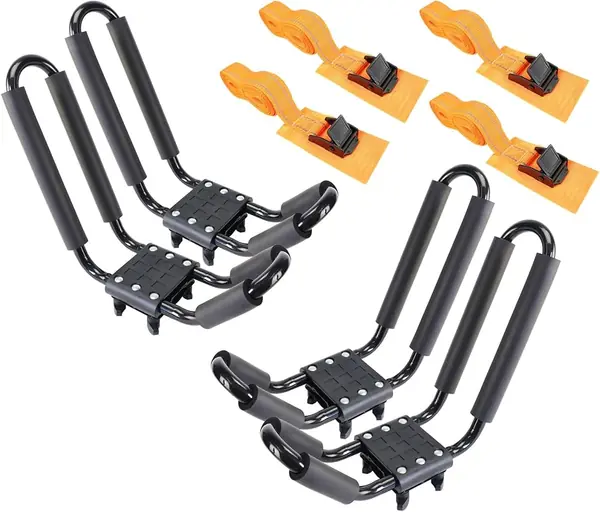
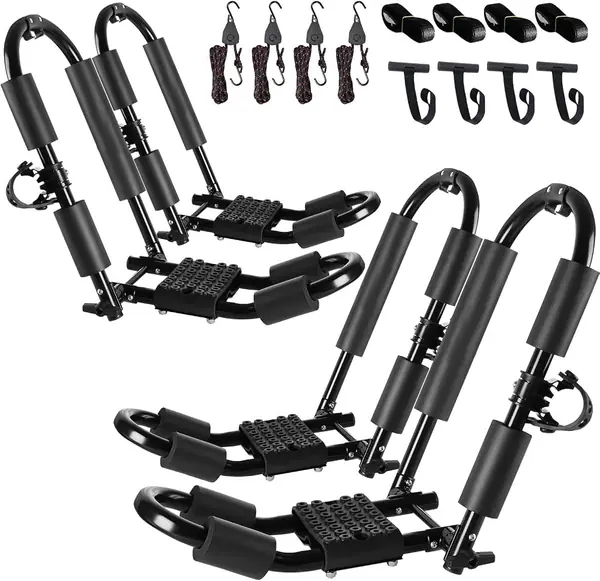
The YUANSHI is the budget two-kayak kit we point to when you want four J-bars and a full set of tie-downs without paying premium prices. The steel frame is rated for 150 pounds, the package includes mounting hardware and four heavy-duty straps, and the J-bars fit most square, oval, and flat crossbars.

We like the simple strap-mount design for a car that switches between kayaks and a cargo box. The wide mouth makes it easier to drop a boat into the cradle, and the foam padding protects the hull at the contact points. The J-bars are tall enough to keep a recreational hull off the roof. The finish is not showroom quality, but it looks tidy enough on a roof.

The caveat is long-term wear. The foam cushions and straps are the parts that show their age first, so inspect them before a long trip and replace anything that has gone soft or frayed. The bolts are standard hardware, so a socket set and a few minutes are all the assembly takes. For occasional weekend use, this is a lot of rack for the money. For a heavy touring boat, step up to a higher-capacity pick.

Pros

  • 150-pound capacity for two kayaks
  • Complete mounting hardware and straps
  • Carbon-steel frame feels substantial
  • Fits square, oval and flat crossbars

Cons

  • Not for round crossbars
Our verdict

We see the YUANSHI as the value two-kayak kit for occasional weekend trips, provided your bars are not round.

Check Latest Price
7

Yima 2-Pair Kayak Roof Rack Best for Light Kayaks

82 /100
Traveler Score Excellent

Key details

Boat Capacity
2 kayaks
Load Capacity
75 lb
Crossbar Fit
Square and flat
Included Straps
4 straps
Check Details on Amazon

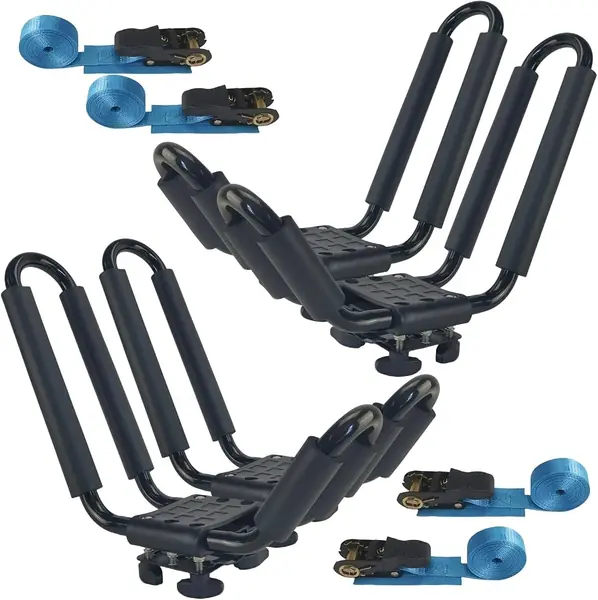
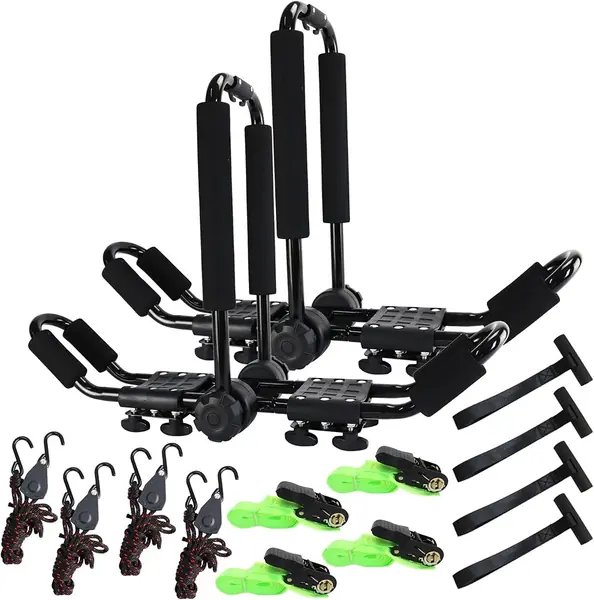
The Yima kit is priced like a budget two-kayak rack, but the load rating tells a different story. You get four J-bars for two kayaks, and the price is low, but the ceiling is lower than the rest of this group. A pair of heavy touring kayaks can blow past it before you add straps and gear. That is the number to write down before you order, not after the first trip.

We recommend it for one or two light recreational kayaks, not a loaded touring setup. The wide-mouth J shape loads easily, the strap-mount hardware fits square and flat bars, and the four included straps are enough to get started. The finish is basic, but the rack feels stable when the knobs are tight. The J-bars leave enough roof space for a second pair if you are carrying two narrow boats.

The padding is the part to watch over time; it can tear where the hull slides across it, so check the contact points before each season. For a first rack on a small car and a couple of budget kayaks, the Yima does the job. The hardware is simple enough to remove at the end of the season. Just do the weight math before you buy.

Pros

  • Four J-bars for two kayaks
  • Simple strap-mount installation
  • Fits square and flat crossbars
  • Includes four tie-down straps

Cons

  • 75-pound load rating limits heavy kayaks
Our verdict

We recommend the Yima for light recreational kayaks, not for a pair of heavy touring boats that test its low load rating.

Check Latest Price

How We Tested Kayak Roof Racks

We started by researching the racks that show up again and again for cars, SUVs, and trucks, then narrowed the field by crossbar compatibility—round, square, factory, and aerodynamic—boat capacity, folding design, and whether the straps and mounting hardware looked substantial enough to reuse. That left us with 12 racks, which we tested over eight months.

Most of our testing happened on real launch days: lifting one and two kayaks onto vehicles in a gravel lot, tightening straps with wet hands, then driving 20 minutes of highway and a few miles of washboard access road before checking every contact point. We timed the first solo installation and the second attempt a week later, noted whether the instructions made sense without a second person, and rechecked bolts and cradles after each trip. To judge stability, we rocked loaded boats side to side before driving and watched for cradle flex, hull shifting, and strap creep at highway speed; to judge noise, we listened for whistles, rattles, and slapping strap tails with the windows up and the radio off.

Between trips, racks stayed mounted in rain and sun so we could inspect folding joints, pad wear, finish, and strap fraying. We also loaded and folded each rack repeatedly, because a rack that fights you in the driveway will be worse at the put-in. Finally, we compared what came in the box—straps, tie-downs, pads, storage bags—against how much fiddling each system required, since a cheaper rack that needs extra hardware is not much of a value.

How to Choose a Kayak Roof Rack

Pick the Rack Type That Matches Your Loading Style

J-bar cradles hold a kayak on its edge and free up roof space, which makes them the best default for one or two boats. Saddle or cradle racks carry a hull flat and suit wide boats and canoes. An upright stacker like the Yakima BigStack is for three or four kayaks on one vehicle. A soft rack is the exception: it straps through the cabin and sits on a bare roof, so it is for occasional trips rather than a permanent installation.

If you load alone, a J-bar with a wide mouth and a folding upright is easier to manage than a flat stack. If you have a garage with a low door, folding matters more than a few pounds of weight.

Match Load Ratings to Your Boats and Your Roof

A two-kayak rack is not a promise that it will carry any two kayaks. Add the hull weights, then add paddles, life jackets, and any gear you strap down. Compare that total with the rack's rating and with your vehicle's roof limit; the lower number wins. The Yima kit, for example, lists a 75-pound capacity, while the ARTIPOLY and FORWODE are rated for 150 pounds or more.

If you are close to the limit, move the heavier boat to the center of the bars and leave the cooler in the trunk. A rack that is overworked will flex, and flex is what loosens hardware.

Check Crossbar Shape and Spread Before Ordering

Universal mounting hardware still has conditions. Some J-bars fit round, oval, square, and flat bars; others fit square and flat only and specifically exclude round bars. A few need a minimum gap between the crossbars or a few inches of clearance above the roof. Measure the bar shape and the spread before you buy, not after the box arrives.

If your bars are aerodynamic or unusually wide, test-fit the clamps before you load a boat. The ARTIPOLY is the broadest fit in this group, while the YUANSHI and Yima kits are the ones to check against round or oversized bars.

Budget for Straps, Padding, and Storage

Included straps are the most common weak point in a roof rack kit. A cam strap that is fine for a short drive can stretch or fray on a long highway run, so plan to replace the working straps with a heavier set and add bow and stern lines. Padding matters too: foam and rubber contact points protect the hull, but they wear, so inspect them before each season.

Folding uprights are worth the extra hardware if the rack lives on a car that parks in a garage. If you remove the rack often, weight becomes a feature; the aluminum ARTIPOLY is easier to handle than the steel FORWODE. Store soft racks dry, because a wet pad left against the roof is how marks start.

Frequently Asked Questions

Final Verdict

The ARTIPOLY is the rack we recommend first because it fits the widest range of crossbars and carries two kayaks without making the roof feel crowded. If you want a steel frame and leave the rack installed, the FORWODE is the heavy-duty alternative. If you regularly move three or four boats, the Yakima BigStack is the better tool. Match the load rating to your actual boats before you buy.