Best Tie Down Straps of 2026

A tie-down strap is a small purchase that can ruin a bigger day: a hook slips, a ratchet gives, and the refrigerator you strapped down starts shifting in the truck bed. I've hauled lumber and a motorcycle, and good straps disappear into the job: they tighten smoothly, stay put over bumps, and release without a fight. Over the past six months, we tested 14 tie-down straps, from heavy ratchet models to cam buckle lashing straps.

The differences rarely show up in break strength. What matters is the working load you can trust, whether the hooks stay seated, and how much excess strap you have to manage. I also watched for soft loops and coated hooks that protect paint, and for a release lever that lets the ratchet back off without a fight. None of these are self-retracting, so I judged retractability by how neatly each strap coiled.

Value comes down to hardware and webbing that hold up, not the lowest price. The picks below are the straps I'd trust again for an appliance move, a bike, or a weekend load.

The Best Tie Down Straps

1

Rhino USA Heavy Duty Ratchet Tie Downs Best Overall
97 /100
Traveler Score Outstanding

Key details

Strap Size
1.6 in x 8 ft
Break Strength
5,000 lb
Kit Contents
4 straps, 4 soft loops
Hooks
Coated full-bend S-hooks
Check Details on Amazon

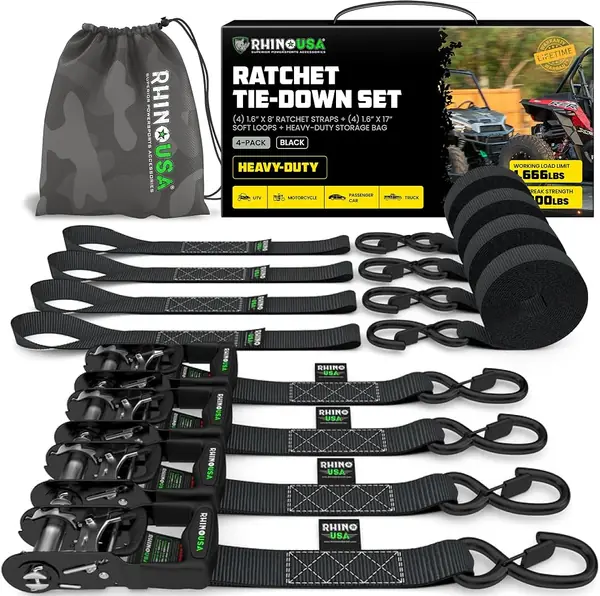
Five thousand pounds of break strength is more than a half-ton pickup will ever ask of a strap, and the surplus is why this is the kit we point to first. The webbing is 1.6 inches wide, broad enough that it doesn't bite into a tailgate or leave a crease across a cabinet edge, and the ratchet body is zinc-coated with a covered end cap that keeps grit out of the mechanism.

Four soft loops come in the box, and they change what the straps can do. Wrapped around a handlebar, a fork leg, or a roof-rack bar, a loop gives you an anchor point that won't scratch paint or slide off a hook, which matters on anything with plastic bodywork or a rounded frame. The S-hooks are full-bend and coated, so they sit flat in a D-ring instead of levering against it, and the padded handle doesn't cut into your palm on the last few clicks.

Eight feet is the number to check before you order. From a trailer deck to a handlebar, or across a load to the far rail of a bed, it's generous; spanning a wide flatbed or reaching bumper to roof rack, it runs out. The release is also stiff after a hard crank — take the tension off the webbing with your palm before you pull the lever rather than fighting a fully loaded ratchet.

What earns it the top spot is the margin. The working load leaves room for a load that shifts, the stitching is doubled at the hook ends, and Rhino backs the set with a lifetime replacement, which on a product that lives in the weather is worth more than another thousand pounds of break strength. It costs more than the budget kits here, and for a truck bed, a trailer, or a bike that has to arrive intact, we think it's the right place to spend.

Pros

  • 5,000 lb break strength on wide 1.6-inch webbing
  • Four soft loops add scratch-free anchor points
  • Padded handle and protected ratchet body
  • Lifetime replacement from the maker

Cons

  • Eight-foot straps run short on wide loads
  • Premium price against the budget sets here
Our verdict

Our top pick for general cargo: 1.6-inch webbing, 5,000 pounds of break strength, four soft loops, and a lifetime replacement behind it.
Check Latest Price
2

Rhino USA Ratchet Straps 1 in x 15 ft Best for Longer Loads

96 /100
Traveler Score Outstanding

Key details

Strap Size
1 in x 15 ft
Break Strength
1,823 lb
Working Load
607 lb
Kit Contents
4 straps, 4 soft loops
Check Details on Amazon

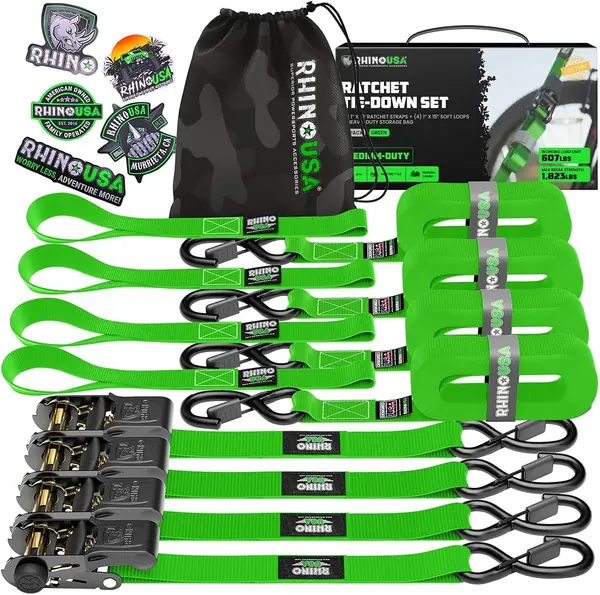
The second Rhino set here trades width for reach. At 1 inch by 15 feet with 1,823 pounds of break strength, it's a lighter strap than the heavy-duty kit, and the extra seven feet is the reason to choose it: an appliance box on a utility trailer, a mattress on a roof rack, a load where the hook sits nowhere near the corner you need to pull from.

We prefer it for moving day, when the load is bulky rather than brutally heavy and the strap has to travel to an anchor. A 607-pound working load covers a refrigerator or a dresser with room left over, and the four included soft loops let you wrap a leg or a corner instead of hunting for a frame rail. The ratchet takes up slack smoothly, and the release comes free once you take the load off the webbing first.

Storage is the quiet advantage. Fifteen feet of 1-inch webbing coils into a bundle that drops into a toolbox drawer or the pocket behind a truck seat, so the set travels instead of living in a tangle on the garage floor. Paired with the heavy-duty kit, you have both ends of the job covered: this one for reach, the wide one for brute capacity.

Pros

  • 15 feet of reach for far-off anchors
  • 607 lb working load handles appliances
  • Four soft loops included
  • Lifetime replacement coverage

Cons

  • Narrow 1-inch webbing needs edge padding
Our verdict

We reach for this set on moving day: 15 feet of reach, a 607-pound working load, and four soft loops for anchors far from the load.

Check Latest Price
3

AUGO Ratchet Straps 4-Pack Best Value Kit

95 /100
Traveler Score Outstanding

Key details

Strap Size
1 in x 15 ft
Break Strength
2,200 lb
Working Load
733 lb
Kit Extras
2 bungees, 4 soft loops, bag
Check Details on Amazon

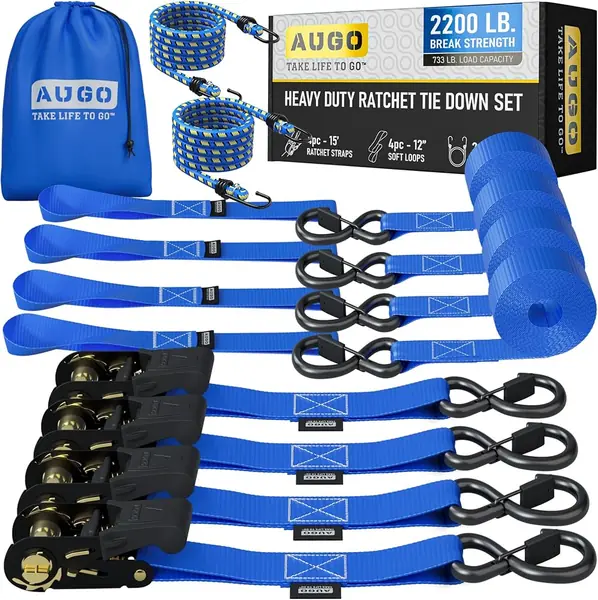
Two bungee cords, four soft loops, four 15-foot ratchet straps, and a bag that keeps the whole thing together: AUGO is the only set here that arrives as a tie-down system rather than four straps and good intentions. The 2,200-pound break strength and 733-pound working load sit in the middle of this group, which is exactly where most household hauling lives.

The S-hooks carry a spring-loaded safety latch and a rubber coating, two small things that decide whether a load stays put: the latch keeps the hook from bouncing out of a rusted anchor eye on a rough road, and the coating keeps it from chipping paint on the way in. The soft loops do the rest, wrapping a handlebar or a roof-rack bar where there's nothing to hook. The bungees earn their place too, for the cooler lid or the gas can that a ratchet is simply too much strap for.

Judged against the Rhino kits, this is the value play: less break strength per strap, more in the box, and enough length that a second set is rarely needed. For a household hauling a few times a year — a couch, a fridge, a load of landscaping material — that's the trade we take.

Pros

  • Complete kit with loops, bungees, and bag
  • 733 lb working load covers appliances
  • 15-foot straps reach most anchors
  • Latching, rubber-coated S-hooks

Cons

  • Release lever needs a firm pull
  • Bungee cords are short for big loads
Our verdict

Our most complete kit: four 15-foot straps, soft loops, bungees, and a bag, with a 733-pound working load that covers furniture and appliances.

Check Latest Price
4

Everest Premium Ratchet Tie Down Best for Heavy Loads

94 /100
Traveler Score Outstanding

Key details

Strap Size
2 in x 27 ft
Break Strength
10,000 lb
Working Load
3,333 lb
Hook Style
Double J-hook
Check Details on Amazon

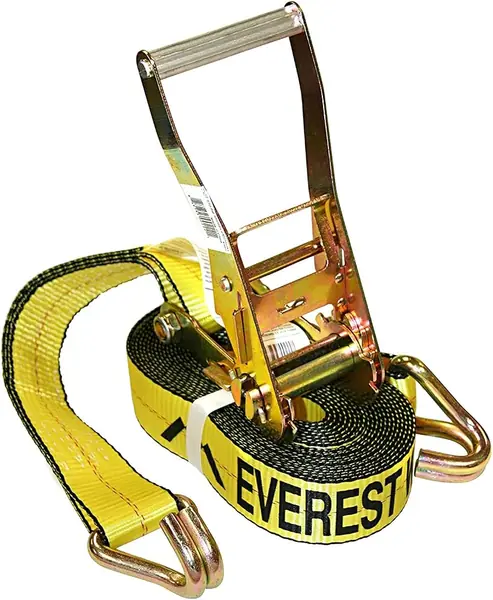
The Everest is the outlier on this page: one strap, 2 inches wide and 27 feet long, rated to 10,000 pounds of break strength and 3,333 pounds of working load, priced below every other pick. If you're securing a tractor implement, a stack of lumber, or anything with a frame rail you can hook, it buys more capacity for the money than anything else here, and the working load is high enough that you stop doing arithmetic about what's in the bed.

The double J-hook is the detail that decides whether it suits you. A J sits in a slot or around a thin frame member where a bulky S-hook won't, but it needs a real edge to bite — against a smooth bumper it has nothing to hold. The aluminum handle takes a two-handed pull without flexing, an edge guard is woven into the webbing to slow abrasion where it crosses a sharp corner, and the stainless hardware holds up to weather. Twenty-seven feet means a long tail on a short haul, so tie it off instead of letting it trail.

Pros

  • 10,000 lb break strength, the highest here
  • 3,333 lb working load for equipment
  • 2-inch webbing with a woven edge guard
  • Lowest price in this group

Cons

  • Sold as one strap per pack
  • J-hooks need a solid edge to grab
Our verdict

We recommend the Everest when the load is heavy and long: a 2-inch, 27-foot strap with 10,000 pounds of break strength for the least money here.

Check Latest Price
5

Pro Taper 1.5 in Tie Downs Best for Motorcycles

93 /100
Traveler Score Outstanding

Key details

Base Hook
360-degree swivel carabiner
Pack Size
2 tie-downs
Strap Width
1.5 in
Load Capacity
1200 lb
Check Details on Amazon

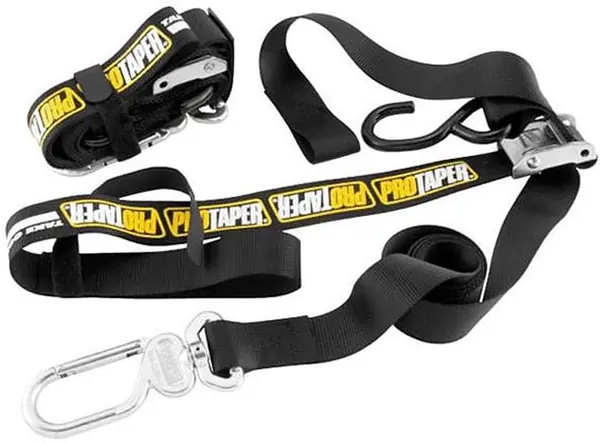
A base hook that swivels a full 360 degrees is the detail that makes these feel different. Clip the carabiner into a bed anchor at whatever angle it sits and the strap finds its own line, without twisting the webbing or walking the hook sideways as you tension it. Pro Taper builds that swivel into a 1.5-inch nylon tie-down with a coated S-hook at the other end.

These are cam-lock tie-downs, not ratchets, and that's the trade. There's no crank handle, so you tension them by hand — faster, quieter, and much harder to over-crank onto a fork seal or a handlebar. We like them for dirt bikes and sportbikes: soft loop over the bar, carabiner on the anchor, pull the tail, done. For a refrigerator or a stack of plywood, you want the mechanical advantage of a ratchet instead.

The webbing is broad enough at 1.5 inches to spread load across a handlebar without marring it, and hook-and-loop keepers hold the tails so nothing whips at highway speed. What you're paying for is the hardware and the speed: no ratchet to maintain, no metal teeth near a painted surface, and a base hook that never fights the anchor.

Pros

  • 360-degree swivel carabiner base hook
  • Cam lock is quicker than a ratchet
  • 1.5-inch webbing protects bars
  • Keepers hold the loose tails

Cons

  • Two tie-downs per pack
  • Premium price for a two-strap set
Our verdict

We choose these for bikes: a cam lock, a 360-degree swivel carabiner, and 1.5-inch webbing that protects bars and paint without a ratchet handle.

Check Latest Price
6

STANLEY S1007 Ratchet Tie Downs Best for Easy Cranking

92 /100
Traveler Score Outstanding

Key details

Strap Size
1.5 in x 16 ft
Break Strength
3,300 lb
Working Load
1,100 lb
Handle
Padded overmolded grip
Check Details on Amazon

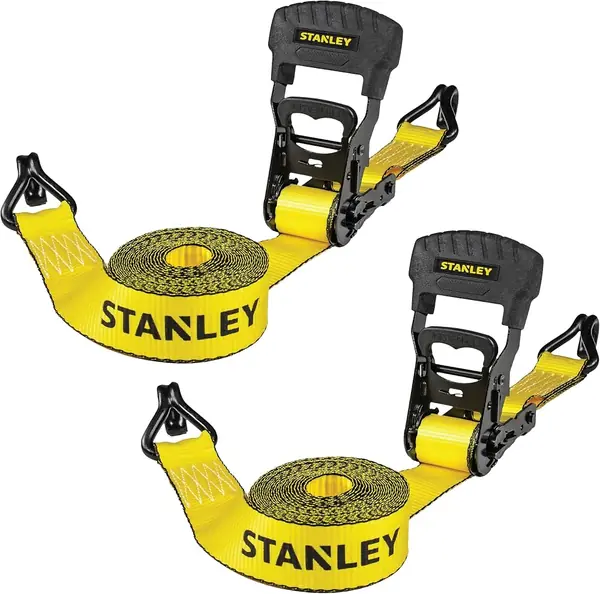
Ratchet handles are where cheap straps hurt you. STANLEY molds recessed grooves into the grip and adds an overmolded finger lever for the release, and the difference shows up on the fourth or fifth crank of a heavy load rather than the first.

The numbers are serious for a two-pack: 1.5-inch webbing, 16 feet long, 3,300 pounds of break strength, and a 1,100-pound working load. Sixteen feet is a useful middle ground, long enough to reach across a trailer deck and back without leaving a coil of tail to manage.

The hooks are coated to sit against a frame without scraping paint, and the ratchet body is coated against weather. One thing to check before a strap goes on the trailer: run it through a full tighten and release cycle in the driveway. A ratchet that locks up under tension is a strap you'll be cutting off at the ramp, and no amount of leverage will talk it loose.

Where it earns its place is the pairing of capacity and hand comfort: wide webbing for furniture and appliances, a working load that covers a loaded toolbox or a fridge, and a handle you can lean on. It's the one to take when someone wants heavy-duty numbers without heavy-duty prices — though you need two packs to tie down four corners.

Pros

  • 1,100 lb working load for heavy cargo
  • Padded grip with a finger release lever
  • 16 feet of reach per strap
  • Coated hooks and weather-coated ratchet

Cons

  • Two straps per pack
  • Bulkier than 1-inch webbing in tight gaps
Our verdict

Heavy-duty capacity with the most comfortable crank in this group — we recommend it for furniture and appliances at 1.5 inches and 1,100 pounds of working load.

Check Latest Price
7

Ayaport Cam Buckle Lashing Straps Best for Light Cargo

91 /100
Traveler Score Outstanding

Key details

Strap Size
0.75 in x 48 in
Break Strength
350 lb
Working Load
260 lb
Buckle
Cam buckle
Check Details on Amazon

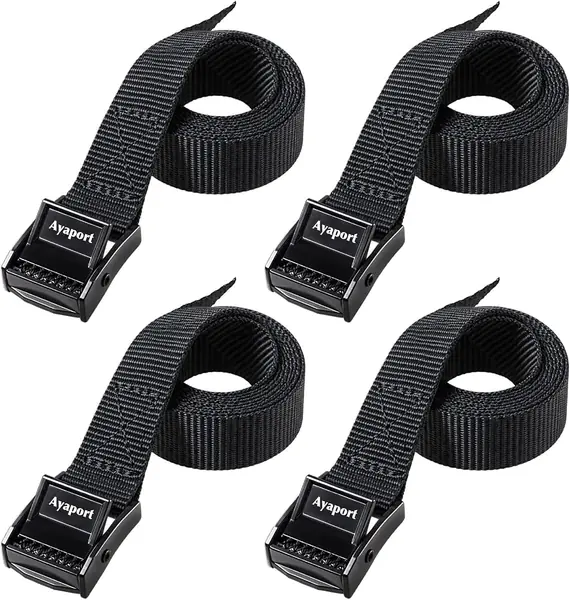
No ratchet, no crank, no metal teeth chewing the webbing: a cam buckle grips when you pull the tail and lets go when you thumb the release. On a 0.75-inch strap rated to 350 pounds of break strength and 260 pounds of working load, that's the entire design — and for a bundle of tent poles or a duffel on a roof rack, it's faster than anything else in this roundup.

Think of them as lashing straps rather than cargo straps. They wrap around gear and cinch tight: firewood bundles, tent poles, a rolled mattress, the awkward things that won't sit still on the way home. The four-pack means there's usually a spare in the bag, so one set lives in the camping bin and another in the trunk.

Adjusting one-handed is the weak spot — the buckle wants one hand on the frame while the other pulls the tail, so give it two hands and it's drama-free. Polypropylene webbing doesn't hold water the way nylon does, which makes these the set that stays useful in the rain and the one we don't think twice about leaving in a boat locker.

Pros

  • Cam buckle tightens in seconds
  • Four straps per pack
  • Polypropylene webbing handles rain
  • Compact enough to live in a trunk

Cons

  • Four-foot straps limit reach
  • 260 lb load rating suits light gear only
Our verdict

We keep a set of these for gear and luggage: a fast cam buckle, four straps, and enough grip for anything you can carry by hand.

Check Latest Price
8

Jack Boss Ratchet Tie Down Set Best for Light Household Hauls

90 /100
Traveler Score Outstanding

Key details

Strap Size
1 in x 15 ft
Break Strength
1,500 lb
Working Load
500 lb
Kit Contents
4 straps, 4 soft loops
Check Details on Amazon

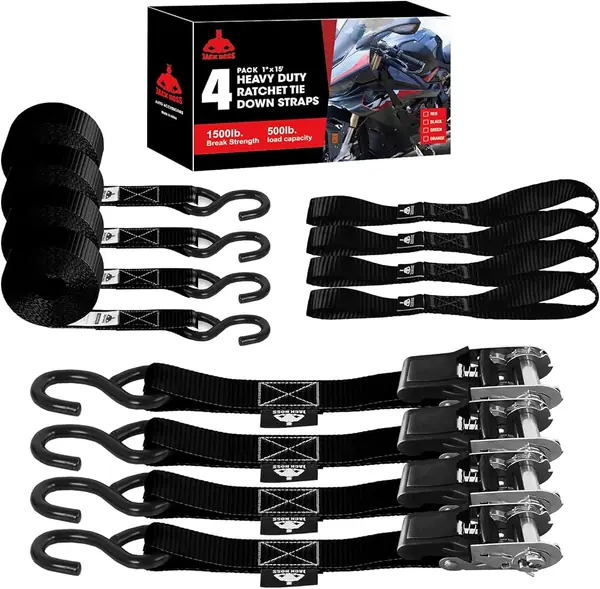
Five hundred pounds of working load is the number that defines this set. That's a light-duty rating — a lawn mower, a dresser, a canoe on a pair of crossbars — and it's an honest description of what four 1-inch straps at this price can hold.

What you get for it: 15 feet of reach, four straps, four soft loops, coated S-hooks, and a padded handle that's better than the money suggests. The length is the surprise. Fifteen feet is enough to reach across a small utility trailer and back, which puts it well beyond the eight-foot Rhino set.

The straps stow flat, the soft loops stay with their straps instead of wandering off in the garage, and the ratchet runs smoothly enough to work one-handed while you hold a corner in place. For a set that gets pulled out a few times a season, that's most of what matters.

Where it gives ground is margin. A 500-pound working load on 1-inch webbing leaves little room for a load that shifts at highway speed, so use two straps where one seems sufficient and check tension after the first few miles. Hand it a mower or a dresser and it behaves; hand it a bike and a loaded trailer and the reserve simply isn't there.

Pros

  • 15 feet of reach at a budget price
  • Four soft loops included
  • Padded handle and smooth ratchet
  • Coated S-hooks protect paint

Cons

  • 500 lb working load limits heavy loads
  • Thinner webbing than the 1.5-inch kits
Our verdict

Our pick for occasional light hauling: 15 feet of reach, four soft loops, and a smooth ratchet, as long as the load stays under 500 pounds.

Check Latest Price

How We Tested Tie-Down Straps

We started by researching the straps shoppers actually compare, then filtered by webbing width, overall length, hook style, working load, and the presence of soft loops. From that pool, we bought 14 straps and used them for six months, favoring manual ratchet models with S hooks and J hooks, plus cam buckle lashing straps, so the test reflected the range of jobs people buy these for.

The straps lived in truck beds and on roof racks during weekend lumber runs, an appliance move, a motorcycle trip, and yard cleanup with a mower. For each one, I hooked it to a real anchor point, tensioned it solo, and drove at highway speed, then checked for slack, creeping hooks, and scratches on painted or chrome surfaces; soft loops got extra attention when metal hooks were involved.

To judge adjustability and length, I tightened the same strap around both a short bundle and a long load, noting how much tail was left to secure and whether the ratchet released smoothly under tension or snarled. I also timed setup and takedown with gloves on, because ease of use matters most when your hands are cold or the load is awkward. None of these straps retract on their own, so I scored storage by how neatly each coiled and whether the excess strap stayed put.

Durability and quality checks came after each use: I inspected webbing for fraying, stitching for pulls, hooks for bending or gaping, and ratchet teeth for skipping. I compared each strap's stated working load with the loads I would actually trust on a highway, and weighed value by how the hardware and webbing held up rather than by sticker price alone.

How to Choose Tie Down Straps

Start With the Working Load, Not the Break Strength

A 10,000-pound figure on the label is the point where the webbing fails, not what it can hold down a highway. Across these straps the working load limit runs at roughly a third of the headline number: 3,333 pounds against 10,000 on the Everest, 733 against 2,200 on the AUGO. Add up what you're hauling and pick a strap rated to about twice that. A 500-pound strap under a 400-pound load has nothing left for a pothole.

Ratchet or Cam Buckle

A ratchet gives you mechanical advantage — crank the handle and the tension stays — which is what heavy, stiff loads need. The cost is speed and the risk of over-tightening, since a ratchet can crush a kayak hull or dent a cabinet. Cam buckles pull tight by hand and release with a thumb, so they suit light gear, luggage, and anything fragile. If you haul heavy loads regularly, buy a ratchet set; if you mostly lash gear, a cam-buckle four-pack will do more of your work.

Match Length and Width to the Load

Measure from anchor to anchor, double it for the trip over the load, and add a couple of feet for what the ratchet takes up. Eight feet covers bikes, ATVs, and short-bed corners; 15 feet handles trailers and roof racks; 27 feet is for long spans and big equipment, and it leaves a tail you have to tie off. Width matters too: 1-inch webbing is fine for a mower, while 1.5- and 2-inch straps spread force and are gentler on soft or sharp edges.

Hooks, Loops, and Anchor Points

An S-hook with a keeper clip stays in a D-ring; a J-hook fits slots and thin frame rails where a bulky hook won't; a swivel carabiner lets the strap find its own angle. None of them help when there's nothing to hook at all, which is why soft loops matter — they wrap a handlebar, a fork leg, or a roof-rack bar and give the hook something to grab. If your vehicle has few anchor points, buy a kit that includes loops.

Frequently Asked Questions

Final Verdict

For most people the Rhino USA heavy-duty four-pack is the answer: 1.6-inch webbing, 5,000 pounds of break strength, four soft loops, and a ratchet that takes up slack cleanly. It's the set we'd put in a truck bed first, and it's the one that leaves the most margin for a load that shifts.

If your anchors sit far from the load — a mattress on a roof rack, an appliance in a long bed — step to the 15-foot Rhino set for the reach. And if you're securing one heavy, awkward item instead of four corners, the Everest's 2-inch, 27-foot strap is the least expensive way to get serious capacity.