Best Jump Starters of 2026

The click when you turn the key is its own kind of bad news: the dash lights dim, the engine gives you nothing, and the guy with the truck next to you wants $80 to uncoil his cables. A jump starter turns that into a five-minute inconvenience — clamp it on, press the button, drive away, recharge it that night.

What separates a good one from a mediocre one isn't the number on the box. A well-built 1,000-amp unit will crank a cold V-8 while an off-brand 4,000-amp unit sits there clicking; that figure is a peak number measured for a fraction of a second, and thin cables and small clamps give the game away. We ran 12 jump starters through six months of real use to find out which ones actually deliver.

The picks run from a pack you'll forget is under the seat to a heavy garage-dweller that has never let me down. Price doesn't track neatly with power here — a couple of the cheaper units out-cranked the expensive ones — and the best jump starter is still the one that holds a charge months after you tossed it in the trunk.

The Best Jump Starters

1

Hulkman Alpha85 Best Overall
97 /100
Traveler Score Outstanding

Key details

Peak Amps
2000 A
Battery Capacity
20000 mAh
Engine Rating
Up to 8.5L gas / 6.0L diesel
Recharge Time
0-80% in 1 hour
Check Details on Amazon

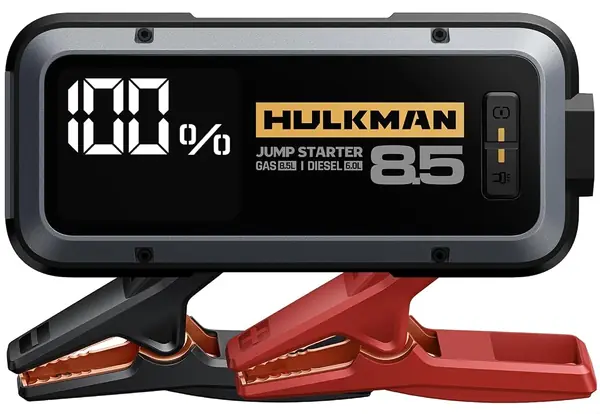
Peak amps are the number most shoppers compare, and the Alpha85's 2,000 are double what the NOCO GB40 offers, but the reserve behind them is what settled it for us. This pack carries 20,000 mAh and is rated for 8.5L gasoline and 6.0L diesel engines, so a half-drained V8 or a cold diesel isn't the edge case it is on the 1,000-amp units. It's 1.8 inches thick, and ours lives flat under the back seat.

The 3.3-inch screen is the feature we didn't expect to care about. Most packs here give you four bars and a guess; this one shows a percentage and an error code, so you know whether you're working with a full pack before you open the hood. Charging is the other quiet win. The included 65W adapter takes it from 0 to 80 percent in about an hour, which turns a top-up into something you do while the groceries come in rather than an overnight project.

One thing to know before ordering: there's no case in the box. Clamps, wall adapter, and USB-C cable arrive loose, so plan on a zip pouch or a small tool bag to keep the set together. And since charge retention is the least predictable part of this category, put a recurring reminder in your phone to top the pack up every few months instead of trusting it to sit for a year.

The detail that keeps this one in the trunk is the cigarette-lighter adapter. Long drives recharge the pack from the car's own socket, so a road trip doesn't have to end with a flat booster and a shrug.

Pros

  • 2,000 amps and 20,000 mAh of reserve
  • Screen shows charge percentage and error codes
  • 0 to 80 percent in about an hour
  • Recharges from a 12V socket on the road

Cons

  • No carrying case included
  • 4.5 pounds, over twice the NOCO's weight
Our verdict

Our pick for most people: 2,000 amps and a 20,000 mAh reserve mean a cold V8 or a diesel doesn't rattle it, and the screen tells you it's ready before you lift the hood.
Check Latest Price
2

NOCO Boost GB40 Best for Glove Boxes

96 /100
Traveler Score Outstanding

Key details

Peak Amps
1000 A
Weight
2.4 lb
Battery Capacity
2150 mAh
Engine Rating
Up to 6.0L gas / 3.0L diesel
Check Details on Amazon

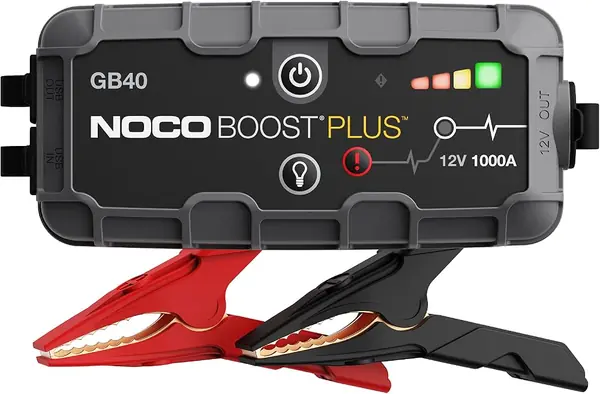
At 2.4 pounds the GB40 is the pack that actually disappears into a glovebox, a saddlebag, or the bin behind the seat. That's the whole case for it, and it holds up. The booster you have with you beats the bigger one in the garage.

The 1,000 amps are honest ones. They'll crank a 6.0L gasoline or 3.0L diesel engine, and the rated 20 starts per charge is more than a commuter with a failing alternator needs. What we watch is the reserve: 2,150 mAh is the smallest battery here by a wide margin, which leaves less slack if the pack sits uncharged for a season. Ours goes on the charger every time we rotate the emergency kit, and that habit is the whole trick with a pack this size.

The clamps are the reason we trust it with other people's cars. They're spark-proof and reverse-polarity protected, so a wrong-order connection simply does nothing: no arc, no drama, no jump-starting lesson in a parking lot. We've handed it to people who have never opened a hood. There's also a 100-lumen light with seven modes, including SOS, and a USB port that will get a phone back on its feet in a pinch.

Where it stops is engine size. At 3.0L diesel it reaches its ceiling, so a pickup, a boat, or a tractor wants more amps and more reserve. For a sedan, a crossover, or a mower, it's the least fussy pack in this group: clamp, wait for the light, crank.

Pros

  • Smallest pack here at 2.4 pounds
  • Spark-proof, reverse-polarity clamps anyone can use
  • Rated for 20 starts per charge
  • Seven-mode 100-lumen light plus USB charging

Cons

  • 2,150 mAh is the smallest reserve here
  • One-year warranty, the shortest in this group
Our verdict

The one we hand to people who want a pack in the glovebox and nothing else to think about: small, spark-proof, and enough for a 6.0L gas engine.

Check Latest Price
3

GOOLOO GP4000 Best for Big Engines

95 /100
Traveler Score Outstanding

Key details

Peak Amps
4000 A
Weight
3.9 lb
Battery Capacity
24000 mAh
Engine Rating
All gas / 10.0L diesel
Check Details on Amazon

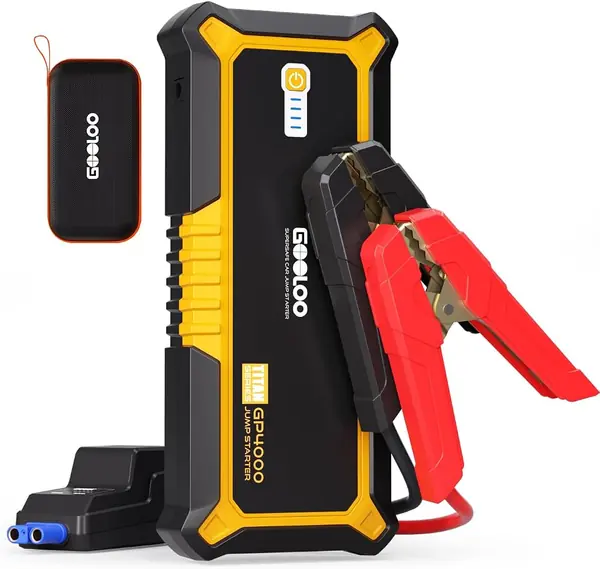
More claimed peak amps and a bigger battery than our top pick, for less money: the GP4000 is the value argument in this group. It's rated at 4,000 amps and 24,000 mAh, handles any gasoline engine and diesels up to 10.0L, and does it from a case that's 1.5 inches thick.

It's also the pack that comes with somewhere to put everything. The zippered EVA case holds the clamps, the USB-C cable, and the cigarette-lighter adapter, which is the detail we missed on the Hulkman. Ten built-in protections cover the usual list, including reverse polarity, overcurrent, and short circuit, and the dual USB ports will fast-charge a phone while the pack waits.

The savings come out of the housing rather than the electronics. The body is hard plastic with rubber corner guards, and durability is the least settled measure on this pack, so treat it as a wear item rather than the last booster you'll buy. The boost button is small and flush, too: fine with bare hands in daylight, slower to find with a glove on at night.

Where it makes sense is the vehicle that works for a living, whether that's a plow truck, a boat trailer, or a farm pickup that sits for weeks and needs to fire on the first crank of the season.

Pros

  • 4,000 amps and 24,000 mAh for less than the top pick
  • Zippered case holds the clamps and adapters
  • 1.5 inches thick, slides under a seat

Cons

  • Plastic body; durability is the least settled measure here
  • 18-month warranty, shorter than the two-year picks
Our verdict

For a truck, a boat, or anything with a big engine, this is the most starting power for the money here, as long as you accept a plastics-and-bumpers build.

Check Latest Price
4

WOLFBOX MegaVolt24 Best for Cold Weather

94 /100
Traveler Score Outstanding

Key details

Peak Amps
4000 A
Battery Capacity
88.8 Wh
USB-C Port
65 W
Operating Range
-4 to 140°F
Check Details on Amazon

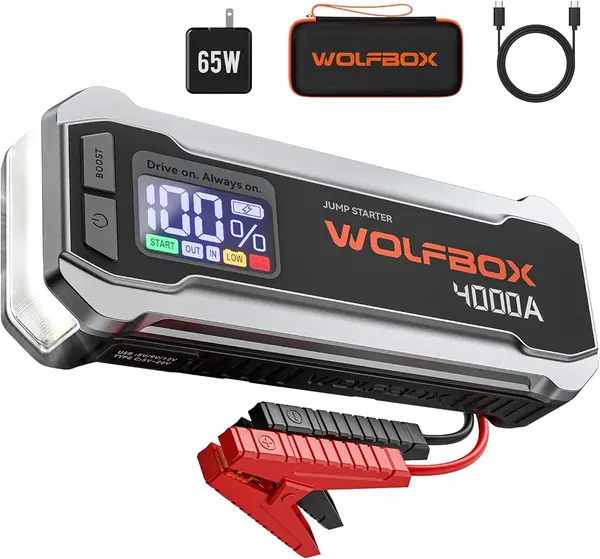
Minus 4 to 140 degrees Fahrenheit is the number that got our attention, because a jump starter is a winter tool first: batteries fail in the cold, and lithium packs lose cranking power in the same weather. WOLFBOX rates the MegaVolt24 across that whole spread, and the one-touch boost is there for batteries that have dropped below the voltage where the clamps would normally wake the pack up.

Around that core it's the most forthcoming pack here. The LCD shows charge and status instead of four blinking bars, the 65W USB-C port works in both directions so it charges the pack and a laptop, and a PD65W wall charger comes in the box. Capacity is 88.8 Wh in a 3-pound body, which is a lot of reserve for something that fits in a duffel.

Our reservation is longevity. Charge reliability is the most uneven measure on this pack: the failure to watch for is a unit that reads full and then won't take a charge, or one that goes flat sitting in a trunk between seasons. The two-year warranty is a real backstop, but if you want the pack you think about least, that's still the Alpha85.

One quirk worth knowing before you need it: the boost mode is on a timer. Press it and you have a short window to reach the ignition, so get your keys and your footing sorted first instead of hunting for them afterward.

Pros

  • Rated from -4 to 140°F
  • 65W USB-C in and out, wall charger included
  • LCD shows charge level and error states

Cons

  • Charge reliability is the least even measure here
Our verdict

For winter driving, this is the pack we want in the car: rated from -4 to 140°F, with 65W USB-C top-ups and a screen that reads out what's happening.

Check Latest Price
5

HALO Bolt AIR Best Jump Starter and Air Compressor

93 /100
Traveler Score Outstanding

Key details

Peak Amps
1500 A
Weight
2.2 lb
Warranty
90 days
Air Compressor
Built in, 4 nozzles
Check Details on Amazon

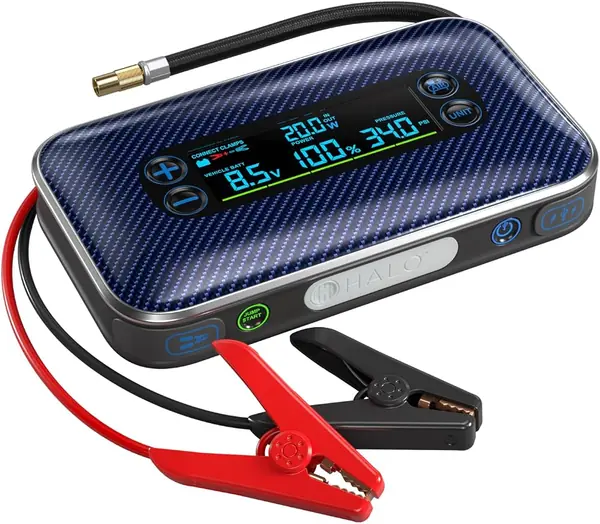
The compressor is why you buy this one. Four nozzles, a target-pressure setting you dial in on the screen, and a body light enough to hold in one hand while it works: that combination is why the Bolt AIR rides in the trunk instead of a separate inflator and a separate booster competing for the same corner.

As a jump starter it's a passenger-car tool: 1,500 amps at 11.1 volts, rated for cars rather than trucks or diesels. That covers the sedan in the driveway, the mower in the shed, and a neighbor's dead battery, and it won't touch a diesel pickup, which is a job for the Hulkman or the GOOLOO. We appreciate that it makes no promises it can't keep.

The compressor is also the part to keep an eye on. A unit that runs but won't build pressure is the failure that shows up on these, and it's the add-on rather than the battery that tends to go first. Nothing about the jump-start side has worried us in use.

Everything else is sorted: a 100-lumen flood light with three modes, USB-A and USB-C ports, reverse-polarity and short-circuit protection, and spark-resistant cables. For a small car with a shallow trunk, that consolidation is the whole argument.

Pros

  • Jump starter and tire inflator in 2.2 pounds
  • Target-pressure setting takes the guesswork out
  • 100-lumen flood light and USB charging

Cons

  • Compressor is the part that fails first
  • 90-day warranty is the shortest here
Our verdict

The one we pack when trunk space is tight: 1,500 amps for a car and a tire inflator that reads its own pressure, together at 2.2 pounds.

Check Latest Price
6

Clore Jump-N-Carry JNC660 Best Heavy-Duty

92 /100
Traveler Score Outstanding

Key details

Peak Amps
1700 A
Weight
18 lb
Battery Type
22Ah AGM
Cable Length
46 in
Check Details on Amazon

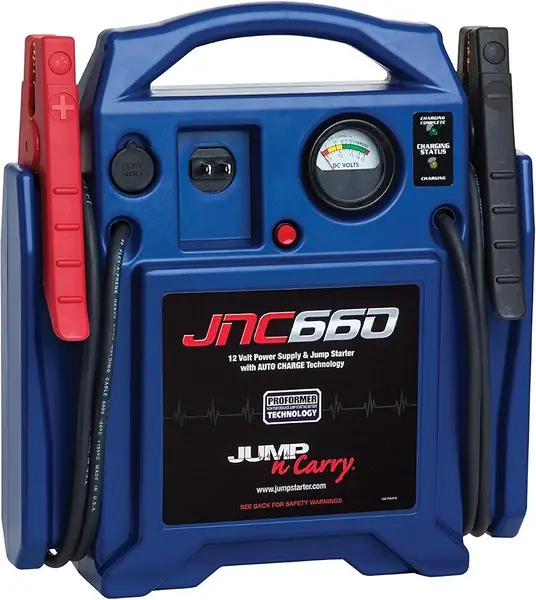
Eighteen pounds, sixteen inches tall, and a handle that expects a work glove. The JNC660 is the only pack here that feels like it belongs to a garage instead of a glovebox.

The weight is a 22Ah AGM battery and 46 inches of number-two-gauge cable, which is a different class of connection from the short leads on a pocket-sized lithium pack. Peak amps are 1,700, there's a voltmeter on the front so you can read the state of charge before you commit, and a 12V socket runs a work light or a phone charger. It's rated for trucks, buses, RVs, tractors, and boats.

What we appreciate is that it behaves like equipment. No screens to interpret, no boost button to find: clamp on, read the needle, crank. For a shop or a farm that's the feature, not a shortcoming. It isn't maintenance-free, though, and a lead-acid pack wants a recharge after each use rather than a corner of the barn floor for six months.

The jaws are industrial hot-jaw style and they bite hard, which is the point when you're clamping a corroded terminal at zero degrees. Ours lives on a shelf by the door, and that's the honest picture of how this pack gets used: within reach of the vehicle, not carried around in it.

Pros

  • 1,700 amps and 22Ah of lead-acid reserve
  • 46-inch number-two-gauge cables
  • Voltmeter reads state of charge at a glance

Cons

  • 18 pounds, a two-hand lift for some
  • No AC charging cord in the box
Our verdict

This is the one we keep by the bay door rather than in the trunk: 1,700 amps, 46-inch cables, and nothing to configure.

Check Latest Price
7

DBPOWER 3000A Best Budget

91 /100
Traveler Score Outstanding

Key details

Peak Amps
3000 A
Weight
1.1 lb
Battery Capacity
18000 mAh
Engine Rating
Up to 8.0L gas / 6.0L diesel
Check Details on Amazon

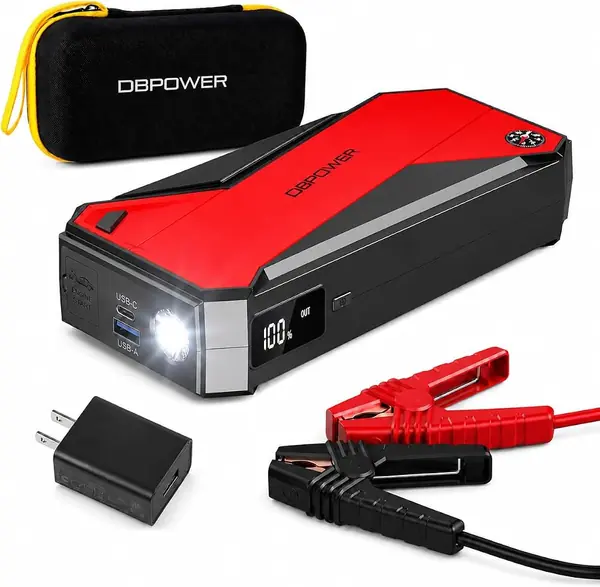
This is the least expensive way into big-amp numbers here, and the specs don't look like a compromise: 3,000 peak amps, 18,000 mAh, rated to 8.0L gasoline and 6.0L diesel, with up to 30 jumps per charge claimed.

It's also about a pound, which makes it the lightest full-size pack in this group and the easiest to hand over a fence to a neighbor. There's a hard carrying case, an LCD that shows remaining charge, a smart USB port, a light, and a compass we have never once needed.

What you accept is a shorter useful life. Battery life and durability are the least consistent measures on this pack: a unit that won't take a charge a few months in is the failure to plan around, and the body has the hollow feel you'd expect at this end of the range. Charge it before you store it, and check it before the first cold snap rather than after.

As a second booster, for the mower, the boat, or the kid's first car, it earns its place, and the price makes buying more than one easy to justify. As the only pack in a family vehicle you count on, the money is better spent on the Alpha85.

Pros

  • 3,000 amps and 18,000 mAh at the entry price
  • Hard carrying case included
  • Lightest pack here at about a pound

Cons

  • Battery life and durability are the weak measures
  • Body feels hollow next to the pricier packs
Our verdict

We keep one as a second pack for the mower and the boat: 3,000 amps and 18,000 mAh at the bottom of the price range, with a hard case.

Check Latest Price
8

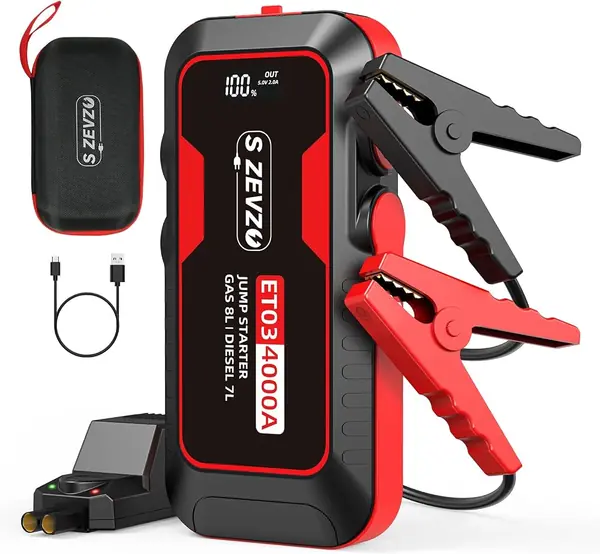
S ZEVZO ET03 Carrying Anywhere

90 /100
Traveler Score Outstanding

Key details

Peak Amps
4000 A
Weight
1.4 lb
Battery Capacity
20000 mAh
Engine Rating
Up to 8.0L gas / 7.0L diesel
Check Details on Amazon

The first thing we do with a new pack is clamp it on and see how the leads behave, and the ET03 came as a surprise. At 1.4 pounds the clamps are heavy enough to pull the pack off a terminal, so it sits on the engine cover rather than hanging from the posts.

For that weight you get a claimed 4,000 amps and 20,000 mAh, rated to 8.0L gasoline and 7.0L diesel, plus a force-start function built into the clamps for batteries that have dropped below the voltage where the pack would normally wake. There's a 500-lumen light, USB ports, an LCD, a storage case, and two years of coverage.

Consistency is the caveat. Long-term reliability is the least even measure on this pack, and the numbers on the box ask you to believe a lot from a 1.4-pound body. Treat it as a pack to check on a schedule rather than one to trust on faith.

Where it earns a place is a different kind of portability: a backpack, a bike pannier, a motorcycle tail bag, the cubby of a car you drive twice a month. Two years of coverage matches the Hulkman's, which is more than we expect at this size and price.

Pros

  • 1.4 pounds, easy to carry anywhere
  • Claimed 4,000 amps and 20,000 mAh
  • Force-start handles deeply discharged batteries
  • Two-year warranty at a budget price

Cons

  • Reliability is the least even measure here
  • Clamps can tip the light body off a terminal
Our verdict

We reach for it when the pack has to travel: 1.4 pounds, a claimed 4,000 amps, and two-year coverage at a budget price.

Check Latest Price

How We Chose and Tested the Best Jump Starters

We started by reading listings and customer reviews for roughly 40 jump starters, then cut anything with swollen amp claims, undersized cables visible in the photos, or no reverse-polarity protection. Engine ratings, clamp size, and price all factored into the filter, with value judged against what each unit actually promised. That left 12, ranging from glovebox packs to full-size garage units.

Testing ran six months, in my driveway and wherever a dead battery turned up: a neighbor's V-6 sedan on a February morning, a riding mower in April, a friend's truck in a gravel lot after dark. I drained batteries on purpose — headlights left on, keys in the ignition — then timed how long it took from opening the case to the engine catching, once barehanded and once in gloves and near-freezing air. In the dark I worked only by the unit's own light and display, and I clamped the leads on backward on purpose to see whether the safety circuitry refused the connection.

Every unit got weighed on a kitchen scale and tried in a glovebox, under a seat, and in a trunk, because compact is a claim, not a measurement. I ran each one down and timed a full recharge from a wall outlet, then charged a phone off its USB ports to see how much power bank was really in there. After that they sat in trunks and on garage shelves for weeks at a stretch while I checked how much charge they held, and two took a waist-high drop onto concrete to see what stayed together.

How to Choose a Jump Starter

Match the Pack to the Engine, Not the Amp Badge

Peak amps sell packs, but those figures aren't measured to one standard, so a 4,000-amp badge on a small jump box doesn't automatically out-crank a 2,000-amp unit. Shop by the engine rating instead: the NOCO GB40's 1,000 amps are rated for 6.0L gasoline and 3.0L diesel, which covers most sedans, crossovers, and mowers. A diesel pickup, a boat, or a tractor wants 2,000 amps and up, plus the bigger reserve that comes with it.

Reserve Decides How Many Tries You Get

Capacity, in milliamp-hours or watt-hours, sets how many attempts a pack has in it and how much slack is left after months in a trunk. The GB40's 2,150 mAh is enough for a car you top up on a schedule; the Hulkman's 20,000 mAh and the WOLFBOX's 88.8 Wh will crank a truck several times without a recharge. Reserve costs weight, from about a pound up to 4.5, so buy for the vehicle you actually drive.

Plan How You'll Keep It Charged

Recharge speed runs from about an hour at 65 to 80 watts down to three hours on plain USB-C, and that gap matters more than it sounds: a pack you can refill over lunch is a pack that's full when you need it. Check the box, too. Several jump starters include a cable but no wall adapter, and the Clore JNC660 ships without an AC cord at all. A 12V socket adapter, like the one bundled with the Hulkman, keeps a pack topped up on long drives.

Safety Features Worth Paying For

Reverse-polarity and spark-proof clamps are the baseline. Connect in the wrong order and the pack simply refuses to send current, which matters when you hand it to someone who has never opened a hood. The second feature to look for is a forced-start or boost override, which pushes current into a battery so flat the clamps wouldn't otherwise detect it. Boost modes run on a timer, so press the button when you're ready to crank.

Decide Whether You Want the Extras

A compressor, a USB power bank, and a flood light all earn their place in an emergency kit, and a 2-in-1 like the HALO Bolt AIR saves the space of two devices in a small trunk. What you accept is a second mechanism that can fail, and on these the compressor is usually the part that goes first. If tire pressure isn't a recurring problem, buy a simpler booster and keep a separate inflator.

Frequently Asked Questions

Final Verdict

The Hulkman Alpha85 is our pick for a family vehicle: 2,000 amps, 20,000 mAh of reserve, and a screen that tells you the truth about its charge before you lift the hood. If the pack has to live in a glovebox, the NOCO GB40 is the one that fits. For a truck, a boat, or a farm, the Clore JNC660 is still the simplest thing that works.