Best Pop-Up Camping Tents of 2026

The worst part of camping has never been the camping. It's the ninety minutes at dusk — headlights on, hungry kids, a pile of poles, and instructions that make no sense. Instant tents exist to delete that scene: the frame comes pre-assembled, so you shake it out, pop the hubs, and you're done in the time it takes to boil water. The catch is that anything that fast earns suspicion. Will it sag, leak, or fight you just as hard at pack-up?

I've been burned by flimsy tents before, so we spent eight months with 12 of them — spring-loaded pop-ups, instant cabins, hub designs — through backyard overnights, one wet weekend, and plenty of driveway practice. Setup speed gets advertised; what decides whether you still like a tent on Sunday is rainfly coverage, the zipper you open forty times, whether it goes back in the bag without a fight, and how much floor the sloped walls steal.

The picks below run from a festival throw-down to a big cabin for a family of five, and each one pitches taut and earns its price.

The Best Pop-Up Camping Tents

1

FanttikOutdoor Zeta C6 Pro Best Overall
92 /100
Traveler Score Outstanding

Key details

Sleeps
6 person
Peak Height
66 inches
Floor Size
10 x 9 ft
Water Resistance
1500 mm
Check Details on Amazon

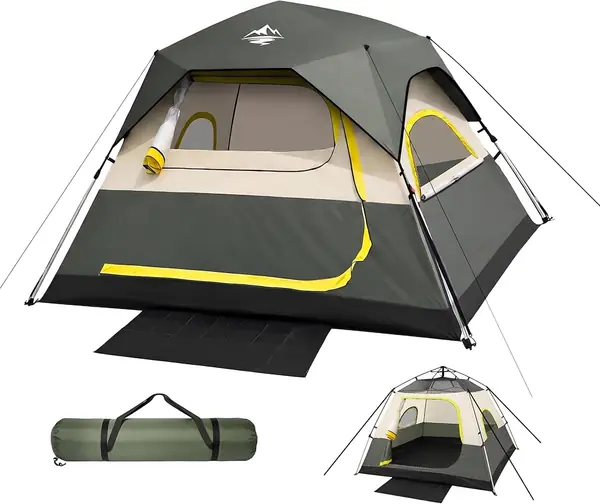
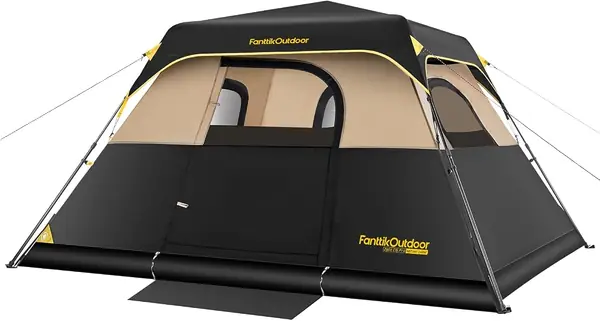
Sixty seconds is the claim on the box, and the part we watched hardest was the last few — whether the corner poles lock with one person working alone. They do, with no second set of hands and nothing to thread. Setup is unclip, spread, push up, stake; there are no sleeves and no color-matched poles to sort. That is the whole reason this is our top pick: it turns arriving at a dark campsite into a few minutes of work instead of a chore everyone argues about.

The floor is 10 by 9 feet, which in practice swallows two queen air mattresses with a strip of floor left for bags, and the 66-inch peak lets most adults crouch-walk and sit upright on a cot. If you are over six feet you will stoop, and that is the price of a cabin that still packs down to 19 pounds and goes into a trunk by itself.

Weather is where it separates itself from the cheaper instant tents here. The fabric is rated to 1500 mm, the rainfly covers the roof properly, and four mesh windows plus a mesh ceiling panel move enough air that condensation does not leave your bag damp by morning. We did find the door zipper catching on the waterproof flap behind it; hold that flap flat with one hand as you zip and the problem disappears.

The poles are steel rather than the fiberglass on several tents in this group, and at this size we are happy with the extra few pounds, because the frame feels like it will survive being folded by a tired person in the rain. Our favorite detail is smaller than that: a drainage channel under the door zipper, so water running down the door runs out instead of pooling where you step.

Pros

  • One-person setup in about a minute
  • Fits two queen mattresses with floor left
  • 1500 mm fabric with a full roof fly
  • Mesh ceiling and four windows fight condensation

Cons

  • Door zipper snags on the waterproof flap
  • 66-inch peak means tall campers stoop
Our verdict

Our default pick: a six-person cabin one person can lock into place alone in about a minute, with the weather protection to back up the speed.
Check Latest Price
2

CORE 9 Person Instant Cabin Best for Big Groups

91 /100
Traveler Score Outstanding

Key details

Sleeps
9 people
Peak Height
78 inches
Floor Size
14 x 9 ft
Weight
27.6 lb
Check Details on Amazon

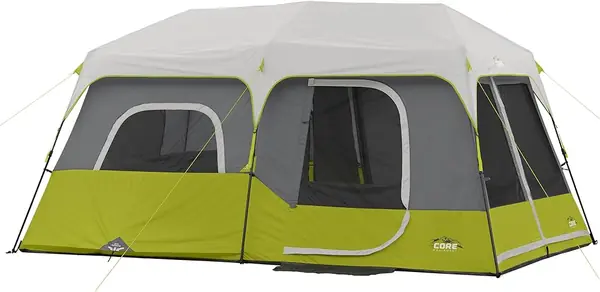
Everything the Fanttik does for a family of four, the CORE does for six or seven. The floor is 14 by 9 feet — 126 square feet — and the center height is 78 inches, tall enough that a six-footer can stand and pull on pants without doing it lying down. Set the two side by side and the difference is not subtle.

That height is why we keep steering big families here. A tent you can stand in stops feeling like a cave on the third rainy afternoon, and the hanging divider splits the single room into two, which is the difference between a parents' half and a kids' half. Both doors sit on the long walls, so nobody climbs over anybody at 2 a.m. The two-minute setup claim is honest, and take-down is quicker than most pop-ups because the frame folds rather than coils.

Two things to know before you order. At 27.6 pounds with a long packed length, it goes from the car to the site and no farther; this is not a tent you carry. And rain protection is good rather than absolute — the 1200 mm fabric and taped fly handle most storms, but a long soaking can find the floor corners, so peg the fly out fully and taut instead of half-pegged for airflow.

Pros

  • 14 x 9 floor sleeps a large family
  • 78-inch ceiling you can stand under
  • Room divider and two long-wall doors
  • Fast setup and fast take-down

Cons

  • 27.6 pounds with a long pack
  • Poles are the weak point over several seasons
Our verdict

Buy it if you sleep six or more and want to stand up indoors; it is the roomiest instant cabin here and still goes up in minutes.

Check Latest Price
3

Gazelle T4 Hub Tent Best for Tall Campers

90 /100
Traveler Score Outstanding

Key details

Sleeps
4 people
Peak Height
78 inches
Floor Size
94 x 94 inches
Shell
210D Oxford
Check Details on Amazon

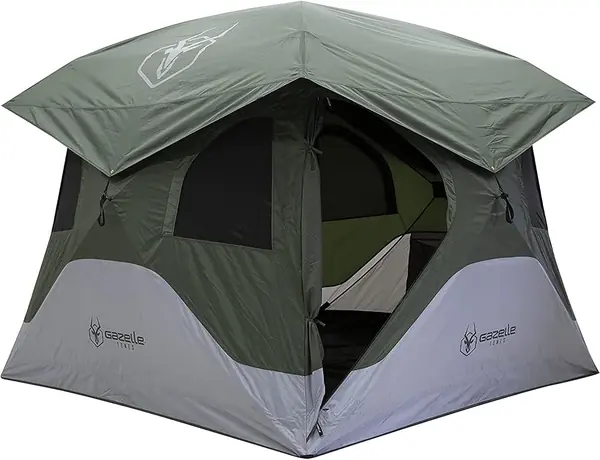
Thirty pounds is not a typo, and it is the whole argument. The T4 is a hub tent — a fiberglass frame that springs out like an umbrella — and the weight buys 78 inches of headroom, a 94-by-94-inch floor, and a 210D Oxford shell over a 300D Oxford floor. Put it beside the thin-taffeta pop-ups in this group and it is not the same class of object.

Setup takes about ninety seconds with one person and involves no sleeves, no pole feeding, and no color matching: pull the roof up, push each hub out, stake the corners. Packing it away is the same in reverse, which is unusual here, where most tents are quick up and slow down. The removable floor is the detail we did not expect to care about and now do — shake it out, hose it off, put it back.

Water resistance is decent rather than bulletproof. The Oxford shell sheds rain well, and the seams and floor corners are where a long storm gets in, so a coat of seam sealer and a footprint are worth the trouble. What you get in exchange is a tent you can stand up in, hang a lantern from, and spend a wet afternoon inside without losing your temper.

Pros

  • 78-inch ceiling and 94-inch floor
  • Hub frame pitches in about 90 seconds
  • Oxford shell and heavy floor fabric
  • Removable floor for easy cleaning

Cons

  • 30 pounds before stakes and gear
Our verdict

Worth the money and the weight if standing room and tough fabric matter more to you than a light pack.

Check Latest Price
4

Purebox 4 Person Instant Tent Best Budget

86 /100
Traveler Score Excellent

Key details

Sleeps
4 person
Peak Height
59 inches
Floor Size
8.04 x 8.04 ft
Weight
13.4 lb
Check Details on Amazon

The Purebox is the least expensive way into this group, and it does not read like a penalty box: 8 by 8 feet of floor, 59 inches at the peak, and a 2000 mm PU coating with taped seams — a spec sheet that looks like tents costing noticeably more.

For a first tent, a festival, or a backyard, that combination is hard to argue with. Setup is about fifty seconds of unclip-and-lift, the fly comes off so you can sleep under the mesh on a clear night, and 13.4 pounds is light enough for one adult to carry from the trunk without a second trip. Where it gives ground is height: 59 inches means you sit and kneel rather than stand, and four adults fit only if they are sleeping in it rather than living in it.

The frame is aluminum and the zippers are double pulls, but the fabric is light, and the poles are the part to watch, since a bent section is what ends these tents early. The two-layer ceiling that gives you the stargazing view also traps the odd twig or bug between the layers, which is worth knowing before you unzip it over your sleeping bag.

Pros

  • Taped seams and a 2000 mm coating
  • Roughly 50-second setup
  • Removable fly for clear nights
  • 13.4 pounds, one-trip carry

Cons

  • 59-inch peak is sit-up height only
  • Light fabric and poles are the weak point
Our verdict

The tent we point first-time campers to: quick, inexpensive, and dry enough for three-season weekends.

Check Latest Price
5

Night Cat Pop-up Tent Best for Tight Storage

85 /100
Traveler Score Excellent

Key details

Sleeps
2 to 4 persons
Peak Height
120 cm
Weight
6.6 lb
Packed Size
28 x 28 x 2.8 inches
Check Details on Amazon

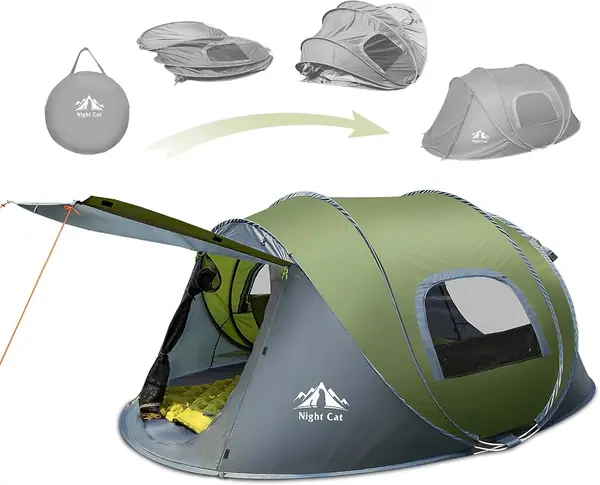
Pop-up tents usually fold into a circle the size of a card table, which is why so many of them live in the garage instead of the car. Night Cat solved that in the design: this one collapses in four circles rather than three, into a flat 28-by-28-by-2.8-inch package that slides behind a seat or stands in a closet corner. It is the only tent here that stores like a folded camp chair.

Opening it takes about three seconds — throw it down, spread the frame, and it is a tent. Closing it is the part people fight with, and the answer is the pattern printed on the bag: fold in a figure eight, twice, then strap it. Once you have done it on a lawn it is a two-minute job; the first time, in the rain, at night, it is not.

For one or two people who want a roomy tent that does not eat storage space, this is the pick. The 9.5-by-6.6 floor swallows a queen mattress with room for bags, the mesh panels keep a warm night comfortable, and 6.6 pounds is light enough to move by hand. Treat it as fair-weather shelter: the fly is rated to 2000 mm and the seams are the weak link, so a three-day blow is not its assignment.

Pros

  • Packs flat to 28 x 28 x 2.8 inches
  • Opens in about three seconds
  • Queen mattress fits with room for bags
  • 6.6 pounds carries in one hand

Cons

  • Folding it back takes practice
  • Limited protection in sustained rain
Our verdict

The pop-up for people with a small trunk and little patience for folding: it packs flat and opens in seconds.

Check Latest Price
6

Rivenlo Pop Up Tent with Skylight Best for Stargazing

84 /100
Traveler Score Excellent

Key details

Sleeps
4 person
Peak Height
52 inches
Floor Size
9.5 x 6.6 ft
Weight
8.6 lb
Check Details on Amazon

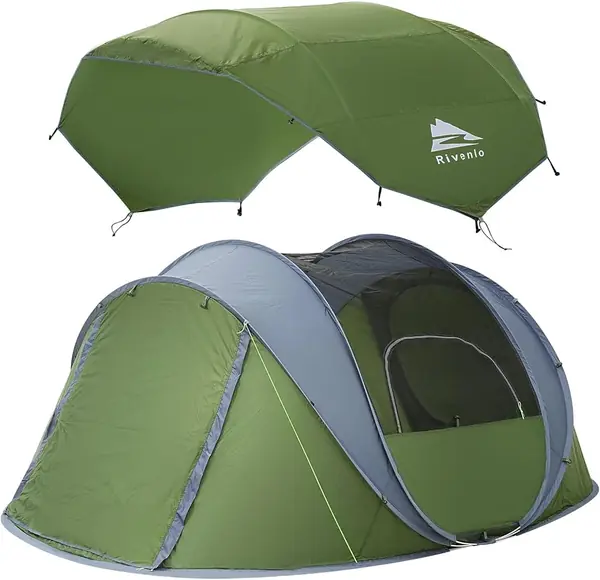
The skylight is the reason to look at this one: an overhead panel that opens the roof to the sky, so you can fall asleep counting stars and, more usefully, let daylight in when you are changing clothes at six in the morning. Unclip the rainfly and the ceiling is mesh; clip it back and the tent is closed for the night.

Inside, 9.5 by 6.6 feet holds a queen mattress and two bags without a fight, and four mesh windows plus two doors give you a cross breeze on a still night. Setup is the pop-up standard — unstrap and let go — and the fly goes on from outside in about a minute. Headroom is 52 inches, so this is a tent you crawl into and sit up in, not one you stand in.

We like it best for couples, or one parent with two kids, on trips where the evenings are the point — the skylight turns a clear night into part of the plan rather than something you step outside for. Packing it away takes a couple of tries to learn, and the fabric is light, so keep it off sharp ground and put the fly on when the forecast is unsure.

Pros

  • Skylight for stargazing
  • Queen mattress fits with floor to spare
  • Four mesh windows and two doors
  • Under nine pounds packed

Cons

  • Repacking takes trial and error
  • Light fabric needs the fly in real rain
Our verdict

Pick it for couples and small families who want a roomy tent with a view of the sky, and fold it on a dry lawn the first time.

Check Latest Price
7

ADSMART 6 Person Instant Tent Best for Lightweight Family Camping

83 /100
Traveler Score Excellent

Key details

Sleeps
6 person
Peak Height
66 inches
Floor Size
10 x 9 ft
Weight
16 lb
Check Details on Amazon

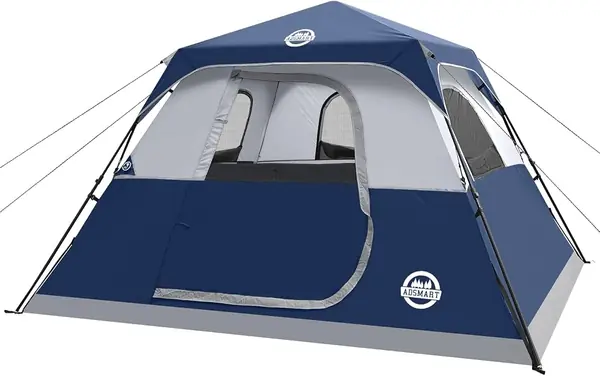
Six people and 16 pounds is a combination that usually means a toy, so we paid attention to how ADSMART got there. The answer is a four-leg steel frame instead of a full hub, which trims weight but gives the walls less structure than the cabin tents above it in this list.

The floor plan is the same 10 by 9 as our top pick, so it takes a queen mattress with gear beside it, or three sleeping bags and a dog with room to move. Three mesh windows run along the walls for crossflow, the peak is 66 inches, and it folds to 8 by 8 by 42 inches in an expandable bag — a trunk item, but one you can carry to the site in a single trip.

The rainfly is a roof cover rather than a full wrap, which is fine over this much mesh on a summer night and less fine in an all-night soaker; stake every corner and run the guylines and it holds its shape in a breeze. Think of it as a three-season car-camping tent with a four-season label.

For a couple who wants space to spread out, or a family of four who camps out of a hatchback, the arithmetic works: six-person floor area, well under the weight of the big cabins. It is not the tent for a week of coastal rain, but it is the one you will actually load.

Pros

  • 16 pounds for a 10 x 9 cabin
  • 66-inch peak with three mesh windows
  • Expandable bag takes a loose fold

Cons

  • Rainfly covers the roof only
  • 42-inch pack is still a trunk item
Our verdict

A sensible six-person cabin for car campers who count pounds — 16 of them, with room for a queen mattress and gear.

Check Latest Price

How We Tested 12 Pop-Up Camping Tents

We started with every instant, pop-up, and hub tent sold by the major outdoor retailers, then narrowed by capacity, packed size, price, and one non-negotiable: the frame had to arrive pre-assembled, not as a bag of poles. Reviews eliminated a few before we ever pitched them — models where the same complaint kept surfacing, like a rainfly that stops short of the vents or a bag the tent reportedly never fits back into. That left 12 tents, which we used for eight months.

Each was pitched solo with a stopwatch running from bag-open to last stake, once in a calm backyard and again on a windy afternoon, and we noted where hands got pinched in the hubs. Takedown was timed too, and foldability came down to whether the tent went back into its own carry bag without a fight — in daylight, and once by headlamp.

For water resistance, we ran a hose over each rainfly for ten minutes and checked the seams and floor for wicking; three tents also sat through a real overnight storm. Zippers were opened and closed dozens of times, watching for snags where the door curves and on the bag itself. Bug protection came down to mesh — gaps along the door bottom, and whether the zippers closed all the way.

Durability showed up slowly: floor abrasion after a weekend on gravel, hub joints after a dozen pitches, fabric that stayed taut or sagged by morning. We slept in each with two adults and gear to see how much floor the sloped walls steal, and judged appearance both on a crisp first pitch and after a windy night.

How to Choose a Pop-Up Camping Tent

Speed Matters Twice: Pitching and Packing Away

Every tent here goes up fast; the difference shows on the last morning, when the tent is wet and the car is waiting. Pop-ups fold in a pattern — three circles on most, four on the Night Cat — and that pattern is not intuitive the first time. Learn it on a lawn at home, with the printed diagram or a saved video, rather than in the dark at a campsite with no signal.

Then judge the door and the bag. A wide door and an expandable stuff sack forgive a sloppy fold; a tight sack does not. If you know you will be breaking camp in the rain, favor a tent whose bag has slack over one that only closes on a factory roll.

Trust the Floor Plan, Not the Sleeper Count

Capacity figures assume sleeping bags laid shoulder to shoulder on bare floor. Add a queen air mattress — roughly 60 by 80 inches — and a four-person tent becomes a two-person tent with luggage. A 9.5-by-6.6 floor takes one queen with room for bags; two queens need a 10-by-9 cabin or larger.

Height decides how the tent feels by day three. Anything under 60 inches is a sit-up tent, 66 inches lets most adults crouch-walk, and 78 inches is genuine standing room. That last figure is the biggest single comfort difference between a budget cabin and a premium one, and it is worth paying for if you will spend a rainy afternoon inside.

Water Protection Lives in the Fly and the Seams

Coating ratings — 1200 mm, 1500 mm, 2000 mm — describe how much water pressure the fabric resists before it leaks. They say nothing about the seams, the floor, or how much of the tent the fly actually covers. A roof-only fly over a mesh ceiling is fine for a shower and poor for an all-night soak; a full-coverage fly is worth more than another 500 mm on the label.

The trap is the word waterproof on the box, which usually refers to the fabric rather than to the tent. Water arrives through stitched seams, floor corners, and the gap where the fly meets the wall. Peg the fly taut and clear of the inner wall, and choose a tent whose fly reaches low on the sides if you camp where rain comes in sideways.

Weight and Packed Shape Decide How You Travel

The lightest tent here is 6.6 pounds and folds to a flat 28-inch square; the heaviest is 30 pounds with a pack long enough to claim the trunk rather than the back seat. Between them sits the practical line between carrying a tent a few hundred yards and wishing you had not.

Packed shape matters as much as weight. A flat disc slides behind a seat or stands in a closet corner; a long duffel has to go on top of everything else. If your camping is car-based and your storage is tight, choose the fold before you choose the features.

Frames and Zippers Are What End a Tent's Life

Poles fail before fabric does. Fiberglass is light and snaps, steel is heavier and bends, aluminum sits between and dents. Whichever you buy, the break usually comes from forcing a joint that is not lined up, so slow down at the corners when the frame is cold and stiff.

Zippers are the second weak point, and the usual cause is a storm flap sewn too close to the coil. Hold the flap back with one hand while you zip with the other, and open and close the door once before you commit to a tent if you can. A door that snags every time is the annoyance you will remember longest.

Frequently Asked Questions

Final Verdict

We recommend the FanttikOutdoor Zeta C6 Pro to most people. It is the one tent here that combines a frame one person can lock alone in about a minute, a 10-by-9 floor that takes two queen mattresses, and a 1500 mm fly with full mesh ventilation for warm nights — at mid-range money rather than the top of the market.

If your group is bigger than six, the CORE 9 Person earns the extra spend: 14 by 9 feet and a ceiling you can stand under, at the cost of 27.6 pounds that never leave the car. And if trunk space is the real constraint, the Night Cat's flat 28-inch fold solves a problem no round pop-up can.