Best 6-Person Camping Tents of 2026

A six-person tent sleeps six the way a hotel room sleeps four — two on the beds, one on the floor, and everyone's duffel jammed into the corner. The number on the box is a starting point, not a promise. What a good one actually buys you is a base camp where nobody climbs over anybody at 2 a.m., the gear stays out of the rain, and the whole thing goes up before the kids lose interest and start asking about marshmallows.

My team and I have pitched 10 of these over the past eight months, in backyards, at drive-in campsites, and through one memorably soggy spring weekend, and the spread was wider than I expected. Setup ran from about four minutes solo to a twenty-minute wrestling match with a pole sleeve. The advice I'd give any first-time buyer: ignore the sleeper count and go straight to the floor dimensions and peak height, because that's what decides whether your family fits or merely survives.

1

Best Overall

Coleman Sundome 6-Person

93 /100
Traveler Score Outstanding

Key details

Doors
1
Floor Area
100 sq ft
Peak Height
6 ft
Floor Dimensions
10 x 10 ft
Check Details on Amazon

Six people in a ten-foot square sounds roomy until the mattresses go in. Two queen air beds eat 120 by 80 inches, which leaves this tent's 100 square feet a strip of floor at the foot for duffels and a cooler, and no aisle between them. Sleep in bags instead and six adults fit with the usual elbow room, while four have space to spare. Decide which of those trips you're actually taking before you trust the capacity label on anything.

What earns it the top spot is how little goes wrong. The 6-foot center height lets most adults stand to change, the continuous pole sleeves and clips went up for us in well under the ten minutes the box promises, fly and stakes included, and the single door swallows a duffel without a fight. WeatherTec's welded corners and inverted seams handled a wet night without drama; we still put a groundsheet under the polyethylene floor, and so should you.

The compromise is the one door. At bedtime six people share a single opening, and the queue forms whether or not it's raining — we noticed it most on the second night, when everyone wanted out at once. A family that turns in together won't care, and that simplicity is exactly what you're buying.

Pros

  • Square 100-square-foot floor takes two air beds
  • Six-foot center height for standing up
  • Forgiving dome pitch with rainfly included
  • Welded corners and inverted seams keep rain out

Cons

  • Poles and fabric are the durability weak point
Our verdict

Our default for family car camping: a square 100-square-foot floor, a 6-foot ceiling, and a pitch that stays simple when everyone is tired and the light is going.

Check Latest Price
2

Best Instant Setup

FanttikOutdoor Zeta C6 Pro

89 /100
Traveler Score Excellent

Key details

Weight
19 lb
Floor Area
90 sq ft
Setup Time
60 seconds
Peak Height
66 in
Check Details on Amazon

The test that matters for an instant tent is arriving after dark, and the Zeta C6 Pro passes it. Its four poles are sewn to the fabric, so you unfold the bundle, extend each leg until it clicks, and the cabin is standing; the fly clips on a couple of minutes later. We had it up and loaded while the kettle was still heating, and that is the entire argument for buying this kind of tent.

The shape is a proper cabin rather than a dome. Walls rise close to vertical to a flat, mesh-paneled roof, and there are mesh windows on all four sides, so a hot afternoon doesn't turn the inside into an oven — with the fly off you can lie back and look at the stars. Ninety square feet takes two queen mattresses, and the 1,500 mm coating with an included fly is enough for an ordinary three-season weekend.

Height is what you pay for the speed. At 66 inches this is the lowest ceiling in the guide, and anyone much over 5-foot-8 will be stooping to move around; it's a sit-down-and-sleep tent, not a stand-up-and-dress one. If your group is tall, spend the extra on the CORE instead.

Pros

  • Frame stands in about a minute
  • Mesh on four sides and the ceiling
  • Two queen mattresses fit the 90-square-foot floor
  • Rainfly and 1,500 mm coating included

Cons

  • 66-inch ceiling has most adults ducking
  • Vestibule is too small to store gear
Our verdict

Buy it when putting the tent up is the part of the trip you dread: the frame unfolds in about a minute, and the cabin walls give you two queen beds of floor.

Check Latest Price
3

Best Cabin Headroom

CORE 6-Person Instant Cabin

85 /100
Traveler Score Excellent

Key details

Weight
23 lb
Floor Area
99 sq ft
Peak Height
72 in
Floor Dimensions
11 x 9 ft
Check Details on Amazon

The feature we didn't expect to care about is the storage. A gear loft hangs under the roof and a wall organizer runs along one side, so headlamps, phones and the kids' socks live off the floor instead of in a heap by the door. Three nights in a tent this size turns that from a gimmick into the reason you can find anything.

The rest is a proper instant cabin: 11 by 9 feet, 99 square feet, 72 inches at the peak, with pre-attached poles that fold out and click into place. The door sits toward one end rather than dead center, so a queen mattress goes in without blocking the exit, and there's room left for a pair of cots and a duffel aisle.

Sixty seconds is the frame, not the whole job — stakes, guylines and the fly add a few minutes, and that's true of every instant tent here. What keeps us recommending this one is how the ceiling and the organizer change a wet day: everyone can stand, wet coats hang on the wall instead of the sleeping bags, and by lunchtime the tent still doesn't feel like a kennel.

Pros

  • 72-inch ceiling lets adults stand to dress
  • Gear loft and wall organizer clear the floor
  • Pre-attached instant frame pitches fast
  • Offset door leaves a full sleeping wall

Cons

  • Zippers are light for a six-person tent
  • Mesh roof and tarp floor are the wear points
Our verdict

For families who want everyone standing and everything off the floor, this instant cabin's 72-inch ceiling and built-in storage make a rainy day inside far easier.

Check Latest Price
4

Best Premium Pick

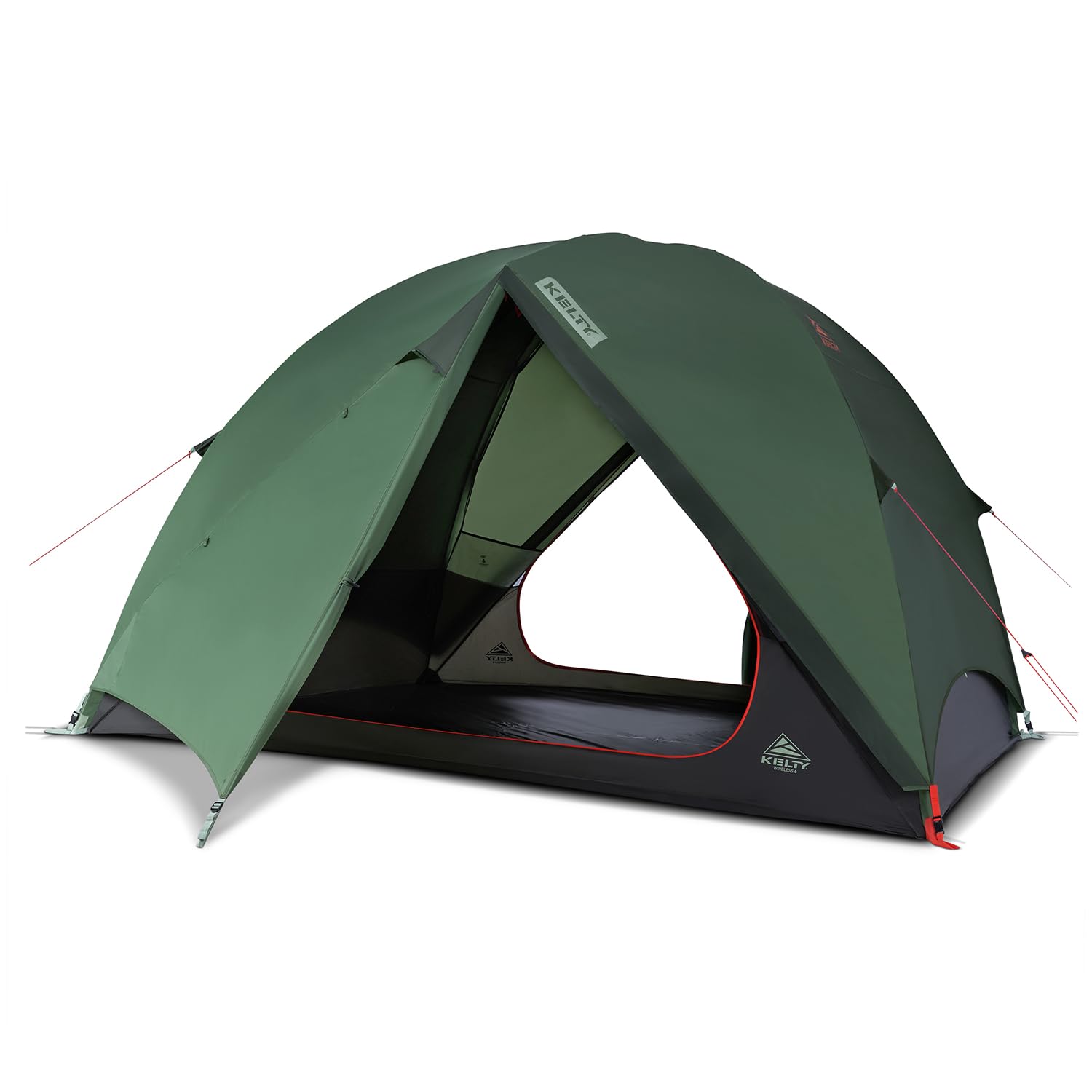
Kelty Wireless 6

85 /100
Traveler Score Excellent

Key details

Doors
2
Weight
19.8 lb
Peak Height
74 in
Floor Dimensions
117 x 106 in
Check Details on Amazon

Two doors and two vestibules is the specification that earns this tent its place, and it changes how a full tent behaves at 7 a.m. Instead of six people queuing at one zipper, one side empties into its own covered porch while the other gets dressed; packs, boots and the stove stay outside the sleeping area. For a family of four or five, that layout is worth more than any fabric upgrade.

The build backs it up. The 68D polyester shell feels a step above the budget tents here, the full fly carries a 1,200 mm rating and runs down over the doors, and the 74-inch peak means most adults stand. It pitches freestanding with one person, the guylines come attached, and the duffel bag is one you can genuinely carry.

You pay for it twice: this is the most expensive tent we recommend, and at 19.8 pounds it is a car-camping tent that nobody is carrying to a backcountry site. Neither matters when the car is parked twenty feet away, which is the trip this tent was built for.

Pros

  • Two doors and two vestibules split the traffic
  • Full-coverage fly with a 1,200 mm rating
  • 74-inch peak and a freestanding frame
  • Pre-attached guylines and a usable duffel

Cons

  • Fiberglass poles are the weak link
Our verdict

The pick for a family of five that camps in shoulder season: two doors, two vestibules, and a full fly that keeps the weather and the wet gear where they belong.

Check Latest Price
5

Best Budget Cabin

UNP 6-Person Cabin Tent

89 /100
Traveler Score Excellent

Key details

Doors
1
Weight
17.8 lb
Floor Area
90 sq ft
Peak Height
78 in
Check Details on Amazon

Seventy-eight inches is the number to notice. This is the tallest tent in the guide — tall enough that a 6-foot-3 camper can stand upright to pull on trousers — and it costs less than most of the domes here. The shape is a 10-by-9 cabin with five mesh windows and a mesh roof panel that turns the ceiling into a skylight when you leave the fly off.

For the money, we think it's the best standing room of the ones we tested, provided you accept the shell for what it is. The coating handles a shower, but sustained rain is where this tent gets tested, and the seams are the place to spend an afternoon with a tube of sealant before a wet-forecast weekend. Do that and add a groundsheet, and it's a lot of cabin for the outlay.

Setup is a conventional pole-and-sleeve pitch rather than an instant frame: about ten minutes alone once you know the order, which is the price of a smaller packed bundle. At 17.8 pounds it's the lightest six-person tent in this guide, and the bag is short enough to slide into a trunk beside the cooler.

Pros

  • 78-inch peak, the tallest in this guide
  • Five mesh windows plus a mesh roof panel
  • Lightest six-person tent here at 17.8 pounds
  • Cabin walls hold their height to the edge

Cons

  • Single-slider door zipper snags on the flap
Our verdict

If someone in your group is over six feet, this is the tent to beat: 78 inches of standing room for less money than the brand-name domes.

Check Latest Price
6

Two Air Mattresses

CAMEL CROWN 6-Person Tent

80 /100
Traveler Score Excellent

Key details

Doors
1
Weight
18 lb
Peak Height
74.8 in
Floor Dimensions
142.5 x 94.5 in
Check Details on Amazon

At 142.5 inches, the floor is the longest in this guide — nearly twelve feet — and that is the reason to look. Two queen air mattresses go in lengthwise with floor left over at the door for boots and a cooler, and nothing else here is that long. For a family that camps twice a summer and wants beds rather than bags, the footprint does the work.

The cabin shape gives 74.8 inches at the peak, so most adults stand, and the shell is Oxford polyester with a polyurethane coating over a PE floor. Setup is conventional sleeves and fiberglass poles rather than an instant frame, and the whole bundle weighs 18 pounds.

The compromise shows up in wind. The pole set flexes more than the Coleman's once gusts get under the fly, and on an exposed site you'll be watching the walls. For fair-weather weekends within an easy drive of home we think it's a fair trade for the savings; for a week in the mountains, it isn't.

Pros

  • Longest floor here; two queens fit lengthwise
  • 74.8-inch peak for standing room
  • Cheapest tent in this guide
  • Coated Oxford shell over a PE floor

Cons

  • Single-slider door zipper needs two hands
  • 30-day warranty is the shortest here
Our verdict

The most sleeping space per dollar here: two queens fit with room to spare, and the 74.8-inch peak keeps most adults upright.

Check Latest Price

How We Tested the Best 6-Person Tents

The shortlist started with research rather than camping. We gathered every six-person tent we could find from brands that keep showing up in owner reviews, then filtered on the numbers that matter before you ever leave the driveway: floor area, peak height, packed weight, pole material, and price relative to livable space. Anything claiming six sleepers while measuring under roughly 85 square feet got cut, as did tents too low to kneel in. That left 10 tents, which we bought ourselves and used for eight months.

Each one was pitched at least half a dozen times, beginning with a solo attempt and a stopwatch: poles clipped, rainfly threaded, guylines staked. Then we did it again at dusk with a headlamp, because that's when most tents actually go up. We noted where poles snagged, whether the color-coded corners were readable in low light, and how much floor we lost to the bathtub seam.

For weather, every tent took a 20-minute sprinkler soak, after which we ran a hand along the inside seams and floor to check for wicking — then checked again at 6 a.m. after a genuinely wet night. Zippers were opened and closed dozens of times, including one-handed from inside in the dark, and we watched for snags at the door curve. Durability meant leaving tents pitched for days in sun and wind, then inspecting pole joints and stitching. We weighed each packed bag on a luggage scale and hauled it from car to site, and we laid four adults and two kids on pads inside to see what room was left for gear. Value came last: what each tent cost against the space, hardware, and weatherproofing it delivered.

How to Choose 6-Person Camping Tents

Floor Area Is Not the Same as Sleeping Capacity

The six-person figure counts sleeping bags laid shoulder to shoulder, and it assumes nobody brought a cooler. Mattresses are the real currency: a queen air bed is 60 by 80 inches, so two of them need 120 by 80 inches of clear floor. A 10-by-10 tent clears that with a strip left at the foot; an 11-by-7 cabin with 77 square feet does not, whatever the label says.

Decide beds or bags before you shop, then subtract about 18 inches at the door for boots and duffels. If two couples are sharing, the 142.5-inch floor of the CAMEL CROWN is the shape that lays two queens end to end without a fight.

Peak Height Decides Who Stops Ducking

Peak height is measured at the center, which is not where you stand to pull on a jacket. Dome walls slope away from the middle, so a 72-inch dome may give you 60 inches near the door, while a cabin like the CORE holds close to its full height out to the edge.

Anyone over 5-foot-10 wants 72 inches or better, and the tallest sleeper should set the number for everyone. If that person is six-two, the UNP's 78-inch ceiling is the one that ends the argument.

Instant Frames, Pole Sleeves, and the Weight You Carry Twenty Feet

There are two families of tent here. Instant cabins have poles sewn to the fabric: unfold, extend, and the shelter stands — genuinely fast, and worth it when you arrive after dark. Pole-and-sleeve domes take longer but pack smaller and cost less.

The catch with instant frames is bulk: the CORE carries 23 pounds against the UNP's 17.8, and its bag is longer in the trunk. If you never carry the tent more than twenty feet, weight is irrelevant; if you do, it isn't. Pitch it once in the yard before the trip either way.

Read the Rainfly, Not the Word Waterproof

Almost everything in this category is advertised as waterproof, and what separates the tents is how far the fly reaches. A small fly caps the roof and leaves the walls to shed rain alone, which is fine for a shower and grim in a long storm. A full fly runs down over the doors, as the Kelty's does.

Look for welded or inverted seams and a floor that turns up at the edge like a tray. Sustained rain finds the seams first, so a tube of seam sealer and a groundsheet are cheap insurance on any of these tents.

Doors, Vestibules, and the Zipper Problem

One door on a six-person tent is a queue at bedtime and a traffic jam at dawn. Two doors, or one door plus a vestibule where wet gear can live, changes a rainy morning more than any fabric upgrade — the Kelty's two vestibules are why it costs what it does.

Zippers are the most common failure in this class. Check that the door has two sliders so it can open from the top, and run it a dozen times before you commit. If it catches on the storm flap in the driveway, it will catch every night at camp.

Frequently Asked Questions

Final Verdict

Buy the Coleman Sundome 6 if you want the tent we hand to first-time family campers. Its 100 square feet and 6-foot ceiling are unremarkable on paper and completely dependable in a field, and the pitch forgives a tired parent at dusk.

Then let your constraint pick the alternative. Setup speed at the end of a long drive: the Fanttik Zeta C6 Pro. Two doors, two vestibules and a full fly for a family that camps into the shoulder season: the Kelty Wireless 6, which earns its premium.