Best Water Filters for Camping of 2026

A mountain stream can look impossibly clean—and that’s what makes a bad camping filter so dangerous. A filter that clogs, leaks, or turns a liter of water into a forearm workout can ruin a trip; worse, one that lets pathogens through can make you sick miles from a trailhead. What you need is a filter that removes the nasties, packs small, and still works when your hands are cold and your patience is thin.

I’ve used gravity bags, pumps, squeeze bottles, and straw-style filters on weekend trips and long backcountry days; over the past seven months, my team and I put 11 of them through the same routines. The keepers were the ones I’d trust in an emergency kit—light enough to carry, simple enough to use when I’m tired, and durable enough to survive a pack week after week. Value matters too, mostly in how long a filter lasts before a cartridge quits. Here’s what earned a spot in my pack.

1

Best Overall

Sawyer Squeeze SP129

95 /100
Traveler Score Outstanding

Key details

Weight
2 oz
Flow Rate
1.7 liters per minute
Filter Life
100,000 gallons
Filter Rating
0.1 micron absolute
Check Details on Amazon

Everything here runs through a 2-ounce cartridge of hollow fiber, and the interesting part is how many ways you can put water through it. Screw the filter onto one of the two included 32-ounce pouches and squeeze. Drink straight through the pop-up straw. Or hang a full pouch from a branch and let gravity pull the water down into a bottle. The same filter threads onto standard 28 mm bottles and plugs into a hydration-pack line with the included adapter, so the bladder you already carry becomes part of the system.

That range is why it's our top pick rather than the lightest or the cheapest filter here. On a trip where you're filling two bottles and a pot before dinner, one device does all of it, and the 100,000-gallon rating means you're buying a filter once instead of a season of cartridges. The pouches roll flat around the filter when they're empty, so the whole kit takes up less room than a sandwich.

The routine matters more than the marketing numbers. Sawyer lists 1.7 liters per minute, and the plunger-and-coupling backflush in the kit is what keeps it anywhere near that; skip it for a few trips and a loaded membrane slows to a dribble. Filling is the other half of the job — the wide-mouth pouch scoops easily from a stream, but a shallow seep or a puddle is awkward, which is where a cut-off bottle earns its place in the pack.

One habit we've adopted: carry a 1-liter bottle with 28 mm threads as the dirty-water container. It threads straight onto the filter, it holds its shape while you squeeze, and it lets one person work the filter while another holds the bottle steady.

Pros

  • Squeeze, straw, or gravity from one filter
  • 2 ounces, and the kit packs small
  • Rated for 100,000 gallons
  • Fits 28 mm bottles and hydration lines

Cons

  • Pouches and plastic threads wear before the membrane
Our verdict

Our default for camping: a 2-ounce filter that fills bottles, bladders, and pots and is rated for 100,000 gallons, so one purchase covers years of trips.
Check Latest Price
2

Best Budget

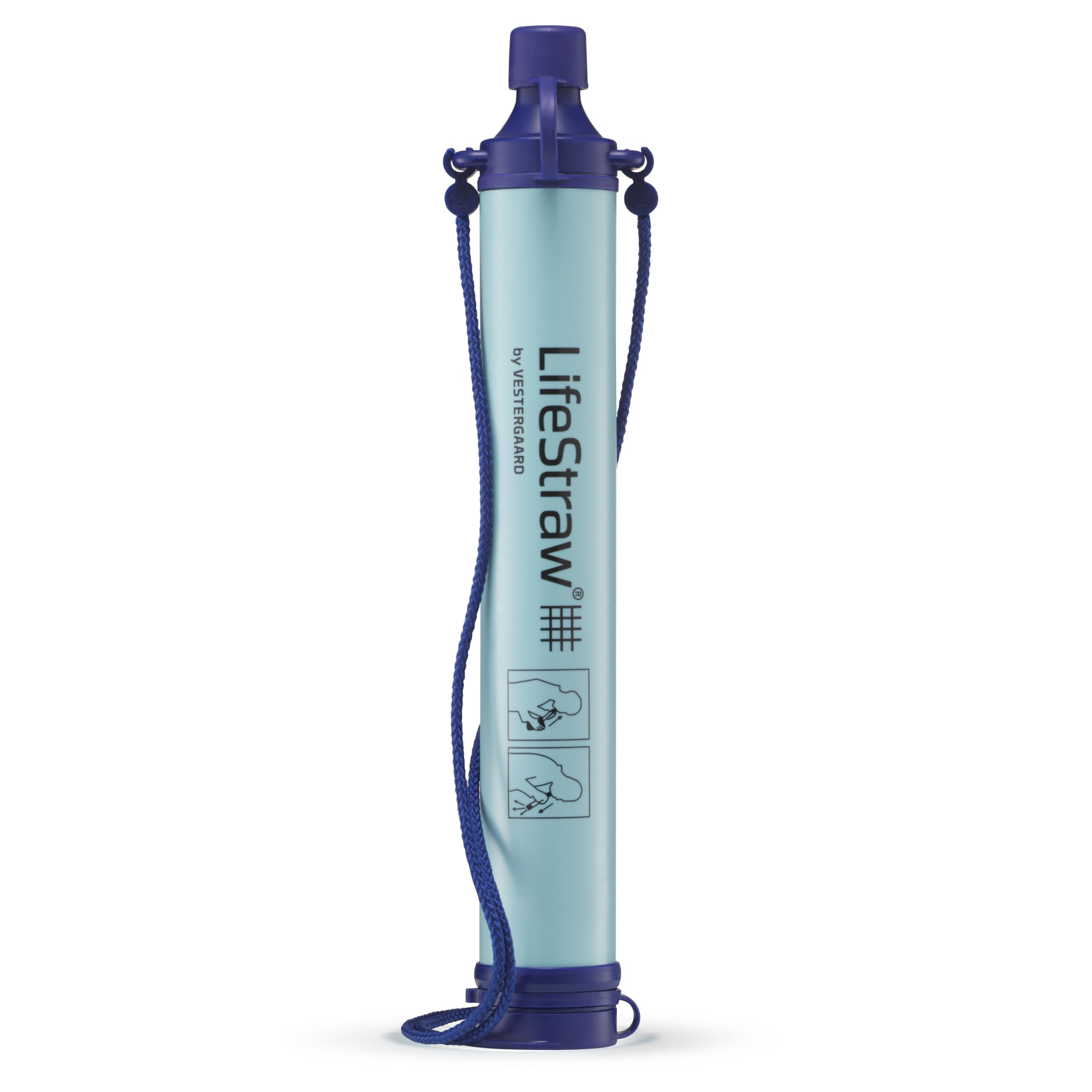
LifeStraw Personal

96 /100
Traveler Score Outstanding

Key details

Weight
1.62 oz
Max TDS
1,000 ppm
Filter Life
1,000 liters
Bacteria Removal
99.999999%
Check Details on Amazon

The lowest-priced filter in this group is also the most limited, and we still think it earns a place in the pack. It's a straw: unscrew the cap, put the filtered end in the water, and drink. There's no bottle to fill, no pouch to squeeze, and nothing to assemble at the end of a long day, which is why it lives in a lid pocket and gets forgotten until the bottle runs dry.

What you trade for that simplicity is control. You can't fill a bottle, a bladder, or a pot with it; it delivers at drinking speed only, and the suction gets harder as the membrane loads. The 1,000 ppm TDS ceiling is the detail people miss — this is a stream, lake, and tap tool, not something for brackish or heavily mineralized water.

Two things make it work better than the price suggests. The membrane is rated for 1,000 liters, which is several seasons of day hikes for one person, and blowing back through the mouthpiece after a drink clears the worst of the loading before it becomes a problem. For a thru-hike or a camp of four it's the wrong tool; for the pack you grab on a day hike, it's the least expensive insurance here.

Pros

  • 1.62 ounces with nothing to assemble
  • Lowest-priced filter in this group
  • 1,000-liter membrane life

Cons

  • Straw only
  • Suction gets harder as the membrane loads
Our verdict

The cheapest filter here is also the simplest: 1.62 ounces, no setup, and a drink from any stream — as long as you only need a mouthful at a time.

Check Latest Price
3

Best for Bottle Refills

LifeStraw Peak Series

95 /100
Traveler Score Outstanding

Key details

Weight
3.5 oz
Flow Rate
3 liters per minute
Connections
Standard bottles and gravity hoses
Filter Life
1,000 gallons (4,000 liters)
Check Details on Amazon

Compared with the original LifeStraw, the Peak changes the end that matters. The bottom cap unscrews to reveal a threaded fitting that takes a standard water bottle or a gravity hose, so instead of sucking you can fill a bottle, screw the filter on, and let water run through into your mouth or a second container. The top is still a straw for the times when there's nothing to screw onto.

The rest of the package is a step up too. The membrane is rated for 1,000 gallons, the listed maximum flow is 3 liters per minute, and the reworked design is meant to shed sand and silt rather than load up on the first silty source. At 3.5 ounces it still disappears in a pack.

Versatility is what you're paying for: one device covers sipping on the move and filling a bottle at camp, and the removable base means tired jaws stop being the limiting factor. It's also the filter we hand to someone who has never used one, because there's nothing to learn beyond filling a bottle and screwing the filter on. The 1,000-gallon rating is the other quiet advantage — for a weekend camper that's years of trips before the membrane needs replacing.

Pros

  • Screws onto standard bottles and gravity hoses
  • Up to 3 liters per minute
  • 1,000-gallon membrane life

Cons

  • No carry case
Our verdict

The straw we want when there's a bottle in the pack: screw it on, filter by gravity instead of suction, and get a faster fill than the original LifeStraw.

Check Latest Price
4

Best for Questionable Water

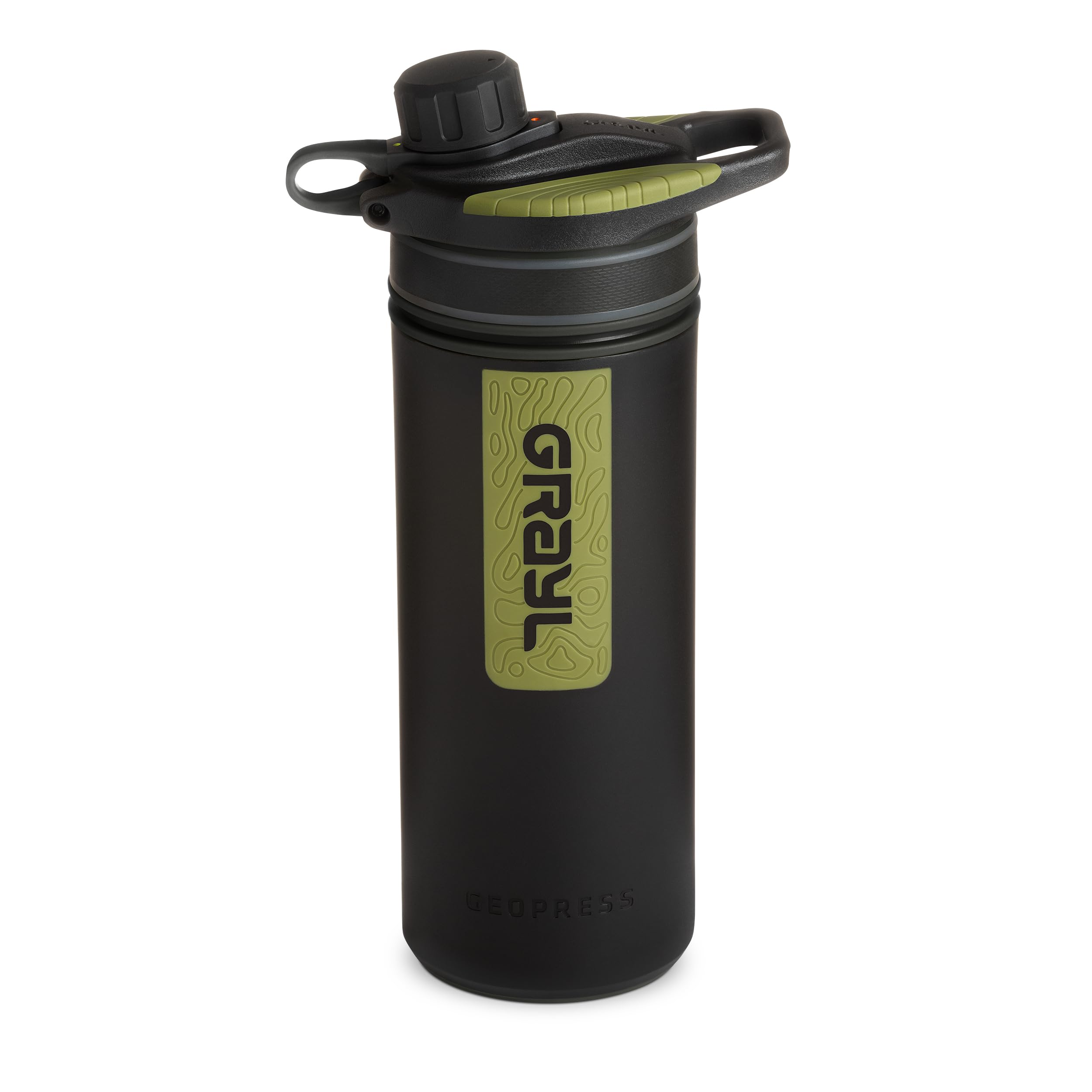
GRAYL GeoPress

93 /100
Traveler Score Outstanding

Key details

Weight
15.9 oz
Removes
Viruses, bacteria, and chemicals
Purify Time
8 seconds per 24 ounces
Cartridge Life
65 gallons (250 liters)
Check Details on Amazon

Most filters in this guide work from one assumption: the danger in backcountry water is biological. The GeoPress assumes more. Its cartridge is rated to remove viruses — rotavirus, norovirus, hepatitis A — as well as bacteria and protozoa, and the carbon and electroadsorption media pull out VOCs, PFAS, pesticides, and heavy metals. You fill the outer cup, press the inner sleeve down, and 24 ounces of treated water rises through the cartridge.

We think that's worth paying for in exactly two situations: travel where the tap is questionable, and any source downstream of farms or industry. On a well-trodden trail with clear water it's more purifier than you need, and the 15.9-ounce weight puts it in the pack that gets set down at camp rather than the one that goes up the ridge.

The press is the part to think about before you buy. It takes real arm strength, it's a two-handed job, and it gets stiffer as the cartridge loads — worth knowing if grip strength is an issue or if you're feeding four people at dinner. What you get in return is speed and certainty: no hoses, no sucking, no waiting, and a carbon stage that handles the sulfur and chlorine notes a hollow-fiber filter leaves behind.

Pros

  • Removes viruses, chemicals, and heavy metals
  • 24 ounces per press with no setup
  • Carbon stage improves taste and odor

Cons

  • Cartridge lasts about 65 gallons
Our verdict

Buy this if the water might carry viruses or farm chemicals: 24 ounces in a single press, with a carbon cartridge that also fixes taste.

Check Latest Price
5

Best Gravity Filter for Base Camp

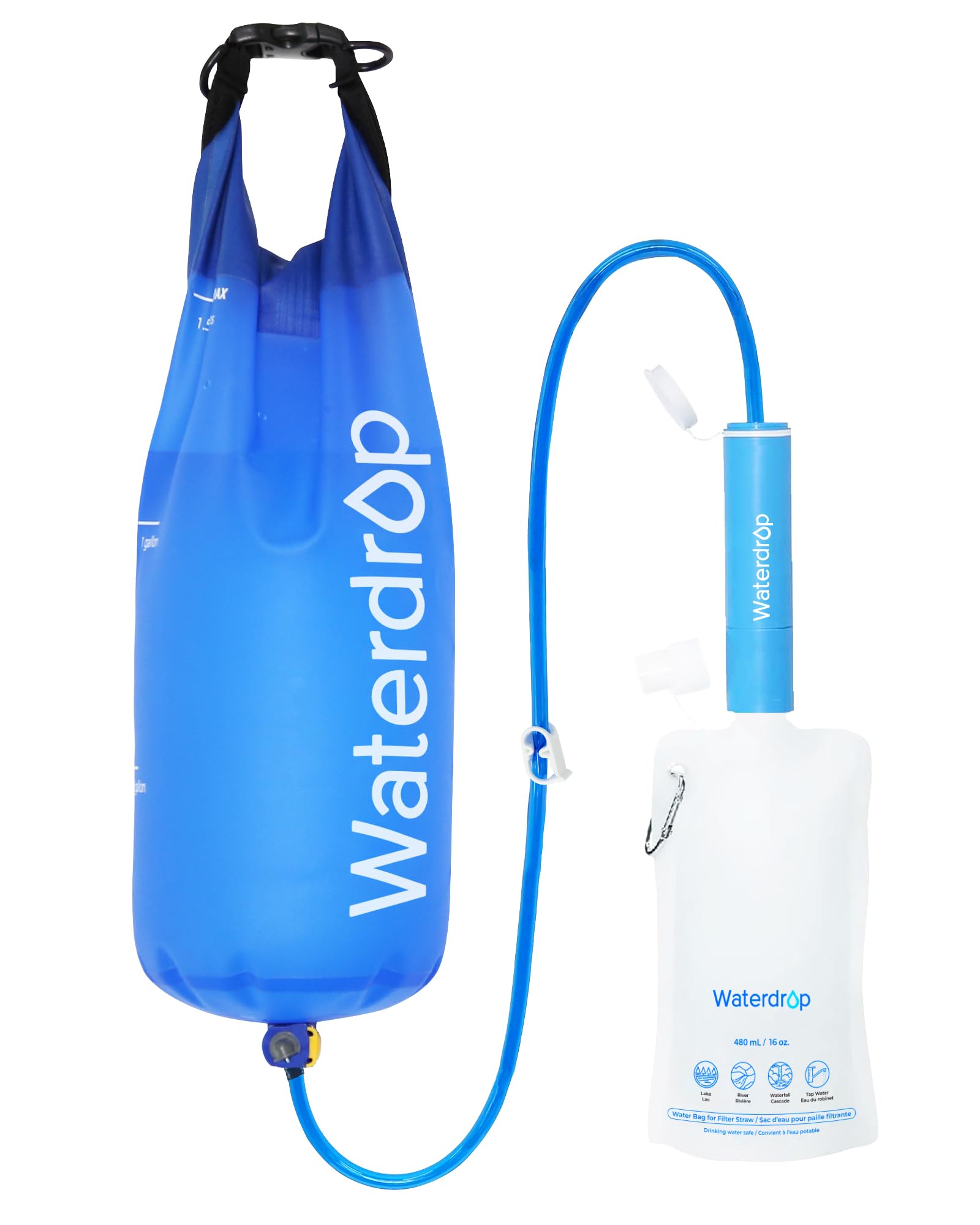
Waterdrop Gravity Filter

93 /100
Traveler Score Outstanding

Key details

Weight
4.64 oz
Flow Rate
700 ml per minute
Reservoir
1.5 gallons
Filter Life
1,400 gallons (5,300 liters)
Check Details on Amazon

The routine is the reason to own a gravity filter. Fill the 1.5-gallon bag from a stream, a tap, or a jug, hang it from a branch or a roof rack, and walk away. The filter sits inline between the bag and whatever you're filling, so there's no pumping, no squeezing, and no reason to stand there watching it drip.

A gallon and a half is a real amount of water at camp — enough for two people to drink through a day and still leave something for a pot of pasta — and the bag rolls down flat when it's empty, which is more than you can say for a rigid jug. The whole kit weighs 4.64 ounces, including the 16-ounce pouch that ships with it.

We reach for this one whenever a trip involves cooking and more than one drinker, because the alternative is standing over a squeeze pouch for twenty minutes. Speed is the caveat: 700 ml per minute is the listed maximum, and a membrane carrying silt won't hit it. The backwash function built into the straw is what brings the flow back, and it's worth running at the end of a day rather than waiting for the trickle to stop.

Pros

  • 1.5-gallon bag filters hands-free
  • Rolls flat when empty
  • Backwash function restores flow without tools

Cons

  • 300 ppm TDS ceiling rules out mineral-heavy water
  • Metallic note in some water sources
Our verdict

For a camp with more than one thirsty person, this is the one: fill 1.5 gallons, hang the bag, and let gravity do the filtering while you do something else.

Check Latest Price
6

Best Pump Filter

Survivor Filter PRO

93 /100
Traveler Score Outstanding

Key details

Weight
12.8 oz
Flow Rate
500 ml per minute
Final Pore Size
0.01 micron
Filtration Stages
Three
Check Details on Amazon

Some sources tell you what they are before you fill anything: brown, tannin-stained, or smelling of iron. The Survivor Filter PRO is built for those. Water passes a 0.1-micron pre-filter, then a carbon stage for chemicals and heavy metals, then a 0.01-micron membrane rated to stop viruses alongside bacteria and protozoa. That's the most thorough path in this guide, and it's the one we want on a muddy bank.

It's a pump, so the work is yours: 500 ml per minute, one handle stroke at a time, into a bottle, a bladder, or the cup in the kit. That's slower than a squeeze filter at full flow and much slower than a gravity bag, but putting a cheap first stage ahead of an expensive membrane is exactly why a pump rides out water a straw would gag on.

The pump adds moving parts that a straw doesn't have, and the lifetime defect warranty is the honest answer to that — it covers the housing and mechanism, so a failure that would otherwise end a trip becomes a warranty claim instead. What no warranty covers is silt: backflush with the included syringe at the end of each day, or the strokes get harder every morning.

Pros

  • Three stages, including carbon
  • 0.01-micron final stage rated for viruses
  • Lifetime defect warranty

Cons

  • Heavier than any straw or squeeze filter here
  • Hoses kink if coiled carelessly
Our verdict

The pump we reach for when the creek runs brown: three stages ending in a 0.01-micron membrane rated for viruses, with carbon for chemicals and taste.

Check Latest Price
7

Certified Backup

Membrane Solutions S1

95 /100
Traveler Score Outstanding

Key details

Weight
2 oz
Pore Size
0.1 micron
Filter Life
1,320 gallons
Certifications
NSF/ANSI 42, 372, 401
Check Details on Amazon

Filter straws are usually sold on percentages printed on the box. This one carries third-party certification — NSF/ANSI 42 for chlorine and taste, 372 for lead-free materials, and 401 for microplastics and particulates — and nothing else in this guide states certification to those standards. Read what that covers before you get comfortable: the certifications are about materials, chlorine, and microplastics, not pathogen removal, which rests on a separate test report.

The five stages are a coarse screen, two layers of PP cotton, coconut-shell activated carbon, and a 0.1-micron hollow-fiber membrane. The carbon is what separates it from a plain straw: chlorine and a good deal of the musty, pondy note come out, which matters on a trip where you're drinking from the same source for days. The listed flow is 500 ml per minute, about a third of the Sawyer Squeeze's 1.7 liters.

It's 7.1 inches long and an inch across, 2 ounces, and it threads onto any standard 28 mm bottle, so a disposable water bottle becomes your dirty-water container and you drink through the straw. Filter life is listed at 1,320 gallons, which is a long time for something this small.

What you're paying for over a basic straw is certification and carbon, and we think that's a fair trade for a filter that lives in a go bag or gets handed to a skeptic. What you don't get is a system: no pouch, no hose, no gravity option, and no way to fill a pot without a container you supply. A Sawyer Squeeze costs more and does the rest of it.

Pros

  • Certified to NSF/ANSI 42, 372, and 401
  • Carbon stage for chlorine and taste
  • Threads onto standard 28 mm bottles
  • 1,320-gallon filter life

Cons

  • No pouch, hose, or gravity option
Our verdict

The straw to hand someone who wants proof rather than adjectives: NSF/ANSI 42, 372, and 401 certification, a carbon stage, and 1,320 gallons of filter life.

Check Latest Price
8

Two Hikers

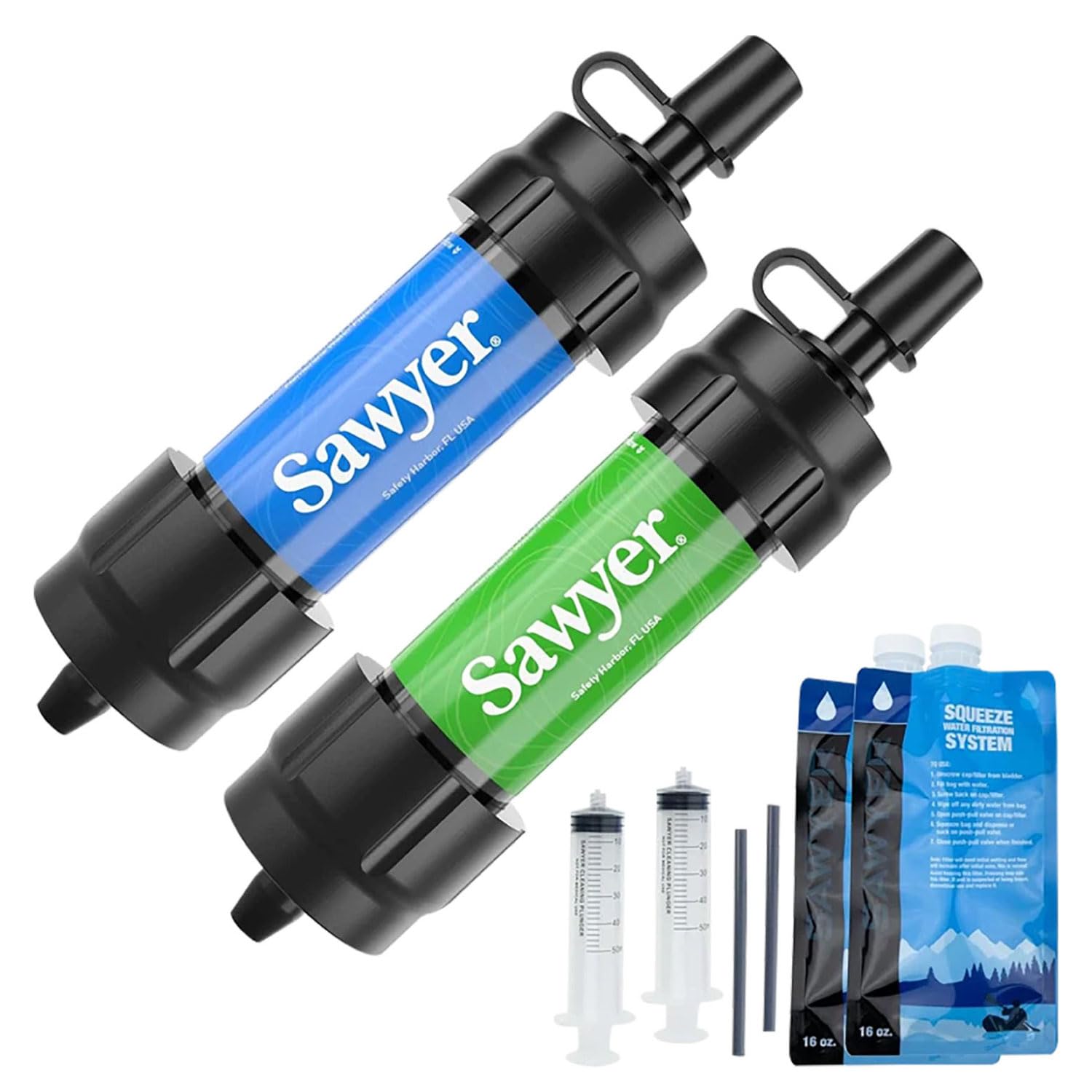
Sawyer MINI 2-Pack

95 /100
Traveler Score Outstanding

Key details

Weight
2 ounces each
Included
Two filters, pouch, two straws and two plungers
Pore Size
0.1 micron absolute
Filter Life
100,000 gallons
Check Details on Amazon

Two filters, one 16-ounce pouch, two straws, and two cleaning plungers. That's the arithmetic of this kit, and it explains both who it's for and where it gets awkward: two people can each carry a filter, but they're sharing a single pouch to squeeze into.

The MINI itself is the smaller sibling of the filter in our top pick — the same 0.1-micron absolute hollow fiber, 2 ounces, rated to 100,000 gallons, and able to screw onto a 28 mm bottle, plug into a hydration-pack line, or be used as a straight straw. Each MINI is individually tested three times before it ships. Two filters and two straws together weigh less than a full water bottle, which is the part we appreciated most when splitting gear between packs.

Sixteen ounces is a small squeeze, so plan on refilling often rather than filling two bottles in one go. The plungers are the maintenance kit: backflush with clean water after every trip and the membrane keeps its flow long after a neglected one slows to a dribble.

The 2-pack makes sense for two hikers who want redundancy more than capacity — a spare membrane is cheap insurance for a trip, and a partner carrying their own filter isn't queueing behind yours. The included 7-inch straws get more use than you might expect, too: on a short stop, drinking straight from a filled bottle beats squeezing a pouch into it.

Pros

  • Two 0.1-micron filters for two packs
  • Fits 28 mm bottles and hydration packs
  • 100,000-gallon rating per filter

Cons

  • Only one 16-ounce pouch in the kit
Our verdict

The right buy when two people each want their own filter: two MINIs, a shared pouch, and the same 100,000-gallon membrane as our top pick.

Check Latest Price

How We Tested Camping Water Filters

We started by gathering filters sold for backpacking, camping, and emergency kits, then narrowed the list by claimed pore size, cartridge lifespan, packed weight, and replacement availability. That left 11 filters, which we tested for seven months. They didn’t live on a lab bench: they went on day hikes, overnight trips, and into a car emergency kit, where they sat between outings and had to work without the instructions in front of us.

At camp, I timed how long it took to fill a one-liter bottle from a silty creek and a clear lake, counted pump strokes or squeezes, and noted whether the filter clogged halfway through. I weighed each one dry and packed, then carried it in a hip-belt pocket and at the bottom of a pack to see if it survived being sat on. We checked connections for leaks, housings for cracks, and flow rate after repeated use; we also tasted the output for grit or plastic flavor. For durability, each filter was dropped from waist height onto rock and packed away wet.

For emergency use, we practiced setting up each filter with cold hands and a headlamp, then stored two in a glovebox for a month to see whether heat or vibration affected the seals. Value came down to cartridge life and replacement cost, not just the initial buy-in. We tracked how many liters each filter moved before flow slowed, cleaned or backflushed per instructions, and ran it again to see if performance came back. We also left filters assembled between trips, because that’s how most people store them, and watched threads, O-rings, and bags for wear.

How to Choose Water Filters for Camping

Match the Format to Your Water Routine

If you drink on the move and carry one bottle, a straw is enough and it weighs almost nothing. If you fill bottles and a pot at camp, you want a squeeze kit that threads onto a bottle and can hang as a gravity system. If you sit still for several days with other people, a gravity bag works while you set up camp. Pumps earn their weight on genuinely dirty water, where a replaceable first stage protects the expensive membrane.

The trap is buying for the trip you imagine rather than the one you take. A straw cannot fill a pot, and a 1.5-gallon gravity bag is dead weight on a day hike. Count the liters you need per person per day and the number of people drinking before you look at anything else.

Understand What a Filter Removes

Almost everything here uses a hollow-fiber membrane with pores around 0.1 micron, which stops bacteria and protozoa and lets viruses through, because viruses are simply too small. If viruses are a real risk, or the water carries farm chemicals or heavy metals, you need a purifier with a carbon or electroadsorption stage. Carbon also improves taste, which is why it turns up on straws and gravity bags as well as on purifiers.

Weigh Filter Life Against Replacement Cost

Filter life in this group runs from a 65-gallon purifier cartridge to a 100,000-gallon Sawyer membrane, and what matters is the cost per liter across the trips you actually take. A weekend camper will never exhaust a hollow-fiber filter; a daily user or a group working through gallons will reach the end of a cartridge. Backflushing is the other half of that calculation — these kits ship with plungers, syringes, or backwash valves because a flushed membrane keeps its flow.

Check the Threads, the Bags, and the Hang Point

Container compatibility decides how a filter fits your routine. Standard 28 mm threads let a filter screw straight onto a disposable water bottle, and hydration-pack adapters and gravity hose fittings go further. A gravity system needs something to hang from — a branch, a roof rack, a tent pole — and a wide-mouth bag is far easier to fill from a shallow stream than a narrow one.

The bag or bottle, not the membrane, is usually what fails first. Hand-tighten plastic threads, keep a rigid bottle as your backup container, and treat a pinhole in a bladder as the end of that bladder.

Know Your Water's Limits

Every filter has a stated ceiling for total dissolved solids — 300 ppm on the Waterdrop and the GeoPress, 1,000 ppm on most straws and squeeze filters, 2,000 on Sawyer's gravity system — and salty or heavily mineralized water sits outside all of them. Silty water is a different problem: it is not more dangerous, it just clogs the membrane. Let sediment settle overnight, strain it through a cloth, or carry a pump with a replaceable first stage.

Frequently Asked Questions

Final Verdict

Most campers should buy the Sawyer Squeeze. It covers the most ground — a bottle filler, a sipper, and a gravity rig in one 2-ounce package — and the 100,000-gallon rating means it stays in your pack for years rather than a season.

If your camp is a base camp with a table and a stove, the Waterdrop gravity bag spares everyone the squeezing. And if the water itself is the question — viruses, farm runoff, a tap you don't trust — the GRAYL GeoPress is the one that answers it, provided you don't mind earning each press.