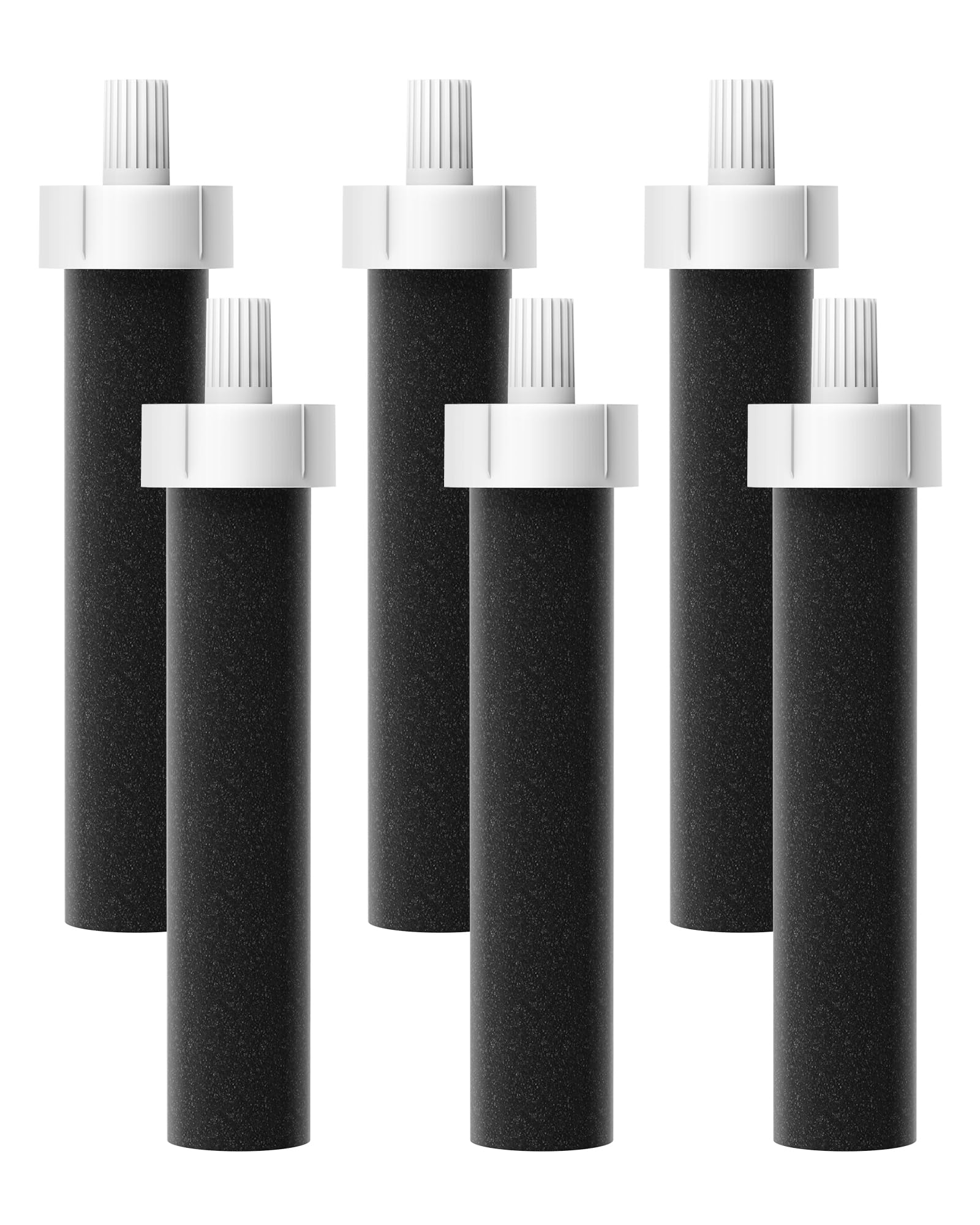
Best Water Bottle Filters of 2026

A filter in a water bottle sounds like a straightforward upgrade: fill, sip, repeat. In practice, most of them turn your bottle into something you have to work at — the flow drops to a trickle, the cartridge dies on a schedule you can't see, and plenty of them don't seat right in the bottle you already own. What a good one actually fixes is simpler than the packaging suggests: it takes the chlorine and metallic edge off tap water so you drink the water you're already carrying.

Fit is the first thing I'd check. A cartridge that threads wrong or sits crooked turns a good bottle into a leaky one, and many only work with their own brand's bottle. Sixteen filters have spent the past five months in my kitchen, gym bag, and desk drawer, and the gap between the best and the rest comes down to flow, taste, and how honest the filter-life number is. Nobody warns you that a 100-liter cartridge is roughly six weeks at four refills a day. The picks below earn their place.

1

Best Overall

Brita BB06 Bottle Filters (6-Pack)

96 /100
Traveler Score Outstanding

Key details

Reduces
Chlorine taste and odor, class VI particulates
Filter Life
2 months or 40 gallons
Filters Per Pack
6
Compatible Bottles
Brita BB06 hard-sided bottles
Check Details on Amazon

If the bottle in your bag is a Brita, this is the cartridge that goes in it, and it's the safest filter decision on this page. Six arrive in one box, each rated for two months or 40 gallons, so the pack covers roughly a year of everyday drinking. The swap takes seconds: rinse the new cartridge for about 15 seconds, seat it in the straw, then align and lock the lid.

What it does to the water is narrower than the purifier cartridges here, and that's the right trade for a municipal tap. The activated carbon strips chlorine taste and odor and class VI particulates while leaving minerals and electrolytes in place, which is more than some filters bother to do. The difference shows up fastest in water that smells faintly of a swimming pool, and in the tea or coffee you make with it.

Fit is the quiet strength. The cartridge seats and locks in Brita's hard-sided bottles without the wobble or the thin, whistling draw that a badly seated filter can bring, and that reliability is why we keep this one at the top of the page rather than sending you to a third-party pack.

Buying six at once is the point. One in the bottle, one in the kitchen drawer, and you swap the moment the taste shifts or the draw slows instead of falling back on bottled water for a week while a replacement ships.

Pros

  • Six cartridges cover about a year
  • Cuts chlorine taste and odor
  • Leaves minerals and electrolytes in place
  • Seats and locks reliably in Brita bottles

Cons

  • Rated life arrives faster with heavy daily use
Our verdict

For everyday tap water in a Brita bottle, we recommend these six cartridges: about a year of clean-tasting water and the most reliable seat of any filter here.

Check Latest Price
2

Best for International Travel

GRAYL GeoPress Replacement Cartridge

95 /100
Traveler Score Outstanding

Key details

Removes
Viruses, bacteria, protozoa, chemicals
Filter Life
350 cycles or 65 gallons (250 L)
Certification
Meets NSF protocols 42 and 53
Compatible Bottles
GRAYL GeoPress
Check Details on Amazon

GRAYL's cartridge is the one here that treats water rather than improving it. It's rated against viruses, bacteria, and protozoan cysts — rotavirus, hepatitis A, norovirus, giardia, cryptosporidium, E. coli among them — and the activated carbon behind that membrane adsorbs chemicals, pesticides, heavy metals, and the compounds behind off flavors. GRAYL also certifies it to meet or exceed NSF protocols 42 and 53.

That's what you're paying for, and this is the most expensive cartridge in the group by a wide margin. It's a fair trade the first time you fill a bottle from a hotel bathroom tap in a city where you've been told not to drink the water. The cost is effort as well as money: the GeoPress works by pressing the inner cartridge down through the outer bottle, so it takes two hands and a firm push rather than a sip.

Two details we appreciated. The rated life is 350 presses, or 65 gallons (250 liters), which GRAYL puts at about three years of use. And an unused cartridge keeps for 10 years stored properly, so buying a spare before a long trip is a sensible purchase rather than a gamble on shelf life.

If you're starting from nothing, the cartridge is the smaller part of the decision — the GeoPress bottle is what makes the system work, and this replacement only makes sense as part of it.

Pros

  • Rated against viruses, bacteria, and protozoa
  • Certified to NSF protocols 42 and 53
  • 350 presses or 65 gallons per cartridge
  • 10-year shelf life on a spare

Cons

  • Fits only the GeoPress bottle and valve
Our verdict

If you're filling from taps or streams you don't trust, this is the cartridge we hand travelers: virus, bacteria, and protozoa ratings in a single press.

Check Latest Price
3

Best for Hiking and Backpacking

LifeStraw Go Series Replacement Filter

88 /100
Traveler Score Excellent

Key details

Removes
Bacteria, parasites, microplastics, chlorine
In The Box
Membrane microfilter and carbon filter
Filter Life
Membrane 1,000 gallons (4,000 L); carbon 26 gallons (100 L)
Compatible Bottles
Go Series bottles from 2023 on
Check Details on Amazon

A thousand gallons is the headline: the membrane microfilter in this replacement is rated for 1,000 gallons (4,000 liters), which is years of refills for most people — and the reason it's our pick for backpacking. The two-stage design pairs that membrane with an activated carbon filter that handles chlorine, organic chemicals, and the flavors that make unfamiliar water hard to drink.

The detail we like most is what happens at the end of the membrane's life. It stops letting water through instead of quietly degrading, so a bottle you can't pull from is your signal to replace rather than a guess. That's the kind of design decision that matters on a trip, where you can't see what's in the water and can't afford to be wrong.

LifeStraw rates it against 99.999999% of bacteria and 99.999% of parasites and microplastics, and it's a lighter, simpler thing to carry than a press-style purifier as long as you don't mind the suction. Drawing through two stages takes more pull than an unfiltered straw; we noticed it most at the end of a long day, not enough to stop reaching for it.

Compatibility is the check before you order. This fits Go Series bottles bought in 2023 or later. The older version, the one with the flip-up mouthpiece and carabiner clip, takes a narrower cartridge that looks similar and doesn't interchange.

Pros

  • Membrane rated for 1,000 gallons
  • Stops flowing at end of life
  • Carbon stage cleans up taste

Cons

  • Carbon stage rated for only 26 gallons
Our verdict

For backpacking and long trips, we like this one best: a 1,000-gallon membrane that fails safe, with a carbon stage for taste.

Check Latest Price
4

Budget Brita Refills

AQUA CREST BB06 Replacement Filters (6-Pack)

91 /100
Traveler Score Outstanding

Key details

Reduces
Chlorine, taste, odor, sand, rust, sediment
Filter Life
2 months or 40 gallons
Filters Per Pack
6
Compatible Bottles
Brita BB06 bottles with straw
Check Details on Amazon

AQUA CREST's six-pack aims at the same bottles as our top pick — Brita's hard-sided 26- and 36-ounce bottles and the 20- and 32-ounce stainless ones — and it costs about the same money. What it doesn't match is the reliability of the seat.

The cartridge itself is a coconut-shell carbon block with a sealed bottom, and it reduces chlorine, taste, odor, sand, rust, and sediment on the same two-month or 40-gallon schedule as the brand-name filter. On paper it's a like-for-like swap, and plenty of bottles take it without complaint. Fit is the variable, and it's the reason this sits below the Brita pack for us.

Where it goes wrong is seating. Some bottles take the cartridge cleanly; others need real force to push it onto the straw, and a filter that doesn't sit flush draws slowly or not at all. If fit has been a problem for you with non-brand cartridges before, this is the one to skip.

The exclusions are worth reading before checkout, too. It isn't for Brita's soft sport or squeeze bottles, and it isn't for bottles without a straw — those take a different cartridge entirely, and no amount of forcing will change that.

Pros

  • Same 40-gallon schedule as the brand-name filter
  • Fits both plastic and stainless Brita bottles
  • Reduces chlorine, sediment, rust, and sand

Cons

  • Can be stubborn to seat on the straw
Our verdict

We like these as a Brita-compatible alternative for bottles that have taken third-party cartridges cleanly before — otherwise, stay with the brand-name pack.

Check Latest Price
5

Philips Bottle Owners

Philips AWP285/37 Bottle Filters (3-Pack)

91 /100
Traveler Score Outstanding

Key details

Reduces
Chlorine and particulates
Filter Life
Up to 2 months or 40 gallons
Filters Per Pack
3
Compatible Bottles
Philips AWP2771, AWP2772, AWP2731, AWP2732
Check Details on Amazon

The filter inside Philips' GoZero bottles is a sheet of activated carbon fiber rather than a dense block of carbon granules, and that construction is the whole pitch: a large adsorption surface that catches chlorine and particulates without strangling the flow. Philips compares the surface area to seven basketball courts, which is marketing arithmetic, but the design intent is real enough.

You get three cartridges, each rated for 40 gallons or about two months, so the box covers roughly half a year. They fit four bottle series — AWP2771, AWP2772, AWP2731, and AWP2732 — and that's the entire compatibility list; the cartridge is molded to those lids and no others.

What we like about this one is how little it asks of you. No pressing, no ceremony beyond a rinse, and a draw that stays close to an unfiltered bottle. Of the carbon cartridges here, it's the one that behaves least like a filter while you're actually drinking.

One check before you order: if your Philips bottle comes from an older or discontinued line rather than the four series above, the mount is different and this cartridge won't be the answer. Confirm the model on the bottle base first.

Pros

  • Carbon fiber keeps the draw fast
  • Three cartridges cover about six months
  • Fits four Philips GoZero series

Cons

  • Sold without a warranty
Our verdict

For a Philips GoZero bottle, this three-pack is what we reach for: fast-drawing carbon fiber and about six months of filters in one box.

Check Latest Price

How We Tested (and Lived With) 16 Water Bottle Filters

We started by pulling every bottle filter we could find that sells a replacement cartridge on its own — anything that locked you into throwing out the whole bottle got cut. From there we narrowed by compatibility, since a cartridge that only works in one proprietary body is useless to most people, and by cost per gallon over the rated life. That left 16 filters, from simple screw-on cartridges to full filter lids.

Each one went into four bottles: a wide-mouth stainless, a standard narrow-neck plastic, a collapsible pouch, and a straw-lid bottle. I timed installation and checked whether the cartridge sat flush or wobbled, then carried each bottle upside down in a tote for an afternoon to see if the seal held. Two leaked; three fit only one bottle in the drawer.

Flow and taste got the most attention, because they're what you notice every day. We timed how long it took to drink a liter — the slowest demanded over four minutes of steady pulling — and noted whether water came through in a stream or a dribble. Taste was a blind side-by-side against unfiltered tap and bottled water, chilled and at room temperature; the ones that scored well knocked out the chlorine edge without leaving a flat, dead finish.

Filter life is where claims and reality part ways. I tallied every refill across five months, compared actual liters against the rated capacity, and ran four cartridges past their stated life to see when flow collapsed — most faded well before the number on the box. We also dropped each bottle from counter height, put the caps through repeated dishwasher cycles, and tracked cost per gallon to see which ones were genuinely worth replacing.

How to Choose Water Bottle Filters

Start With the Bottle You Own

Brita's BB06 cartridges seat in the straw of the brand's hard-sided bottles. GRAYL's cartridge threads into a GeoPress. The LifeStraw replacement fits Go Series bottles made from 2023 onward, not the earlier version with the flip-up mouthpiece and carabiner. Philips' AWP285/37 serves four bottle series and nothing else. Find the model number on the base of your bottle before you order anything.

"Compatible with Brita" is a looser claim than it sounds. Third-party cartridges are molded to someone else's tolerance, and a cartridge that doesn't sit flush on the straw draws slowly or not at all. If your bottle has been fussy about filters before, the brand-name cartridge is the safer buy even at a small premium.

Decide Between Better Taste and Real Treatment

Activated carbon — the Brita, AQUA CREST, and Philips cartridges — reduces chlorine, taste, odor, and sediment. That's the whole job, and for municipal water that already meets safety standards it's the job worth paying for. Pathogen removal is a different product. GRAYL rates its cartridge against viruses, bacteria, and protozoan cysts and certifies it to NSF protocols 42 and 53; LifeStraw rates its membrane against bacteria, parasites, and microplastics.

The practical rule: if you're filling from a hotel bathroom tap, a stream, or an unfamiliar well, buy one of those two. If you're filling from your own kitchen sink and the water smells of chlorine, a taste cartridge does everything you need for a fraction of the price.

Read Filter Life in Gallons, Not Months

"Two months" on a carbon cartridge means 40 gallons, which assumes a certain number of refills a day. Count your own: a 26-ounce bottle filled five times is about a gallon, so 40 gallons is roughly six weeks of steady drinking. The figures diverge sharply across this group — Brita and Philips both rate 40 gallons per cartridge, GRAYL rates 350 presses or 65 gallons, and LifeStraw's membrane is rated for 1,000 gallons while its carbon stage covers 26.

Expect Some Resistance at the Straw

Carbon filtration works by forcing water through a dense medium, so every cartridge here adds draw resistance compared with an open bottle. GRAYL sidesteps suction entirely: you press the inner cartridge through the outer bottle, which is faster but needs two hands and a firm push. LifeStraw's two-stage path is the slowest sip of the group, and Philips builds its cartridge from carbon fiber specifically to keep flow close to unfiltered.

Frequently Asked Questions

Final Verdict

The Brita BB06 six-pack is the filter we point to first: inexpensive to keep running, it seats without drama, and it turns municipal tap water into something you'll finish the bottle of. The exception is water you don't trust. For that, step up to the GRAYL GeoPress cartridge, which is rated against viruses as well as bacteria and protozoa, and which keeps for a decade on a shelf as a spare.

If neither of those bottles is the one in your bag, buy the cartridge molded for the bottle you own and skip the rest of this page. The best filter here is always the one that seats cleanly in your bottle and matches the water you actually fill it from.