Best Camping Water Jugs of 2026

The best ten minutes of a camping trip happen before anyone else is up: light coming through the trees, the coffee going, and cold water still sloshing in the jug. Then comes the other half of the story — the jug that tips in the trunk on the drive home, the spigot that dribbles down the table leg, the ice that's gone by 11 a.m. on a hot afternoon. What you're actually shopping for is a container that keeps water cold through dinner, pours one-handed without leaving a puddle, and survives being knocked off a picnic table.

I've been the person hauling two gallons by the handle across a parking lot, so I have opinions about grip and weight distribution. My team and I have spent the past eight months living with 12 jugs, from stout hard-sided models to collapsible ones that fold flat in a trunk, filling them at kitchen sinks and emptying them at campsites. Here's something a first-time buyer never expects: opening width matters more than capacity. You can't get a tray of ice through a soda-bottle mouth, no matter how many gallons the label claims. The picks ahead were judged on how they behave at a real campsite, not how they look on a shelf.

1

Best Overall

Reliance Aqua-Tainer 7 Gallon

95 /100
Traveler Score Outstanding

Key details

Spigot
Hideaway with screw vent
Capacity
7 gallons
Material
Polyethylene
Check Details on Amazon

Seven gallons is the number that decides this one. At the gallon-a-person-a-day most of us plan around at camp, that is a couple through a long weekend with enough left to rinse dishes and top off a dog bowl. It is also why we fill it where it sits rather than carrying it: a full Aqua-Tainer is a two-handed lift, and nobody who has lugged one pretends otherwise.

The details around that capacity are why it is our default. A screw-on vent lets air in as water leaves, so the spigot pours a steady stream instead of gulping and splashing down the side of the jug. The spigot tucks into a recess so it is not the first thing to snap off in a truck bed, and the rectangular body stacks when empty, which matters if you keep two or three of them in a garage with no shelves.

Sun is the thing that will shorten its life. Prolonged direct exposure makes polyethylene brittle, and the manufacturer's own warning is blunt about it, so ours lives in the garage between trips and sits in the shade at camp rather than on the sunny side of the picnic table. The molded grip on top helps with the lift, though the sensible habit is to slide the jug to the edge of the tailgate before you open the spigot.

The detail we did not expect to appreciate is the cap. It reverses: one way it covers the spigot for the drive, the other way it is the cap you pull off to pour. Nothing loose to lose in the dark, which at a campsite is a bigger deal than it sounds.

Pros

  • Seven gallons covers a group for a long weekend
  • Screw vent keeps the flow steady, not gulping
  • Spigot cap reverses to protect it in transit
  • Stacks and stores flat when empty

Cons

  • Rigid walls can crack if knocked around
Our verdict

For group car camping this is the jug we recommend first: seven gallons, a vented spigot that pours cleanly, and a body that stacks flat when the trip is over.

Check Latest Price
2

Best Insulated

Stanley Adventure Fast Flow 2 Gallon

92 /100
Traveler Score Outstanding

Key details

Weight
4.4 lb
Capacity
2 gallons
Dimensions
11.69" x 11.69" x 13.5"
Insulation
Double-wall foam, iced up to 2 days
Check Details on Amazon

Thirteen hours cold and ice for up to two days is the claim on the box, and what interests us is narrower: water that is still cold at four in the afternoon without a cooler of meltwater sitting next to it. That is the trade we are happy to make here, because you are paying for temperature rather than capacity.

Two gallons is the ceiling. That is a day of drinking for a family of four, or a long hot afternoon for two, and it is the reason the jug fits in a trunk beside the bags instead of on top of them. The high-flow spigot has an ice catch that keeps cubes out of the valve, and the whole tap unscrews for cleaning, which is the job most insulated dispensers make impossible.

The latched foam lid seats with a solid press and stays seated over washboard roads. Empty, the jug is 4.4 pounds; full, it is a two-hand carry from the truck to the table. For a beach day, a tailgate, or an August picnic that is a fair swap, and the lifetime warranty helps. For a scout troop that needs a whole weekend of washing water, it is not the answer.

Pros

  • Keeps water cold 13 hours, ice up to two days
  • Ice catch keeps cubes out of the spigot
  • Latched lid stays seated in transit
  • Lifetime warranty backs the build

Cons

  • Spout can drip after pouring
Our verdict

If cold water is the point of the trip, this is the jug we hand people: two gallons that hold ice overnight and pour without a cooler beside them.

Check Latest Price
3

Best Heavy-Duty

Scepter Military Style 5 Gallon

93 /100
Traveler Score Outstanding

Key details

Weight
4.5 lb
Capacity
5 gallons (20 liters)
Material
BPA-free HDPE
Footprint
13.7" x 6.8" x 18.8"
Check Details on Amazon

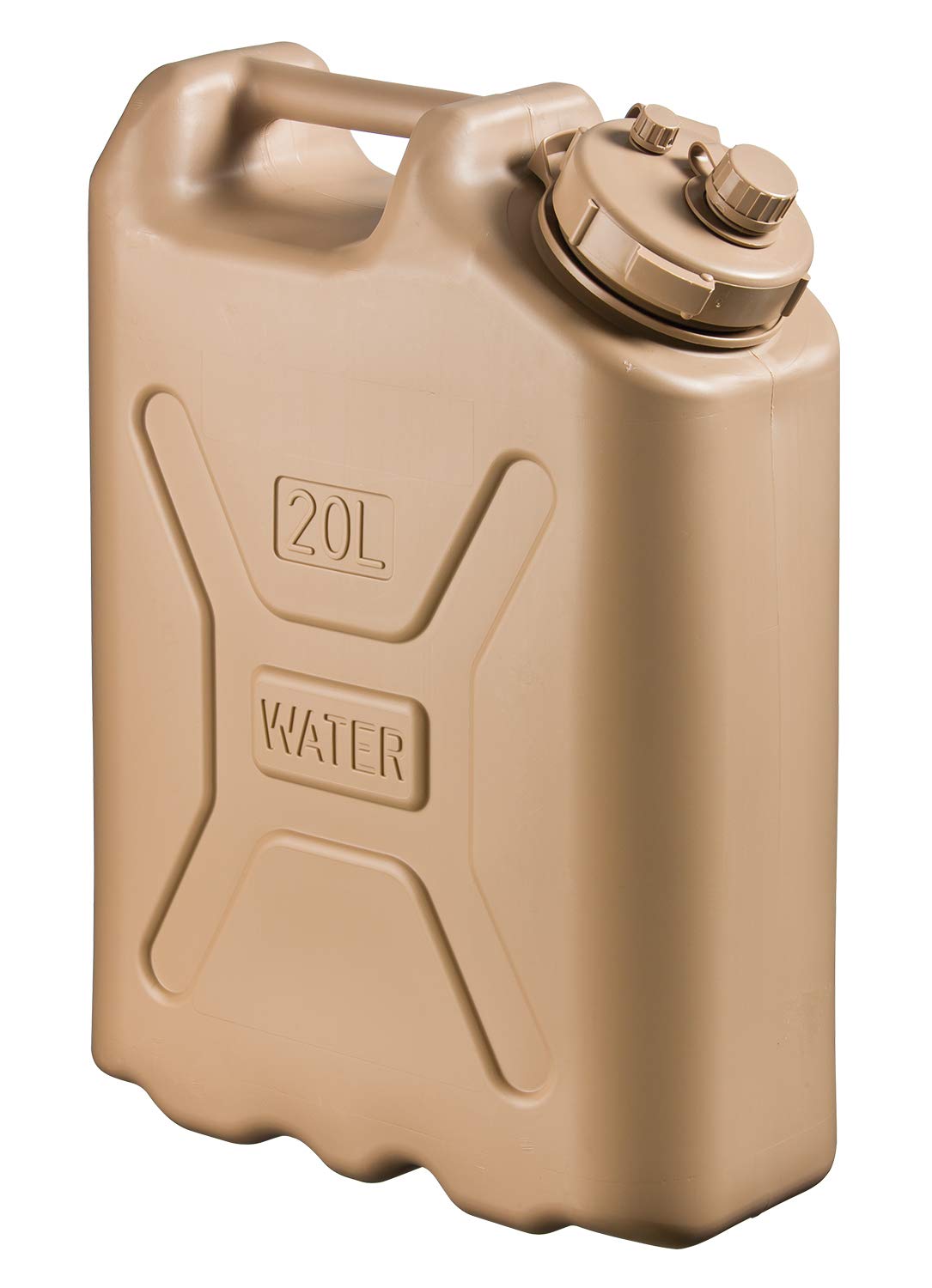
Six and three-quarter inches wide. That is the number that earns this can a place in the truck: it slides behind a seat, stands in the gap between a cooler and a wheel well, and does not need the floor space a rectangular seven-gallon jug demands.

It is a can rather than a dispenser, and the way you use it follows from that. You fill through the big screw cap, pour from the same opening, or park it on a tailgate and top bottles off from the mouth. The cap takes a deliberate turn to seat against its O-ring, and getting that right is the difference between a can that rides on its side without weeping and a damp patch you find two days later.

The build is what convinced us. The molded handle balances a full five gallons better than any strap, the walls take a drop onto rock without starring, and the cap has enough grip for cold hands. For overlanding, a work truck, or a base camp that moves every day, that toughness is worth more than a factory spigot. The 20-liter body is also easy to fill from a standpipe or a jerry-can spout when that is all the water source you have.

Pros

  • Narrow 6.8-inch footprint fits behind a seat
  • Heavy-duty body takes real abuse
  • Molded handle balances a full five gallons

Cons

  • No spigot, so you pour from the cap
Our verdict

For rough roads and tight storage this is our pick: a five-gallon can narrow enough to slide behind a seat and tough enough to take the knocks.

Check Latest Price
4

Best Mid-Size

COOZMENT 3.2 Gallon

89 /100
Traveler Score Excellent

Key details

Mouth
4-inch opening
Weight
1.9 lb
Capacity
3.2 gallons
Includes
Spigot and cleaning brush
Check Details on Amazon

A four-inch mouth is the spec we did not know we wanted until we tried to clean a jug through a two-inch hole. On the COOZMENT you can get a hand and a bottle brush inside, which turns a job that usually ends with a flashlight and some swearing into a two-minute rinse. The brush comes in the box, which tells you the maker expected you to use it.

The rest is sensible mid-size design. Three and a quarter gallons is about as much as one person wants to carry any distance, the two handles let you take the weight with both hands when it is full, and the spigot sits on the opposite side from the fill opening so the pour does not fight the air going in. It is the jug we take for two people and a weekend, or for a picnic where a seven-gallon container would be ridiculous.

Pros

  • 4-inch mouth makes it genuinely scrubable
  • Included brush reaches the corners
  • Two handles balance a full jug
  • 1.9 pounds empty, easy to move

Cons

  • Cap seal can weep if it is not seated squarely
Our verdict

For two people and a weekend this is the size and the mouth we want: easy to fill, genuinely easy to clean, and light enough to carry while it is full.

Check Latest Price
5

Best for Carrying Distance

Digury 5 Gallon

89 /100
Traveler Score Excellent

Key details

Carry
Dual handles and shoulder strap
Mouth
Wide mouth, brush included
Capacity
5 gallons
Footprint
6"W x 14"H
Check Details on Amazon

The walk from the car to the tent is where most water jugs get abandoned. Digury's answer is a shoulder strap, plus two molded handles for the lift out of the truck. On a hundred-yard carry with a full jug, that is the difference between one trip and a rest stop halfway.

It is a compact five gallons as well, six inches across and fourteen tall, roughly the size of a fat briefcase, which slides into the gap behind a folded seat. The wide fill opening takes a tap or a funnel without a second pair of hands, and the nylon brush in the box means you can keep the inside clean rather than just rinsing it and hoping.

What we noticed after a few days is how little fuss there is. The spigot shuts off cleanly between cups, the flat base sits steady on a picnic table, and the strap comes off when you would rather use the handles. It is not the toughest jug here and it is not trying to be; it is the one that makes the carry something you do not think about.

Pros

  • Shoulder strap eases the car-to-camp carry
  • Wide mouth with a brush in the box
  • Compact 6-inch-wide body
  • Dual handles for lifting it full

Cons

  • Spout can develop a steady drip
Our verdict

The five-gallon jug we grab when the campsite is a hike from the parking spot: a shoulder strap, two handles, and a compact body that slots behind a seat.

Check Latest Price
6

Best Collapsible

WaterStorageCube 5.3 Gallon 2-Pack

89 /100
Traveler Score Excellent

Key details

Pack
2 containers
Spigot
Gasketless twist valve
Capacity
5.3 gallons each
Material
Low-density polyethylene
Check Details on Amazon

What a collapsible jug actually buys you is trunk space on the way home. Two of these fold down to roughly the size of folded towels, which is why they end up living in the back of the car all summer instead of on a garage shelf between trips.

Full, they behave like jugs. The body holds its shape well enough to stand on a picnic table, the spigot twists open and shut with a quarter turn, and the wide mouth takes a tap or a funnel without help. The gasketless design means there is no O-ring to lose in the grass, which we appreciate more with every season.

Ten and a half gallons across the pair, and this is the kit we recommend when space is the constraint and the water will sit in one place for a few days. Set one at the kitchen tent and one at the wash station, and a family of four has drinking water and dishwater for a long weekend without a single trip back to the tap.

Folding them back down is more of a chore than the listing suggests. The plastic remembers every crease, and the pair never packs quite as small as the day they arrived. We rinse, dry, and lay ours flat in a bin between trips rather than fighting them back into a stuff sack.

Pros

  • Two 5.3-gallon jugs fold flat for storage
  • Gasketless spigot has no O-ring to lose
  • Wide mouth fills from a tap or funnel
  • Stands up when it is full

Cons

  • Pinholes can open along the fold lines
  • Spigot handle is the first part to fail
Our verdict

When trunk space is the constraint, this is the kit we pack: two 5.3-gallon jugs that fold flat and pour through a gasketless spigot.

Check Latest Price
7

Light Day Trips

CoreMuse 2.1 Gallon 2-Pack

87 /100
Traveler Score Excellent

Key details

Pack
2 containers
Capacity
2.1 gallons (8 liters) each
Openings
Separate fill and spout
Warranty
Lifetime
Check Details on Amazon

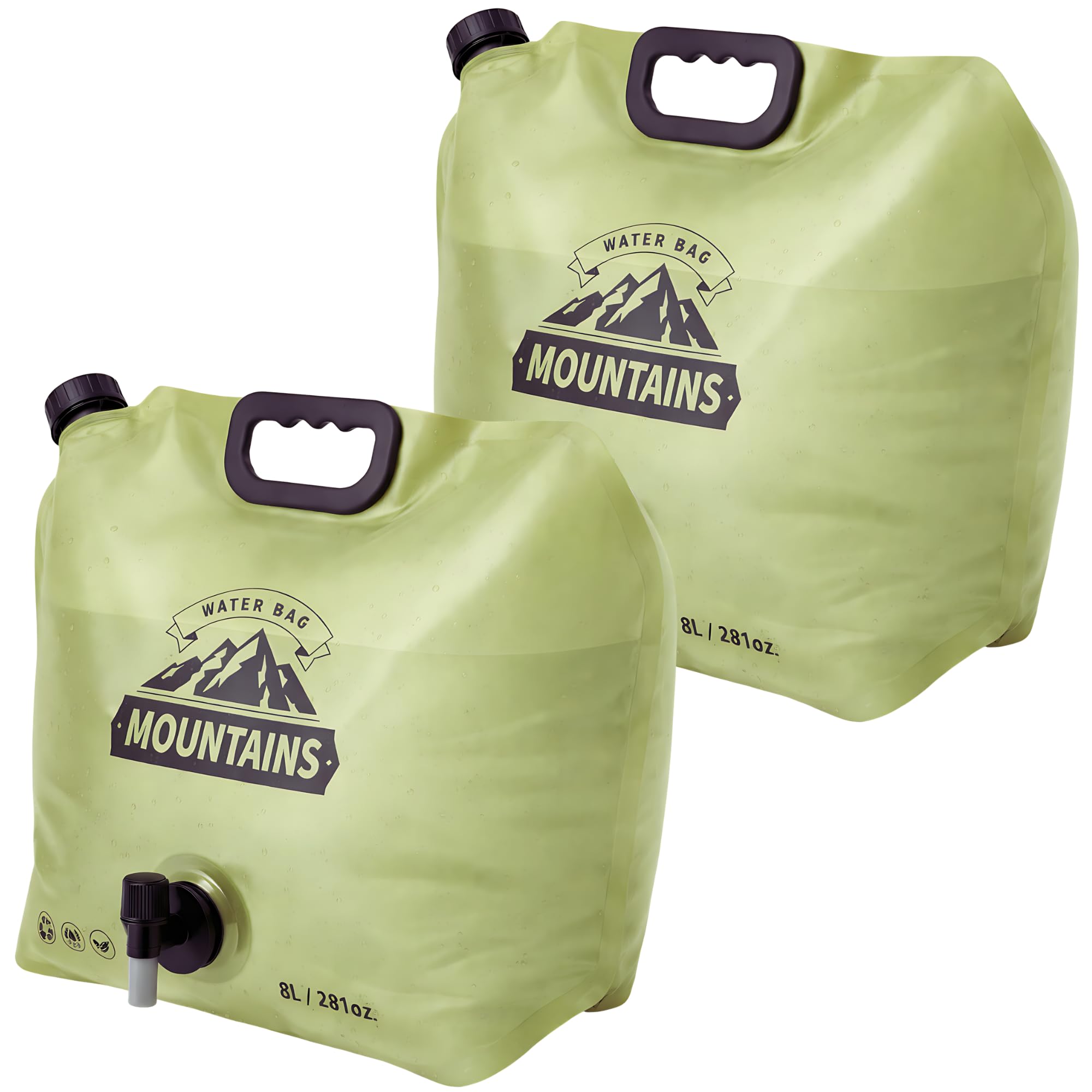
Two small jugs rather than one big one is the idea here, and the separated fill and spout openings make it work. You top up through one without undoing the spigot, and the flow stays steadier because air can get in while water comes out.

At a little over two gallons each, a full one is a one-hand carry for an adult, which is why these end up on day hikes and paddle trips where a five-gallon can is absurd. The material stays soft in the cold, so a frosty morning does not turn filling them into a wrestling match.

The spigot is the fussy part. The knob is stiff enough that wet hands struggle with it, and the flow is a trickle next to a rigid jug, which is fine for filling bottles and slow for filling a pot. A part-full bag also wobbles on a table unless it is leaning on something.

For a couple or a small group where every inch of pack space counts, we like the pair: light, foldable, and easy to find room for. They are not the jug to hand a scout troop, but they are the ones that make it into the canoe instead of staying in the car.

Pros

  • Separate fill and spout openings
  • Two 2.1-gallon jugs fold flat
  • Light enough for one-hand carries
  • Lifetime warranty

Cons

  • Stiff knob and slow flow at the spigot
  • Can develop pinhole leaks
Our verdict

For day trips and small groups these are the jugs we actually pack: light, foldable, and easy to pour one-handed at the end of a hike.

Check Latest Price
8

Solo Cold Water

Meoky 128 oz Insulated Jug

87 /100
Traveler Score Excellent

Key details

Lid
2-in-1 straw and spout
Weight
4.7 lb
Capacity
128 fluid ounces
Insulation
Triple-wall vacuum, cold 48 hours
Check Details on Amazon

Start with what this is not: there is no spigot, so it is not a camp dispenser you set on a table and walk away from. It is a gallon you drink out of, through a flip straw or a spout, which makes it a personal water supply rather than a group's.

As a personal jug it is very good. Triple-wall vacuum insulation with a copper lining keeps water cold for two days on paper and, on a hot afternoon at a trailhead, cold enough that nobody reached for a can instead. The top handle is for carrying across a parking lot; the fold-out side handle is for the trail.

The lid is the weak point. It is a two-in-one with a straw and a spout, and it takes a deliberate press to seat squarely, so doing it in a hurry gets you wet at the first tilt. The bottle is also 4.7 pounds before anything goes in it, which is the price of that insulation.

For a solo hiker, a long shift, or a driver who wants a gallon of genuinely cold water within reach, it earns its spot. For a family campsite it is the wrong shape entirely: one person's bottle does not fill four cups at dinner, and you will still want a jug with a spigot.

Pros

  • Cold for 48 hours on one fill
  • Top and side handles for carrying
  • Straw or spout from one lid
  • 18/8 stainless steel interior

Cons

  • Mouthpiece can drip
Our verdict

For one person who wants a gallon of cold water on the trail, this is the one we hand them: 48 hours of cold and two handles.

Check Latest Price

How We Chose and Tested Camping Water Jugs

We started with roughly 40 jugs sold by outdoor brands, big-box retailers, and hardware stores, then cut the list by reading specs: capacity from one to five gallons, mouth diameter, spigot design, whether the body collapses, replacement-part availability, and price per gallon of capacity. Twelve made the cut, and we bought every one at retail rather than accepting samples. They've been in rotation for eight months across weekend car-camping trips, two backyard campouts, a tailgate, a beach day, and one long highway drive.

Leak testing came first, because it's the failure that ruins a trip. We filled each jug to its marked line, sealed it as instructed, laid it on its side in a hot trunk for a two-hour drive, and checked the cargo mat underneath afterward. At camp we knocked each one over full on the picnic table and watched how quickly water reached the gear piled nearby. Lids got their own scrutiny: whether a full tray of ice fit through the opening, whether the threads caught cleanly with sand in them, and whether we could seal the cap one-handed while holding a cup.

Every jug was carried full from the car to the site in a single trip, and we noted where the handle dug into a palm and whether it took two hands and a knee to manage. Then we poured a full cup one-handed, from a table and from the ground, watching for the drip that follows a closed spigot. For temperature retention, each jug got ice and water at 7 a.m., with probe readings taken at noon and again at 6 p.m., half stored in shade and half in direct sun.

Durability testing was not gentle: dropped full from tailgate height onto gravel, wedged against coolers in a packed truck bed, dragged to the water station and back all summer, then inspected at the seams, handle joints, and spigot threads. The collapsible models were folded and reopened about twenty times each to see whether they still stood up straight when full. We hand-washed all twelve, pulling the spigot where it came off, and set what each one cost against the cold water it actually delivered.

How to Choose Camping Water Jugs

Capacity Is Really a Weight Decision

Plan on about a gallon per person per day for drinking, cooking, and rinsing, then add whatever the group's coffee habit demands. Seven gallons sounds generous until you lift it: that is a jug that lives on a tailgate or a picnic table, gets filled where it stands, and moves in two hands with your knees bent.

Three to five gallons is the range one person can carry a short distance without a rest. Choose the biggest jug you can still move on your own, not the biggest one that fits in the trunk, because the one you cannot lift is the one that stays in the garage.

Rigid, Collapsible, or Insulated

Rigid jugs stand on their own, pour from a table edge, and hold their shape as they empty. Collapsible ones pack down to almost nothing on the way home, but a part-full bag wobbles, so plan on a post or a cooler to lean it against. Insulated jugs buy cold drinking water and cost you weight and money; worth it for the water you sip, wasted on the water you wash dishes in.

The trap is buying for the wrong half of the trip. A collapsible jug saves space in the trunk after the weekend, not while it is sitting full on the camp table.

Spigots, Vents, and What Actually Leaks

A spigot low on the corner needs a table edge or a tailgate to get a bottle under it. A screw vent at the top keeps the stream steady instead of gulping, which is why the Aqua-Tainer fills a bottle without splashing your shoes.

When a jug weeps, the cap gasket is usually the culprit rather than the body. Check that the O-ring is seated and not nicked before a trip, and carry the jug upright and braced in the car. A jug that is dry-tight in the garage can still weep once it is full and warm.

Filling, Cleaning, and the Plastic Taste

A wide mouth is worth more than it sounds: you can reach in with a brush and see whether the inside is actually clean. Narrow-necked cans need a long brush and patience. New polyethylene often smells of the factory for the first few fills, and a rinse with water and a spoonful of baking soda followed by a full air-dry speeds that along.

If you mix drink powder, keep a separate jug for it. Sugar and citrus leave a film that gums up a twist valve, and the next trip's water tastes of last night's lemonade.

Frequently Asked Questions

Final Verdict

For most camping trips, the Reliance Aqua-Tainer is the jug we point people to: seven gallons, a vented spigot that pours without glugging, and a rectangular body that stacks in the garage between trips. Keep it out of the sun and it earns its keep for years.

Change the requirement and the pick changes. Cold drinking water all day makes the Stanley Fast Flow worth the weight, water that rides in a truck bed belongs in the Scepter, and a trunk with no room left goes to the WaterStorageCube pair that folds flat.