Best Camping Water Bottles of 2026

A cold drink on a hot trail is one of camping's small luxuries, and a lukewarm one is one of its small miseries. The problem is that the bottles built to hold ice for a day and a half are heavy and bulky enough to crowd a pack's side pocket, while the light ones give up on temperature by midmorning and leave a puddle in your bag. What you actually need depends on how you camp: a bottle filled at the car and sipped from a camp chair has different demands than one clipped to a daypack and hauled up a ridge. Either way, the payoff is the same — water that still tastes cold hours in, and a duffel that stays dry.

My team and I have spent the past six months carrying 14 bottles on weekend trips and day hikes and on the drives in between, watching how long ice survived, how much each one weighed when full, whether the lid opened with one cold hand, and whether anything leaked into a bag. The bottles that held up best all share a few traits, but color mattered more than I expected: a bright bottle is easier to spot in dim light at a campsite. Below are the ones we'd carry again, sorted by the kind of camper they suit.

1

Best Overall

Iron Flask 40 oz

96 /100
Traveler Score Outstanding

Key details

Lid
Straw lid
Care
Hand wash only
Capacity
40 oz
Cold Retention
24 hours
Check Details on Amazon

Forty ounces is the size that makes a camp bottle useful rather than decorative: enough for a long hike, a drive to the trailhead, and the hours around camp without a refill. The Iron Flask pairs that capacity with double-wall insulation rated for 24 hours cold and 12 hours hot, and the 18/8 stainless body is built to shrug off the usual knocks. We like the straw lid for drinking on the move, and the carabiner clip means it can hang from a pack strap instead of disappearing into the bottom of a duffel.

The 3.5-inch base and 10.4-inch height make it a tall bottle, so it takes up a side pocket rather than a cup holder. That is a fair trade for the capacity, and the narrow base still sits securely on a camp table. The straw lid is also easy to remove for a rinse, which matters when you are cleaning up outdoors.

The one thing we check before packing it sideways is the lid seal. The straw lid is the convenient choice, but it needs to be threaded on squarely; treat it like a screw-top, not a snap cap, and keep the bottle upright until you are sure. Do that, and the 40-ounce Iron Flask is the most complete camping bottle in this group for the money.

Pros

  • 40 oz carries a full camp day
  • 24-hour cold insulation
  • Carabiner straw lid clips to a pack
  • Sturdy 18/8 stainless body

Cons

  • Hand wash only
  • Heavy when filled
Our verdict

This is the camping bottle we hand to someone who wants one bottle to do it all: 40 ounces, all-day insulation, and a straw lid that clips to a pack.

Check Latest Price
2

Best Tough Non-Insulated

Nalgene Wide Mouth 32 oz

96 /100
Traveler Score Outstanding

Key details

Weight
6.25 oz
Capacity
32 oz
Cleaning
Dishwasher safe
Material
Tritan Renew
Check Details on Amazon

The Nalgene Wide Mouth earns its place by refusing to be precious. The 6.25-ounce Tritan body is light enough to forget in a pack, the wide opening takes ice and a bottle brush, and the screw lid seals with the kind of authority that makes it safe to toss beside a sleeping bag. We like that it is dishwasher safe and rated from -40F to 212F, which makes it one of the few bottles here that can handle hot water without a second thought.

The trade-off is temperature: a single-wall plastic bottle will not hold a chill the way a vacuum flask does, so this is the pick for refill-heavy days, cool weather, and campers who care more about weight than ice. The wide mouth is also easy to drink from too fast; on a steep trail, a narrow mouth is tidier.

The payoff is durability and easy care. The bottle is dishwasher safe, the lid is a simple screw cap with no straw or hinge to fail, and the measurement lines are genuinely useful when you are mixing drink powder or tracking water. For a camp bottle that will be dropped, refilled, and shoved into a pack, that simplicity is the feature.

Pros

  • Light 6.25 oz body
  • Dishwasher-safe Tritan
  • Leakproof wide-mouth lid

Cons

  • No insulation
Our verdict

For campers who count grams and don't need ice at noon, the Nalgene Wide Mouth is the tough, simple bottle we trust to take a beating.

Check Latest Price
3

Best Premium

YETI Rambler 36 oz

96 /100
Traveler Score Outstanding

Key details

Weight
1.54 lb
Capacity
36 oz
Cleaning
Dishwasher safe
Insulation
Double-wall vacuum
Check Details on Amazon

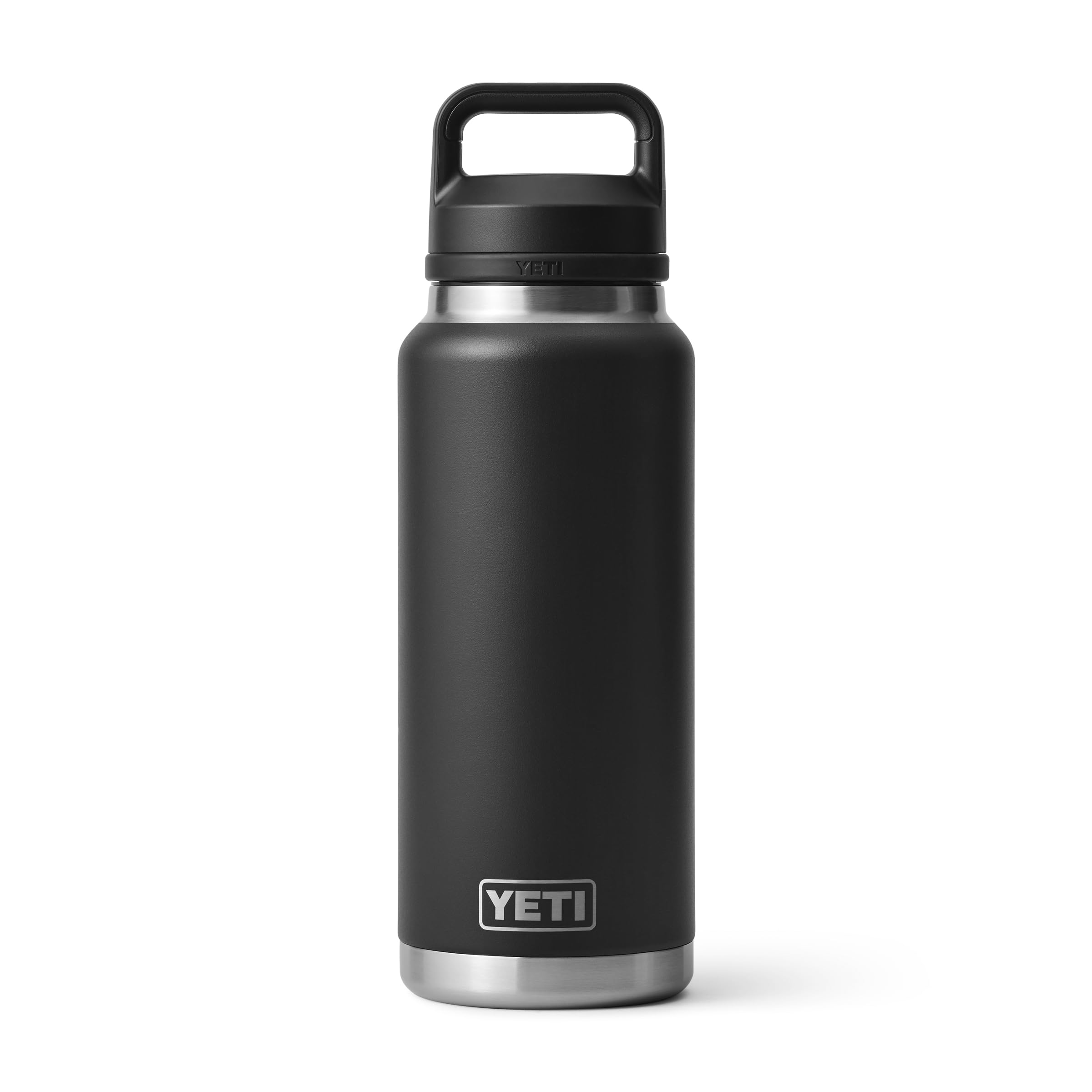
The Rambler 36 is the premium bottle here: 18/8 stainless, a chug cap that opens with a half-twist of the TripleHaul handle, and a 36-ounce body that is dishwasher safe. The 3.8-inch base and 11.6-inch height give it a planted feel, and the leakproof cap is designed to be carried by the handle.

We like it most for campers who hate hand-washing. The dishwasher-safe body and cap remove the post-trip chore that makes other insulated bottles feel like a commitment. The 36-ounce capacity is enough for a half-day hike or a long drive, and the chug cap delivers a serious mouthful without a straw to clean. It is also the bottle in this set that feels most at home on a tailgate or a truck bed.

This is a basecamp bottle rather than a long-approach bottle: it is happiest in a vehicle, a canoe, or a pack that is not going far. The chug cap and dishwasher-safe care make it the easiest premium bottle here to live with.

Pros

  • Dishwasher-safe body and cap
  • Leakproof chug cap
  • 36 oz capacity

Cons

  • Heavy at 700 g empty
  • Paint can scuff with rough use
Our verdict

The YETI Rambler 36 is the premium camping bottle we choose when we want dishwasher-safe cleanup, a secure chug cap, and cold water without babying the bottle.

Check Latest Price
4

Best for Day Hikes

Owala FreeSip 24 oz

93 /100
Traveler Score Outstanding

Key details

Lid
FreeSip straw/chug
Care
Hand wash cup
Weight
13.4 oz
Capacity
24 oz
Check Details on Amazon

The FreeSip spout is the reason to choose this bottle: one opening lets you sip upright through the built-in straw, and the other lets you tilt and swig. The push-button lid locks shut with the carry loop, and the 24-ounce body is narrow enough for a pack pocket and a car cup holder. It is a small bottle by camp standards, but a clever one.

We like it best for day hikes, trailhead coffees, and any trip where you are carrying your own water rather than setting up a basecamp. The 24-hour cold rating is enough for a morning out, and the wide opening takes ice without a funnel. The lock is the detail that sells it: it covers the button and doubles as the carry loop, so a pack strap cannot easily press it.

Twenty-four ounces goes quickly on a hot day, so this is a bottle for a morning hike rather than a full day at camp. For a day hike or a commute, the size is the point: it stays light and fits where bigger bottles will not.

Pros

  • FreeSip straw and swig
  • Push-button lock
  • Fits cup holders
  • 24-hour cold insulation

Cons

  • Not for hot liquids
  • Lid can break on a hard drop
Our verdict

The Owala FreeSip is the day-hike bottle we reach for when we want a straw sip or a full swig without changing lids, and its lock keeps a pack spill out of the equation.

Check Latest Price
5

Best Large Capacity

RAYMYLO 64 oz

93 /100
Traveler Score Outstanding

Key details

Handle
Paracord handle
Capacity
64 oz
Included Lids
Two lids
Cold Retention
Up to 48 hours
Check Details on Amazon

Sixty-four ounces is a different category of bottle: this is the one that fills a camp table, not a backpack pocket. The RAYMYLO backs the capacity with triple-wall insulation rated for up to 48 hours cold and 24 hours hot, plus two lids, a straw, a cleaning brush, and a paracord handle with a carabiner and compass. It is a kit as much as a bottle.

The handle is the detail that makes the size workable. The paracord wrap gives you something substantial to grab when you are carrying it from the tap to the table, and the included brush makes cleaning a wide 64-ounce body less of a project. We also like that the two lids let you switch between a straw and a spout without buying extra parts.

We trust it for a group basecamp, a tailgate, or a long day at a job site. It is not the bottle for a solo hiker who has to carry every ounce, but it is the one that keeps a crew supplied without constant refills.

Pros

  • 64 oz group capacity
  • 48-hour cold claim
  • Paracord handle and carabiner

Cons

  • Handle and lid durability are the weak points
Our verdict

The RAYMYLO 64 is the basecamp bottle we bring when the group needs a lot of cold water and one person is carrying it.

Check Latest Price
6

Packable Day Hikes

Iron Flask 24 oz

95 /100
Traveler Score Outstanding

Key details

Lid
Straw lid
Care
Hand wash only
Weight
10.9 oz
Capacity
24 oz
Check Details on Amazon

The 24-ounce Iron Flask takes the same double-wall stainless build as the larger version and shrinks it to a bottle that disappears into a day pack. The 1.9-inch width and 10.1-inch height make it easy to slide into a side pocket, and the straw lid is set up for drinking while you walk. It also fits a car cup holder, which is more than the 40-ounce version can say.

The capacity is the trade. Twenty-four ounces is a morning hike or a short outing, not a full day at camp; for that, the 40-ounce version is the better choice. The narrow body also means you will refill more often, but it is the bottle that actually fits in a pack pocket.

We like it as a second bottle, a summit pack bottle, or the one that lives in the car between trips. It is easy to carry, easy to drink from, and small enough that we do not think twice about bringing it.

Pros

  • 24 oz packable size
  • Double-wall insulation
  • Straw lid

Cons

  • Hand wash only
  • Lid can break if dropped
Our verdict

The 24-ounce Iron Flask is the packable insulated bottle we take on day hikes, with a straw lid and a narrow body that fits a cup holder.

Check Latest Price
7

Budget Day Trips

CamelBak Chute Mag 25 oz

95 /100
Traveler Score Outstanding

Key details

Weight
5.96 oz
Capacity
25 oz
Cleaning
Dishwasher safe
Material
Tritan plastic
Check Details on Amazon

The magnetic cap is the small pleasure here: it flips open and holds itself to the side while you drink, so you are not chasing a lid or holding it with your teeth. The 25-ounce Tritan body weighs 169 grams, has an integrated carry handle, and is dishwasher safe. For a lightweight camp bottle, that is a useful combination.

The wide opening takes ice and a brush, and the plastic is odor- and stain-resistant, so it does not pick up yesterday's drink. It is a simple bottle to live with: no straw, no hinge, no parts to lose.

The cap needs to be screwed down fully. The magnetic hold is convenient, but the seal depends on the threads being engaged, and a half-turn is not enough. We treat it like a screw-top lid: check it before the bottle goes into a pack.

For short trips and day hikes, the Chute Mag is the bottle we grab when we want something light and uncomplicated. It is not the one we build a camp kit around, but it is the one we do not mind lending.

Pros

  • Magnetic cap stays aside
  • Light 169 g body
  • Dishwasher safe

Cons

  • No insulation
Our verdict

The CamelBak Chute Mag 25 is the light, budget-friendly bottle we grab for short trips, with a magnetic cap that stays out of the way while you drink.

Check Latest Price
8

Camp Coffee

Stanley Heritage 1.1 qt

95 /100
Traveler Score Outstanding

Key details

Lid
Pour-through stopper
Weight
16 oz
Capacity
1.1 qt
Retention
24 hours hot/cold
Check Details on Amazon

The Stanley Heritage is a pour-and-serve bottle, not a trail bottle. The 1.1-quart capacity holds enough coffee for a group, the vacuum insulation is rated for 24 hours hot or cold, and the lid doubles as a cup. The collapsible handle makes a full bottle easier to move from the truck to the table.

We like it for the part of camping that happens around the stove: coffee before a hike, soup at lunch, or a hot drink passed around after dinner. The twist-and-pour stopper lets you fill a cup without taking the whole lid off, and the wide mouth makes it possible to clean after something thicker than water.

It is not a direct-drink bottle: you need a cup, and that makes it a camp-kitchen tool rather than a personal water bottle. For a hike, we leave it behind and take one of the smaller bottles.

Where it earns its place is the cold morning when a group wants coffee without brewing twice. The Stanley is heavy, old-fashioned, and a little fussy, but it does that job with a kind of certainty that a straw bottle cannot match.

Pros

  • 1.1-quart group capacity
  • 24-hour hot or cold retention
  • Pour-through stopper and cup lid

Cons

  • Tall body is awkward in a pack
  • Hand wash only
Our verdict

The Stanley Heritage 1.1-quart is the camp-kitchen thermos we bring for coffee, soup, and group drinks, not the bottle we carry on a hike.

Check Latest Price

How We Picked and Tested Camping Water Bottles

We started by pulling together the bottles that show up repeatedly in camping forums and outdoor retailer best-seller lists, then narrowed the field by capacity, empty and full weight, insulation type, lid style, and price. That left 14 bottles, which we used for six months across weekend car-camping trips, day hikes, and the ordinary weekdays in between.

Each bottle got filled at the kitchen tap on a Friday afternoon and ridden around in a duffel or a pack pocket for the drive out. We checked ice at the six-, twelve-, and twenty-four-hour marks, and noted whether a bottle sweated onto the seat or stayed dry. To test leak-proofing, we filled each one, screwed the lid on as we normally would, and laid it on its side on a towel in a packed bag for a two-hour drive. Back at camp we washed them in cold water with cold hands, opened and closed every lid while wearing a glove, and dropped each one onto granite from waist height to see what chipped, dented, or cracked.

Size and build got the same treatment: we noted whether a bottle slid into a standard pack pocket, fit a car cupholder, or had to be strapped on top, and we weighed each one empty and full, since a pound of steel feels very different at mile six. Appearance was judged after a week of real use rather than out of the box — we looked at which finishes scuffed, which colors showed dirt, and which still looked worth carrying. Temperature retention got the toughest run of all: bottles left in a hot car through an afternoon, and bottles filled with hot tea on a night that dropped below freezing.

How to Choose Camping Water Bottles

Match Capacity to the Trip

Capacity is a comfort decision first. A 24- to 32-ounce bottle is the sweet spot for day hikes and short outings because it stays light in a pack; a 40-ounce bottle like the Iron Flask 40 oz covers a full camp day for most people, while a 64-ounce bottle like the RAYMYLO is a group or basecamp tool. Remember that capacity becomes weight: a full 64-ounce bottle is not something you want on a long climb. Choose the size you will carry, not the size that looks most generous.

Decide Whether You Need Insulation

Insulation is where camping bottles split. Vacuum stainless models keep water cold for hours and are the right call in summer, in a hot car, or when you want ice at lunch. They also add weight and often require hand washing. A Tritan bottle such as the Nalgene Wide Mouth is lighter, dishwasher safe, and easier to fill from a pump, but it will not hold a chill. If cold water is a priority, pay the weight; if you refill often and count ounces, go plastic.

Look at the Lid Before the Bottle

The lid decides how you drink and how safe the bottle is in a pack. Straw lids are easy on the move but have more parts to clean; chug caps deliver a fast mouthful; wide mouths are best for filling, ice, and cleaning but can spill if you drink while walking; pour stoppers are for camp coffee, not trail use. Check that the lid threads engage smoothly and that the seal sits flat. A bottle with a fussy lid becomes the one you leave at home.

Plan for Cleaning and Carry

Camp bottles get dirty, so cleaning should be easy. Wide mouths take a bottle brush and ice; straw lids need a small brush; dishwasher-safe models like the YETI Rambler and CamelBak Chute Mag save time after a trip. Carry options matter too: a carabiner loop, paracord handle, or molded grip makes a full bottle easier to move. If the bottle will live in a pack, keep the empty weight low; if it stays in the truck, a handle is worth more than a few grams.

Frequently Asked Questions

Final Verdict

The Iron Flask 40 oz is the default we recommend: it holds a full camp day, insulates, and clips to a pack. If you count ounces, the Nalgene Wide Mouth is the lighter, tougher carry; if you want dishwasher-safe convenience, the YETI Rambler 36 earns its premium. Choose the Stanley Heritage only for camp coffee and group drinks, not as your trail bottle.