Best Camping Coffee Makers of 2026

The first cup at camp is supposed to be the reward for getting out there. Too often it's a gritty, lukewarm affair that takes two hands, a level patch of ground, and more cleanup than dinner did. A good camping coffee maker fixes that: it turns a bag of grounds and hot water into something you actually want to drink, without turning your morning into a chore. I've made plenty of bad camp coffee over the years, so I know the difference between a gadget that looks clever in a catalog and one that earns its space in the pack.

Over eight months, I brewed with a dozen camping coffee makers — percolators, pour-over cones, presses, and collapsible designs — on car-camping weekends and backcountry mornings. The best were easy to use before I'd had coffee, turned out a consistently good cup, came apart for cleaning without a sink, held heat through a second cup, and survived crammed into a tote. Appearance mattered less than I expected; durability and rust resistance did not. The picks below are the ones I'd pack again.

1

Best Overall

AeroPress Go

95 /100
Traveler Score Outstanding

Key details

Weight
11.2 oz
Capacity
8 oz
Dimensions
4.2 x 4.2 x 7.3 in
Brew Method
Pressure brew, paper filter
Check Details on Amazon

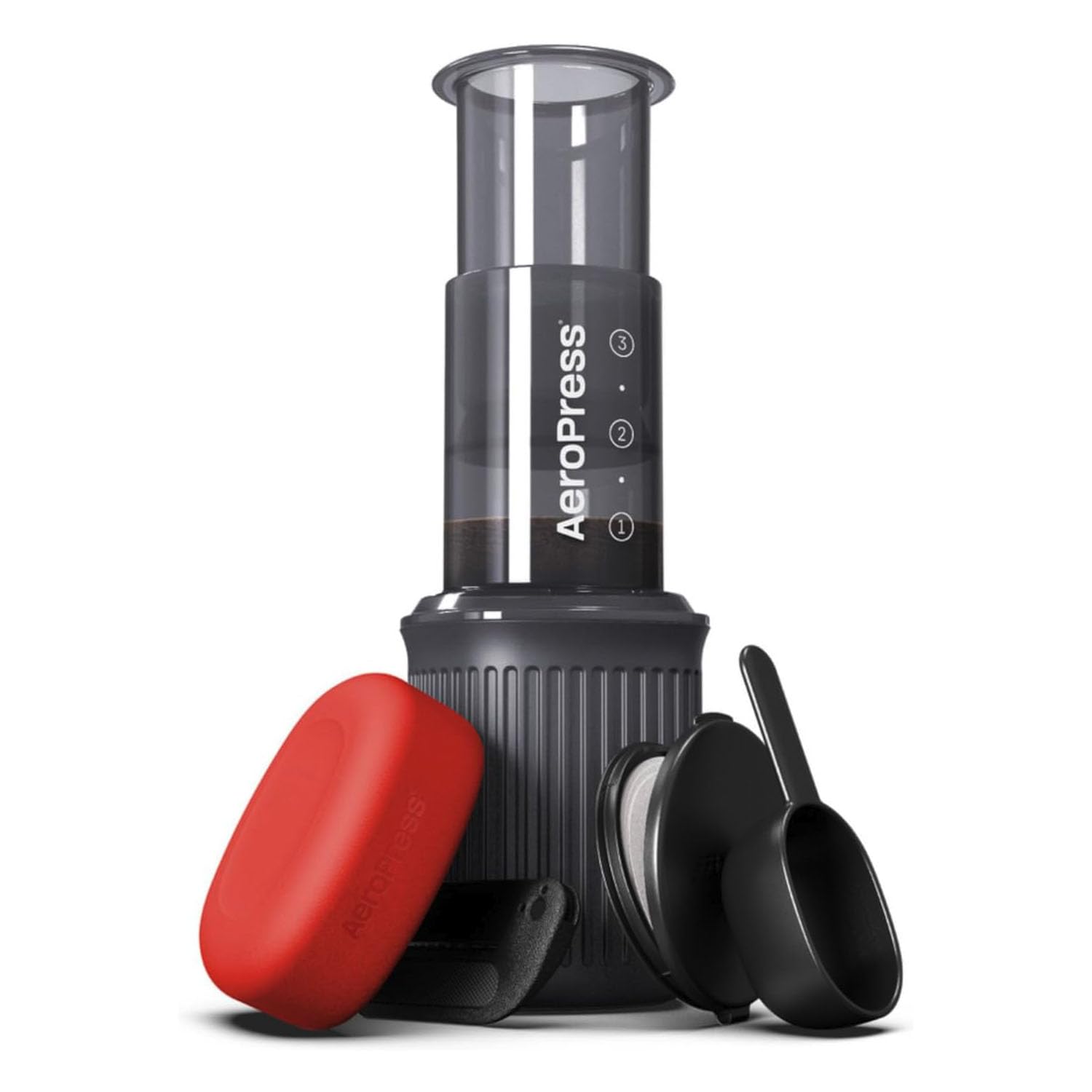
Everything the AeroPress Go needs travels inside its own mug: the chamber, the plunger, the filter holder and a stash of paper micro-filters nest into the cup, which then doubles as the case. That single-piece shape is the reason it's the one we reach for first. At 318 grams, or about 11 ounces, and roughly the size of a large travel mug, it goes into a tote without a hunt for missing parts at the campsite.

The brew is a paper micro-filter plus air pressure: coffee and water in, a short stir and steep, then a slow press. From kettle to full mug is under two minutes. What sets it apart at a campsite is the finish — the grounds come out as a puck, the filter cap wipes clean, and a splash from the water bottle is the whole wash-up. No sink, no strainer, no grounds in the dishwater.

Two details are worth knowing before you pack it. The mug is microwave-safe, which matters if your version of camping involves a trailer or a cabin. And the filter holder doesn't click shut, so the filters ride better in a zip bag than in the holder.

Where it stops is a crowd. Two people brewing back to back takes about four minutes, which is fine; four people is where a steel press or the percolator makes more sense. For solo trips and couples, nothing else here packs this small or cleans up this fast.

Pros

  • Brewer, mug and filters nest into one unit
  • Under two minutes from water to cup
  • Grounds lift out as a puck; a rinse finishes it
  • 318 grams, about the size of a travel mug

Cons

  • Brews one 8-ounce cup at a time
  • Paper micro-filters are a consumable
Our verdict

Start with this one: the AeroPress Go brews a clean 8-ounce cup in under two minutes, packs into its own mug, and rinses clean with a splash of water.
Check Latest Price
2

Best French Press

Secura Stainless French Press

95 /100
Traveler Score Outstanding

Key details

Weight
2.4 lb
Capacity
34 oz (1 liter)
Material
304 stainless steel
Brew Method
French press
Check Details on Amazon

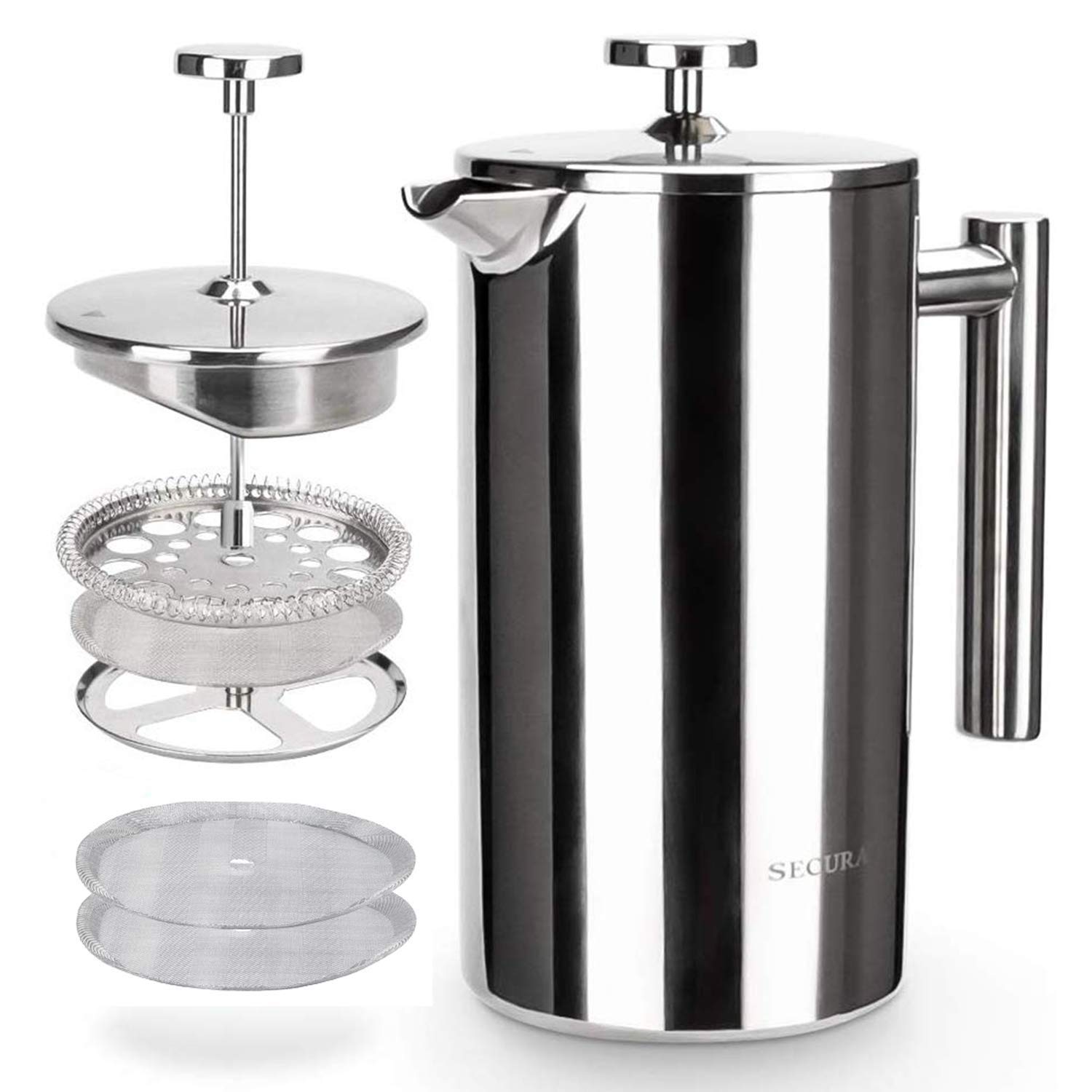
Brewing for four is the one thing the AeroPress Go can't do in a single go, and the Secura is the answer we keep coming back to: a liter of 304 stainless French press with a cool-touch handle and knob, a three-layer filter stack, and spare screens in the box.

What we appreciate at a campsite is that there's nothing to break. The body is steel inside and out, it survives being wedged between a stove and a sleeping bag, and it holds heat long enough that the second mug is still warm — noticeably longer than a glass carafe.

The routine is a coarse grind, hot water, four minutes and a slow press, then a rinse and a wipe at camp, and every part is dishwasher safe once you're home. Three or four people at a picnic table is exactly the morning this press is built for.

Pros

  • Steel body survives being packed and dropped
  • Keeps the second mug warm
  • Brews a liter, or three to four mugs
  • Filter stack comes apart and is dishwasher safe

Cons

  • Needs a separate kettle or pot of hot water
  • Opaque body hides the brew level
Our verdict

Three or four mugs at a time, nothing to break and a second cup that stays warm: this is the steel French press we hand to anyone camping with other people.

Check Latest Price
3

Best for Ultralight Trips

AeroPress Original

93 /100
Traveler Score Outstanding

Key details

Weight
6.4 oz
Capacity
10 oz
Brew Method
Pressure brew, paper filter
Included Filters
50 paper micro-filters
Check Details on Amazon

Six point four ounces is the number that matters here. The Original is the bare brewer — no mug, no case — and at that weight it makes a 10-ounce cup, two ounces more than the Go manages. It's the one we carry when the pack is already heavy and the coffee still has to be good.

It brews the same way the Go does: paper micro-filter, a short steep, a slow press, about two minutes end to end, with more control over grind and water temperature than a French press gives you. Fifty filters come in the box, and cleanup is a puck and a rinse. There's no glass anywhere in it.

What you supply is the cup. A 10-ounce brew wants a mug of its own, plus something to keep the plunger and filter stack together in transit; a stuff sack does the job. If a mug is already in your kit, this is the lightest route to a decent cup outdoors.

Pros

  • 6.4 ounces without a mug or case
  • Brews 10 ounces, more than the Go
  • Fifty paper micro-filters included
  • No glass to break anywhere in the kit

Cons

  • Plunger seal wears over time
Our verdict

We keep the Original for trips where every gram shows on the scale: 6.4 ounces for a 10-ounce cup, as long as you bring your own mug.

Check Latest Price
4

Best for a Crowd

Farberware 12-Cup Percolator

91 /100
Traveler Score Outstanding

Key details

Filter
Permanent metal basket
Capacity
12 cups
Material
Stainless steel
Brew Method
Stovetop percolator
Check Details on Amazon

A percolator makes you watch it. Fill the basket with coarse grounds, set the pot on the camp stove, wait for the glass knob on the lid to show the first dark bubbles, then turn the flame down and let it perk for about ten minutes. It's a ritual, and on a cold morning at a campsite it's a good one.

Twelve cups here is measured in percolator cups of around five ounces rather than mugs, so the pot fills six or eight people — enough for a group without a second round. There's no paper filter; the permanent basket does the work. The coffee keeps getting stronger the longer it perks, so pull it off when it tastes right, and expect sediment in the last half cup, which is normal for the method.

For a crowd it's the simplest thing in this article: one pot, one burner, no filters to count and nothing to press. The stainless body is fully immersible and dishwasher safe at home, and the pot is bulky enough that it lives in the car rather than a pack.

Pros

  • Twelve cups with no paper filters
  • Permanent basket rinses clean
  • Dishwasher safe and fully immersible
  • Brews on a camp stove's burner

Cons

  • Glass knob on the lid is the fragile part
Our verdict

Fill it, set it on the burner and watch the knob: for a big group we haven't found a simpler way to make twelve cups with no filters.

Check Latest Price
5

Large Groups

Belwares 50 oz French Press

93 /100
Traveler Score Outstanding

Key details

Weight
2 lb
Capacity
50 oz (1.5 liters)
Material
Double-wall 304 stainless
Brew Method
French press
Check Details on Amazon

Six people who all want coffee at the same moment is a different problem from one person who wants a good cup, and the Belwares is built for it: 50 ounces, or 1.5 liters, which works out to twelve cups at four ounces each.

We liked how little the size costs you in heat. The wall is double-layer 304 stainless, the four-stage filter stack arrives with two spare screens, and the twist lid and drip-free spout let you pour one-handed with a mug in the other. Fifty ounces is a lot of coffee to keep warm, and this pot manages it to the last mug.

The plunger unscrews into its parts and rinses in seconds, which matters when there's a queue at the water jug. It's also the one here that suits a genuinely large camp: two people will find it more pot than they need, while a family or a tailgate will find the capacity is the whole point.

Pros

  • Brews 50 ounces in one press
  • Double wall holds heat to the last mug
  • Four-stage filter plus two spare screens
  • Plunger comes apart for a quick rinse

Cons

  • Heavy to lift and pour when full
  • Matte black finish can chip and peel
Our verdict

Our pick for a full camp: 50 ounces in one press, still warm at the end of the pot, with a finish worth hand-washing.

Check Latest Price
6

Espresso at Camp

Bialetti Venus Moka Pot

89 /100
Traveler Score Excellent

Key details

Capacity
6 espresso cups (7.9 oz)
Material
18/10 stainless steel
Brew Method
Stovetop moka
Hob Compatibility
Gas, electric, induction
Check Details on Amazon

Six cups sounds like a crowd until you learn the moka arithmetic: a six-cup Venus makes 7.9 ounces, because those cups are demitasse. What you get is a mug and a half of coffee strong enough to take milk or a splash of hot water, which is exactly what some campers want at seven in the morning.

The method is simple. Water in the base to just under the valve, medium-fine grounds level in the basket without tamping, screw the halves together and set it on the burner. When it starts to gurgle and the top chamber fills, it's done, about five minutes. The 18/10 stainless works on gas, electric and induction, so the same pot goes from the camp stove to the kitchen without a second purchase.

Care at a campsite is easier than at home: rinse every part in water, dry it, and skip detergent and the dishwasher entirely, which is the manufacturer's instruction rather than a preference. That suits a picnic table with a water jug.

What the Venus gives you is a short, strong cup with nothing to filter and nothing to plug in — the espresso drinker's answer to a camp stove. Grind a touch finer than you would for a press, fill the basket level, and let the pot do the rest.

Pros

  • Works on gas, electric and induction
  • 18/10 stainless instead of aluminum
  • About five minutes from cold water to coffee
  • Rinses with water only, no filters

Cons

  • Interior corrosion can develop near the base
  • Costs the most of the stovetop pots here
Our verdict

For strong, small cups we point espresso drinkers to the Venus: eight ounces on any hob in about five minutes, with nothing to filter.

Check Latest Price
7

Budget Camp Kit

Utopia Stainless French Press

93 /100
Traveler Score Outstanding

Key details

Weight
2 lb
Capacity
34 oz (946 ml)
Material
Double-wall 304 stainless
Brew Method
French press
Check Details on Amazon

This is the least expensive stainless press in this group, and nothing about it reads as the cheap one. The 304 steel body is double-walled, the filter is a four-layer stack, and it holds 34 ounces — the same liter-ish batch the pricier presses here pour.

What that double wall buys you at camp is a pot that stays warm through a second mug while the outside stays cool enough to grab. The four-layer filter keeps most of the fines out of the cup; a coarse grind and a slow press do the rest. It weighs about 2 pounds, which is fine in a tote and noticeable in a backpack.

We've come to think of it as the sensible first press: nothing on it needs babying, the parts come apart for a rinse, and it undercuts the other steel presses without feeling like a compromise. It's a car-camp tool rather than a pack one, and that's the only decision left to make.

Pros

  • Double wall keeps the batch warm
  • Four-layer filter leaves little grit
  • 34-ounce batch at the lowest price here
  • All parts come apart to rinse

Cons

  • Lid has no marked pour spout
Our verdict

We recommend it as the first steel press for a new camp kit: a double-walled 34-ounce batch for less money than the other steel presses here.

Check Latest Price

How We Tested a Dozen Camping Coffee Makers

We started by mapping the category — percolators, pour-over cones, presses, and collapsible brewers — then narrowed the field by packability, material, price, and whether the thing could be cleaned without a sink. That left 12 models, which I used over eight months on weekend car-camping trips, a handful of backcountry mornings, and at home between trips. I brewed the same medium roast in each, drank it black, and noted grit, strength, and bitterness.

At camp, I timed setup and brewing with cold hands, on uneven ground, and in wind, because a maker that needs two hands and a flat table is a hassle before coffee. I filled each with hot water, took the temperature right away, then checked it again after 20 minutes to see how well the second cup held up. I cleaned every model with a small bottle of water and camp soap, counting the parts that needed scrubbing and looking for grounds stuck in corners.

Durability and rust resistance got their own rough treatment: I packed each maker wet in a stuff sack overnight, dropped it from counter height, and checked handles and seals for loosening. I also noted how each looked after a season of use — scratched, stained, or still decent on the table. The models that made the cut did all of this without making me dread the next morning.

How to Choose Camping Coffee Makers

Start with your heat source

Every pick here brews without mains power, but they split in two. French presses and the AeroPress need hot water from a kettle or a pot; percolators and moka pots sit on the burner themselves. On a single-burner backpacking stove, a press or an AeroPress is the practical choice, because you're boiling water anyway. With a two-burner camp stove, a percolator or moka pot can hold one burner and brew while you cook.

One trap worth naming: a French press or an AeroPress never goes on a flame. The plastic and the seals won't take it, and neither will a glass carafe. If your only heat is a fire, choose a metal pot that is designed to sit on it.

Count mugs, not cups

Cup is the least reliable word in coffee gear. A twelve-cup percolator makes roughly sixty ounces, a six-cup moka pot makes 7.9 ounces, and a 34-ounce French press fills three or four mugs. Multiply your campers by the mugs each one drinks, convert that to ounces, and compare that number to the capacity figures.

A solo traveler with one cup a day is well served by an 8-ounce AeroPress. Four people who each want two mugs need a liter or more, which is where the steel presses and the percolator earn their space. Buying for the group you actually camp with saves you either a second round of brewing or a pot you never fill.

Decide between the pack and the trunk

Weight is the dividing line. The AeroPress Original is 6.4 ounces and the Go is 318 grams, while the steel presses run about 2 pounds and the percolator 2.5. Anything that rides on your back wants plastic or thin steel and no glass anywhere in the kit; anything that rides in a car can be heavy and generous.

Watch what compact means on a product page — it usually means the thing fits in a tote, not that it disappears into a pack. Measure the space you actually have, whether that's a stuff sack or the box behind the back seat, before you commit.

Plan the wash-up before you leave

Grounds are the real chore, and each design handles them differently: the AeroPress drops a puck, a percolator lifts out a basket, a French press needs its filter stack taken apart, and a moka pot needs the basket knocked out. Pick the one whose cleanup you can manage with a cup of water and a rag, because that is what a campsite usually offers.

Bring a bag to pack the grounds out rather than scattering them at the site, and keep them away from streams and fire rings. If there's a sink waiting at the end of the trip, dishwasher-safe parts are a bonus worth having.

Frequently Asked Questions

Final Verdict

The AeroPress Go is the camp coffee maker we recommend first. It brews a clean eight-ounce cup in under two minutes, packs into its own mug, and washes up with a splash of water — three things that matter more at a campsite than any feature list.

If you're filling four mugs at once, the Secura's liter of steel is the better tool. For a crowd on one burner, the Farberware percolator still can't be beaten on simplicity.