Best Solar Power Banks for Outdoor Emergencies of 2026

The worst time to learn your power bank is mostly marketing is when your phone is at 2 percent and the trailhead is a mile behind you. I've had a pack quit on a cold night in a tent, so I don't trust a solar panel until it has charged something. We tested 14 models over five months, and the gaps in real capacity, charging speed, and solar performance were wider than the spec sheets let on. A good solar power bank for outdoor emergencies keeps your phone, headlamp, and maybe a small camp light alive when the outlet is nowhere nearby.

Portability is the feature that matters most, because the best power bank is the one you carry; we stuffed each into a jacket pocket and daypack, checking whether the built-in cable felt sturdy and the light was bright enough for a dark tent. Solar charging is slow, so we timed what an hour of direct sun added, and the picks below are the ones that held their charge.

1

Best Overall

BLAVOR PN-W12-Pro 20,000mAh

90 /100
Traveler Score Outstanding

Key details

Output
18W USB-C PD, QC 3.0
Warranty
3 years
Solar Panels
4 foldable, 1.2 A max
Battery Capacity
20,000 mAh
Check Details on Amazon

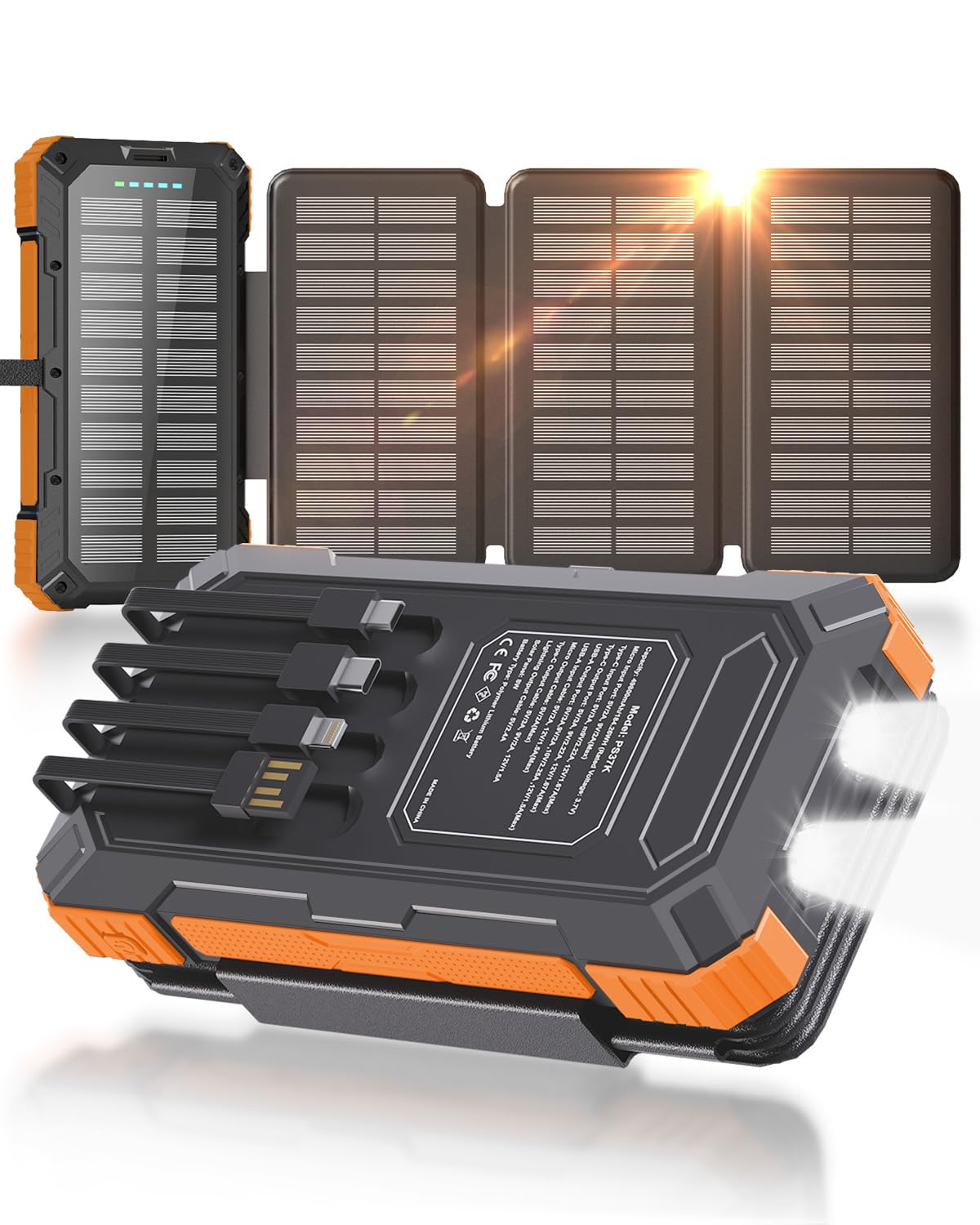
Four hinged panels, rated at 300mA each and 1.2A combined in 25,000-lux sun, are the part of this pack that made us look twice. They fold out so you can aim the array instead of propping a whole brick on a rock, and that aiming is most of the battle: a flat panel molded into the side of a power bank spends the day at the wrong angle and quietly does nothing.

What actually sold us is the battery underneath. The 20,000mAh lithium-polymer cell carries UL2056 certification, which is not a claim every pack here can make, and it comes with three years of warranty coverage, the longest in this group. At about 74 watt-hours it also clears the usual 100Wh airline carry-on ceiling without a conversation at the gate. Charging runs 18W over USB-C PD with a QC3.0 USB-A port alongside it, three outputs in total, enough for a phone and a headlamp at once without either crawling.

The light is the piece we underrated. There is a three-level camping light built into the body plus a separate flashlight with normal, SOS and strobe modes, and the low setting is the one that matters in a tent, because a bright-only light burns through the battery you are trying to conserve. IPX5 sealing, a compass and a carabiner finish a package that reads as outdoor gear rather than a product render.

It is not small. Seven by 3.5 by 1.6 inches is a chunky rectangle in a daypack, and that bulk is what buys the capacity and the panels. We take the trade: a certified 20,000mAh with a real panel array beats a 50,000mAh label on a battery nobody has verified.

Pros

  • Four hinged panels you can aim at the sun
  • UL2056-certified cell with three-year cover
  • Three-level camp light plus an SOS flashlight
  • About 74Wh, under the usual flight limit

Cons

  • Bulky 7-inch body for the capacity
  • Refilling from the wall can take a long time
Our verdict

The pack we point friends toward first: a certified 20,000mAh cell, four panels that fold out toward the sun, and a light bright enough to run a tent.
Check Latest Price
2

Best for Light Packing

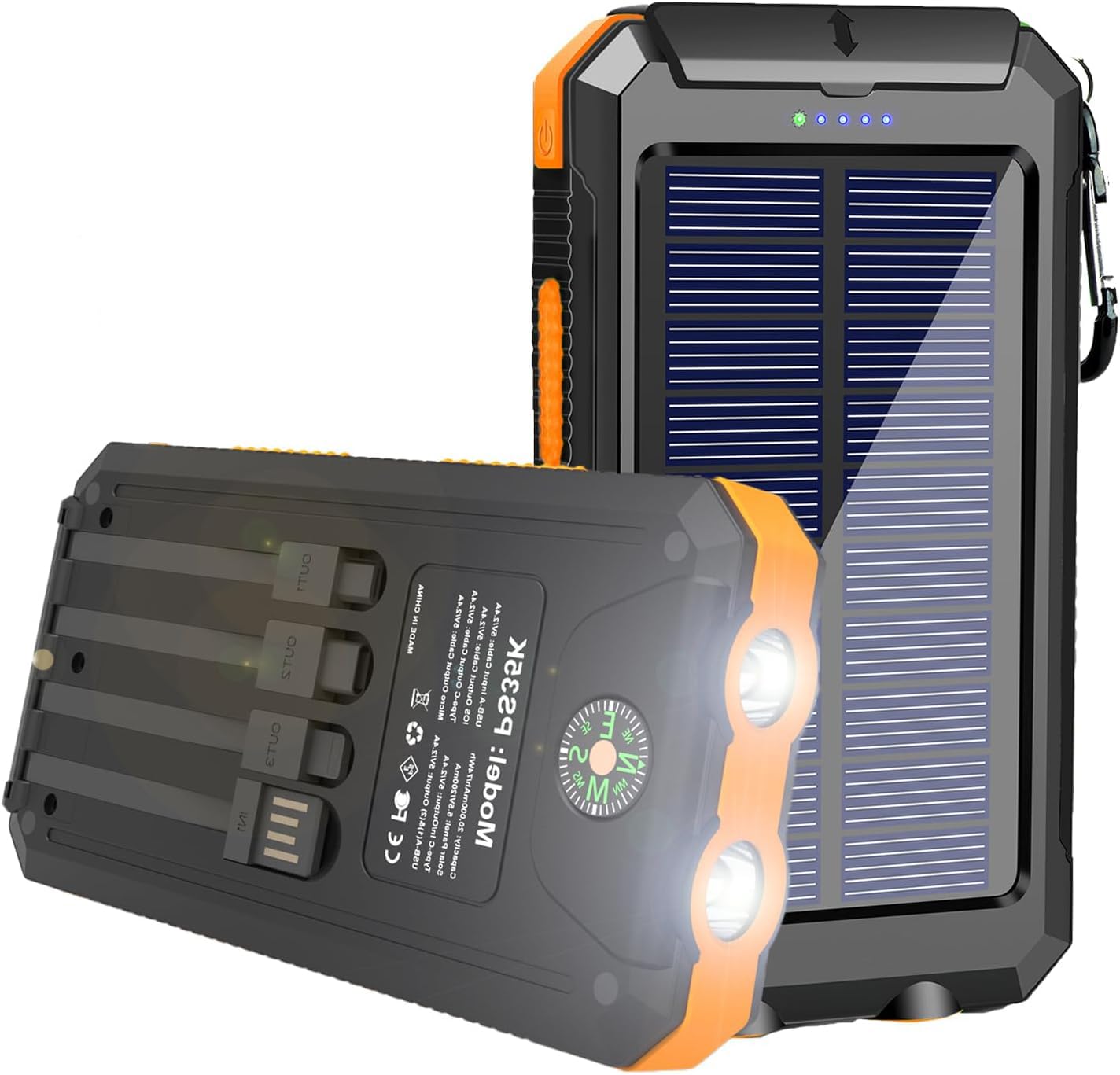
YELOMIN PS35K 20,000mAh

82 /100
Traveler Score Excellent

Key details

Weight
8.82 oz
Built-in Cables
4
Battery Capacity
20,000 mAh
Water Resistance
IP65
Check Details on Amazon

Two hundred and fifty grams, and 0.98 inches thick. That is the whole argument for this one: it slides into a jacket pocket or a glovebox and you stop thinking about it, which is how a backup battery actually earns its keep. The claimed 20,000mAh is enough for a couple of phone charges, a headlamp and an e-reader across a weekend.

For something this small the feature set is oddly complete. Four cables are built into the shell, a USB-C port works in both directions, there is a USB-A output, IP65 sealing, two LEDs with steady, SOS and strobe modes, and a compass. Nothing here needs a separate pouch or a cable that lives in a different bag.

Speed is what you give up. Charging sits near the bottom of this group both into a phone and back out of a wall outlet, and the six-month replacement window is the shortest coverage here by a wide margin. Neither is a surprise at this size, but neither is nothing.

Buy it as the second pack, the one that lives in the car or at the bottom of a daypack and gets checked twice a year. It is not the pack to bring as the only power on a five-day trip, and it does not pretend to be.

Pros

  • Fits a jacket pocket at 250 grams
  • Four built-in cables and a two-way USB-C port
  • IP65 sealing and SOS lighting at the smallest size here
  • One of the least expensive packs in this group

Cons

  • Near the bottom of this set on charging speed
  • Six-month replacement window
Our verdict

At 250 grams and under an inch thick, this is the pack we leave in a daypack and forget about until somebody's phone dies.

Check Latest Price
3

Best for Wireless Charging

A ADDTOP 20,000mAh

86 /100
Traveler Score Excellent

Key details

Solar Panels
4
Built-in Cables
4 plus 3 ports
Battery Capacity
20,000 mAh
Wireless Charging
Built-in pad
Check Details on Amazon

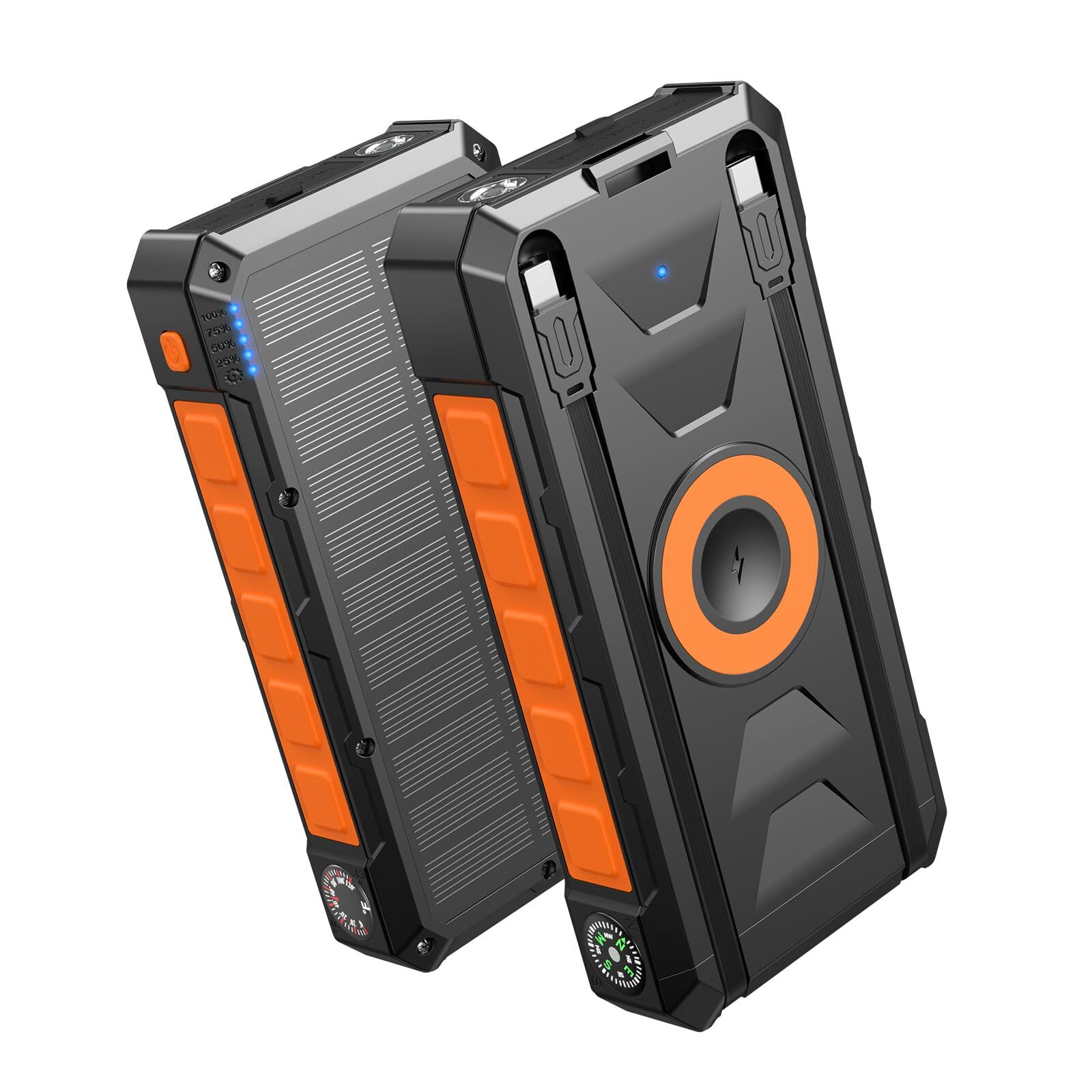
Set a phone down on top of this pack and it starts charging. That sounds like a gimmick until you are in a tent at 2 a.m. with cold hands, one working headlamp and a phone at 4 percent, at which point a pad you can hit blind is the difference between charging and fumbling. Any wireless-charging phone works on it, and the four built-in cables cover everything older.

Four solar panels are set into the shell, the battery is a claimed 20,000mAh, and the whole thing is sealed against water, dust and shock. A year of warranty coverage sits in the middle of the range here and is worth having on gear that lives outdoors. Four built-in cables plus three ports add up to seven devices at once, which is more than anyone needs until three people are queuing for a charge.

Two things we noticed. The panels are fixed flat to the body rather than hinged, so a good angle means propping the entire pack against something, and the BLAVOR's folding array is easier to aim. And this pack shares its model number and its manufacturer with a unit sold as 48,000mAh: same hardware family, same factory, capacity claims 28,000mAh apart. We raise it not to single this pack out but because it is the clearest illustration we found of how elastic these numbers are. Judge this one on the 20,000mAh it claims.

At 6.5 by 3.5 by 1.6 inches it is the same sort of brick as everything else in the mid-capacity range. The wireless pad and the built-in cables are the reasons to choose it; the silhouette is not.

Pros

  • Wireless pad charges any compatible phone
  • Four built-in cables plus three ports
  • Four solar panels sealed into the shell
  • A year of warranty coverage

Cons

  • Panels are fixed flat and awkward to angle
Our verdict

We reach for this one when a cable is not happening: a wireless pad on top, four built-in cables, and enough ports for a family's worth of gear.

Check Latest Price
4

Best Value in a Big Battery

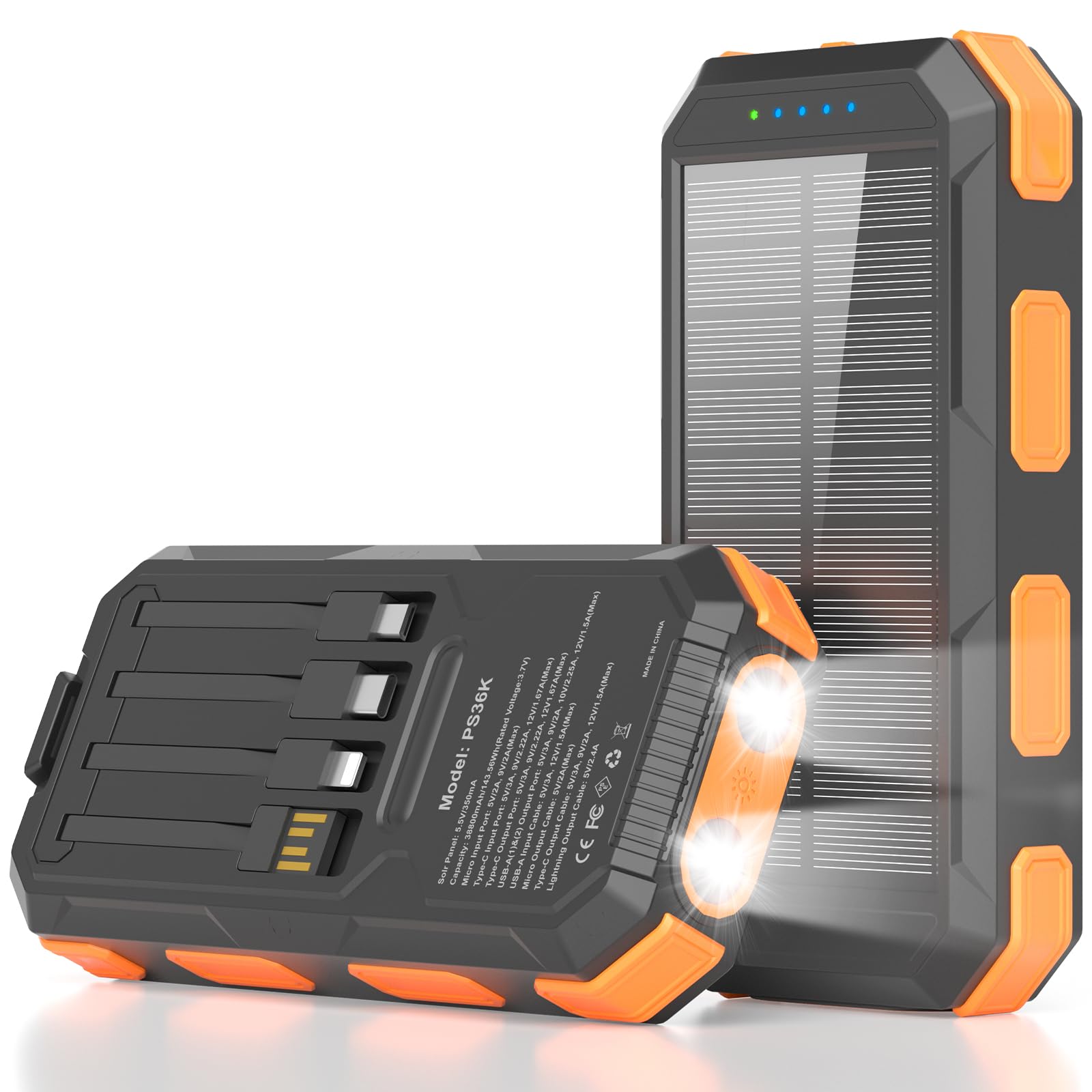
YELOMIN PS36K 38,800mAh

84 /100
Traveler Score Excellent

Key details

Output
22.5W USB-C
Built-in Cables
4
Battery Capacity
38,800 mAh
Water Resistance
IP65
Check Details on Amazon

Twenty-two and a half watts over USB-C is where this one starts, and it is the same fast-charge tier as packs that cost appreciably more in this group. Around it: four built-in cables, a USB-C port that takes a charge as well as gives one, a USB-A output, IP65 sealing and dual LEDs with an SOS mode. At 1.38 inches thick it is also noticeably slimmer than the 50,000mAh bricks here, which is not nothing when it is going in a pack.

The capacity is why it earns its place. 38,800mAh is roughly six phone charges in the best case, which covers a long weekend for two people, and the price lands well below the big-capacity competition. It does not feel like the value pick either: the shell is solid and the cable bays sit flush, the sort of detail that usually gets skipped at this end of the market.

The caveats are about capacity in practice. These packs deliver less than their label once conversion losses are counted, and a full wall charge on this one can stretch out to most of a day. Twelve months of warranty is on the short side for a pack this size, too.

If you are weighing it against the 20,000mAh options, the honest question is how often you are more than three days from an outlet. Twice a year does not justify the weight; most months do.

Pros

  • 22.5W USB-C in the same tier as pricier packs
  • 38,800mAh covers a long weekend for two
  • Four built-in cables and a two-way USB-C port
  • Slimmer than the 50,000mAh packs here

Cons

  • A full wall charge can take most of a day
  • Twelve-month warranty
Our verdict

Our value pick when you want a big reserve: 22.5W charging, four built-in cables and 38,800mAh near the bottom of this group's price range.

Check Latest Price
5

Best Built-In Cable Setup

BLASOUL PD-W49 49,800mAh

83 /100
Traveler Score Excellent

Key details

Output
22.5W PD 3.0 and QC 3.0
Built-in Cables
4, three out and one in
Battery Capacity
49,800 mAh
Wireless Charging
15W
Check Details on Amazon

Three output cables (Lightning, USB-C and Micro) plus a USB-A input cable are part of the shell, alongside three ports and a 15W wireless pad. That sounds like a small thing and is not: the cable is what gets left at home, and the pack with nothing to forget is the one that actually gets used. There is no pouch to hunt through in the dark either.

Underneath sits a claimed 49,800mAh feeding 22.5W over PD 3.0 and QC 3.0, sealed to IP65 and measuring 7 by 3.66 by 1.28 inches. It is a brick, and the capacity is the reason. In a canoe dry bag or a car console that weight is irrelevant; at the bottom of a daypack on a long climb you feel it with every step.

Charge retention is the weak point. Some units lose capacity within a few months rather than over seasons, and the one-year warranty is the only backstop if yours is one of them, so register it the day it arrives. Solar, meanwhile, does what a panel this size can do: it holds the level between wall charges and adds a little on a bright day.

For a storm kit, a basecamp box or a boat bag where the pack mostly stays put, this is a lot of capacity and a complete charging kit in one object. For a pack you carry all day, the 20,000mAh options earn their place.

Pros

  • Three output cables and an input built in
  • Claimed 49,800mAh with 22.5W and 15W wireless
  • Complete charging kit with no loose cables

Cons

  • Heavy enough to notice in a daypack
  • Some units stop holding a full charge within months
Our verdict

We like this one for the cable deck: three outputs and an input built into the shell, so nothing gets left on the kitchen counter.

Check Latest Price
6

Slim Go-Bag

SOARAISE SPB2601 50,000mAh

86 /100
Traveler Score Excellent

Key details

Output
22.5W USB-C, 15W wireless
Weight
16 oz
Dimensions
6 x 3 x 1 in
Battery Capacity
50,000 mAh
Check Details on Amazon

Six by three by one inch, 16 ounces, and a claimed 50,000mAh. That last number is where we did the arithmetic: 50,000mAh works out to roughly 185 watt-hours, and cells holding that much weigh about twice what this pack does. Treat the label as optimistic and the shell as the real feature, because this is a big-capacity pack that fits a jacket pocket and almost none of them do.

The feature list is the longest in this group. 22.5W over USB-C, 15W wireless, two built-in cables (USB-C and Lightning), three ports, six devices at once, a three-mode flashlight, a compass and a thermometer. That thermometer is the small, strange addition we ended up appreciating: it tells you how hot the pack is getting in the sun, and heat is what actually shortens a lithium battery's life.

Solar is the weak spot. The array is a single panel set into the body, and days in full sun can leave the gauge exactly where it started. It will hold a charge across a trip; it will not add one. If the panel is the reason you are buying, this is not the pack.

What it is for: a go-bag or a glovebox, where the slim shape, the light and the wireless pad matter more than a capacity figure. If the number on the box is why you are buying, buy one of the packs whose numbers we could check.

Pros

  • Six-by-three-inch shell for a claimed 50,000mAh
  • 22.5W USB-C plus 15W wireless charging
  • Thermometer, compass and three-mode light

Cons

  • Claimed capacity does not square with its 16-ounce weight
  • Solar panel adds very little
Our verdict

The slimmest way to carry a big claimed capacity: we like the six-by-three shell, the wireless pad and the thermometer, and we take the 50,000mAh with a grain of salt.

Check Latest Price
7

Fold-Out Panels

GULLVEN PS37K 49,800mAh

81 /100
Traveler Score Excellent

Key details

Output
22.5W
Solar Panels
4 foldable, 1,280 mA max
Battery Capacity
49,800 mAh
Water Resistance
IP65
Check Details on Amazon

Four hinged panels rated at 1,280mA combined, a claimed 49,800mAh, 22.5W over USB-C and four built-in cables with three ports. Read against the BLAVOR, this is the same idea with a bigger reserve and a smaller bill, and the folding array is the reason to look at all, since a panel you can aim is worth several you cannot.

The catch is that a panel rating is a maximum, not an average. 1,280mA assumes the array is square to full sun at the stated brightness; angle it away or let a cloud go over and you get a fraction of that. Days of sun on this pack will hold the level and add a little. They will not refill it. That is less a flaw in this pack than the physics of a panel that folds into a pocket.

Everything around the panels is competent: IP65 sealing, a camping light with three modes, a four-level battery indicator, a carabiner and a year of warranty. Where we hesitate is the hardware that never shows up on a spec sheet. Hinge arms and cable bays are where money gets saved on a pack at this price, and they are the parts that decide whether it lasts three seasons or one.

Buy it if the folding array and the bigger reserve are exactly what you are after. Buy the BLAVOR instead if a certified cell and three years of coverage matter more than capacity on paper.

Pros

  • Four hinged panels you can aim at the sun
  • Claimed 49,800mAh with 22.5W and four cables
  • Costs less than our top pick

Cons

  • Panel rating is a maximum, not typical output
  • One-year warranty
Our verdict

We like the arithmetic: four folding panels and roughly double the claimed capacity of our top pick, for less money.

Check Latest Price
8

No-Sun Backup

QiSa S86 Pro 40,000mAh

83 /100
Traveler Score Excellent

Key details

Output
22.5W
Dimensions
6.5 x 3 x 1.5 in
Charging Modes
Solar, hand crank, USB
Battery Capacity
40,000 mAh
Check Details on Amazon

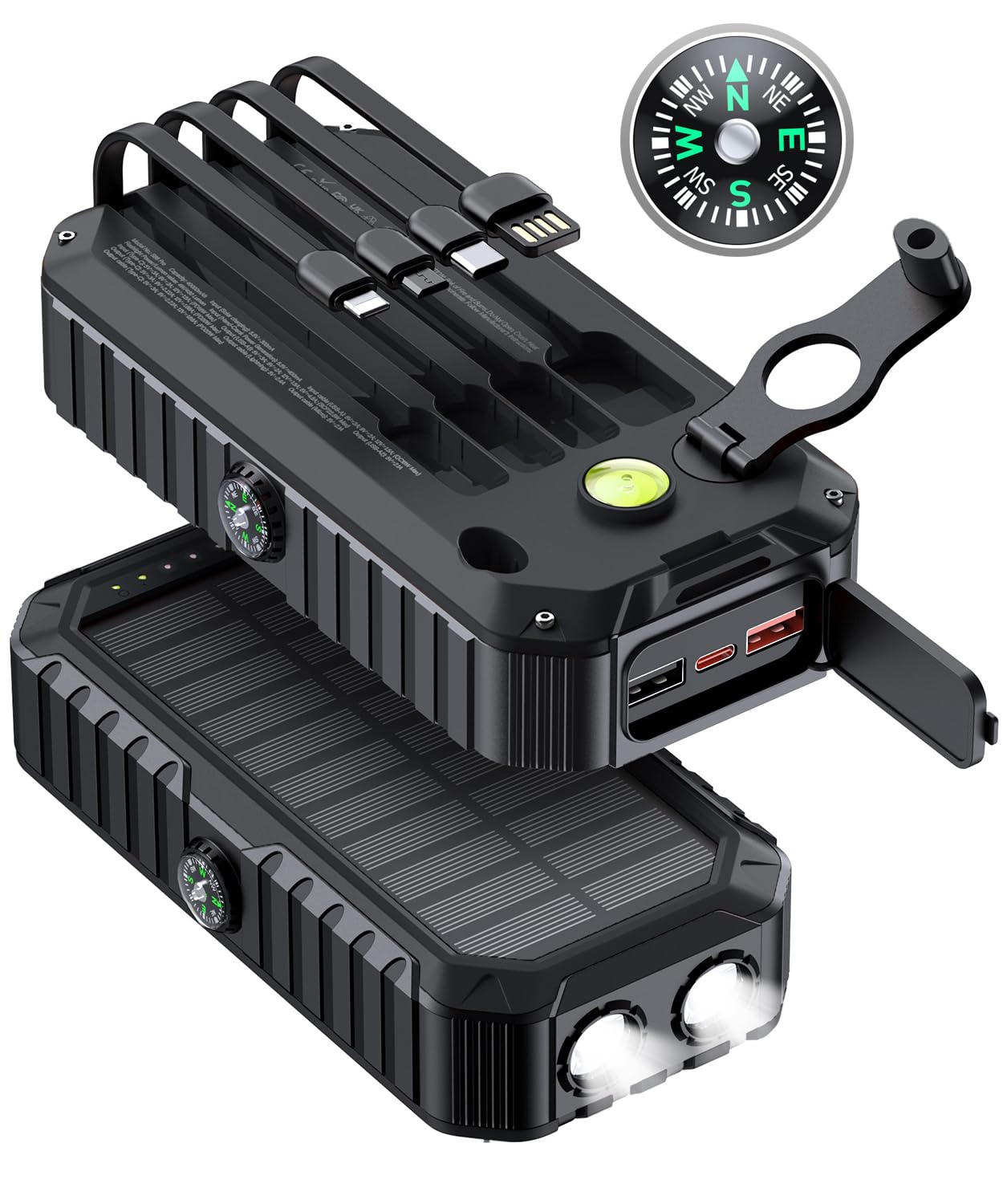
A folding handle on the back turns muscle into current. It is a trickle: enough for a short call or a text message, not for a recharge. But it is the only source of power in this group that needs neither sun nor a wall outlet, and in a genuine outage that is a category of one.

The rest of the kit is conventional and complete. A claimed 40,000mAh, 22.5W fast charging, three built-in output cables (Micro, USB-C and Lightning) plus a USB-A input cable, and a four-mode light with super-bright, soft, SOS and strobe settings. Six and a half by three by one and a half inches, wrapped in ABS with shock, dust and water claims attached.

The small parts are what worry us. A compass and a bubble level stuck to the outside of a pack that rides in a Jeep are the first things to come loose, and the crank arm is a pin-and-slot assembly, the kind of mechanism that works loose rather than wearing out gracefully. Check the crank, the compass and the level when it arrives, and again at the start of each season.

Forty thousand milliamp-hours is a lot of reserve for a pack that will mostly serve as a flashlight and a phone charger. Buy it as the storm-box item with one capability nothing else here has, not as the pack you carry every day.

Pros

  • Hand crank makes power without sun or outlet
  • Claimed 40,000mAh with 22.5W output
  • Four light modes including SOS and strobe

Cons

  • The crank produces a trickle, not a recharge
  • Compass and bubble level can come loose
Our verdict

We keep one of these in the storm box for the crank alone, since it is the only pack here that makes power with no sun and no socket.

Check Latest Price

How We Tested Solar Power Banks for Outdoor Emergencies

We started with more than 30 solar power banks and narrowed the field by claimed capacity, panel size, weight, built-in cable design, light output, and price, then bought 14 to test for five months. The goal was not to crown the biggest battery; it was to find units that could still do useful work after a week in a pack, a storm outage, or a long day hike.

We used them on three camping weekends, during a 48-hour home outage after a storm, on day hikes, and in a car glove box, weighing each one packed and carrying it in a daypack. At each scene, we started with a dead phone and recorded the battery percentage after 30 minutes, then plugged in a headlamp and a small fan to see how the ports handled a second device. We ran the built-in light in a dark tent and during the outage, noting how far it reached and whether it was bright enough to sort gear. For solar, we set each panel in direct midday sun for an hour and measured the added charge, then repeated on a cloudy afternoon.

We drained and recharged every bank, checked whether the built-in cable stayed connected when the phone was moved, and noted whether the case felt solid or flexed under pressure. After five months, we rechecked each unit to see if it still held a charge and whether the solar panel had lost any output. We compared price against usable capacity and features rather than the mAh on the box, because a cheap bank with inflated specs is no bargain in an emergency.

How to Choose Solar Power Banks for Outdoor Emergencies

What the Panel Can Actually Do

Fold-out arrays on the packs here are rated at roughly 1 to 1.2 amps in full sun, which is a trickle next to a wall charger. That is physics rather than a fault. In practice, solar is for the second week of a trip, not the first morning: it holds a pack's level and adds a little on a bright day, and it will not refill a dead pack before dinner.

So charge from the wall before you leave, then pick panels that fold out and can be aimed. A flat panel molded into the side of a brick spends most of the day at the wrong angle; the BLAVOR's four hinged panels are the ones we trust to move the gauge.

Capacity, Weight, and the Number on the Box

The headline milliamp-hour figure is the least reliable number on these packs. One model number and one factory sit behind a pack sold as 20,000mAh and another sold as 48,000mAh, and a claimed 50,000mAh in a 16-ounce shell does not square with what lithium cells weigh.

Work from need instead. 20,000mAh is three or four phone charges in a pack you can carry all day, usually somewhere around 350 to 400 grams. From 38,800mAh upward you are into car, cabin and storm-box territory: more reserve, more weight, and more optimistic labels.

Cables, Ports and What Three Ports Means

Built-in cables are the most useful feature in this category, because the cable is what gets left at home. Count which ones you get: Lightning for older iPhones and base iPads, USB-C for everything current, Micro for headlamps and older accessories.

Then read the ports carefully, because a USB-C port is not always an output. On several packs here it exists to charge the pack rather than your phone. 18W to 22.5W over USB-C is the fast-charge band worth paying for; below that you are filling a phone overnight rather than over lunch.

The Light Is the Feature You Will Actually Use

In an outage the flashlight gets used a hundred times before the charger does. Look for a low or soft setting as well as a bright one, since a single blinding mode burns through the battery you are trying to conserve, plus a separate SOS or strobe mode for signalling.

Two lights beat one: a diffused camping light for a tent or a room and a focused beam for walking out to the car. The BLAVOR's three-level camp light beside its own flashlight is the arrangement that works best of the packs here.

Sealing, Heat and Warranty

An IP rating is worth having and easy to over-read. IP65 means dust-tight and spray-resistant, which is fine for rain and a wet canoe bottom and not fine for a swim. Heat is the bigger threat: a pack left on a dashboard or baking in the sun runs hot, and heat is what actually kills lithium cells, which is why a built-in thermometer is more useful than it sounds.

Finally, look at how long the maker stands behind the pack. Three years is the longest coverage in this group and six months the shortest, and that gap tells you something about how it was built.

Frequently Asked Questions

Final Verdict

The BLAVOR PN-W12-Pro is the pack we recommend, because it is the one whose numbers hold up: a certified 20,000mAh cell, panels that fold out and can be aimed, a light with a usable low setting, and three years of coverage.

If you will be sleeping in a car or a cabin rather than carrying everything, the YELOMIN PS36K gives you roughly twice the reserve for less. If every ounce counts, the YELOMIN PS35K disappears into a jacket pocket.