Best Sleeping Bags of 2026

A sleeping bag is the one piece of gear you can't fake your way through. If it's cold, you'll know by 2 a.m., and the zipper that snagged on every shift won't help. I've had bags where the draft collar gaped at the shoulders and the temperature rating turned out to be fiction. What a good one fixes is simple: it keeps you warm without turning you into a mummy, and it packs small enough that you don't resent carrying it.

We've spent the past eight months sleeping in a dozen bags — in tents, in a van, and on a few floors — and the differences come down to warmth, weight, packed size, comfort, and whether the zipper behaves at 2 a.m. Here's what first-timers rarely hear: the number on the tag is usually a survival limit, not a comfort rating, so look for the comfort number instead. The picks below are the ones we'd happily sleep in again.

1

Best Overall

VENTURE 4TH XXL Sleeping Bag

93 /100
Traveler Score Outstanding

Key details

Weight
4.4 lb
Dimensions
90 x 39 in
Fits Height
Up to 7.5 ft
Temperature Rating
30°F to 70°F
Check Details on Amazon

Thirty-nine inches is the number that decides this one. Nearly every other bag in this guide is 31.5 inches wide, and that extra seven and a half inches is the difference between sleeping on your side and fighting the shell all night. Length runs to 90 inches, the brand rates it from 30°F to 70°F, the shell is a water-resistant polyester, and it weighs 4.4 pounds.

That combination is why we put it first. Three seasons of range, room for a broad frame, and a compression sack that gets it down to something you can throw in a trunk, all for midrange money. Set it against the Coleman Heritage and you give up 20 degrees of cold-weather headroom and get back four and a half pounds. Set it against the MalloMe and you gain a shoulder season at both ends for a few pounds more.

Two things to know before you order. At 4.4 pounds and 90 by 39 inches, this is a car-camping bag or a short walk-in bag, not a backpacking bag, and a wide bag takes a few minutes longer to warm up around you than a snug one. The zipper is the part to check first: run it the full length when the box arrives, because a drag or a separation at the start is easier to deal with then than at 2 a.m.

Pros

  • Room for broad shoulders and side sleepers
  • 30°F to 70°F covers three seasons
  • Lifetime replacement guarantee
  • Compression sack and water-resistant shell

Cons

  • 4.4 lb and a bulky pack, so it is car-first
  • Zipper can drag or separate
Our verdict

Our pick for most campers: the 39-inch width fits people other bags squeeze, and 30°F to 70°F covers three seasons. Buy it unless you need to carry a bag for miles or sleep below freezing.
Check Latest Price
2

Best for Cold-Weather Car Camping

Coleman Heritage Big & Tall 10°F

94 /100
Traveler Score Outstanding

Key details

Fill
5 lb Holofill 808
Weight
8.9 lb
Dimensions
40 x 84 in
Temperature Rating
10°F
Check Details on Amazon

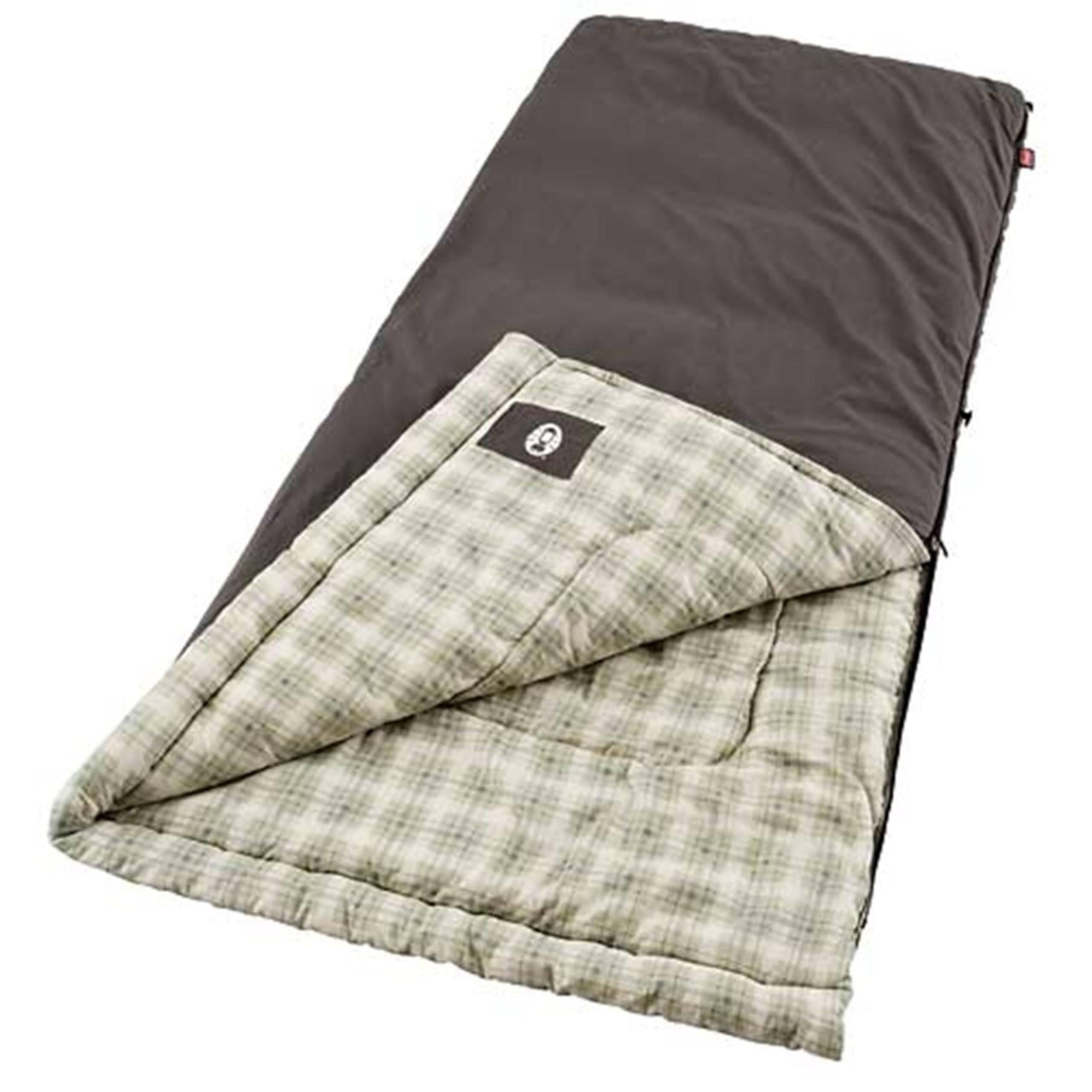
When the forecast reads like a warning, this is the bag we take. Coleman rates it to 10°F and backs that with five pounds of Holofill 808 between a cotton cover and a flannel liner, which is why it feels less like camping gear and more like the bed you left at home. It measures 40 inches wide by 84 long, and the warmth holds up even in the low 30s.

Weight is the price. At 8.9 pounds it is the heaviest bag here by a wide margin, and the Wrap 'N' Roll panel, which folds the bag onto its own base and cinches down, makes packing easier without making the bundle small. Nothing about this bag is designed to be carried further than a few steps from the car.

For drive-in trips in the shoulder seasons, the details hold up to the job. The no-snag zipper does not catch the liner, FiberLock construction keeps the fill from migrating into one end, it is machine washable, and the warranty runs five years. Just do not plan on July with it, because you will end up sleeping on top of it rather than in it.

Pros

  • 10°F rating with 5 lb of Holofill 808
  • Flannel liner and cotton cover feel like bedding
  • No-snag zipper and FiberLock fill
  • Machine washable with a 5-year warranty

Cons

  • 8.9 pounds, so it stays within steps of the car
Our verdict

When the forecast turns nasty and the tent is beside the truck, this is the bag we take: a 10°F rating, a flannel liner, and room for a big frame at the cost of 8.9 pounds.

Check Latest Price
3

Best Budget

MalloMe Sleeping Bag

91 /100
Traveler Score Outstanding

Key details

Shape
Rectangular
Weight
3 lb
Dimensions
86.6 x 31.5 in
Temperature Rating
50°F to 80°F
Check Details on Amazon

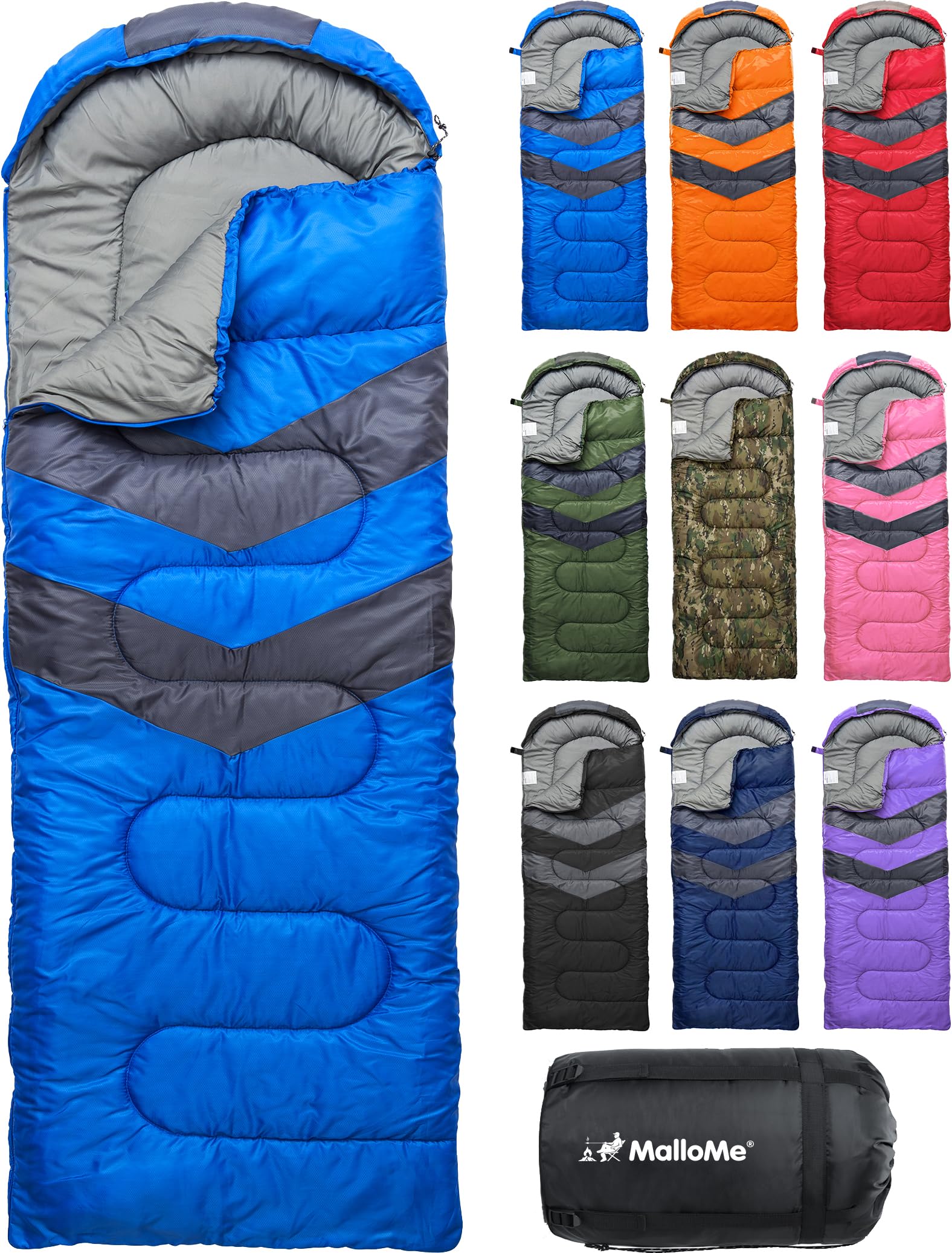
Three pounds, 86.6 inches long, and a stuff sack small enough to live in a duffel: this is the bag we hand to someone who camps a few summer weekends a year and does not want to think hard about it. It is rated 50°F to 80°F, which tells you exactly what it is — a warm-weather bag with a polyester shell and fill.

What you get for the money is more than the price suggests. The 31.5-inch cut is standard rather than stingy, the shell shrugs off tent condensation, and rolling it back into the sack takes a minute rather than a wrestling match. It is also long enough for a six-foot adult, which is not guaranteed at this end of the market.

We keep coming back to this as the sensible first bag: cheap enough to buy two, light enough to carry into a festival, warm enough for June through August. What it will not do is stretch into the shoulder seasons, because 50°F is the floor and a 40-degree night will have you reaching for a jacket. Broad-shouldered sleepers should look at the 39-inch VENTURE instead.

Pros

  • Three pounds and packs up small
  • Long enough for a six-foot adult
  • Cheap enough to buy a spare

Cons

  • 50°F floor limits it to summer
  • 31.5-inch width is snug for broad shoulders
Our verdict

The cheapest sensible bag here: three pounds, long enough for a six-footer, and warm enough for summer. Buy it for July nights and sleepovers, not for a cold snap.

Check Latest Price
4

Best for Big and Tall

HiZYNICE XXL Cold Weather

91 /100
Traveler Score Outstanding

Key details

Lining
100% cotton flannel
Weight
7 lb
Dimensions
90 x 39 in
Temperature Rating
30°F comfort, 15°F limit, 0°F extreme
Check Details on Amazon

Flannel changes the feel of a sleeping bag more than any specification on the label. This one lines 90 by 39 inches with 100% cotton flannel, and the effect is a bed you are happy to sleep in at a cabin rather than a nylon tube you tolerate. It is also the rare listing that separates its numbers: 30°F comfort, 15°F limit, 0°F extreme, with a draft tube along the zipper to keep heat from leaking out.

That width is why we like it for big and tall sleepers. At 39 inches across and 90 long, someone 6-foot-7 can turn over without unzipping, and a right-zip paired with a left-zip joins into one double, which makes it the most practical couples bag here. Seven pounds is the trade: it lives in a car, a cabin, or a canvas tent, never on your back.

Run the zipper the full length and look over the seams the day it arrives, because that is where trouble shows up first, and keep it out of the summer pile — the flannel is genuinely too warm for a July night. Treated as a cold-weather base-camp bag rather than an all-rounder, it earns its place.

Pros

  • Cotton flannel lining is soft and warm
  • 90 x 39 in fits big and tall sleepers
  • Left and right zips pair into a double
  • Publishes comfort, limit, and extreme ratings

Cons

  • Seven pounds, so it is car and cabin only
  • Too warm for summer camping
Our verdict

Our pick for tall, broad sleepers and for couples who want one big bag: a flannel-lined 90-by-39 at a fair price, as long as seven pounds never has to go on your back.

Check Latest Price
5

Best Lightweight Value

Sportneer 3-Season Sleeping Bag

91 /100
Traveler Score Outstanding

Key details

Weight
3.3 lb
Dimensions
87 x 31.5 in
Foot Zipper
Two-way separating
Temperature Rating
32°F to 80°F
Check Details on Amazon

The feature we noticed first sits at the wrong end of the bag: a two-way separating zip across the footbox. On a muggy night you open it and let your feet breathe; on a cold one you close it and cinch the semi-circular hood. That foot zip, plus 3.3 pounds on the scale, is why this is our budget pick for anyone who actually carries their gear.

The listing rates it 32°F to 80°F across 87 by 31.5 inches, built from a 190T polyester taffeta shell, a pongee lining, and polyester fill. Treat the low number as a survival figure rather than a comfort figure, and it makes sense from late spring through early fall. The cut is narrow, so if you are broad across the shoulders, pay more for the VENTURE.

The shell is thin and the one-year warranty is the shortest in this guide. Neither matters much for a bag that lives in a trunk and comes out a dozen nights a year, which is exactly the bag this is. If you want one that survives a decade of weekends, spend more.

Pros

  • Two-way foot zip for warm nights
  • 3.3 lb with a compression sack
  • Drawstring hood seals in heat

Cons

  • Narrow cut suits smaller frames
  • Thin shell and a one-year warranty
Our verdict

The bag we point to when someone wants to carry a bag and spend very little: 3.3 pounds, a two-way foot zip, and a narrow cut that suits smaller frames.

Check Latest Price
6

Kids and Guests

JEAOUIA Lightweight Sleeping Bag

91 /100
Traveler Score Outstanding

Key details

Weight
3.3 lb
Dimensions
86.6 x 31.5 in
Fits Height
Up to 5 ft 11 in
Temperature Rating
50°F to 68°F
Check Details on Amazon

Eighty-six and a half inches long sounds generous until you read the rest of the listing: the brand caps this bag at 5 feet 11 inches. Length is not the limit here, width is. At 31.5 inches across, it is a bag for teenagers, smaller adults, and anyone who sleeps on their back and stays put through the night.

The rest is honest budget work: 3.3 pounds, a drawstring hood that tightens around your head, a zip at the foot for warm nights, and a rating of 50°F to 68°F that puts it firmly in summer. It rolls up small enough to live in a suitcase, which is why it ends up at sleepovers and in guest rooms as often as it does at campsites.

We treat this as the guest-and-kid bag: light, cheap, and no heartbreak if it comes home muddy. The zip is the part to watch, since it can come undone partway along, so run it twice before a trip and keep the receipt. Adults who are broad or tall should spend a little more and take the VENTURE.

Pros

  • 3.3 pounds and packs into luggage
  • Drawstring hood and foot zip
  • Low cost for a spare or guest bag

Cons

  • Rated only to 50°F, so summer use
  • Too narrow for broad adults
Our verdict

A long, light, inexpensive bag for kids, guests, and fair-weather trips. Check the zipper before you rely on it, and do not expect it to fit a broad adult.

Check Latest Price

How We Tested the Best Sleeping Bags

We started with a shortlist of about 30 bags, comparing temperature ratings, fill type, packed weight, and price, then narrowed it to 12 that covered budget, mid-range, and a couple of premium options. Over eight months, we took them on weekend car-camping trips, two backpacking overnights, a handful of nights in a van, and a few floor sleeps at home. Each bag got at least two nights, and we rotated them between testers of different sizes so we could judge fit and comfort honestly.

Warmth was judged on real nights, not in a lab: we noted whether anyone woke up cold at 3 a.m., where the chill hit first (shoulders, feet, or the draft collar), and how the bag performed when the temperature dipped into the high 30s. We weighed each bag on a kitchen scale and stuffed it into its sack, then compared the packed size to a one-liter bottle. Comfort came down to whether we could roll over without wrestling the bag, whether the hood cinched down without smothering us, and whether the lining felt clammy by morning.

For the zippers, we ran each one up and down at least 30 times, including with gloves on, and noted any snags, catches on the lining, or spots where the pull felt flimsy. Durability got checked after two washings — we looked at seam stitching, loft recovery, and abrasion at the footbox. Value was a simple comparison: what the bag delivered against what it cost, especially for occasional campers who don't need a premium bag. Camping suitability meant using each bag with a pad in a tent, checking whether it was too warm for summer or too drafty for shoulder season.

How to Choose Sleeping Bags

Read the Temperature Rating Before Anything Else

A three-number rating is the most useful thing a listing can give you. Comfort is the temperature you'll sleep well at, limit is where a cold sleeper starts shivering, and extreme is survival. HiZYNICE publishes all three, which is why we can say its 30°F comfort figure suits spring and fall camping rather than deep winter.

When a bag lists a single number, treat it as a limit and leave room. Plan for the coldest night you expect, then allow a margin of roughly ten degrees, and remember that a rating measured with a pad and a sheltered tent will not hold on bare ground.

Weight Decides Where the Bag Sleeps

Two bags can share a rating and differ by six pounds. The Coleman Heritage is 8.9 pounds and belongs beside a vehicle; the MalloMe is three pounds and disappears into a duffel. If you walk more than a mile to your site, stay in the three-to-four-pound range and put the savings into a better pad.

Read "compact" carefully. Listings use it for the stuff sack, not for how the bag carries on your back, and a 90-inch rectangular bag compresses into a bundle that fills a pack even when the scale looks reasonable.

Fit Is About Width, Not Just Length

Most bags here are 31.5 inches across and two are 39. The JEAOUIA is 86.6 inches long and still capped at 5 feet 11 inches, because a narrow bag stops you rolling over long before its length runs out. Side sleepers, broad shoulders, and anyone over about 220 pounds should start with the wider bags.

Measure your shoulder circumference and compare it with the listed width instead of guessing from your height. A bag that pinches at the shoulders feels colder than its rating, no matter how good the insulation is.

Zippers and Seams Are Where Budget Bags Fail

Zippers are the weakest part of this category and the failure that ruins a trip. Before you leave, run the zip from foot to hood twice, look at how the stitching attaches it at the bottom stop, and check whether a draft tube or flap sits behind the teeth. A separating zip at the foot is a nice extra; a zip that closes cleanly every time is the thing worth paying for.

Buy from a seller with a return window you can still use after a test night, and keep the packaging until the bag has been slept in once.

Washing, Drying, and Storing

Most synthetic bags here are machine washable: front-loading machine, mild detergent, low tumble or a line. Dry it completely before it goes away, because fill stored damp grows mildew. Store it loose rather than compressed — the stuff sack is for travel, not for the eight months it spends in a closet.

Frequently Asked Questions

Final Verdict

Buy the VENTURE 4TH if you want one bag for spring through fall that fits a body bigger than the 31.5-inch standard. The 39-inch cut and the 30°F-to-70°F range solve the two problems that ruin most nights out, and the lifetime replacement backing makes the midrange price easier to justify.

If your camping means a tent beside the truck in November, the Coleman Heritage at 10°F is worth the extra weight and money. And if you only camp in July, the MalloMe does the job for a fraction of the outlay.