Best Rooftop Tents of 2026

A ground tent is fine until the night it isn't — the rock under your hip, the puddle at the door, the animal nosing around the cooler at 2 a.m. Moving my setup onto the roof of my truck solved all three, and I haven't pitched on the ground since. What a rooftop tent really fixes is the gap between wanting to camp and the hour on your knees in the dark it takes to get there.

The catch is that these are heavy, pricey pieces of gear, and the wrong one will have you dreading the ladder. Weight matters more than the spec sheet lets on — you're hoisting it onto a roof with a second person — and a tent that fights you on the fold stops getting used. My team and I have spent nine months in six different tents, from soft-shell wedges to hard-shell pop-ups, and the good ones share three things: a frame that doesn't shimmy in wind, fabric that survives a summer of sun, and a footprint that sleeps two adults. The six below are the ones I'd mount again.

1

Best Overall

HEYFUN Adventurer Pro

87 /100
Traveler Score Excellent

Key details

Sleeps
3
Weight
160 lb
Open Height
62.99 inches
Closed Dimensions
83.86"L x 51.57"W x 7.00"H
Check Details on Amazon

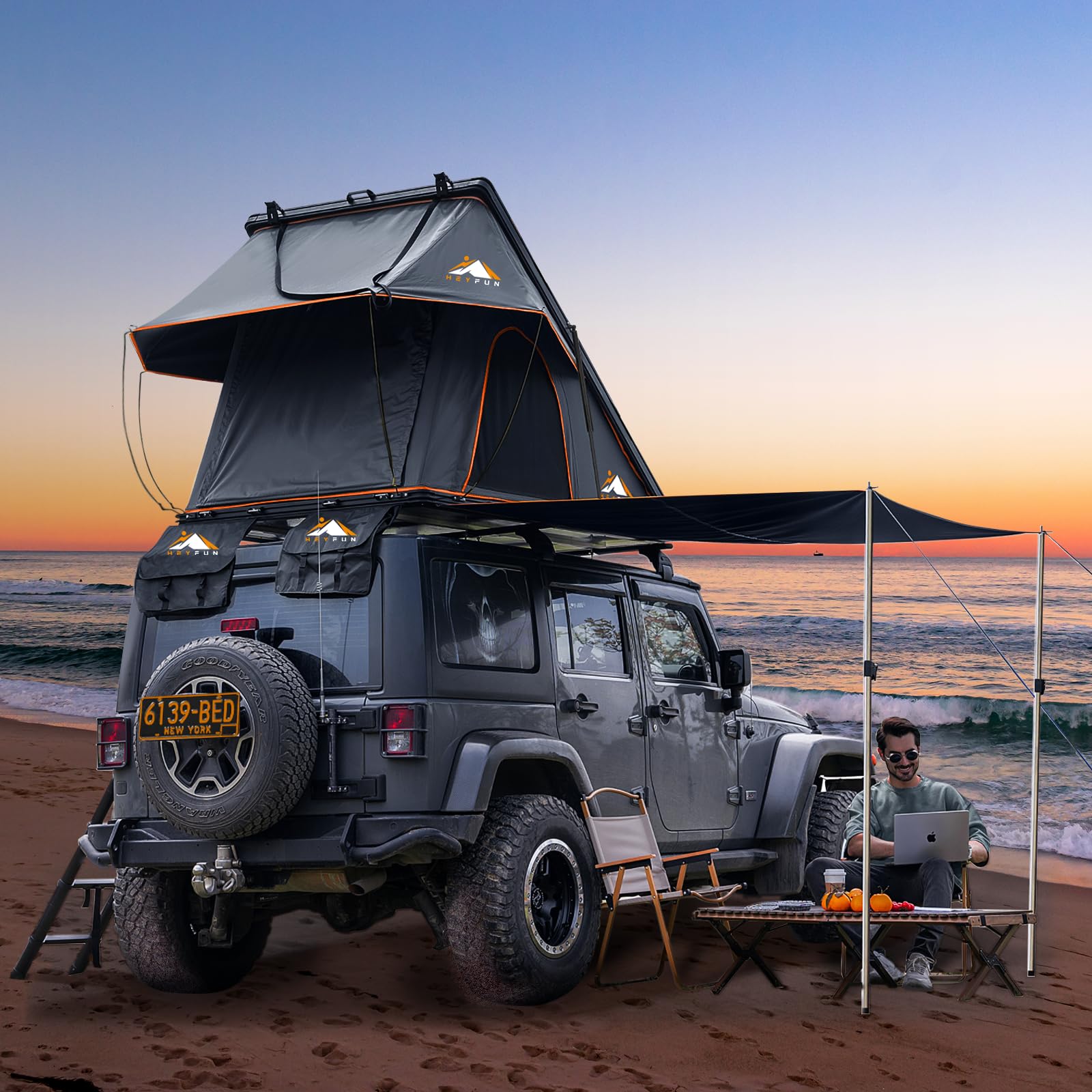
The hydraulic pop-up is the first thing that sold us on the Adventurer Pro: release the latches, push the shell up, and the tent is essentially standing before you have unpacked the ladder. That speed matters at a rainy trailhead or a late arrival, and it is paired with a genuinely useful three-person interior rather than a two-person box stretched by marketing. The closed size is 83.86 by 51.57 by 7 inches, opening to 62.99 inches of headroom, and the floor plan felt roomy enough for two adults plus a child or a dog without turning every movement into a negotiation.

We also appreciated the details that usually get left off a value-priced hard shell: a built-in LED strip, 13 pockets, a side awning, and a condensation mat over the sleeping surface. The mattress is not the place to expect luxury, so budget on a topper for a multi-night trip, but the flocked floor and blackout fabric make the interior feel more finished than the price suggests. At 160 pounds, it is a two-person mounting job, not something to wrestle onto crossbars alone.

Where it gives ground is portability and ultimate weather margin. It is heavier than the slim two-person shells here, and its 5,000 mm waterproofing is a match for the WildFinder rather than a step beyond it. Neither matters much if the tent lives on a truck for the season, which is exactly the buyer we have in mind. For a family or couple who wants one hard shell to do everything, from weekend car camping to overland trips and the occasional rainy night, this is the one we keep coming back to.

Pros

  • Hydraulic shell opens in seconds
  • Three-person interior with 62.99-inch headroom
  • LED strip, side awning, and 13 pockets included
  • Strong value for a complete hard-shell kit

Cons

  • Taller closed profile than the slimmest hard shells
Our verdict

We recommend the Adventurer Pro as the default three-person hard shell because it pops open in seconds, sleeps a small family, and includes lighting and an awning without feeling stripped down.
Check Latest Price
2

Best Lightweight Hard Shell

SanHima Hotham Lite

85 /100
Traveler Score Excellent

Key details

Sleeps
2
Power Ports
USB-C, USB-A, CIG socket
Closed Height
4.57 inches
Waterproofing
5,000 mm
Check Details on Amazon

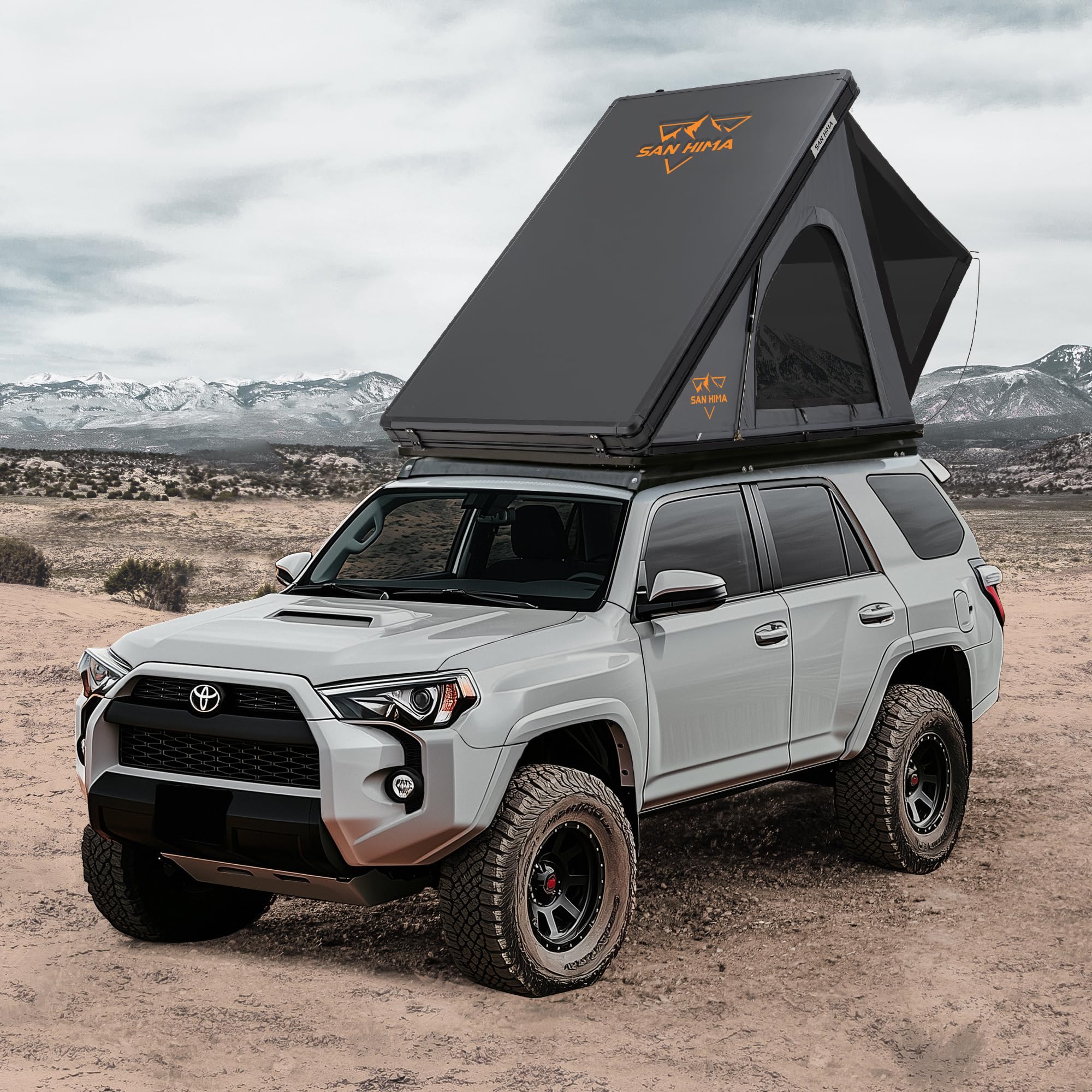
The Hotham Lite's 4.57-inch closed height is the number that changes how this tent lives on a vehicle. It sits low enough that a rooftop tent no longer looks like a hard-shell suitcase bolted to the roof, and the 5,000 mm waterproofing, UV50+ fabric, and USB-C/USB-A/CIG power panel are the kind of specs that make a two-person tourer feel sorted. We also like that the gas struts are internal, where they are less exposed to road spray and trail dust.

For two people who prioritize a low roof profile, this is our pick. The 83.46 by 51.57-inch sleeping area is honest two-person space rather than a hopeful three, and the 4.57-inch shell leaves more room in a garage or parking structure. We did not find it as versatile for a family, but that is not the assignment: it is the hard shell for a couple who wants to keep the vehicle sleek and the setup simple. The 1-year warranty is ordinary, not a reason to choose it.

What keeps it from being the all-rounder is capacity, not build. The sleeping area is a true two-person size, and the ladder and interior are scaled for that use; a third adult or a restless child changes the trip. For couples, that focus is the point: nothing in the tent feels like it was added to chase a higher sleeper count.

Pros

  • Low 4.57-inch closed profile
  • 5,000 mm waterproofing and UV50+ fabric
  • USB-C, USB-A, and CIG power panel
  • Internal gas struts protected from weather

Cons

  • May need vehicle-specific rack adapters
Our verdict

If saving roof height and weight matters more than sleeping three, we think the Hotham Lite is the two-person hard shell to beat here.

Check Latest Price
3

Best Low-Profile Three-Person

WildFinder Hard Shell

84 /100
Traveler Score Excellent

Key details

Sleeps
3
Weight
198 lb
Waterproofing
5,000 mm
Closed Dimensions
83"L x 52"W x 9"H
Check Details on Amazon

The box arrives more like a base-camp starter kit than a bare tent: a 7.5-foot telescoping ladder, ladder organizer, ten organizer bags, LED strip, two shoe organizers, three mesh windows, and a built-in mattress are all included. That bundling is the reason to look at the WildFinder rather than a stripped-down shell, because the small stuff, such as ladder storage, a place for shoes, and a light that stays put, is exactly what turns a rooftop tent from a novelty into a workable camp.

We think it earns its place as the low-profile three-person option: the 83 by 52 by 9-inch shell is sleek on a rack, the 5,000 mm rain rating matches the better hard shells here, and the three-person floor plan is useful for two adults plus gear. The bigger issue is weight: 198 pounds is a two-person lift onto the roof, and it is not the tent to move between vehicles on a whim.

Closing takes attention, too. The shell pulls down easily until the last stretch, then needs a firm, even pull to latch; one person can do it, but it is not the effortless close the hydraulic tents here offer. If you value the included kit and the low profile more than the quickest possible pack-down, this is a sensible choice. If you want the simplest close, the HEYFUN is the easier recommendation.

Pros

  • Complete accessory bundle included
  • Low-profile three-person shell
  • 5,000 mm waterproofing and high UV protection
  • Three mesh windows and built-in lighting

Cons

  • Thin mattress needs a topper
Our verdict

We like this one for campers who want the full accessory kit and a low-profile three-person shell, provided they can handle a heavy lift and a firm final close.

Check Latest Price
4

Best for Off-Grid Power

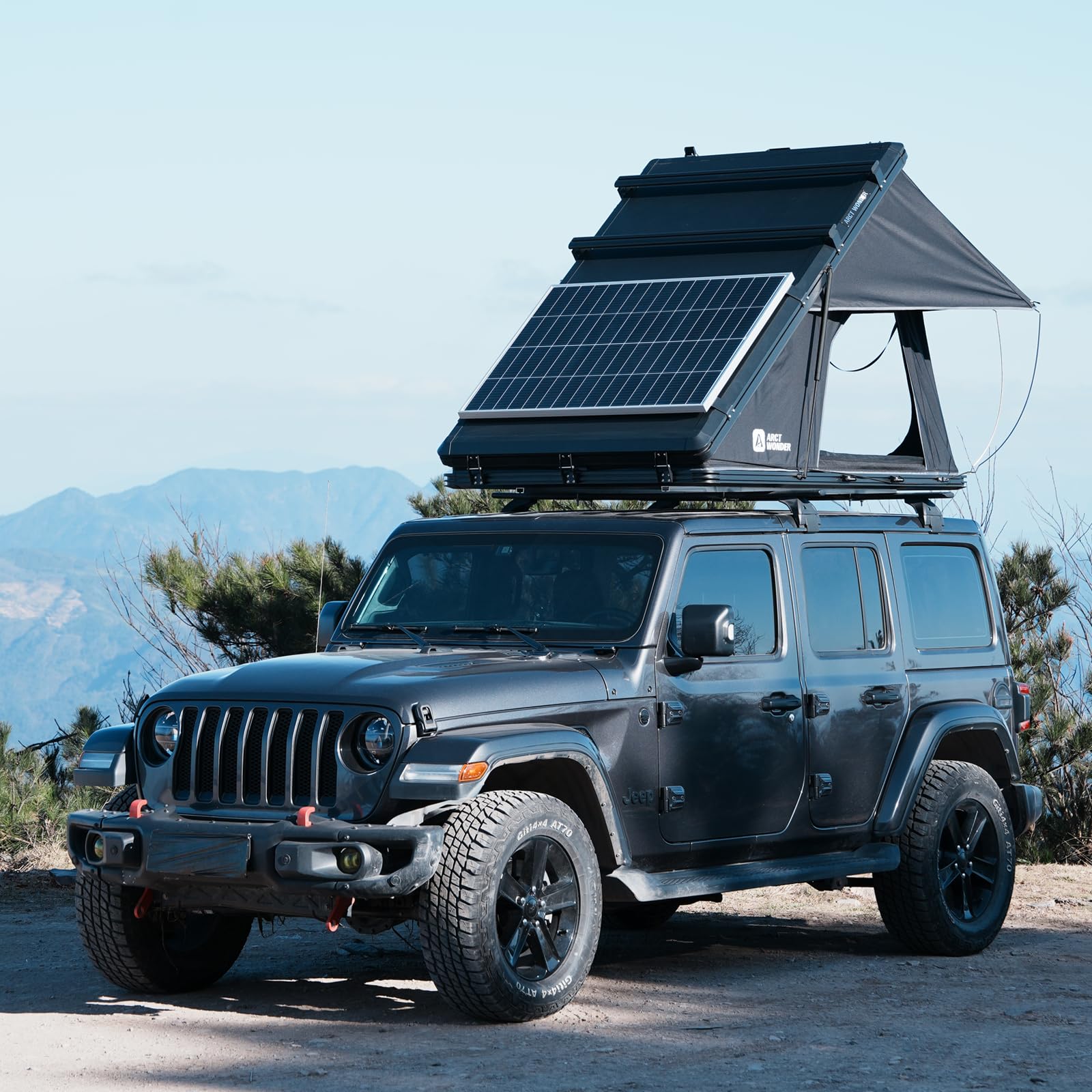
ARCTWONDER Solar Hard Shell

89 /100
Traveler Score Excellent

Key details

Sleeps
2 adults + 1 child/pet
Weight
198 lb
Open Space
85"L x 52"W x 59"H
Solar Panel
12V 216W
Check Details on Amazon

A 216-watt solar panel on a tent roof is either a gimmick or the reason to pick this one, and on a long off-grid trip it is the latter. The panel feeds a 12-volt system and can top up a power bank without a separate suitcase panel taking up room in the vehicle. We like that it is integrated into the roof rather than strapped on as an afterthought, though it does make the tent heavier and more expensive than the simpler hard shells here.

The sleeping arrangement is a useful 85 by 52 by 59 inches, with three windows and awnings, enough for two adults and a child or a pet in the claimed layout. The blackout fabric is a real plus for summer mornings: when we closed up the shell, the interior stayed noticeably dark, and the LED strip makes the ladder easier to find at night. The mattress is thin, so treat the included pad as a base layer.

The trade-off is mass and price. At 198 pounds, this is not a tent you move between vehicles on a whim, and the solar hardware only pays off if you actually camp off-grid for multiple days. If you are mostly a weekend campground camper, the panel is dead weight. If you run a fridge, charge cameras, or work from the road, the ARCTWONDER turns the roof into a small power station, and that is a genuinely different proposition from the other hard shells here.

Pros

  • Integrated 216W solar panel
  • Blackout fabric and LED strip
  • Room for two adults and a child or pet
  • Rapid gas-strut pop-up

Cons

  • No battery included for storing solar charge
Our verdict

For long off-grid trips where a solar panel earns its keep, we think this is the hard shell to choose, as long as you have the roof capacity for its bulk.

Check Latest Price
5

Best Soft-Shell

OVS TMBK Soft Shell

83 /100
Traveler Score Excellent

Key details

Sleeps
3
Weight
108 lb
Mattress Height
2.25 inches
Open Dimensions
56.5" x 94.5" x 51"
Check Details on Amazon

The skylight is the detail we kept coming back to on the TMBK. Unzip the roof panel and you get a direct view of the sky from the sleeping area, which is the sort of thing that sounds like a gimmick until you wake up under it. The rest of the tent is old-school soft-shell: an A-frame that unfolds from the roof, a high-density foam mattress with a cotton cover, and a rainfly over the top. Setup is a matter of unfolding and bracing rather than hydraulics, and it takes a few minutes once you know the routine.

We recommend it to campers who want more room than a compact hard shell and don't mind doing a little pole work. The 56.5 by 94.5-inch open footprint gives two adults generous space and a third person or dog a place to curl up, and the 108-pound package is easier to handle than the big family soft-shell. The mattress is basic but thicker than the pads in some hard shells, and the travel cover attaches with Velcro to the tent body so it doesn't flap at highway speed. That last detail is small, but it is the kind of thing you notice on a windy drive.

The soft shell is the trade: packing it away takes more folding and pole wrangling than a hydraulic hard shell, and the fabric walls need more attention to keep taut in wind. What you get in return is a roomier, more tent-like interior with a skylight that makes the roof feel less like a lid. For a couple who camps a few weekends a season and wants a roomy base camp, the TMBK is the one we point to first.

Pros

  • Skylight over the sleeping area
  • 108-pound soft-shell package
  • Velcro travel cover resists highway flapping
  • Roomy 56.5 by 94.5-inch open footprint

Cons

  • Must be bone-dry before storage to avoid mildew
Our verdict

The TMBK is our soft-shell pick for campers who want more room and a skylight and don't mind a few minutes of pole work.

Check Latest Price
6

Family Trips

Smittybilt Overland Gen2 XL

85 /100
Traveler Score Excellent

Key details

Sleeps
3–4
Weight
170 lb
Bed Size
King, 92.5" x 74.8"
Open Size
122" W x 76" L x 51" H
Check Details on Amazon

The bed is the pitch: 92.5 by 74.8 inches, or a king-size sleeping area, in a rooftop tent that opens to 122 by 76 by 51 inches. That is not a couple's tent with a child squeezed in; it is a family or group tent that happens to live on the roof. The soft-shell A-frame uses a 2.5 cm aluminum/polyurethane sandwich base and a 420D Oxford rainfly, and the whole package is listed at 170 pounds.

Space is the reason to accept the weight and the packing. Four adults can sleep here in the listed configuration, and the king bed gives everyone more room than the three-person tents that dominate this group. The trade is a longer, heavier package that takes more rack space and more effort to mount; this is not the tent you move from vehicle to vehicle for a solo weekend. It is the one you leave on the truck for a season of family trips.

We see it as a specialist rather than a default. If your trips involve kids, dogs, or friends who would otherwise be on the ground, the extra sleeping area is worth the slower setup. If you mostly camp as a couple, the smaller hard shells are easier to live with. But for a big crew, nothing else in this set offers this much bed.

Pros

  • King-size 92.5 by 74.8-inch bed
  • Sleeps up to four
  • Thick sandwich base and 420D rainfly

Cons

  • 2,000 mm water resistance trails hard-shell rivals
Our verdict

We see the Overland Gen2 XL as the family tent of this group: its king-size bed is the reason to accept a bigger, heavier soft-shell package.

Check Latest Price

How We Chose and Tested Six Rooftop Tents

We began with roughly 40 tents and cut the field down by checking mounting hardware first — whether a tent actually fits a bed rack, a small trailer, or factory crossbars — then packed weight, footprint against common vehicle roofs, and what comes in the box. Ladder, mattress, annex, and mounting brackets vary a lot between models, and a tent that includes all four can end up the better buy. Six made the final list.

Those six lived on two vehicles for nine months: a mid-size truck with a bed rack and a crossover on its factory rails. We timed setup alone with a stopwatch, from unclipping the travel cover to the last window open, then did it again in the dark with a headlamp. Pack-down got timed twice, once dry and once in the rain, because folding a wet tent is the part that breaks people. After every trip we ran a hand along the seams, worked the zippers, and checked the shell for sun fading or scuffing, and we pushed hard on the frame and corners to see how much the whole thing flexed.

Size we measured ourselves: real sleeping footprint with two adults and a dog, headroom sitting up, and how much mattress sat between a hip and the floor panel. We weighed every tent on a shipping scale, then lifted each onto the roof with two people to see how bad the hoist really was. For appearance, we noted how tall the tent sat once mounted and whether the vehicle still cleared a standard garage door. Value got the last word — what came included, how things looked after nine months, and whether any part of it felt cheap.

How to Choose Rooftop Tents

Hard Shell or Soft Shell?

A hard shell pops up on gas struts and clamshells shut; a soft shell unfolds from the roof and relies on poles or a telescoping frame. Hard shells win on speed, a lower closed profile, and a tidy pack-down, which is why they suit campers who move every day. Soft shells give you more floor space and headroom for the footprint, and they often feel more like a tent inside, but they take longer to fold and need to be dry before storage. Choose the hard shell for touring; choose the soft shell for a base camp.

Match the Bed to the Crew

Sleeping capacity is a rough label, not a measurement. A three-person tent can mean two adults plus a child, and a two-person tent is tight for two broad-shouldered sleepers. Look at the sleeping area and bed size instead: the Smittybilt's king bed is a different proposition from a two-person shell, while the HEYFUN's three-person floor plan gives a couple room for gear. If you camp with a dog, count it as a body. Measure your roof footprint before you fall for the floor plan.

Check the Rack Before You Buy

The tent is only as secure as the rack under it. Confirm that your crossbars are rated for the tent's weight and that the spread matches the mounting hardware, then check the vehicle's roof load limit. Some tents need vehicle-specific brackets, and the hardware in the box may not suit every rail. A dry fit on the ground helps you see whether the ladder reaches and whether the tent overhangs the windshield or tailgate. If the numbers are close, choose the lighter tent rather than assuming the rack has margin.

Plan for Weather, Ventilation, and Power

Waterproofing numbers are not a complete weather guarantee; seam sealing, a rainfly, and ventilation matter as much as the millimeter rating. Condensation is the quiet enemy of a sealed hard shell, which is why a condensation mat and mesh windows earn their place. Power is the other differentiator: a built-in LED strip is convenience, while a solar panel like the ARCTWONDER's can change a long off-grid trip. Decide whether you need to generate power on the roof or just charge a phone from a power bank.

Frequently Asked Questions

Final Verdict

The HEYFUN Adventurer Pro is our default because it does the most things well: it opens in seconds, sleeps three in real comfort, and includes the light and awning that make a roof camp feel finished. The low-profile SanHima is the better two-person choice when roof height and a sleek profile matter more than a third berth, while the ARCTWONDER earns its premium when you need solar power off-grid. Start with the HEYFUN unless your vehicle or your crew clearly points elsewhere.