Best Mirrorless Cameras for Beginners of 2026

The first mirrorless camera is supposed to make photography feel easier, not like a second job. But the beginner shelf is crowded, and the wrong pick can mean soft pictures indoors, a battery that quits before the party does, or autofocus that keeps locking onto the background instead of your kid. I care about image quality, but I also want a camera that feels solid in hand, fits in a day bag, and earns its price. That last part matters: this is often a first big purchase, so value and straightforward controls are not small details.

Over nine months, my team and I carried eight beginner mirrorless cameras through weekend trips, neighborhood walks, family gatherings, and dim living rooms. We shot stills and video, tracked moving subjects, and kept notes on battery life and menus. The cameras that rose to the top were not always the most feature-packed; they were the ones that produced pleasing pictures consistently and stayed out of the way. If you are shopping for your first step up from a phone, the right pick is below.

1

Best Overall

Canon EOS R50 Kit

90 /100
Traveler Score Outstanding

Key details

Video
4K 30p, 6K oversampled
Screen
3.0-inch articulating touchscreen
Sensor
24.2MP APS-C CMOS
Autofocus
Dual Pixel AF II, 651 zones
Check Details on Amazon

Point the R50 at a moving kid and a box sticks to their eye without you touching anything. Dual Pixel AF II covers the frame with 651 zones and recognizes people, animals and vehicles on its own, and it was the camera here that needed the least explanation before someone who had only used a phone could take a sharp picture. That's what a beginner body is for: not more features, fewer obstacles.

Canon's Advanced A+ Assist backs that up. It reads the scene and picks the settings, so the camera returns something usable while you're still working out what the exposure triangle is. The screen flips out and turns to face you, which sounds like a vlogging feature until you use it to shoot a group photo from the front and stop guessing whether you're in frame.

Video is uncropped 4K at 30p oversampled from 6K, and Full HD reaches 120p for slow motion. For a first camera that's more headroom than you need today and exactly enough in a year, which means one body covers a holiday, a school project and a hobby channel. The 18-45mm kit lens collapses small and has stabilization built in, and the two together are easy to carry all day.

What struck us is how small the R50 is. It disappears into a bag and the grip is shallow, so if your hands are large, hold one before ordering. The habit that worked for us: leave it in Auto for the first month, then move to Aperture Priority once the autofocus has stopped being the thing you think about.

Pros

  • Subject-detecting autofocus that finds faces and eyes
  • Articulating screen frames you for photos and video
  • Uncropped 4K 30p oversampled from 6K
  • Small, stabilized kit zoom that travels well

Cons

  • Kit zoom is slow and stops at 45mm
Our verdict

The R50 is the beginner camera we hand people first: 651 autofocus zones, a screen that faces you, and uncropped 4K make the first year easy.

Check Latest Price
2

Best Budget

Canon EOS R100 Kit

90 /100
Traveler Score Outstanding

Key details

Video
4K up to 24p
Screen
3.0-inch fixed LCD
Sensor
24.1MP APS-C CMOS
Autofocus
Dual Pixel AF, 143 zones
Check Details on Amazon

The R100 is the cheapest way into Canon's current RF mount, and it does the two things a first camera actually has to do: it finds a face by itself, and it produces a 24.1MP file worth printing. The rest of the body is where the money went missing, but you still get an electronic viewfinder, and that's the feature we care most about at this price.

It's the smallest body in Canon's R series, and with the collapsible 18-45mm attached it drops into a jacket pocket, which is the real reason to pick it over the R50 if you walk a lot. The Dual Pixel system covers 143 zones and tracks eyes, which is plenty for a portrait or a slow toddler. The R50's wider coverage is what pays off when a dog runs at you across a field.

Video is where the budget shows. 4K tops out at 24p, so handheld pans can smear, and Full HD at 60p or 120p is the safer choice for anything with movement in it. Since most first videos end up on a phone screen anyway, that's a trade we can live with. The RF-S lens list is short, but every full-frame RF lens fits, so glass bought later can follow you to a bigger body.

Here's the version of this purchase we like: put what you save toward a second lens rather than toward nothing. Outgrown gently with one fast prime, the R100 stays useful for years; left on the kit zoom alone, it will feel like a compromise by next summer.

Pros

  • Least expensive route into Canon RF glass
  • 24.1MP APS-C stills with eye-detection autofocus
  • Electronic viewfinder at an entry price
  • Small enough to carry every day

Cons

  • Fixed screen can't tilt or face forward
Our verdict

Budget decides it for us: the R100 returns 24MP stills and the whole RF lens range for the least money in this group.

Check Latest Price
3

Best for Action

Sony Alpha a6400 Kit

91 /100
Traveler Score Outstanding

Key details

Burst
11 fps
Video
4K
Screen
180° tilting touchscreen
Autofocus
425 phase-detect points
Check Details on Amazon

The a6400 is the oldest design in this group and still the fastest to lock focus. That's not a small thing to be best at. Its 425 phase-detect points cover most of the frame, the eye detection holds through a burst, and 11 frames per second means you get several chances at the one frame where the dog is airborne.

For anyone photographing children, pets or club sport, this is the pick. The difference we noticed came with a subject moving toward the camera: the focus box stayed on the face instead of drifting to the background behind it. That's the whole argument for paying attention to autofocus coverage rather than to resolution, and it's why a body from an older generation still earns a place here.

The body is compact and the controls are dense. Dials fall under your thumb quickly, but nothing about the layout explains itself, and the a6400 rewards a weekend spent with the manual in a way the Canons don't require. Buyers who want the camera to teach them should look at the R50; buyers who want to learn the craft will get further with this one.

Video is 4K, the screen tilts up to face forward for self-recording, and E-mount has the widest choice of third-party lenses of the three mounts here, which matters when an inexpensive fast prime is the next thing you want.

Pros

  • Fast 425-point phase-detect autofocus
  • 11 fps bursts for fast-moving subjects
  • Widest third-party lens choice of the three mounts
  • Tilting screen faces forward for self-recording

Cons

  • No in-body stabilization for handheld video
  • Kit zoom is dim at f/3.5-5.6
Our verdict

The oldest design here is still the quickest to lock focus, which makes it our pick for kids, pets, and anything that moves.

Check Latest Price
4

Best for Video

Sony ZV-E10 Kit

85 /100
Traveler Score Excellent

Key details

Video
4K 30p from 6K
Screen
3.0-inch side flip-out
Autofocus
425-point hybrid AF
Viewfinder
None
Check Details on Amazon

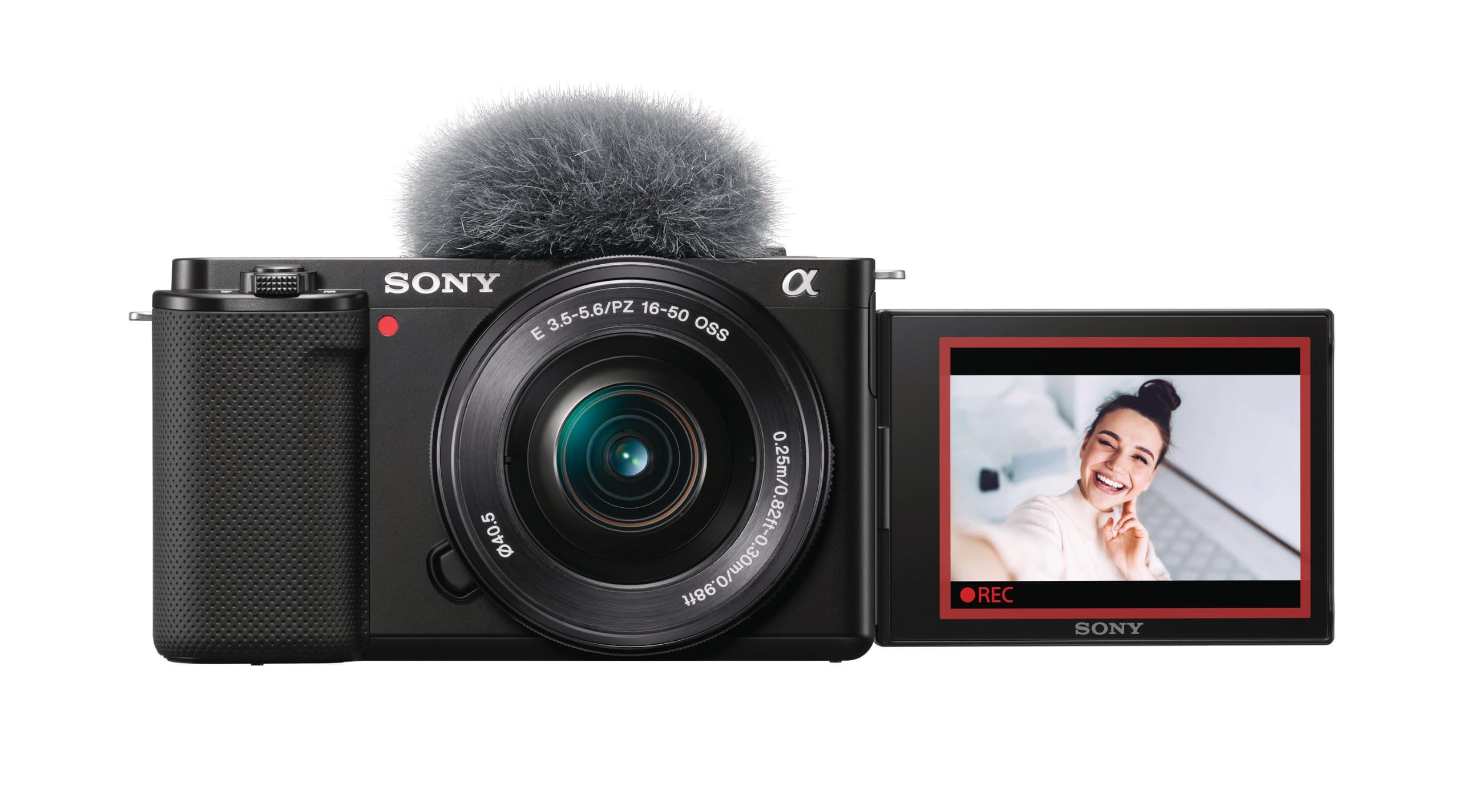
The ZV-E10 has a directional three-capsule microphone and a windscreen built into the top plate, and that one detail explains the whole camera. Sound is the part of video beginners get wrong first, and this is the only body here that arrives with audio you can publish before you've bought a single accessory.

Everything else is arranged for one person filming themselves. The screen swings out to the side and faces forward, the Background Defocus button blurs a shot with one press instead of a menu dive, and Product Showcase drops focus from your face to whatever you hold up. We think that last feature sounds like a gimmick until you've tried to demo something on camera and fought the autofocus for the whole take.

Underneath it's a 24.2MP APS-C body with 425-point hybrid autofocus and 4K oversampled from 6K with full pixel readout, so the picture holds up as well as the sound does. The 16-50mm power zoom moves smoothly and quietly, which is exactly what you want while recording, and it keeps the whole kit light enough to carry on a grip or a small tripod.

For a channel started this month, it's the shortest path to watchable audio and steady framing without a shopping list of extras. Our one caution is that this is a video camera that takes good stills, not the reverse, so decide which you're actually going to do before you commit.

Pros

  • Built-in directional mic and windscreen
  • Side flip-out screen for framing yourself
  • 4K oversampled from 6K with full pixel readout
  • One-press background blur and product showcase

Cons

  • No viewfinder for eye-level shooting
Our verdict

We point vloggers to the ZV-E10: the flip-out screen, directional mic, and 6K-sampled 4K do more for solo video than an extra lens would.

Check Latest Price
5

Best Two-Lens Kit

Nikon Z50 II Two-Lens Kit

88 /100
Traveler Score Excellent

Key details

Video
4K UHD up to 60p
Sensor
20.9MP APS-C CMOS
Autofocus
231-point hybrid AF
Kit Lenses
16-50mm and 50-250mm, both VR
Check Details on Amazon

Most beginner kits stop at 50mm and leave you cropping. Nikon's box adds a 50-250mm stabilized zoom to the standard 16-50mm, so the reach for a school concert, a bird feeder or a kid on a soccer field is already in the bag on day one rather than on a wish list.

The body underneath is the most capable here on paper: a 20.9MP APS-C sensor, a large bright viewfinder, detection for nine kinds of subject, 4K at up to 60p and a built-in flash for indoor snapshots. The dedicated Picture Control button scrolls 31 presets, and we found those more useful than they sound, because they give a beginner a look to aim for while shutter speed and aperture are still a mystery.

Where we land is that this is the most camera in the group, and the premium buys the second lens rather than a spec you'll never use. If your subjects are within arm's reach, the R50 does the same everyday work for less and is easier to carry. The moment your subjects get far away, though, the extra zoom is the whole decision.

Pros

  • Two stabilized zooms cover wide to 250mm
  • Subject detection for nine kinds of subject
  • 4K UHD up to 60p with slow-motion options
  • Built-in flash for indoor and night shots

Cons

  • 2.4 pounds of body and lenses to carry
Our verdict

We think the two-lens box earns its price: this is the only kit here that shoots wide, close, and far without another purchase.

Check Latest Price

How We Chose and Tested Beginner Mirrorless Cameras

We started by pulling together a shortlist of 30 current beginner mirrorless cameras, then cut anything whose kit lens or control layout undercut the point of moving up from a phone. Price, sensor size, lens mount, and included accessories narrowed that list to eight cameras we could recommend for a first serious setup. We did not rank on specs alone; a camera had to feel worth its price once it was in a bag and in use.

Each camera went through nine months of ordinary use: weekend trips, neighborhood walks, family gatherings, and dim living rooms. I shot the same scenes with each one, comparing skin tones, shadow detail, and whether fine texture survived in JPEG and raw files. For autofocus, I had each camera track a friend walking toward me, a dog crossing a yard, and a kid on a swing, noting whether it grabbed the eye and held it or drifted to the background. I also packed each body into a small shoulder bag with a water bottle and notebook to judge compact size, grip, and how easily it came out for a quick shot.

Battery life was tested on full-day outings, starting at 100 percent and shooting until shutdown, with notes on whether each camera survived an afternoon of stills and short video clips. I ran through menus as a beginner would, timing how long it took to change exposure, find silent shutter, and pair with a phone, because functionality matters more than a long spec sheet. Value came down to image quality, autofocus reliability, and build feel against the price of the body and kit lens; the eight finalists all had clear strengths, but only a few made the beginner learning curve feel short.

How to Choose Mirrorless Cameras for Beginners

Decide Whether You Need a Viewfinder

An electronic viewfinder does three jobs a rear screen can't. It shows the exposure before you press the shutter, it stays readable in bright sun, and holding the camera to your eye gives you a third point of contact for steadier shots. Four of the five cameras here have one.

Skip it only if you shoot video on a tripod or frame yourself on a flip-out screen most of the time, which is exactly the trade the Sony ZV-E10 makes. If more than half your shooting is stills outdoors, buy a body with a viewfinder and don't look back.

Match the Kit Lens to What You'll Photograph

Every kit here ships with a standard zoom in the 16-50mm range, and they are all slow at the long end, which shows up indoors and at dusk as either motion blur or grainy high-ISO files. No beginner kit escapes that; you work around it with a faster prime later.

Range matters more than aperture at this stage. If your subjects are children, animals, or anything on a field, the Nikon Z50 II's second lens reaches 250mm without another purchase, and adding that reach later usually costs more than the difference between kits. If you mostly shoot people and places at arm's length, a single 18-45mm is lighter and enough.

Treat Autofocus as the Spec That Ages

Megapixels are settled: 20 to 24 is plenty for prints and for cropping, and every camera here clears that bar. Autofocus is not settled, and it's the reason a well-chosen body still feels current two years later while a cheaper one feels its age.

Look for subject detection rather than a raw point count. The Canon EOS R50's 651-zone system with automatic person, animal and vehicle recognition is the difference between a camera that finds a toddler's eye and one that finds the wall behind them. Our advice is to spend the difference on that rather than on resolution.

Know What 4K on the Box Actually Means

Almost every camera here records 4K; what varies is the frame rate and whether the full width of the sensor is used. Uncropped 4K at 30p keeps your wide shots wide, while a slower, tighter mode nudges a standard zoom toward telephoto and makes handheld pans smear.

For travel clips and family video, 4K at 30p is the comfortable baseline and Full HD at 60p or 120p is the genuinely useful extra for slow motion. Do check that the screen can face you if you plan to be on camera, because that single hinge decides more vlogs than the codec does.

Buy for the Mount, Not the Body

Bodies are disposable; lenses are not. Canon RF, Sony E and Nikon Z all have full-frame upgrade paths and affordable standard zooms, so any of the three is a safe place to start, and the glass you buy now keeps working when the body is replaced.

What to avoid is an orphan mount. Canon's older EF-M system, which still turns up in discounted kits, has been superseded by RF, so those lenses won't follow you to a new body. Check the mount name on the box before you fall for a bargain.

Frequently Asked Questions

Final Verdict

Every camera here takes a good photo in daylight. The differences show up in the second month, when you're trying to catch something that moves and the camera either helps or doesn't. That's why the Canon EOS R50 is our default: its subject-detecting autofocus and forward-facing screen remove the two obstacles beginners hit first.

If most of what you shoot moves fast, choose the Sony a6400 instead. If you're filming yourself, the ZV-E10's microphone and flip-out screen settle it. And if a second lens is in the plan from day one, the Nikon two-lens kit is the only box here that already has it.