Best Lightweight Travel Binoculars of 2026

Full-size binoculars are wonderful right up until the moment you have to carry them. A big pair pulls a jacket pocket out of shape, knocks against the seat in front of you, and quietly ends up back in the car by mid-afternoon — which is why so many binoculars sit in a closet while their owners squint at things instead. Lightweight travel binoculars fix that one specific problem: they're small and light enough to live in a daypack or a coat pocket without a second thought, so they're actually there when a hawk comes over the ridge or the whales surface a hundred yards off the bow.

I've kept a pair in my bag next to a folding rain shell for years, and the ones that stay there are never the most powerful — they're the ones that don't get left behind. Over the past six months, my team and I have had 12 pairs in rotation, from true pocket compacts to slim roof-prism models, and the pattern held: magnification numbers sell binoculars, but brightness, clarity, and a focus wheel you can turn with cold fingers are what make you keep reaching for them. The picks below are the ones that earned a permanent spot in the bag.

1

Best Overall

Hontry 10x25 Compact

91 /100
Traveler Score Outstanding

Key details

Weight
9.6 oz
Field Of View
362 feet
Magnification
10x
Objective Lens
25 mm
Check Details on Amazon

Ten power is the number that does the most work in a travel binocular, and the Hontry gets everything else right around it. A 25 mm objective, BAK-4 Porro prisms, fully multicoated lenses, a 362-foot field of view at 1,000 yards, and 9.6 ounces — light enough to forget on a strap, solid enough that the image settles instead of swimming.

That balance is why it's our top pick. The hinge spans 60 to 75 mm, so the same pair fits a narrow face and a broad one without a fight, and the center-focus wheel has enough drag to hold a setting once you find it. In flat light before a storm, the view stayed bright enough to pick a heron out of a reed bed at the far edge of the water.

It's a compact, not a pocket pair: 9.6 ounces and a 4.3-inch body want a strap or a jacket pocket rather than a shirt pocket, and the rubber-armored body is sturdy without pretending to be armored for combat. What you get back is a three-year warranty, the longest coverage here apart from Nikon's lifetime terms, and a binocular that behaves like a much more expensive one in good light.

Pros

  • 10x that stays steady in hand
  • Wide 362-foot field of view
  • Hinge spans 60-75 mm for kids and adults
  • Three-year warranty

Cons

  • Bulkier than folding 5-ounce pocket pairs
Our verdict

For most travelers this is the pair to buy: 10x is the steadiest useful power, the view is wide enough to find a bird fast, and 9.6 ounces rides a strap all day.

Check Latest Price
2

Best Optics

Nikon Travelite EX 8x25

87 /100
Traveler Score Excellent

Key details

Field Of View
435 feet
Magnification
8x
Waterproofing
Nitrogen-purged, 2 m for 5 minutes
Objective Lens
25 mm
Check Details on Amazon

The Travelite is what the extra money buys here, and if the image itself is the point of the trip, it's the one to take. Nikon's multilayer coatings on a 25 mm Porro prism produced the cleanest, brightest view of this group, and the 435-foot field of view is the widest on the list — you find a bird faster because you're looking through less tunnel.

It's an 8x glass, the steadiest power here and the reason it works on a moving deck. The package is built for weather: nitrogen-purged and O-ring sealed, rated waterproof to 2 meters for five minutes, with turn-and-slide eyecups and a click-stop diopter that stay where you set them. The lifetime limited warranty covers the optics.

What it gives up is reach. At 8x a warbler forty yards out stays small, and the 10x and 12x pairs here pull it closer. You're also paying for glass rather than accessories — the removable lens caps are the one part of the kit that annoyed us, easy to pop off and easy to lose in a coat pocket.

Pros

  • Cleanest, brightest image in this set
  • 435-foot field of view, widest here
  • Waterproof and fogproof sealing
  • Lifetime limited warranty

Cons

  • Removable lens caps are easy to lose
Our verdict

Spend the extra if the view is the point — the cleanest, widest image in this group, sealed against weather, and backed for life.

Check Latest Price
3

Best for Bird Watching

Aurosports 10x25 Compact

89 /100
Traveler Score Excellent

Key details

Weight
8.8 oz
Warranty
1 year
Magnification
10x
Objective Lens
25 mm
Check Details on Amazon

The Aurosports runs the same 10x25 formula as our top pick — 362-foot field of view, BAK-4 Porro prisms, fully multicoated lenses — and it's the pair we hand to someone heading out birding rather than sightseeing. Textured rubber armor wraps the barrels, which matters more than it sounds when your hands are damp at six in the morning.

It's 0.8 ounces lighter than the Hontry, the armor grips better on a hot day, and there's a tripod socket underneath for an evening spent watching one stretch of water. The center focus and right-barrel diopter work the same way, and the twist-up eyecups take a pair of glasses without a fight.

Where it lands for us: this is the 10x pair for a summer birding trip, a dusty trail, or a stadium, and it's an easy recommendation at its price. The Hontry still edges it for a trip where weather is part of the plan.

Pros

  • Grippy rubber armor for damp hands
  • Lightest 10x pair here at 8.8 ounces
  • Wide 362-foot field of view
  • Tripod socket for steady viewing

Cons

  • Water resistant, not sealed against rain
  • One-year warranty
Our verdict

Take this one on dry trails and summer birding trips: lighter and grippier than our top pick, with the same wide 10x view.

Check Latest Price
4

Best for Pocket Carry

VULNESS 8x21 Folding

84 /100
Traveler Score Excellent

Key details

Weight
5.6 oz
Folded Size
4.1 x 3.5 x 1.4 in
Magnification
8x
Objective Lens
21 mm
Check Details on Amazon

This is the pair for the traveler whose binoculars live in a jacket pocket and come out at a balcony seat. It folds to roughly the footprint of a passport — 4.1 by 3.5 by 1.4 inches — and weighs 5.6 ounces, so it goes into a bag in a way a 25 mm Porro never will.

Eight power is the right call for that job. It's steady in one hand, wide enough to take in a whole stage, and the foldable hinge closes down to fit a smaller face, which is why it kept getting passed around. Center focus plus a right-eye diopter gets a sharp image in a couple of seconds, even in dim house light.

Twenty-one millimeters of objective is the catch: at dusk or under heavy overcast it dims sooner than the 25 mm and 32 mm pairs here, and the anti-reflective coating isn't in Nikon's class. Neither matters much at a seven o'clock curtain or on a sunny promenade, which is where this one belongs.

Pros

  • Folds to 4.1 by 3.5 by 1.4 inches
  • 5.6 ounces on a strap or in a pocket
  • 8x view that stays steady in one hand
  • Right-eye diopter for mismatched vision

Cons

  • 30-day warranty coverage
Our verdict

Our pick for balcony seats and city days: a folding 8x21 that vanishes into a pocket, as long as you're not asking it to work at dusk.

Check Latest Price
5

Best in Low Light

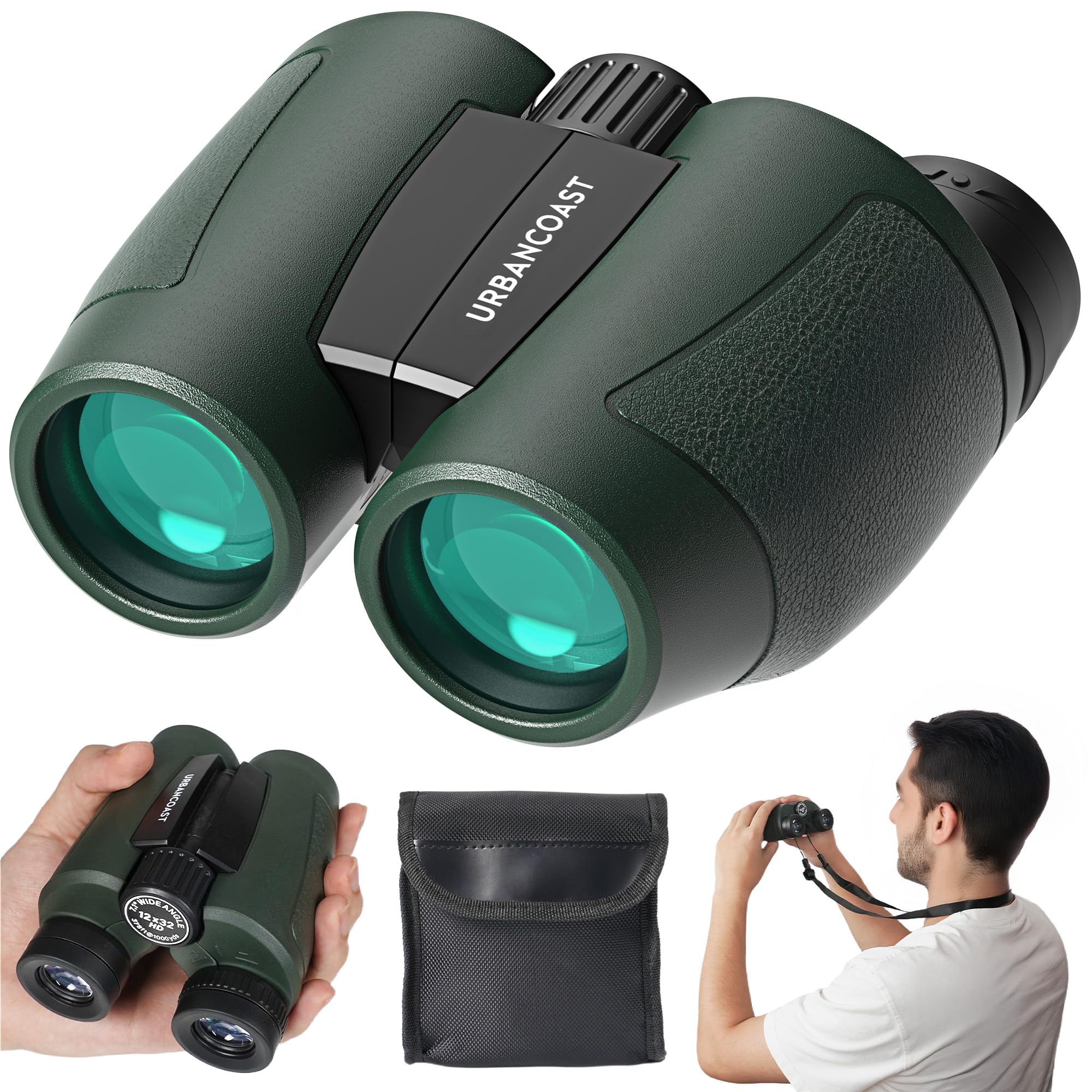
URBANCOAST 12x32

85 /100
Traveler Score Excellent

Key details

Weight
12 oz
Field Of View
378 feet
Magnification
12x
Objective Lens
32 mm
Check Details on Amazon

Twelve power behind a 32 mm objective is an unusual combination in a compact, and it's the reason this one is on the list. Divide the objective by the magnification and you get a 2.7 mm exit pupil, against roughly 2.1 mm on the 12x25 pairs here — noticeably more light in the tubes when the sun drops.

That makes it the pick for the last hour of daylight: a cruise deck, a safari vehicle, a hide at a waterhole. The field of view runs 378 feet at 1,000 yards, wide for 12x, which helps you get on a moving animal, and the BAK-4 roof prisms with multicoating keep color in the shadows instead of flattening them to grey.

Twist-up eyecups and 14 mm of eye relief work with glasses, the body is sealed against rain and fog, and a two-year warranty sits behind it. It asks for a steady hand at 12x, so brace it on something and let the glass do the work.

Pros

  • 32 mm objective gathers light at dusk
  • 378-foot field of view, wide for 12x
  • Waterproof and fog-resistant body
  • Twist-up eyecups for glasses

Cons

  • Twelve ounces makes it a bag binocular
Our verdict

The dusk pick: more light through a 32 mm objective than the 12x25 pairs here, on a body that lives in a bag rather than a pocket.

Check Latest Price
6

Best Budget

AHFLRITO 8x21 Compact

85 /100
Traveler Score Excellent

Key details

Weight
5.3 oz
Field Of View
122 ft/1,000 yds
Magnification
8x
Objective Lens
21 mm
Check Details on Amazon

This is the least expensive way onto this list, and it buys a folding 8x21 that weighs a claimed 5.3 ounces, with an aluminum frame under rubber armor and a body rated waterproof.

Eight power through a 21 mm lens is a daytime instrument. In good sun it's bright and sharp enough to sort a hawk from a vulture a few hundred yards out; under a heavy canopy or after sunset it goes dim in a way the 25 mm picks don't. The focus wheel also takes some hunting at long distance, so give it a beat to settle rather than chasing the image.

As a second pair it earns its spot: the one in the glovebox, the daypack, the beach bag, where a lost or scratched binocular wouldn't end the day. As the only pair on a once-in-a-lifetime trip, step up to a 25 mm — the difference in dim light is the difference between seeing the animal and seeing a shape.

Pros

  • 5.3 ounces and folds flat
  • Waterproof aluminum body with rubber armor
  • Two-year warranty

Cons

  • Narrow 122-foot field of view
Our verdict

Buy it as a spare, not as your only pair: five ounces, waterproof, and good enough in full sun.

Check Latest Price
7

Glasses Wearers

Occer 12x25 Compact

89 /100
Traveler Score Excellent

Key details

Weight
13.8 oz
Eye Relief
20 mm
Magnification
12x
Objective Lens
25 mm
Check Details on Amazon

Twenty millimeters of eye relief is the number that stands out here, and it's the one most compact listings bury. The Occer's rubber eyecups pull down so glasses sit close to the lens instead of being pushed back off it — the difference between the full view and two dark crescents for anyone who wears specs.

Twelve power is the most reach on this list, and it shows detail on a far ridge that the 8x and 10x pairs turn into a smudge. It also magnifies every wobble, so treat it as a binocular for a railing, a balcony, or a stadium seat rather than a long walk.

The rest of the package is BAK-4 prisms, fully multicoated lenses, a center-focus wheel, plus or minus 5 diopters on the right eyepiece, and a waterproof body. The listing puts the weight at 0.39 kg — about 14 ounces — which is heavy for a compact and the main thing to know before you commit.

For glasses wearers who want reach from a fixed seat, this is a lot of binocular for the money and the most comfortable view in the group with specs on. For a hiking trip where it rides on your chest all day, one of the 9-ounce pairs is the better answer.

Pros

  • 20 mm eye relief suits glasses
  • 12x reach for distant detail
  • Eyecups pull down for glasses
  • Waterproof, fully multicoated BAK-4 optics

Cons

  • Narrow 273-foot field of view
  • No stated warranty
Our verdict

The best choice here for glasses wearers who want 12x reach from a fixed seat, with the roomiest eye relief in the group.

Check Latest Price
8

Ultralight 12X

POLDR 12x25 Pocket

88 /100
Traveler Score Excellent

Key details

Weight
5.8 oz
Eye Relief
16 mm
Magnification
12x
Objective Lens
25 mm
Check Details on Amazon

At 165 grams — 5.8 ounces — this is the lightest 12x pair on the list, and that number is most of the argument. It costs nothing to carry and still puts 12x in front of your eye.

The body is magnesium with a BAK-4 roof prism, the right eyepiece adjusts plus or minus 5 diopters, eye relief is 16 mm, and the housing is rated waterproof. For something this small, that's a serious build.

Focus is where it asks for patience: the wheel travels a fair way to snap a distant ridge in, so set the diopter once and leave it alone. Get that right and the view is clean in daylight, which is what a pocket pair is for.

Treat it as a second pair — the one in a jacket pocket for the deck, the stadium, or the balcony, where 12x and 5.8 ounces are exactly right and a narrow view doesn't matter because the subject sits still.

Pros

  • 5.8 ounces at 12x
  • Magnesium body with BAK-4 prism
  • Waterproof housing
  • 16 mm eye relief

Cons

  • Narrow 126-foot field of view
Our verdict

The lightest way to carry 12x: a 5.8-ounce pocket pair for a fixed seat, with the narrow view that comes with it.

Check Latest Price

How We Chose and Tested the Lightweight Travel Binoculars

We started with a running list of about 40 pairs, pulled specs straight from manufacturer listings, and filtered hard on folded width, listed weight, magnification and objective lens size, price, and whether the housing was sealed and purged. Anything too bulky for a jacket pocket or priced above $300 came off, along with models that had thin review histories. That left 12 pairs, which we bought at retail ourselves so nothing arrived pre-tuned by a brand.

Testing ran six months and followed the binoculars rather than a lab bench. They went birdwatching off a back deck at first light, up to the top row of a football stadium, out on a whale watch in chop, and into a glovebox for a two-week road trip. For clarity we read a stop sign across an open field and picked apart a chickadee's eye stripe in shade, then kept glass on a treeline at dusk to see how long color and detail held before the image went flat.

Focus got its own checks: we turned each wheel bare-handed and again in winter gloves, counted the travel from close focus to infinity, and noted whether the diopter drifted after a day loose in a bag. We weighed every pair on a kitchen scale with strap and case attached, tried sliding each into a jacket pocket and a hipbelt pouch, and watched for fogging when stepping from air conditioning into summer humidity. Value came down to one question at the end — did the extra money buy noticeably better glass?

How to Choose Lightweight Travel Binoculars

Match Magnification to How Steady You'll Be

8x, 10x, 12x is a trade between reach and steadiness, and it cuts both ways: every step up shows more detail at distance, narrows the view, and magnifies hand movement. We treat 10x as the travel default, with enough reach for birds and wildlife and still holdable without a rest. Go 8x for balcony seats, boats, and pairs shared with kids; go 12x when the binocular lives on a rail or a seat and the detail is the point.

The 12x25 Occer shows a ridge clearly and makes a handheld scan of open water hard work. Neither is wrong — they are different jobs.

Objective Size Is About Light, Not Power

Divide the objective by the magnification and you get the exit pupil, the circle of light that reaches your eye. An 8x25 gives about 3.1 mm, a 10x25 about 2.5 mm, a 12x25 about 2.1 mm, and a 12x32 about 2.7 mm. Bigger is brighter at dusk and heavier in the hand.

For daytime travel, 21 to 25 mm keeps the package small and is plenty. If the trip centers on dawn and dusk — a wildlife cruise, a safari vehicle, a hide — the 32 mm objective on the URBANCOAST buys real light for the extra ounces.

Judge the Carry, Not the Claim

Compact in a listing can mean it fits a glovebox, not that it fits a shirt pocket. Check folded dimensions and weight in ounces before anything else. The folding 8x21s here run five to six ounces and disappear into a jacket; the 25 mm Porro pairs run nine to ten and want a strap or a bag pocket; the 12-ounce 12x32 is a bag binocular, full stop.

Then look at what holds it: a case with a belt loop and a strap that doesn't cut into your neck matter more on a full day than a fraction of an ounce.

Check Eye Relief and the Hinge Before You Buy

If you wear glasses, look for eyecups that fold or twist down and eye relief of 16 mm or more. The Occer's 20 mm is the roomiest here, and Nikon's high-eyepoint eyecups are built for the same job.

Then check the interpupillary range: the hinge has to close to your pupil distance or you'll see two circles instead of one. The Hontry spans 60 to 75 mm, which covers most adults and older children, and folding roofs often shut narrower for small faces.

Waterproof Means Sealed, Not Splashed

Listings use waterproof and water resistant loosely. Sealed means nitrogen-purged and O-ring sealed, as on the Nikon Travelite, and it survives rain and spray. Water resistant is splash protection — fine in a daypack, not fine on a boat.

If your trip involves salt water or tropical humidity, pay for the seal. Fog inside the tube is not something you can fix on the road.

Frequently Asked Questions

Final Verdict

Hontry's 10x25 is the pair we recommend first: 10x is the power most travelers can hold steady, the 362-foot view is wide enough to find a bird before it moves, and 9.6 ounces rides on a strap all day without complaint.

If the glass matters more than the packing, the Nikon Travelite EX is the sharpest binocular here, with the widest view and sealing that handles weather. And if it has to vanish into a jacket pocket, the VULNESS 8x21 is the one that will.