Best Mirrorless Cameras for Travel Photography of 2026

Every travel camera is a compromise you carry. A bigger sensor and a fast lens buy you the shot at dusk, but the same kit stays in the hotel room because your shoulder aches by noon. Mirrorless bodies cut the bulk without giving up much image quality, and what that really buys you is smaller than the spec sheet suggests: the camera comes out on day three of the trip, not just day one.

I've dragged everything from a full-frame body with a 24-70 to a palm-sized sensor through airports and up hills, and my team spent the past 10 months traveling with seven mirrorless cameras to see which ones kept earning their place in the bag. The keepers locked focus on a subject moving through bad light, held a charge through a full day of walking, and didn't make me fumble through a menu mid-scene. Value counted for as much as picture quality — a cheaper body that needs two spare batteries isn't the bargain it looks like. The ones that survived the carry-on are below.

1

Best Overall

Sony Alpha a6400

91 /100
Traveler Score Outstanding

Key details

Sensor
20.1MP APS-C
Weight
10.3 oz
Kit Lens
16-50mm (24-75mm equivalent)
Continuous Shooting
11 fps
Check Details on Amazon

The first thing we noticed is how quickly the a6400 finds a face. Sony's 425 phase-detection points sit across most of the frame, and the eye tracking picks a subject up and holds through a turn of the head. Of the six cameras here it is the surest at keeping someone sharp while they walk toward you, which is most of what travel photography actually asks for.

The body is the other half of the argument. At 10.3 ounces it slides into a small shoulder bag, and it still has an electronic viewfinder with 1.07x magnification. That matters more than the number suggests: at midday a rear screen becomes a mirror, and the finder is how you frame without guessing. The kit zoom runs 16-50mm, or 24-75mm in full-frame terms — streets, plates, doorways, the person you are traveling with, all covered by the lens that came in the box.

The E-mount is the long game. Lenses you add later keep fitting, and one small wide prime for evenings will do more for your pictures than any body upgrade. The 11 fps burst with tracking means a moving subject usually leaves you one usable frame, and nothing about the camera gets in the way while you take it. On days when the plan was unclear, this is the body we reached for.

Pros

  • Eye autofocus that holds a moving subject
  • Viewfinder in a 10.3-ounce body
  • 24-75mm equivalent kit range
  • E-mount glass to grow into

Cons

  • No in-body stabilization
Our verdict

Buy this if you want one small camera that handles streets, portraits, and bright noon light without asking you to think about it.
Check Latest Price
2

Best for Beginners

Canon EOS R50

91 /100
Traveler Score Outstanding

Key details

Sensor
24.2MP APS-C
Kit Lens
18-45mm
Autofocus
Dual Pixel AF II
ISO Range
100-25600
Check Details on Amazon

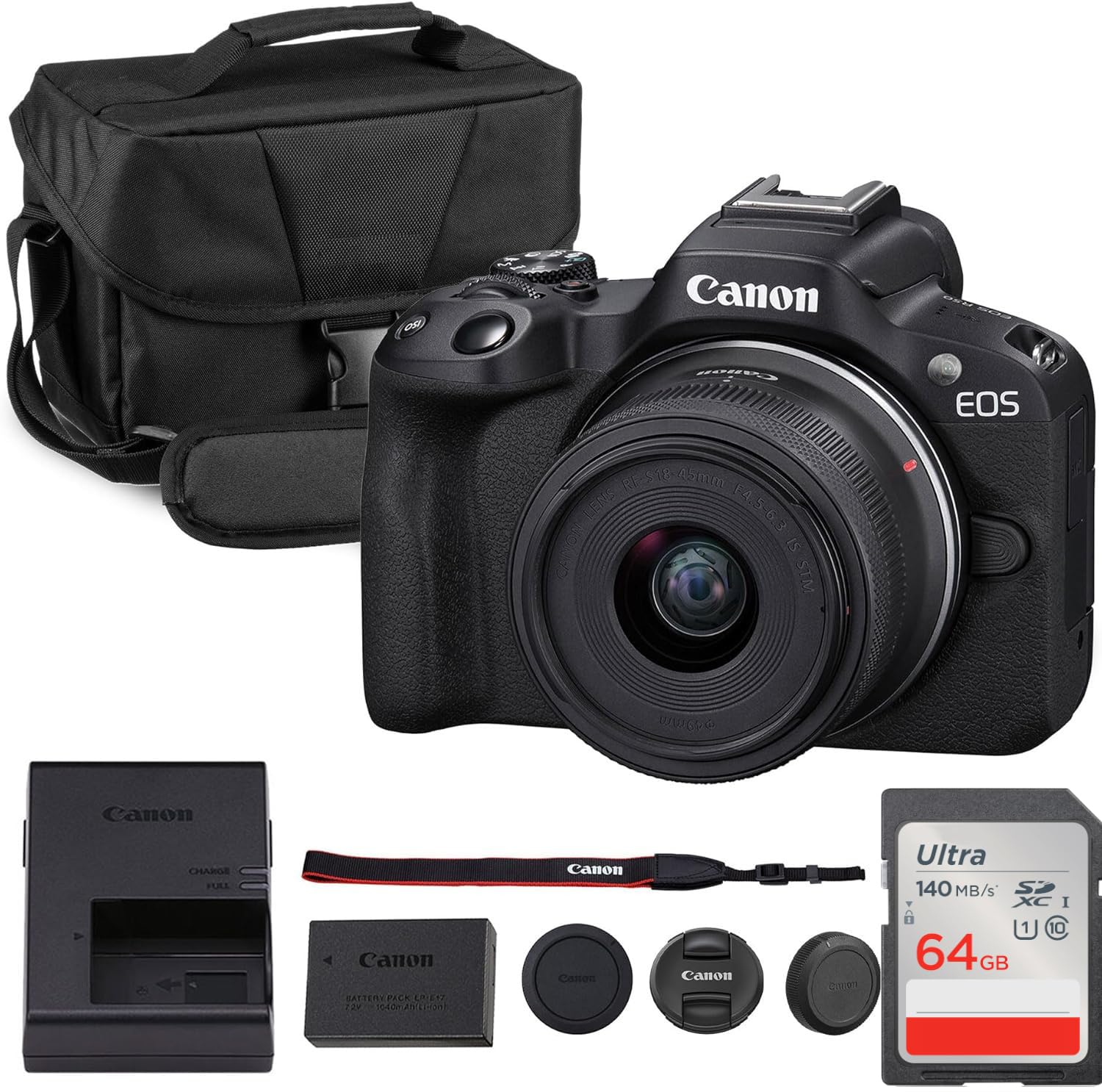
If the last camera you owned was a phone, the R50 is the least intimidating way into this list. Canon's guided menus explain a setting while you change it, the Creative Assist modes hand you a look and let you adjust from there, and the body is small enough to live in a tote bag rather than a camera bag. That sounds cosmetic until you have carried a camera you resented.

What we appreciated is how little Canon stripped out to reach this position. The 24.2MP APS-C sensor oversamples 4K video, the autofocus is Dual Pixel AF II, and the RF mount is shared with Canon's full-frame bodies — so a lens bought now for a small camera still fits if you move up in a few years. That is an unusual amount of future-proofing at the bottom of a range.

Vertical video and one-tap sharing are here for people who post from the road, and neither gets in the way if you never touch them. Set against the a6400, the choice comes down to temperament: Sony hands you more direct control and a busier menu, Canon walks you through the same decisions. On a trip where the camera is a companion rather than a project, that guidance is the feature.

Pros

  • Guided menus and Creative Assist modes
  • Oversampled 4K from a 24.2MP sensor
  • RF mount shared with full-frame bodies

Cons

  • Body is not weather-sealed
  • Small grip for larger hands
Our verdict

Buy this if you are stepping up from a phone and want the gentlest possible introduction to a real lens camera.

Check Latest Price
3

Best All-In-One Zoom

Canon EOS R10

87 /100
Traveler Score Excellent

Key details

Video
4K 60p
Sensor
24.2MP APS-C
Kit Lens
18-150mm
Continuous Shooting
15 fps mechanical
Check Details on Amazon

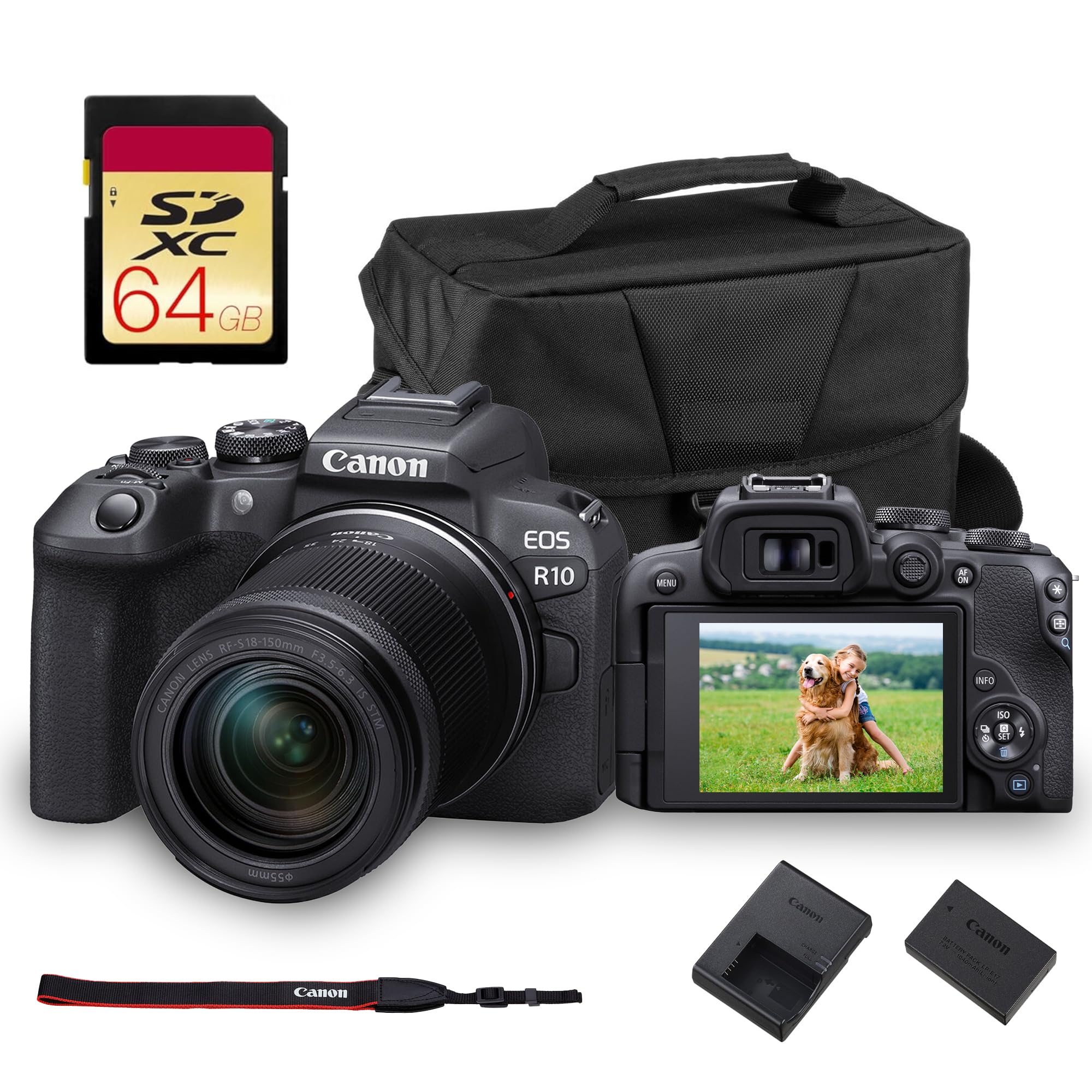
Eighteen to 150 millimeters is the range that changes how a trip works. On the R10's 1.6x crop sensor that is roughly 29-240mm in full-frame terms, so the same lens frames a street corner and then pulls a detail off a roofline without you changing glass in a crowd. It is the only single-lens kit here that covers that much ground.

The body underneath is quick in the way that matters when you are shooting people rather than buildings: 15 fps with the mechanical shutter, 23 fps electronic, Dual Pixel AF II with subject detection, and 4K 60p oversampled from 6K. We rate that focus system above a slightly larger sensor, because a sharp frame of a friend turning toward you beats a beautifully rendered one that missed.

The trade is aperture. A superzoom ends at f/6.3, so the last hour of daylight costs you either a higher ISO or a steadier hand than you have after a day of walking. At noon it costs you nothing, and the bundle arrives with a memory card and a bag, so the box is shootable on day one. That combination — one lens, no decisions — is why it suits a trip where looking matters more than fiddling.

Pros

  • 18-150mm covers wide to telephoto
  • 15 fps mechanical, 23 fps electronic
  • 4K 60p oversampled from 6K
  • Bundle includes card and bag

Cons

  • No in-body image stabilization
Our verdict

Buy this if you want to leave the second lens at home and cover a whole trip with one zoom that goes wide to long.

Check Latest Price
4

Best Two-Lens Kit

Nikon Z50 II

88 /100
Traveler Score Excellent

Key details

Screen
3.2-inch tilting
Sensor
20.9MP APS-C
Viewfinder
Electronic, 1.02x
Lenses Included
16-50mm and 50-250mm
Check Details on Amazon

Two lenses in the box is the Z50 II's whole pitch: a 16-50mm for the street and a 50-250mm for everything you cannot walk to. Between them you go from a wide square to a bird on a wire, and both lenses carry stabilization — which is more than the bodies at this position usually manage on their own.

The surprise is how much of the camera is aimed at people who want a finished picture rather than a file to edit. A dedicated Picture Control button calls up 31 presets, and there is a built-in flash, genuinely useful at a restaurant table where the alternative is a phone snap. The viewfinder is the other quiet win: 1.02x magnification and a 3.2-inch screen that feels like the backup rather than the primary.

Reach is the reason to choose it over the R10, and the price is the reason to choose it over almost anything else here with a finder included. Nothing about carrying two lenses felt like a compromise in practice — the short zoom stays mounted and the long one comes out when the scene asks for it. For a trip built around landscapes and wildlife rather than cafés, that is the right shape.

Pros

  • Two stabilized zooms cover 16-250mm
  • 31 presets on a dedicated button
  • Built-in flash for evening shots
  • 1.02x electronic viewfinder

Cons

  • Kit zooms narrow to f/6.3 at full reach
Our verdict

Buy this if your trips are about landscapes and wildlife and you want two stabilized lenses plus a viewfinder in one purchase.

Check Latest Price
5

Best Full-Frame

Sony Alpha 7 IV

92 /100
Traveler Score Outstanding

Key details

Video
4K 60p 10-bit
Sensor
33MP full-frame
Memory Slots
Two (CFexpress Type A / SD)
Stabilization
5-axis in-body
Check Details on Amazon

The a7 IV answers a specific question: what if the trip is the reason you own a camera? Its 33MP full-frame sensor leaves room to crop into a facade or print the one frame that mattered, and because the sensor is back-illuminated it holds color together as the light drops, which is exactly where a smaller sensor starts to struggle.

The five-axis in-body stabilization is what we valued most in hand-held use. It steadies any lens you mount, so slow shutter speeds at dusk stop being a gamble and handheld video stops jittering. Combine that with real-time eye autofocus and the camera handles the two hard parts of travel photography — holding still and holding focus — without asking you to think about either.

Two card slots, 10-bit 4K 60p, and a grip that balances a long lens make this the most capable body here. It is also the heaviest, and it arrives as a body only, so budget for a lens on top. For a fortnight a year that happens mostly in daylight, that is capability you will not use; for a trip built around blue hour and interiors, it is the one that stops you compromising.

Pros

  • 33MP full-frame files with crop room
  • Five-axis in-body stabilization
  • Two card slots
  • 10-bit 4K 60p video

Cons

  • Body only, so a lens is extra
  • Heaviest body of these picks
Our verdict

Buy this if your trips are photography trips first, and blue hour, interiors, and large prints are the reason you are shopping.

Check Latest Price
6

Video-First Trips

Nikon Z30

85 /100
Traveler Score Excellent

Key details

Screen
3-inch flip-out touchscreen
Sensor
20.9MP APS-C
Weight
12.3 oz
Kit Lens
16-50mm
Check Details on Amazon

The Z30 is built for the traveler who comes home with clips rather than contact sheets. It shares the 20.9MP APS-C sensor and the Z mount with Nikon's stills bodies, but the layout — flip-out screen, prominent record button, built-in stereo mic with adjustable sensitivity and a red record light — is aimed at someone talking to the camera.

The detail work is what makes it livable on the road. Constant power over USB-C means a power bank keeps it running through a long afternoon, and the screen folds out far enough to frame yourself without guessing at the edges. Stills are not an afterthought either: 20.9MP and 11 fps covers a trip's worth of photographs, and the Z mount gives you a path to better glass later.

The 16-50mm kit zoom is stabilized and stays compact, so the whole kit drops into a day bag beside a water bottle. As the least expensive body here, it is the cheapest way into an APS-C sensor and a proper lens mount in this group — and the only one that treats video as the main event rather than a mode you scroll past.

Pros

  • Flip-out screen for framing yourself
  • Built-in stereo mic with adjustable sensitivity
  • Constant power over USB-C
  • Stabilized 16-50mm kit zoom

Cons

  • Screen only, no electronic viewfinder
Our verdict

Buy this if you come home with clips rather than contact sheets and want a real sensor, a real mount, and a screen that faces you.

Check Latest Price

How We Picked and Tested Seven Travel Cameras

We started with roughly two dozen bodies announced or still widely sold in the past three years, then filtered hard: anything too heavy to carry all day with a lens mounted came out, as did systems without a compact standard zoom worth traveling with, and anything priced so far above the field that it wasn't a real comparison. Seven cameras made the cut, from small crop-sensor bodies to full-frame options, and we shot with each of them for 10 months.

Testing happened on actual trips, not on a tripod in a studio. Each camera went to street markets after dark, on a wet week where I was wiping the front element every few minutes, up a hill on a cold morning, and through an airport terminal at 5 a.m. I tracked a cyclist riding toward me down a narrow street, had a friend walk through a crowded plaza while I shot wide open, and handed each body to a stranger to see whether face detection found them with no instruction. Every camera started the day at 100 percent; I logged the percentage left after a 12-hour walking day and counted how many spares I'd have needed to carry.

For image quality, I shot the same street corner at dusk at high ISO on every body and compared how much shadow detail held up and how far I could crop before the file fell apart. Reliability showed up on its own — one camera fogged its viewfinder after a drizzle, another threw a card error that cleared on reinsertion, and I noted both. At night in the hotel I paired each camera to my phone and timed a 30-photo transfer, watching for dropped connections and re-pairing prompts. Functionality came down to small things: whether I could change shutter speed with cold hands, whether the grip fit, whether the battery door opened with the camera on a strap. Finally, I added up the real cost of the kit you'd actually travel with — body, one lens, a spare battery, a card — because that number, not the body price, is the value story.

How to Choose Mirrorless Cameras for Travel Photography

Pack the lens, not just the body

The weight that matters is body plus lens plus a spare battery, and the body is usually the smaller part of the sum. The a6400's body is 10.3 ounces; the a7 IV is listed at close to a kilogram before you mount anything. Two cameras that look similar on a spec sheet feel nothing alike on the fourth hour of a walking day.

Before you commit, check the packed length with the lens mounted against the width of the bag you already own. A kit zoom that stays compact when collapsed is the single biggest reason a camera comes out of the bag at lunch instead of staying in the room.

Decide whether you need a viewfinder

An electronic viewfinder is the difference between composing a shot and guessing at one. In open sun the rear screen washes out, and the finder is what lets you read framing, exposure, and focus at the same time. Bodies designed around video often give the finder up to make room for a bigger flip-out screen — the Nikon Z30 is the one here that relies on its screen alone.

If your photography happens at midday in streets and squares, pay for the finder. If you mostly shoot clips and can step into shade to check the screen, going without saves money and bulk.

How much zoom the kit should cover

A 24-75mm equivalent, which is what the a6400 and R50 kits deliver, covers most of a trip: streets, plates, doorways, the person you are traveling with. A superzoom such as the R10's 18-150mm reaches roughly 240mm equivalent and spares you a lens change in a crowd.

The catch sits at the long end. These kit lenses narrow to f/6.3, dim enough that the last hour of daylight wants a steadier hand or a higher ISO. Two-lens kits solve reach a different way: more focal length for similar money, at the cost of a swap when the scene changes fast.

Stabilization, sensor size, and low light

In-body stabilization steadies every lens you mount; lens-based stabilization steadies only the lens it was built into. For dusk streets and handheld video that distinction is worth paying for, and it is why the a7 IV's five-axis system stands out in this group.

Sensor size buys cleaner files in dim rooms and more room to crop, then charges you in weight and lens money. The crop-sensor picks answer with lighter kits and cheaper glass, which is a fair trade if most of your shooting happens in daylight.

Frequently Asked Questions

Final Verdict

Of the six, the Sony a6400 is the one we hand to most travelers. It has the three things that decide a trip — a body small enough to carry without thinking about it, a viewfinder that works at noon, and autofocus that finds a face in a crowd — and it has them in the middle of this group's price range.

Choose the Canon R10 instead if you want one lens that reaches everything and can live with a dimmer long end. Choose the Sony a7 IV if the trip is a photography trip first and a holiday second.