Best Inflatable Kayaks of 2026

A hardshell kayak is a commitment — a roof rack, a garage wall, a second set of hands at the ramp. An inflatable asks for a closet shelf and a few minutes with a pump, and the good ones paddle closer to a hardshell than most people expect. The catch is that the differences between models show up in the floor, the seams, and what actually comes in the box.

We spent the past eight months paddling 12 of them — solo boats, tandems, a couple of three-seaters — on flat lakes, a slow river, and one windy bay. The biggest upgrade you can pay for is a drop-stitch floor: pump it up and the boat tracks instead of wallowing, which several of these do. After that, check weight capacity and included gear, since a wheezy pump and a throwaway seat cost more to replace than they save.

The picks below cover a solo boat you can carry on a bus, a tandem for two adults and a cooler, and everything in between. None of them paddle like a touring hardshell — that's the trade, and for most people it's the right one.

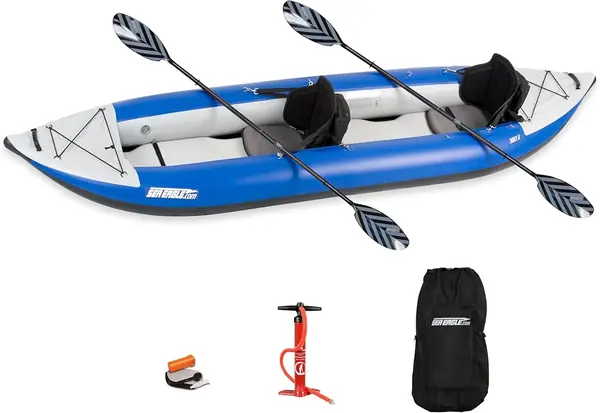
The Best Inflatable Kayaks

1

Sea Eagle 370 Pro Best Overall
89 /100
Traveler Score Excellent

Key details

Packed Weight
33 lb
Weight Capacity
650 lb
Seating Capacity
3
Inflated Size
150"L x 34"W x 19"H
Check Details on Amazon

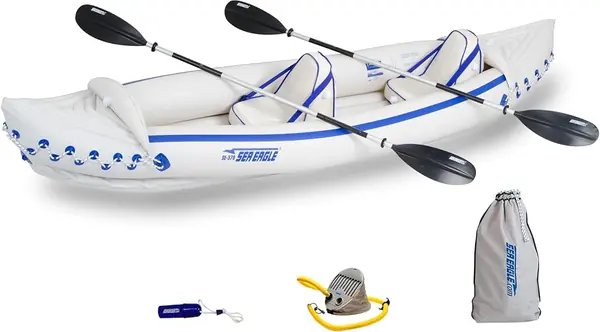
The Sea Eagle 370 Pro is the rare inflatable that can seat three and still pack down to 33 pounds. That combination is why it earns our top spot: two adults can paddle with a child or a pile of gear, yet one person can wrestle the bag into a trunk. The 650-pound capacity leaves more margin than most tandems here, and the three-person layout does not feel like a stretch.

We like the pro package for the details that usually cost extra: two deluxe seats with real back support, paddles, a foot pump, and a carry bag. The seats sit five inches off the floor, which keeps your hips from folding into a low paddling position. The hull is rated for Class III whitewater, but we see it as a versatile family boat first; it is stable enough for lakes and mild rivers, and the included skeg helps it track when the water opens up.

The trade-off is weight and bulk. At 33 pounds, it is manageable for one fit adult, but it is not a backpacking kayak, and the bag is bulky once the boat is inside. The included paddles are serviceable rather than light and stiff. For a first family kayak, that balance matters more than a fancy floor.

It is the one we reach for when the plan is a lake afternoon with two adults and a cooler, or a river day where the water might get pushy.

Pros

  • Seats three without a huge packed footprint
  • 650-pound capacity leaves room for gear
  • Whitewater rating adds versatility
  • Pro seats sit higher for a better paddle position

Cons

  • Bag is bulky for one-person trips
  • Included paddles are basic
Our verdict

For most couples and small families, this is the inflatable kayak we recommend first: roomy, portable, and able to handle more than a calm lake.
Check Latest Price
2

Intex Explorer K2 Best Budget Tandem

88 /100
Traveler Score Excellent

Key details

Packed Weight
35 lb
Weight Capacity
400 lb
Seating Capacity
2
Inflated Size
123"L x 36"W x 20"H
Check Details on Amazon

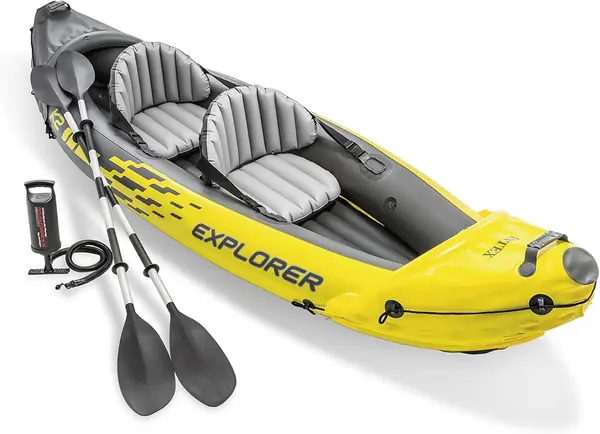
The Explorer K2 wins on completeness. For the least money among the tandems here, you get the boat, two 86-inch paddles, two inflatable seats with backrests, a high-output pump, and a carry bag. That is a real advantage for a first-time buyer who does not want to assemble a kit piece by piece.

We like the 10.3-foot length and 36-inch beam for easy paddling and a stable feel on flat water. The I-beam floor is basic, but it gives the boat enough shape to paddle rather than wallow. The Boston valves make inflation and deflation quick, and the whole package is light enough for one person to move from car to shore in a couple of trips.

The seats are the weak point. The front seat lacks the back support of the rear, so the taller paddler should take the back. The paddles flex more than we like. Seam leaks can also appear, so check the welds before every trip and keep the patch kit handy. None of that changes the value equation for a calm lake, but it does mean this is not the boat for rocky rivers or frequent rough launches.

For a family that wants to try kayaking without spending much, the Explorer K2 is the easy call. It is the one we recommend when the water is gentle and the budget is fixed.

Pros

  • Complete kit includes paddles, pump, seats, and bag
  • 400-pound capacity for two adults and gear
  • Quick Boston valves speed setup

Cons

  • Front seat has weak back support
  • ⚠️ Seam leaks can develop
Our verdict

This is the budget tandem we point to for casual lake days, as long as you treat the seams and front seat as the price of admission.

Check Latest Price
3

Intex Challenger K1 Best Budget Solo

87 /100
Traveler Score Excellent

Key details

Packed Weight
26 lb
Weight Capacity
220 lb
Seating Capacity
1
Inflated Size
108"L x 30"W x 13"H
Check Details on Amazon

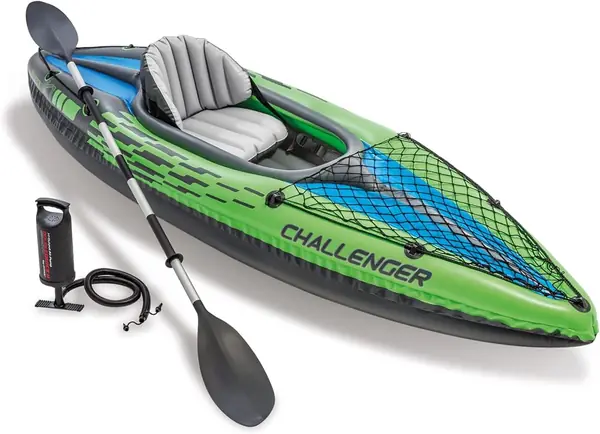
The Challenger K1 is the solo boat for someone who has nowhere to store a hard kayak. It weighs 26 pounds, rolls into a bag, and takes up about as much room as a duffel. It does not ask for a roof rack or a second person to launch.

The cockpit is low and open, with a removable adjustable seat and enough legroom for an average adult. The 30-inch beam is narrow compared with the tandems here, so it feels quicker to turn but less forgiving when the water chops up. The set includes a pump and paddle, though the paddle is best treated as a spare.

We see this as a calm-lake and slow-river boat, not a rough-water or long-touring choice. The PVC shell can develop seam leaks, and the narrow hull is not the stable platform a wider recreational kayak gives you. For a first solo kayak, that is a fair trade for the weight and price.

It is not the boat for every paddler, but it is a smart one for the person who wants to keep a kayak in a closet and still get on the water quickly.

Pros

  • 26-pound package is easy for one person
  • Fits in a closet or trunk
  • Low-profile cockpit is easy to enter

Cons

  • Narrow hull feels tippy in chop
  • ⚠️ PVC seams can leak
Our verdict

A light, inexpensive solo kayak that makes apartment storage and quick lake paddles easy, provided you stay in calm water.

Check Latest Price
4

Sea Eagle 380x Explorer Best for Whitewater

86 /100
Traveler Score Excellent

Key details

Packed Weight
40 lb
Weight Capacity
750 lb
Seating Capacity
3
Floor
Removable drop-stitch, 10 PSI
Check Details on Amazon

The 380x is the most serious boat in this group. The removable drop-stitch floor inflates to 10 PSI, which gives it a rigidity that the budget PVC boats cannot match. Add 1000-denier reinforced material, quadruple-overlapped seams, and a Class IV whitewater rating, and it is clear this is built for bigger water than a hotel lake.

We like the 16 self-bailing drain valves: open them for rapids and the boat clears quickly; close them for flatwater touring and you stay dry. The 750-pound capacity is generous enough for two large adults plus gear, and the pro package includes tall-back seats, paddles, a high-output pump, and a backpack. That is a complete whitewater kit, not a starter set.

It is also heavy and expensive. At 40 pounds, it is a two-person carry to the water, and the flatwater speed will not match a longer touring hull. The 380x is not the kayak we recommend for a casual afternoon on a pond; it is the one for paddlers who already know they will use the whitewater capability. For everyone else, the extra cost buys headroom they may never use.

If your trips include rocks, eddies, and a shuttle, the 380x earns its place. It is a specialized tool, and it is very good at that job.

Pros

  • Class IV rating and 16 drain valves
  • 10 PSI drop-stitch floor adds rigidity
  • 750-pound capacity for two adults and gear

Cons

  • 40-pound package needs two people
  • Premium price buys whitewater headroom
Our verdict

The whitewater pick for experienced paddlers who want a rigid, high-capacity tandem and will pay for it.

Check Latest Price
5

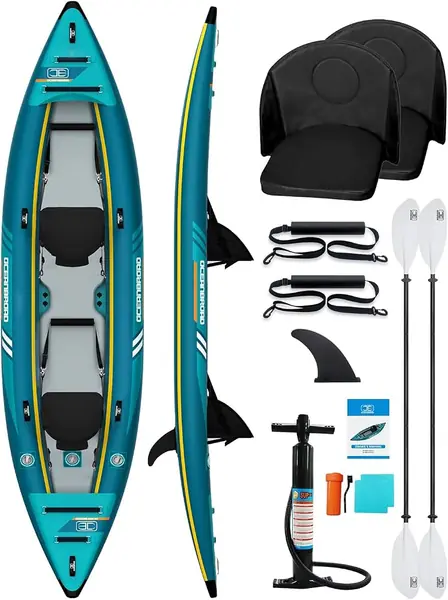
OCEANBROAD V420 Best Tandem for Touring

85 /100
Traveler Score Excellent

Key details

Packed Weight
51.7 lb
Weight Capacity
500 lb
Seating Capacity
2
Inflated Size
13.7 x 2.95 x 0.79 feet
Check Details on Amazon

At 13.7 feet, the V420 is one of the longest tandems here, and that length is the point. It tracks better than the shorter recreational boats, so you spend less energy correcting course. The drop-stitch floor adds rigidity underfoot, and the removable fin helps it hold a line on open water. We like it for lake crossings and slow rivers where a straight track matters.

The seats are padded EVA with back support, and the footrests give both paddlers something to push against. The Halkey-Roberts valves are a step up from the simple Boston valves on the budget boats, and the floor is detachable for cleaning. That last detail is more useful than it sounds after a muddy launch.

The cost is weight. At 51.7 pounds, the V420 is the heaviest boat in this set, and the bag is not something one person wants to carry far. The included pump is also not the strongest, so plan on a better pump or an electric inflator if you paddle often. It is a two-person setup from car to water.

For a couple who wants a touring-style inflatable and does not mind the carry, the V420 is a satisfying paddler. It is less appealing for solo launches or quick after-work sessions.

Pros

  • 13.7-foot hull tracks straighter
  • Drop-stitch floor and removable fin
  • Detachable floor simplifies cleaning

Cons

  • 51.7-pound package is a two-person carry
  • Included pump is weak
Our verdict

A long, rigid tandem for two paddlers who want touring manners and will accept a heavy pack.

Check Latest Price
6

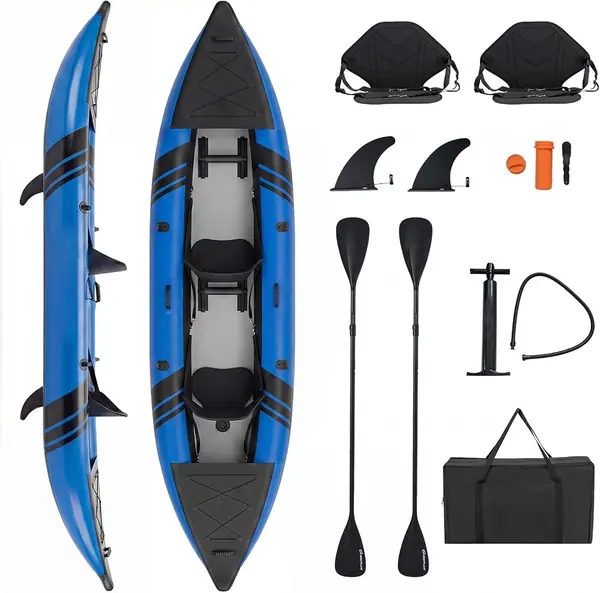
S AFSTAR 2-Person Best Value Drop-Stitch Tandem

84 /100
Traveler Score Excellent

Key details

Packed Weight
39 lb
Weight Capacity
507 lb
Seating Capacity
2
Inflated Size
150"L x 37"W x 16"H
Check Details on Amazon

The AFSTAR is the value play for a rigid-floor tandem. You get a 12.5-foot boat, a 507-pound capacity, and a drop-stitch floor for less than the premium tourers here. The floor is the feature that matters: it makes the boat feel more solid underfoot and less like a pool toy when you push off the beach.

The 16-inch-wide seat area and adjustable seats give two adults room to sit without shoulder-to-shoulder crowding. The paddle holders on both sides are a small convenience that keeps the deck clear when you stop to fish or take a break. The boat comes with paddles, a pump, a carry bag, and a repair kit, so it is ready to launch.

The trade-off is refinement. The included paddles are basic, and the seats are not as supportive as the Sea Eagle pro seats. The 39-pound package is manageable for one person but not a backpacking load. For a couple who wants a rigid floor on a midrange budget, those are reasonable compromises.

We think that makes it the tandem to choose when the budget stops short of a premium tourer but the paddlers still want a firm floor.

Pros

  • Drop-stitch floor at a midrange price
  • 507-pound capacity and 16-inch seat area
  • Paddle holders keep the deck clear

Cons

  • Basic paddles and seats
  • 39-pound package is a one-person carry
Our verdict

A midrange tandem that gives you a drop-stitch floor and a complete kit without the premium touring price.

Check Latest Price
7

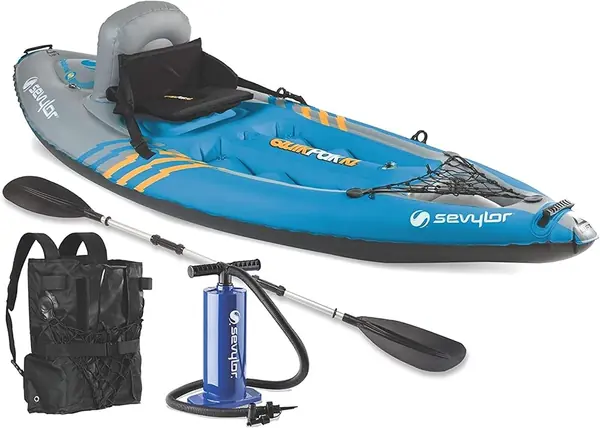
Sevylor QuickPak Best Solo for Travel

83 /100
Traveler Score Excellent

Key details

Packed Weight
20.3 lb
Weight Capacity
400 lb
Seating Capacity
1
Carry System
Backpack converts to seat
Check Details on Amazon

The QuickPak's party trick is the backpack that turns into the seat. That is not a gimmick: it means the carry system and the seat are one piece, so there is less to lose and less to pack. At 20.3 pounds, it is the lightest solo boat here, and it folds small enough to live in a closet or a car trunk.

We like the multiple air chambers for the margin they add: if one chamber is punctured, the others can still keep the boat afloat. The tarpaulin bottom is a sensible guard against beach abrasion, and the 400-pound capacity is generous for a solo boat. It is a calm-lake and slow-river design, not a touring hull.

We wish the included paddle were stiffer; it is the first thing to replace. The center can also sag when the floor is not inflated firmly, so use the pump and check the pressure before launching. Stability is fine for sheltered water but not for chop or strong current.

For a traveler who wants a kayak in the trunk and a short paddle at the destination, the QuickPak is a clever, light solution. It is not the boat for big water.

Pros

  • Backpack converts into the seat
  • 20.3-pound package is the lightest solo here
  • Multiple air chambers add a safety margin

Cons

  • Included paddle flexes
  • Floor can sag if underinflated
Our verdict

The solo travel kayak we recommend for calm water and small storage, with the caveat that the included paddle is the first thing to replace.

Check Latest Price
8

BEYOND MARINA Explorer Best for Premium Touring

80 /100
Traveler Score Excellent

Key details

Packed Weight
38.5 lb
Weight Capacity
507 lb
Seating Capacity
2
Inflated Size
165.35"L x 32"W x 19.7"H
Check Details on Amazon

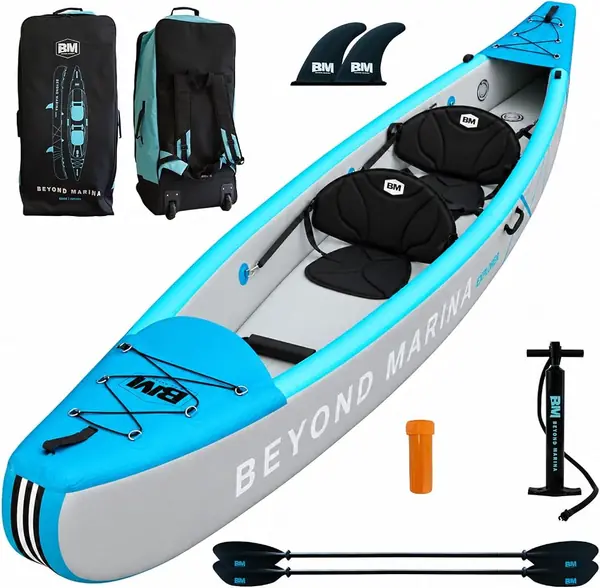
The Explorer's calling card is the wheeled backpack. At 38.5 pounds, it is lighter than most tandems here, and the wheeled bag makes the walk from parking lot to launch much less of a chore. That is a practical advantage you notice before you even inflate the boat.

The hull is full drop-stitch, including the side chambers, and the 19.7-inch depth is deeper than the other tandems here. That combination gives a secure, high-sided feel and a rigid floor. The 507-pound capacity and 13.77-foot length give two adults room to stretch out, and the package includes two paddles, two seats, a fin, footrests, and a repair kit.

The downsides are price and refinement. It is one of the most expensive boats in this group, and the deep hull can catch wind, which makes it trickier to handle than a lower-profile kayak. The skegs are a weak point in shallow water, so be careful around ramps. The seats are adjustable, but the footrests do not work for every paddler.

For a couple who values lighter weight and a wheeled carry above all else, the Explorer is worth a look. For most buyers, the top pick offers a more proven balance.

Pros

  • Wheeled backpack eases the carry
  • Full drop-stitch hull and deep 19.7-inch sides
  • 507-pound capacity and 13.77-foot length

Cons

  • Premium price
  • Skegs can break in shallow water
Our verdict

A premium, lightweight tandem with a wheeled backpack and a deep, rigid hull, though the price and wind-catching hull keep it behind our top picks.

Check Latest Price

How We Tested 12 Inflatable Kayaks on Lakes, Rivers, and a Windy Bay

We started with research, not water: we read spec sheets and owner reviews for every inflatable kayak we could find, then narrowed by floor construction, weight capacity, packed size, and what came in the box, making sure the shortlist spanned budget PVC boats, drop-stitch models, and both solo and tandem layouts. That left 12 kayaks, which we paddled over eight months, from late spring through the first cool weeks of fall.

Each boat was inflated in a driveway with the pump that shipped with it, and we timed how long it took to go from bag to fully firm, noting whether the valves seated cleanly and whether the floor ever reached a stiffness you'd trust. We weighed every packed boat on a bathroom scale, then carried it from the car to the water alone, because that short walk is what actually decides whether a kayak comes along. After each outing we deflated and folded it back into its carry bag and noted how much shoving that took.

On the water we paddled the same three places: a flat local lake, a slow river with a gravel put-in, and a bay that picks up morning chop. We turned figure-eights around buoys, paddled straight into the wind to see whether a boat held its line, swapped seats between testers, and loaded two adults, a cooler, and one very unhelpful dog into the tandems. We also climbed in from a dock and waded in from knee-deep water to gauge how much stability we could count on at the edges.

Durability got checked after every trip — seams, valves, floor, and any skid material on the hull — and we deliberately dragged a few hulls across gravel at the put-in, which is what everyone does anyway. At season's end we looked at the whole package: which included pumps, paddles, and seats we were still using, which we'd quietly replaced, and which boats we reached for on an ordinary weeknight. That last one turned out to be the most honest measure of fun.

How to Choose an Inflatable Kayak

Match the boat to the paddlers and the load

An inflatable kayak's stated weight capacity is a ceiling, not a comfortable target. Two adults plus a cooler and dry bags eat into a 400-pound limit quickly, so a tandem rated for 500 pounds or more gives you margin. Solo boats around 220 pounds suit one average adult; a 400-pound solo like the Sevylor QuickPak leaves room for gear or a dog. Check legroom and seat width too, especially if either paddler is tall.

Seating capacity is also about layout. A three-person boat can be a roomy two-person boat with gear, while a narrow solo cockpit can feel cramped with a life jacket and a dry bag. If you paddle with a child or a dog, choose an open cockpit and a floor that can take a paw or a cooler without sagging. A blow-up kayak is still a kayak, so the same fit questions apply.

Choose the floor before the features

An I-beam floor is the budget standard: it inflates into tubes that give the boat shape, but it flexes underfoot and feels less rigid. A drop-stitch floor is made of thousands of threads that hold the top and bottom surfaces apart, so it can inflate to higher pressure and feel closer to a hard-shell deck. For touring, fishing, or standing to cast, the extra rigidity is worth the cost and packed bulk.

If you paddle calm lakes a few times a summer, an I-beam floor is adequate. If you plan long crossings or want to mount accessories, look for drop-stitch. The Sea Eagle 380x and OCEANBROAD V420 show the difference: both use rigid floors, and both weigh more than the budget boats.

Weigh the carry, not just the kayak

Packed weight is the specification that decides whether the boat actually leaves the garage. A 20-pound solo is a one-person carry; a 35- to 40-pound tandem is a two-trip job for most people; a 50-pound tandem is a two-person lift. The bag matters as much as the number: a wheeled backpack can make a heavier boat easier than a duffel with a thin strap.

Measure the folded package against your trunk, closet, or stairwell. A boat that fits in the trunk but not in the elevator is not portable for you. If you launch alone, stay near the lower end of the weight range; if you always paddle with a partner, a heavier drop-stitch boat is easier to justify.

Budget for seams, valves, and a better paddle

Seams and valves are where inflatable kayaks earn or lose their reputation. Look for welded or overlapped seams, valves that seal cleanly, and a repair kit included. PVC boats can develop pinholes or seam leaks, so rinse and dry the boat before storage and avoid dragging it over sharp rocks. A 90-day warranty is common on budget boats; premium models may offer one to three years.

The included paddle is often the first upgrade. A light, stiff paddle makes a bigger difference than a fancy seat. A manual pump is fine for occasional use, but a dual-action or electric pump saves time if you inflate often. Keep the repair patch, a spare valve wrench, and a towel in the bag.

Frequently Asked Questions

Final Verdict

For most paddlers, the Sea Eagle 370 Pro is the best inflatable kayak in this set because it combines three-person capacity, a 33-pound pack, and whitewater headroom that the budget boats cannot match. If you paddle calm lakes and want the lowest-cost complete tandem, the Intex Explorer K2 is the value alternative. For serious whitewater, step up to the Sea Eagle 380x; for long tandem touring, the OCEANBROAD V420 tracks better and accepts the heavier carry.