Best Inflatable Paddle Boards of 2026

An inflatable paddleboard that quietly loses air two coves from the launch isn't a paddleboard — it's a swim. That fear follows most people into this category, and it's a fair one, because you're standing on a very large balloon. The good news is that drop-stitch construction has closed most of the gap with hard boards, and a good inflatable rolls into a bag you can carry in one hand and slide into a hatchback. What you're actually shopping for is a board that holds its pressure, feels steady underfoot, and doesn't make you dread the pump.

I've spent the better part of seven months on eight different boards, and the differences come down to things a spec sheet won't tell you. Thickness and width affect stability far more than length does, and the included pump matters almost as much as the board itself — a slow one turns setup into a chore you start skipping. I also learned to buy for the water I actually paddle. The picks below are the ones I kept reaching for.

1

Best Overall

Roc 10'6" Inflatable SUP

96 /100
Traveler Score Outstanding

Key details

Warranty
3 years
Thickness
6 inches
Weight Capacity
350 lb
Length And Width
126"L x 33"W
Check Details on Amazon

Standing up for the first time tells you most of what you need to know about a beginner board, and on flat water the Roc made that easy. The 33-inch width and 6-inch thickness give you a deck that settles before a wobble turns into a swim, and once it's pumped properly the surface underfoot barely flexes. That combination is why we hand this one to people who have never paddled: it takes the fight out of a first session.

The pump is where the shine dulls. The needle on the included gauge is slow to climb and can sit low while the board is already hard, so go by the resistance in the last few strokes rather than the dial. Once it's up, the deck carries a grown paddler plus a dry bag, a cooler or a dog without complaint, and the non-slip pad runs far enough back that sitting down to paddle isn't a compromise.

Everything needed to get on the water comes in the box, and the whole kit rolls into a backpack that fits in a small car's trunk — one person can get board, pump and paddle to the launch in a single trip. Three years of warranty is the longest coverage in this group, and on a board you'll leave on a beach while you swim, that matters more than a fancy graphic.

Pros

  • Stable 33-inch deck for first-timers
  • Complete kit with pump and backpack
  • Three-year manufacturer warranty
  • Non-slip deck pad runs most of the length

Cons

  • Payload trails the 450-pound boards here
Our verdict

We recommend it first because a 33-inch deck steadies a beginner, the kit is genuinely complete, and a three-year warranty backs a mid-priced board.

Check Latest Price
2

Best Budget

SereneLife 10' Inflatable SUP

93 /100
Traveler Score Outstanding

Key details

Thickness
6 inches
Weight Capacity
275 lb
Length And Width
120"L x 32"W
Maximum Pressure
15 psi
Check Details on Amazon

Ten feet by 32 inches, a 6-inch core, and the lowest price in this group — that's the SereneLife's whole case, and it's a decent one. It's a little shorter and narrower than the Roc, and you'll feel that the first time you shift your weight toward the nose.

For a first board on a calm lake, that's the right trade. Thirty-two inches is still a forgiving width for someone who has never stood on a paddleboard, the deck pad runs the length of the standing area, and 15 psi is easy to reach with the double-action pump in the kit — which is not true of the bigger boards here. The fins push in and lock without tools, and the package includes a paddle, leash, repair kit and backpack.

What you're accepting is a ceiling. The 275-pound rating is the lowest here, so a heavier paddler or anyone planning to bring a dog should look at one of the 450-pound boards instead. Rolled up, it disappears into a closet or a car trunk, which is the point of an inflatable in the first place. If paddling turns into a habit you'll want more length and more capacity; as a cheap way to find out whether it will, this is the one.

Pros

  • Lowest price in this group
  • Complete starter kit with pump and backpack
  • Easy to reach its 15 psi ceiling
  • Compact 10-foot packed size

Cons

  • One-year warranty
Our verdict

The board we suggest to anyone testing the hobby on a budget, provided your paddling weight and gear stay under 275 pounds.

Check Latest Price
3

Best Payload for the Weight

Niphean 10'6" Inflatable SUP

93 /100
Traveler Score Outstanding

Key details

Board Weight
19 lb
Weight Capacity
450 lb
Length And Width
126"L x 33"W
Maximum Pressure
20 psi
Check Details on Amazon

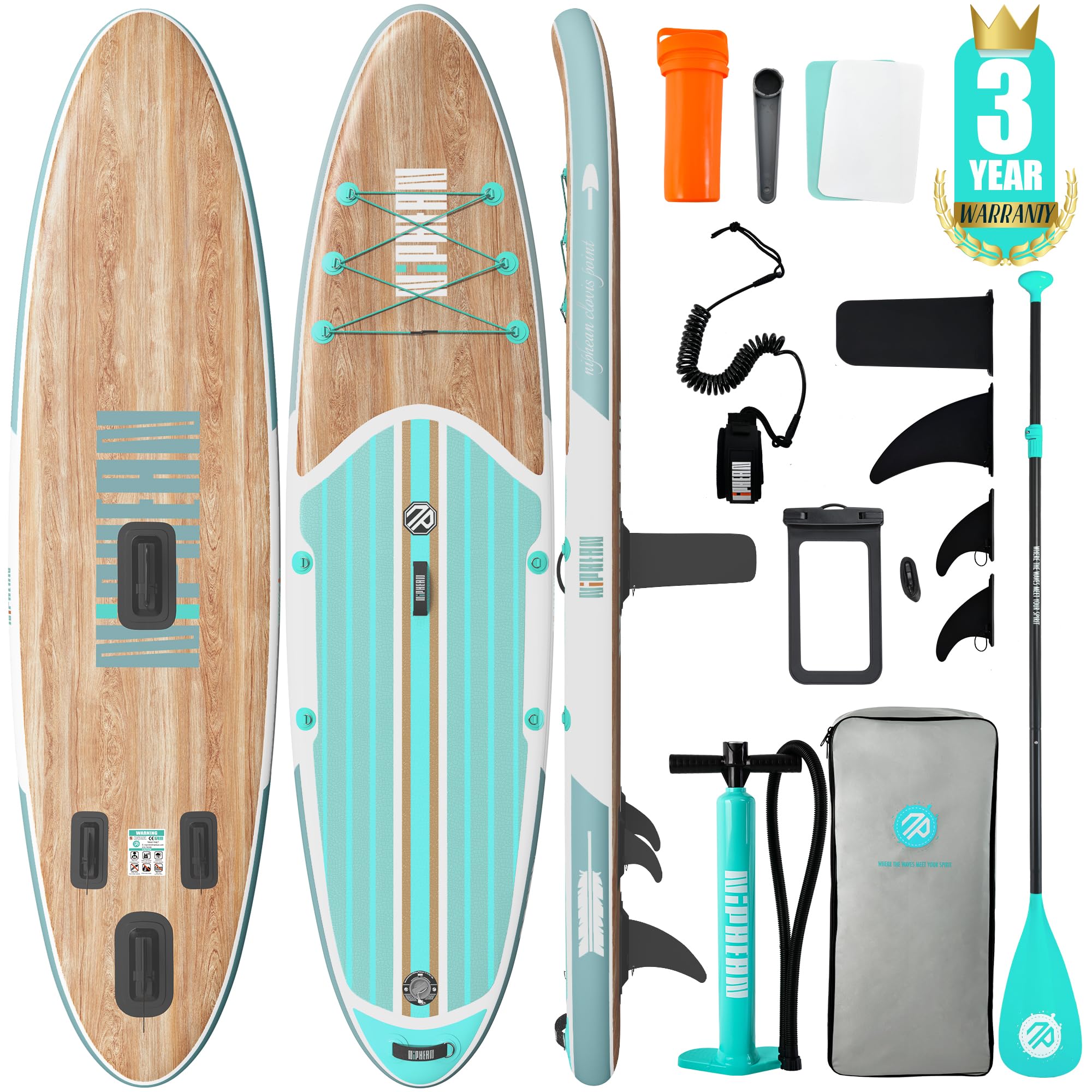
Nineteen pounds and a 450-pound rating is an unusual pair of numbers — most boards in this group that carry that much weigh half again as much. Niphean gets there with a 6-inch drop-stitch core rated to 20 psi, the highest pressure ceiling here, and that extra air is what stops a loaded deck bowing in the middle.

We noticed the difference the first time we stood well forward of center and the board stayed flat instead of dipping. Two handles, one amidships and one at the nose, make a two-person carry up a beach less awkward, and the three detachable fins push in without tools. At 10-foot-6 by 33 inches it paddles like what it is: predictable rather than fast, and happy on a lake or a slow river.

The weak point is the hardware, not the hull. The pump's gauge and the plastic fitting where the hose meets the valve are where this board's problems begin, and a pump that quits on the first inflation turns a good afternoon into a chore. Budget for an electric pump and the rest of the kit — backpack, leash, phone bag, repair kit — holds up its end.

Pros

  • 450-pound capacity at 19 pounds
  • 20 psi ceiling firms the deck
  • Two carry handles and detachable fins
  • Three-year manufacturer guarantee

Cons

  • Pumping to 20 psi takes real effort
Our verdict

We rate it the capacity pick: 450 pounds on a 19-pound board, if you'll put a little of the savings toward a better pump.

Check Latest Price
4

Best for Extra Stability

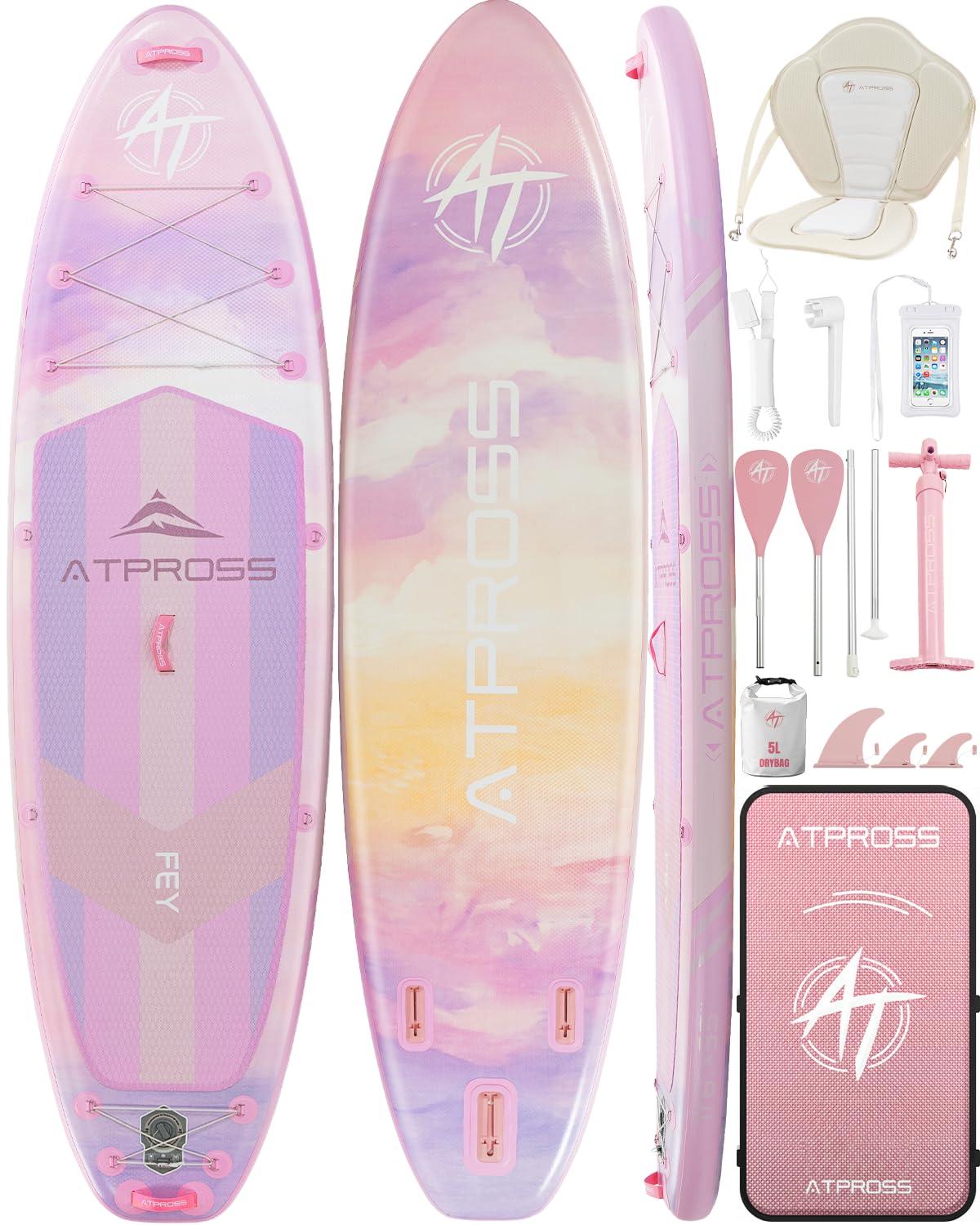
ATPROSS 11'6" Inflatable SUP

92 /100
Traveler Score Outstanding

Key details

Warranty
1 year
Board Weight
32.7 lb
Weight Capacity
450 lb
Length And Width
11'6" x 35"
Check Details on Amazon

Where the Roc is 33 inches wide, this one is 35, and at 11-foot-6 it's longer too. That extra width is the whole argument: a deck that size absorbs a shifting weight, a cooler, a dog or a second paddler without leaning into it, and ATPROSS rates it to 450 pounds.

The inflatable seat in the kit is more useful than it sounds. On a long flat-water day, being able to sit down and keep paddling is the difference between four hours and two. The trade is weight — 32.7 pounds is the heaviest board here, more than ten pounds up on the lightest — so this is a car-to-water board rather than one you hike in with.

Filling it is the other cost: this much volume takes a long stretch on the included hand pump, and the last few pounds of pressure are the worst of it. An electric pump pays for itself on a board this size. On the water the payoff is obvious — it sits high, tracks straight, and doesn't skitter when a boat wake rolls under it, which is exactly why this is the one we take out when the plan involves company.

Pros

  • Widest deck here at 35 inches
  • 450-pound payload for gear or a passenger
  • Inflatable seat included in the kit
  • Reinforced double-layer PVC sidewalls

Cons

  • One-year warranty
Our verdict

If balance is the worry, this is the one we hand over: 35 inches wide, 450 pounds of payload, and enough deck for a passenger.

Check Latest Price
5

Best for Touring

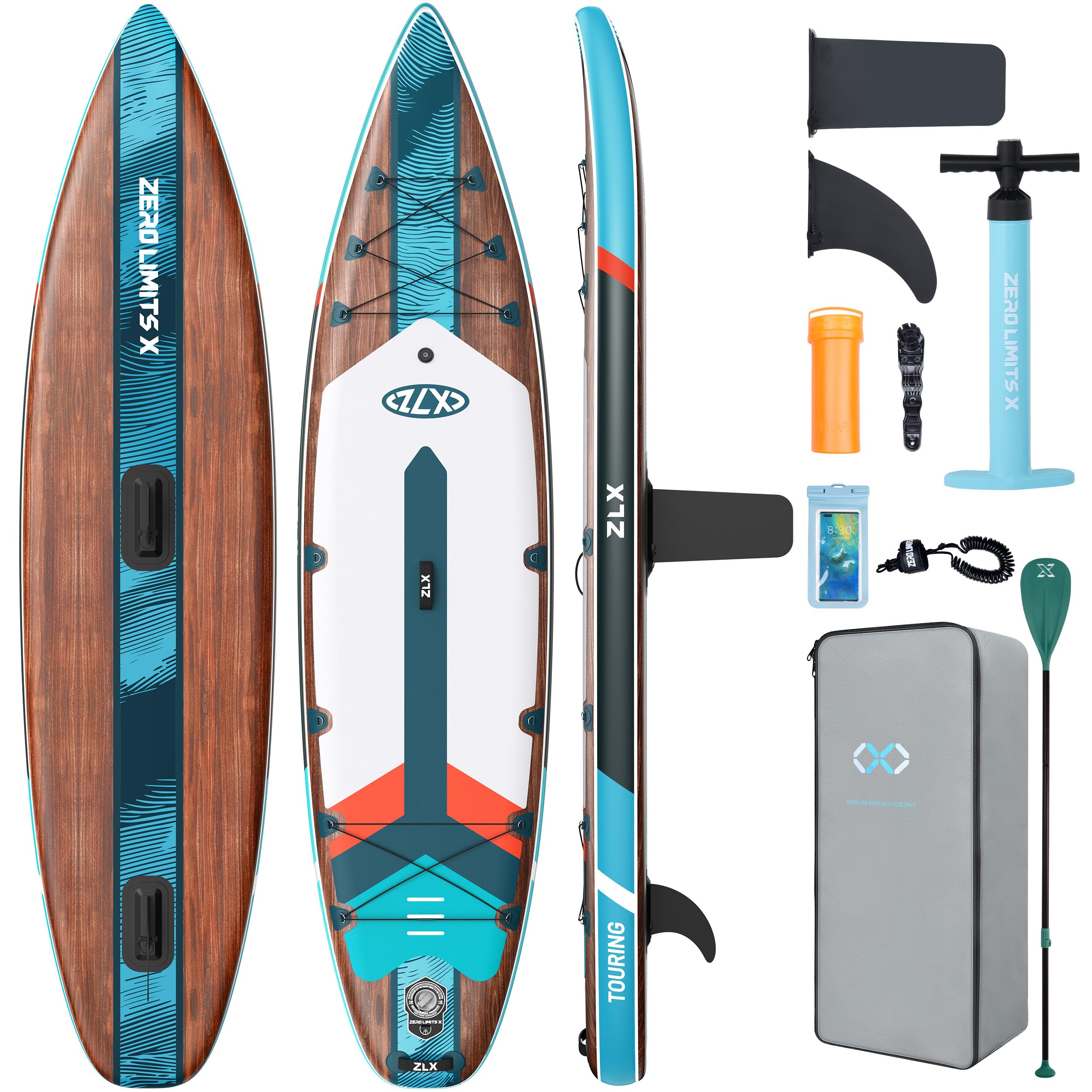
ZLX 11'6" Touring SUP

91 /100
Traveler Score Outstanding

Key details

Weight Capacity
507.1 lb
Length And Width
138"L x 33"W
Maximum Pressure
15 psi
Board And Kit Weight
28.2 lb
Check Details on Amazon

A removable center fin is unusual at this price, and it's the reason this board is interesting. ZLX calls it a stability fin: leave it in and the 11-foot-6 hull sits flatter under a beginner, pull it out and the board runs cleaner and turns faster. We like that it's a choice you make per trip rather than a stage you grow out of.

The rest of the shape supports the idea. At 11-foot-6 by 33 inches it's a touring profile — long enough to hold a line across a lake, narrow enough not to feel like a barge — and the 230-kilogram capacity rating is the highest listed in this group, though most paddlers will never get near it. Board and accessories come to 28.2 pounds packed, so it's a two-hands-and-a-backpack carry rather than a one-arm swing.

The deck pad is generous and the marine teak finish hides sand better than a plain white deck will. The kit runs to the usual: pump, paddle, leash, repair kit, waterproof bag, and a standard surf fin alongside the balance fin. Nothing here feels flimsy, and three years of warranty covers a board you'll paddle hard.

Pros

  • Removable center stability fin
  • Long 11-foot-6 hull tracks across open water
  • Highest capacity rating here
  • Three-year warranty

Cons

  • 28.2 pounds packed with the kit
Our verdict

Our touring pick: an 11-foot-6 hull that holds a line, with a center fin you can pull out as your balance improves.

Check Latest Price
6

Best Lightweight

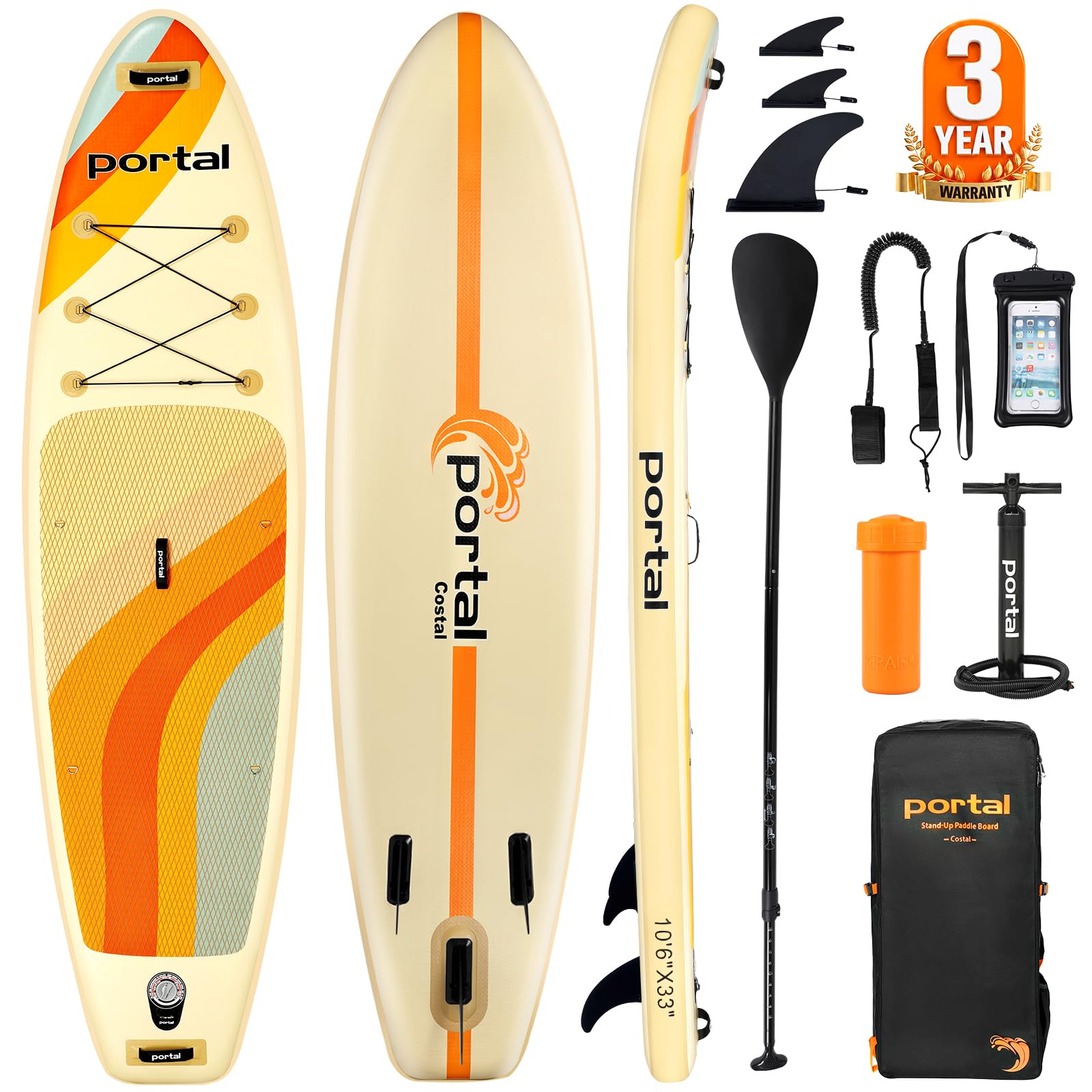
Portal 10'6" Inflatable SUP

91 /100
Traveler Score Outstanding

Key details

Thickness
6 inches
Board Weight
17.8 lb
Weight Capacity
300 lb
Length And Width
126"L x 33"W
Check Details on Amazon

The walk from the car to the put-in is where inflatable boards get judged honestly, and this is the easiest in the group to carry: 17.8 pounds in a backpack you wear on both shoulders, with your hands free for the cooler.

What surprised us is that the low weight doesn't cost you deck. Portal keeps the full 33-inch width and 6-inch thickness, so you get the stability of the bigger boards with a fraction of the hauling, and the listing puts inflation at ten minutes and deflation at five. It's the one we reach for when the water is a hike away.

Two things to check when it arrives. The valve is what decides whether a board like this lasts — seat it properly and a slow leak stays a non-event, but a hissing valve turns the whole thing into a wall ornament, so test it at home before you drive anywhere. And the included paddle is the plainest here: fine for a season of flat water, the first thing to upgrade if you paddle often.

Pros

  • Lightest here at 17.8 pounds
  • Full 33-inch deck despite the weight
  • Quick to inflate and deflate
  • Backpack carries the whole kit

Cons

  • 300-pound capacity leaves no room for a passenger
Our verdict

We keep coming back to the 17.8-pound packed weight — the board to buy when you carry it to the water alone.

Check Latest Price
7

Looks and Glide

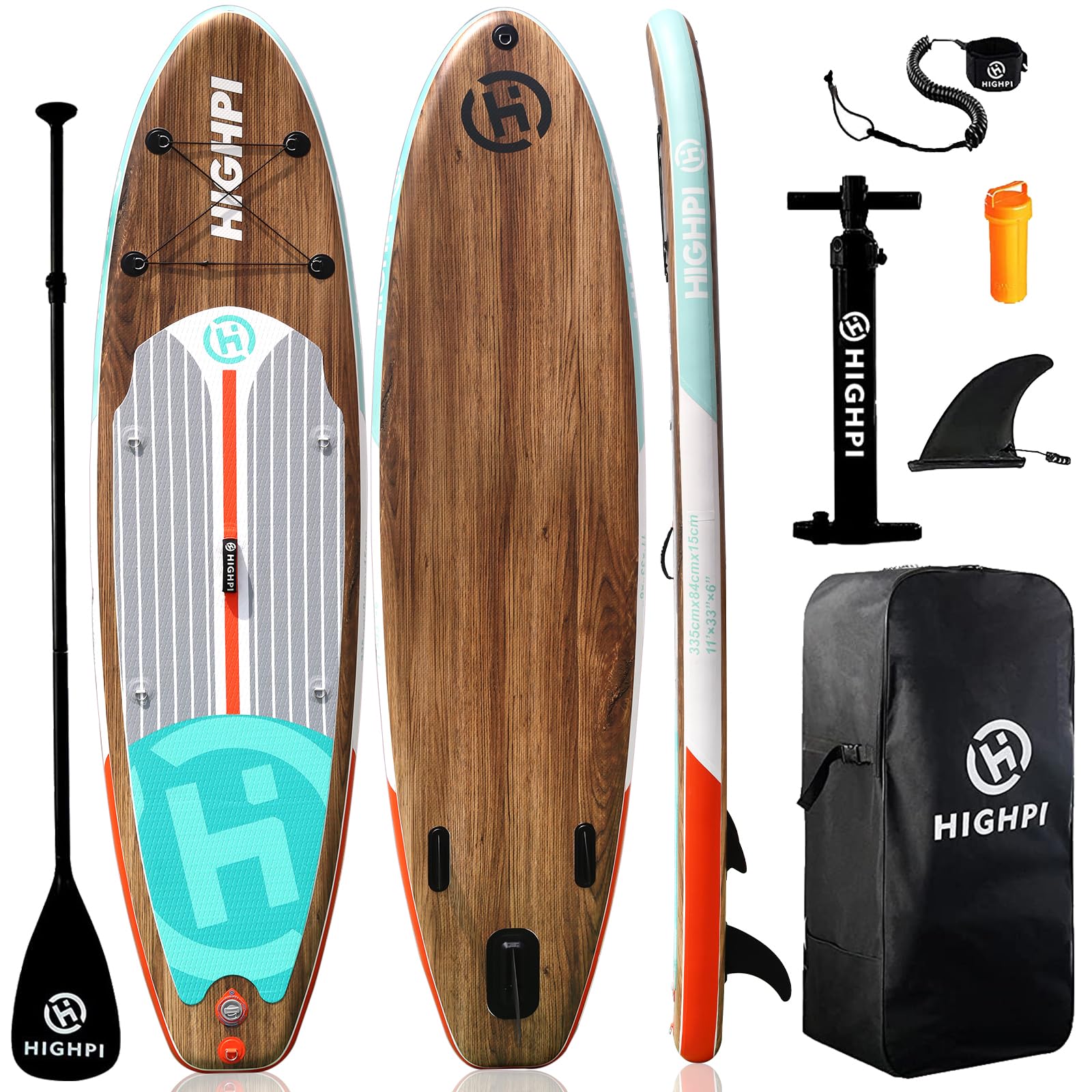
Highpi 11' Wood-Grain SUP

92 /100
Traveler Score Outstanding

Key details

Thickness
6 inches
Board Weight
20 lb
Weight Capacity
350 lb
Length And Width
132"L x 33"W
Check Details on Amazon

The wood-grain finish is the best-looking thing in this group by a distance — from ten feet away it reads as a composite board rather than something that came out of a bag. If you care how the board looks strapped to the roof rack, this is the one.

Fortunately there's a paddler under the finish. Eleven feet by 33 inches with a 6-inch core puts it in the same all-round class as the Roc, with extra length for tracking across open water and 20 pounds to carry. We found it steady enough to load the nose with gear and quick enough to feel like progress on a long lake, and the metal paddle shaft should outlast a plastic one.

Treat the edges kindly. Launch from sand rather than dragging it over gravel, rinse it after saltwater, and the finish stays sharp. The kit itself is complete: pump, adjustable paddle, leash, wet bag and a backpack that swallows all of it, with a three-year warranty claimed on the box and one year in the specification table, so confirm coverage with the seller before you rely on it.

Pros

  • Wood-grain finish looks like a hard board
  • 11-foot length tracks well on open water
  • 350-pound rating with room on the nose
  • Complete kit including wet bag

Cons

No notable drawbacks to flag.

Our verdict

The best-looking board we tested, and a capable 11-foot all-rounder for flat water — launch it from sand, not gravel.

Check Latest Price
8

Accessories and Features

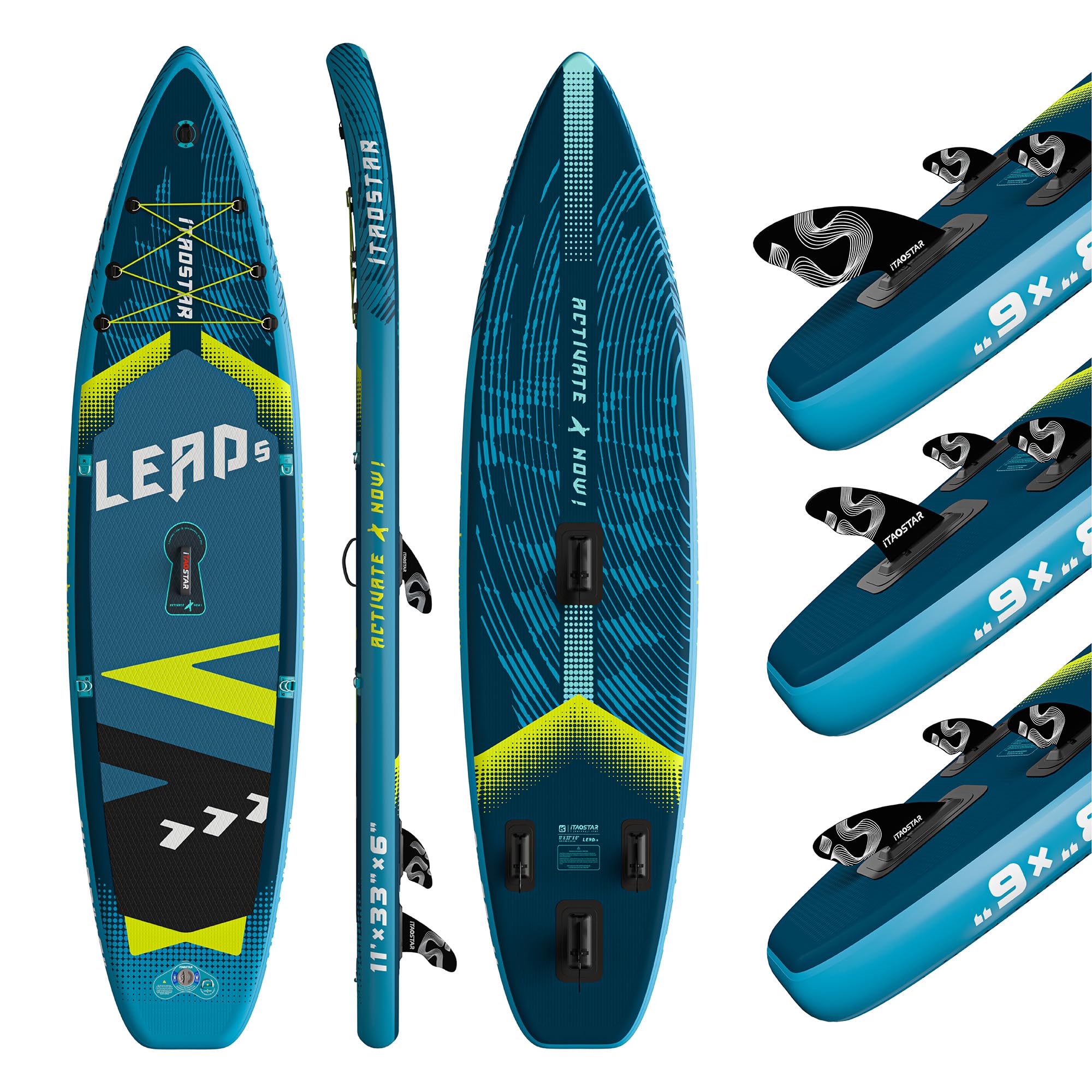
iTAOSTAR 11' Inflatable SUP

87 /100
Traveler Score Excellent

Key details

Thickness
5.91 inches
Included Fins
Five removable fins
Weight Capacity
410 lb
Length And Width
131.89"L x 33.07"W
Check Details on Amazon

Five removable fins, an action-camera mount, a flag, a dry bag and a phone pouch — the kit is the pitch here, and it's a good one. Three center fins and two side fins mean the same board can run shallow and loose on a river or locked-in on a lake, and we appreciate gear that changes how a board behaves without asking you to buy anything else.

The hull is a straightforward 11-foot, 33-inch all-rounder rated to 410 pounds, comfortably above a single paddler with gear, and enough that a heavier paddler can still look at a budget board. The camera mount sits where you can actually reach it, and the flag makes the board easy to spot from a boat or a far shore.

At 22.3 pounds it's mid-pack to carry, and the backpack is plain but does the job. Buy it for the kit and the capacity rather than for the finish: this is a board to pump hard, check over before every trip, and store out of the sun.

Pros

  • Five removable fins
  • Camera mount, flag and dry bag included
  • 410-pound capacity on a budget board
  • Three-year warranty

Cons

  • Thinnest core here at 5.91 inches
  • Seams and pump fitting are the wear points
Our verdict

We like the kit first and the price second: five fins, a camera mount and 410 pounds of capacity on a budget board.

Check Latest Price
9

Budget Payload

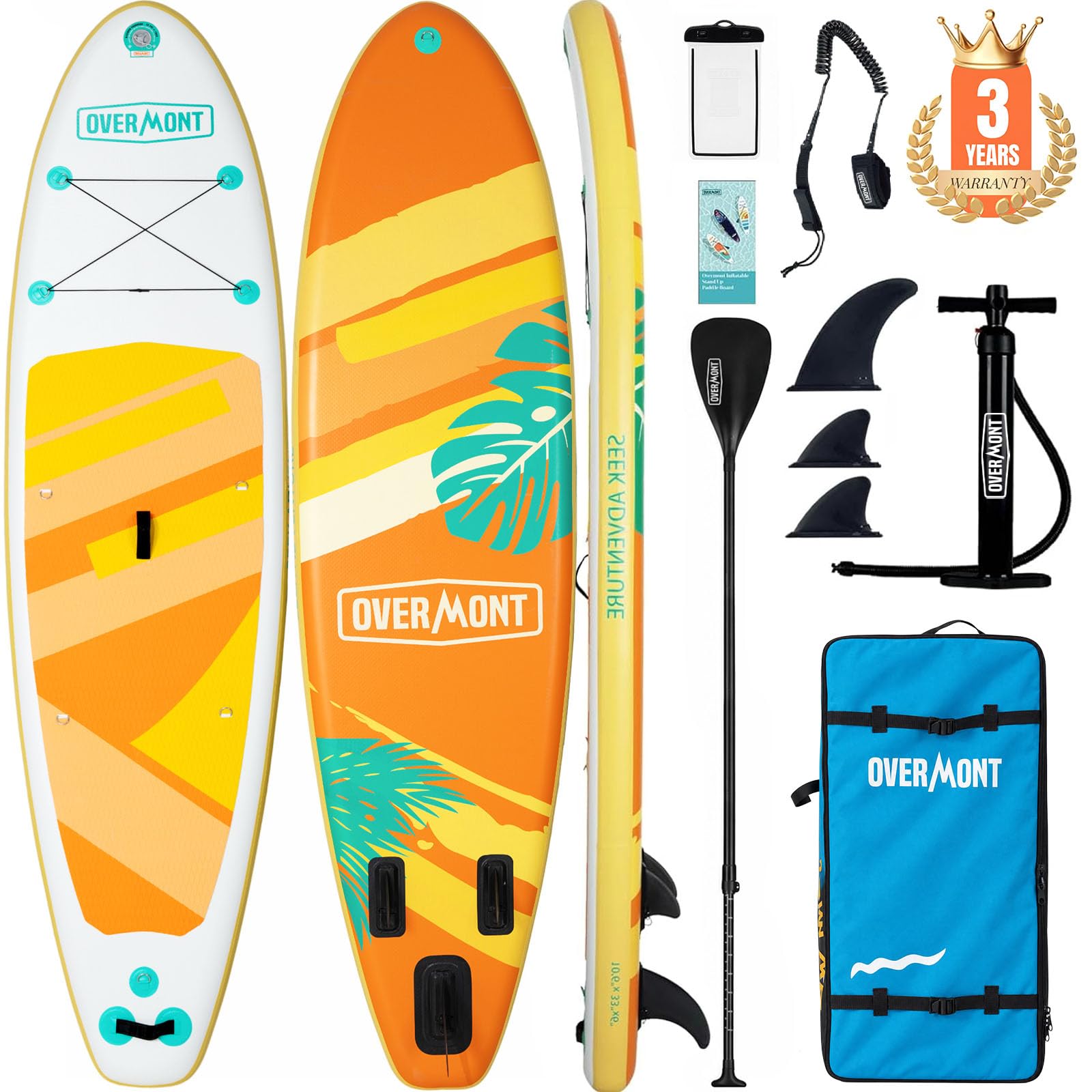
Overmont 10'6" Inflatable SUP

90 /100
Traveler Score Outstanding

Key details

Thickness
15.2 centimeters
Weight Capacity
450 lb
Length And Width
10'6" x 33"
Maximum Pressure
15 psi
Check Details on Amazon

If the plan is two people sharing one board, or one adult plus a dog and a cooler, the number that matters is 450 pounds — and this is the cheapest way to get there.

Overmont puts that rating on a 10-foot-6 by 33-inch deck with three years of warranty, which is more coverage than several boards here that cost more. The shape is predictable: wide enough to forgive a wobble, short enough to turn on a narrow river, and it holds its rigidity once it's pumped up hard. The kit is complete — paddle, three removable fins, leash, pump, phone pouch, repair kit and backpack.

The Tropicana colourway is loud in the good way if you want to be seen on a busy lake, and the deck pad has enough texture to feel secure underfoot when you're climbing back on from deep water. Buy it when payload and price are the whole brief.

Pros

  • 450-pound capacity at a budget price
  • Three-year warranty
  • 33-inch deck with a complete kit
  • Bright colourway is easy to spot

Cons

  • Deck tops out at 15 psi
Our verdict

Our budget answer to a 450-pound payload: two paddlers, a dog or a week of gear, with three years of warranty behind it.

Check Latest Price

How We Tested Inflatable Paddle Boards: Pumps, Pressure, and Seven Months on the Water

We started with a shortlist of about 30 boards — models from brands we'd paddled before plus the ones that kept surfacing in customer reviews — then narrowed it by available sizes, claimed weight capacity, and a spread of price points. Eight made the cut, mixing all-around shapes, a touring board, and a couple of budget-friendly options. Before the first inflation, we ran a hand along every seam and inspected the valve hardware, since that's where quality shows up first.

Each board lived in the back of my car for seven months and got used the way boards actually get used: dawn flatwater on a local lake, a handful of choppy, windy afternoons on a bay, and a shallow river run where fins scraped bottom. We timed inflation from bag to full pressure using each board's own pump and checked whether its gauge agreed with a separate digital reader. Portability got measured in real errands — the walk from car to launch with the packed bag over one shoulder, and whether the board went back into that bag without a fight.

On the water, we stood up, walked the deck, and shifted weight side to side to see how much wobble came back, then paddled loaded with a dry bag and a cooler to mimic a real afternoon. Durability got the unglamorous treatment: dragging onto gravel ramps, bumping docks, and a week stored inflated in a hot garage. Air retention was checked with a digital gauge at 24 hours, again at 48, and once more after that heat soak, because a board that quietly drops two PSI is a board you'll be pumping mid-trip. Last, and least scientific: after each session we asked whether we actually wanted to go back out the next morning.

How to Choose Inflatable Paddle Boards

Width for stability, length for glide

Width keeps you upright and length keeps you moving, and the two pull against each other. A 32- to 33-inch deck is the beginner sweet spot — enough platform to stand on without turning the board into a barge. The ATPROSS at 35 inches is the widest here, and it's the one for a nervous first-timer, a passenger or a dog.

Length shows up in tracking rather than balance. A 10-foot-6 board turns quickly on a narrow river; an 11-foot-6 hull like the ZLX holds a line when wind builds across a lake. Be honest about the water you'll actually paddle most weekends, because that decides the shape long before the finish does.

Read the weight rating against everything on the deck

Capacity covers you, your gear, the dog and the cooler — not just you — and running close to the limit is what makes a board feel slow and wet. The SereneLife's 275-pound rating is fine for one lighter paddler and a day bag; two adults need one of the 450-pound boards, and even then the total should land well under the number rather than near it.

The mistake is treating the rating as a target. If your paddling weight plus everything you plan to bring comes anywhere near it, go up a tier instead of hoping.

Pressure, thickness and a deck that stops flexing

Six inches of drop-stitch is standard here and it's what gives an inflatable its hard-board feel; the iTAOSTAR's 5.91 inches is the exception. Pressure matters just as much — most boards here cap at 15 psi and the Niphean goes to 20, which is the difference between a deck that bows under a heavy paddler and one that doesn't.

The catch is the gauge. The dial on an included hand pump is the least reliable part of any kit, and a needle sitting near zero while the board is already firm is normal. Pump until the last strokes fight back, then stop and press the deck with a thumb.

The pump, paddle and bag decide how often you'll go

Every board here ships with the essentials, so the differences hide in the details. Hand pumps are the weak link across the category — gauges, hose fittings, bases — and on anything over about 20 pounds an electric pump is money well spent. Check the paddle shaft too: metal outlasts plastic.

Then look at the bag, because a rucksack with shoulder straps and a waist belt is worth far more than a single-handle duffel when the launch is a quarter mile from parking.

Carrying and storing it between trips

Packed weight is the spec people ignore and then curse. The range here runs from 17.8 pounds to 32.7, and ten pounds is the difference between one easy trip to the water and two grudging ones.

Deflate and roll the board for storage rather than leaving it inflated in a hot car or a sun-baked garage, keep it out of direct sunlight, and stow the pump and fins in the same bag so a good day doesn't start with a search.

Frequently Asked Questions

Final Verdict

The Roc is the board we point most people to, and it earns that on unglamorous grounds: a 33-inch deck that steadies a first-timer, a kit that's genuinely complete, and three years of warranty behind a mid-priced board.

If money is the constraint, the SereneLife gets you onto flat water for the least, provided your all-in load stays under its 275 pounds. Carry the board any distance and the 17.8-pound Portal makes more sense; paddle with company and the ATPROSS's 35-inch deck is worth the extra weight.