Best Hiking First Aid Kits of 2026

The scrape happens two miles from the trailhead, usually when the bandage you packed three summers ago has lost its sticky. A hiking first aid kit is not about summit emergencies; it is about the small stuff that can end a trip early—a hot spot turning into a blister, a cut from a granite edge, a twisted ankle on a root. The right kit is complete enough to be useful, compact enough to live in your pack without a second thought, and well made enough that the contents are usable when you open it.

Over six months, my team and I tested 12 kits on day hikes, overnight backpacking trips, and family walks, comparing contents, packed size, portability, and value. A kit can look thorough on the shelf and be mostly filler; it can also be tiny enough to forget and too skimpy for a real scrape. The ones that earned a spot in our packs were the ones we could carry without noticing and open with cold, muddy hands. Here are the kits that held up.

1

Best Overall

Protect Life Travel First Aid Kit

95 /100
Traveler Score Outstanding

Key details

Case
Waterproof plastic case
Pieces
100
Weight
9.88 oz
Case Size
7.5 x 5.2 x 1.5 in
Check Details on Amazon

An inch and a half is the number that decided our top pick. The Protect Life case measures 7.5 by 5.2 by 1.5 inches, so it slides down a pack's back panel or lies flat against a hydration sleeve instead of pushing into your spine. We moved it from a stuff sack to a lid pocket and nothing else in the pack had to shift to make room.

Inside are 100 pieces: several bandage shapes, gauze, antiseptic wipes, gloves, and scissors, plus a thermal blanket and a doctor-written first aid guide. The blanket is the item we didn't expect to care about, since it weighs almost nothing and covers the evening a turned ankle makes you late. The guide earns its place when you're the one improvising five miles from the trailhead.

The case is waterproof and zips shut, which matters on a trail in a way it doesn't in a bathroom cabinet. Rain, creek spray, and the damp bottom of a pack are all normal conditions, and a kit that turns into a soggy bundle is one you stop trusting. At 9.88 ounces it lands in the middle of this group.

Opening it is undramatic, which is how we like a first aid kit: the case lies open, the contents sit in their own sections, and repacking takes a minute rather than a search. Ours rides at the top of a 22-liter daypack, where a hand finds it without the pack coming off.

Pros

  • Flat 1.5-inch case fits a pack panel
  • Waterproof case with a zip closure
  • Doctor-written first aid guide included
  • Thermal blanket for unplanned nights out

Cons

  • Widest footprint of the small kits here
Our verdict

We think this is the kit most hikers should buy: flat enough to forget, waterproof, and stocked with a guide that helps when you're improvising.

Check Latest Price
2

Best Organization

Vriexsd Mini 150-Piece Kit

96 /100
Traveler Score Outstanding

Key details

Case
Waterproof EVA shell
Pieces
150
Weight
10.9 oz
Case Size
6.49 x 4.92 x 2.76 in
Check Details on Amazon

Packing 150 pieces into a case that measures 6.49 by 4.92 by 2.76 inches takes some engineering, and Vriexsd does it with sleeves and labeled compartments rather than one deep cavity. Open the zip and nothing has migrated: gauze sits with gauze, wipes with wipes.

That layout is why it earned a place in this guide. On a trail you're usually searching one-handed with the other hand holding a bandage, and separate sections turn a two-minute rummage into a five-second grab. The EVA shell is waterproof and stiff enough to protect what's inside, and the included carabiners let you hang the kit off a pack when the interior is already full.

The sleeves only stay tidy if you put things back where they came from, a two-second habit that keeps the kit quick for the rest of the trip. The contents also lean toward dressings, so check the packing list for antibiotic ointment and add a small tube if it isn't there.

Pros

  • Categorized sleeves make one-handed searching easy
  • Waterproof EVA shell protects the contents
  • 150 pieces in a 6.5-inch case
  • Carabiners for clipping outside a pack

Cons

  • Heaviest of the small hard-shell kits at 10.93 ounces
Our verdict

For hikers who want to find the right thing fast, this is our pick: labeled compartments, a waterproof shell, and 150 pieces in a six-inch case.

Check Latest Price
3

Best Ultralight

General Medi Mini 110-Piece Kit

95 /100
Traveler Score Outstanding

Key details

Case
Soft mini pouch
Pieces
110
Weight
5.6 oz
Case Size
7.1 x 1.9 x 5.1 in
Check Details on Amazon

5.6 ounces is the whole argument for the General Medi kit. It's the lightest full kit in this group, a little over half the weight of our top pick, and it still carries 110 pieces, including a foil emergency blanket, scissors, and dressings, in a 7.1 by 1.9 by 5.1-inch pouch. For a fast-and-light day where every item gets argued over, it's the one we tuck into a lid pocket and forget about.

The saving comes out of the case. A soft pouch keeps the weight down but doesn't hold its shape inside a pack, so we slide it in beside something rigid rather than at the bottom under a stove. For a solo hiker on a marked trail that's the right bargain, and it's the kit we reach for on short, quick days. If the kit will be thrown in a truck bed for seasons, spend the ounces on a hard shell instead.

Pros

  • Lightest full kit here at 5.6 ounces
  • 110 pieces including foil blanket and scissors
  • Budget price for the contents

Cons

  • Soft pouch with bagged contents, not a hard case
Our verdict

We count this as the lightest way to carry a real kit: 5.6 ounces, 110 pieces, and a foil blanket, as long as a soft pouch works for you.

Check Latest Price
4

Best for Small Packs

Atickyaid 120-Piece Hard Shell Kit

95 /100
Traveler Score Outstanding

Key details

Case
Waterproof EVA hard case
Pieces
120
Weight
7.9 oz
Case Size
5.9 x 4.3 x 1.9 in
Check Details on Amazon

Smaller than our top pick in every dimension and roughly two ounces lighter, the Atickyaid is the kit we point to when a pack has no spare flat space. At 5.9 by 4.3 by 1.9 inches it fits a lid, a front pocket, or the gap beside a water bottle, and the 120 pieces inside reach the edges of the case.

The closure is what we appreciate most. The zip runs around the case so it opens like a book, which means you can lay both halves down and see everything at once instead of digging into a pouch, and it shuts with one pull when you're in a hurry. The rigid EVA shell means a pack set down on top of it isn't a problem.

It sits at the budget end of this set despite the hard case, which makes it a straightforward recommendation for anyone who wants a proper shell without paying for one. The shell is the part we stopped worrying about first: it takes a loaded pack's weight on top and still holds its shape.

Pros

  • Opens flat like a book for easy sorting
  • Waterproof rigid shell protects supplies
  • 120 pieces in a 5.9-inch case
  • Budget price for a hard-shell kit

Cons

  • Case is packed full, so repacking takes care
Our verdict

Our pick for small packs: a zippered hard shell that opens flat, packs into a lid, and still holds 120 pieces.

Check Latest Price
5

Best for Group Hikes

Band-Aid All-Purpose 160-Piece Kit

96 /100
Traveler Score Outstanding

Key details

Pieces
160
Weight
1.19 lb
Case Size
9.5 x 7 x 3.25 in
Medications
Neosporin, Benadryl, Tylenol
Check Details on Amazon

Most kits in this set give you bandages. The Band-Aid 160-piece goes further, with Neosporin antibiotic cream, Benadryl for bites and rashes, and Tylenol for pain. On a hike those are often what separates patching a scrape from handling the thing that ends the day early: a sting, an itchy rash, or a headache three miles from the trailhead.

The catch is the box. It's the biggest and heaviest kit we're recommending, hard plastic with organized compartments, and no amount of clever packing makes it disappear into a small daypack. This one lives in a car, a cabin, or a basecamp bin, and it's happiest there.

Where it earns its place is with groups. For a family of four on a popular trail, or a scout group whose leader carries supplies for everyone, the extra weight buys medications and a spread of bandage types a solo hiker never touches. Split the contents between two packs and it stops feeling heavy at all.

For us it's the group kit rather than the personal one. Hike alone and a flatter, lighter case does the same job for a fraction of the weight; be the person everyone turns to when someone goes down, and this is the one worth carrying.

Pros

  • Includes Neosporin, Benadryl, and Tylenol
  • Wide assortment of bandage styles and sizes
  • Organized compartments in a hard case

Cons

  • 1.19 pounds and 3.25 inches thick
Our verdict

For group hikes and basecamps, this is the kit we hand over: real medications, 160 pieces, and a hard case, if you can spare 1.19 pounds.

Check Latest Price
6

Short Local Walks

DMI Mini 20-Piece Kit

94 /100
Traveler Score Outstanding

Key details

Case
Water-resistant case
Pieces
20
Weight
1.76 oz
Case Size
4 x 1 x 3.5 in
Check Details on Amazon

Twenty pieces sounds like a toy kit until you read the list: six alcohol swabs, two gauze pads, a bandage roll, tape, and ten adhesive bandages in a case 4 by 1 by 3.5 inches. That's a job description rather than a full kit. Clean a cut, cover it, keep moving.

What it leaves out matters just as much. There are no gloves, no tweezers for a splinter or a tick, nothing for a blister or a sting, and no blanket. On a short loop you know well, that's an acceptable gamble. On a long, remote day it's the wrong kit to rely on alone, and we don't treat it as one.

At 1.76 ounces it's the one that never gets left behind, which is the metric that decides whether a first aid kit is any use at all. We keep it in a hipbelt pocket on familiar trails with a strip of tape and a couple of blister plasters added, and the bigger kit goes in the pack on the long days.

Pros

  • 1.76 ounces, small enough for a pocket
  • Covers cleaning and covering a cut

Cons

  • Water-resistant case rather than waterproof
Our verdict

We carry this one on short, familiar hikes as a supplement, not as the only first aid kit in a pack.

Check Latest Price
7

Car and Camp

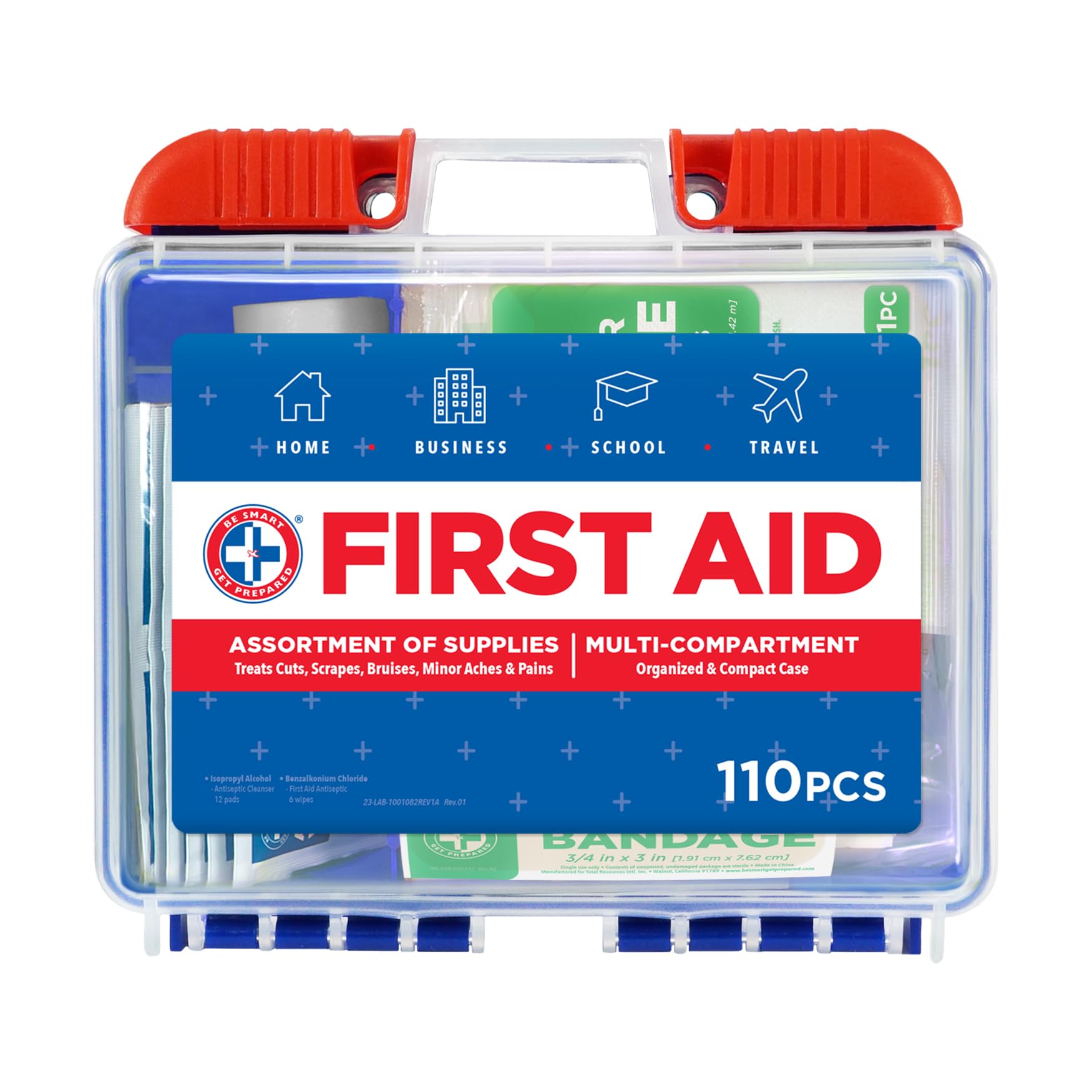
Be Smart Get Prepared First Aid Kit

95 /100
Traveler Score Outstanding

Key details

Case
Hard plastic case
Weight
11.4 oz
Case Size
7.5 x 2.5 x 6.75 in
Check Details on Amazon

The Be Smart kit arrives packed to the lid. The case measures 7.5 by 2.5 by 6.75 inches, so it's a flat, wide box that slides under a car seat or stands up in a gear bin, and the hard plastic is impact resistant enough to handle either spot.

Two easy-slide latches hold it shut, which is the part that matters when a kit lives in a vehicle. A lid that pops open in a hot car leaves you with a glovebox full of loose bandages, and these click firmly enough that we stopped thinking about it after the first trip.

For a car, a camper, or the pack that hangs by the door for local walks, the sturdy case and low price make it an easy yes. For a long hike where everything depends on what's in the bag, we prefer a smaller kit with a more deliberate contents list.

Pros

  • Hard plastic case with secure slide latches
  • Budget price for a large kit
  • Flat shape slides under a car seat

Cons

  • Bandage-heavy contents need gauze and tape added
Our verdict

We keep this one in the car: a sturdy, budget kit for short local walks that needs gauze and tape before a long hike.

Check Latest Price

How We Tested Hiking First Aid Kits

We built a shortlist from kits sold by outdoor retailers and camping brands, then filtered by packed weight, contents, construction quality, and price. Anything stuffed with unlabeled packets or sealed in a pouch that felt likely to split inside a pack was cut early. That left 12 kits, which we tested over six months on day hikes, overnight backpacking trips, and neighborhood walks with kids.

Each kit rode in a hipbelt pocket, a top lid, or a daypack's front pocket, depending on its size, so we could tell which ones disappeared into a pack and which ones became a lump. We weighed every kit packed, opened and closed it with cold hands, and checked the zippers, buckles, and pouches after repeated use. On trail, we dealt with blisters, scrapes, splinters, and headaches, noting whether gauze stayed put, tape stuck to damp skin, scissors cut cleanly, and antiseptic wipes were still moist.

Completeness was judged against the injuries that actually happen on a hike, not the longest contents list. We counted usable items, checked expiration dates and sterile packaging, and priced out replacing the basics to see whether a kit was good value or just a lot of filler. Kits that were too bulky for a daypack or too thin for an overnight trip got marked down no matter how neatly they were organized.

How to Choose Hiking First Aid Kits

Start With Weight and Packed Shape

Two kits can hold similar supplies and feel completely different in a pack. Our lightest full kit weighs 5.6 ounces in a soft pouch; the 160-piece Band-Aid case runs 1.19 pounds and 3.25 inches deep. The first disappears into a lid pocket, the second needs its own real estate.

Decide where the kit will live before you buy. A flat, inch-and-a-half case like our top pick wants a back panel or a lid, while a wide pouch wants a front pocket. If nothing in your pack has a home for it, it ends up staying in the car.

Read the Contents, Not the Count

A high piece count is mostly small adhesive bandages. What actually treats a trail injury is gauze, tape, antiseptic wipes, gloves, and tweezers for a splinter or a tick, plus blister coverage if you're going far. Look for a kit that names those items and their quantities.

Expect to add a couple of things yourself. Our 20-piece pick is honest about being a cut-and-scrape kit; a 150-piece case that skips wound cleaning is a bigger number without more capability.

Look Hard at the Case

Cases fail in ordinary ways: a zip that jams with cold fingers, a soft pouch that lets gauze turn to dust, a lid that stops latching after the fifth opening. A waterproof hard shell earns its weight in rain and creek spray, and a case that opens flat lets you lay supplies out on a rock.

Try the closure before a trip. If it takes two hands and a level surface at the kitchen table, it will be worse on a slope with a wind blowing.

Plan for Refills and Expiry

Every kit is a consumable. Bandages get used, creams and medicated items carry dates, and sterile packets stop being sterile once torn. Buy a case with a little slack so a spare tube or extra gauze has somewhere to go.

Check the kit each spring and again before a long trip. Writing the earliest expiry date on the outside of the case with a marker turns a five-second glance into a real answer about whether it's trail-ready.

Frequently Asked Questions

Final Verdict

Most hikers should buy the Protect Life kit. It's flat enough to slide into a pack panel, waterproof, stocked with a guide that helps when you're the one improvising, and 9.88 ounces is a fair price in weight for a hundred pieces. It asks you to give up footprint, not capability.

If your pack is genuinely small, the Atickyaid hard shell takes less room and opens like a book. If weight is the only number you care about, the General Medi pouch is the lightest full kit here, and the Band-Aid case is the one to carry when you're responsible for a group.