Best Camping First Aid Kits of 2026

The cut happened at dusk, on a picnic table, from a can lid — and the only kit in camp held forty adhesive bandages, blunt scissors, and nothing that would stop a real bleed. That is the trap with camping first aid kits: the big number on the front of the box tells you almost nothing about what you can actually do with one at 9 p.m. with a headlamp clamped in your teeth. A good kit buys you the ability to handle a burn, a sprain, or a deep cut without breaking camp, and to put your hand on the right thing in the first thirty seconds rather than the fifth minute.

Over the past six months my team and I have carried 12 kits into the field, from featherweight pouches that disappear into a daypack to hard cases sized for a family's basecamp. The lesson that kept repeating: most kits pad their item count with bandages while skimping on gauze, tape, gloves, and anything to irrigate a wound. What separates the good ones is less about volume than organization — whether the bag still seals, and still makes sense, after you have opened it in the rain. The picks below are the ones I would hand to a friend heading out for the weekend.

1

Best Overall

Protect Life Travel First Aid Kit

95 /100
Traveler Score Outstanding

Key details

Case
Waterproof hard shell
Pieces
100
Weight
9.88 oz
Dimensions
7.5 x 5.2 x 1.5 inches
Check Details on Amazon

Flat is the thing we kept coming back to. At 7.5 by 5.2 by 1.5 inches this case slides down the back panel of a daypack or into a lid pocket the way a paperback does, and the hard shell keeps gauze dry when everything else in the tent is damp. Mid-trip we handed it to someone who had never opened it and they found the gauze without a briefing, which is the test a kit actually has to pass.

The hundred pieces lean toward wound care: assorted bandages, gauze, antiseptic wipes, gloves, scissors, and a thermal blanket. The printed guide is what we didn't expect to value so much. On a trip where the nearest clinic is an hour of rough road away, a page that walks you through a burn or a sprain is worth more than another ten bandages.

The case has a little slack in it, enough for the painkillers and antihistamine your group actually uses rather than the ones a manufacturer guessed at. That small margin matters more than it sounds: a kit you can top up is a kit that stays relevant to the people carrying it.

What earns it the top spot is the balance — weather protection, a shape that disappears into a pack, and enough supplies for two or three people over a long weekend. It is the one that leaves the shelf first when we're packing for a trip with a long drive at the far end.

Pros

  • Sealed hard case that packs flat
  • Printed first aid guide included
  • Thermal blanket and gloves in the box
  • A little room for your own additions

Cons

  • Supply depth suits a weekend, not a long expedition
Our verdict

The camping kit we reach for first: a slim sealed case that vanishes into a pack and still covers the wound care a weekend produces.

Check Latest Price
2

Best for Day Hikes

Vriexsd Mini First Aid Kit 150

96 /100
Traveler Score Outstanding

Key details

Case
Waterproof EVA hard shell
Pieces
150
Weight
10.9 oz
Dimensions
6.49 x 4.92 x 2.76 inches
Check Details on Amazon

Two kits here use a waterproof EVA shell, and this is the shorter, chunkier one — which decides where it rides. At 6.49 by 4.92 by 2.76 inches and 10.93 ounces it drops into a hipbelt pocket or a lid, and the deep body means the scissors and tweezers don't get bent the way they do in a flat pouch.

Inside, the 150 pieces sit in labelled sleeves rather than one main compartment, so the povidone-iodine swabs and the dressings stay put after a day of being sat on. Two carabiners come in the box, and clipping the case to a strap or a tent loop is the detail we used most — it hangs out of the way until someone needs it.

The antiseptic here is povidone-iodine rather than a cream, and a couple of the extras are survival odds and ends — a whistle, safety pins — instead of more gauze. If antibiotic ointment is part of your routine, add a small tube; there's just enough slack inside for it.

Pros

  • Waterproof EVA shell with labelled sleeves
  • Two carabiners for clipping to a pack
  • Full-size scissors and tweezers

Cons

  • Deeper body takes more space than a flat kit
Our verdict

Clipped to a strap or stuffed in a lid, this is the kit we take when the pack is small and the day is long.

Check Latest Price
3

Best Ultralight

General Medi Mini First Aid Kit

95 /100
Traveler Score Outstanding

Key details

Pieces
110
Weight
5.6 oz
Dimensions
7.1 x 1.9 x 5.1 inches
Check Details on Amazon

Five point six ounces is the entire pitch. This is the lightest kit in this group by a wide margin — less than half the weight of our top pick — and on a fast overnight or a long walk in, that is the difference you feel at the end of the day rather than at the start.

The 110 pieces cover cleaning and dressing: bandages, gauze, antiseptic wipes, scissors, safety pins, a foil blanket that folds down to roughly the size of a deck of cards, and a CPR face shield. The pouch is soft, thin, and about the size of a paperback, so it goes in a jacket pocket or a fanny pack and stops being something you have to plan around.

What it won't do is keep itself tidy. Everything lives in one bag, so repacking it in a breeze takes a minute and a flat rock. For a two-day trip with one or two people, that's the right trade — you're carrying the medicine, not the furniture.

Pros

  • Lightest kit here at 5.6 ounces
  • Foil blanket and CPR face shield included
  • Small enough for a jacket pocket

Cons

  • Soft pouch offers no protection from crushing
Our verdict

The one to buy when weight is the argument: 5.6 ounces that covers cuts and grazes and then gets out of the way.

Check Latest Price
4

Best for Family Basecamp

First Aid Only 298-Piece Kit

96 /100
Traveler Score Outstanding

Key details

Case
Soft-sided zippered
Pieces
298
Weight
1 lb
Dimensions
9.25 x 3 x 7 inches
Check Details on Amazon

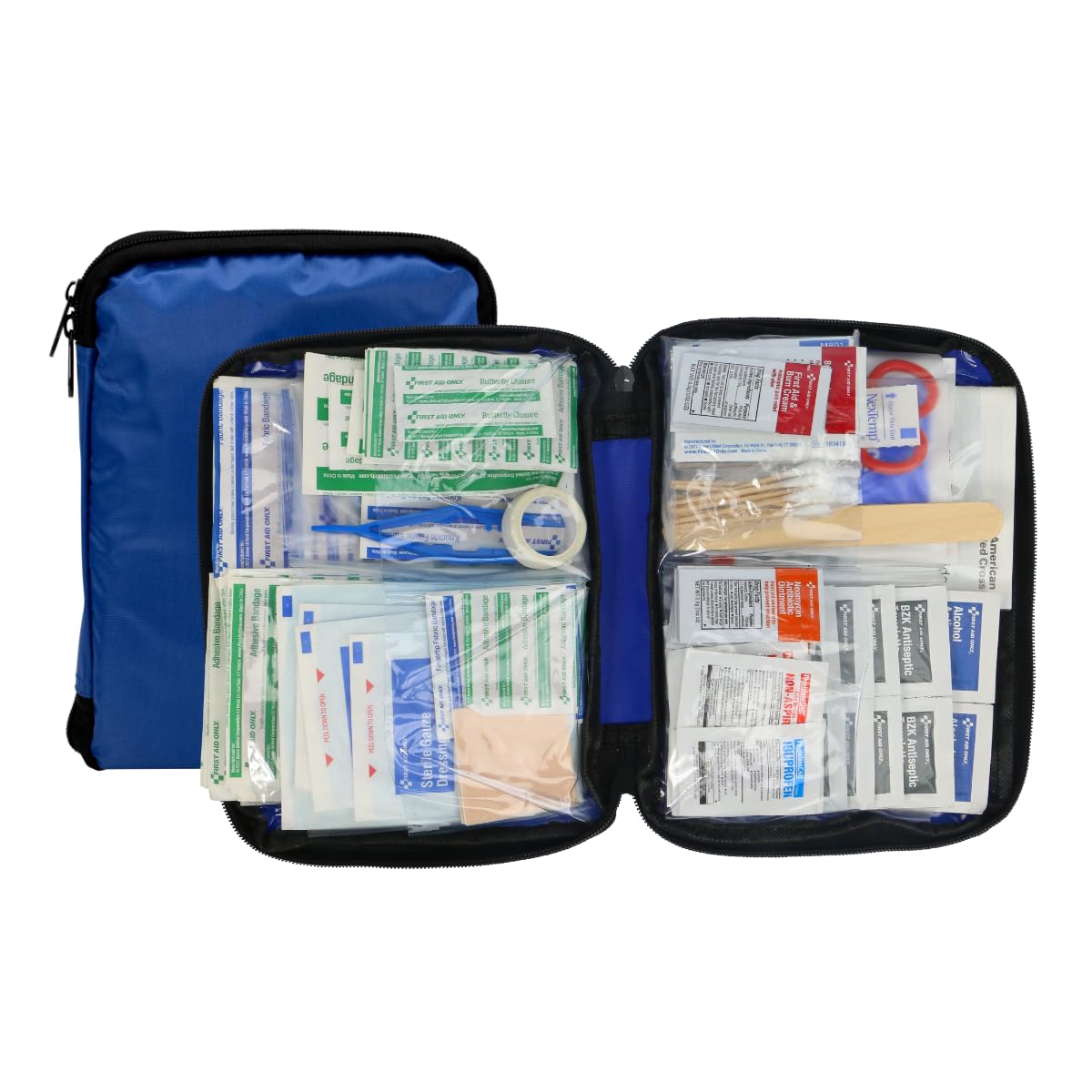
If you are the person who ends up carrying for four people, this is the kit that heads off the mid-trip run to a pharmacy. The 298 pieces are the broadest set here: fabric and plastic bandages, antibiotic ointment, BZK wipes, burn cream packets, gauze rolls and pads, all in a soft two-layer case that opens like a book.

The burn cream is the piece we noticed, because camp cooking produces more small burns than hiking produces cuts. Having a packet sized for one hand rather than a tube you have to hunt for is a small thing that reads as thoughtful every time you open the lid.

Two layers with individual compartments beats a single pouch, but the system only works if you put things back. After a scramble across a campsite, everything ends up in the wrong compartment and the next search takes longer than it should. It's the compromise of a big kit: more to find, more to lose track of.

At 9.25 by 3 by 7 inches and about a pound, this is basecamp luggage rather than something that goes on a summit push. In a tent, a cabin, or a trunk it's exactly right; on a long walk it is not, and that's the honest boundary.

Pros

  • Broadest supply set here at 298 pieces
  • Burn cream packets included
  • Two-layer case with individual compartments

Cons

  • Soft case needs a dry bag in wet weather
Our verdict

For a family camp where the kit lives in the tent, the breadth of supplies and the burn care here are the reason to choose it.

Check Latest Price
5

Best for Remote Trips

EVERLIT 250 Pc Survival Kit

96 /100
Traveler Score Outstanding

Key details

Case
MOLLE EMT pouch
Pieces
250
Material
1000D water-resistant nylon
Check Details on Amazon

Half of this kit isn't medical. Alongside the first aid supplies you get a mylar space blanket, a three-mode flashlight, and paracord, and the pouch is built to be strapped to something rather than buried at the bottom of a pack. That is either the point or the problem, depending on the trip you're planning.

The bag is the reason to buy it. It is 1000D water-resistant nylon with three large compartments and MOLLE strapping, so it rides on a pack, a saddlebag, or a roll bar and stays reachable. A kit you can see is a kit that gets used; the ones that vanish into a pack usually get found a day late.

It is more kit than a two-night car camp needs, and if all you want is bandages and tape, you are paying for a flashlight you may never switch on. Where it earns its place is the trip where you are the only responder for miles, and that is a narrower audience than the listing suggests.

Pros

  • MOLLE pouch mounts to a pack or roll bar
  • 1000D water-resistant nylon construction
  • Blanket, flashlight, and paracord included

Cons

  • Bulky pouch beside the compact hard cases here
Our verdict

Buy it for the mounting pouch and the remote-trip contents, and skip it if what you want is a medical kit and nothing else.

Check Latest Price
6

Best for Car Camping

Band-Aid All-Purpose 160 Pc

96 /100
Traveler Score Outstanding

Key details

Case
Hard plastic case
Pieces
160
Weight
1.19 lb
Medications
Neosporin, Benadryl, Tylenol
Check Details on Amazon

Neosporin, Benadryl, and Tylenol are in the box, sealed and labeled, and those three are what people actually go looking for once the tents are up. Name-brand medications are an unusual thing to find inside a first aid kit, and it is the detail that separates this one from the plainer hard cases here.

The 160 pieces live in a hard plastic case with internal compartments, which makes refilling painless: pull out what you used, drop in a replacement, and the layout still makes sense. Bandages come in assorted sizes and styles, and the brand-name bandages inside are the ones people reach for first.

Where it belongs is the trunk of the car or the shelf of a cabin, where its boxy shape is a feature because it stacks with the stove and the lantern. For a family that camps out of a vehicle and wants one kit that answers most of the small stuff, this is the least fussy way to get there.

Pros

  • Neosporin, Benadryl, and Tylenol included
  • Hard case with compartments that refill easily
  • Assorted Band-Aid brand bandages

Cons

  • Too bulky for backpacking
Our verdict

A car-camping kit that already contains the three medications you end up wishing for at ten at night.

Check Latest Price
7

Truck and Car

Be Smart Get Prepared Kit

95 /100
Traveler Score Outstanding

Key details

Case
Hard plastic case
Weight
11.4 oz
Closure
Easy-slide latches
Dimensions
7.5 x 2.5 x 6.75 inches
Check Details on Amazon

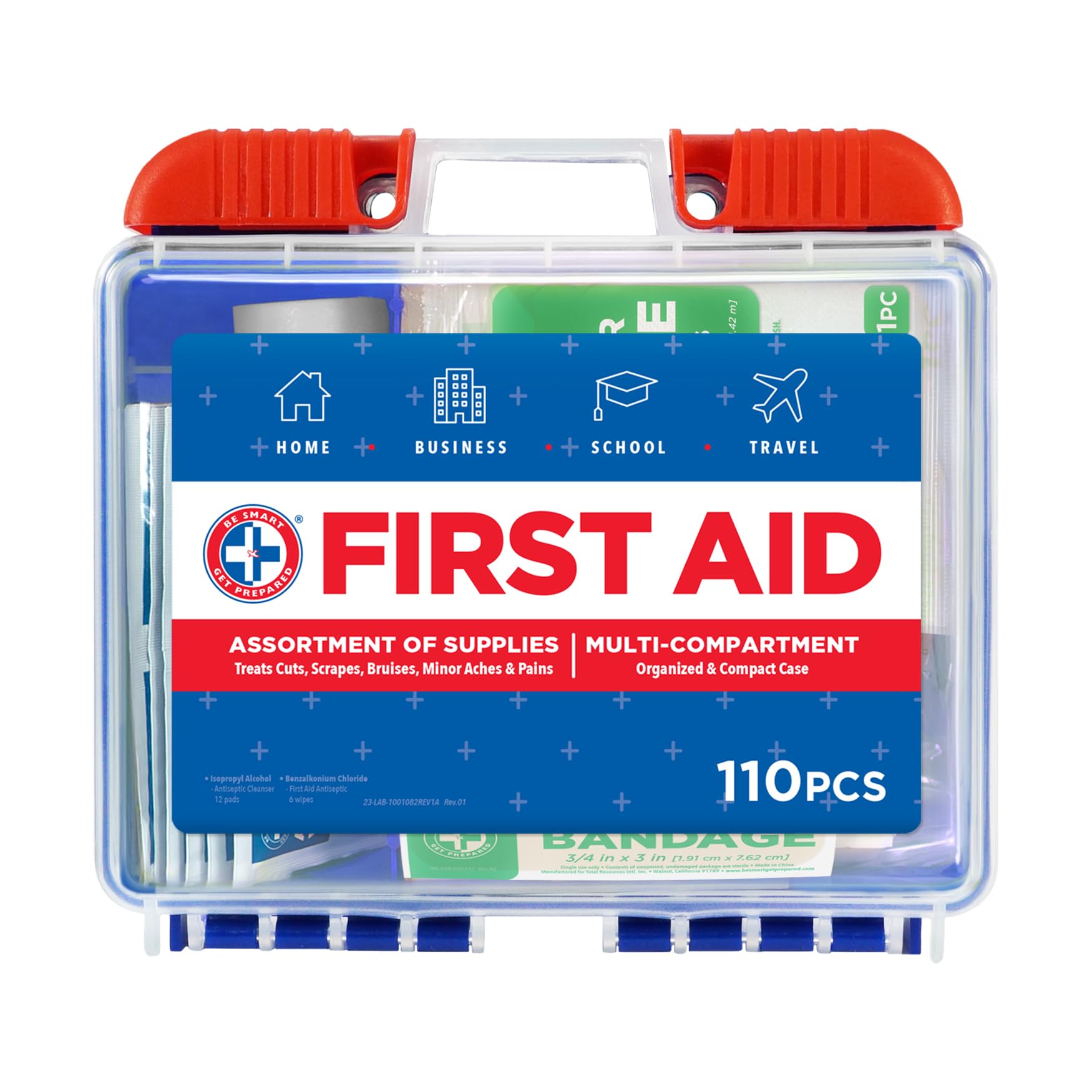
Lift the lid and the contents are already sorted into compartments, which sounds minor until you are looking for a gauze pad in the dark. The high-density plastic case is impact resistant, the easy-slide latches lock positively instead of drifting open in a door pocket, and at 7.5 by 2.5 by 6.75 inches it tucks under a seat.

The listing quotes the contents two ways — 110 pieces in the title, 100 in the product description — so plan around roughly a hundred rather than a specific inventory. Whichever number is right, what you get is a case that holds its shape and compartments that keep small items from migrating.

At 11.36 ounces it is not the lightest thing to drop in a daypack, and the rigid box takes up the volume it takes up. That stiffness is the trade: a case that doesn't flex is a case that survives being stepped on in a tent vestibule or slid under a truck seat.

Our take is to buy it as an inexpensive car, boat, or work-truck kit and add the two or three things your household actually uses. It earns a place here because the case is better than the contents, and that is the right way round — contents get used up and replaced, cases don't.

Pros

  • Impact-resistant hard case with slide latches
  • Compartments keep contents sorted
  • Small enough to fit under a seat

Cons

  • Bandage-heavy mix, thin on other supplies
Our verdict

A tough little hard case worth buying as a truck or glovebox kit you top up yourself.

Check Latest Price
8

Budget All-Rounder

YIDERBO 277 Pc First Aid Kit

95 /100
Traveler Score Outstanding

Key details

Case
Water-resistant EVA shell
Pieces
277
Weight
10 oz
Dimensions
7.84 x 5.71 x 3.03 inches
Check Details on Amazon

An instant ice pack and a burn dressing are the two items most compact kits skip, and they are the first things we look for now. A turned ankle on rough ground and a hand on a hot stove lid are the two injuries a camp kit is most likely to meet, and this one is stocked for both rather than for another fifty bandages.

The 277 pieces live in a water-resistant EVA shell described as shockproof, with the contents split into compartments and an emergency blanket, scissors, and safety pins rounding things out. At 7.84 by 5.71 by 3.03 inches and 10 ounces it is a lid-pocket kit rather than a strap-on one.

The mix skews practical rather than exhaustive: you get the injury-specific extras and a moderate supply of bandages, and it carries fewer bandage sizes than the larger kits here. For two or three people over a couple of nights, that is the right allocation — you run out of dressings before you run out of small adhesive strips.

What we like most is that nothing in it feels like filler. It is a kit assembled around the injuries a campsite actually produces, at a price that sits in the middle of this group, and it does the job without asking you to carry a flashlight or a fire starter to get it.

Pros

  • Instant ice pack and burn dressing included
  • Water-resistant, shockproof EVA shell
  • Emergency blanket and scissors included

Cons

  • Fewer bandage sizes than the bigger kits here
Our verdict

A sensible middle-of-the-road pick for campers who want burn and sprain supplies without paying for survival gear.

Check Latest Price

How We Chose and Tested Camping First Aid Kits

We started by pulling together every kit sold at outdoor retailers and big-box stores, then filtered on packed size, weight, listed contents, and price. Anything whose item count was clearly padded with bandages got cut early. That left 12 kits, which we used over six months.

Testing happened where these kits actually live: four weekend car-camping trips, a string of day hikes, one four-day road trip, and a wet-weather weekend where everything in camp got soaked. Between trips, we repacked each kit at the kitchen table, since that is when most people discover their kit has turned into a loose pile.

In the field, we opened each kit one-handed with a headlamp on and timed how long it took to find a 4-by-4 gauze pad and a saline wipe. At home, we counted usable items against filler, weighed each kit packed on a kitchen scale, and divided the price by the number of items we would genuinely reach for. We also ran each closed kit under a watering can for two minutes to see whether the contents stayed dry, checked expiration dates, and confirmed whether refills are sold separately.

How to Choose Camping First Aid Kits

Case first: sealed or soft

Rain, tent condensation, and a tipped water bottle do more damage to sterile supplies than most trips do to people. A sealed hard shell forgives all three; a water-resistant fabric bag is lighter and squeezes into odd spaces but wants a zip bag inside it. Look at the closure rather than the adjective — a lid that overlaps is not a seal.

Our top pick takes the sealed route in a case 1.5 inches thick. The soft-sided First Aid Only kit carries far more for a basecamp, and we'd still put it in a dry bag.

Decide where it rides before what's inside

A kit for the trunk and a kit for a pack are different objects, and the two smallest dimensions tell you which you have. Something 9.5 inches wide is glovebox or crate furniture; something 1.5 inches thick disappears into a pack lid or against your back.

If you want the kit on a hipbelt or a strap, a carabiner loop or a strip of webbing buys you more than another ten bandages. This is the single specification most people skip and then regret.

Read the contents for wound care, then for your trip

Bandages and gauze are the baseline. Tape, antiseptic, and gloves are what make a dressing stay on, so check for all three before anything else. Then match the extras to what your trip actually produces: burns from a stove, blisters from new boots, and turned ankles on rough ground.

Piece counts are a weak guide. A 300-piece kit can be 250 adhesive bandages, so scan the list for categories rather than totals — and expect to add your own painkiller and antihistamine to almost anything compact.

Buy something you can refill

Sterile items are single-use and adhesive supplies age, so the cheapest kit over a few seasons is the one you can restock rather than replace. Fixed compartments in a hard case make it obvious what's missing; a single soft pouch needs discipline.

Empty the kit at the start of each season, bin anything opened or past its date, and replace what you used on the last trip. A kit you haven't opened since August is a kit you can't trust in October.

Frequently Asked Questions

Final Verdict

The Protect Life Travel kit is the one we reach for: a flat sealed case, wound care that covers a weekend, and a printed guide that earns its place when the clinic is an hour of dirt road away. It is the safest default for most camping trips.

If weight is the binding constraint, the General Medi Mini does the basic job in 5.6 ounces. If you're outfitting a family basecamp, the First Aid Only kit's 298 pieces and burn cream buy you coverage the compact kits can't match — just pack it inside a dry bag.