Best Headlamps for Backpacking of 2026

The best part of a backpacking day is dropping your pack at camp; the worst is realizing you still have to filter water, hang a food bag, and find your toothbrush in the dark. That's when a headlamp earns its keep. A weak one dims as the air gets cold, a loose one slides down your forehead on a descent, and a dead battery at 9 p.m. three miles from the trailhead is a mistake you only make once. You want a light bright enough to read a map, steady enough to trust, and light enough to forget.

I've hiked out by phone flashlight before, so I don't take this category lightly. Over eight months, my team and I took 12 headlamps on real trips — wet, cold, and longer than planned — and one lesson kept surfacing: the lights you can rely on rarely have the biggest lumen number on the box. Peak brightness lasts a few seconds before it steps down, and battery claims are usually measured at a setting nobody would actually hike with. The picks below earned their spot on the trail, not the spec sheet.

1

Best Overall

Foxelli MX200

95 /100
Traveler Score Outstanding

Key details

Power
USB-C rechargeable
Weight
2.4 oz
Runtime
40 hours
Max Output
180 lumens
Check Details on Amazon

Weight is the kind of number that means nothing in a spec table and everything at hour six. At 2.4 ounces the Foxelli MX200 is the lightest lamp we recommend here, and the difference shows up in small ways: it stays where you put it when you look up at a blaze, it doesn't leave a red mark when you take it off, and the stretch band holds without being cranked tight over a beanie. On a trip where every item gets argued over, this is the one we hand people first.

What it does with that weight is modest on paper and well judged in use. The 180 lumens throw a wide, even pool about 300 feet down the trail, enough to walk at a normal pace over roots and rock, and the 45-degree tilt drops the beam to your feet for a scrappy descent or lifts it to a hung food bag. Five modes cover white high and low, red, and an SOS strobe; the red is the one we use most at camp, because it doesn't blow out your night vision or light the inside of a shelter like a car headlight.

USB-C charging and a claimed 40 hours of runtime are what turn it from a gadget into a backpacking light: we top it up from a power bank every few days and otherwise forget it exists. A full charge takes a few hours, so plan the top-up around a long lunch rather than arriving at camp with a dead cell. The ceiling is output. At 180 lumens this is a walking light, not a route-finding one, and trackless terrain after dark wants more punch. For marked trail after sunset, it's the one we reach for.

Pros

  • 2.4 ounces, the lightest of our picks
  • Claimed 40-hour runtime with USB-C top-ups
  • Red mode and 45-degree tilt for camp
  • IPX5 rated for sustained rain

Cons

  • 180 lumens is a walking beam, not a route finder
  • Sealed battery cannot be swapped on trail
Our verdict

Our pick for most backpackers: light enough to forget, honest about runtime, and bright enough for any marked trail after dark.
Check Latest Price
2

Best for Night Route-Finding

Coast XPH30R

95 /100
Traveler Score Outstanding

Key details

Power
USB-C rechargeable
Runtime
6.75 hours (high), 10 hours (medium), 28 hours (low)
Max Output
1,200 lumens (turbo)
Water Resistance
IP54
Check Details on Amazon

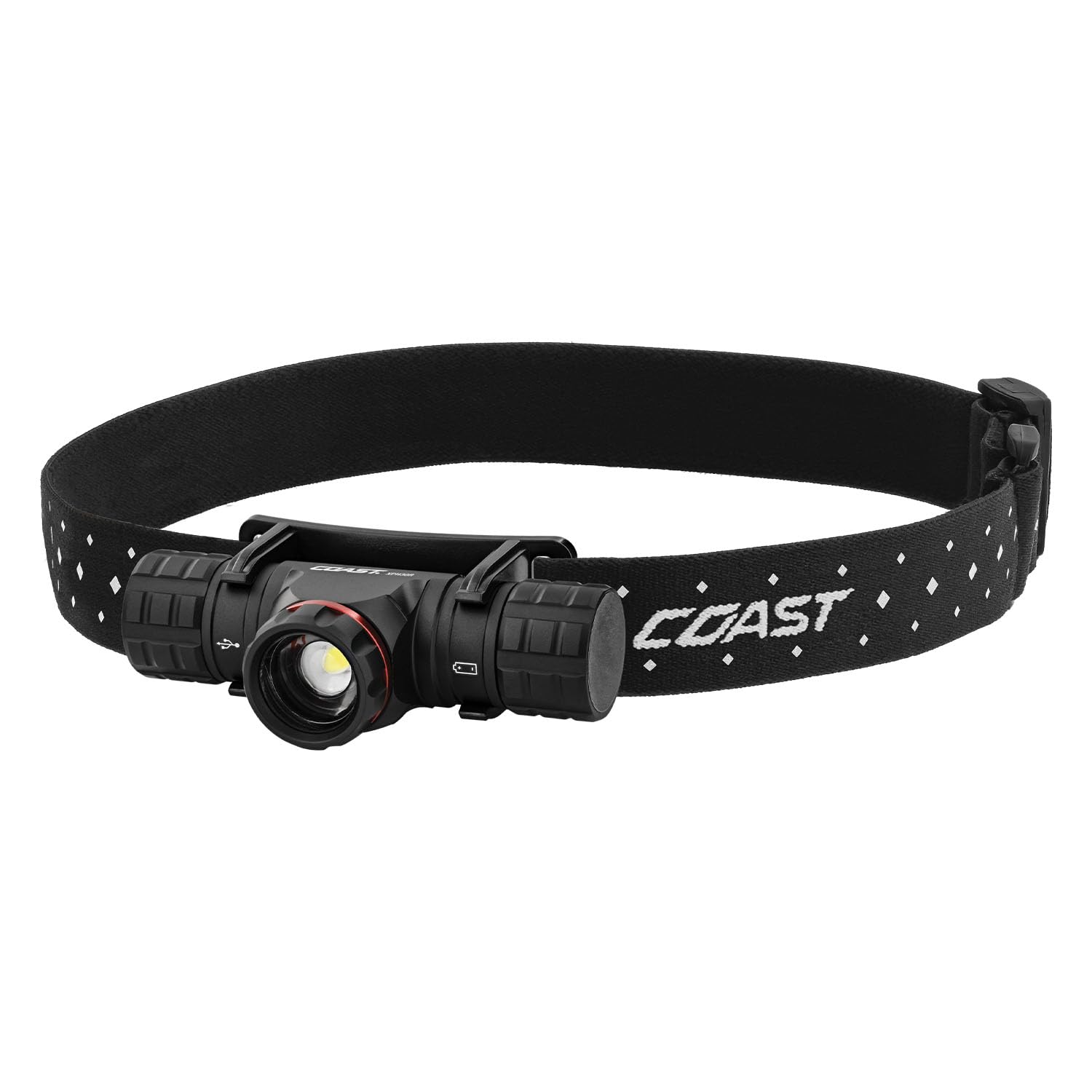
The Coast XPH30R costs more than anything else here, and it is the only light in the group that made us stop on a dark stretch of trail and look further down it. Twist the bezel and the beam narrows from a broad camp glow to a spot that reaches 165 meters, far enough to pick up a reflective blaze or a creek crossing well before you're on top of it. Turbo is 1,200 lumens, which is a burst rather than a setting, but on high it turns a black trail into something you can hike at full speed.

What earns it a spot on a backpacking list is the body. The aluminum shell has a magnetic base, so the lamp pops off the headband and sticks to a stove, a tailgate, or a shelter frame, and we used it that way more than we expected. It's rated IP54 with a one-meter drop rating and a lifetime warranty, which is the sort of thing you stop thinking about right up until the night a light fails.

The trade-off sits on your forehead. This is a front-heavy lamp, and after a few hours you feel the head pressing above your eyebrows in a way the Foxelli never does. Treat it as the light for trips where seeing far matters more than carrying little: shoulder-season routes, late descents, anywhere you're navigating rather than strolling. For a fast summer trip on marked trail, it's more light than the job asks for.

Pros

  • 1,200-lumen turbo with a twist-focus beam
  • Magnetic body detaches from the headband
  • Aluminum shell with a lifetime warranty

Cons

  • Front-heavy after a few hours of wear
  • Turbo is a burst, not a hiking mode
Our verdict

We reach for this one when the route is unmarked and the daylight is running out; the throw is worth the weight up front.

Check Latest Price
3

Best Battery-Powered

Energizer PRO-260

95 /100
Traveler Score Outstanding

Key details

Power
3 AAA (included)
Weight
3.52 oz
Runtime
35 hours
Max Output
260 lumens
Check Details on Amazon

Three AAA cells and no cable is the entire pitch, and for a certain trip it's the right one. The Energizer PRO-260 ships with its batteries, claims 35 hours on low, and asks nothing of the power bank you're nursing for a phone that's also your map. On a long resupply stretch, or in cold where a sealed rechargeable cell sags, that independence is worth more than a couple of ounces. It's also the light for someone who wants one switch and no menu to learn in the dark.

Seven modes sounds like a lot, and it is: high and low spot, high and low wide, red, and a red flash. They're laid out the way you'd expect, and the wide low setting is the one that earns its keep in camp, spreading an even wash across a stove and a map without blinding whoever is sitting across from you. Next Push Off is the detail we appreciated most. Hold the button and the light dies without a lap through every other mode, which you notice every single time you turn in.

The body is plastic, IPX4, rated for a one-meter drop, and fitted with a shatterproof lens: fine for rain and a tumble off a log, not a light to abuse. At 3.52 ounces with cells in it, it's noticeably heavier on the head than our top pick, and 260 lumens is a walking beam rather than a search beam. You'll also be buying AAA cells for as long as you own it, which is the cost of never hunting for an outlet. For a week out with a spare set in the pack, that's a trade we make happily.

Pros

  • Runs on three AAA cells, included
  • Claimed 35-hour runtime on low
  • Wide low mode plus a red light
  • Next Push Off skips the mode cycle

Cons

  • 3.52 ounces with cells is heavy on the head
  • AAA cells are an ongoing purchase
Our verdict

The light we trust where there's no outlet for days: simple, dependable on AAA cells, and easy to hand to anyone in the group.

Check Latest Price
4

Best Budget Pair

Lepro Rechargeable 2-Pack

91 /100
Traveler Score Outstanding

Key details

Weight
2.85 oz
Runtime
30 hours
Pack Size
2 lamps
Max Output
150 lumens
Check Details on Amazon

A pair of lamps changes how you use them. One rides on your head while the other sits on the power bank, and you start every evening with a charged light instead of a decision. At 2.85 ounces each the Lepro lamps disappear into a pack, the band is removable and washable, and nothing about them asks to be handled carefully.

The beam is honest for the money: 150 lumens with a claimed 500-foot reach, which reads as a tighter, throwier spot than the wide wash the Energizer gives you. Three white levels plus steady and flashing red cover camp chores, a latrine run, and the walk back to the tent, and the head tilts far enough to point at your hands while you cook. Water resistance is rated, the band adjusts without a fight, and a charging cable comes in the box.

We rate it the value pick rather than the default because the battery is sealed inside. When a built-in cell stops taking a charge the lamp is finished, and the plastic housing is built to a price rather than to survive a decade of trips. What you get back is two chances: if one misbehaves you still have a light in your pack, plus a lamp you don't mind leaving in the car between trips or handing to a friend who forgot theirs.

Pros

  • Two lamps so one charges while one hikes
  • 2.85 ounces each with a washable band
  • Claimed 500-foot reach with a red mode

Cons

  • Sealed battery cannot be swapped
Our verdict

Our value pick: two capable rechargeable lamps, best bought as spares or a first set rather than as a single do-everything light.

Check Latest Price
5

Backup and Loaner

GearLight S500 2-Pack

93 /100
Traveler Score Outstanding

Key details

Power
3 AAA (not included)
Runtime
10 hours
Pack Size
2 lamps
Max Output
200 lumens
Check Details on Amazon

The cheapest pair here has one obvious weakness, and it's the part that touches your head: the strap and its clips are what give out, not the LED. That matters on trail, because a headlamp you can't wear is a headlamp you carry in your hand. Set that against the rest and the GearLight still makes a case for itself: 200 lumens, seven modes with a proper red, a 45-degree tilt, and two lamps that cover you and a partner.

As a spare, that's a fair trade; as your only light on a five-day trip, it isn't. Where these earn their keep is the second layer of a kit: one in the pack as a backup, one lent to the friend who forgot theirs, one living in the glovebox between trips. The beam is a broad, slightly cool pool that's perfectly good for cooking and reading and a little flat for picking out roots at speed, and the tilt holds its angle instead of drooping after a few nights.

Runtime is the other thing to plan around: a claimed 10 hours is the shortest of the lights here, so on a long trip you'll be feeding it AAA cells, and none are in the box. Buy a set before you leave rather than at the trailhead. The band washes clean and adjusts down far enough for a kid, which is why these tend to end up as the family's camping lights. Just don't make one the only light you pack above treeline.

Pros

  • Two lamps for backup and loaner duty
  • 200 lumens with seven modes and red
  • 45-degree tilt that holds its angle

Cons

  • Strap and clips are the failure point
  • 10-hour runtime is the shortest here
Our verdict

A cheap pair for the glovebox and the loaner bag, with a strap that keeps it off the list of lights to trust on a long trip.

Check Latest Price
6

Rugged All-Rounder

SLONIK 1000

93 /100
Traveler Score Outstanding

Key details

Power
USB rechargeable
Weight
4 oz
Runtime
4 hours
Max Output
1,000 lumens
Check Details on Amazon

An aluminum body on a headlamp isn't cosmetic. It's the difference between a light that comes out of a pack working and one that comes out rattling, and the SLONIK's shell is aero-grade aluminum, dustproof, and rated IPX4. The head swivels through 90 degrees to point at a stove, a map, or the rock above your tent, and it detaches from the band to work as a handheld light, which is the feature we used most around camp.

Output is the headline: 1,000 lumens across six brightness levels and three modes, with a single large button that's easy to find with gloves on and that remembers the setting you left it in. That's the most light for the money in this set, and it's enough to turn a late bail-out into something you can actually see. Four hours at the top end is the catch, so this is a lamp to run on medium and save high for the moments that need it.

Where it falls short is the bracket joining the lamp to the strap, a plastic part that takes the stress every time you pull the band over a hat. Check that joint before a trip rather than discovering it at dusk, and be gentle pulling the light on one-handed. Battery life lands mid-pack, and on a long trip you'll be charging it every couple of days. For a rugged all-rounder that splits its time between trail, garage, and hard hat, it's a sensible buy.

Pros

  • Aluminum body with a 90-degree swivel head
  • 1,000 lumens across six brightness levels
  • Single large button works with gloves
  • Head detaches for handheld use

Cons

  • Plastic strap bracket is the weak point
  • Four hours of runtime at the top end
Our verdict

A metal-bodied, glove-friendly all-rounder we like for tailgates and rocky descents alike, as long as you watch the strap bracket.

Check Latest Price

How We Tested Backpacking Headlamps

We started with roughly 40 headlamps pulled from spec sheets, thru-hiker forums, and the warranties makers are willing to stand behind. We cut anything over 3.5 ounces with batteries, anything that needed a proprietary charging cable, and anything with no published runtime data — and we weighed price against what you actually get, since a cheap light that eats specialty batteries isn't cheap. That left 12 models, all bought at retail so nobody could send us a ringer, and we spent eight months wearing them on overnighters and long day hikes that ended after dark.

In camp, that meant wearing each one through the whole evening routine: filtering water, cooking, reading in the tent, and the 3 a.m. walk to the bear box, usually with gloves on. We noted whether the buttons were findable by feel and whether the strap stayed put when we looked up at the stars. On the trail, we judged the beam by how far ahead we could pick out a blaze or a root, and whether colors stayed readable or washed out blue. A few got rained on, one tumbled down a rocky slope, and several rode home loose in the bottom of a pack.

Back home we got less romantic. Each light went on a kitchen scale with fresh batteries, then ran on medium inside a chest freezer until it died, so we could compare real runtime against the boost-mode headline. We dropped them waist-high onto concrete, ran them under a faucet for five minutes, and tried swapping batteries in a pitch-dark room to see what a fumbled spring costs you. Every light also had to spend a night in a cold car and still turn on first click — the reliability question, asked the way a trip actually asks it.

How to Choose Headlamps for Backpacking

Weight, and where it sits

An ounce on your forehead is worth three in your pack, because you feel it every time you look up. Front-heavy lamps press above the eyebrows after a couple of hours, which is the real cost of the Coast's big reflector; a light with a rear battery pack balances better but adds a strap across the back of your head that fights a hood.

Check whether the quoted weight includes cells, since three AAAs add real mass to a two-ounce lamp. For most three-season trips, anything at or under about three ounces with the battery in is comfortable enough to forget.

Rechargeable or AAA: match the power to the trip

A rechargeable lamp is lighter and cheaper to run, but it makes you part of a system: the bank, the cable, and the discipline to top up before dark. It also has a single point of failure, because when a sealed cell dies the light is finished.

AAA lamps trade that risk for ongoing cost and a habit of carrying spare cells, which is what we carry on long, cold, or remote trips. If your next resupply is more than four or five days away, take a cell-powered light or a spare.

Beam shape beats the lumen count

Lumens sell lights; beam shape is what you hike with. A wide, even pool at 150 to 300 lumens is enough to walk a marked trail at a normal pace, while a focused spot punches further and narrows your view of everything at your feet. That's why the twist-focus Coast and the spot-and-wide Energizer cover more ground than their headline figures suggest.

A red mode costs almost nothing, saves your night vision, and keeps the tent peaceful, so look for one. Treat the highest setting as a burst for route checks rather than the mode you'll hike in.

Switches, straps, and rain

The parts that fail are rarely the LED. Straps and the plastic brackets joining them to the lamp take the stress every time you pull one over a hat, and a switch you can't work with gloves turns a two-second job into a stop on the trail. Press every button before a trip and count the clicks to red.

IPX4 shrugs off rain; a higher rating buys tolerance for splashes and wet hands, but none of these lights should go swimming. Take a second light anyway.

Frequently Asked Questions

Final Verdict

Start with the Foxelli MX200. At 2.4 ounces it's the light most backpackers should carry: a usable beam, a real red mode, and enough runtime that a five-day trip needs one top-up from a bank.

Step up to the Coast XPH30R when your days run late and unmarked and you want 1,200 lumens of throw in a metal body, knowing you'll feel it on your forehead. If you'll be out for a week or more, or the forecast sits well below freezing, the Energizer PRO-260 and a spare set of AAAs take charging out of the plan entirely.