Best Flight-Safe Power Banks

The worst time to discover your power bank isn't flight-safe is with your shoes off and a security bin sliding away. A good one removes the worry: the watt-hour rating is clearly printed and under the airline limit, it disappears into a personal item, and it charges fast enough to rescue a dying phone on a short layover. I've hunted for outlets in too many terminals to trust a sleek bank that delivers one slow, half-hearted charge. Over the past four months, we've traveled with 16 carry-on-friendly power banks, and the differences showed up quickly.

The box's mAh number is not what reaches your phone—heat, cable length, and age eat into it. Built-in cables are handy until the connector wiggles, and a light bank can become a paperweight by dinner. We tracked weight, charge speed, actual top-ups, and whether each one survived a tote, then weighed that against price. The picks below are the ones that earned their place.

1

Best Overall

INIU P55 10,000mAh

91 /100
Traveler Score Outstanding

Key details

Weight
6.5 oz
Capacity
10,000 mAh
Max Output
45 W
Built-in Cable
Detachable USB-C lanyard
Check Details on Amazon

At 6.5 ounces and 4.4 by 2.7 by 0.7 inches, the P55 is smaller than the phone it's charging and about half the weight of the 20,000mAh packs in this set. That's the case for it as a flight battery: a power bank only helps if you actually have it on you, and this is the one that disappears into a jacket pocket or a seat-back pouch instead of becoming the heaviest thing in your personal item.

The 45 watts matter more than the figure suggests. It's enough to fast-charge a tablet or push useful charge into a small USB-C laptop, which is more than the 20W and 22.5W packs here manage. Capacity is the honest limit: 10,000mAh is roughly two phone charges, so it covers a travel day rather than a week off-grid.

We ended up fonder of the lanyard cable than we expected to be, because it detaches. Cord strain is what kills a built-in cable first, and here a frayed cord costs you a cable instead of the whole bank. There's a fold-out stand that sounds like filler until you're watching something on a tray table, and a three-year warranty that's as good as anything in this group.

Two things to go in knowing. Three ports will run a phone, a tablet and headphones, but not all of them at full speed. And 37Wh does almost nothing for a laptop — if that's the job, the Anker below is where to look.

Pros

  • 6.5 oz and pocket-sized for 10,000mAh
  • 45W output handles tablets and small laptops
  • Lanyard cable detaches and can be replaced
  • Three-year warranty

Cons

  • About two phone charges per full pack
  • 37Wh won't meaningfully charge a laptop
Our verdict

We recommend the P55 to almost every air traveler: 6.5 ounces, 45 watts, and roughly two phone charges, all comfortably inside the carry-on limit.
Check Latest Price
2

Best All-In-One for Travel

INIU P24 10,000mAh

88 /100
Traveler Score Excellent

Key details

Weight
8.1 oz
Capacity
10,000 mAh
Max Output
45 W
Built-in Charging
Fold-out AC plug plus USB-C cable
Check Details on Amazon

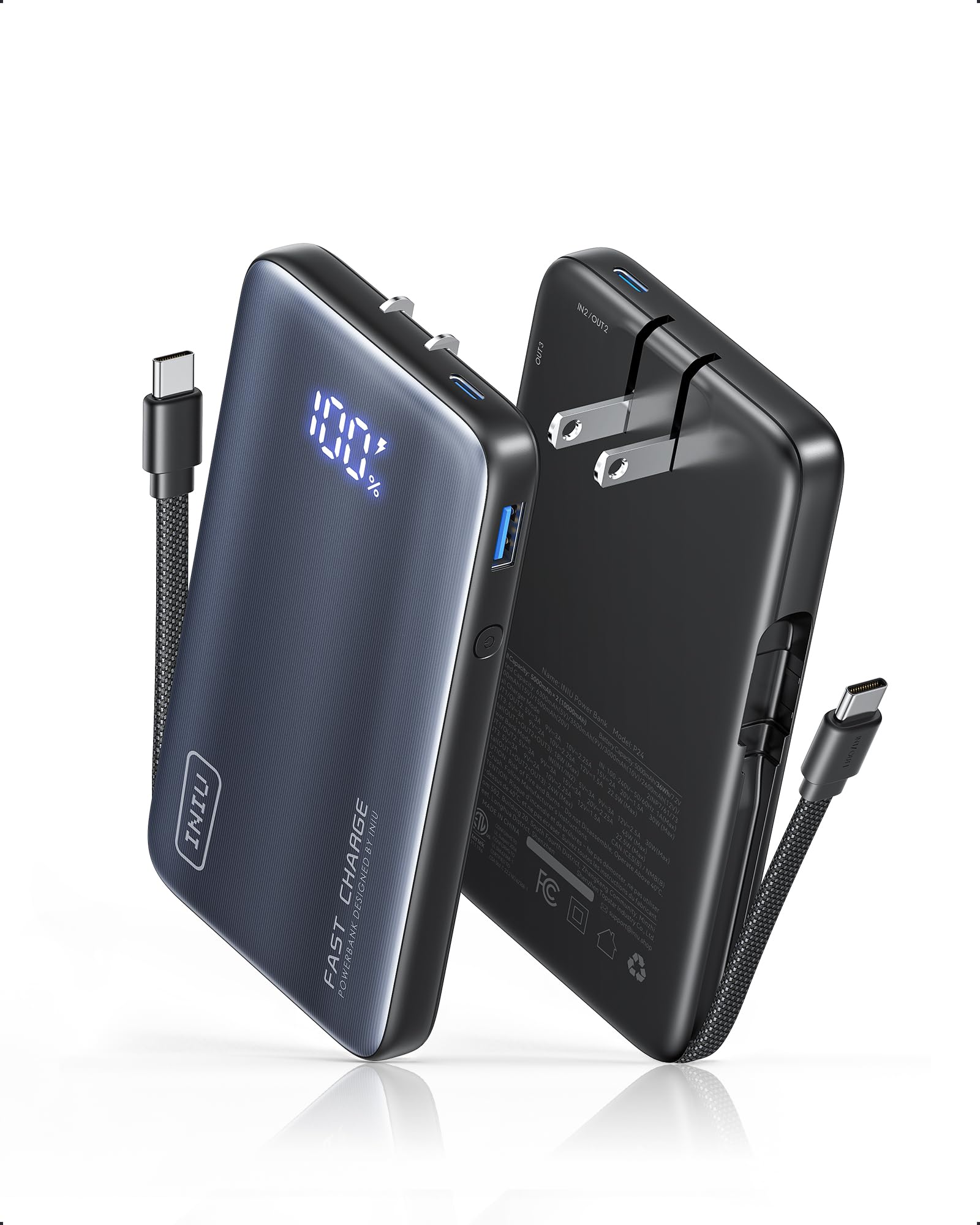
Almost every power bank makes you carry a second charger to refill it. The P24 folds an AC plug into its own body, so the thing that tops up your phone also tops up itself from any wall outlet or airport socket — and it can do both at once.

That single design decision is what earns it a place here. It replaces the charging brick in your bag, so the packed weight roughly evens out despite the P24 being 1.6 ounces heavier than our top pick, and at 0.6 inches thick it slides into a laptop sleeve. Both are 10,000mAh and 45W; the difference is that this one doesn't need help.

Pass-through charging is the payoff in practice — one outlet, one cable, and both the bank and the phone fill overnight, which is the arithmetic of a hotel room with a single accessible socket. A percentage display takes the guesswork out of the morning, and a three-year warranty backs it. It is a chunky little thing in the hand and it won't suit a family charging four devices at once, but for one traveler with one bag it solves a problem nothing else here does.

Pros

  • Fold-out AC plug refills it without a charger
  • Pass-through charging from a single outlet
  • 45W output with a built-in USB-C cable
  • Three-year warranty

Cons

  • 1.6 ounces heavier and wider than our top pick
Our verdict

Buy this one if you want to leave the charger home: the fold-out plug refills the bank from any outlet, and pass-through charging looks after the phone at the same time.

Check Latest Price
3

Best for Laptops

Anker 25,000mAh 165W

89 /100
Traveler Score Excellent

Key details

Capacity
25,000 mAh
Total Output
165 W
Built-in Cables
Two USB-C, one retractable
Devices At Once
4
Check Details on Amazon

At 25,000mAh this is the only pick here that gets near the airline ceiling, working out to roughly 93Wh — under the 100Wh line, so it flies in the cabin without approval, but close enough that you want the printed rating on the back to be readable rather than rubbed off.

What the capacity buys is a laptop. Three USB-C ports at up to 100W each and 165W in total is a different job from the phone banks in this set: a USB-C laptop, a phone and a tablet can charge at once without the laptop crawling. Working from a train or a long delay, that's the entire reason to carry something this big.

Two cables are built in, and the retractable one reaches 2.3 feet and is rated for 20,000 retractions — the number we cared about, because a retraction mechanism is the part that jams first. The shorter cable doubles as a carry strap, which is the sort of thing you only appreciate after you've dropped a bank on a tile floor. Our reservation is the moving parts: a spring-loaded reel and a glass-fronted display give this more ways to go wrong than a bare pack with a fixed cord, and that's worth weighing before you spend premium money on one.

Weight is the honest trade. It's a brick in a personal item — no jacket pocket is taking it — and the price puts it in a different bracket from the rest of this list. If a laptop travels with you, it earns the space. If it doesn't, the 10,000mAh picks above do the same job for a fraction of the weight in your bag.

Pros

  • Roughly 93Wh, still under the 100Wh limit
  • Three 100W USB-C ports, 165W total
  • Two built-in USB-C cables, one retractable
  • Charges four devices at once

Cons

  • Heavy
  • Premium price for the capacity
Our verdict

Worth the weight and the money only if a laptop is in your bag — but then nothing else here comes close on wattage or capacity.

Check Latest Price
4

Best for Multiple Devices

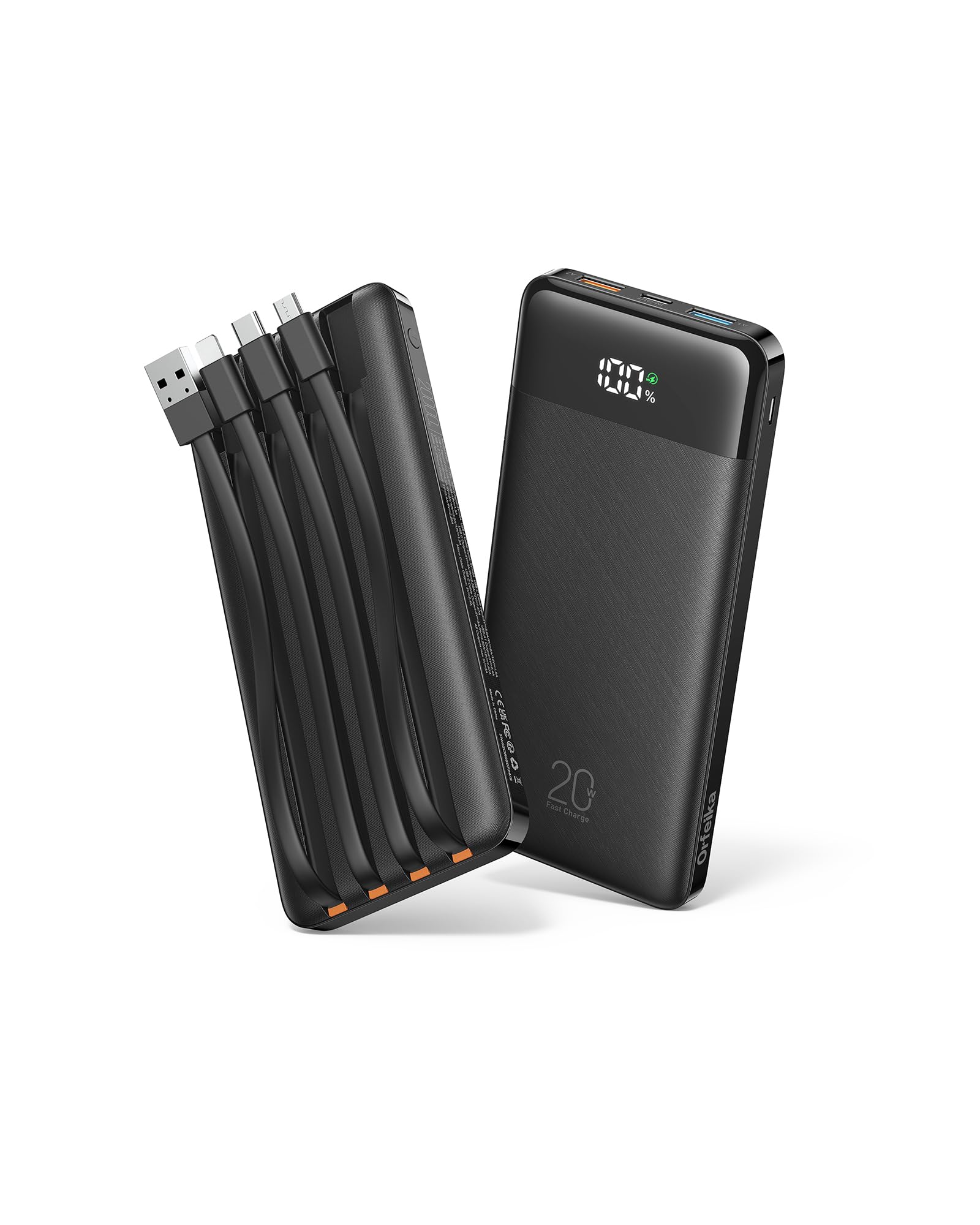
Orfeika K26F 20,000mAh

91 /100
Traveler Score Outstanding

Key details

Weight
0.73 lb
Capacity
20,000 mAh
Max Output
20 W
Built-in Cables
Four, three output plus one input
Check Details on Amazon

Four built-in cables — three for output and one for input — is the most cable coverage in this set, and it changes what you pack rather than just what you carry. An iPhone, a USB-C tablet and an older micro-USB device can all be plugged in without a single loose cord, and the fourth cable means the bank itself refills from whatever brick is already in the room.

Capacity is the other half of the pitch. 20,000mAh is roughly three phone charges, and six outputs means a family can plug in at once without negotiating — more than any other pick here offers. The compromise is speed, and it's the one thing to be clear-eyed about before buying.

What we appreciate most is the input cable. The cord most likely to be left behind in a hotel room is the one you need to recharge the bank, and here it's attached to the body. Two years of warranty backs it, and a digital display gives you a percentage instead of four vague dots. For a group trip with mixed phones and tablets, that combination is hard to beat in this set.

Pros

  • Four built-in cables, including an input cable
  • Six outputs for a family's worth of devices
  • 20,000mAh, roughly three phone charges
  • Two-year warranty

Cons

  • 20W output tops out at phone speed
  • 0.73 lb, so it lives in a bag
Our verdict

For a family with mixed devices this is the pick: four built-in cables and six outputs, with 20W as the price of all that coverage.

Check Latest Price
5

Best Budget

Tikeyo N13 12,000mAh

87 /100
Traveler Score Excellent

Key details

Weight
8.3 oz
Capacity
12,000 mAh
Max Output
22.5 W
Built-in Cables
Three (USB-C, Lightning, micro-USB)
Check Details on Amazon

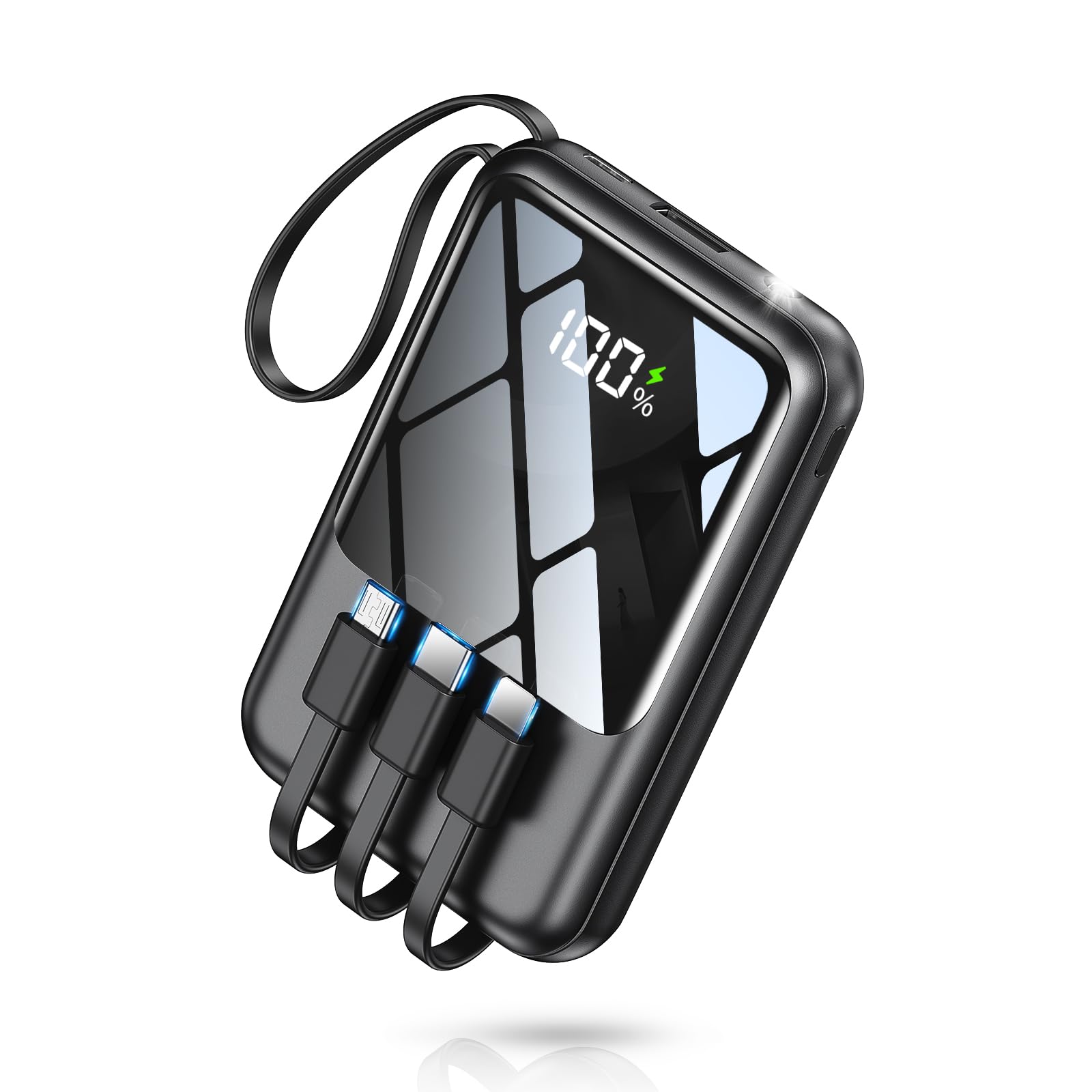
12,000mAh is an odd capacity, and that's exactly why it's interesting. It works out to about 44Wh, nowhere near the cabin ceiling, and buys roughly half a phone charge more than a 10,000mAh pack without the heft of a 20,000mAh brick. It's also the least expensive bank in this guide.

We expected the budget end to feel like a compromise and it doesn't. Three built-in cables cover a USB-C phone, an iPhone and a micro-USB gadget, so a household with mixed gear needs nothing else in the bag, and a percentage display at this price is a small luxury. There's a three-year manufacturer warranty behind it, which is the practical answer to buying a less familiar name. What it won't do is fast-charge a tablet, and at 8.3 ounces it's actually heavier than our 10,000mAh top pick — the extra capacity costs you in the hand.

Pros

  • 12,000mAh, about 44Wh, well clear of the limit
  • Three built-in cables cover most phones
  • Percentage display at a budget price
  • Three-year manufacturer warranty

Cons

  • 22.5W max, so tablets charge slowly
  • 8.3 oz, heavier than our top pick
Our verdict

A budget bank that doesn't behave like one — 12,000mAh, three built-in cables, and a real warranty for the least money in this guide.

Check Latest Price
6

Slim High Capacity

Neoseek iPB2055s 20,000mAh

89 /100
Traveler Score Excellent

Key details

Weight
12.4 oz
Capacity
20,000 mAh
Thickness
0.7 in
Max Output
45 W
Check Details on Amazon

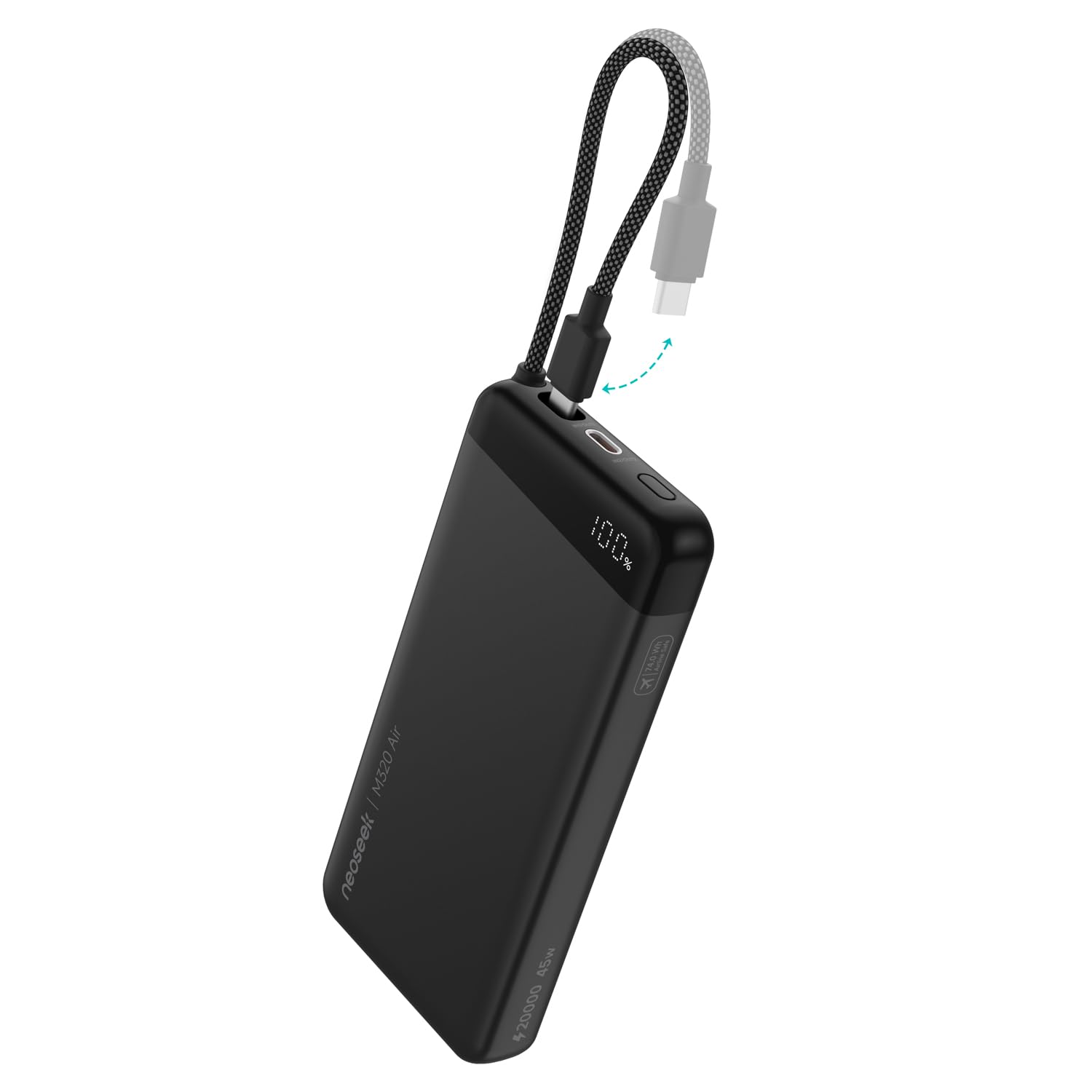
Seven-tenths of an inch is the number that changes packing. A 20,000mAh bank that flat slides into a laptop sleeve or the panel pocket of a day bag instead of forcing a lump into the middle of it, and the aluminum shell is a nicer thing to handle than the plastic bodies on most of these.

Forty-five watts out and 40 watts in is the pairing we like most. The output handles a tablet properly, and the input is what makes it a travel bank rather than a desk one — recharging a 20,000mAh pack is where a short trip loses an evening. Two devices at once is modest for the capacity, so plan on a phone and a tablet rather than a family.

The trade is weight and coverage. At 12.35 ounces it's heavier than the Orfeika at the same capacity, and the warranty runs a year where INIU gives three. We still reach for it on a trip where flat beats light — going into a laptop sleeve next to a tablet — provided the shorter coverage doesn't worry you.

Pros

  • 0.7-inch aluminum body slides into a sleeve
  • 45W output and 40W input
  • Built-in braided USB-C cable

Cons

  • 12.35 oz at 20,000mAh
  • One-year warranty
Our verdict

Our choice when flat beats light: 0.7 inches of aluminum holding 20,000mAh, with a fast 40W input for short trips.

Check Latest Price
7

Fast 20K Charging

TRKOY 20,000mAh 45W

94 /100
Traveler Score Outstanding

Key details

Capacity
20,000 mAh
Max Output
45 W
Built-in Cables
Two braided USB-C
Devices At Once
4
Check Details on Amazon

Twenty thousand milliamp-hours and 45 watts is the pairing most travelers should want if a laptop isn't coming along: roughly 74Wh, three or four phone charges, and enough output to fast-charge a tablet instead of merely topping it up. This one delivers it with two braided USB-C cables built into the body and a percentage display across the front.

The cables are the detail we keep coming back to. Both are rated for 20,000 folds and plug cycles, and one doubles as a carry handle — a nicer solution than a fabric loop, though it does mean you're hanging the bank from the part that has to keep working. Four devices at once is more than a two-cable design usually manages.

Where it lands in this set: if wattage matters more to you than connector variety, this is the 20,000mAh bank we point you to over the Orfeika, charging a tablet at roughly twice the wattage for about the same money. What it gives up is that pack's spread of connectors — the built-in cables are USB-C, full stop — so a household still running a Lightning iPhone or a micro-USB gadget should look there instead.

Pros

  • 20,000mAh with 45W output
  • Two braided USB-C cables built in
  • Charges four devices at once
  • Percentage display

Cons

  • Built-in cables are USB-C only
  • One-year warranty
Our verdict

If 45W matters more than connector variety, this is the 20,000mAh bank we point you to — tablet-speed output and two braided USB-C cables built in.

Check Latest Price

How We Tested Flight-Safe Power Banks

We started by narrowing a long list of carry-on-friendly power banks to models with a printed watt-hour rating under the common airline limit, a built-in cable or at least two output options, and a size that would fit a jacket pocket or seatback pouch. That left 16 banks, which we used for four months across airport security lines, boarding queues, long-haul flights, commutes, and weekend drives. We weighed each one on a kitchen scale and carried it in a personal item rather than a checked bag, noting whether it disappeared into a pocket or felt like a brick.

At security, we checked that the capacity markings were legible and that the bank slid out of a pouch without a tangle. In the air, we timed a 30-minute top-up from a nearly dead phone, then a full charge, and counted how many phone charges each bank delivered before it needed recharging. We also ran each built-in cable through repeated plugging, bending, and tugging, because that cable is often the first part to fail. Compact size got judged against real pockets: does it fit beside a passport, or does it crowd everything else?

Back home, we kept using the same banks for four months—on trains, at coffee shops, through a few drops from waist height onto carpet and tile—to see which ports loosened, which cases scuffed, and which still held a charge. We compared what each one delivered against its price and its weight, since a cheap bank that dies early or a light one that needs constant recharging is no bargain. The result is a short list of banks that earned a place in a carry-on, not just a spot in a drawer.

How to Choose Flight-Safe Power Banks

Watt-Hours, Not Milliamp-Hours

Airline rules are written in watt-hours, and the conversion is simple: multiply the milliamp-hour figure by 3.7 volts and divide by 1,000. A 10,000mAh pack is about 37Wh, 20,000mAh is about 74Wh, and 25,000mAh lands near 93Wh. All three sit under the 100Wh line that lets you carry a power bank on board without special approval; above that you're in the territory where an airline has to say yes first.

Before you fly, check that the printed rating on the case is still readable. A rubbed-off label is the one thing that turns a compliant pack into an argument at the checkpoint, and it costs nothing to look now rather than at the tray.

Capacity You'll Actually Get

Every pack gives back less than its rating, because some energy goes to conversion heat. Plan on a 10,000mAh bank delivering roughly two phone charges, a 20,000mAh unit three to four, and a tablet eating about a third of a pack per top-up.

That's why we don't send everyone toward the biggest battery here. A 20,000mAh pack runs roughly twice the weight of our top pick, which is the difference between a bank that lives in a jacket pocket and one that lives in a tote. Buy for your longest realistic day, not for a hypothetical week off-grid.

Wattage: What Will It Actually Charge?

Twenty watts is comfortable for a phone and slow for everything else. Forty-five watts will fast-charge a tablet and put useful charge into a small USB-C laptop; 65W and up is where laptops stop being an emergency measure and start being practical.

Read the numbers carefully. Wattage is usually quoted per port or as a combined total, so charging three devices at once splits it, and a cable rated for 20W will cap a 45W port no matter what the bank can manage.

Built-In Cables and What You Stop Packing

Built-in cables earn their place for one reason: you can't leave them in a hotel room. The trade is durability, since a fixed cord is often the first thing to fail, so look at how the cable is anchored where it leaves the shell and prefer a detachable one where the design allows it.

Our top pick's lanyard cord unclips and can be replaced; the Orfeika gives up that repairability in exchange for four cables that cover almost any device. Count your devices honestly too — a family of four needs more outputs than one traveler with a phone and a pair of earbuds.

How You'll Recharge the Bank Itself

Input speed is the specification nobody advertises and everybody notices. A pack that refills quickly can be topped up over breakfast; a 20,000mAh unit on a slow input will occupy most of an evening. If you want to stop carrying a charger at all, look for a bank with a fold-out AC plug.

The INIU P24 is the one here that refills straight from the wall, and it passes power through to your phone at the same time — which is exactly what you need in a hotel room with one usable socket behind the desk.

Frequently Asked Questions

Final Verdict

For most travelers the INIU P55 is the answer: 6.5 ounces, 45 watts, and 37Wh that clears the cabin limit without a second look. Pack the INIU P24 instead if leaving the charger at home is worth 1.6 ounces — the fold-out plug earns that back on the first night of a trip.

If a laptop is coming along, the Anker 25,000mAh is the only pick here with the wattage and capacity to matter, and the weight is simply the cost of that.