Best Climbing Harnesses of 2026

A climbing harness is the one piece of gear you wear the entire time you're at the wall, and the one that has to hold if something goes wrong. A waist belt that creeps up every time you reach, or leg loops that dig into your hips during a long belay, will end a session faster than sore forearms. Fit, comfort, and construction aren't extras here — they're the whole point.

My team and I have spent the past eight months climbing in 12 harnesses: weekday gym laps, weekend crag trips, and long stretches hanging at belays. The thing that surprised our newer climbers most is how much adjustable leg loops matter once you're wearing layers, and gear loop placement only reveals itself when cams and quickdraws are swinging off your hips. A CE or UIAA mark is the floor, not the selling point.

What follows covers gym beginners, all-day climbers, and kids just starting out — some of these are dialed in once and forgotten, and others adjust with gloves on.

The Best Climbing Harnesses

1

Petzl Corax Best Overall
95 /100
Traveler Score Outstanding

Key details

Leg Loops
Adjustable
Waist Adjustment
Double-sided
Buckles
Auto-lock
Check Details on Amazon

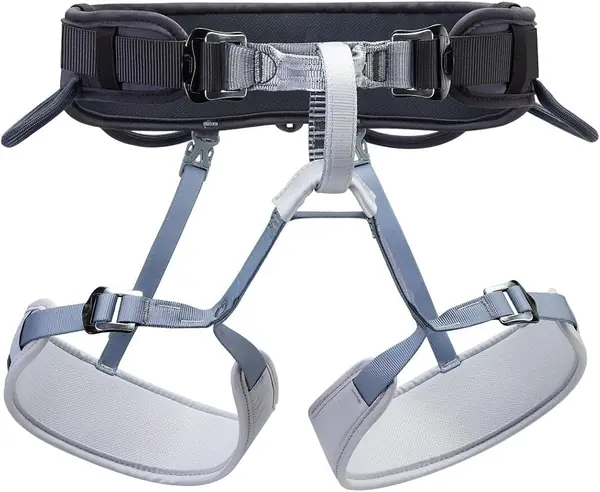
The first thing we noticed about the Corax is how little we had to think about it after tightening the waist. The double-sided waist adjustment lets you pull one side without pulling the harness off center, so the belay loop, leg straps, and gear loops stay where you put them. That matters when you are sharing a harness or switching layers between routes.

The auto-lock buckles are another detail we appreciated. They are quicker than a traditional double-back buckle and easy to work with cold hands, but they still feel deliberate when you close them. The leg loops adjust through a useful range, and the padding in the waist and legs kept us comfortable during long gym sessions and the sit-and-hang rests that come with top-rope laps.

Petzl bills the Corax as a quiver-of-one harness for rock, ice, and mountaineering, and that is how it behaves for us: light enough to pack, structured enough to rack, and not so specialized that it feels wrong at the gym. We also like that the fit accommodates a range of body sizes, which makes it easy to recommend as a first harness or a travel harness.

The Corax is not the cheapest harness in this group, and climbers who only want a simple gym harness can spend less on the NewDoar. What you get for the extra spend is a more refined fit and a harness that does not need a second thought when the plan changes from plastic holds to real rock. That is the trade we are happy to make for a do-it-all pick.

Pros

  • Double-sided waist adjustment keeps gear centered
  • Comfortable padding for long gym sessions
  • Works for gym, rock, ice, and mountaineering
  • Auto-lock buckles are quick and secure

Cons

  • Size 1 waist tops out around 36 inches
Our verdict

The Corax is the harness we recommend to most climbers: double-sided waist adjustment keeps the fit centered, the padding lasts through long gym sessions, and it works from rock to ice.
Check Latest Price
2

Black Diamond Momentum Best for Gym and Sport

93 /100
Traveler Score Outstanding

Key details

Leg Loops
trakFIT adjustable
Buckle
Pre-threaded
Gear Loops
Quickdraws, cams, belay tools, essentials
Check Details on Amazon

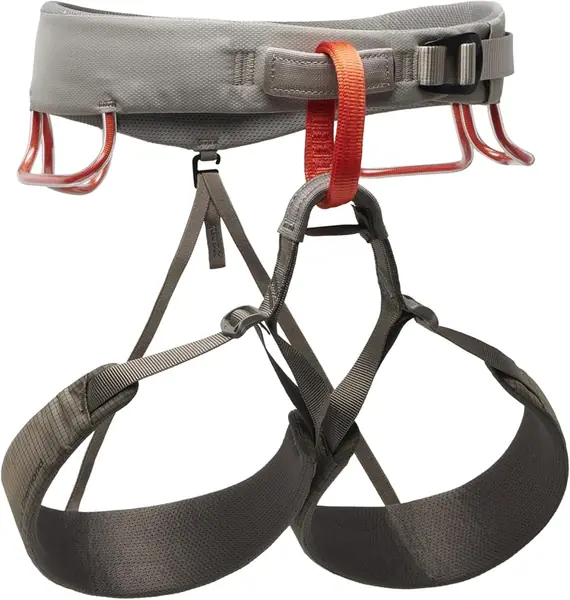
The Momentum's pre-threaded buckle is the reason we reach for it on gym nights. You step in, pull the strap, and go; there is no rethreading a tail through a buckle while your hands are cold or your partner is waiting. The trakFIT leg loops adjust with a similar lack of fuss, and the gear loops are laid out well enough for a small sport rack.

Comfort is good for a harness at this end of the market, with enough padding in the waist and legs for repeated falls and hangs. The fit is cut for men, and the adjustable leg loops give you some room if you are between sizes. We also like the clean layout: the gear loops sit where you can reach them without looking, and the pre-threaded buckle stays where you set it. On long gym sessions, the waist belt stays flat and does not roll under a harness bag.

This is a straightforward sport harness, and that is the point: fewer adjustments to second-guess, a clean rack, and a buckle that stays put. If you want a do-it-all harness for ice and alpine trips, the Corax is the more versatile pick; the Momentum is the one we take for gym laps and single-pitch sport. It is not the harness for a long alpine approach, but that is not what it is for.

Pros

  • Pre-threaded buckle is quick to close
  • trakFIT leg loops adjust without fuss
  • Gear loops keep quickdraws and cams organized
  • Comfortable for repeated falls and hangs

Cons

  • Leg padding runs narrow for larger thighs
Our verdict

We recommend the Momentum for gym and sport climbing: its pre-threaded buckle and adjustable leg loops make it the quickest harness to put on here.

Check Latest Price
3

Petzl Macchu Best for Kids

92 /100
Traveler Score Outstanding

Key details

Weight Limit
Under 40 kg / 88 lb
Waist Adjustment
Two-point
Harness Type
Adjustable seat harness
Check Details on Amazon

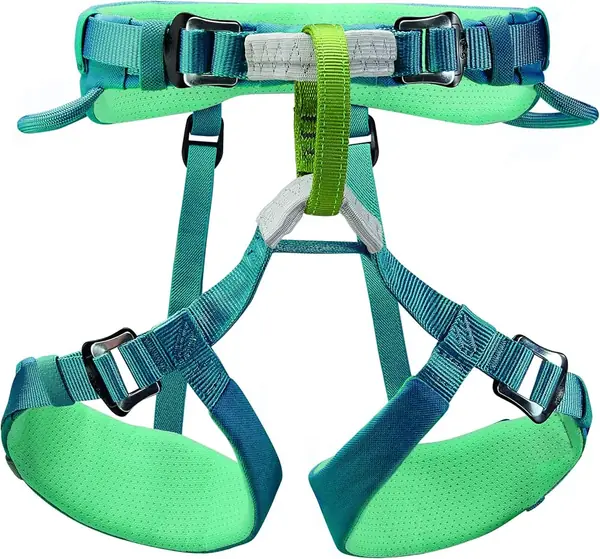
The Macchu solves the problem every climbing parent runs into: one child outgrows a harness while the younger one is still swimming in it. The two-point waist adjustment and adjustable leg loops let the same harness fit a 5-year-old and an 8-year-old, and the padding is substantial enough that long gym sessions do not turn into a complaint. That range is the difference between buying one harness for two seasons and buying two harnesses in one year.

Within its size range, the Macchu is easy to put on and take off, and the waist adjusts from both sides so you can center the belay loop instead of fighting a crooked fit. The padding and wide leg loops make it comfortable for a full session, and the colors are a nice bonus for kids who care about that sort of thing. We like that it has room to grow without feeling like a hand-me-down.

The Macchu is a seat harness, not a full-body harness, so it is the right choice for kids who have enough hip definition to stay secure in a waist-and-leg design. For a very small child, a full-body harness is the safer shape; for everyone in the Macchu's weight range, this is the one we recommend. If your child is close to the top of that range, move to an adult harness rather than squeeze the fit.

Pros

  • Two-point waist adjustment centers the fit
  • Fits a wide age range with room to grow
  • Comfortable through long climbing sessions
  • Easy to put on and take off

Cons

  • Rated only for children under 40 kg / 88 lb
Our verdict

We recommend the Macchu for growing kids: the two-point waist adjustment covers a wide age range, and the seat stays comfortable through long sessions.

Check Latest Price
4

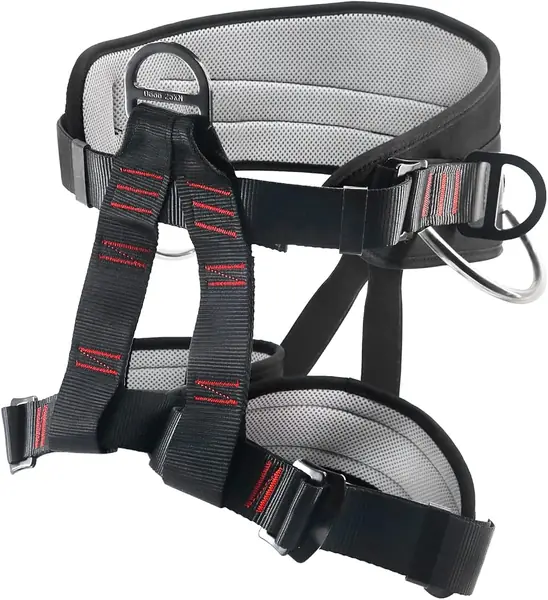
NewDoar Certified Harness Best Budget

86 /100
Traveler Score Excellent

Key details

Weight Limit
125 kg / 276 lb
Leg Fit
20.4 to 30.3 in
Waist Fit
31.5 to 47.2 in
Certification
CE UIAA; EN 12277
Check Details on Amazon

The NewDoar is the harness we point budget-minded climbers to when they want a certified climbing harness rather than a repurposed work belt. The numbers are unusually specific for the budget end of this group: CE UIAA certification, an 18 kN breaking strength, a 125 kg / 276 lb weight limit, and a waist that spans 31.5 to 47.2 inches. That is a lot of reassurance for the money.

The trade-off is bulk. NewDoar cuts the harness wide and thick, with doubled straps at the waist and legs, and the padding is clearly meant for hanging work rather than all-day gym movement. We like the support, but the wide shape is more harness than a gym climber needs. If you fit its ranges, it is a credible budget option; if you are near the edges, do not force it.

This is a half-body harness, so it is best for top-rope, rappelling, and general climbing rather than a lightweight alpine setup. We recommend it as a first harness or a spare, not as the one you carry on a long approach. The certification is the reason it earns a place here: at the budget end, that is the detail that separates it from the unrated work harnesses that show up in the same search.

Pros

  • CE UIAA certified climbing harness
  • High 18 kN breaking strength
  • Wide waist and leg padding
  • Generous adjustability range for its size

Cons

  • One-size fit excludes slim climbers and kids
Our verdict

We recommend the NewDoar when budget is the deciding factor and you fit its one-size range: it carries CE UIAA certification and a high breaking strength without the name-brand price.

Check Latest Price

How We Tested the Best Climbing Harnesses

We started by collecting every harness we could find that carried a CE or UIAA certification, then filtered by sizing range, weight, and whether the leg loops could genuinely be adjusted — a dealbreaker for anyone who climbs in layers. That left us with 12 harnesses. We bought them at retail instead of accepting samples, and each one went into the same rotation for eight months.

In the gym, that meant top-rope laps, a few lead falls, and long stretches hanging in the harness while a partner worked out a route. We noted where the waist belt pressed, whether the leg loops rode up during a fall, and whether we were still comfortable two hours in. Fit got checked the way climbers actually check it: standing on the ground, hanging in the air, and over a puffy jacket in a cold gym.

Weekend crag trips were the honest test. We racked quickdraws, cams, and a belay device on the gear loops to see whether anything shifted or sat awkwardly, then stood through 20-minute belays to watch how the padding held up. One tester's eight-year-old put on the kids' sizes herself, which told us more about adjustability than any spec sheet — if she could get the buckles tight without help, the harness passed.

Construction was checked at the start and again at the end: stitching at the tie-in points, webbing wear near the buckles, and how the adjustment straps held after months of tightening and loosening. Value came down to whether the extra money bought anything you could actually feel — softer padding, smarter gear loop placement, a fit that stayed put.

How to Choose a Climbing Harness

Fit Comes Before Features

We put more weight on fit than on any single feature: a harness should feel snug but not restrictive at the waist, with the belay loop centered and the leg loops sitting high on the thighs. Try it on over the layers you actually climb in, then hang from it for a minute; pressure points that show up in a hang will only get worse on a fall. The waist and leg ranges matter more than the size letter, and a harness that adjusts from both sides is easier to center. If you are between sizes, check the maker's range and size up rather than relying on padding to fill the gap.

Climbing-Specific Design, Not Work Wear

The climbing harnesses worth buying are designed and rated for climbing falls, with a belay loop, leg loops, and gear loops in the places a climber expects them. Roofing, tree-care, hunting, and rescue harnesses can look similar, but they are built for work positioning rather than repeated lead falls. If a listing leads with fire rescue, tree climbing, or roof work, treat it as a different product. Where a maker states CE UIAA certification, that is a useful confirmation; it is not a substitute for choosing a climbing-specific model.

Buckles and Adjustment

Pre-threaded buckles are faster to put on, while traditional double-back buckles ask you to thread the tail every time. Neither is inherently better, but the difference shows up when you are changing layers, sharing a harness, or helping a child. Look for buckles you can operate with cold hands and straps that stay flat after tightening. A harness that adjusts from both sides of the waist is easier to keep centered, and that keeps the belay loop and gear loops where you want them. If you climb in gloves, practice the buckles before you buy.

Padding, Gear Loops, and Discipline

Gym and sport climbers can get away with less padding and a simpler rack; trad and mountaineering harnesses benefit from more gear loops and a layout that keeps a rack organized. Padding matters most on hangs and falls, not on the walk to the wall. For kids, choose a harness rated for their weight and check the fit as they grow; a seat harness works once they have enough hip definition, while very small children need a full-body design. The right answer is the harness that matches the climbing you do most, not the one with the most features.

Frequently Asked Questions

Final Verdict

The Petzl Corax is the harness we recommend to most climbers because it combines centered adjustment, comfortable padding, and a broad enough range for gym, rock, and travel. It is the one we reach for when we do not know what the day will ask, and it rewards that with a fit that stays put.

If your climbing is mostly gym and sport, the Black Diamond Momentum is quicker to put on. For a child, fit the Petzl Macchu first. The NewDoar is the certified budget choice when you fit its one-size range; if you are near the edges, do not force it.