Best Camping Axes of 2026

A camp axe is a compromise you can hold in your hand: a full-size splitting axe makes fast work of a woodpile but is a burden to carry, while a compact hatchet rides easily in a pack and can leave you hacking at a stubborn round. The right one turns damp branches into a bed of coals without wearing out your shoulder or your patience. I've learned that the hard way, with an axe too big for the trunk and a hatchet too small for the fire.

Over eight months, my team and I tested 14 axes and hatchets, from 14-inch pack models to 27-inch splitters. We paid attention to how quickly the edge bit into wet wood, whether the handle shocked your palm on a missed swing, how the grip held with gloves, how much the tool weighed after a short carry, and whether it earned its price. The best ones combined a sharp edge, a solid build, a comfortable handle, and a size that matched the way you camp—that is what the picks below have in common.

The Best Camping Axes

1

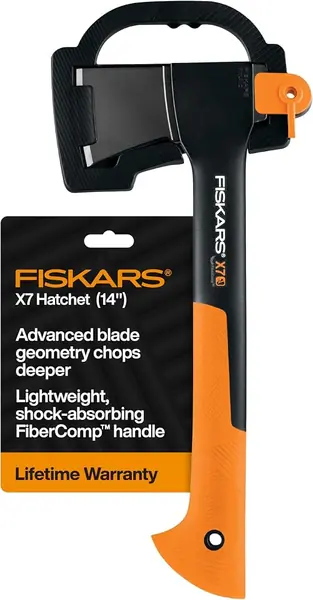
Fiskars X7 Hatchet Best Overall
97 /100
Traveler Score Outstanding

Key details

Item Weight
1.4 lb
Overall Length
14 in
Blade Length
5.12 in
Head Weight
1.5 lb
Check Details on Amazon

Fourteen inches and 1.4 pounds is the balance we keep coming back to. The X7 is short enough to lash to a daypack, light enough to carry without thinking about it, and still head-heavy enough to bite into kindling. For most campers, that combination makes it the default camping axe.

What makes it easy to live with is the construction. The forged steel head is molded into the handle rather than hung on a wedge, so there is no eye to tighten after a few trips. The low-friction blade coating helps the head pull free from wet wood, and the shock-absorbing handle keeps the sting out of repeated swings. We also appreciate the included sheath, which has enough coverage to protect the edge in a pack.

It is happiest making kindling, shaving starter curls, and trimming small limbs around camp. On a normal campground pile, that covers most of the work. The X7 has enough axe to matter without becoming a burden.

Pros

  • Light 1.4-pound carry
  • Insert-molded head needs no wedge tightening
  • Shock-absorbing handle reduces sting
  • Low-friction coating helps release

Cons

  • Short handle limits leverage on larger rounds
Our verdict

The X7 is our default camping axe: 14 inches and 1.4 pounds, with enough bite for kindling and small limbs without weighing down a pack.
Check Latest Price
2

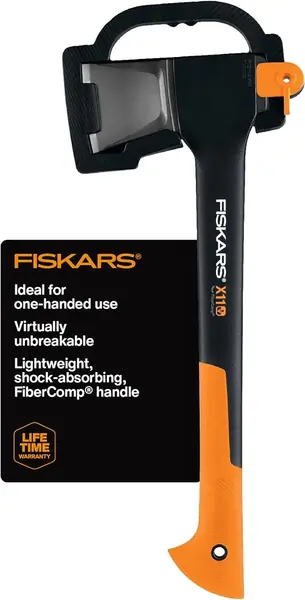
Fiskars X11 Splitting Axe Best for Splitting Kindling

96 /100
Traveler Score Outstanding

Key details

Item Weight
2.2 lb
Overall Length
17 in
Blade Length
5.99 in
Head Type
Splitting wedge
Check Details on Amazon

The X11 is not the axe you clip to a pack for a long hike. It is what we pick up when the wood is already in camp and the job is turning split rounds into kindling.

At 17 inches and 2.2 pounds, it sits between a hatchet and a full axe. The splitting-wedge head and bevel-convex grind push fibers apart instead of just biting, and the low-friction coating helps the head pull free. We found it easy to swing one-handed and easy to place on a small round, which is the point of a camp splitter.

The handle is the part we appreciate after a pile of kindling: the shock-absorbing FiberComp takes the vibration out of repeated hits. It is a focused tool, and that focus is why it works so well on small rounds.

Pros

  • Splits small rounds efficiently
  • One-handed 17-inch size
  • Shock-absorbing handle

Cons

  • Splitting profile is less useful for limbing
Our verdict

When the wood is already bucked, the X11's 17-inch splitting head turns rounds into kindling faster than a short axe; that is why we reach for it.

Check Latest Price
3

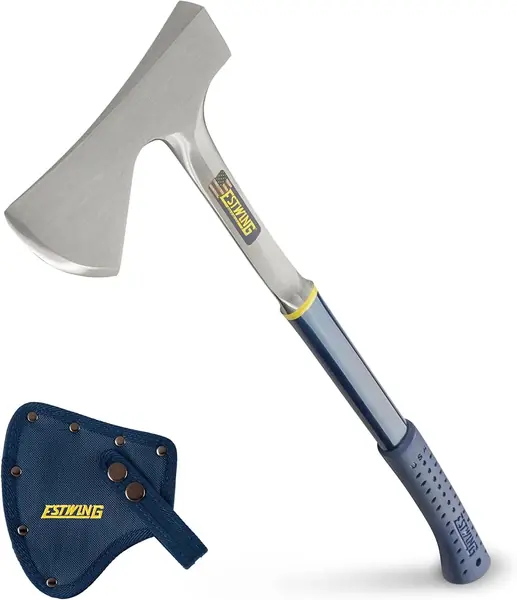
Estwing Camper's Axe 26-Inch Best Long-Handled Camp Axe

95 /100
Traveler Score Outstanding

Key details

Item Weight
3.5 lb
Overall Length
26 in
Head Weight
2.5 lb
Construction
Forged one-piece steel
Check Details on Amazon

A 26-inch handle changes the math. You get two hands on the swing, more reach into a brush pile, and enough leverage to chop through a limb that stalls a short pack axe. That is why we keep the Estwing Camper's Axe for trips where wood gathering is the main event.

The 2.5-pound head and 3.5-pound total weight are substantial without crossing into maul territory. The one-piece forged steel construction means there is no wood handle to loosen, and the shock-reduction grip takes the sting out of repeated hits. We also like the sheath, which has a belt loop and enough structure to protect the edge in the truck.

At 26 inches, it is a camp axe, not a backpacking tool. It rides in the truck or straps to a pack frame, and it is the one we grab for clearing a site or breaking down branches.

Pros

  • Two-handed reach for limbing
  • Forged one-piece steel
  • Shock-reduction grip

Cons

  • 3.5 pounds is a lot to carry far
Our verdict

Reach and two-handed control are why we choose this 26-inch Estwing for limbing, clearing, and larger camp wood.

Check Latest Price
4

Estwing Sportsman's Axe 14-Inch Best Traditional One-Piece

94 /100
Traveler Score Outstanding

Key details

Item Weight
1.8 lb
Overall Length
14 in
Blade Length
3.25 in
Handle Material
Leather
Check Details on Amazon

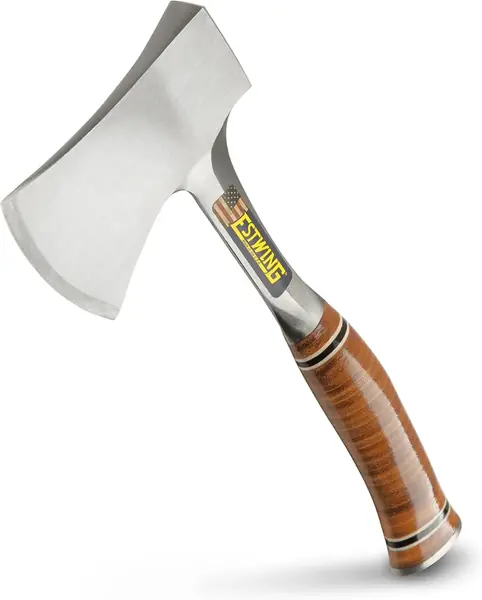
The leather handle is the first thing you notice, and it is what makes this Estwing feel like a traditional axe rather than a plastic tool. It is hand-sanded and lacquered, with a shape that fills the hand without feeling bulky.

Under that handle is a 14-inch, 1.8-pound forged one-piece steel axe with a 3.25-inch blade. We like the dead-in-the-hand feel: there is no wedge or glue line between head and handle, and the weight sits where you want it for a one-handed swing. It is a chopper and limber first, and it handles kindling well when you choke up on the grip.

The leather is the trade-off. It looks and feels excellent, but it needs more attention than a synthetic handle. For a traditional kit that gets wiped down and stored dry, that is a fair exchange.

Pros

  • Forged one-piece steel
  • Comfortable leather grip
  • Compact 14-inch length
  • Heavy-duty sheath

Cons

  • Leather grip can get slick when wet
Our verdict

For a traditional forged-steel camp axe with a warm leather grip and a solid one-piece feel, the Sportsman's is our pick.

Check Latest Price
5

Gerber Pack Hatchet Best Ultralight Pack Axe

93 /100
Traveler Score Outstanding

Key details

Item Weight
1.3 lb
Overall Length
9.46 in
Blade Length
3.5 in
Construction
Full tang
Check Details on Amazon

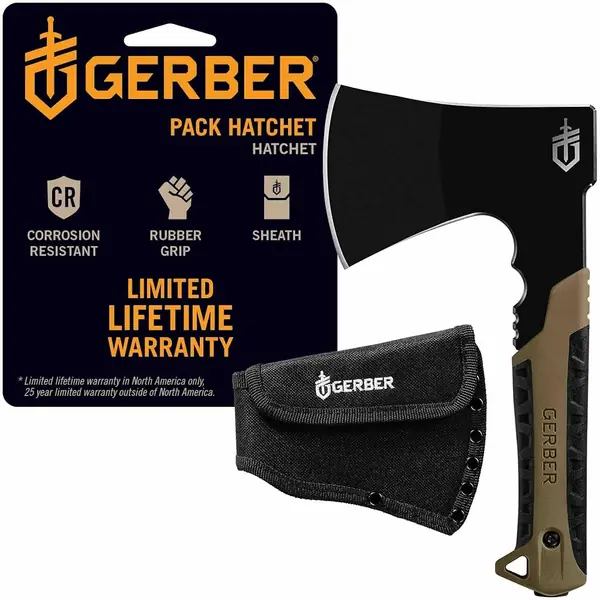
The Gerber pack axe is the one that disappears into a daypack. At 9.46 inches overall and 1.3 pounds, it takes up about as much room as a large knife and adds little weight to a summit pack or canoe bag.

The 3.5-inch full-tang blade has a tall grind and a black oxide coating, and the handle is shaped for a secure grip. The nylon sheath mounts to a pack or belt, which is the detail that makes it useful on the move. We found the compact length handy for controlled cuts on small branches, though you give up speed on bigger wood.

Where it earns its place is light camp work: shaving kindling, trimming small branches, and splitting thumb-thick sticks. It is not a wood-splitting axe, and we do not treat it like one. If your camp wood is bigger than your wrist, bring a longer axe.

Pros

  • Fits in a daypack
  • Full-tang 3.5-inch blade
  • Sheath mounts to pack or belt

Cons

  • Sheath can be fiddly to secure
Our verdict

Ultralight trips are where the Gerber Pack Hatchet earns its keep; we pack it when every ounce counts and the wood is already small.

Check Latest Price
6

KSEIBI 274150 Hatchet Best Budget

92 /100
Traveler Score Outstanding

Key details

Item Weight
1.3 lb
Overall Length
15 in
Blade Length
4.13 in
Handle Material
Fiberglass
Check Details on Amazon

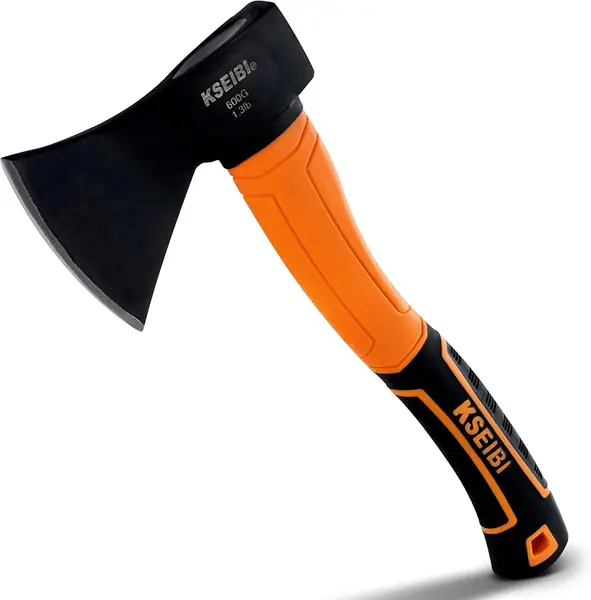
Budget axes usually ask you to give up something obvious: steel quality, handle comfort, or a usable edge. The KSEIBI 274150 gives up a little on all three, but it still arrives as a real axe rather than a toy, and it is the least expensive pick in this group.

At 15 inches and 1.3 pounds, it is a light one-hander with a fiberglass handle and a 4.13-inch forged steel blade. The size is right for a camp box or a daypack, and the fiberglass handle shrugs off wet weather better than wood. We found it comfortable enough for light chopping and kindling.

The edge is the part to watch. The factory grind can be inconsistent, and a few minutes with a file or puck before the first trip makes a real difference. For light camp chores and occasional kindling, it earns its low price.

Pros

  • Light 15-inch frame
  • Fiberglass handle resists moisture
  • Low cost for a usable camp axe

Cons

  • Fit and finish feel less refined
Our verdict

Budget-minded campers who will hone the factory edge get a light 15-inch axe in the KSEIBI; that is the trade we recommend.

Check Latest Price
7

Cold Steel Trail Boss Best for Traditional Long Swings

91 /100
Traveler Score Outstanding

Key details

Item Weight
2.6 lb
Overall Length
27 in
Handle Material
Hickory
Blade Material
1055 carbon steel
Check Details on Amazon

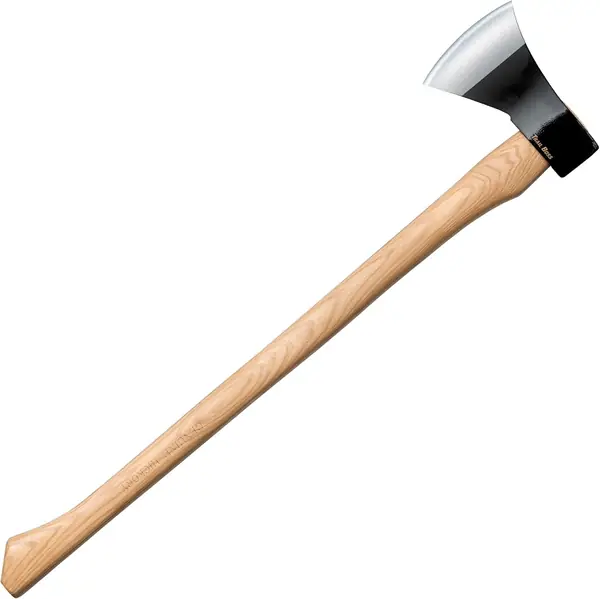
The Trail Boss looks like the axe people picture when they hear the word: a 27-inch straight-grain hickory handle, a 1055 carbon steel head, and a 4-inch blade with a long cutting edge. It is a traditional tool, not a tactical package.

At 2.6 pounds, it is light enough to carry on a short trek and long enough to swing two-handed. The hickory handle gives the axe a lively feel that steel handles do not match, and the carbon steel takes a keen edge when you take the time to sharpen it.

The edge is often the first chore. The factory grind can need work, and 1055 carbon steel will rust if you put it away wet. We keep a small puck and a rag handy, and we dry and oil the head before the axe goes back in the truck.

The handle is the bigger question. Hickory gives the axe its character, but it can split under hard use, and a loose or cracked handle is a safety issue. We check the head fit before every trip and do not use the axe as a wedge. For a traditionalist who enjoys the upkeep, the Trail Boss is a satisfying long-swinging camp axe; for a set-and-forget pack tool, the one-piece Estwings are the safer call.

Pros

  • Traditional hickory handle
  • 1055 carbon steel takes a keen edge
  • Light enough for short treks

Cons

  • 27-inch length is awkward in a small pack
Our verdict

Hickory and 1055 carbon steel give the Trail Boss a traditional feel we like, but this 27-inch axe asks for edge care and handle checks.

Check Latest Price

How We Tested Camping Axes

We started by pulling together the camping axes and hatchets that show up again and again in outdoor shops and owner reviews—compact pack axes, mid-size camp axes, and full-size splitters—then narrowed the field by steel type, handle material, sheath design, listed weight, and price. That left us with 14 models, from 14-inch hatchets to 27-inch axes, and we used each one for eight months.

Most testing happened where these tools actually live: weekend car-camping trips, backyard fire-pit nights, and a few damp mornings splitting wet rounds for a stubborn fire. We used each axe for kindling prep, small-log splitting, and one-handed chopping, then packed it back into its sheath and carried it in a truck bed, a gear tote, and a backpack. We also weighed each one and chopped with gloves on, in rain, and handed each axe to different users to compare grip and control.

For sharpness and cutting performance, we started each session by shaving curls from a dry stick and slicing cardboard, then counted how many strikes it took to halve a wrist-thick round. For handle and chopping performance, we noted hot spots, shock on missed swings, and whether the grip got slick with rain or gloves, and we watched how cleanly each head bit and cleared chips. For durability and quality, we checked the head-to-handle fit after repeated strikes, looked for loosening or wobble, and inspected the sheath stitching and retention. At the end, we compared each axe's performance against its price to see which ones delivered real value.

How to Choose a Camping Axe

Match the Handle to the Walk

A 14-inch hatchet like the Fiskars X7 is the easy choice when the axe has to ride in a daypack or a canoe bag. Step up to 17 inches and you get more leverage for splitting, which is why the Fiskars X11 is a better kindling tool than a short axe. At 26 or 27 inches, an axe like the Estwing Camper's or Cold Steel Trail Boss wants a truck, a pack frame, or a short walk from camp. The trap is assuming compact always means convenient: a 9-inch pack axe stows easily but runs out of power on anything beyond thumb-thick wood.

Weight and Balance Beat the Scale

A camp axe can weigh 1.3 pounds or 3.5 pounds and still feel wrong if the head is too light for the handle. For one-handed kindling work, look for a head-heavy balance that lets the bit do the work without a hard swing. For two-handed limbing, a longer handle and a 2.5-pound head give you reach and momentum. We pay more attention to how the axe hangs in the hand than to the total weight alone, because a well-balanced 2-pound axe can feel easier to use than a nose-heavy 1.5-pound one.

Choose a Head and Handle You Will Maintain

Forged one-piece steel, molded composite, and hickory all work, but they ask for different care. One-piece steel axes like the Estwing Sportsman's avoid a wedge or glue line, while hickory handles like the Trail Boss feel livelier and need to be kept dry and checked for looseness. Fiberglass and molded handles are the low-maintenance choice for wet trips. The blade matters just as much: a splitting wedge with flared cheeks is for pushing rounds apart, while a thinner chopping profile is for limbing. Buy for the job you do most, not the one you imagine.

Plan for the Edge and the Sheath

A camp axe is only as useful as its edge, and many new axes need a few minutes with a file or puck before the first trip. If you are not ready to sharpen, choose a pick that arrives with a workable edge and keep a small sharpener in your kit. A sheath is not optional: it protects the blade in transit and protects you when you reach into a pack. Look for one that stays on securely and has a belt loop or pack attachment if you plan to carry the axe outside your bag.

Frequently Asked Questions

Final Verdict

For most campers, the Fiskars X7 is the one to buy: 14 inches, 1.4 pounds, and enough edge to make kindling without weighing down a pack. If your camp wood is mostly split rounds, the Fiskars X11 gives you a dedicated splitting head and one-handed control. If you need reach and two-handed leverage for limbing, step up to the 26-inch Estwing Camper's Axe.