Best Canopy Tents of 2026

The first hot Saturday of the season is when a canopy tent earns its keep, and when you find out whether you bought a good one. I've watched grown adults lose twenty minutes and a chunk of their dignity to a frame that won't lock while the food sits in the sun. What a canopy fixes is simple: it puts shade, and a place to set the potato salad, wherever you happen to be standing. Whether it goes up fast, stays where you put it, and survives an afternoon of wind is what separates a tent you use all summer from one that never leaves the garage.

A 10-by-10 canopy doesn't actually give you 10 by 10 feet of shade — the legs sit inside the footprint, and the sun moves. Over eight months, my team and I pitched 12 of these at soccer tournaments, in the driveway, and in the backyard for a birthday, then took every one back down. Setup speed, packed weight, and how the top handled rain mattered more than any spec sheet suggested, and none of it shows up in the marketing photos.

1

Best Overall

Crown Shades 10x10 Pop Up Canopy

93 /100
Traveler Score Outstanding

Key details

Weight
36 lb
Footprint
10 x 10 ft
Peak Height
9 ft
Canopy Fabric
Silver-coated, UPF 50+
Check Details on Amazon

The push is the whole idea. One shove on the hub at the center of the frame locks all four legs at once, and the frame arrives assembled with the through-bolts already in place, so there's nothing to thread or pin. We've wrestled with enough pin-and-slider canopies to appreciate how much time that saves, especially with one pair of hands. It's why this Crown Shades is our top pick: the tent that goes up fastest is the tent you actually use.

The top clips to the frame and stays clipped when you fold it, so the whole canopy goes back in the bag assembled rather than as a frame plus a separate sheet of polyester. The bag has wheels, and the package is 36 pounds — light enough for one adult to pull across a field and lift into a hatchback, and a long way from the 61-pound Eurmax on this list.

Inside, 100 square feet and a nine-foot peak mean tall friends aren't ducking and a six-foot table plus chairs disappears into the shade. Ten people is a standing-room number, not a seating one. Stakes and ropes come in the bag; weights don't, so plan on sandbags for open ground. Speaking of coverage: two years, with a full canopy replacement in year one and parts in year two, is the longest warranty on this list.

Pros

  • One push locks all four legs
  • Top stays clipped on for storage
  • Wheeled bag at 36 pounds
  • Nine-foot peak over 100 square feet

Cons

  • Frame and canopy can fail in strong wind
  • Water-resistant top, not waterproof
Our verdict

For most buyers this is the one: a single push locks the frame, the top stays on in the bag, and one person can handle all 36 pounds of it.
Check Latest Price
2

Best for Vendors

Eurmax 10x10 Commercial Canopy

89 /100
Traveler Score Excellent

Key details

Frame
Full truss steel
Walls
4 zippered, removable
Weight
61 lb
Footprint
10 x 10 ft
Check Details on Amazon

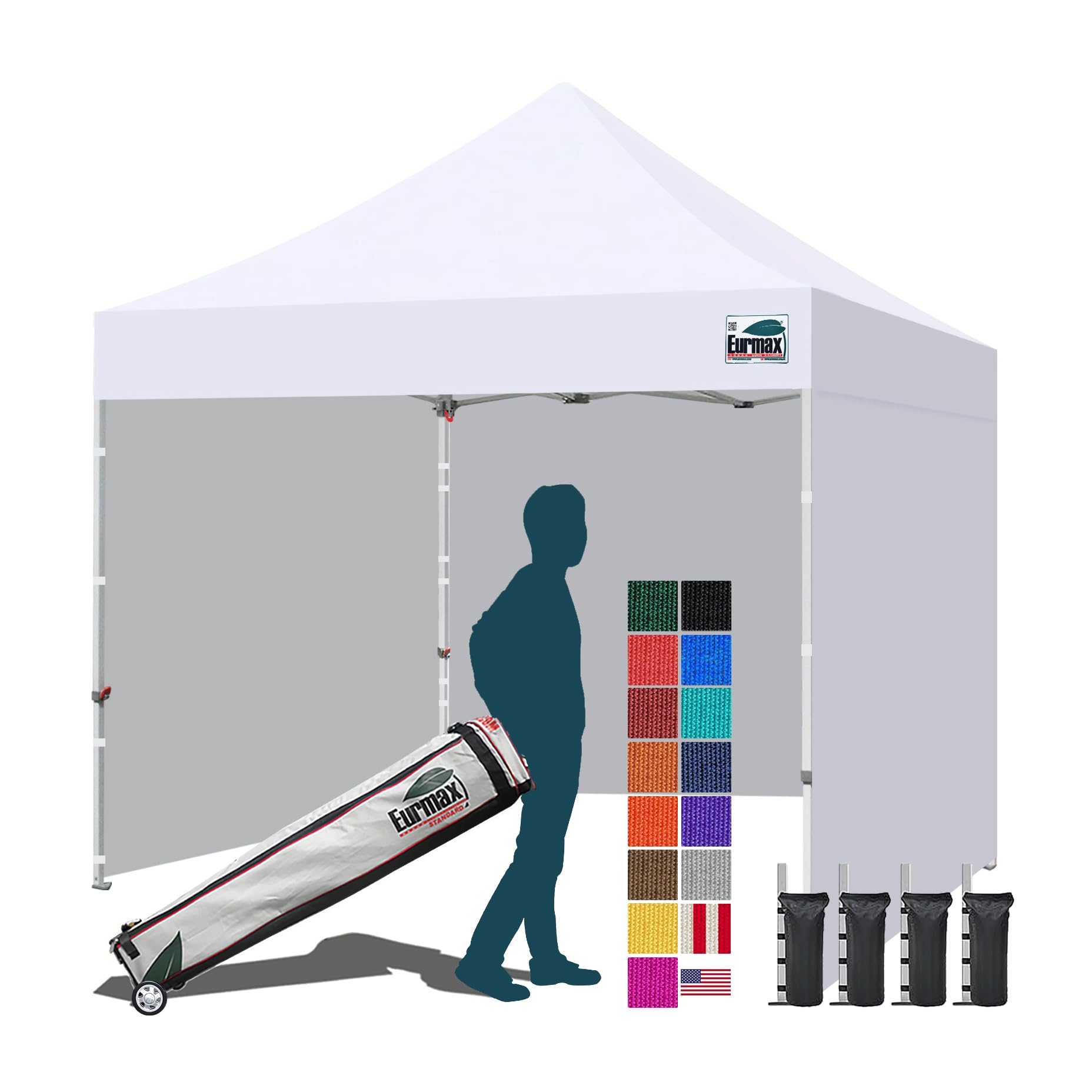
Four walls change what a canopy is. On the Eurmax they run the full length of the frame, Velcroed under the top and zipped to each other at the corners, so the shelter closes into something like a room — and any panel comes off when you want the breeze back.

What you're paying for is the frame. This is a full truss with hardened through-bolts rather than the lighter bracing on the recreational tents here, and Eurmax stocks replacement parts in the U.S., which matters when you're setting up every Saturday and a leg eventually goes. We think that's the right trade for anyone selling or exhibiting: it behaves like equipment rather than a weekend accessory.

The price of that is 61 pounds. Two people lift it into a truck bed without ceremony; one person can roll it on the bag's wheels but will feel every curb. Setup is a two-person job the first time and a comfortable solo job after that. The bag is thick and roomy enough to swallow the frame with the top still attached, which is the difference between a quick pack-up and a folding exercise in the dark.

Pros

  • Full truss frame with through-bolts
  • Four walls zip into a closed booth
  • Replacement parts stocked in the U.S.

Cons

  • Legs can need a second push to lock
  • Frame can twist when wind gets under the walls
Our verdict

Buy this one if you sell, exhibit, or need walls that actually close: the frame is commercial-grade and the panels come off when they don't.

Check Latest Price
3

Best for Wet Weather

Crown Shades 10x10 Commercial Canopy

89 /100
Traveler Score Excellent

Key details

Walls
4 sidewalls included
Footprint
10 x 10 ft
Peak Height
112 in
Canopy Fabric
300D silver-coated, UPF 50+
Check Details on Amazon

The fabric is where this canopy separates itself from the cheaper Crown Shades here. It's 300D silver-coated polyester rather than 150D, with sealing tape over the seams and a CPAI-84 flame rating, and the heavier cloth is the difference between a top that shrugs off a shower and one that starts dripping at the stitching. When the sky can't make up its mind, this is the one we reach for.

The rest of the package is built for a long day. Four sidewalls, a center hub that locks all four legs with a single push, pinch-free buttons for the height, and two legs with wheels built in, so you can tip a standing tent and roll it a few feet to chase the shade. The peak clears nine feet with six feet of headroom under the valance; 12 people is standing room, not seating.

It packs into the Sto-N-Go bag with a separate pocket for the walls, which is the small thing that keeps you from arriving with four panels in a heap. Plan on a second pair of hands for the lift into a truck. Against the everyday Crown Shades you're paying for cloth, tape, and walls — worth it when the event can't move indoors.

Pros

  • 300D fabric with taped seams
  • Four sidewalls in the box
  • Wheels built into two legs

Cons

  • Side walls can leak where they meet the top in driving rain
Our verdict

For events that happen rain or shine, this is the canopy we hand people: heavier cloth, taped seams, four walls, and wheels to move it once it's up.

Check Latest Price
4

Carrying Solo

Eagle Peak 10x10 Pop Up Canopy

89 /100
Traveler Score Excellent

Key details

Weight
32.8 lb
Footprint
10 x 10 ft
Peak Height
112.2 in
Canopy Fabric
150D oxford, UPF 50+
Check Details on Amazon

At 32.8 pounds, this is the lightest 10x10 on our list, and that number does more for a beach trip than anything else on the spec sheet. It's the difference between one trip from the lot and two, or between loading the car yourself and waiting for help.

The frame is still powder-coated steel with hardened through-bolts, and the center lock works like the Crown Shades: one push at the hub, then the legs extend to the height you want. The top is 150D silver-coated oxford with heat-sealed seams and UPF 50+, and the peak sits a little over nine feet, so eight to ten people fit without anyone's head in the valance.

The wheeled bag is compact enough for a trunk, and one person can have the whole thing standing and staked without a second set of hands, which is the entire point of a tent this light. What you give up is margin: of the four canopies here, this frame has the least in reserve for a gusty afternoon, and a season of weekend markets will be harder on it than a handful of summer Saturdays at the lake.

Pros

  • 32.8 pounds, the lightest here
  • Center push lock for solo setup
  • Wheeled bag sized for a car trunk

Cons

  • Seams can leak in steady rain
Our verdict

If you load and carry the canopy yourself, this is the one we point to: 32.8 pounds, a center lock one person can work, and 100 square feet of shade.

Check Latest Price

How We Tested Canopy Tents, From Backyard to Sideline

We started with every canopy we could find that had a straight-leg frame, a wheeled bag, and a stated 10-by-10 footprint — big enough for a picnic table and a few chairs. We cut anything without a warranty, anything with a low peak height, and anything heavy enough to need two people just to move. That left 12 tents, from budget to genuinely nice, all bought with our own money, which made us honest about whether the extra spend bought anything you could feel.

Each one went through the same eight months: a backyard birthday, a summer of Saturday soccer sidelines on an open field, a camping weekend, and a stretch of driveway use while I repainted a room. I set every tent up alone with a stopwatch running, from unzipping the bag to the last leg locked, then did it again to see what a second attempt taught me. I noted whether one person could push the center hub up without help, whether the legs locked with an audible click, and whether the bag went back over the frame without a fight.

For water resistance, I ran a watering can over each roof for five minutes, then checked the seams and the underside for drips; a top that beads light rain but wets through at the stitching isn't much use. Wind got tested the way it actually arrives — tents left standing on a gusty afternoon while I watched the frame flex, the stakes pull, and whether the roof vented or ballooned. Durability showed up in smaller ways: bent truss bars, frayed bag seams, chalky fabric, zippers that quit. Every tent was also weighed on a luggage scale, packed exactly as it would leave my car, because 40 pounds carried across a field feels nothing like 40 pounds on a spec sheet.

How to Choose Canopy Tents

Start With Shade Area and Headroom

A 10x10 canopy covers 100 square feet, which is a six-foot table with chairs around it or eight to ten people standing at a stall. Peak height matters just as much: nine feet keeps tall guests out of the valance, while a lower peak has everyone ducking near the edges. The trap is the slant-leg design. A slant-leg tent sold as 10x10 leans its legs inward and can shade only about 64 square feet up top. Check the listed shade area rather than the footprint, and if the number is 64, that's what you'll be standing under.

Decide Who Raises It

Center-lock hubs, where one push at the middle locks every leg, are the difference between a one-person tent and a two-person negotiation. The second half of the job is the fabric: a top that clips to the frame and stays attached for storage saves the worst part of packing up. If someone always helps, a cheaper pin-and-slider frame is fine. If you're usually alone, pay for the center lock — a canopy that needs two people is a canopy you stop taking.

Fabric, Water, and Wind

Fabric weight tells you how much weather a top will shrug off: 150D is the recreational standard, and 300D with taped seams is what you want if rain is likely. Water-resistant is the honest phrase, and it means a shower, not a storm. Anchoring matters more than either. Stakes and ropes come in the bag, weights usually don't, and stakes do nothing in sand or on pavement — a filled bag on each leg is the fix. Take it down when the wind builds; nothing at this weight is a permanent structure.

Do You Need Sidewalls?

One wall blocks the low sun and gives a little privacy; four turn a canopy into a booth you can sell from or shelter inside. They also catch wind and add a hanging step at each end of the day. If you vend, exhibit, or sit out a whole day of changeable weather, walls earn their keep and are cheaper bundled than bought later. For tailgates and beach afternoons, skip them and keep the open shade.

Weight, Bag, and the Last Twenty Feet

Our picks run from just under 33 pounds to 61. The walk from the car is where a canopy gets judged, and the bag matters as much as the number: wheels handle grass and gravel, but you still lift it into the trunk. If you load solo, stay in the mid-30s. If the tent lives in a truck bed or trailer for the season, a heavier frame buys stability you'll notice in a breeze.

Frequently Asked Questions

Final Verdict

For most people, the Crown Shades 10x10 is the canopy to buy. One push locks the frame, the top stays on in the bag, 36 pounds is manageable alone, and two years of coverage is the longest here. It's the tent that gets used because it's the tent that's easy.

Change the requirement and the pick changes. Selling or exhibiting? The Eurmax's four zippered walls and full truss frame are built for weekly setups. Facing a wet forecast? The Crown Shades commercial version, with 300D taped fabric and walls, comes closest here to a rain shelter. Loading a small car on your own? Take the Eagle Peak at 32.8 pounds.