Best Camping Pillows of 2026

A bad camping pillow rarely ruins the first night. It waits until the second morning, when you sit up with a stiff neck and realize the stuff sack you folded under your head wasn't a pillow at all. The right camping pillow gives you a consistent place to rest your head without eating half your pack, and it should feel supportive whether you sleep on your back, side, or stomach. Over six months, my team and I took 12 camping pillows on weekend car-camping trips and longer backcountry overnights, and the differences in comfort, support, and packed size showed up fast.

What surprised me is how much personal preference matters: a pillow that felt perfectly soft to me was too flat for a side sleeper on my team, and the firmest option wasn't automatically the most supportive after a long hike. We also paid attention to size — both the inflated footprint and how small it compressed — because a pillow that swallows pack space or slides off a sleeping pad is a hassle no matter how comfortable it is. Value isn't just the lowest price; it's whether the pillow still feels supportive after repeated inflating and deflating, and whether it looks and feels like it will last. The picks below are organized around those trade-offs, with options for different sleep styles and packing priorities.

1

Best Overall

Nappler Small Memory Foam Pillow

91 /100
Traveler Score Outstanding

Key details

Fill
Shredded memory foam
Cover
Removable, machine washable
Weight
8 oz
Inflated Size
19 x 13 in
Check Details on Amazon

What separates the Nappler from the pile of small foam pillows is a zipper. The case is stuffed with shredded memory foam rather than a molded block, so you can unzip it, pull out a handful or two, and close it again with the loft sitting exactly where your neck wants it — keep the spare foam in a bag for the night you want more height. At 8 ounces and 19 by 13 inches, it's the pillow we recommend first to most people, because it's the one that behaves like a pillow.

It sleeps the way a bed pillow does: soft microfiber cover, a slight yield under your head, no taut drum skin and no rustle when you turn over. The cover unzips and goes in the wash, which matters more on night four than night one. One thing to plan for is that it arrives vacuumed flat and needs several hours of air before it reaches full loft, so open it at home and give it an afternoon rather than debuting it in a tent.

The trade is bulk. Eight ounces is light for foam, but the packed roll is several times the size of a pocket inflatable, and it holds its place by being big and grippy rather than by being attached to anything — roll around a lot and one of the strapped air pillows here holds position better. If you're counting grams or sharing a narrow mummy pad, go elsewhere. Eight ounces is a fair price for sleeping like you're at home.

Pros

  • Shredded fill you can add or remove
  • Real-pillow feel at 8 ounces
  • Removable, machine-washable cover
  • Packs into a carry case with a snap loop

Cons

  • Packs much larger than an air pillow
Our verdict

The camping pillow we point most people to: eight ounces, a real-pillow feel, and fill you can pull out until the loft suits your neck.

Check Latest Price
2

Best for Backpacking

Sea to Summit Aeros Premium

91 /100
Traveler Score Outstanding

Key details

Weight
2.8 oz
Thickness
4.3 in
Packed Size
3.3 x 2.8 in
Inflated Size
13.4 x 9.4 in
Check Details on Amazon

Two point eight ounces, packed to 3.3 by 2.8 inches. For a committed backpacker the Aeros settles the question before comfort even comes up. Inflated, it's 13.4 by 9.4 inches and 4.3 inches thick, with a brushed knit surface instead of the slick nylon you find on cheaper inflatables, so your face isn't resting on something that feels like a pool toy.

The valve is the detail we appreciate most: a multi-function mini valve lets you add a breath or bleed one out without dumping the whole pillow, so you can chase the right firmness in the dark instead of starting over. If you already sleep on one of Sea to Summit's mats with PillowLock patches, the base fastens to them and the pillow stops wandering; without the patches, it's an ordinary pillow.

What the money buys is finish and weight, not sleeping area. At 13.4 inches across it has the smallest surface in this group, which suits back sleepers and wears thin for side sleepers who need something to fill the gap at the shoulder. Care is hand-wash only, so on a long trip you're wiping it down rather than laundering a cover. We take that trade for backpacking; for tent camping with a car parked nearby, a foam pillow is the better night.

Pros

  • Packs to 3.3 by 2.8 inches
  • Valve lets you fine-tune firmness at night
  • Brushed knit surface, not slick nylon
  • Fastens to PillowLock sleeping mats

Cons

  • Smallest sleeping surface in this group
  • Hand-wash only, no cover to launder
Our verdict

For backpacking we take the 2.8-ounce Aeros every time — just go in knowing it's a back sleeper's pillow and care is hand-wash only.

Check Latest Price
3

Best for Side Sleepers

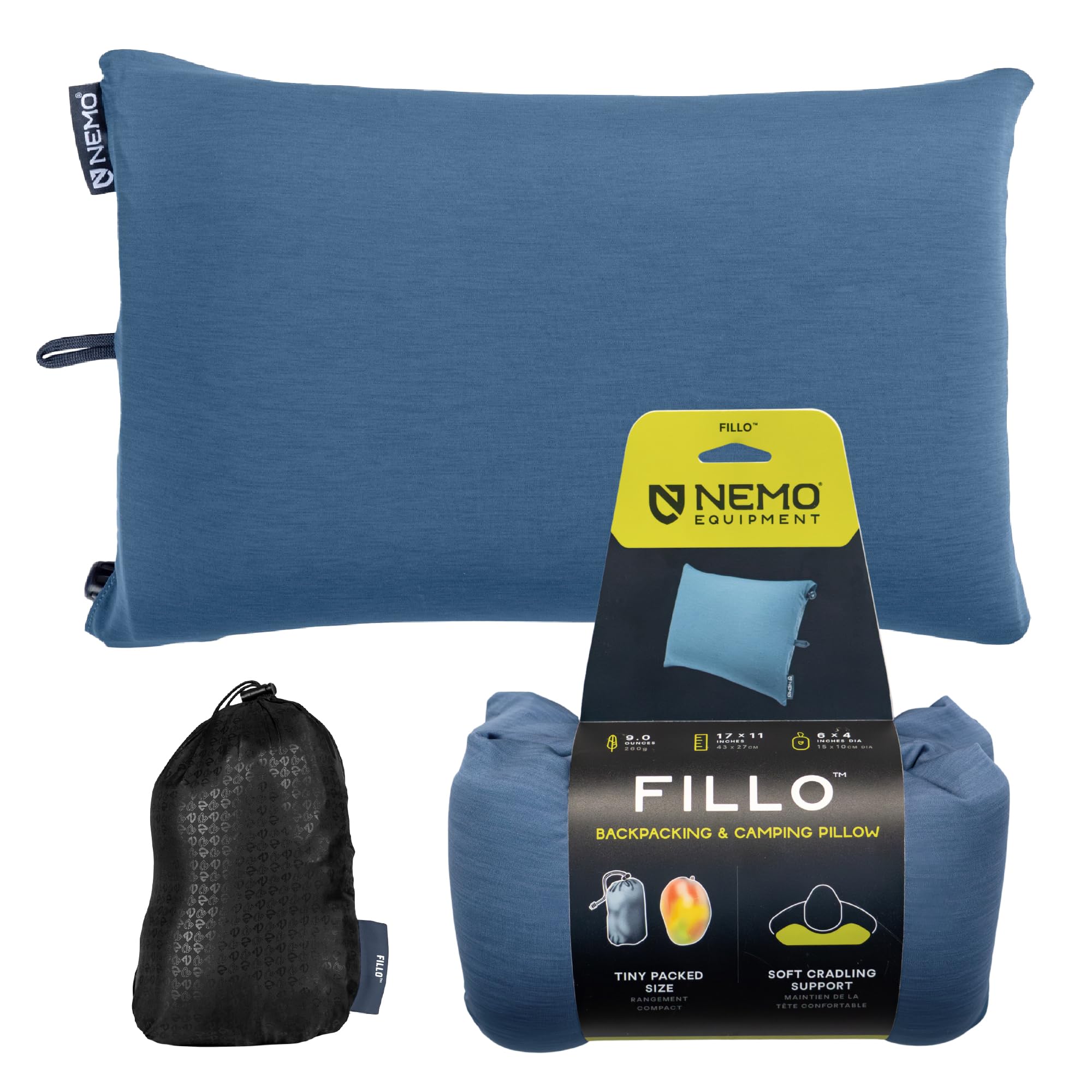
NEMO Fillo

90 /100
Traveler Score Outstanding

Key details

Fill
Foam over air cell
Cover
Removable, machine washable
Weight
9.2 oz
Thickness
4 in
Check Details on Amazon

Blow up an air pillow hard and it holds your head the way a beach ball would. The Fillo's fix is a three-inch baffled air cell with a slab of foam on top, so the surface your cheek lands on is soft and slightly yielding while the air underneath supplies the structure. Add a removable, machine-washable recycled microfiber cover and an integrated stuff sack that stays attached to the pillow instead of getting lost in a pack.

The move we like is not inflating it all the way. Fill it to roughly 80 percent and let the foam do the rest: the pillow gives a little under your head instead of bouncing back at you, and the micro-adjustable valve lets you add or bleed air in small amounts rather than in one big commitment. At 4 inches thick it's the pillow here we point side sleepers toward first.

Two things to weigh. The first is bulk: it packs bigger than 9.2 ounces suggests, and if your pack is already tight, one of the two- or three-ounce inflatables disappears where this one takes up real room. The second is cost — this is the priciest pillow in this group, and the construction and the lifetime warranty are what you're paying for. The bulk is the part that makes us hesitate; the price we can justify.

Pros

  • Foam top gives a soft, non-balloon surface
  • Part-inflate to tune the give
  • Removable, machine-washable cover
  • Backed by a lifetime warranty

Cons

  • Packed bulk outruns its 9.2 ounces
Our verdict

The pillow we hand to side sleepers: foam over an air cell, tunable by how much you inflate it, and worth the bulk if you sleep badly without it.

Check Latest Price
4

Best for Car Camping

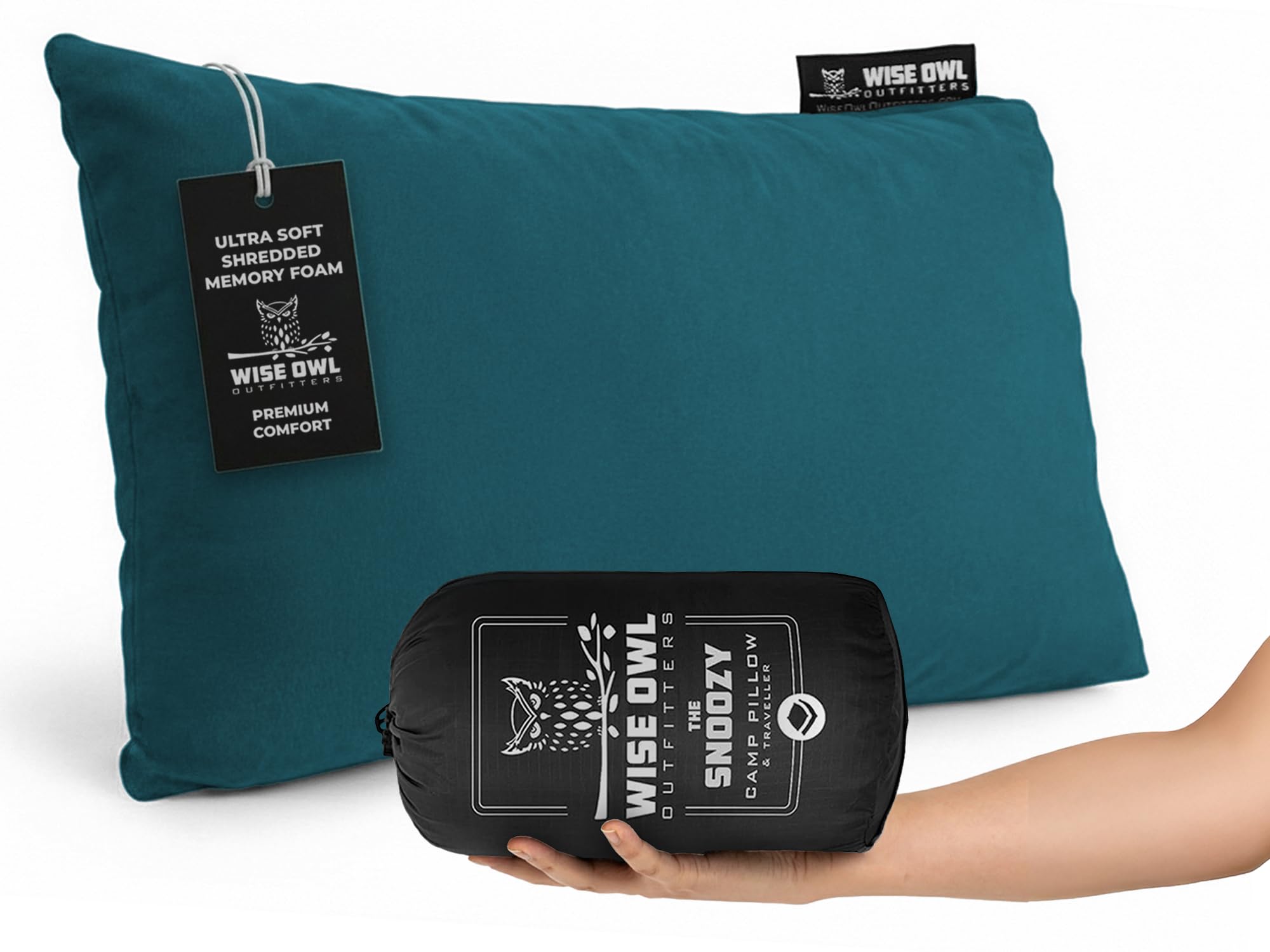
Wise Owl Outfitters Pillow

91 /100
Traveler Score Outstanding

Key details

Fill
Shredded memory foam
Weight
11 oz
Thickness
4 in
Inflated Size
14 x 18 in
Check Details on Amazon

If your camping involves a car, the Wise Owl is the pillow that makes the most sense. It's a 14-by-18-inch shredded memory foam pillow with a silky microsuede cover and four inches of loft — the closest thing in this group to picking up your bed pillow and putting it in the tent. At 11 ounces it's one of the heavier picks here, and we're happy to spend that weight in a duffel rather than on our backs.

It's genuinely comfortable. The foam shifts under your head and settles instead of pushing back, the cover unzips and machine washes, and it ships with a waterproof stuff sack that keeps it dry in a tent that takes on condensation. The sack is a snug fit, so packing up is a shove rather than a fold, but it does go.

Two caveats. Shredded foam can clump into lumps after a stretch of compression, so shake it out and break up the fill before you lie down. And despite the stuff sack, this isn't a backpacking pillow: it's for the tent you drive to, the van, and the guest room at the rental. On those trips it earns its weight.

Pros

  • Four inches of memory foam loft
  • Cover unzips and machine washes
  • Waterproof stuff sack included

Cons

  • Eleven ounces is heavy for a pack
  • Shredded foam can clump between trips
Our verdict

Our car-camping pick: a four-inch memory foam pillow that feels like the one at home, with a cover you can pull off and wash.

Check Latest Price
5

Best Budget

TREKOLOGY Aluft 2.0

89 /100
Traveler Score Excellent

Key details

Weight
3.84 oz
Thickness
4 in
Packed Size
5 x 2 in
Inflated Size
16 x 12 in
Check Details on Amazon

Rubber dots on the back and an elastic strap are the two details that lift the Aluft 2.0 out of the sea of lookalike inflatables. The strap wraps around a sleeping pad and the dots grip the fabric, so the pillow is still under your head at 3 a.m. instead of wedged against the tent wall. On a tapered mummy pad, that's the difference between a decent night and a bad one.

It's also the least expensive way into a decent night's sleep here. At 3.84 ounces it disappears into a pack, folds to 5 by 2 inches — smaller than a soda can — and takes a couple of breaths through a click-button valve. The fabric is water resistant, the inflated shape is 16 by 12 inches with 4 inches of height, and it's hand-wash only. For a first trip or a scout weekend, this is the one we suggest.

The honest caveat is longevity. These are great for a season of trips, and then some of them go soft or stop holding air — a pillow that lives compressed in a pack and gets sat on is exactly the kind that develops a leak at a seam or a valve. Buy it expecting to replace it eventually rather than to hand it down. If you want a pillow to last a decade, spend more on a foam one.

Pros

  • Under four ounces and packs to soda-can size
  • Strap and grip dots hold it on the pad
  • Fast to inflate and adjust
  • Water-resistant TPU fabric

Cons

  • Air retention can fade with steady use
Our verdict

The best budget camping pillow here: under four ounces, a strap that keeps it on your pad, and a price that makes replacing it painless.

Check Latest Price
6

Best Adjustable Loft

Therm-a-Rest Compressible Cinch

90 /100
Traveler Score Outstanding

Key details

Fill
Upcycled urethane foam
Loft
Adjustable cinch cord
Thickness
6 in
Inflated Size
18 x 14 in
Check Details on Amazon

A drawstring on the back of the Therm-a-Rest does something the inflatables can't: it squeezes the foam inside, so one pillow covers a range of heights and firmnesses. Cinch it tight for a thinner, firmer surface; let it out for six inches of loft. If you've ever woken up because your pillow sat too tall for the way you sleep, that adjustability is the entire feature.

The fill is upcycled urethane foam under a soft stretch-knit cover, and it feels like bedding rather than gear — closer to your pillow at home than anything else in this group that isn't a full-size memory foam block. Eighteen by fourteen inches gives you a real surface to land on, and six inches of loft is among the tallest here, which side sleepers who need height at the shoulder will appreciate.

Compression is where it gives ground. The cinch shrinks it for packing, but this isn't a pillow that vanishes into a pack — it goes as a soft bundle, and if you're counting liters rather than ounces that's a real cost. The foam can also arrive lumpy and needs breaking up, by hand or with a no-heat tumble, before it settles into shape.

Where we land: for basecamp, a camper van, or any trip where the walk in is short and the sleep matters, this is the pillow we reach for. It's the most home-like night here without carrying a bed pillow, and the cover is machine washable. On a long carry the calculus flips, and a three-ounce inflatable wins.

Pros

  • Cinch cord adjusts loft and firmness
  • Six inches of foam, tall enough for side sleepers
  • Stretch-knit cover feels like bedding
  • Machine-washable cover

Cons

  • Packs as a soft bundle, not a fistful
Our verdict

The most home-like sleep here: a cinch cord tunes loft and firmness across six inches of foam, at a price that says basecamp rather than backpack.

Check Latest Price
7

No-Fuss Setup

TETON Sports Camp Pillow

91 /100
Traveler Score Outstanding

Key details

Fill
Fiber fill
Weight
9.6 oz
Thickness
6.9 in
Inflated Size
18 x 12 in
Check Details on Amazon

No valve, no breaths, no pump. The TETON lofts on its own when you pull it out of its stuff sack, which sounds like a small thing until it's dark and cold and you've just done it with an inflatable for the fourth night running. It's a fiber-filled pillow, 18 by 12 inches with 6.9 inches of loft, a polyester case, and a total weight of 9.6 ounces.

It's a soft pillow rather than a supportive one — the loft gives under your head, comfortable for back sleepers and short on the height a side sleeper needs to keep the neck straight. At 18 by 12 inches it's on the small side once you're actually lying on it, though it fluffs up enough to feel like a pillow rather than a cushion. The whole thing goes in the machine, not just the cover.

For scout trips, guest beds, camping with kids, and anyone who doesn't want to think about gear, this is the one we hand over. It's the least expensive pillow here, it carries a lifetime warranty against defects, and it survives being dragged around by a nine-year-old. It won't give a side sleeper the height they need, but it will outlast plenty of gear that costs more.

Pros

  • No inflation, no valve, no effort
  • Whole pillow is machine washable
  • Lowest price tier in this set

Cons

  • Soft loft gives little side-sleeper support
Our verdict

The no-fuss pick: it lofts itself, the whole pillow goes in the wash, and it sits at the bottom of the price ladder here.

Check Latest Price
8

Warm-Weather Camping

Weekender Cooling Gel Pillow

88 /100
Traveler Score Excellent

Key details

Fill
Gel memory foam
Weight
1.1 lb
Thickness
3.5 in
Inflated Size
18 x 12 in
Check Details on Amazon

The Weekender is 1.1 pounds of gel memory foam, 18 by 12 inches and 3.5 inches thick — heavier than anything else in this guide and not something you carry far. That weight is the price of the most bed-like construction here: a ventilated gel foam core, a zippered polyester cover that's machine washable and dryer safe, a carry bag, and a three-year limited warranty.

The cooling claim is the part we're least sold on. The gel layer feels cool to the touch when you first lie down, which is genuinely pleasant in a warm tent, but whether it stays cool through the night depends on the night and the airflow; the gel is a surface treatment, not air conditioning.

It's also a firm pillow, and firm divides people. If you sleep on your stomach or want a soft, sink-in surface, this one pushes back. Back and side sleepers who like their head held high get along with it better, and 3.5 inches of loft is a sensible middle height for a foam pillow of this size.

Where it earns its place is the tent you drive to in July, the van, the cabin, and the guest room afterwards — anywhere the pillow doesn't have to travel on your back. The washable cover and the warranty make it a reasonable long-term buy for that job, and the firmness is the thing to think hardest about before you commit.

Pros

  • Gel foam feels cool on contact
  • Cover is machine washable and dryer safe
  • Three-year limited warranty

Cons

  • 1.1 pounds is car-camping weight
  • Firm feel splits sleepers
Our verdict

A firm, cool-to-the-touch foam pillow for car camping and warm nights, built to live in a van rather than in a backpack.

Check Latest Price

How We Tested Camping Pillows

We started by reading owner reviews and spec sheets for dozens of camping pillows, then narrowed the field to 12 that spanned inflatable, foam, and hybrid designs and covered a wide range of packed sizes and prices. Over six months, we slept on each one during weekend car-camping trips and longer backcountry overnights, plus a few living-room naps to compare them side by side.

The first thing we did with each pillow was inflate it, note how many breaths it took, and check how stable it felt when we pressed a hand into the center. We adjusted firmness to each sleeper's preference, then asked back, side, and stomach sleepers to report neck stiffness the next morning; a pillow that felt plush at bedtime sometimes left side sleepers propping it up with a jacket by 2 a.m.

Size and compression got equal attention: we measured each pillow inflated, then packed it into its stuff sack and into a 40-liter backpack to see how much room it stole. We noted whether the surface felt cool or clammy after an hour, how the fabric and seams held up after repeated inflations and a few accidental sit-ons, and whether the pillow still looked tidy after a trip or two. Value came down to whether those details held up night after night, not just on the first camping trip.

How to Choose Camping Pillows

Air, Foam, or Both

Air pillows are the lightest things here and the easiest to tune: a few breaths in, one out, and you've changed the height. The catch is the surface — an overinflated air pillow is taut and bouncy, and it's the pillow most likely to wake you when it shifts. Foam sleeps more like home and weighs more. A hybrid like the NEMO Fillo puts a layer of foam over an air cell so you get softness with structure, at the cost of both weight and money.

Start with foam if the pillow travels in a car or a duffel, and with air if it travels on your back. If you want comfort and light weight, the middle ground — a small shredded foam pillow — is where most people end up.

Packed Size Is Not Sleeping Size

When a listing calls a pillow compact, it's telling you about the stuff sack, not the surface you'll sleep on. Check both numbers. The Sea to Summit Aeros packs to 3.3 by 2.8 inches but gives you 13.4 by 9.4 inches under your head, while the Nappler and the Wise Owl give you 19 by 13 and 14 by 18 with a much bigger bundle to carry.

For side sleepers, the inflated width matters more than the packed figure: you need enough pillow to fill the gap between your shoulder and your ear, and a slim air pillow leaves that gap open.

Height, Firmness, and How You Sleep

Back sleepers want a couple of inches of support, side sleepers need enough height to keep the neck in line with the spine, and stomach sleepers should look for the least loft they can get. That's why adjustability beats any single measurement: fill you can pull out, a cinch cord, or a valve you can bleed.

If you change position through the night, buy the pillow that changes with you. A firm slab is a fine choice for one sleep style and a miserable one for another, and you won't know which until you've spent a night on it.

Covers, Washing, and Tent Hygiene

On a two-night trip nobody cares. By night six, a pillow you can wash stops being a nicety. A removable cover is the easy answer — the Nappler, Wise Owl, NEMO and Weekender all give you one — while the TETON goes into the machine whole. The inflatables are hand-wash only, which on a long trip means a wipe with a damp cloth.

If you run hot or you're sleeping in the same bag for a week, put a washable cover near the top of your list, above an extra half inch of loft.

How Long It Should Last

Inflatables fail at the valve or a seam, and the ones that live compressed in a pack are the likeliest to. That's not a reason to avoid them: it's a reason to buy the inexpensive one and treat it as replaceable, or to pay for a maker that stands behind the pillow, as NEMO, Sea to Summit and TETON do with lifetime warranties. Foam lasts longer but can clump and flatten with use.

Whichever you choose, inflate it at home and leave it a night before you depend on it in a tent.

Frequently Asked Questions

Final Verdict

The Nappler is the pillow we tell most people to buy. Eight ounces is light enough to justify in a pack, the shredded fill lets you dial the loft to your neck, and it sleeps like a pillow instead of a balloon — which is the entire reason to bring one. If you're counting every gram, the Sea to Summit Aeros does the same job at 2.8 ounces with less surface and hand-wash care.

And if the pillow never leaves the car, the Wise Owl's four inches of memory foam is the better night. Two different trips, two different pillows: that's the whole decision.