Best Backpacking Pillows of 2026

The third night out is where a bad setup catches up with you. I've rolled a puffy into a stuff sack, propped it against my pack, and woken at 2 a.m. with my ear on the tent floor and a knot in my neck. A real backpacking pillow weighs two or three ounces and costs less than a town meal, and what it buys is sleep you actually recover on — a neck that isn't stiff at breakfast, shoulders that don't ache on the first climb.

Over the past eight months, my team and I have slept on 14 of them in tents, in huts, and on a friend's floor, inflating and repacking each far more times than anyone should. The pattern: the pillow that packs to the size of a lime is rarely the one you're still happy with at 4 a.m., and thickness in the hand says little about how it feels under your head. A good one disappears into your pack and you forget it's there; the picks below are the ones we kept reaching for.

1

Best Overall

TREKOLOGY Aluft 2.0

89 /100
Traveler Score Excellent

Key details

Valve
Clicked-button air valve
Weight
3.84 oz
Packed Size
5 x 2 in
Inflated Size
16 x 12 in
Check Details on Amazon

Five by two inches and 3.84 ounces is the entire pitch. The Aluft 2.0 deflates to something smaller than a soda can, disappears into a lid pocket, and inflates into a 16-by-12-inch surface with four inches of loft. For most backpackers that is the trade they are actually looking for, and it is why this is the pillow we recommend first.

Two details earn it the top spot over other air pillows. The elastic strap wraps around a sleeping pad and holds the pillow under your head, and the back carries rubber grip dots so it does not skate across nylon when you turn over; on a tapered mummy pad that matters more than another half inch of loft. The click valve fills in a couple of breaths and bleeds air in small steps when you want it softer.

The air bladder is the one thing we hedge on. This is a thin TPU shell, and it can start losing air after a run of nights rather than a run of seasons. Treat it as kit with a lifespan: keep it clear of zipper teeth and anything sharp in your pack and it will see more trips. If you are leaving for a month on trail, we point people at a hybrid instead.

For a first backpacking pillow, or a spare that lives in the car, that gamble is worth taking. It is also the pillow we keep recommending to people who insist they do not need one, right up until the second night.

Pros

  • Packs to 5 x 2 inches at 3.84 ounces
  • Elastic strap and grip dots hold it on the pad
  • Click valve adjusts firmness in seconds

Cons

  • Firm, rustly air-pillow surface
  • Hand wash only, no removable cover
Our verdict

The pillow we hand a first-time backpacker: under four ounces, smaller than a can when packed, and strapped in place so it is still under your head at 3 a.m.

Check Latest Price
2

Best for Ultralight Backpacking

Sea to Summit Aeros Premium

91 /100
Traveler Score Outstanding

Key details

Valve
Multi-function mini valve
Weight
2.8 oz
Packed Size
3.3 x 2.8 in
Inflated Size
13.4 x 9.4 x 4.3 in
Check Details on Amazon

At 2.8 ounces and a packed size of 3.3 by 2.8 inches, the Aeros Premium is the lightest and smallest pillow in this group, and it costs roughly double our top pick. What the money buys is that weight, that bundle, and a much quieter night.

We think it is worth it for anyone who sleeps badly in a tent. The brushed knit face feels like fabric rather than a bladder, and it does not crackle when you turn your head, which on a still night in a quiet campsite matters more than the spec sheet suggests. The valve is the other reason it earns a place: a multi-function cap with a push button that bleeds pressure in tiny increments, so you can firm it up when the tent cools and back it off again without starting over. It also clips to Sea to Summit mats through their PillowLock patches, which is the only genuinely secure hold here.

The regular size is a headrest rather than a pillow at 13.4 by 9.4 inches, and it is at its best clipped to one of those mats. It suits a thru-hiker who sleeps on their back and wants a pillow they never notice in the pack; if you need bulk under your ear, take one of the foam picks.

Pros

  • Lightest and smallest pack in this group
  • Quiet brushed knit instead of crinkly bladder
  • Push-button valve fine-tunes pressure

Cons

  • Small surface for restless sleepers
  • PillowLock hold only works on Sea to Summit mats
Our verdict

Worth the upgrade if you sleep light and hate noise: the lightest pillow here, quiet against the ear, with a valve you can adjust without sitting up.

Check Latest Price
3

Best Hybrid Foam-And-Air Feel

NEMO Fillo

90 /100
Traveler Score Outstanding

Key details

Fill
Foam over air cell
Cover
Removable recycled microfiber
Weight
9.17 oz
Thickness
4 inches
Check Details on Amazon

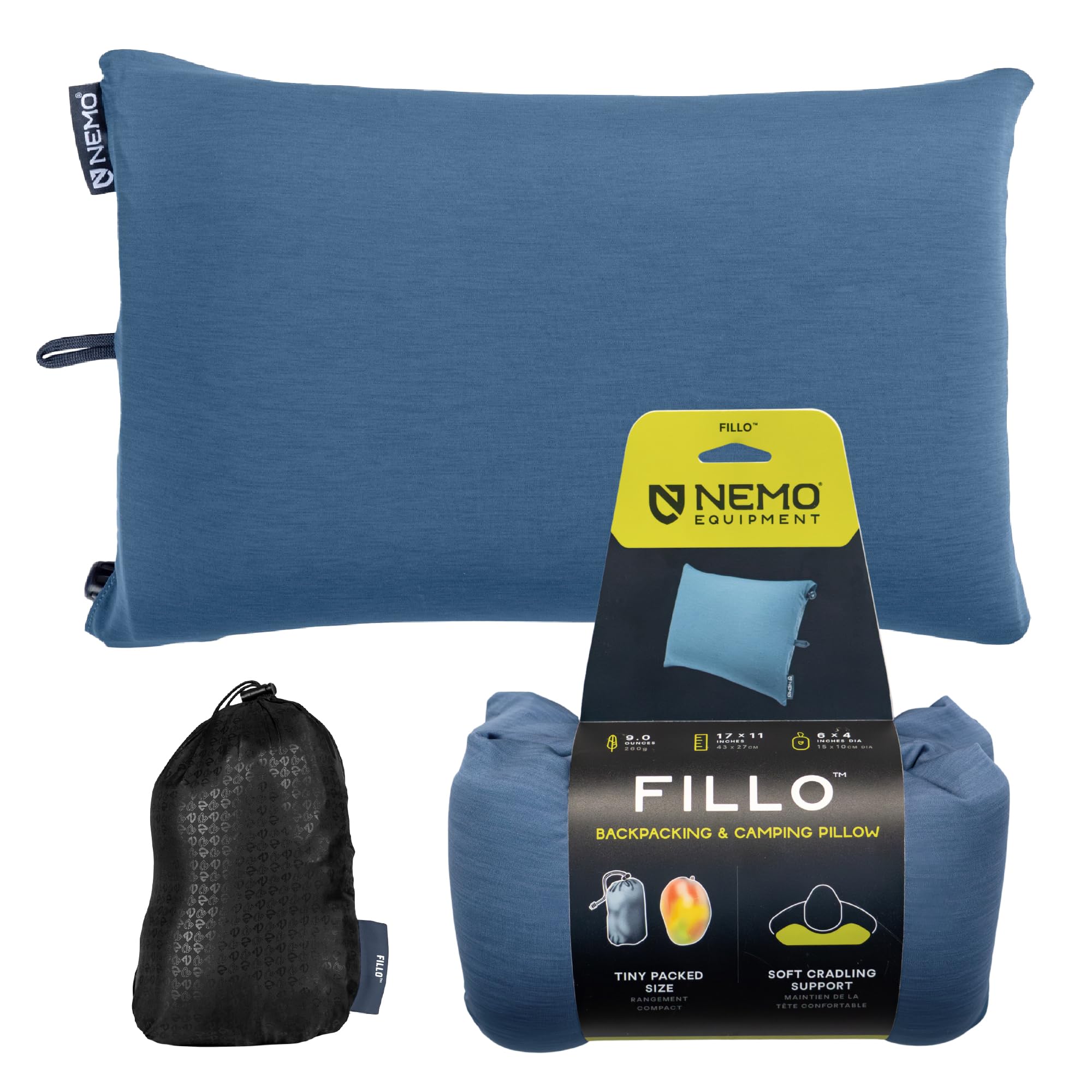
A three-inch baffled air cell with a foam layer over the top sounds like a compromise and turns out to be the best of both: the air holds the height and the shape, the foam gives your ear something soft to land on. It is the one pillow here that feels like bedding rather than a pool toy.

The micro-adjustable valve is what makes the hybrid work. We could fill it firm, then bleed it down in small steps until the foam stopped feeling stretched, without dumping the whole pillow and starting again. The cover unzips for the washing machine and is made from recycled fabric, which is a nice touch in a category full of plain polyester.

The stuff sack is sewn into the pillow, so there is nothing to lose and nothing to hunt for in the dark. That is the kind of detail you notice on the second night rather than the first, and it is the reason the Fillo ends up in the pack on trips that do not obviously justify it.

None of that makes it a thru-hiking pillow. It is the one you carry when you have already decided comfort is the point of the trip, and on a base-camp weekend we pick it over anything else on this page.

Pros

  • Foam-over-air surface feels like a real pillow
  • Micro-adjustable valve for fine firmness changes
  • Removable, machine-washable recycled cover
  • Stuff sack sewn in so it cannot get lost

Cons

  • Listed 0.26 kg is heavy next to inflatables
  • Premium price for a camp pillow
Our verdict

Our pick when comfort beats grams: foam over air gives a real-pillow feel, and the sewn-in sack means nothing goes missing in the dark.

Check Latest Price
4

Best Plush Pillow for Base Camp

Klymit Luxe

93 /100
Traveler Score Outstanding

Key details

Fill
Polyester fill and air
Width
22 inches
Weight
7 oz
Cover Care
Machine wash, tumble dry low
Check Details on Amazon

Twenty-two inches of width is the whole idea. The Luxe is wide enough that you do not have to place your head precisely in the dark, and the polyester-over-air fill gives it a padded, plush feel a bare bladder cannot manage. In a hammock or on a wide pad, that width is the difference between sleeping and readjusting.

It takes a dozen breaths to fill rather than two, and the plain screw cap costs you a little air as you close it, so this is a pillow you inflate once and leave inflated rather than top up in the dark. The payoff is a surface that stays cool enough to leave your face against, and a cover that can go in a machine and a low tumble dryer, which puts it ahead of the hand-wash inflatables on a long trip.

For hammock camping, canoe routes, and car camping where the pack is not the constraint, it is the most comfortable thing here after the Fillo, and it earns that on feel rather than features. Backpackers counting ounces should keep walking.

Pros

  • 22-inch width forgives head placement
  • Polyester fill over air feels plush, not balloon-like
  • Cover is machine washable and tumble dryable

Cons

  • Screw cap is not one-way, so closing costs air
  • 7 ounces is heavy for a backpacking kit
Our verdict

For hammocks and base camps, this is the one we take: a wide, plush surface that stays cool, as long as you are not the one carrying it far.

Check Latest Price
5

Best Compressible Foam Pillow

Wise Owl Camping Pillow

91 /100
Traveler Score Outstanding

Key details

Fill
Memory foam and shredded foam
Cover
Removable microsuede
Weight
11 oz
Inflated Size
12 x 16 in
Check Details on Amazon

If you have tried three inflatables and woken up with a sore neck on each of them, this is the pivot point. The Wise Owl is memory foam that behaves like a pillow: your head sinks in, the foam holds it there, and the 12-by-16-inch surface at four inches thick is big enough to actually sleep on.

The microsuede cover is the pleasant surprise. It is warm and slightly brushed rather than slick, and quiet against a sleeping bag, which is not something we expected to care about. It unzips and goes in a washing machine, and after a week of sweaty nights that is worth more than any valve feature. Inside is shredded foam, which conforms rather than pushes back, though it runs firmer than the silky-soft wording suggests.

The cost is weight. At 11.04 ounces it carries the heaviest listed weight here, and while it compresses into the included waterproof stuff sack, it does not vanish; expect a real lump in a 40-liter pack. Getting it back into the sack takes a couple of tries the first few nights and gets easier with practice. For a weekend where you have budgeted the weight, that is a fair trade. For an ultralight kit, it is not.

Pros

  • Shredded foam supports side sleepers properly
  • Microsuede cover is quiet and machine washable
  • Waterproof stuff sack included

Cons

  • Heaviest listed weight here at 11.04 ounces
  • Firmer foam than the description implies
Our verdict

This is our pick for side sleepers who cannot sleep on air: real foam support, a washable microsuede cover, and a stuff sack that keeps it dry.

Check Latest Price
6

Best Budget Pick

TETON Sports Camp Pillow

91 /100
Traveler Score Outstanding

Key details

Fill
Cotton fiber
Weight
9.6 oz
Included
Compression sack and pillowcase
Inflated Size
18 x 12 in
Check Details on Amazon

There is no huffing involved. Open it up, give it a few minutes, and the TETON lofts on its own into an 18-by-12-inch pillow that runs nearly seven inches deep at its fullest, the deepest in this group. After a long day, not having to blow up a pillow in the dark is worth more than it sounds.

It is also the least expensive pick here, and the one we point at for a scout troop or a family weekend. The flannel cover is soft and stays cool, the whole pillow can go in a washing machine, and it arrives with a compression sack and a pillowcase. Value is the argument, and it is a strong one.

What it is not is compact. At 9.6 ounces and a roll that eats real pack space, this is a base-camp, road-trip, and float-trip pillow rather than a thru-hike one. If your pack is already tight, the Aluft does the job at a fraction of the weight. If you want a proper pillow for the least money, this is the one.

Pros

  • Lofts with no breath needed
  • Least expensive pillow in this group
  • Whole pillow is machine washable
  • Compression sack and pillowcase included

Cons

  • 9.6 ounces and a bulky roll for backpacking
Our verdict

Our budget pick: it lofts without a single breath, washes in the machine, and costs less than anything else here, so long as you are not carrying it far.

Check Latest Price
7

Weekend Trips

Hikenture Camping Pillow

89 /100
Traveler Score Excellent

Key details

Cover
Removable cotton cover
Weight
5.6 oz
Thickness
4.7 inches
Inflated Size
12.2 x 17.3 in
Check Details on Amazon

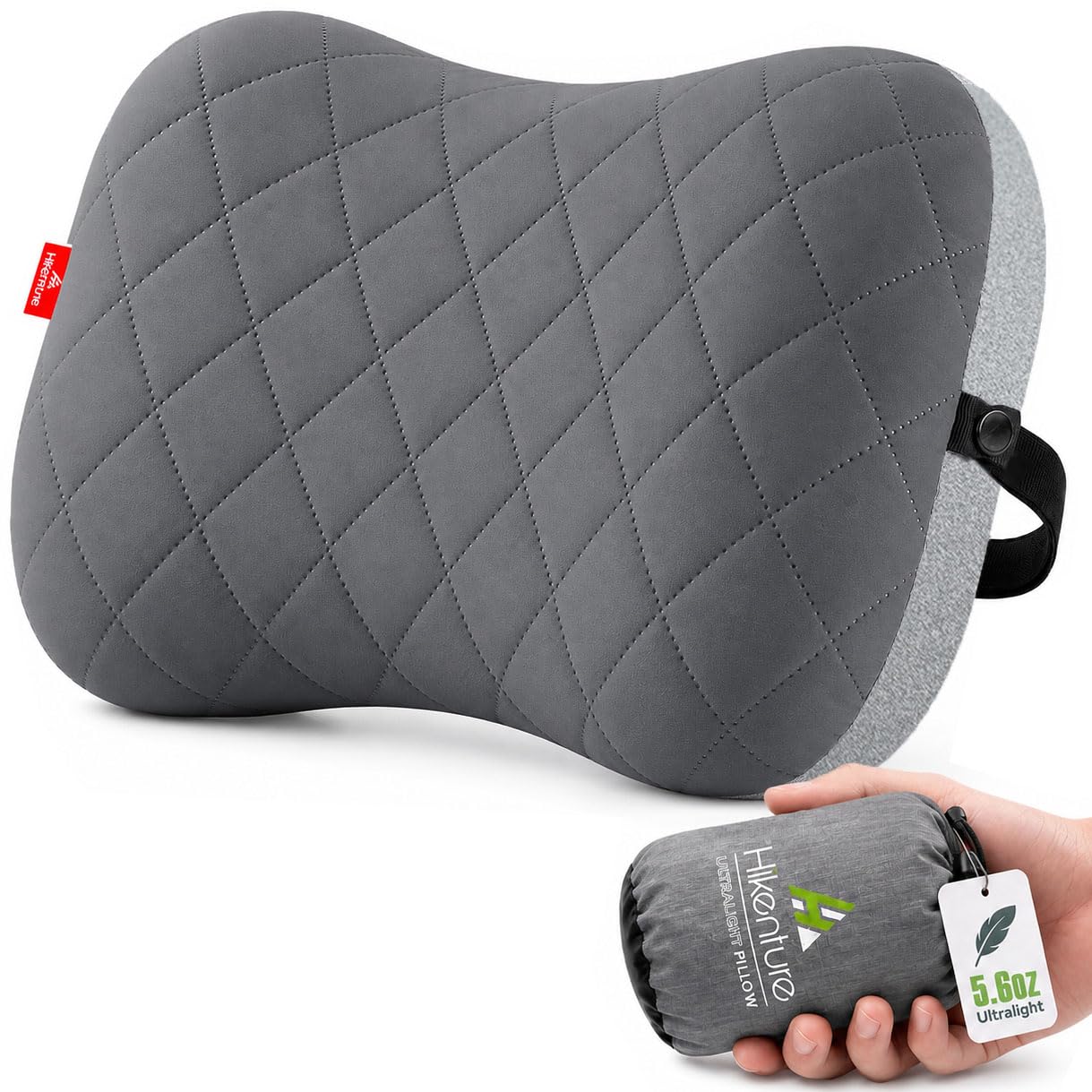
A removable, washable cover on an inflatable pillow is rarer than it should be, and it is the reason the Hikenture is on this list. The cotton cover zips off, so you are not sleeping against a week of your own face oil, and the fabric feels cooler against the skin than a bare TPU surface does.

The rest is competent rather than distinctive: a one-click valve that fills it in a few breaths, 4.7 inches of thickness, a 12-by-17-inch surface that is roomy for an air pillow, and 5.6 ounces in the pack. The gentle ergonomic curve works for back sleepers and, with a bit of fiddling, for side sleepers too.

Air retention is where it slips. The bladder can stop holding air within a few trips, and when it goes it tends to go at a seam or at the valve rather than fading gradually.

That makes it a good weekend pillow rather than a long-trail one. At this end of the price range, keeping one in the car or the boat bag makes sense. For a month on trail, we pay more for the Aeros Premium and its better record of staying inflated.

Pros

  • Removable cotton cover washes separately
  • 4.7 inches thick with a roomy surface
  • One-click valve fills in a few breaths

Cons

  • Air loss can appear within a few trips
  • Cover stitching is another wear point
Our verdict

A sensible weekend inflatable with a cover you can actually wash, though we would want a sturdier bladder before trusting it to a long trail.

Check Latest Price
8

Adjustable Fill

Nappler Travel Pillow

91 /100
Traveler Score Outstanding

Key details

Fill
Shredded memory foam
Weight
8 oz
Inflated Size
19 x 13 in
Check Details on Amazon

The fill is not sealed in. The Nappler's shredded memory foam can be taken out or put back through the zipper, so you can tune it from a firm, hotel-style pillow down to something much flatter without buying anything else. For a pillow that has to work in a tent and then on a guest bed, that is genuinely useful.

At 8 ounces and 19 by 13 inches it is a full-size-feeling pillow that still rolls into its carry pouch, with a viscose-polyester cover that stays cool and comes off for the wash. We found the fill medium-firm: supportive enough for side sleeping, with enough give that back sleepers will not feel like they are on a brick.

Two things to plan around. The foam arrives compressed and takes hours to reach full loft the first time, so unpackage it well before your trip rather than in the tent. And it rolls into a bigger bundle than any inflatable here, which is the price of foam.

That price is worth paying on a trip that is more camping than backpacking: drive-up sites, canoe routes, festival weekends. It is the most bed-like of the foam picks after the Fillo, and it costs a fraction of it.

Pros

  • Fill can be added or removed to tune firmness
  • 8 ounces for a full-size-feeling pillow
  • Breathable cover comes off for washing

Cons

  • Bigger packed bundle than any inflatable here
Our verdict

We keep coming back to this one for trips with room to spare: dial the shredded foam to your liking and it doubles as the best guest pillow here.

Check Latest Price

How We Tested Backpacking Pillows

We started with a list of roughly 40 backpacking pillows and narrowed it by packed size, listed weight, valve style, and price, then cut anything with a pattern of leak complaints in owner reviews. That left 14 pillows, which we used over eight months on backcountry overnights, in a couple of huts, on a friend's floor, and on one red-eye flight where a pillow was the only thing between me and a stiff neck.

Inflation was the first thing we timed. Each pillow was deflated fully, then we counted breaths and seconds to get it firm, noted whether the valve stayed open on its own or needed a finger held over it, and whether the job took one hand or two. To check air retention, we inflated each one to firm at bedtime and pressed a palm into it the next morning; a few had gone noticeably soft by 4 a.m., and one was flat enough to fold in half. Every pillow got at least three nights of sleeping, side and back, and we noted whether it stayed under the head or slid off a sleeping pad, how it sat inside a mummy bag hood, and whether the fabric felt tacky against a cheek.

Portability came down to a kitchen scale and a stuff sack: we weighed each one, packed it against a sleeping bag, and checked whether it vanished into a pack lid or ate real space. For durability we ran the valve through dozens of inflate-deflate cycles, inspected seams after a week of being sat on, and washed the ones the maker said could be washed. Value we judged against weight and packed size rather than sticker price alone — the cheapest pillow that holds air until morning beats an expensive one that doesn't.

How to Choose Backpacking Pillows

Air, Foam, or Hybrid

Air pillows are the lightest and pack smallest: our top pick weighs 3.84 ounces and folds to about the size of a soda can. Foam pillows feel like bedding but add real weight and take up pack space. Hybrids put a foam layer over an air cell and land in between, which is what the NEMO Fillo does so well.

Our rule is simple. If you are counting ounces on a long carry, go air. If you have never slept well on an inflatable, go foam or hybrid and accept the weight as the price of sleeping.

Compare Packed Size, Not Inflated Size

Listings lead with inflated dimensions because comfort sells. What goes in your pack is the packed figure, so line those up instead: the Aeros Premium packs to 3.3 by 2.8 inches, while a foam pillow compresses into a bundle several times that.

There is a trap in the word compact. On a product page it usually means compact next to a bed pillow, not compact enough for a 40-liter pack. Look for an actual packed measurement, and if there is not one, treat the stuff sack photo as your best estimate.

Match Thickness to How You Sleep

Side sleepers need height to keep the neck level. The thickest picks here run from 4.7 inches on the Hikenture to nearly 7 inches on the TETON, and the hybrids let you add air until your ear stops touching the ground. Back sleepers do better with 4 inches or less.

If you are somewhere in between, choose a pillow with a valve you can fine-tune rather than a fixed foam loft. You can firm it up on the first night and bleed it down on the second, once you know how the ground actually feels.

Valves and the 2 A.M. Top-Up

Two breaths versus a dozen is the difference between a pillow you use every night and one you leave in the pack. One-click and multi-function valves fill fast and let you bleed pressure in small steps; a plain screw cap gives up a little air as you close it.

A small battery pump is worth the few ounces on a big hybrid if you prefer not to use your breath. Whatever you buy, inflate it at home before you leave, because a valve that will not stay shut is worthless once you are out there.

Keep It on the Pad

An inflatable on a nylon sleeping pad slides, usually at the worst moment. Straps and grip dots are the fix: the Aluft uses an elastic band plus rubber dots on the back, and the Aeros Premium locks to Sea to Summit mats through their PillowLock patches.

If yours has neither, wrapping the pillow in a spare shirt or tucking it into a sleeping bag hood adds enough friction to keep it in place. Test the setup on a hard floor at home before you trust it on a sloping pitch.

Frequently Asked Questions

Final Verdict

Buy the TREKOLOGY Aluft 2.0 if you want one pillow that disappears into your pack and does the job. It is the lightest full-size air pillow in this group, it stays on the pad, and it asks the least money of almost anything here.

Spend more only for a reason you can name. The Sea to Summit Aeros Premium buys silence and a smaller bundle, the NEMO Fillo or the Wise Owl is the answer if you have never slept well on air, and the TETON is what to grab when the budget decides.