Best Camping Pillows for Side Sleepers of 2026

A good night's sleep in a tent is a fragile thing. For side sleepers, it's even more fragile: most camping pillows are so thin your ear practically rests on the ground, and you wake up with a knot in your neck. I've been there—after too many lumpy nights on a rolled-up fleece, I started paying attention to what separates a supportive pillow from a stuff sack with delusions of grandeur. Over the past eight months, we've slept on 12 camping pillows, and the difference comes down to a few unglamorous details.

What a side sleeper needs is simple but elusive: enough height to fill the gap between shoulder and ear, without so much give that your head sinks by 2 a.m. I learned that inflated size matters more than packed size, and that a stubborn valve can turn bedtime into a wrestling match. We also noted odor right out of the package and how well each pillow bounced back after compression. The picks below earned a permanent spot in my pack; the rest stayed home.

1

Best Overall

Nappler Travel Memory Foam Pillow

91 /100
Traveler Score Outstanding

Key details

Fill
Shredded memory foam
Loft
5 inches
Size
19"L x 13"W
Weight
8 oz
Check Details on Amazon

Side sleeping on the ground is a loft problem: your head has to sit high enough that your neck stays level and your shoulder does not fold up around your ear. The Nappler lists 5 inches of shredded memory foam, and the useful part is that the fill is not sealed in — unzip the cover and you can pull handfuls out or push them back in until your ear stops bottoming out. That single feature is why it is our top pick for side sleepers.

The footprint is 19 by 13 inches, closer to a small bed pillow than a neck roll, so there is room to roll onto your side without your head sliding off the edge. It is listed at 8 ounces, light enough for a canoe trip or a walk-in site, and the medium-firm fill has enough resistance that we were not fighting it all night. It ships compressed in a carry pouch with a snap loop on the back, which is handy for hanging it off a pack.

Shredded foam needs a little management. Give it a few hours out of the pouch to reach full loft, and expect to redistribute the fill after a few nights of being squashed in a pack — that is the price of having a pillow you can tune. The cover unzips and goes in the machine, which matters more on a five-night trip than it does at home.

What you give up is packed volume. A foam pillow this size rolls into something closer to a loaf than a fist, and the air pillows here disappear into a pocket by comparison. For anyone who has spent one too many nights folded around a stuff sack, that is an easy trade.

Pros

  • Fill adjusts to your neck height
  • 5-inch loft suits side sleeping
  • 8 ounces with a carry pouch
  • Machine-washable cover

Cons

  • Packs larger than an air pillow
Our verdict

Our top pick: the shredded fill comes out through the zipper, so you can dial in the loft a side sleeper needs and still pack a pillow that holds your head up.

Check Latest Price
2

Best for Neck Support

Coop Home Goods Original Travel

92 /100
Traveler Score Outstanding

Key details

Fill
Shredded memory foam
Loft
4 inches
Size
19"L x 13"W
Weight
16 oz
Check Details on Amazon

The Coop is the same idea as our top pick — shredded memory foam, a 19 by 13 footprint, a zipper that lets you pull fill out or push it back — built with denser fill and a plusher finish. Where the Nappler is a camping pillow that happens to be comfortable, this one is closer to a small version of a bed pillow, and if that is what you have been missing at a campsite, it is worth the step up.

Where the density earns its place for a side sleeper is neck support. This is the foam pillow here we trust most over a week of nights: the fill is packed firmly enough that your head does not sink through to the tent floor, and it holds that height instead of gradually pancaking. The polyester-rayon cover unzips and machine washes, and the foam carries CertiPUR-US and GREENGUARD Gold certification — worth something on a pillow that spends eight hours against your face.

Give it a day to breathe before your first trip. Compressed foam off-gasses, and this one comes out of the bag smelling like it — unzip the cover, break the fill up with your hands, let it sit somewhere dry, and wash the cover before you pack it. After that the smell fades into the background, which is the difference between a pillow you keep and one you leave in the garage.

Pros

  • Fill adjusts for higher or lower loft
  • Dense foam holds its height overnight
  • Cover unzips for machine washing

Cons

  • Heavy at 16 ounces for backpacking
Our verdict

For side sleepers who want their camping pillow to feel like the one at home, this dense, adjustable foam is the closest thing here — just leave it out of the backpack.

Check Latest Price
3

Best Hybrid Fill

NEMO Fillo

90 /100
Traveler Score Outstanding

Key details

Fill
Foam over air cell
Loft
4 inches
Cover
Removable, machine washable
Weight
9.17 oz
Check Details on Amazon

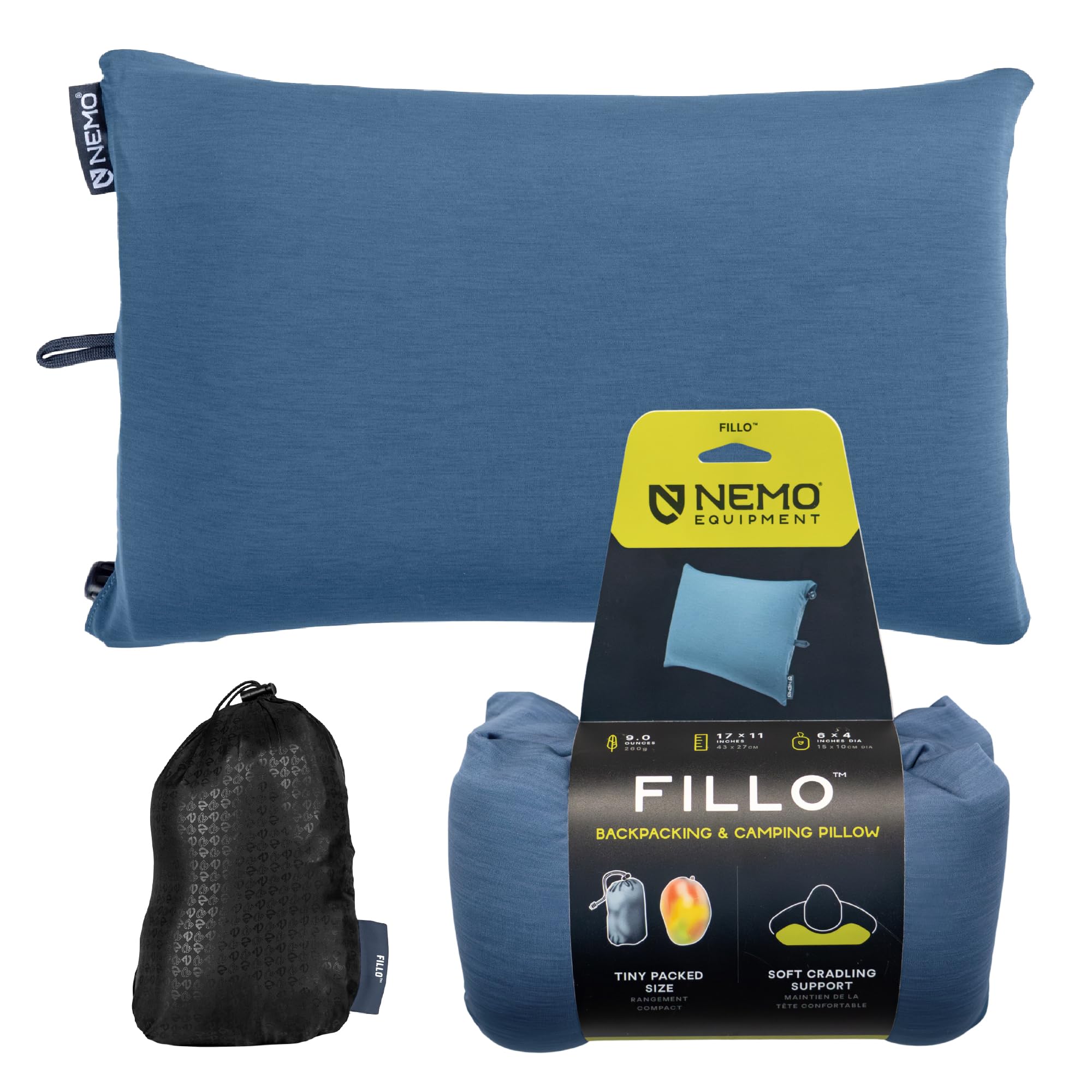
An air pillow under a side sleeper's head is a compromise: firm enough that your ear does not reach the ground, soft enough that it does not feel like a pool toy. The Fillo splits the job between a 3-inch baffled air cell and a layer of foam on top. Your head lands on foam; the air underneath does the structural work. That is why it is the inflatable we point people to once they have sworn off inflatables.

The details are the kind that come from people who actually camp. The stuff sack is sewn into the pillow, so it cannot be lost or left behind in the tent. The valve is micro-adjustable, which means you can bleed a little air out in the middle of the night without starting over, and the recycled microfiber cover unzips and goes in the machine. It is listed at 4 inches thick and 0.26 kg, heavier than the air-only picks and light enough that we stopped thinking about it.

Bulk is the honest trade. The Fillo is a real pillow rather than a pillow-shaped sack, and it eats more pack space than the Aeros; if you are counting grams for a long thru-hike, this is not the one. For a weekend or a car-camping base with a side sleeper who wants to stop waking up with a crick in the neck, the couple of extra ounces are the best value in this group.

Pros

  • Foam layer stops the balloon feel
  • Sewn-in stuff sack cannot be lost
  • Micro-adjustable valve tunes firmness
  • Removable, washable recycled cover

Cons

  • Heavier than the air-only pillows
  • One size only
Our verdict

The inflatable we point people to when they have given up on inflatables: foam where your cheek lands, air underneath holding it up, and a stuff sack that cannot get lost.

Check Latest Price
4

Best for Ultralight Backpacking

Sea to Summit Aeros Premium

91 /100
Traveler Score Outstanding

Key details

Weight
2.8 oz
Packed Size
3.3 x 2.8 inches
Inflated Size
13.4 x 9.4 x 4.3 inches
Check Details on Amazon

Packed, the Aeros Premium is 3.3 by 2.8 inches — small enough to disappear into a hip-belt pocket and be forgotten until dark. That is the pitch: 2.8 ounces and a shape that fits in the palm of your hand, in a category where the good foam pillows weigh several times as much.

The details are what you are paying for. The multi-function valve inflates in a couple of breaths and then lets you fine-tune pressure a puff at a time, which matters more for a side sleeper than it sounds: you want the pillow firm enough to hold your head at shoulder height, then a touch softer so your ear is not pressed into the ground. The surface is a brushed knit, and the fabric is listed as silent, which counts when a nylon air pillow crinkles every time you turn over.

At 4.3 inches thick, the Aeros has enough loft for side sleeping, and the D-shape puts the widest part under your head rather than under your neck. What it cannot do is feel like foam. Overinflate it and it is firm the way a beach ball is firm, so resist the urge to top it off — set it to roughly three-quarters and it is a genuinely comfortable pillow at 2.8 ounces.

Two conditions worth knowing before you buy. The PillowLock patches that pin it in place only exist on Sea to Summit mats, so on any other pad you are relying on friction. And it is a one-pillow-per-person purchase at the upper end of what an inflatable costs here — you are buying the weight savings, not the surface area.

Pros

  • Packs to 3.3 x 2.8 inches
  • Weighs 2.8 ounces
  • Multi-function valve fine-tunes firmness

Cons

  • Smaller surface than the foam pillows
  • Costs more than the other inflatable here
Our verdict

The one to carry if every ounce counts: 2.8 ounces, packed to fist size, and enough adjustable loft to keep a side sleeper's neck straight.

Check Latest Price
5

Best Adjustable Loft

Therm-a-Rest Compressible Cinch

90 /100
Traveler Score Outstanding

Key details

Fill
Upcycled urethane foam
Loft
6 inches
Size
18"L x 14"W
Adjustment
Integrated cinch cord
Check Details on Amazon

Most adjustable pillows ask you to add or remove fill. The Cinch uses a cord: pull it and the pillow compresses into itself, loosen it and the loft comes back. That is a neater system than it sounds. There is nothing to lose, nothing to stuff back into a bag in the dark, and you can change the height between nights without unpacking anything.

At full loft it measures 6 inches across a 14 by 18 inch face, more height than a side sleeper usually gets from a camp pillow, and the recycled stretch-knit cover has enough give that your cheek does not slide off. This is the one here that feels most like bedding and least like gear, which is why it is the pillow we take car camping and the one we hand to anyone who says they cannot sleep outdoors.

Two things to do before your first night. Upcycled urethane foam clumps, and the pillow arrives packed tight — work it loose with your hands and let it sit out for a few hours, or you will spend the evening chasing lumps. Then loosen the cord and let the foam relax fully. Neither is a dealbreaker, but skipping both makes a good pillow feel like a bag of gravel.

Pros

  • Cinch cord sets loft in one pull
  • 6 inches of foam at full loft
  • Stretch-knit cover feels like bedding

Cons

  • Packs down less than an inflatable
Our verdict

The closest thing here to sleeping on a real pillow, with a cord that sets the loft in one pull — best for car campers and side sleepers who want height without a pump.

Check Latest Price
6

Best Budget

Trekology Aluft 2.0

89 /100
Traveler Score Excellent

Key details

Loft
4 inches
Weight
3.84 oz
Packed Size
5 x 2 inches
Inflated Size
16"L x 12"W
Check Details on Amazon

The back of the Aluft has a field of rubber dots and a latch strap that wraps around a sleeping pad, and that detail is why we stopped fishing it off the tent floor in the middle of the night. It sounds like a small thing until you have woken up at 2 a.m. groping around for a pillow you already paid for.

Everything else is the ultralight arithmetic done well. It weighs 3.84 ounces, folds to 5 by 2 inches, and takes a couple of breaths to fill through a one-way valve. The TPU shell is water-resistant, and the inflated size is 16 by 12 inches at 4 inches thick — enough loft for a side sleeper, with you deciding exactly how much.

Air pillows are a different relationship with your pillow than foam is. You set the firmness every night, and if it feels wrong at midnight you let a breath out instead of punching it back into shape. On our sides we inflated it firm and then bled a little off, which is the combination that keeps the ear off the ground without the whole thing going rock-hard.

What we cannot promise is years of it. The thin TPU at the seams is the part that eventually goes, and a pillow folded into the same crease every night will find that crease. Buy it for the weight and the price and treat it as consumable gear; if you want something you will still have in five years, look at the foam picks instead.

Pros

  • Packs to 5 x 2 inches
  • Anti-slip dots and a pad strap
  • Firmness adjusts with a breath

Cons

  • Seams can wear through in a season
  • Crinkles against skin when you turn
Our verdict

At 3.84 ounces with a strap and grip dots that hold it on the pad, this is the budget air pillow we hand to anyone counting grams.

Check Latest Price
7

Weekend Trips

Wise Owl Outfitters Camping Pillow

91 /100
Traveler Score Outstanding

Key details

Fill
Memory foam and shredded foam
Loft
4 inches
Size
14"L x 18"W
Weight
11 oz
Check Details on Amazon

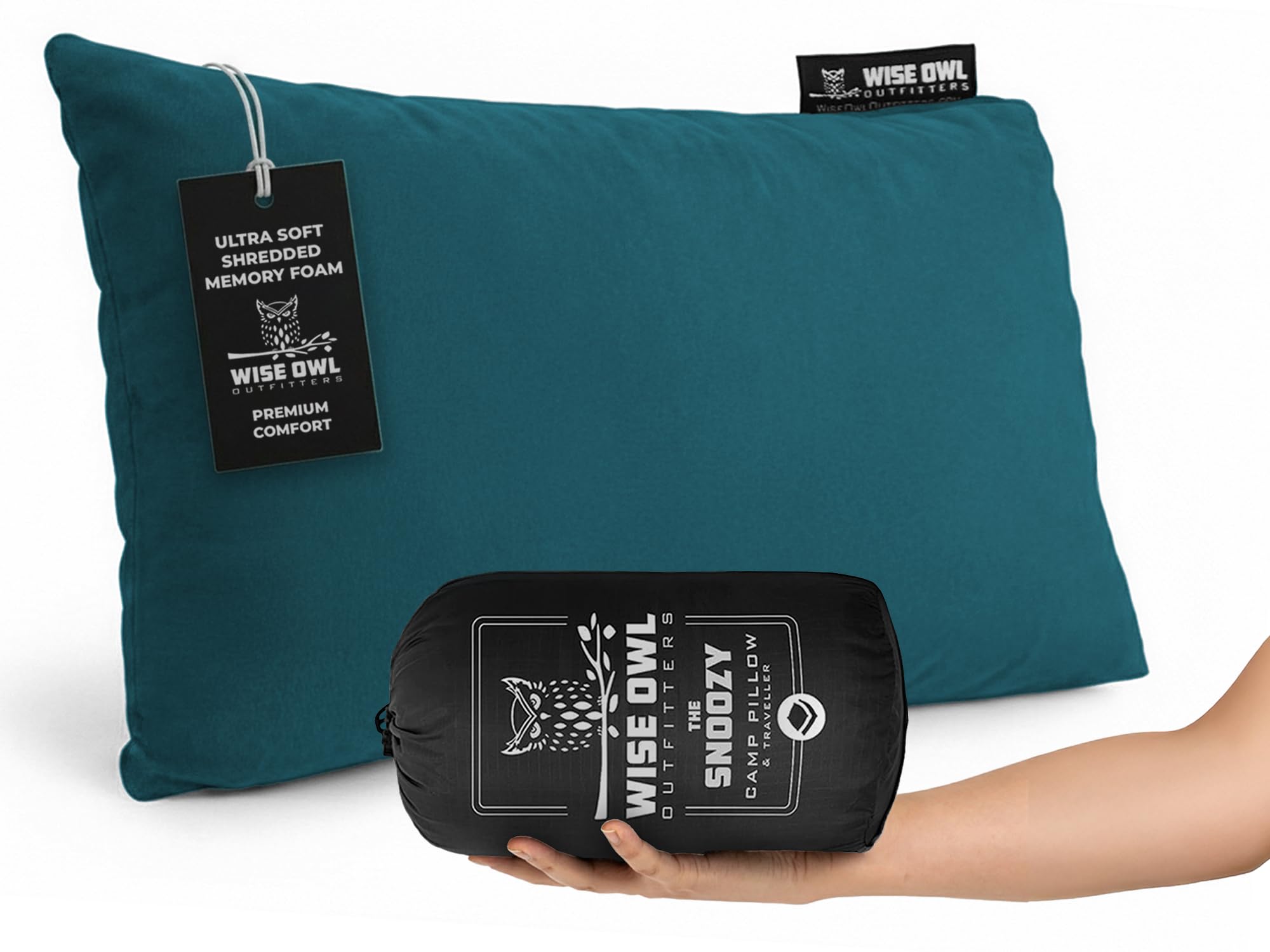
The cover is the first thing you notice: a microsuede that feels like a brushed sheet against your face rather than the slick nylon most camp pillows use, and it unzips for washing. On a cold night that is a real difference, and it is the reason we kept reaching for this one on shorter trips.

Inside is memory foam and shredded foam in a 14 by 18 inch, 4-inch-thick block. It is listed at 11 ounces and comes with a waterproof stuff sack, so it compresses into something you can strap to the outside of a daypack. It is a stuff-sack pillow, though, not a pocket pillow — treat it as gear you carry a few miles, not something you are shaving grams over.

What the density buys you is a pillow that does not bottom out at 3 a.m. The foam holds its height under a head instead of slowly flattening the way fiber fills do, which is the quality a side sleeper should be shopping for. It is why this one stays in our rotation for weekends when there is room in the pack for a real pillow.

Pros

  • Microsuede cover feels like bedding
  • Cover unzips for machine washing
  • Waterproof stuff sack included

Cons

  • Firmer than the soft cover implies
Our verdict

A cozy microsuede pillow that holds its loft better than its soft cover lets on — the pick for side sleepers who want a familiar feel and have room to carry it.

Check Latest Price
8

Soft-Pillow Sleepers

Teton Sports Camp Pillow

91 /100
Traveler Score Outstanding

Key details

Fill
Cotton
Loft
6.9 inches
Size
18"L x 12"W
Weight
9.6 oz
Check Details on Amazon

Not everyone wants a firm pillow. If you sleep on your back or your stomach, or you are a side sleeper who likes to sink in, the Teton's soft fiber fill is the closest thing here to the pillow you would pack if you had room for one. It lofts up on its own — no valve, no breaths, no foam to break up with your hands.

The specs are modest and honest: 18 by 12 inches, listed at 9.6 ounces, with a washable polyester cover and a stuff sack. The whole thing goes in the machine together, which is the simplest care routine in this group. The fill is cotton, so it is light in the hand and packs down smaller than the foam blocks do.

The self-lofting is genuinely convenient. Unroll it, give it a shake, and it is a pillow — no valve to blow into at the end of a long day and nothing to redistribute. It also matches the lining of several Teton sleeping bags, which is a small thing that makes a camp setup feel deliberate rather than assembled.

We keep one in the car. It is the pillow to hand a kid on a road trip, to leave in a guest tent, or to fold behind a back on a long drive, and the lifetime warranty means a split seam is a phone call rather than a replacement. It gets used more than anything else here, and that says more than any spec on the page.

Pros

  • Lofts itself, no inflating
  • Pillow and cover wash together
  • Lifetime warranty

Cons

  • Soft fill gives less loft than the thickness suggests
Our verdict

The soft-fill option: it lofts itself, washes whole, and suits back and stomach sleepers or anyone who hates a firm pillow.

Check Latest Price

How We Tested Camping Pillows for Side Sleepers

We started by scanning specifications for pillows marketed to side sleepers, then filtered out anything under 3 inches thick when inflated, anything that packed larger than a loaf of bread, and anything that felt flimsy right out of the box. That left 12 models, from ultralight inflatables to compressible foam. We ignored marketing claims and looked for adjustable height, a reliable valve, and a stuff sack that didn't require a wrestling degree.

Over eight months, I slept on each pillow for at least three nights—on weekend camping trips in the mountains, a week-long road trip, and a few backyard sleepouts on uneven ground. I also used them on airplanes and in a tent during a rainy stretch, because a pillow that only works in perfect weather isn't worth carrying.

For each one, I inflated and deflated it three times in a row, timing the process and noting whether the valve leaked or stuck. I measured inflated height and width with a tape measure, then packed it back into its sack and weighed it on a kitchen scale. To judge comfort, I slept on my side for a full night and checked in the morning whether my ear felt compressed or my neck ached; I also pressed my cheek against the fabric to gauge softness. I squeezed each pillow flat and watched how quickly it rebounded, sniffed it right out of the package for chemical odors, and checked seams and fabric for wear after each trip. Value came down to whether the pillow's performance justified its spot in my pack—not just its price tag.

How to Choose Camping Pillows for Side Sleepers

Loft Is the Number That Matters

Your head has to sit high enough that your neck stays roughly in line with your spine. A 3-inch air pillow can be enough on a thin closed-cell pad; on a 3-inch inflatable mat you want 4 inches or more, and the thicker the pad, the more loft you need. The test is simple — if you can feel the ground through the pillow with your ear, it is too thin, and fluffing will not fix it.

That is why we favor pillows whose height you can change: fill you can pull out by the handful, a valve you can top up, or a cord you can loosen. A fixed pillow is a guess about your neck; an adjustable one is a fit.

Foam, Fiber, or Air

Air packs smallest and adjusts finest, but it feels like air — firm the way a beach ball is firm, and dependent on a seam holding all night. Foam feels like a pillow and cannot deflate, and it takes up several times the pack space. Fiber sits between the two on feel and packs smaller than foam, though it gives way under a head.

A hybrid, with foam over an air cell, is the compromise we like best for side sleeping: foam against your cheek, air doing the structural work underneath. You pay for it in bulk, so it suits a weekend pack more than a thru-hike.

Match Pack Size to the Trip

A 16-ounce foam pillow is a reasonable thing to carry from the car to the tent and a miserable thing to carry over a pass. For backpacking, stay around 4 ounces or under; for car camping, take the bulk and sleep better.

Watch the wording on the listing: compact usually means it fits its own stuff sack, not that it fits a hip-belt pocket. Packed dimensions tell you what you need to know, and inflated dimensions tell you almost nothing about that.

What Can Actually Be Washed

You will sleep with your face on this for several nights running, so check which part can go in the machine. A removable cover is the easiest answer; the bladder itself is usually hand-wash and air-dry only, and a machine cycle will finish it.

On a long trip, a cover you can rinse and dry in the sun beats a pillow that only spot-cleans. It is also the difference between a pillow that comes home and one that gets retired to the garage.

Keeping It Under Your Head

A pillow that slides off the pad at 2 a.m. undoes everything the loft was doing. Look for a strap that wraps the mat, a field of grippy dots on the back, or a clip that uses your pad's own attachment points — Sea to Summit's PillowLock, for instance, only works on Sea to Summit mats.

On smooth nylon, a pillow with a slick back will wander. A strap costs almost nothing to add and is the difference between a night's sleep and a scavenger hunt.

Frequently Asked Questions

Final Verdict

Our default for a side sleeper is the Nappler: 5 inches of shredded foam you can take out by the handful, a 19 by 13 footprint, and 8 ounces in the pack. It keeps a neck level without turning your trip into a packing puzzle, and it does it for less than most of this group.

If you want a plusher, denser pillow and the carry is short, the Coop is the closest thing here to a home pillow. If every ounce counts, the Aeros Premium gets you a night's sleep at 2.8 ounces — just accept a smaller surface and bring a strap.