Best Camera for Scuba Diving of 2026

A scuba camera has one job it cannot fumble: keep the water out. Everything else—true color at depth, controls you can work in thick gloves, a battery that lasts a two-tank morning—only matters if the housing stays dry. The right one gets out of the way of the dive and brings back footage you actually want to share, without turning every descent into a gear check.

Over eight months, my team and I took seven cameras through pool sessions, shore dives, and a liveaboard week. We compared image and video quality in the same water, timed battery drain across repeated dives, and watched for reliability problems—fogged ports, stiff buttons, dropped connections—because a camera that quits on day two is no bargain. We also noted how easily each offloaded clips to a phone on the boat, and weighed value by what came in the box: trays, handles, mounts, and spare batteries. The best scuba camera is the one whose controls and seals you trust, not the one with the longest spec sheet. The picks below reflect that.

1

Best Overall

AKASO EK7000 Pro

89 /100
Traveler Score Excellent

Key details

Video
4K at 30fps
Batteries
2 x 1350mAh
In The Box
Floating hand grip, carry bag
Case Depth Rating
131 ft
Check Details on Amazon

Open the box and the dive kit is already there: a case rated to 131 feet, a floating hand grip, two 1350mAh batteries, a dual charger and a wrist remote. That's why we make it the default recommendation. The GoPros here are rated to 33 feet and need a housing before they can join a real dive; this one is ready exactly as it comes.

At 4K/30 the footage is crisp in good light, and the electronic stabilization keeps a swim-through watchable instead of seasick. The 20MP stills hold up for a print, provided you're shooting in the top 30 feet where daylight still reaches.

The touchscreen is a boat-deck luxury. Once the camera is sealed in its case you're working through the housing's buttons, so set resolution and stabilization before you splash. The 5x digital zoom is the one control to leave alone: underwater it just crops away detail you'll want back later, and swimming closer works better.

Two cells rated at up to 140 minutes each is generous against a 50-minute dive, so charge both before a two-tank day and keep the spare in a dry bag rather than in the camera. Pair it with a V30 card as well; 4K writes faster than an old phone card will take, and a slow card shows up as stuttering you only discover back at the hotel.

Pros

  • Case rated to 131 ft included
  • Floating hand grip and carry bag bundled
  • Two 1350mAh batteries plus dual charger
  • Wrist remote and touchscreen for setup

Cons

  • Battery life is the weak point
  • Small 1/3-inch sensor limits color at depth
Our verdict

We recommend it to divers who want a complete, sealed, 131-foot kit without paying premium prices — the case, float and spare battery come in the box.

Check Latest Price
2

Best Footage

DJI Osmo Action 5 Pro

92 /100
Traveler Score Outstanding

Key details

Sensor
1/1.3-inch
Battery
1950mAh, up to 4 hours
Storage
47GB built in
Stabilization
360° HorizonSteady
Check Details on Amazon

Depth takes color before it takes anything else, which is why the sensor is the first thing we check for dive footage. The Osmo Action 5 Pro uses a 1/1.3-inch sensor with 2.4µm pixels, and that extra light gathering is what keeps a reef looking like a reef at 20 or 30 meters instead of a green smear.

We think it earns its place on footage quality. HorizonSteady holds the horizon level through a barrel roll or a wobble on the fin kick, the dual OLED screens are bright enough to frame with on deck, and 40MP stills mean you come home with photographs rather than frame grabs. It's also waterproof without a case, which is one less thing to seal.

Four hours of recording from the 1950mAh cell covers a two-tank day with room to spare, and around 47GB of built-in storage means a card left in the cabin doesn't end the dive. The app is the part we're cool on: pairing can be fussy and slow, and a card reader gets files onto a phone faster.

Pros

  • 1/1.3-inch sensor holds color at depth
  • Up to four hours from one battery
  • 360° HorizonSteady keeps shots level
  • Built-in storage covers a forgotten card

Cons

  • No stated depth rating for dive use
Our verdict

For divers who care most about how their footage looks, this is the camera we reach for — the sensor, stabilization and battery all pull in the same direction.

Check Latest Price
3

Best Video Features

GoPro HERO13 Black

89 /100
Traveler Score Excellent

Key details

Photo
27MP
Video
5.3K at 60fps
Waterproof
33 ft (10 m)
Lens System
HB-Series compatible
Check Details on Amazon

Thirty-three feet is the number to start with: that's how deep the HERO13 Black is waterproof on its own, and it's well short of a typical dive profile. Add a housing and the picture changes, but that's real money on top of a premium camera, so budget for both before you compare it with something that arrives sealed.

What the money buys is resolution and speed. 5.3K at 60fps is as high as anything in this group, 27MP stills survive a crop, and burst slow motion stretches the action to 13x normal speed — a single turtle pass becomes the clip you actually show people. The HB-Series lenses are detected automatically, so the camera reconfigures itself the moment you screw one on, and the hybrid stabilization handles the handheld wobble between dives. It's the pick for a diver who already lives in GoPro's mount ecosystem and wants the sharpest file, not the simplest trip.

Pros

  • 5.3K60 video and 27MP photos
  • 13x burst slow motion
  • HB-Series lenses auto-detect

Cons

  • Battery rated for only 79 minutes
Our verdict

The sharpest footage in this group, and the one to build a GoPro kit around if 5.3K and slow motion matter more than simplicity.

Check Latest Price
4

Best Value Upgrade

DJI Osmo Action 4

94 /100
Traveler Score Outstanding

Key details

Video
4K at 120fps
Sensor
1/1.3-inch
Battery
1770mAh, up to 160 min
Field Of View
155°
Check Details on Amazon

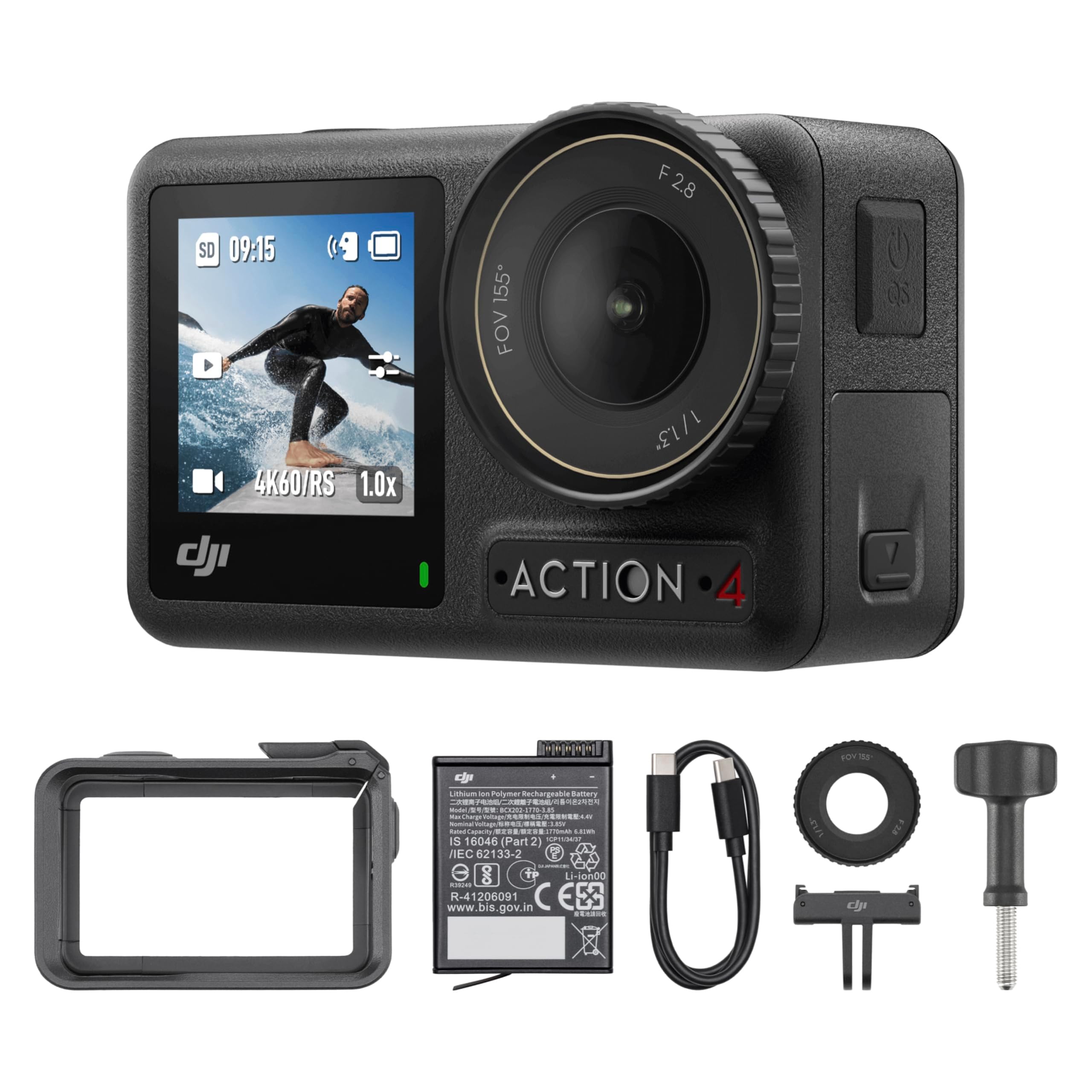
The Action 4 is the older, cheaper version of our footage pick, and the gap between the two cameras is smaller than the gap between their prices. Same 1/1.3-inch sensor, same magnetic quick-release mount, same 155-degree field of view; the differences turn up in battery capacity and in the screens.

What you get is a camera that holds color well below the surface and hands you 10-bit D-Log M if you want to grade footage afterwards. RockSteady and HorizonBalancing are the modes that matter on a dive — the first smooths out the fin kick, the second keeps the horizon straight when you roll.

Where it trails the newer model is endurance and polish. The 1770mAh battery is rated to about 160 minutes against the Action 5 Pro's four hours, and you're getting dual full-color touchscreens rather than OLED panels. Neither changes what comes back from the dive.

If you're shooting for yourself and editing on a phone, this is the sensible buy. The money you don't spend here covers a spare battery and a tray, and a steady tray will improve your footage more than the newer camera does.

Pros

  • 1/1.3-inch sensor and 10-bit D-Log M
  • 155-degree field of view
  • Magnetic quick-release mounting
  • Stabilization holds the horizon level

Cons

  • No stated depth rating for dive use
Our verdict

We point divers here when they want premium footage without premium money; the sensor and stabilization are the same story as our top video pick.

Check Latest Price
5

Stills and Macro

OM System TG-7

82 /100
Traveler Score Excellent

Key details

Video
4K
Stills
12MP, RAW
Waterproof
50 ft (15 m)
Macro Focus
Down to 1 cm
Check Details on Amazon

Small, awkward subjects are what this camera is for. It focuses down to a centimeter from the end of the lens, carries five underwater modes including an underwater microscope setting, and shoots RAW — which is why we rate it the best stills camera of this group and the wrong tool for a deep dive.

Fifty feet is the ceiling. The TG-7 is waterproof to 15 meters on its own, without a housing, and that covers snorkeling, pool sessions and shallow reef work. Most dive profiles go deeper, and a housing isn't in the package, so work out your deepest planned dive before you choose it — the cameras here that ship with a 40-meter case don't need that conversation.

In exchange you get a camera that slips into a buoyancy pocket, shrugs off a drop onto a deck, and frames close-ups an action camera simply can't. The f/2.0 lens and RAW files give you room to rescue a shot afterwards, which matters more underwater than it does on land.

Pros

  • Macro focus down to 1 cm
  • Five underwater shooting modes
  • RAW capture with an f/2.0 lens
  • Shockproof and freezeproof body

Cons

  • Small sensor struggles in low light
  • Menus take time to learn
Our verdict

Buy it if you'd rather come home with ten great macro stills than one video clip — no other camera here is built for that.

Check Latest Price
6

First Dive Trips

TIMNUT C16

85 /100
Traveler Score Excellent

Key details

Video
4K at 60fps
Stills
48MP
In The Box
64GB card, two batteries
Case Depth Rating
131 ft (40 m)
Check Details on Amazon

A 170-degree lens is wider than most of the cameras here, and in green water that width is what lets you get close enough to a subject to keep any color at all. That was the first thing we noticed about the C16, and it's most of the reason a camera this cheap earns a place on the list.

The kit is the other half of the argument: a 64GB card, two 1350mAh batteries, a case rated to 131 feet and a full set of mounts, with nothing else to buy before a trip. Set it to 4K/30 and the footage is sharper than the money suggests, and the case carries the same 40-meter rating as the pricier picks here.

The controls are simple enough for a first-timer, which is the point at this price, and the menus are short. What you're not buying is polish or much beyond the box. For a diver doing two trips a year and shooting for their own camera roll, that trade is easy to make.

Pros

  • 64GB card and two batteries included
  • Case rated to 131 ft (40 m)
  • 4K video with stabilization
  • Two-year warranty

Cons

  • Stabilization only works up to 4K30
  • App and Wi-Fi pairing are unreliable
Our verdict

A complete 131-foot kit for the least money here — the right first dive camera for someone who wants to try underwater video without committing.

Check Latest Price
7

5.3K on a Budget

GoPro HERO12 Black

90 /100
Traveler Score Outstanding

Key details

Photo
27MP
Video
5.3K at 60fps
Battery
1720mAh, up to 70 min
Waterproof
33 ft (10 m)
Check Details on Amazon

The HERO12 Black is the cheaper route to the same 5.3K60 video and 27MP photos as the HERO13, in a body that costs noticeably less. If you want GoPro's color and stabilization without paying for the newest lens system, this is where the value sits in the GoPro pair.

Underwater it behaves like the rest of the line. HDR holds detail in both the bright surface and a shadowed reef, HyperSmooth takes the wobble out of a fin kick, and the 156-degree view is wide enough to keep a whole turtle in frame at arm's length. The 1/1.9-inch sensor is smaller than the DJI pair's, so flat, deep light is where it gives ground.

Battery is the thing to plan around. The Enduro cell is rated to 70 minutes at 5.3K60, which is fine for one dive and tight for a full day, so buy a second one and charge both in the room overnight. With that sorted, this is the least fussy way into GoPro's image quality.

Pros

  • 5.3K60 video and 27MP photos
  • HDR holds contrasty scenes together
  • HyperSmooth stabilization
  • 156-degree field of view

Cons

  • Rated to 33 ft, so deeper dives need a housing
  • No dive mounts in the box
Our verdict

For divers who want GoPro's 5.3K footage without the newest price, the HERO12 Black gets you the same resolution, HDR and stabilization.

Check Latest Price

How We Tested Scuba Cameras

We started by pulling cameras with depth ratings suited to recreational diving, user-replaceable batteries, and mounting systems that don't require a separate tray just to add a light. I filtered out anything with vague seal instructions or an app that hadn't been updated in years; a camera is only as reliable as the support around it.

Across eight months, seven cameras came with us to weekly pool sessions, a run of shore dives, and one liveaboard week. Each was rinsed and dried the same way after every saltwater day. In the pool, I handed each camera to divers in thick gloves and asked them to switch from stills to video, lock exposure, and review a clip without removing it from the mount; I noted which controls needed a fingernail or two hands. On the reef, we shot the same coral heads and swim-throughs at 15, 40, and 80 feet, then reviewed color, autofocus, stabilization in surge, and how quickly the camera recovered from a dark crevice. We started each dive day with a full battery and logged how many clips and stills it captured before shutdown, plus whether it survived a two-tank morning.

Durability and reliability got the least glamorous treatment: we opened and reseated every O-ring before each trip, checked for fogging after rinses, and kept a log of stuck buttons, failed seals, and dead ports. For connectivity, I paired each camera with a phone on the boat and a laptop back at the rental, timing transfers and noting dropped connections or app crashes. We also sorted the included accessories—trays, handles, mounts, cases—and added up the must-have extras, because a camera that needs a tray, light, and spare battery to be usable is not the value it looks like.

How to Choose the Right Camera for Scuba Diving

Start With the Depth Number, Not the Spec Sheet

Waterproof means different things here, and the difference decides whether a camera is coming on your dive. The GoPros in this guide are sealed to 33 feet on their own; the AKASO kits reach 131 feet only once the camera is inside the case; a compact like the TG-7 stops at 50 feet. Match the number to your deepest planned dive, then check whether the case is in the box or an extra purchase.

A camera plus housing can easily cost more than a sealed kit that already goes deeper, so price them as a pair. And once a case is involved, its O-ring becomes part of your dive prep — that is now the part that keeps the water out.

Stills or Video?

Decide this before anything else, because it splits the field in two. An action camera is a video tool that also grabs stills: wide, stabilized, and made to be mounted to a tray or your wrist. A compact like the TG-7 is built around stills and macro, with a fast lens and a zoom, and it rewards a slower approach.

If your trip is about wide reef footage, buy for video. If it's about nudibranchs and shrimp, buy for macro and accept that the wide stuff will look less cinematic.

Light Is What You're Really Buying

Red light disappears in the first 10 meters, and after that every camera here is fighting for color. A larger sensor with bigger pixels keeps more of it, which is why the 1/1.3-inch models look richer at depth than the budget action cams. Stabilization matters just as much: the sea moves you, and a steady frame reads as higher quality than a sharper but shaky one.

Our advice is to spend on the sensor and the mount before the megapixel count, and to add a dive light once your dives are regularly deeper than 15 meters.

Batteries, Cards and Cold Water

Quoted runtimes are usually measured warm and at a sensible resolution, and a cold boat ride is not that. Treat the box figure as a ceiling, carry one spare battery per tank, and keep both warm between dives if the day is chilly. Cards matter too: 4K wants a V30 or U3 card, and a slow one shows up as stuttering clips you only discover afterwards.

Buy a second card rather than deleting footage during the surface interval — it's the cheapest insurance on the boat.

Controls You Can Work With Cold Hands

Touchscreens are great on deck and useless inside a housing. Look for physical buttons on the case, short menus, and an underwater white-balance mode, then set everything before you splash. Field of view is the setting people forget: the widest option distorts badly at close range and pushes your subject away.

A record lever or dial on the housing is worth more than a second screen. If you have to look at the camera to start a clip, you've already missed the shot.

Frequently Asked Questions

Final Verdict

Buy the AKASO EK7000 Pro if you want one payment and a bag that's ready for the boat — case, float, two batteries and charger, all in the box. If the footage matters more than the convenience, the DJI Osmo Action 5 Pro is the better camera and the one we pack for a dedicated dive trip.

And if you'd rather come home with macro stills than a video clip, the TG-7 earns its shallower limit.