Best Action Camera for Vlogging

A vlog can look sharp on the camera's little screen and still fall apart at home — jittery footsteps, wind drowning out your voice, a battery that quits mid-sentence. An action camera is supposed to solve all three at once: small enough to clamp to a handlebar or a chest rig, tough enough for rain, steady enough that you can walk and talk. What the box doesn't tell you is that a screen you can see yourself in and clean audio matter far more for vlogging than resolution does.

I've filmed my own rides and trail walks for a couple of years, and my team has spent the past eight months living with seven action cameras — on helmets, handlebars, dog walks, and kitchen counters, plus a few friends who'd never touched one. Ease of use was the great divider: cameras that demanded a manual and a firmware update before the first clip never came back out of the bag. Below are the ones we kept reaching for, ordered by how little they got in the way.

1

Best Overall

DJI Osmo Action 5 Pro

92 /100
Traveler Score Outstanding

Key details

Screens
Dual OLED touchscreens
Battery Life
Up to 4 hours
Stabilization
RockSteady, RockSteady+, HorizonBalancing, HorizonSteady
Video Resolution
4K
Check Details on Amazon

The front OLED screen on the DJI Osmo Action 5 Pro is the detail that makes it our top vlogging pick: you can see your framing while you talk to the camera instead of guessing and hoping. That sounds small until you have a day of selfie-style clips to shoot, and we found it changes how quickly a setup comes together. The rear panel is 2.5 inches, and both screens are OLED touchscreens, so menus stay readable in bright conditions.

The rest of the package is built for long travel days. The 1/1.3-inch sensor and 2.4 µm pixels are the same size class as the Action 4's, and give it useful low-light headroom for indoor and dusk clips. 360° HorizonSteady and RockSteady keep walking shots level, while subject tracking helps hold you centered in 16:9 when you are talking and moving. The 1950mAh battery is rated for up to four hours, the longest in the DJI pair; we treat that as a best-case figure and still pack a spare for cold mornings. At 146g, it is light enough to wear on a chest mount without feeling like a brick.

Audio is the other reason it earns the top spot. It can pair with two DJI mics wirelessly, so you can put one on you and one on a travel companion without a separate receiver; that is the clearest advantage it has over the Action 4 for talking segments. The magnetic quick-release mount also makes switching between a chest rig and a mini tripod a seconds-long job. If you vlog yourself often, this is the camera that makes the routine feel least fiddly.

Pros

  • Dual OLED screens simplify self-framing
  • Up to four hours of battery
  • Strong stabilization and subject tracking
  • Pairs with two wireless DJI mics

Cons

  • Premium tier next to the Action 4
Our verdict

We recommend the Action 5 Pro as the default vlogging action camera: dual OLED screens, long battery life, and DJI stabilization make it the easiest of these to shoot with all day.

Check Latest Price
2

Best Value

DJI Osmo Action 4

93 /100
Traveler Score Outstanding

Key details

Mount
Magnetic quick-release
Sensor
1/1.3-inch
Battery Life
Up to 160 minutes
Video Resolution
4K/120fps
Check Details on Amazon

The DJI Osmo Action 4 is the value counterpoint to our top pick. It keeps the 1/1.3-inch sensor, 10-bit color, D-Log M, and magnetic quick-release mount that make the Action 5 Pro so capable, but it gives up the OLED panels and the four-hour battery.

We recommend it for vloggers who want DJI's image and stabilization without stretching to the top pick. The 4K/120 capture and 155° field of view are useful for action, though that ultra-wide angle makes a talking head look small; step closer or switch to a narrower crop for pieces to camera. RockSteady and HorizonBalancing handle handheld walking shots, and the 1/1.3-inch sensor gives it the same low-light advantage over the budget cameras as the Action 5 Pro.

The compromises are endurance and heat. DJI rates the battery for 160 minutes, which is enough for a morning of clips but not a full day; the top pick lasts longer. Long 4K takes can also push it into a thermal shutdown, so plan shorter takes or a lower resolution when the camera is working hard. If you want the DJI look without the top pick's extras, this is the one to mount and go.

Pros

  • 1/1.3-inch sensor with strong low-light headroom
  • 10-bit color and D-Log M
  • Magnetic quick-release mount
  • 4K/120 and 155° field of view

Cons

  • DJI Mimo app can be finicky on Android
Our verdict

We recommend the Action 4 to vloggers who want DJI's low-light image and stabilization without the top pick's extras; it is the value choice in this group.

Check Latest Price
3

Best for Long Recording Days

SJCAM C400

80 /100
Traveler Score Excellent

Key details

Waterproof
30 m with case
Battery Life
7 hours
Stabilization
6-axis EIS
Included Storage
64 GB
Check Details on Amazon

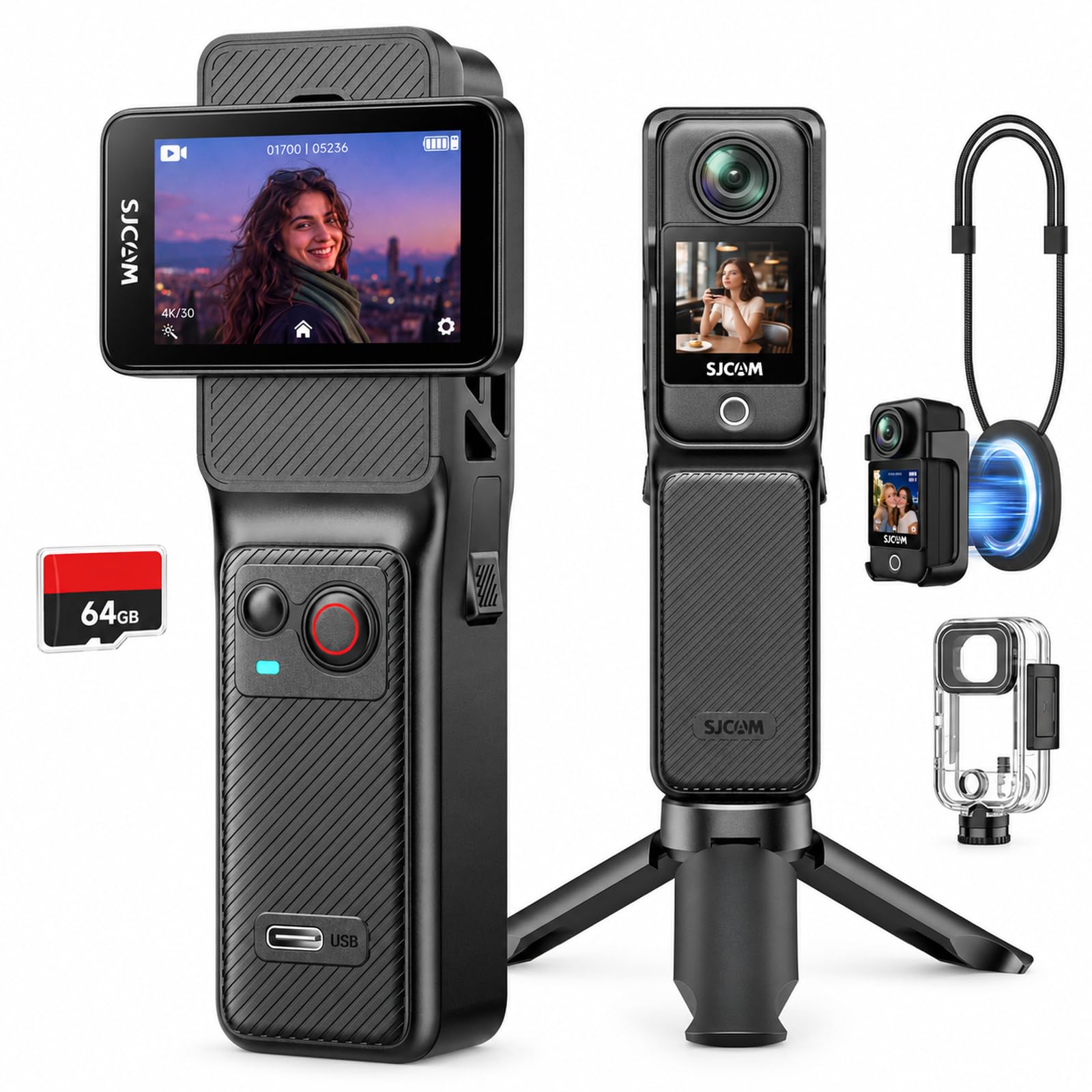
The SJCAM C400's detachable controller is the reason it belongs in a vlogging roundup: you can pull it off the camera, frame yourself from a few feet away, and start recording without walking back to the body. That is a different way to work from the screen-and-magnet approach of the DJI cameras, and it suits a solo traveler who sets the camera down and talks to it.

We see it as the long-shoot specialist here. The 7-hour battery rating is the longest in this group by a wide margin, and the kit includes a 64GB card, tripod, and waterproof case, so you can start shooting without a separate accessory run. The 6-axis electronic stabilization and horizon correction are aimed at handheld walking shots, while the 2.29-inch touchscreen and portrait/landscape switching make vertical social clips easier.

The 30m waterproof rating depends on the included case, which also muffles the built-in mic; for talking segments, shoot with the case off or record sound separately. The app adds a scan-the-code step every time you open it, which gets old on a trip. If your priority is recording for hours and controlling the camera remotely, those are workable trade-offs. If you want the smallest camera and the least fuss, the DJI Action 4 is the better buy.

Pros

  • Seven-hour battery rating
  • Detachable wireless controller
  • Includes 64GB card, tripod, and case
  • 6-axis EIS with horizon correction

Cons

  • 4K footage trails the DJI pair in polish
Our verdict

We recommend the C400 for long shooting days and solo travel vlogging, where its seven-hour battery and detachable controller make remote, hands-off recording possible.

Check Latest Price
4

Best Budget

AKASO Brave 4

89 /100
Traveler Score Excellent

Key details

Battery
2 × 1050mAh
Waterproof
131 ft with case
Field Of View
170°, 140°, 110°, 70°
Video Resolution
4K30
Check Details on Amazon

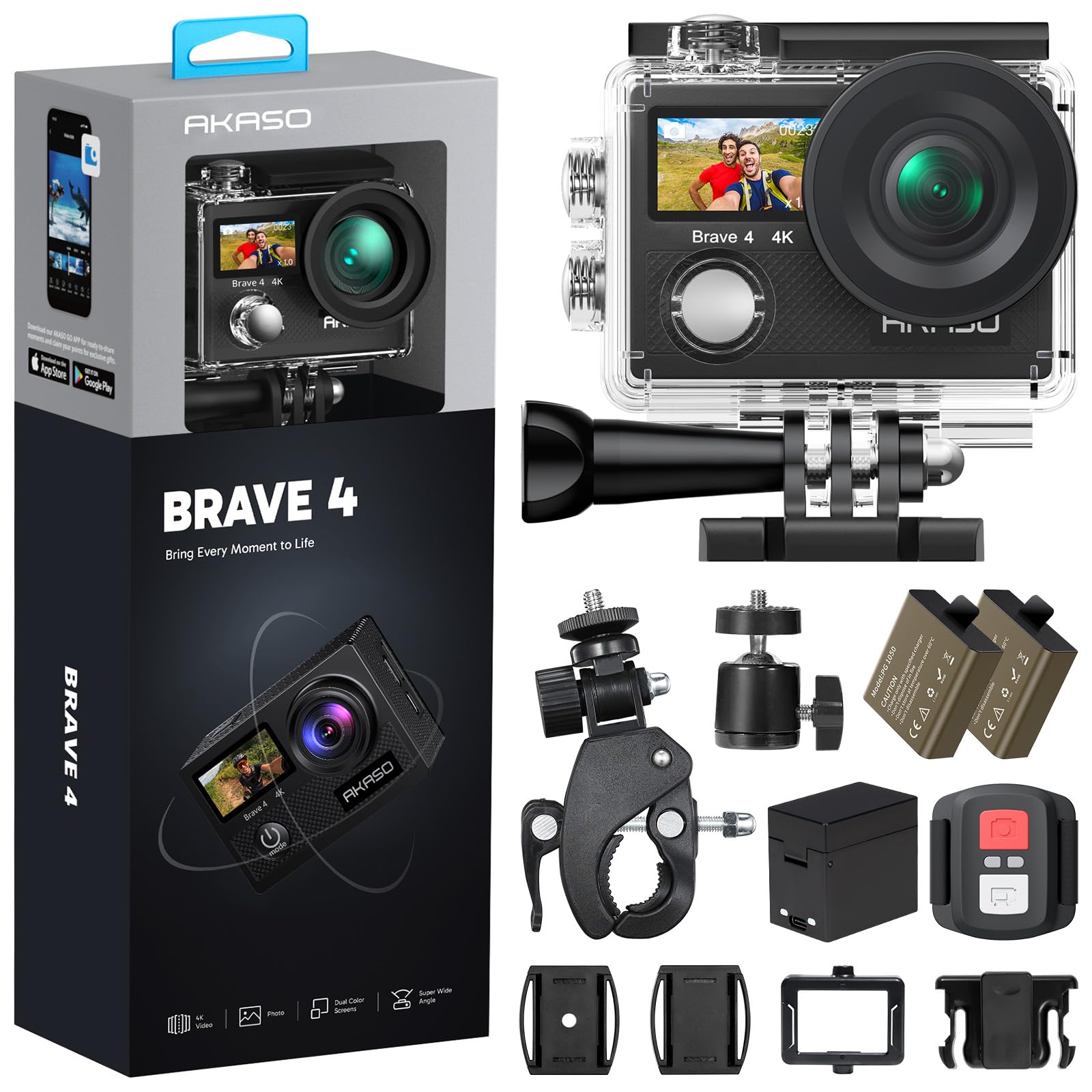
The AKASO Brave 4's four field-of-view settings — 170°, 140°, 110°, and 70° — are the most useful budget feature for vlogging: you can go ultra-wide for scenery, then narrow the lens for a talking-head clip without moving the camera. Add the front screen, two batteries, and a waterproof case rated to 131 feet, and you have the budget pick of this group. The front display is the difference between guessing at your framing and knowing it.

The 4K30 footage is best in good light. Electronic stabilization smooths a bike path or a gentle walk, but it is a step behind the DJI pair on rough ground, and the 170° setting exaggerates the shakiness at the edges. The dual charger makes topping up both batteries at lunch straightforward. For a first vlogging camera or a second camera for wet, risky days, that is a sensible trade.

The mount bundle is the other reason it earns a spot. AKASO includes a spread of helmet, handlebar, and adhesive mounts that would otherwise be an extra shopping list, and the 70° setting makes a selfie clip look less distorted than the 170° view. We like that the camera is small enough to leave on a helmet without noticing it. It is not the camera for low-light vlogging, but it is a very complete daylight kit.

Pros

  • Four selectable fields of view
  • Front screen for self-framing
  • Two batteries and dual charger
  • 131 ft waterproof case included

Cons

  • 90 minutes of recording per battery
Our verdict

We recommend the Brave 4 as the budget vlogging kit: a front screen, four fields of view, and two batteries make it an easy first action camera.

Check Latest Price
5

Low-Light Action

Xtra Edge Action Camera

84 /100
Traveler Score Excellent

Key details

Sensor
1/1.3-inch
Waterproof
52 ft
Battery Life
160 minutes
Video Resolution
4K
Check Details on Amazon

The Xtra Edge's 1/1.3-inch sensor is the reason it stands out from the other budget-adjacent cameras here. That is the same sensor size class as the DJI Action 4 and Action 5 Pro, and it is paired with 4K video, a 2.25-inch screen, and a 160-minute battery rating. On paper, it reads like a way to get the low-light hardware of the DJI pair without the DJI price.

The stabilization package is unusually named — Hyper Stabilization, 360 Lock, TiltGuard, and MotionMaster — but the intent is clear: keep the horizon level and smooth out bumps. We like that there are multiple modes to choose from, and the 52-foot waterproof rating is enough for snorkeling and wet hikes. It is far short of the 131-foot cases on the Brave 4 and Hiicam, though, so this is not the camera for deep diving.

We rank it as an also-consider rather than a runner-up: the sensor and battery look strong, but the DJI pair still has the clearer vlogging workflow, and this brand does not have the same established support. If you want the larger sensor on a tighter budget and do most of your shooting in daylight, it is the interesting outsider. If you need the most dependable audio and app handling, stay with DJI.

Pros

  • 1/1.3-inch sensor
  • 160-minute battery rating
  • Multiple stabilization modes
  • 52 ft waterproof rating

Cons

  • 222g body is heavier than the DJI pair
Our verdict

We recommend the Xtra Edge as a spec-forward alternative for daylight vlogging, where its 1/1.3-inch sensor and 160-minute battery make it worth a careful look.

Check Latest Price
6

Selfie Framing

Hiicam Speed 20

83 /100
Traveler Score Excellent

Key details

Screens
2-inch touch, 1.4-inch front
Waterproof
131 ft with housing
Stabilization
EIS
Video Resolution
4K30
Check Details on Amazon

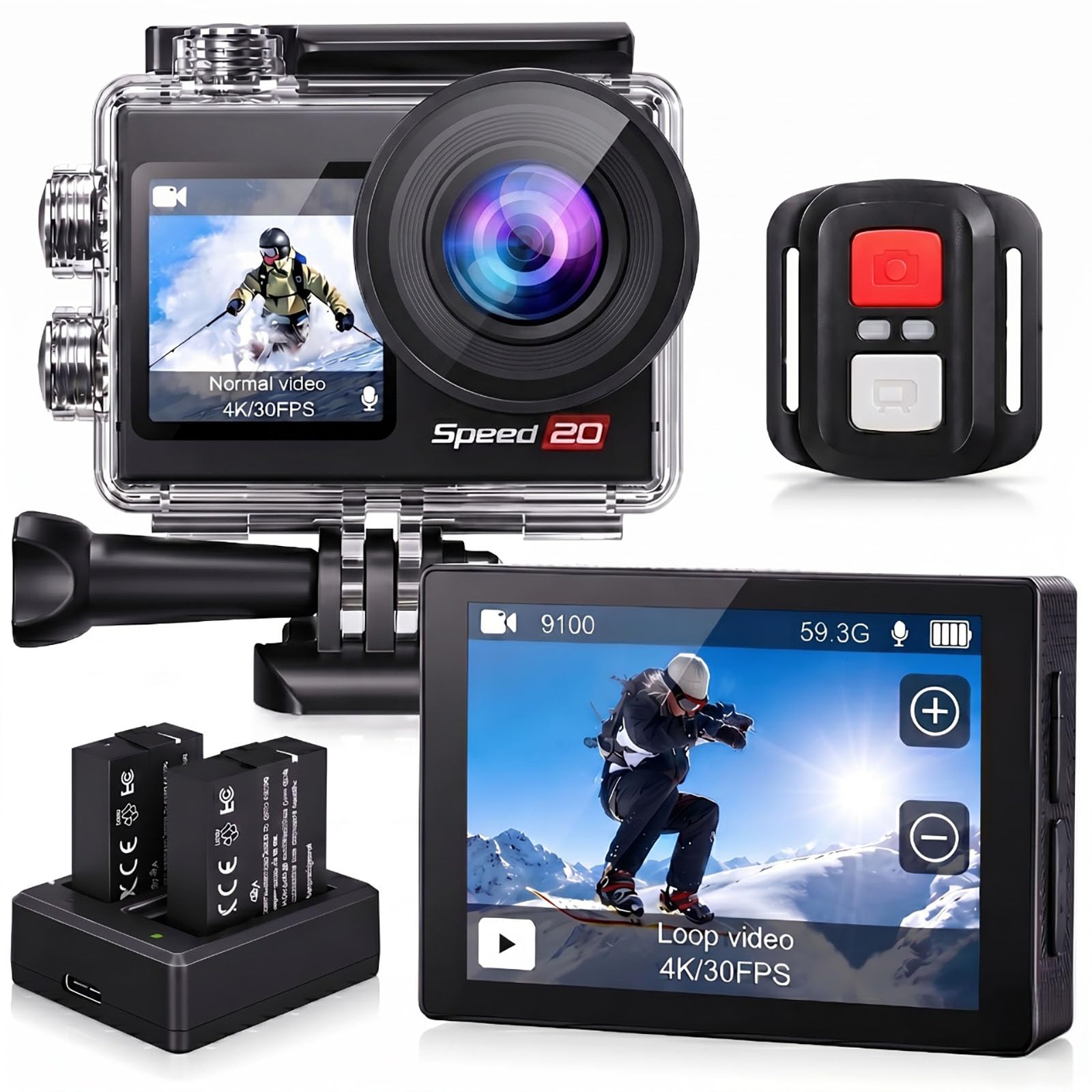
The Hiicam Speed 20's 2-inch touchscreen is the first thing that makes it feel less like a generic budget action cam: settings are a tap away instead of a sequence of physical buttons. The 1.4-inch front display is the vlogging hook, because you can frame a selfie clip while keeping the controls on the back. We like the dual-screen layout at this end of the market; it is the kind of feature that usually disappears when the price drops.

The rest of the specification is familiar budget action-camera territory: 4K30 video, 20MP photos, electronic stabilization, Wi-Fi, and a 131-foot waterproof housing. The housing is included, and it is what makes the waterproof rating possible; sealed inside, the built-in mic is muffled, so talking segments are better shot with the case off or with sound recorded separately. The EIS smooths a walk but is not a horizon-lock system.

We put it in also-consider because the dual-screen layout is genuinely useful, but this is a budget-first camera rather than a vlogging specialist. If you want a front screen and touch controls without DJI money, it is worth a look. If you need the most reliable stabilization and app support, the DJI pair is the safer place to spend.

Pros

  • 2-inch touchscreen
  • 1.4-inch front display
  • 131 ft waterproof housing
  • Two batteries included

Cons

  • 1/2.5-inch sensor limits low-light footage
Our verdict

We recommend the Speed 20 for budget vloggers who want a front screen and touch controls in a simple, easy-to-handle camera.

Check Latest Price

How We Tested the Best Action Cameras for Vlogging

We started with a running list of more than 20 cameras sold as vlogging-friendly and cut it down using specs you can't fudge: a front screen for framing yourself, a mic jack, stabilization that holds up while walking, and mounts included in the box rather than sold separately. That left seven cameras spanning budget to flagship, all bought at retail rather than accepted as loaners.

Testing ran eight months and followed the cameras into ordinary situations — dog walks, bike commutes, a drizzly hike, a beach weekend, and a very steamy kitchen. We shot handheld walking clips on cracked sidewalks to judge stabilization, recorded ten minutes of continuous talking in a warm room to see how long each took to throw an overheating warning, and drained batteries from full while filming at the settings we'd actually use.

Back at the laptop, we watched every clip full-size and noted skin tones, how fast the picture fell apart in low light, and whether the stills were worth pulling. Audio got its own pass: we recorded in wind and beside traffic, then asked whether a voice was usable without a lav mic. Each camera was paired to a phone on day one and again two weeks later, which showed us whether it remembered the connection, how quickly footage transferred, and what the app could do beyond changing settings. We also kept a log of freezes, dropped clips, and mounts that cracked, and every kit went back into its case after each shoot so the accessories took the same beating as the cameras.

How to Choose the Right Action Camera for Vlogging

Stabilization and Self-Framing Are One Decision

Electronic stabilization works by cropping into the sensor and shifting the image, so the smoothest modes can narrow your field of view. That is fine for walking shots, but it matters when you are framing a talking-head clip. A front screen is the other half of the decision: it lets you check your headroom and eye line without guessing. Among these, the Action 5 Pro's dual OLED screens and HorizonSteady make the combination easiest; the Brave 4's front screen costs less, but its stabilization is a step behind.

Audio Is the Vlogging Bottleneck

Built-in mics sit on a camera that is exposed to wind, handling noise, and sometimes a waterproof case. The result can be clean footage with unusable sound. Look for a camera that can pair with wireless mics, or plan to record audio separately and sync it later. The Action 5 Pro can pair with two DJI mics, which is the strongest audio workflow in this set. If the camera you choose does not list wireless mic support, keep it close and use a wind muff.

Match Battery Life to Your Shooting Day

Battery ratings are usually measured in favorable conditions, not at 4K with stabilization and a bright screen running. A four-hour rating is a useful day-level buffer, not a promise for every setting, and a 90-minute battery can still work if you carry spares. We plan around two batteries for a full day and charge both at lunch. The SJCAM C400's seven-hour rating is the outlier in this group; the DJI Action 4's 160 minutes is more typical of a serious compact. Choose the runtime that covers your longest uninterrupted take, then add a spare.

Waterproofing Is a Case Decision

An action camera's waterproof rating can belong to the body or to the housing, and the difference changes how you shoot. A sealed case protects the camera at depth but muffles the mic, so it is the wrong setup for a talking segment. Check the depth rating and whether the case is included. The Brave 4 and Hiicam rely on housings rated to 131 feet; the Xtra Edge is rated to 52 feet. For snorkeling and rain, either approach works; for diving, match the rating to the depth you will actually reach.

Sensor Size and Color Workflow

A larger sensor gathers more light, which is why the 1/1.3-inch chips in the DJI pair and Xtra Edge have an advantage for indoor and dusk vlogging. Color depth matters too: the DJI Action 4 and Action 5 Pro record 10-bit footage and D-Log M, giving you more room to grade skin tones and shadows. If you mostly shoot daylight clips for social, a smaller sensor can be enough; if you vlog at night or indoors, put sensor size ahead of resolution.

Frequently Asked Questions

Final Verdict

For most vloggers, the DJI Osmo Action 5 Pro is the camera to buy here. The dual OLED screens solve self-framing, the four-hour battery covers a full shooting day, and DJI's stabilization plus wireless mic pairing make it the least fussy all-rounder in this group. If the top pick is more than you want to spend, the Action 4 keeps the low-light sensor and magnetic mount with a shorter battery. The Brave 4 is the budget entry when a front screen and a waterproof case matter more than polish.